Reputation
Management
Mark Misercola
Jan. 2018
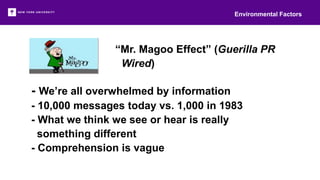
“Mr. Magoo Effect” (Guerilla PR
Wired)
- We’re all overwhelmed by information
- 10,000 messages today vs. 1,000 in 1983
- What we think we see or hear is really
something different
- Comprehension is vague
Environmental Factors
• Mr. Magoo Effect is compounded
by “Data Smog.”
- Brain capacity is inundated
- Can only recall sound bites … not all of it
is accurate
• We’re making decisions based
on bits of information that mesh
with pre-conceived beliefs or
perceptions.
Environmental Factors
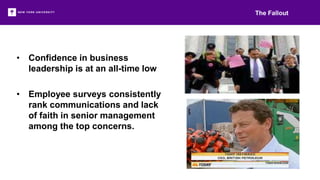
• Confidence in business
leadership is at an all-time low
• Employee surveys consistently
rank communications and lack
of faith in senior management
among the top concerns.
The Fallout
The Fallout
The Fallout
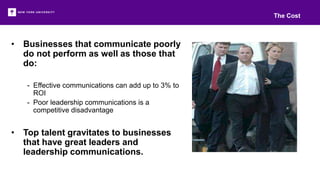
• Businesses that communicate poorly
do not perform as well as those that
do:
- Effective communications can add up to 3% to
ROI
- Poor leadership communications is a
competitive disadvantage
• Top talent gravitates to businesses
that have great leaders and
leadership communications.
The Cost
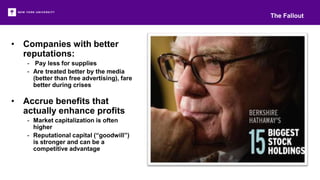
• Companies with better
reputations:
- Pay less for supplies
- Are treated better by the media
(better than free advertising), fare
better during crises
• Accrue benefits that
actually enhance profits
- Market capitalization is often
higher
- Reputational capital (“goodwill”)
is stronger and can be a
competitive advantage
The Fallout
How do we effectively manage and enhance corporate
reputation in a business world where audiences are
overwhelmed, highly skeptical and difficult to
reach?
The Central Challenge
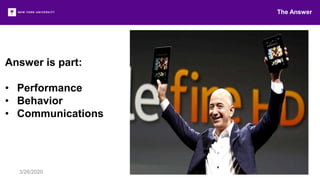
The Answer
3/26/2020 10
Answer is part:
• Performance
• Behavior
• Communications
Chapter 1
Reputational Management
Chapter 1: Reputational Management
3/26/2020 12
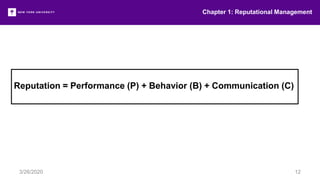
Reputation = Performance (P) + Behavior (B) + Communication (C)
Chapter 1: Reputational Alignment
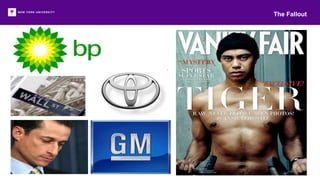
Chapter 1: Companies that Paid the Ultimate Price
Establish a formal mechanism to periodically
monitor, measure and manage reputation.
Page 14
Chapter 1: How do you effectively manage reputation?
3/26/2020 15
Chapter 1: 10 Precepts of Reputational Management
3/26/2020 16
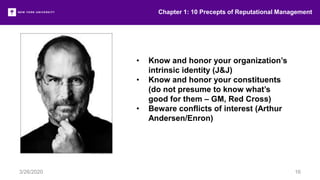
• Know and honor your organization’s
intrinsic identity (J&J)
• Know and honor your constituents
(do not presume to know what’s
good for them – GM, Red Cross)
• Beware conflicts of interest (Arthur
Andersen/Enron)
Chapter 1: 10 Precepts of Reputational Management
3/26/2020 17
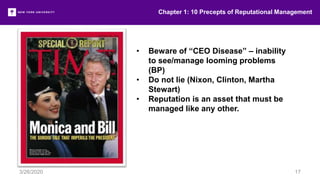
• Beware of “CEO Disease” – inability
to see/manage looming problems
(BP)
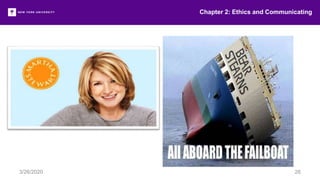
• Do not lie (Nixon, Clinton, Martha
Stewart)
• Reputation is an asset that must be
managed like any other.
Chapter 1: Expanded Reputation Formula
3/26/2020 18
Authenticity counts – to be authentic requires
integrity.
Chapter 1: Expanded Reputation Formula
3/26/2020 19
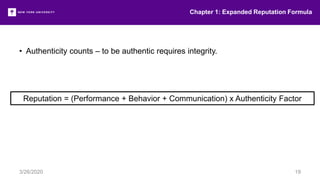
• Authenticity counts – to be authentic requires integrity.
Reputation = (Performance + Behavior + Communication) x Authenticity Factor
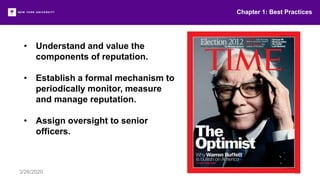
• Understand and value the
components of reputation.
• Establish a formal mechanism to
periodically monitor, measure
and manage reputation.
• Assign oversight to senior
officers.
Chapter 1: Best Practices
3/26/2020 20
Chapter 2
Ethics and Communication
“Communications take place in a climate of belief. Effective
persuasion over time requires not merely truthfulness but
intentionally about truthfulness.”
Page 39
Chapter 2: Ethics and Communication
3/26/2020 22
“Leadership is a relationship between those who aspire to lead
and those who chose to follow … success in leading is wholly
dependent upon building and sustaining those relationships that
enable people to get extraordinary things done on a regular
basis.”
Page 33
Chapter 3: Leadership is a Relationship
3/26/2020 23
Chapter 2: Ethics and Communicating
3/26/2020 24
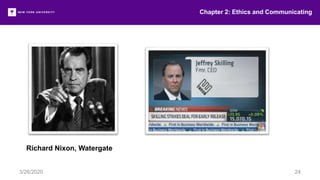
Richard Nixon, Watergate
Chapter 2: Ethics and Communicating
3/26/2020 25
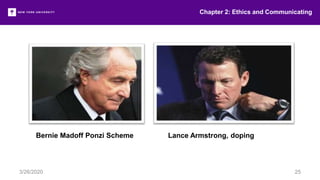
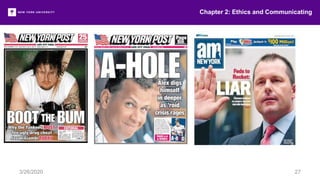
Bernie Madoff Ponzi Scheme Lance Armstrong, doping
Chapter 2: Ethics and Communicating
3/26/2020 26
Chapter 2: Ethics and Communicating
3/26/2020 27
Chapter 2: Ethics and Communicating
3/26/2020 28
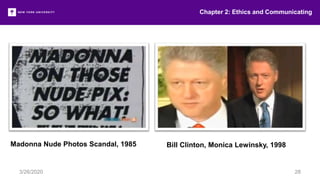
Bill Clinton, Monica Lewinsky, 1998Madonna Nude Photos Scandal, 1985
Chapter 2: Ethics and Communicating
3/26/2020 29
“Increasingly, corporate communications departments are
seen as the conscious of a company, and play an important
role in helping a company behave ethically.”
Page 60
Chapter Two: Ethics and Communications
3/26/2020 30
High Road
• Always tell the truth and do what’s right
• When you’re wrong admit it, beg for forgiveness
• Fire/punish those responsible
• Put in place a system to detect, monitor and promote
ethical behavior.
Chapter Two: Ethics and Communications
3/26/2020 31
Less than High Road (Madonna Approach)
• Acknowledge the problem and admit nothing
• I don’t have a problem with it, you do!
• My family is off limits
• Go to rehab or detox
• Come back in six months and no one will remember
• Cautionary note: Works well for top celebrities but not
corporate executives.
Chapter Two: Ethics and Communications
3/26/2020 32
Chapter 3
Media Relations
Chapter Three: Media Relations
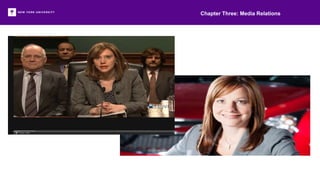
• Media relations is one PR’s
core disciplines and often one
of the most visible.
• The most prized of all
communications skills and
those who have excellent
media contacts/ relationships
get more job offers.
• One of the most difficult for
senior management to
understand.
Chapter Three: Media Relations
3/26/2020 36
Chapter 3: Media Relations
3/26/2020 37
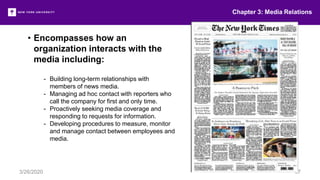
• Encompasses how an
organization interacts with the
media including:
- Building long-term relationships with
members of news media.
- Managing ad hoc contact with reporters who
call the company for first and only time.
- Proactively seeking media coverage and
responding to requests for information.
- Developing procedures to measure, monitor
and manage contact between employees and
media.
Chapter 3: Media Relations
3/26/2020 38
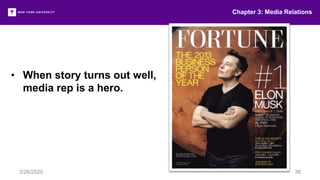
• When story turns out well,
media rep is a hero.
Chapter 3: Media Relations
3/26/2020 39
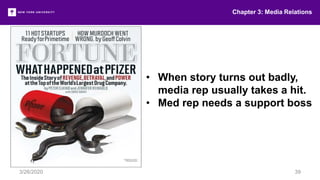
• When story turns out badly,
media rep usually takes a hit.
• Med rep needs a support boss
Chapter 3: Media Relations
3/26/2020 40
• The best media relations professionals are
advocates in two directions:
- They clarify and focus the organization’s viewpoint for news
media.
- Also help management better understand the reporter’s
intentions and whether to engage with him/her.
• Friend or foe?
Chapter 3: Media Relations
3/26/2020 41
“A big part of the media relations person’s job is to figure out what
the journalist’s perspective is. If the perspective is favorable and
accurate, reinforce it. If unfavorable, try to understand why, and
then deal with the problems and issues.”
Page 87
Chapter 3: Media Relations
3/26/2020 42
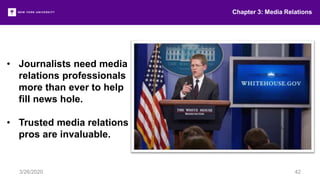
• Journalists need media
relations professionals
more than ever to help
fill news hole.
• Trusted media relations
pros are invaluable.
Chapter 4
Social Media
Chapter 4: Social Media
3/26/2020 44
“The collection of software that enables individuals and
communities to gather, communicate, share, and in some cases
collaborate or play.”
Chapter 4: Social Media
3/26/2020 45
“Social media has become a fundamental and widespread part of
how people and organizations communicate and participate
online.”
Chapter 4: Why Social Media Matters
3/26/2020 46
Chapter 4: Why Social Media Matters
3/26/2020 47
“With social media, anyone can create and distribute
content online easily, quickly, often freely (or cheaply),
and with little or no technical know how. With social
media, people can connect with organizations and
each other in ways that were limited or not possible
before.”
Chapter 4: Why Social Media Matters
3/26/2020 48
Chapter 4: Social Media
3/26/2020 49
Enables Conversations
Chapter 4: Social Media
3/26/2020 50
Encourages Collaboration
Chapter 4: Social Media
3/26/2020 51
Fosters Engagement
Chapter 4: Social Media
3/26/2020 52
“Social media does not replace most other
forms of communication; it
complements, expands and enriches
organizational communication.”
Chapter 4: Social Media Characteristics
3/26/2020 53
• Authenticity: people want
organizations to
communicate as they would
in conversation.
• Transparency: Organizations
must be more transparent on
social media and willing to
field/deal with complaints in
a public forum.
• Two-Way Conversations:
Favors bottoms-up
information flow, instead of
top-down.
Chapter 4: Social Media Characteristics
3/26/2020 54
• Speed: Social media favors
those who respond quickly
and honestly.
• Collaboration: When used
correctly, social media is
great relationship building
tool.
Chapter 4: Social Media
3/26/2020 55
“The collection of software that enables individuals and
communities to gather, communicate, share, and in some cases
collaborate or play.”
Chapter 4: Social Media
3/26/2020 56
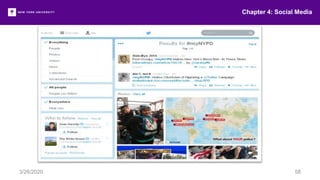
Chapter 4: Social Media
3/26/2020 57
Chapter 4: Social Media
3/26/2020 58
Chapter 5
Organizational Communications
Chapter 5: Aligning Employees with Organizational Interests
3/26/2020 60
“A 2007 study by Brodeur Partners and Watson Wyatt found that
across organizations, only half of managers described
themselves as knowledgeable about how their company wants to
project itself … and less than half said their company enabled
them to take action to deliver the brand support the
organization’s reputational interests.”
Page 137
Chapter 5: Aligning Employees with Organizational Interests
3/26/2020 61
“Companies that solve the problem and succeed in creating
alignment can expect to see increased discretionary effort,
retention of top performers, and overall financial performance.”
Page 137
Chapter 5: Aligning Employees with Organizational Interests
3/26/2020 62
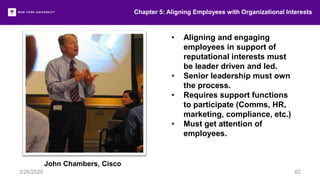
• Aligning and engaging
employees in support of
reputational interests must
be leader driven and led.
• Senior leadership must own
the process.
• Requires support functions
to participate (Comms, HR,
marketing, compliance, etc.)
• Must get attention of
employees.
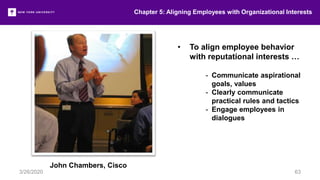
John Chambers, Cisco
Chapter 5: Aligning Employees with Organizational Interests
3/26/2020 63
• To align employee behavior
with reputational interests …
- Communicate aspirational
goals, values
- Clearly communicate
practical rules and tactics
- Engage employees in
dialogues
John Chambers, Cisco
Chapter 5: Aligning Employees with Organizational Interests
:
3/26/2020 64
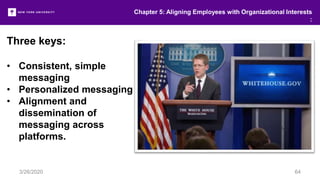
Three keys:
• Consistent, simple
messaging
• Personalized messaging
• Alignment and
dissemination of
messaging across
platforms.
Chapter 5: Aligning Employees with Organizational Interests
3/26/2020 65
“ … through our internal tracking studies in dozens of
organizations, we discovered … a phenomenon we call the ‘puke
point.’ It refers to the point in time that leaders become so sick
of staying on message (and hearing themselves repeat it) that
they ‘want to lose their lunch.’”
Page 151
Chapter 5: Aligning Employees with Organizational Interests
3/26/2020 66
“ What’s remarkable is that this point in time frequently coincides
with an upswing in employee understanding of and engagement
around the strategy. In other words, it’s important for leaders to
stay on message even after they’re sick of doing so because
that’s … when employees are just starting to truly get it.”
Page 151
• People are more likely to act
to solve a problem if they
know they only need to do
one thing.
• “Single action bias.”
• When you need to create
urgent action, don’t ask
everyone to do 20 things.
Chapter 5: Aligning Employees with Organizational Interests
3/26/2020 67
To align employee performance with reputational interests …
• Provide a message with which everyone can align.
• Stay on message (in words and actions).
• In tough times, rally employees around a cause that they can believe in.
• Don’t let employees practice on customers – rehearse them before the
customer encounter.
Chapter 5: Aligning Employees with Organizational Interests
3/26/2020 68
Chapter 12
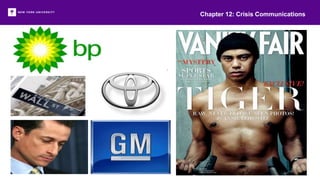
Crisis Communications
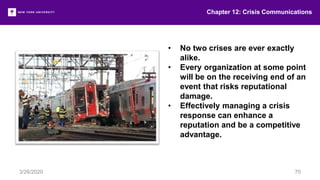
• No two crises are ever exactly
alike.
• Every organization at some point
will be on the receiving end of an
event that risks reputational
damage.
• Effectively managing a crisis
response can enhance a
reputation and be a competitive
advantage.
Chapter 12: Crisis Communications
3/26/2020 70
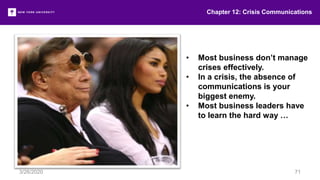
• Most business don’t manage
crises effectively.
• In a crisis, the absence of
communications is your
biggest enemy.
• Most business leaders have
to learn the hard way …
Chapter 12: Crisis Communications
3/26/2020 71
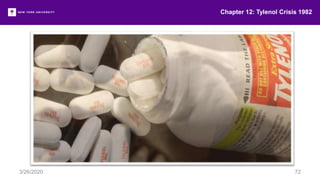
Chapter 12: Tylenol Crisis 1982
3/26/2020 72
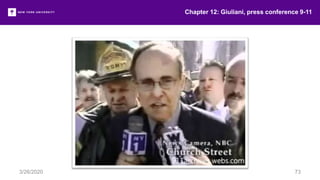
Chapter 12: Giuliani, press conference 9-11
3/26/2020 73
Chapter 12: Crisis Communications
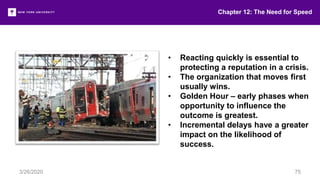
• Reacting quickly is essential to
protecting a reputation in a crisis.
• The organization that moves first
usually wins.
• Golden Hour – early phases when
opportunity to influence the
outcome is greatest.
• Incremental delays have a greater
impact on the likelihood of
success.
Chapter 12: The Need for Speed
3/26/2020 75
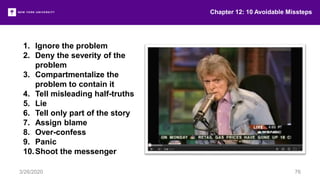
1. Ignore the problem
2. Deny the severity of the
problem
3. Compartmentalize the
problem to contain it
4. Tell misleading half-truths
5. Lie
6. Tell only part of the story
7. Assign blame
8. Over-confess
9. Panic
10.Shoot the messenger
Chapter 12: 10 Avoidable Missteps
3/26/2020 76
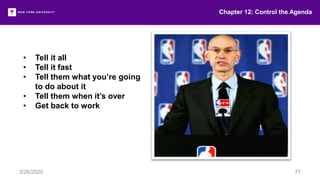
• Tell it all
• Tell it fast
• Tell them what you’re going
to do about it
• Tell them when it’s over
• Get back to work
Chapter 12: Control the Agenda
3/26/2020 77
1. Ignore the problem
2. Deny the severity of the problem
3. Compartmentalize the problem to contain it
4. Tell misleading half-truths
5. Lie
6. Tell only part of the story
7. Assign blame
8. Panic
9. Shoot the messenger
Chapter 12: 10 Avoidable Missteps
3/26/2020 78
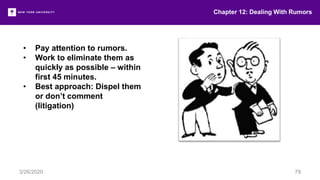
• Pay attention to rumors.
• Work to eliminate them as
quickly as possible – within
first 45 minutes.
• Best approach: Dispel them
or don’t comment
(litigation)
Chapter 12: Dealing With Rumors
3/26/2020 79
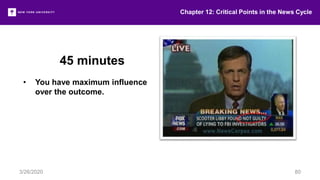
45 minutes
• You have maximum influence
over the outcome.
Chapter 12: Critical Points in the News Cycle
3/26/2020 80
6 Hours
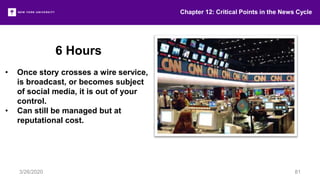
• Once story crosses a wire service,
is broadcast, or becomes subject
of social media, it is out of your
control.
• Can still be managed but at
reputational cost.
Chapter 12: Critical Points in the News Cycle
3/26/2020 81
Three Days
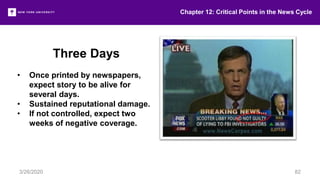
• Once printed by newspapers,
expect story to be alive for
several days.
• Sustained reputational damage.
• If not controlled, expect two
weeks of negative coverage.
Chapter 12: Critical Points in the News Cycle
3/26/2020 82
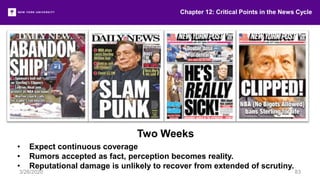
• Expect continuous coverage
• Rumors accepted as fact, perception becomes reality.
• Reputational damage is unlikely to recover from extended of scrutiny.
Chapter 12: Critical Points in the News Cycle
3/26/2020 83
Two Weeks

Nyu reputation management spring 2018 (2)

  • 1.
  • 2.
    “Mr. Magoo Effect”(Guerilla PR Wired) - We’re all overwhelmed by information - 10,000 messages today vs. 1,000 in 1983 - What we think we see or hear is really something different - Comprehension is vague Environmental Factors
  • 3.
    • Mr. MagooEffect is compounded by “Data Smog.” - Brain capacity is inundated - Can only recall sound bites … not all of it is accurate • We’re making decisions based on bits of information that mesh with pre-conceived beliefs or perceptions. Environmental Factors
  • 4.
    • Confidence inbusiness leadership is at an all-time low • Employee surveys consistently rank communications and lack of faith in senior management among the top concerns. The Fallout
  • 5.
  • 6.
  • 7.
    • Businesses thatcommunicate poorly do not perform as well as those that do: - Effective communications can add up to 3% to ROI - Poor leadership communications is a competitive disadvantage • Top talent gravitates to businesses that have great leaders and leadership communications. The Cost
  • 8.
    • Companies withbetter reputations: - Pay less for supplies - Are treated better by the media (better than free advertising), fare better during crises • Accrue benefits that actually enhance profits - Market capitalization is often higher - Reputational capital (“goodwill”) is stronger and can be a competitive advantage The Fallout
  • 9.
    How do weeffectively manage and enhance corporate reputation in a business world where audiences are overwhelmed, highly skeptical and difficult to reach? The Central Challenge
  • 10.
    The Answer 3/26/2020 10 Answeris part: • Performance • Behavior • Communications
  • 11.
  • 12.
    Chapter 1: ReputationalManagement 3/26/2020 12 Reputation = Performance (P) + Behavior (B) + Communication (C)
  • 13.
  • 14.
    Chapter 1: Companiesthat Paid the Ultimate Price
  • 15.
    Establish a formalmechanism to periodically monitor, measure and manage reputation. Page 14 Chapter 1: How do you effectively manage reputation? 3/26/2020 15
  • 16.
    Chapter 1: 10Precepts of Reputational Management 3/26/2020 16 • Know and honor your organization’s intrinsic identity (J&J) • Know and honor your constituents (do not presume to know what’s good for them – GM, Red Cross) • Beware conflicts of interest (Arthur Andersen/Enron)
  • 17.
    Chapter 1: 10Precepts of Reputational Management 3/26/2020 17 • Beware of “CEO Disease” – inability to see/manage looming problems (BP) • Do not lie (Nixon, Clinton, Martha Stewart) • Reputation is an asset that must be managed like any other.
  • 18.
    Chapter 1: ExpandedReputation Formula 3/26/2020 18 Authenticity counts – to be authentic requires integrity.
  • 19.
    Chapter 1: ExpandedReputation Formula 3/26/2020 19 • Authenticity counts – to be authentic requires integrity. Reputation = (Performance + Behavior + Communication) x Authenticity Factor
  • 20.
    • Understand andvalue the components of reputation. • Establish a formal mechanism to periodically monitor, measure and manage reputation. • Assign oversight to senior officers. Chapter 1: Best Practices 3/26/2020 20
  • 21.
    Chapter 2 Ethics andCommunication
  • 22.
    “Communications take placein a climate of belief. Effective persuasion over time requires not merely truthfulness but intentionally about truthfulness.” Page 39 Chapter 2: Ethics and Communication 3/26/2020 22
  • 23.
    “Leadership is arelationship between those who aspire to lead and those who chose to follow … success in leading is wholly dependent upon building and sustaining those relationships that enable people to get extraordinary things done on a regular basis.” Page 33 Chapter 3: Leadership is a Relationship 3/26/2020 23
  • 24.
    Chapter 2: Ethicsand Communicating 3/26/2020 24 Richard Nixon, Watergate
  • 25.
    Chapter 2: Ethicsand Communicating 3/26/2020 25 Bernie Madoff Ponzi Scheme Lance Armstrong, doping
  • 26.
    Chapter 2: Ethicsand Communicating 3/26/2020 26
  • 27.
    Chapter 2: Ethicsand Communicating 3/26/2020 27
  • 28.
    Chapter 2: Ethicsand Communicating 3/26/2020 28 Bill Clinton, Monica Lewinsky, 1998Madonna Nude Photos Scandal, 1985
  • 29.
    Chapter 2: Ethicsand Communicating 3/26/2020 29
  • 30.
    “Increasingly, corporate communicationsdepartments are seen as the conscious of a company, and play an important role in helping a company behave ethically.” Page 60 Chapter Two: Ethics and Communications 3/26/2020 30
  • 31.
    High Road • Alwaystell the truth and do what’s right • When you’re wrong admit it, beg for forgiveness • Fire/punish those responsible • Put in place a system to detect, monitor and promote ethical behavior. Chapter Two: Ethics and Communications 3/26/2020 31
  • 32.
    Less than HighRoad (Madonna Approach) • Acknowledge the problem and admit nothing • I don’t have a problem with it, you do! • My family is off limits • Go to rehab or detox • Come back in six months and no one will remember • Cautionary note: Works well for top celebrities but not corporate executives. Chapter Two: Ethics and Communications 3/26/2020 32
  • 33.
  • 34.
  • 35.
  • 36.
    • Media relationsis one PR’s core disciplines and often one of the most visible. • The most prized of all communications skills and those who have excellent media contacts/ relationships get more job offers. • One of the most difficult for senior management to understand. Chapter Three: Media Relations 3/26/2020 36
  • 37.
    Chapter 3: MediaRelations 3/26/2020 37 • Encompasses how an organization interacts with the media including: - Building long-term relationships with members of news media. - Managing ad hoc contact with reporters who call the company for first and only time. - Proactively seeking media coverage and responding to requests for information. - Developing procedures to measure, monitor and manage contact between employees and media.
  • 38.
    Chapter 3: MediaRelations 3/26/2020 38 • When story turns out well, media rep is a hero.
  • 39.
    Chapter 3: MediaRelations 3/26/2020 39 • When story turns out badly, media rep usually takes a hit. • Med rep needs a support boss
  • 40.
    Chapter 3: MediaRelations 3/26/2020 40 • The best media relations professionals are advocates in two directions: - They clarify and focus the organization’s viewpoint for news media. - Also help management better understand the reporter’s intentions and whether to engage with him/her. • Friend or foe?
  • 41.
    Chapter 3: MediaRelations 3/26/2020 41 “A big part of the media relations person’s job is to figure out what the journalist’s perspective is. If the perspective is favorable and accurate, reinforce it. If unfavorable, try to understand why, and then deal with the problems and issues.” Page 87
  • 42.
    Chapter 3: MediaRelations 3/26/2020 42 • Journalists need media relations professionals more than ever to help fill news hole. • Trusted media relations pros are invaluable.
  • 43.
  • 44.
    Chapter 4: SocialMedia 3/26/2020 44 “The collection of software that enables individuals and communities to gather, communicate, share, and in some cases collaborate or play.”
  • 45.
    Chapter 4: SocialMedia 3/26/2020 45 “Social media has become a fundamental and widespread part of how people and organizations communicate and participate online.”
  • 46.
    Chapter 4: WhySocial Media Matters 3/26/2020 46
  • 47.
    Chapter 4: WhySocial Media Matters 3/26/2020 47 “With social media, anyone can create and distribute content online easily, quickly, often freely (or cheaply), and with little or no technical know how. With social media, people can connect with organizations and each other in ways that were limited or not possible before.”
  • 48.
    Chapter 4: WhySocial Media Matters 3/26/2020 48
  • 49.
    Chapter 4: SocialMedia 3/26/2020 49 Enables Conversations
  • 50.
    Chapter 4: SocialMedia 3/26/2020 50 Encourages Collaboration
  • 51.
    Chapter 4: SocialMedia 3/26/2020 51 Fosters Engagement
  • 52.
    Chapter 4: SocialMedia 3/26/2020 52 “Social media does not replace most other forms of communication; it complements, expands and enriches organizational communication.”
  • 53.
    Chapter 4: SocialMedia Characteristics 3/26/2020 53 • Authenticity: people want organizations to communicate as they would in conversation. • Transparency: Organizations must be more transparent on social media and willing to field/deal with complaints in a public forum. • Two-Way Conversations: Favors bottoms-up information flow, instead of top-down.
  • 54.
    Chapter 4: SocialMedia Characteristics 3/26/2020 54 • Speed: Social media favors those who respond quickly and honestly. • Collaboration: When used correctly, social media is great relationship building tool.
  • 55.
    Chapter 4: SocialMedia 3/26/2020 55 “The collection of software that enables individuals and communities to gather, communicate, share, and in some cases collaborate or play.”
  • 56.
    Chapter 4: SocialMedia 3/26/2020 56
  • 57.
    Chapter 4: SocialMedia 3/26/2020 57
  • 58.
    Chapter 4: SocialMedia 3/26/2020 58
  • 59.
  • 60.
    Chapter 5: AligningEmployees with Organizational Interests 3/26/2020 60 “A 2007 study by Brodeur Partners and Watson Wyatt found that across organizations, only half of managers described themselves as knowledgeable about how their company wants to project itself … and less than half said their company enabled them to take action to deliver the brand support the organization’s reputational interests.” Page 137
  • 61.
    Chapter 5: AligningEmployees with Organizational Interests 3/26/2020 61 “Companies that solve the problem and succeed in creating alignment can expect to see increased discretionary effort, retention of top performers, and overall financial performance.” Page 137
  • 62.
    Chapter 5: AligningEmployees with Organizational Interests 3/26/2020 62 • Aligning and engaging employees in support of reputational interests must be leader driven and led. • Senior leadership must own the process. • Requires support functions to participate (Comms, HR, marketing, compliance, etc.) • Must get attention of employees. John Chambers, Cisco
  • 63.
    Chapter 5: AligningEmployees with Organizational Interests 3/26/2020 63 • To align employee behavior with reputational interests … - Communicate aspirational goals, values - Clearly communicate practical rules and tactics - Engage employees in dialogues John Chambers, Cisco
  • 64.
    Chapter 5: AligningEmployees with Organizational Interests : 3/26/2020 64 Three keys: • Consistent, simple messaging • Personalized messaging • Alignment and dissemination of messaging across platforms.
  • 65.
    Chapter 5: AligningEmployees with Organizational Interests 3/26/2020 65 “ … through our internal tracking studies in dozens of organizations, we discovered … a phenomenon we call the ‘puke point.’ It refers to the point in time that leaders become so sick of staying on message (and hearing themselves repeat it) that they ‘want to lose their lunch.’” Page 151
  • 66.
    Chapter 5: AligningEmployees with Organizational Interests 3/26/2020 66 “ What’s remarkable is that this point in time frequently coincides with an upswing in employee understanding of and engagement around the strategy. In other words, it’s important for leaders to stay on message even after they’re sick of doing so because that’s … when employees are just starting to truly get it.” Page 151
  • 67.
    • People aremore likely to act to solve a problem if they know they only need to do one thing. • “Single action bias.” • When you need to create urgent action, don’t ask everyone to do 20 things. Chapter 5: Aligning Employees with Organizational Interests 3/26/2020 67
  • 68.
    To align employeeperformance with reputational interests … • Provide a message with which everyone can align. • Stay on message (in words and actions). • In tough times, rally employees around a cause that they can believe in. • Don’t let employees practice on customers – rehearse them before the customer encounter. Chapter 5: Aligning Employees with Organizational Interests 3/26/2020 68
  • 69.
  • 70.
    • No twocrises are ever exactly alike. • Every organization at some point will be on the receiving end of an event that risks reputational damage. • Effectively managing a crisis response can enhance a reputation and be a competitive advantage. Chapter 12: Crisis Communications 3/26/2020 70
  • 71.
    • Most businessdon’t manage crises effectively. • In a crisis, the absence of communications is your biggest enemy. • Most business leaders have to learn the hard way … Chapter 12: Crisis Communications 3/26/2020 71
  • 72.
    Chapter 12: TylenolCrisis 1982 3/26/2020 72
  • 73.
    Chapter 12: Giuliani,press conference 9-11 3/26/2020 73
  • 74.
    Chapter 12: CrisisCommunications
  • 75.
    • Reacting quicklyis essential to protecting a reputation in a crisis. • The organization that moves first usually wins. • Golden Hour – early phases when opportunity to influence the outcome is greatest. • Incremental delays have a greater impact on the likelihood of success. Chapter 12: The Need for Speed 3/26/2020 75
  • 76.
    1. Ignore theproblem 2. Deny the severity of the problem 3. Compartmentalize the problem to contain it 4. Tell misleading half-truths 5. Lie 6. Tell only part of the story 7. Assign blame 8. Over-confess 9. Panic 10.Shoot the messenger Chapter 12: 10 Avoidable Missteps 3/26/2020 76
  • 77.
    • Tell itall • Tell it fast • Tell them what you’re going to do about it • Tell them when it’s over • Get back to work Chapter 12: Control the Agenda 3/26/2020 77
  • 78.
    1. Ignore theproblem 2. Deny the severity of the problem 3. Compartmentalize the problem to contain it 4. Tell misleading half-truths 5. Lie 6. Tell only part of the story 7. Assign blame 8. Panic 9. Shoot the messenger Chapter 12: 10 Avoidable Missteps 3/26/2020 78
  • 79.
    • Pay attentionto rumors. • Work to eliminate them as quickly as possible – within first 45 minutes. • Best approach: Dispel them or don’t comment (litigation) Chapter 12: Dealing With Rumors 3/26/2020 79
  • 80.
    45 minutes • Youhave maximum influence over the outcome. Chapter 12: Critical Points in the News Cycle 3/26/2020 80
  • 81.
    6 Hours • Oncestory crosses a wire service, is broadcast, or becomes subject of social media, it is out of your control. • Can still be managed but at reputational cost. Chapter 12: Critical Points in the News Cycle 3/26/2020 81
  • 82.
    Three Days • Onceprinted by newspapers, expect story to be alive for several days. • Sustained reputational damage. • If not controlled, expect two weeks of negative coverage. Chapter 12: Critical Points in the News Cycle 3/26/2020 82
  • 83.
    • Expect continuouscoverage • Rumors accepted as fact, perception becomes reality. • Reputational damage is unlikely to recover from extended of scrutiny. Chapter 12: Critical Points in the News Cycle 3/26/2020 83 Two Weeks

Editor's Notes

  • #29  Clinton 1 https://www.youtube.com/watch?v=_aGbdni7QNs Clinton 2 https://www.youtube.com/watch?v=ZmjTMNvH6eI
  • #47 Additional on Iacocca – commercial from 1980: http://www.youtube.com/watch?v=MwNKjK4T-Y8
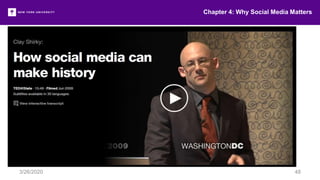
  • #49 http://www.ted.com/talks/clay_shirky_how_cellphones_twitter_facebook_can_make_history#t-11431
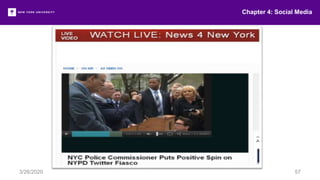
  • #58 http://www.nbcnewyork.com/video/#!/on-air/as-seen-on/NYC-Police-Commissioner-Puts-Positive-Spin-on-NYPD-Twitter-Fiasco/256447291
  • #59 http://www.nbcnewyork.com/video/#!/on-air/as-seen-on/NYC-Police-Commissioner-Puts-Positive-Spin-on-NYPD-Twitter-Fiasco/256447291
  • #77 https://www.youtube.com/watch?feature=player_detailpage&v=tTkdgalPpSg