Design Sprints
Marc O’Connor & James Oliver
24 May 2018
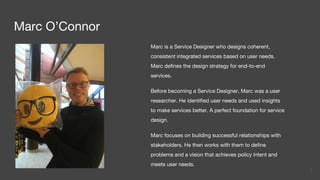
Marc O’Connor
Marc is a Service Designer who designs coherent,
consistent integrated services based on user needs.
Marc defines the design strategy for end-to-end
services.
Before becoming a Service Designer, Marc was a user
researcher. He identified user needs and used insights
to make services better. A perfect foundation for service
design.
Marc focuses on building successful relationships with
stakeholders. He then works with them to define
problems and a vision that achieves policy intent and
meets user needs.
2
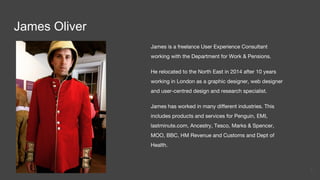
James Oliver
James is a freelance User Experience Consultant
working with the Department for Work & Pensions.
He relocated to the North East in 2014 after 10 years
working in London as a graphic designer, web designer
and user-centred design and research specialist.
James has worked in many different industries. This
includes products and services for Penguin, EMI,
lastminute.com, Ancestry, Tesco, Marks & Spencer,
MOO, BBC, HM Revenue and Customs and Dept of
Health.
3
WHAT IS A DESIGN SPRINT?
4
5
Is a idea worth
pursuing?
Let’s test it quickly
in 5 days
6
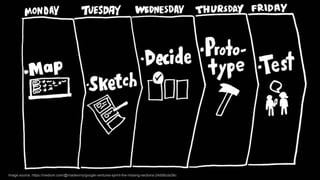
Google Ventures: The Design Sprint
7
Image source: https://medium.com/@rnadworny/google-ventures-sprint-the-missing-sections-24dd8cda36c
Google Venture
Design Sprint
8
9
PLANNING
10
11
You need the right team...
12
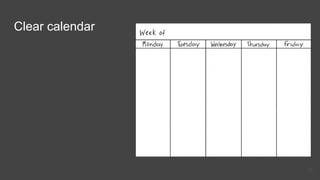
Clear calendar
13
Gathering existing insights
● User insight?
● Personas?
● Business data?
● Maps of any older processes?
14
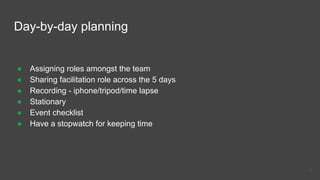
Day-by-day planning
● Assigning roles amongst the team
● Sharing facilitation role across the 5 days
● Recording - iphone/tripod/time lapse
● Stationary
● Event checklist
● Have a stopwatch for keeping time
15
Rules
16
Rules
● No grades
● No phones
● No bad ideas
● Be collaborative
● *Remember* Decision-maker has final say
17
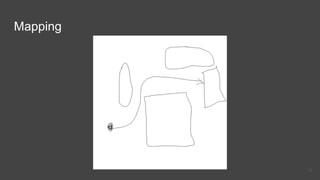
Mapping
18
THE 5-DAY EVENT
19
20
Day 1 - Map
● Agree on a long-term goal (if known)
● Present any research findings
● Have your map framework ready… then create
● Map expert’s pain points
● ‘How might we’ statements… (write, organise, vote)
● Pick a BIG GOAL for this sprint
21
Big goal:
How can I confidently
and quickly book a
package holiday?
22
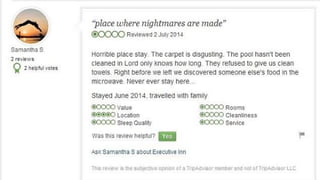
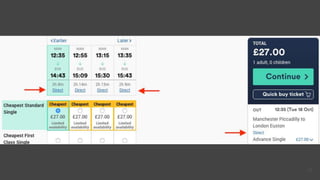
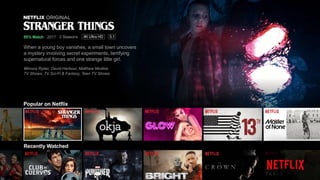
Activity
‘think about examples of
products or services to review
for inspiring solutions’
23
24
25
26
27
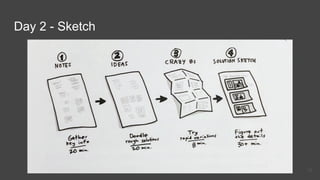
Day 2 - Sketch
28
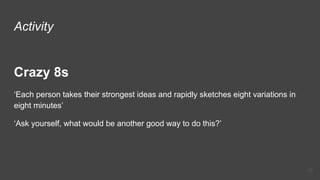
Activity
Crazy 8s
‘Each person takes their strongest ideas and rapidly sketches eight variations in
eight minutes’
‘Ask yourself, what would be another good way to do this?’
29
30
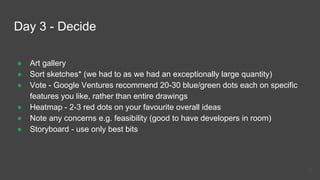
Day 3 - Decide
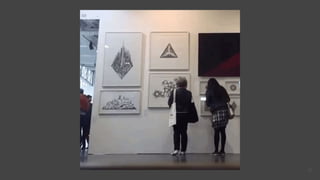
● Art gallery
● Sort sketches* (we had to as we had an exceptionally large quantity)
● Vote - Google Ventures recommend 20-30 blue/green dots each on specific
features you like, rather than entire drawings
● Heatmap - 2-3 red dots on your favourite overall ideas
● Note any concerns e.g. feasibility (good to have developers in room)
● Storyboard - use only best bits
31
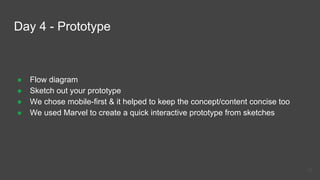
Day 4 - Prototype
● Flow diagram
● Sketch out your prototype
● We chose mobile-first & it helped to keep the concept/content concise too
● We used Marvel to create a quick interactive prototype from sketches
32
33
Day 5 - Test
● User testing
● What is the measurement for success to see if we met our big goal?
● We travelled to London and met 5 users
● *Recruit right user types in advance if possible, saves time at the end
(2 week lead-time is normal in GOV for example)
● We wanted to have observers so needed a lab
34
END OF THE DESIGN SPRINT
35
36
37
DID WE ANSWER OUR BIG GOAL?
38
WHAT NEXT?
39
Post-event
● Overall excitement & enthusiasm generated for the project
● Brought everyone together quickly in terms of a shared goal
● Positive feedback from our business expert participants involved
● Our experiences were shared across wider government
● The recorded artifacts proved so powerful post-event
● We ran a retrospective - to learn & improve for next time
40
WHEN?
41
42
When is the best time?
● Discovery – *Design Sprint – Alpha – Beta – Live
● We advise before development starts, but after some basic insights have
already been gathered
● Avoid having existing live service bias
● Don’t start at very beginning without any background knowledge
● When you can ensure the attendance will include the right people
43
WHY?
44
45
Why do a design sprint?
● Experiment
● Rapid progress
● Prove a good/bad idea before it’s too late
● All about focus - more focus will provide better output
46
“It’s a ‘greatest hits’ of
business strategy,
innovation, behavioural
science and design”
47
“It’s not just about
speed. It’s about
momentum, focus, and
confidence”
48
49
Thank you!
ANY QUESTIONS?
50
Further reading
Google Ventures: Design Sprint
http://www.gv.com/sprint/
Some examples of different types of maps:
https://www.nngroup.com/articles/ux-mapping-cheat-sheet/
Recommended rapid prototyping tool
https://marvelapp.com/
All GIFs kindly sourced from:
https://giphy.com/
51
52

Nux 240518-slides

  • 1.
    Design Sprints Marc O’Connor& James Oliver 24 May 2018
  • 2.
    Marc O’Connor Marc isa Service Designer who designs coherent, consistent integrated services based on user needs. Marc defines the design strategy for end-to-end services. Before becoming a Service Designer, Marc was a user researcher. He identified user needs and used insights to make services better. A perfect foundation for service design. Marc focuses on building successful relationships with stakeholders. He then works with them to define problems and a vision that achieves policy intent and meets user needs. 2
  • 3.
    James Oliver James isa freelance User Experience Consultant working with the Department for Work & Pensions. He relocated to the North East in 2014 after 10 years working in London as a graphic designer, web designer and user-centred design and research specialist. James has worked in many different industries. This includes products and services for Penguin, EMI, lastminute.com, Ancestry, Tesco, Marks & Spencer, MOO, BBC, HM Revenue and Customs and Dept of Health. 3
  • 4.
    WHAT IS ADESIGN SPRINT? 4
  • 5.
  • 6.
    Is a ideaworth pursuing? Let’s test it quickly in 5 days 6
  • 7.
    Google Ventures: TheDesign Sprint 7 Image source: https://medium.com/@rnadworny/google-ventures-sprint-the-missing-sections-24dd8cda36c
  • 8.
  • 9.
  • 10.
  • 11.
  • 12.
    You need theright team... 12
  • 13.
  • 14.
    Gathering existing insights ●User insight? ● Personas? ● Business data? ● Maps of any older processes? 14
  • 15.
    Day-by-day planning ● Assigningroles amongst the team ● Sharing facilitation role across the 5 days ● Recording - iphone/tripod/time lapse ● Stationary ● Event checklist ● Have a stopwatch for keeping time 15
  • 16.
  • 17.
    Rules ● No grades ●No phones ● No bad ideas ● Be collaborative ● *Remember* Decision-maker has final say 17
  • 18.
  • 19.
  • 20.
  • 21.
    Day 1 -Map ● Agree on a long-term goal (if known) ● Present any research findings ● Have your map framework ready… then create ● Map expert’s pain points ● ‘How might we’ statements… (write, organise, vote) ● Pick a BIG GOAL for this sprint 21
  • 22.
    Big goal: How canI confidently and quickly book a package holiday? 22
  • 23.
    Activity ‘think about examplesof products or services to review for inspiring solutions’ 23
  • 24.
  • 25.
  • 26.
  • 27.
  • 28.
    Day 2 -Sketch 28
  • 29.
    Activity Crazy 8s ‘Each persontakes their strongest ideas and rapidly sketches eight variations in eight minutes’ ‘Ask yourself, what would be another good way to do this?’ 29
  • 30.
  • 31.
    Day 3 -Decide ● Art gallery ● Sort sketches* (we had to as we had an exceptionally large quantity) ● Vote - Google Ventures recommend 20-30 blue/green dots each on specific features you like, rather than entire drawings ● Heatmap - 2-3 red dots on your favourite overall ideas ● Note any concerns e.g. feasibility (good to have developers in room) ● Storyboard - use only best bits 31
  • 32.
    Day 4 -Prototype ● Flow diagram ● Sketch out your prototype ● We chose mobile-first & it helped to keep the concept/content concise too ● We used Marvel to create a quick interactive prototype from sketches 32
  • 33.
  • 34.
    Day 5 -Test ● User testing ● What is the measurement for success to see if we met our big goal? ● We travelled to London and met 5 users ● *Recruit right user types in advance if possible, saves time at the end (2 week lead-time is normal in GOV for example) ● We wanted to have observers so needed a lab 34
  • 35.
    END OF THEDESIGN SPRINT 35
  • 36.
  • 37.
  • 38.
    DID WE ANSWEROUR BIG GOAL? 38
  • 39.
  • 40.
    Post-event ● Overall excitement& enthusiasm generated for the project ● Brought everyone together quickly in terms of a shared goal ● Positive feedback from our business expert participants involved ● Our experiences were shared across wider government ● The recorded artifacts proved so powerful post-event ● We ran a retrospective - to learn & improve for next time 40
  • 41.
  • 42.
  • 43.
    When is thebest time? ● Discovery – *Design Sprint – Alpha – Beta – Live ● We advise before development starts, but after some basic insights have already been gathered ● Avoid having existing live service bias ● Don’t start at very beginning without any background knowledge ● When you can ensure the attendance will include the right people 43
  • 44.
  • 45.
  • 46.
    Why do adesign sprint? ● Experiment ● Rapid progress ● Prove a good/bad idea before it’s too late ● All about focus - more focus will provide better output 46
  • 47.
    “It’s a ‘greatesthits’ of business strategy, innovation, behavioural science and design” 47
  • 48.
    “It’s not justabout speed. It’s about momentum, focus, and confidence” 48
  • 49.
  • 50.
  • 51.
    Further reading Google Ventures:Design Sprint http://www.gv.com/sprint/ Some examples of different types of maps: https://www.nngroup.com/articles/ux-mapping-cheat-sheet/ Recommended rapid prototyping tool https://marvelapp.com/ All GIFs kindly sourced from: https://giphy.com/ 51
  • 52.