Do you have what you
need?
• Situations you need more people
• Is this rapid really a code?
• Situations you need less people
• Room control
• The family?
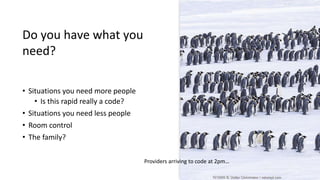
Providers arriving to code at 2pm…
A cardiac arrest occurring in
which of the following patients
would warrant calling for
additional help beyond those that
usually respond at the U of U ?
• a code blue in a 30-year-old with myocarditis
• a respiratory arrest on the floor that has been
paged out as a code blue
• a rapid response on a surgical patient.
• a rapid response in rehab?
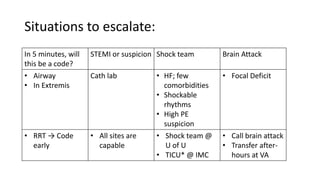
Situations to escalate:
In 5 minutes, will
this be a code?
STEMI or suspicion Shock team Brain Attack
• Airway
• In Extremis
Cath lab • HF; few
comorbidities
• Shockable
rhythms
• High PE
suspicion
• Focal Deficit
• RRT → Code
early
• All sites are
capable
• Shock team @
U of U
• TICU* @ IMC
• Call brain attack
• Transfer after-
hours at VA
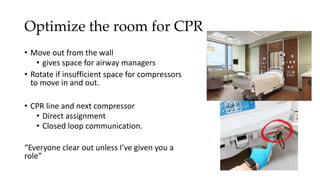
Optimize the room for CPR
• Move out from the wall
• gives space for airway managers
• Rotate if insufficient space for compressors
to move in and out.
• CPR line and next compressor
• Direct assignment
• Closed loop communication.
“Everyone clear out unless I’ve given you a
role”
Bringing family in to observe an attempt at
resuscitation has been shown to:
[select all that apply]
• increase ROSC rate
• decrease ROSC rate
• increase PTSD in the family
• decrease PTSD in the family
Bringing family in to observe an attempt at
resuscitation has been shown to:
[select all that apply]
• increase ROSC rate
• decrease ROSC rate
• increase PTSD in the family
• decrease PTSD in the family
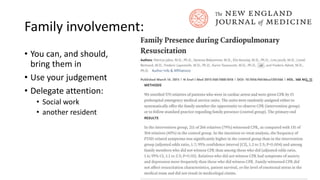
Family involvement:
• You can, and should,
bring them in
• Use your judgement
• Delegate attention:
• Social work
• another resident
Review: Do you have what you need?
• Situations you need more people: Airway, Cath/Shock Team,
Neuro
• Is this rapid really a code? Can’t breathe; in extremis
• Situations you need less people: Most codes
• Room control: move the bed out, lower the bed
• The family? Bring them in

Personnel and Equipment - Code and Rapid Response Workshop

  • 1.
    Do you havewhat you need? • Situations you need more people • Is this rapid really a code? • Situations you need less people • Room control • The family? Providers arriving to code at 2pm…
  • 2.
    A cardiac arrestoccurring in which of the following patients would warrant calling for additional help beyond those that usually respond at the U of U ? • a code blue in a 30-year-old with myocarditis • a respiratory arrest on the floor that has been paged out as a code blue • a rapid response on a surgical patient. • a rapid response in rehab?
  • 3.
    Situations to escalate: In5 minutes, will this be a code? STEMI or suspicion Shock team Brain Attack • Airway • In Extremis Cath lab • HF; few comorbidities • Shockable rhythms • High PE suspicion • Focal Deficit • RRT → Code early • All sites are capable • Shock team @ U of U • TICU* @ IMC • Call brain attack • Transfer after- hours at VA
  • 4.
    Optimize the roomfor CPR • Move out from the wall • gives space for airway managers • Rotate if insufficient space for compressors to move in and out. • CPR line and next compressor • Direct assignment • Closed loop communication. “Everyone clear out unless I’ve given you a role”
  • 5.
    Bringing family into observe an attempt at resuscitation has been shown to: [select all that apply] • increase ROSC rate • decrease ROSC rate • increase PTSD in the family • decrease PTSD in the family
  • 6.
    Bringing family into observe an attempt at resuscitation has been shown to: [select all that apply] • increase ROSC rate • decrease ROSC rate • increase PTSD in the family • decrease PTSD in the family
  • 7.
    Family involvement: • Youcan, and should, bring them in • Use your judgement • Delegate attention: • Social work • another resident
  • 8.
    Review: Do youhave what you need? • Situations you need more people: Airway, Cath/Shock Team, Neuro • Is this rapid really a code? Can’t breathe; in extremis • Situations you need less people: Most codes • Room control: move the bed out, lower the bed • The family? Bring them in

Editor's Notes

  • #2  Room management: Recognize situations where you need more people? Code, shock team Recognize situations where you need less people (most) Equipment – move the room around to make space; go drop the bed Ethan’s Spreadsheet
  • #5  OPA/NPAs/BVMs airway management; oxygen - all (25 mins w portable tank) Bed issues
  • #8 Social work / delegation. Other work corroborates this: https://link.springer.com/article/10.1186/s40560-015-0107-2