
Nutrition & Wellness
Purbangshu Chatterjee
National Training Manager
Proveda Herbals
What is Nutrition
• Nutrition is how food affects
the health of the body. Food is
essential—it provides vital
nutrients for survival,
• Helps the body function and
stay healthy.
• Food is comprised of
macronutrients including
protein, carbohydrate and fat
that not only offer calories to
fuel the body and give
• it energy but play specific roles
in maintaining health.
• Food also supplies
micronutrients (vitamins and
minerals)
Macronutrients: Protein,
Carbohydrate and Fat
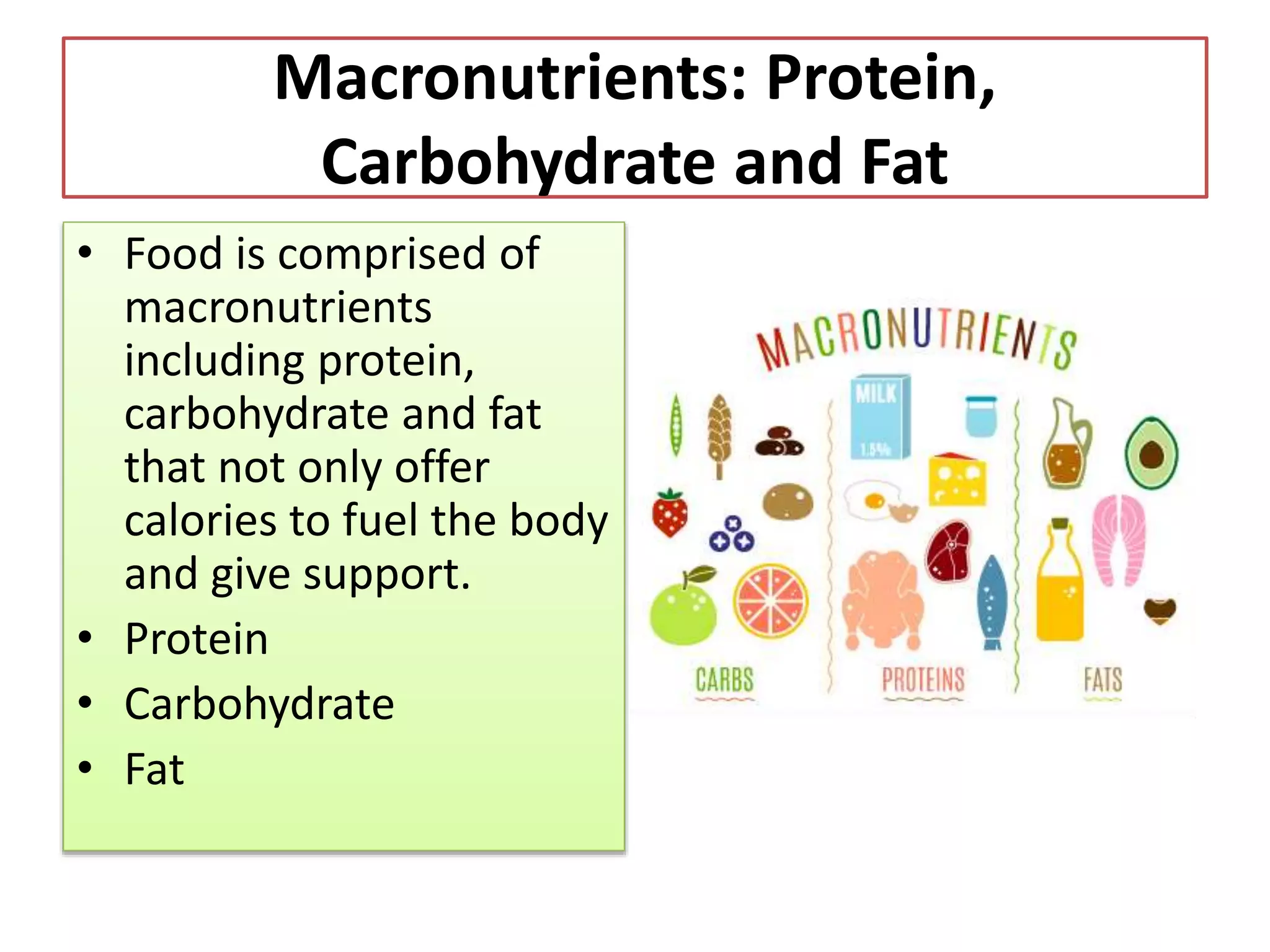
• Food is comprised of
macronutrients
including protein,
carbohydrate and fat
that not only offer
calories to fuel the body
and give support.
• Protein
• Carbohydrate
• Fat
Protein
• Found in meats, fish and seafood,
eggs, soybeans and other
legumes
• protein provides the body with
amino acids.
• Amino acids are the building
blocks of proteins which are
needed for growth, development,
and repair and maintenance of
body tissues.
• Protein provides structure to
muscle and bone, repairs tissues
when damaged and helps
immune cells fight inflammation
and infection.
Carbohydrates
• The main role of a
carbohydrate is to provide
energy and fuel the body the
same way gasoline fuels a car.
• Foods such as beans,
plantains, rice, potatoes and
other root vegetables
• Energy allows the body to do
daily activities
• Fuel is needed for growth,
which makes sufficient fuel .
• Even at rest, the body needs
calories to perform vital
functions
Fats
• Fat: Dietary fat, which is
found in oils, coconut,
nuts, milk, cheese, meat,
poultry and fish
• Fat provides structure to
cells and cushions
membranes to help
prevent damage.
• Oils and fats are also
essential for absorbing
fat-soluble vitamins
Concept of Calories
• A calorie is a unit of energy. In
nutrition,
• calories refer to the energy
people get from the food and
drink they consume,
• The energy they use in
physical activity.
• Calories are listed in the
nutritional information on all
food packaging.
• Many weight loss programs
centre around reducing the
intake of calories.
•
Micronutrients: Vitamins and
Minerals
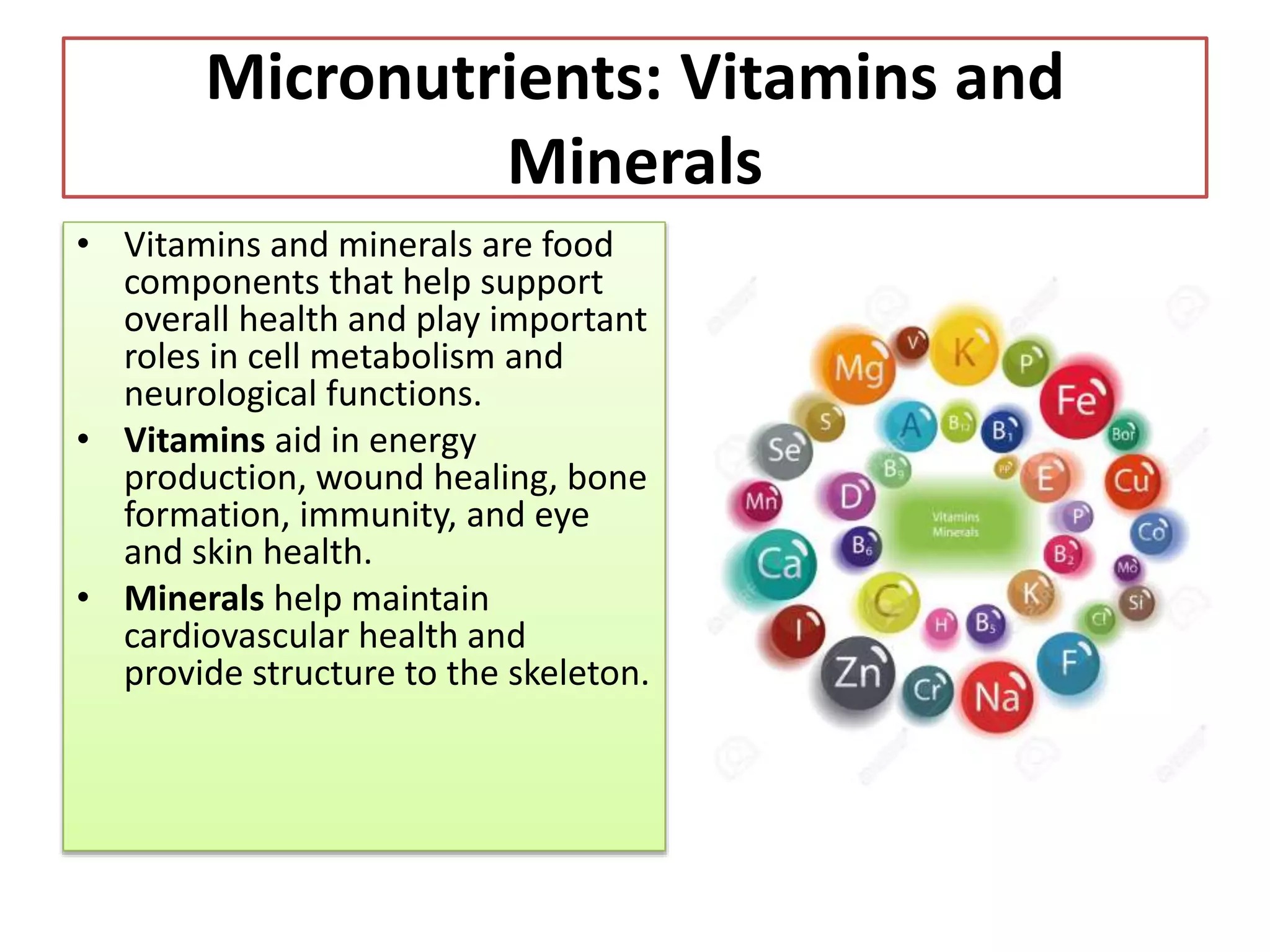
• Vitamins and minerals are food
components that help support
overall health and play important
roles in cell metabolism and
neurological functions.
• Vitamins aid in energy
production, wound healing, bone
formation, immunity, and eye
and skin health.
• Minerals help maintain
cardiovascular health and
provide structure to the skeleton.
Types of Vitamin & its Deficiency
Major Minerals : Sources & Deficiency
Water
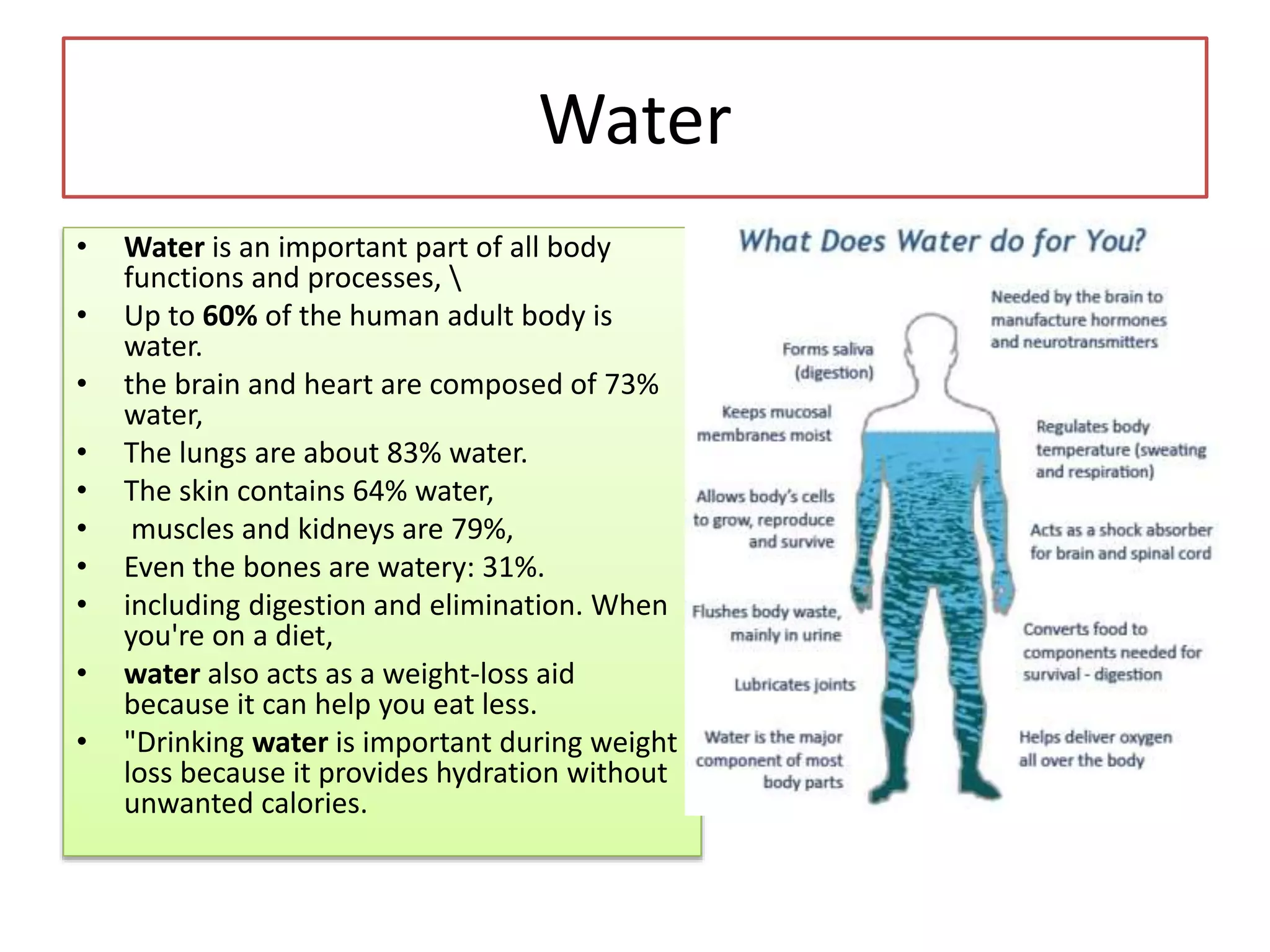
• Water is an important part of all body
functions and processes, 
• Up to 60% of the human adult body is
water.
• the brain and heart are composed of 73%
water,
• The lungs are about 83% water.
• The skin contains 64% water,
• muscles and kidneys are 79%,
• Even the bones are watery: 31%.
• including digestion and elimination. When
you're on a diet,
• water also acts as a weight-loss aid
because it can help you eat less.
• "Drinking water is important during weight
loss because it provides hydration without
unwanted calories.
What is fibre?
• Dietary fibre is a term that is used for plant-based carbohydrates
that, unlike other carbohydrates (such as sugars and starch), are not
digested in the small intestine and so reaches the large intestine or
colon.
Soluble and insoluble fibre
• You may have heard of the terms ‘soluble fibre’ or ‘insoluble fibre’–
these are words that are sometimes used to describe the types of
fibre in our diet.
• Although scientific organisations argue that these terms are no
longer really appropriate, you may see these terms being used, with
soluble fibre including pectins and beta glucans
• insoluble fibre including cellulose (found for example in wholegrains
and nuts). What is important to remember is that fibre-rich foods
typically contain both types of fibre.
Fibre rich foods
• Wholegrain breakfast
cereals, whole wheat pasta,
wholegrain bread and oats,
barley and rye
• Fruit such as berries,
pears, melon and oranges
• Vegetables such as broccoli,
carrots and sweet corn
• Peas, beans and pulses
• Nuts and seeds
• Potatoes with skin
Benefits of Fibre
• Fibre helps to keep our digestive system healthy and
helps to prevent constipation.
• The European Food Safety Authority suggests that
including fibre rich foods in a healthy balanced diet can
improve weight maintenance.
• Dietary fibre can reduce your risk of: Cardiovascular
disease (heart disease and stroke) and type 2 diabetes
• Foods such as oats and barley contain a type of fibre
known as beta glucan, which may help to reduce
cholesterol levels
• Colorectal cancer (bowel cancer) : 45% of bowel cancer
could be prevented through diet, physical activity and
weight?
Nutrients as Building Blocks
• Building blocks include protein for
growing babies, for child and
adolescent growth
• Repairing damaged skin, blood, and
other body parts in adults who aren't
growing.
• Some parts of the body are replaced
regularly, like blood and skin, so even
adults are building new body parts
regularly.
• Calcium is also a building block for
building bones. Iron is a building
block for blood.
• Since blood cells only last a few
months, the body constantly needs
more iron and protein to make new
blood.
Diet
• In nutrition, diet is the sum
of food consumed by a
person or other organism.
• The word diet often implies
the use of specific intake
of nutrition for health or we
ight-management
• Humans are omnivores,
each culture and each
person holds some food
preferences
• This may be due to personal
tastes or ethical reasons.
Food Pyramid
Are We Taking Balance Diet?
We need Support
from
Wellness
What is Wellness
• State of complete
physical , mental and
social well being and
not merely the absence
of disease or infirmity”
• Health is a destination
that we reach to help us
become productive in
life
• WHO (World Health
Organisation)
Health vs. Wellness Health
• Condition of being of sound
body with emphasis on
freedom from pain and
disease
Health
• A multi-dimensional state of well-
being, a holistic approach to life that
encompasses physical, emotional,
intellectual, spiritual, social,
environmental, and occupational.
Wellness
Health
Elements of Wellness
Wellness Supports
What you eat today
walks and talks
tomorrow
Aging process - largely caused by what we eat and how we
live, "What do heart disease, high cholesterol, diabetes, high
blood pressure, and various other cardiovascular ailments
all have in common? They are unnatural diseases – These
are life style disorders”
Julian Whitaker, M.D., 1994
Health Matters
• Millions of Americans today
are taking dietary
Supplements, practicing yoga
and integrating other natural
therapies into their lives.
• These are all preventive
measures that will keep them
out of the doctor's office and
drive down the costs of
treating serious problems like
heart disease and diabetes.
Andrew Weil
Nutritional Imbalance and deficiency
with faulty lifestyle leading us to..
Unhealthy Unhappy Un-WELL
Lifestyle Diseases: Alarming Facts
Diabetes in
India
• By 2030
Asia is
expected to
have 190
million
Diabetes
cases, more
than half of
them in
India &
China
Heart
Diseases in
India
• WHO
estimates
that 60% of
cardiac
patients in
the worlds
will be
Indians by
2010
Obesity In
India
• Scientists
say that the
percentage
of
overweight /
obese
people in
India is on
track to rise
from 9% in
1995 to 24%
in 2025
Osteo-arthritis
in India
• By 2020,
scientists
expect 40
million
people will
suffer from
Osteo-
arthritis
Deaths in
India
• By 2020,
chronic
diseases are
expected to
claim 7.63
million lives
in India,
compared to
3.78 million
in 1990
This industry is a newcomer
since fifteen years ago it
didn’t even exist. However,
today the Wellness Industry
reached the trillion dollar
mark in 2010. You will find
Vitamin stores, fitness
centres, natural food
markets, and so many more
wellness related businesses
seem to be emerging at
incredible rates! A massive
wave is forming.
The Wellness Revolution
Why Supplements ?
Absence of Complete & Balanced
Nutrition in our daily diet
Need for Supplementation
with essential nutrients like proteins, carbohydrates,
vitamins and minerals
Fill the gaps with Supplements
Nutrition and Wellness / food Supplements /

Nutrition and Wellness / food Supplements /

  • 1.
    Nutrition & Wellness PurbangshuChatterjee National Training Manager Proveda Herbals
  • 2.
    What is Nutrition •Nutrition is how food affects the health of the body. Food is essential—it provides vital nutrients for survival, • Helps the body function and stay healthy. • Food is comprised of macronutrients including protein, carbohydrate and fat that not only offer calories to fuel the body and give • it energy but play specific roles in maintaining health. • Food also supplies micronutrients (vitamins and minerals)
  • 3.
    Macronutrients: Protein, Carbohydrate andFat • Food is comprised of macronutrients including protein, carbohydrate and fat that not only offer calories to fuel the body and give support. • Protein • Carbohydrate • Fat
  • 4.
    Protein • Found inmeats, fish and seafood, eggs, soybeans and other legumes • protein provides the body with amino acids. • Amino acids are the building blocks of proteins which are needed for growth, development, and repair and maintenance of body tissues. • Protein provides structure to muscle and bone, repairs tissues when damaged and helps immune cells fight inflammation and infection.
  • 5.
    Carbohydrates • The mainrole of a carbohydrate is to provide energy and fuel the body the same way gasoline fuels a car. • Foods such as beans, plantains, rice, potatoes and other root vegetables • Energy allows the body to do daily activities • Fuel is needed for growth, which makes sufficient fuel . • Even at rest, the body needs calories to perform vital functions
  • 6.
    Fats • Fat: Dietaryfat, which is found in oils, coconut, nuts, milk, cheese, meat, poultry and fish • Fat provides structure to cells and cushions membranes to help prevent damage. • Oils and fats are also essential for absorbing fat-soluble vitamins
  • 7.
    Concept of Calories •A calorie is a unit of energy. In nutrition, • calories refer to the energy people get from the food and drink they consume, • The energy they use in physical activity. • Calories are listed in the nutritional information on all food packaging. • Many weight loss programs centre around reducing the intake of calories. •
  • 8.
    Micronutrients: Vitamins and Minerals •Vitamins and minerals are food components that help support overall health and play important roles in cell metabolism and neurological functions. • Vitamins aid in energy production, wound healing, bone formation, immunity, and eye and skin health. • Minerals help maintain cardiovascular health and provide structure to the skeleton.
  • 9.
    Types of Vitamin& its Deficiency
  • 10.
    Major Minerals :Sources & Deficiency
  • 12.
    Water • Water isan important part of all body functions and processes, • Up to 60% of the human adult body is water. • the brain and heart are composed of 73% water, • The lungs are about 83% water. • The skin contains 64% water, • muscles and kidneys are 79%, • Even the bones are watery: 31%. • including digestion and elimination. When you're on a diet, • water also acts as a weight-loss aid because it can help you eat less. • "Drinking water is important during weight loss because it provides hydration without unwanted calories.
  • 13.
    What is fibre? •Dietary fibre is a term that is used for plant-based carbohydrates that, unlike other carbohydrates (such as sugars and starch), are not digested in the small intestine and so reaches the large intestine or colon. Soluble and insoluble fibre • You may have heard of the terms ‘soluble fibre’ or ‘insoluble fibre’– these are words that are sometimes used to describe the types of fibre in our diet. • Although scientific organisations argue that these terms are no longer really appropriate, you may see these terms being used, with soluble fibre including pectins and beta glucans • insoluble fibre including cellulose (found for example in wholegrains and nuts). What is important to remember is that fibre-rich foods typically contain both types of fibre.
  • 14.
    Fibre rich foods •Wholegrain breakfast cereals, whole wheat pasta, wholegrain bread and oats, barley and rye • Fruit such as berries, pears, melon and oranges • Vegetables such as broccoli, carrots and sweet corn • Peas, beans and pulses • Nuts and seeds • Potatoes with skin
  • 15.
    Benefits of Fibre •Fibre helps to keep our digestive system healthy and helps to prevent constipation. • The European Food Safety Authority suggests that including fibre rich foods in a healthy balanced diet can improve weight maintenance. • Dietary fibre can reduce your risk of: Cardiovascular disease (heart disease and stroke) and type 2 diabetes • Foods such as oats and barley contain a type of fibre known as beta glucan, which may help to reduce cholesterol levels • Colorectal cancer (bowel cancer) : 45% of bowel cancer could be prevented through diet, physical activity and weight?
  • 16.
    Nutrients as BuildingBlocks • Building blocks include protein for growing babies, for child and adolescent growth • Repairing damaged skin, blood, and other body parts in adults who aren't growing. • Some parts of the body are replaced regularly, like blood and skin, so even adults are building new body parts regularly. • Calcium is also a building block for building bones. Iron is a building block for blood. • Since blood cells only last a few months, the body constantly needs more iron and protein to make new blood.
  • 17.
    Diet • In nutrition,diet is the sum of food consumed by a person or other organism. • The word diet often implies the use of specific intake of nutrition for health or we ight-management • Humans are omnivores, each culture and each person holds some food preferences • This may be due to personal tastes or ethical reasons.
  • 18.
  • 19.
    Are We TakingBalance Diet?
  • 20.
  • 21.
    What is Wellness •State of complete physical , mental and social well being and not merely the absence of disease or infirmity” • Health is a destination that we reach to help us become productive in life • WHO (World Health Organisation)
  • 22.
    Health vs. WellnessHealth • Condition of being of sound body with emphasis on freedom from pain and disease Health • A multi-dimensional state of well- being, a holistic approach to life that encompasses physical, emotional, intellectual, spiritual, social, environmental, and occupational. Wellness Health
  • 23.
  • 24.
  • 25.
    What you eattoday walks and talks tomorrow Aging process - largely caused by what we eat and how we live, "What do heart disease, high cholesterol, diabetes, high blood pressure, and various other cardiovascular ailments all have in common? They are unnatural diseases – These are life style disorders” Julian Whitaker, M.D., 1994
  • 26.
    Health Matters • Millionsof Americans today are taking dietary Supplements, practicing yoga and integrating other natural therapies into their lives. • These are all preventive measures that will keep them out of the doctor's office and drive down the costs of treating serious problems like heart disease and diabetes. Andrew Weil
  • 27.
    Nutritional Imbalance anddeficiency with faulty lifestyle leading us to.. Unhealthy Unhappy Un-WELL
  • 28.
    Lifestyle Diseases: AlarmingFacts Diabetes in India • By 2030 Asia is expected to have 190 million Diabetes cases, more than half of them in India & China Heart Diseases in India • WHO estimates that 60% of cardiac patients in the worlds will be Indians by 2010 Obesity In India • Scientists say that the percentage of overweight / obese people in India is on track to rise from 9% in 1995 to 24% in 2025 Osteo-arthritis in India • By 2020, scientists expect 40 million people will suffer from Osteo- arthritis Deaths in India • By 2020, chronic diseases are expected to claim 7.63 million lives in India, compared to 3.78 million in 1990
  • 29.
    This industry isa newcomer since fifteen years ago it didn’t even exist. However, today the Wellness Industry reached the trillion dollar mark in 2010. You will find Vitamin stores, fitness centres, natural food markets, and so many more wellness related businesses seem to be emerging at incredible rates! A massive wave is forming. The Wellness Revolution
  • 30.
    Why Supplements ? Absenceof Complete & Balanced Nutrition in our daily diet Need for Supplementation with essential nutrients like proteins, carbohydrates, vitamins and minerals
  • 31.
    Fill the gapswith Supplements