Aditya Kumar Baruah
AAH-MA7-01
Biological and chemical methods for
recovery of nutrients from liquid and
solid wastes
Introduction
• Nitrogen (N), phosphorus (P), and potassium (K) are
critical to intensive agriculture and there are concerns over long-term
availability and cost of extraction of these nutrients
• P and K are predominantly sourced from mineral deposits, and are
nonrenewable and is becoming progressively limited with supply
• N is a renewable resource, the process by which N (as ammonia) is industrially
synthesized (Haber–Bosch process) is energetically intensive.
• Currently there is very little scope for many developing countries to be self-
sufficient with respect to supply of N, P & K by conventional fertilizers
• Demand for food for increasing global population and to create energy from
biomass will drive demand for nutrients from alternative sources upwards into
the future.
• The use of inorganic or synthetic nutrient fertilizers is ubiquitous in modern
agriculture
• Humans and animals consume nutrients from crops and produce nutrient-rich
waste streams from processing food
• It is estimated globally that the total P content in excreted human waste (urine and
feces) can meet approximately 22% of the demand for P
• Limited recycling and inefficient nutrient management, made these nutrients a
major contributors to the environmental impact of domestic, agricultural, and
industrial waste streams
• Greenhouse gases, Methane and nitrous oxide, are generated in large amounts by
manure management and excess use of N-based fertilizers & there is strong
concern of excess nutrients in waterways causing eutrophication
• Along with environmental impact, eutrophication can have major economic
impacts by damaging valuable marine fisheries and impairing water bodies used
for potable water supply and recreation
Summary of the concept
NUTRIENT ACCUMULATION TECHNOLOGIES
Prokaryotic Accumulation
Chemical Accumulation via Precipitation
Adsorption/Ion-Exchange
Algae Accumulation
Liquid–Liquid Extraction
Plant Accumulation
Membrane Filtration
Magnetic Separation
Prokaryotic Accumulation
• Common nutrient accumulating microbes are
proteobacteria such as polyphosphate-accumulating
organisms (PAOs) and purple non-sulfur bacteria and BGA.
• 9 PAOs are currently extensively used for phosphorous removal and can
accumulate as polyphosphate up to 20–30% of P by weight.
• Bacterial-accumulation of P through enhanced biological phosphorus removal
(EBPR) is used in sewage treatment plants to remove 80–90% of soluble P from
the effluent.
• The optimum aerobic P uptake occurs at pH 7–8 and wastewater should contain
carbon to P ratios of 5 or higher to enhance accumulation of P.
• Pre-fermentation of wastewater to produce volatile fatty acids (VFAs) is often
beneficial and sometimes essential for EBPR.
• Phosphate-rich sludge with PAOs can be separated from the wastewater by
settling, and nutrients can then be released and recovered.
• Purple non-sulfur bacteria and cyanobacteria can grow with and without light,
and consume water, carbon dioxide or oxidized substrate, and nutrients to
produce organic matter and oxygen.
• Purple non-sulfur bacteria can be used to treat many kinds of wastewater to
produce highly nutrient-rich biomass when compared to activated sludge
processes.
• Blue–green algae are suitable for luxury uptake of N. The protein concentration
reported for cyanobacteria is up to 80% of the dry weight, and consists of 8–12%
N and 1% P.
• Purple non-sulfur bacteria have a high tolerance to heavy metal exposure, but
unfortunately accumulate heavy metals along with nutrients from the wastewater.
Chemical Accumulation via Precipitation
• Chemical accumulation of nutrients can be accomplished via coagulation and
flocculation
• Soluble nutrients and nutrients bound to colloids (0.01–1 µm) are precipitated as
solids and separated by settling in clarifiers.
• Aluminum- or iron-based coagulants are commonly used for accumulating of P
from dilute wastewater
• Calcium, natural, and synthetic organic polymers, and prehydrolyzed metal salts
such as polyaluminum chloride and polyiron chloride are also used
• Metal ions can also be delivered through sacrificial iron or aluminum anode
electrodes through electro-coagulation.
• The coagulants, when added to water, hydrolyze rapidly and form multicharged
polynuclear complexes with enhanced adsorption characteristics
• Once suspended particles have flocculated into larger particles (sludge) they can
usually be removed from the treated water by sedimentation
• Disadvantages associated with chemical accumulation by precipitation include
– high operating costs,
– increased salinity in the effluent (mainly as chloride or sulfate),
– increased sludge production (up to 35 vol%),
– the addition of heavy metals present in the raw coagulant, and
– inhibitory effects on the biological process such as anaerobic digestion
following the coagulation process.
• Advantages are ease of operation, flexibility to changing conditions, and low
capital cost to reduce effluent P concentration to less than 1 mg/L
Adsorption/Ion-Exchange
• During adsorption and ion-exchange, ions are transferred from the solvent to
charged surfaces of insoluble, rigid sorbents suspended in a vessel or packed in
a column
• The sorbents are made from porous materials containing interconnected cavities
with a high internal surface area
• Adsorption and ion-exchange can accumulate soluble N, P, or K from waste
• Spent sorbents are regenerated using low-cost, high concentration aqueous
solutions of cations or anions such as sodium, sulfate, or chloride
• Adsorption and ion-exchange technology is suitable for waste streams with a
range of nutrient concentrations (1–2000 mg/L), but relatively low solids
concentrations (<2000 mg/L)
• For low strength waste streams such as effluent from sewage treatment plants
and artificial lakes where nutrient concentrations are less than 5 mg/L, advanced
engineered polymeric sorbents are employed
• For concentrated waste streams (>2000 mg/L), typically, red mud, metal
oxide/hydroxide, and zirconium sorbents are used for P recovery and modified
zeolite and clinoptilolite for N and K recovery.
• The potential advantages of this technology are the ability to achieve high P
accumulation and low P concentrations in the treated effluent of < 0.1 PO4-P/L.
• Advantages - no additional sludge (other than spent media) is produced and the
pH of the waste streams remains unaffected.
• Challenges- chemicals required for the regeneration of the sorbents, biofouling,
large amounts of resin required for complete removal, limited resin life, and
competitive foreign ion adsorption
• Adsorption/ion-exchange can be categorized as a hybrid nutrient accumulation-
nutrient recovery technique because the nutrient-laden sorbent/exchange
media can potentially be directly applied as a nutrient product in agriculture.
Algae Accumulation
• Algae have received significant attention worldwide as a valuable source of
biomass for energy because of their high growth rates as compared to terrestrial
plants
• Reports have suggested that the nutrient content of algal dry biomass could reach
up to 2% N and 3.3% P.
• Algae-based systems can be- suspended or nonsuspended
• In nonsuspended systems, the algae are immobilized on a resin
• The surface immobilized algae reduce nutrient load in the waste streams via
adsorption and/or precipitation on the surface of the material as well as through
nutrient uptake by the biomass.
• Nonsuspended systems have been successfully tested in high-nutrient
agriculture streams such as dairy, poultry, and swine manure waste
• Suspended algae configurations are used in facultative and high rate algal ponds.
• A tubular photo-bioreactor with suspended algae was found to be the
most promising option for producing algal biomass in full-scale applications
• As carbon dioxide (CO2) is consumed by algae during photosynthesis, the pH of
the waste stream can increase which can encourage further minerals precipitation
and volatilization of N as ammonia
• Floating algal farming is an emerging nutrient removal/accumulation process from
waste streams.
• This approach may be most appropriate in coastal regions where nutrients are
discharged directly to ocean from agriculture activities
• The nutrient-rich algae can be processed with nutrient release techniques such as
anaerobic digestion or thermochemical methods, or may be used directly as an
animal feed or a fertilizer
Tubular photo-bioreactor
Liquid–Liquid Extraction
• Liquid–liquid extraction is a method of separating compounds based on relative
solubility in two immiscible liquids, and can be used to recover soluble nutrients
• In this process, an extractant is dissolved in an organic phase. This organic phase
with extractant is brought into contact with the waste which causes a transfer of
nutrients into the organic phase until equilibrium is reached with the aqueous
(wastewater) phase
• The organic phase laden with nutrients is then brought into contact with another
secondary aqueous phase at conditions where the nutrients are highly soluble in
the secondary aqueous phase
• A mixture of kerosene (organic phase) and benzyldimethylamine (extractant) in a
2:1 ratio worked best for phosphate extraction, and that combined use with 6.0 M
sulfuric acid as the secondary aqueous phase provided a high P recovery of >93%
Schematic representation of a liquid–liquid extraction
process.
Plant Accumulation
• In this system, nutrients accumulate as plants grow on the water surface, creating
anaerobic conditions in the surrounding water
• The anaerobic conditions drive digestion reactions where organic matter is metabolized to
produce nutrients that can then be further accumulated by the plants
• These plants, however, must be routinely harvested to ensure that the accumulated
nutrients are not recycled.
• Free-floating plants have a higher capacity for nutrient accumulation as they grow on the
surface of the water and the roots are kept suspended in the water column to allow
accumulation of the nutrients
• Water hyacinths (Eichhornia crassipes), duckweeds (Lemna minor, Landoltia Punctata, and
Spirodela polyrrhiza) can tolerate high-nutrient loads and have a high-nutrient removal
capacity
Membrane Filtration
• Microfiltration (MF), ultrafiltration (UF), nanofiltration (NF), and reverse osmosis
(RO) are all membrane processes which selectively separate constituents from
waste.
• Nutrients in particulate form >0.1 µm in size (suitable for MF or UF) or in soluble
form (suitable for NF or RO) can be selectively removed
• The membrane module configurations can be hollow fiber, flat sheet, tubular, or
spiral wound.
• The waste stream volumes can be reduced by 4–6 times (concentrate with
nutrients is 25–16% of the original volume), while retaining all nutrients and may
be suitable for irrigation or subsequent recovery processes
• The retention of ammonium and nitrate by NF and RO membranes is >80% and it
improves with reduction in pH
• Disadvantages are mainly the high energy costs involved in membrane filtration
as well as accumulation of unwanted contaminants and salts, which generally
render concentrate unsuitable for direct reuse.
Membrane Filtration- illustration
Magnetic Separation
In this approach, soluble nutrients are accumulated from the waste stream by
employing adsorption to a carrier material that has magnetic properties.
• The nutrients-laden carrier material can be recovered by capturing the magnetic
particles with a magnetic field in high gradient magnetic separators
(HGMS)
• The magnetic carrier can be regenerated via chemical release techniques & this
process can simultaneously recover soluble N, P, or K from waste streams using
specific adsorbents
The magnetic carriers commonly used are
magnetite, zirconium ferrate, carbonyl iron,
and iron oxide.
Magnetic Separation
NUTRIENT RELEASE TECHNOLOGIES
Biological Release
Thermochemical Stabilization and Chemical Release
Bioleaching/Extraction
Biological Release
• Anaerobic digestion is the most commonly used process for stabilization of
wastes, organic solids destruction, pathogen destruction, and energy recovery
from wastes in the form of biomethane.
• The digestion process facilitates the release of nutrients from the biodegradable
fraction of the waste. Organic N is converted into ammonium and organic P is
hydrolyzed to soluble P.
• The optimum operating temperature for anaerobic digestion is 35–40°C for
mesophilic bacteria and 55–60°C for thermophilic bacteria. The optimum pH is in
the range of 6.5–7.5.
• Released nutrients are soluble and tend to form inorganic compounds or adsorb
onto solid surfaces in the digestate.
• The soluble P content in most municipally digested wastes range from 50 to 500
mg /L and N is often five times higher than soluble P.
Thermo-chemical Stabilization and Chemical
Release
• Thermochemical processes like thermal hydrolysis, wet oxidation, incineration,
gasification, and pyrolysis can greatly reduce the bulk volume of wastes by
destroying a large proportion of the carbon.
• The char/ash/oil that is produced from the thermochemical processes retains
most P and K, but N is lost in the gas stream.
• Wet oxidation is carried out at moderate temperatures (180–315°C), and at high
pressures of 2–15 MPa. Metals are oxidized to their highest valency and P to P2O5.
• Incineration and gasification occurs in the presence of excess oxygen above 800
°C, while pyrolysis operates under a limited supply of oxygen and at relatively low
temperatures .
• The solid by-products (ash/char) from thermochemical treatment can be further
processed thermally in the presence of chloride salts, which convert heavy metals
into heavy metal chlorides to be vaporized and removed from the char/ash.
• Chemical extraction involves the addition of acids or bases to char, digester
reject, solid waste, or waste streams, at moderate temperatures and/or
pressures to release nutrients into a leachate
• The chemical extractants typically used are inorganic acids (H2SO4, HCl,
HNO3), organic acids (citric and oxalic acids), inorganic chemicals (e.g., ferric
chloride solution), and chelating agents (e.g., EDTA)
• The Seaborne, Sesal-Phos, Biocon, Sephos, Pasch, Stuttgarter Verfahren,
and Loprox/Phoxnan processes dissolve nutrients and heavy metals using
acids at a pH below 3, while the Kreprco and Aquareci processes are
operated at high temperatures (>100 ◦C) and pressures (>5 bar) for nutrient
dissolution.
• The dissolved ions (nutrients and heavy metals) are subsequently separated
by crystallization (Seaborne, Stuttgarter Verfahren, Sephos, Sesal-Phos, and
Krepco), membranes (Loprox/Phoxnan), solvent extraction (Pasch), or ion-
exchange (Biocon)
Bioleaching/Extraction
• Bioleaching is a release technology that relies on the solubilization of nutrients
and heavy metals from solid substrates either directly by the metabolism of
leaching microorganisms or indirectly by the products of metabolism
• Microorganisms with potential for bioleaching activity include mesophiles such
as Acidithiobacillus thiooxidans and Acidithiobacillus ferrooxidans; thermophiles
such as Sulfobacillus thermosulfidoxidans; and heterotrophic microbes such as
Acetobacter, Acidophilum, Fusarium, Penicillium, and Aspergillus
• These organisms survive acidic environments and carry out oxidation of
insoluble iron and sulfur compounds, causing the low pH and the
release/solubilizing of previously complexed nutrients and heavy metals.
• For bioleaching of nutrients from sewage sludge, phosphate rock, and ash,
different energy sources such as FeSO4, FeS2, and elemental sulfur have been
provided to a mesophilic mixture containing At. ferrooxidans and At. thiooxidans
strains
NUTRIENT EXTRACTION AND RECOVERY
TECHNOLOGIES
Chemical Precipitation/Crystallization
Gas-Permeable Membrane and Absorption
Liquid–Gas Stripping
Electrodialysis (ED)
Chemical Precipitation/Crystallization
• Chemical precipitation via crystallization is a phase change process that converts
previously dissolved components into a particulate, inorganic compound, for
separation from the liquid bulk.
• Supersaturated conditions are created in the waste streams through a change in
temperature, pH, and/or by the addition of metal ions.
• Struvite (MgNH4PO4·6H2O) crystallization is a well-known example of this
technique being applied to simultaneously recover N and P from nutrient-rich
water.
• Chemical precipitation can remove 80–90% of soluble phosphates and 20–30% of
soluble ammonia from the waste streams.
• Since struvite has a specific gravity of 1.7, the crystals can be readily separated
from the liquid bulk by gravity settling, by mechanical separation (filter press) or
by the use of an integrated crystallization and separation process.
• Alternative products like calcium phosphate, magnesium potassium phosphate,
or iron phosphate can be produced in a similar manner.
Gas-Permeable Membrane and Absorption
• Gas-permeable membranes can be used to recover N as ammonia from the liquid
phase
• In this process, ammonia is transferred by convection and diffusion from the
liquid stream across a membrane. Ammonia volatilizes through a hydrophobic
membrane and is either condensed or absorbed into an acidic solution
• Following ammonia recovery via membrane concentration, acids such as sulfuric
acid are used to recover ammonium as ammonium sulfate
• The membranes in this process are typically hydrophobic and may be comprised
of silica, ceramic, polyvinylidene fluoride (PVDF), polypropylene (PP),
polytetrafluorethylene (PTFE), or polymer composites
• Membranes can be constructed in different configurations including hollow fiber,
tubular flat sheet, and spiral wound cylinders and can be used in submerged or
external configurations.
Gas-Permeable Membrane and Absorption
Liquid–Gas Stripping
• Gas stripping is a physiochemical process that involves the mass transfer of
ammonia from the liquid phase to the gas phase.
• This transfer is accomplished by contacting the dissolved ammonia with an
extractant gas (usually air) and is mainly applicable to situations where the
effluent has a relatively high ammonia concentration.
• As with gas-permeable separation, air stripping usually requires an elevated
temperature (>80 ◦C) and pH (>9.5) to increase the proportion of free ammonia in
the treated waste streams and in this way decrease the amount of air required.
• Recovery of the stripped ammonia occurs via condensation, absorption, or
oxidation to produce a concentrated fertilizer product.
• The main challenges to implementing this technology are the relatively high
operating cost per unit volume.
Electrodialysis (ED)
• ED is an extraction technology which selectively separates anions and cations
across an ion-exchange membrane, driven by an applied electrical field between
electrodes.
• Cationic species (K+ and NH4 +) move toward the cathode passing through
cation-exchange membranes (CEM) which allow only positively charged species.
• Anions (e.g., PO4 3−) move toward the anode passing through anion exchange
membranes (AEM) which allow only negatively charged species.
• ED cells can contain up to several pairs of AEMs and CEMs arranged alternately
between the electrodes.
• ED has the potential to recover all nutrients but is most applicable for N and K, as
P can be effectively removed using other lower cost methods.
• ED is also considered to be appropriate for recovering ions from nutrient streams
at low nutrient concentrations (below 2000 mg L−1 ) and in fact low nutrient
concentrations are preferred due to a lower potential for membrane fouling or
scale formation.
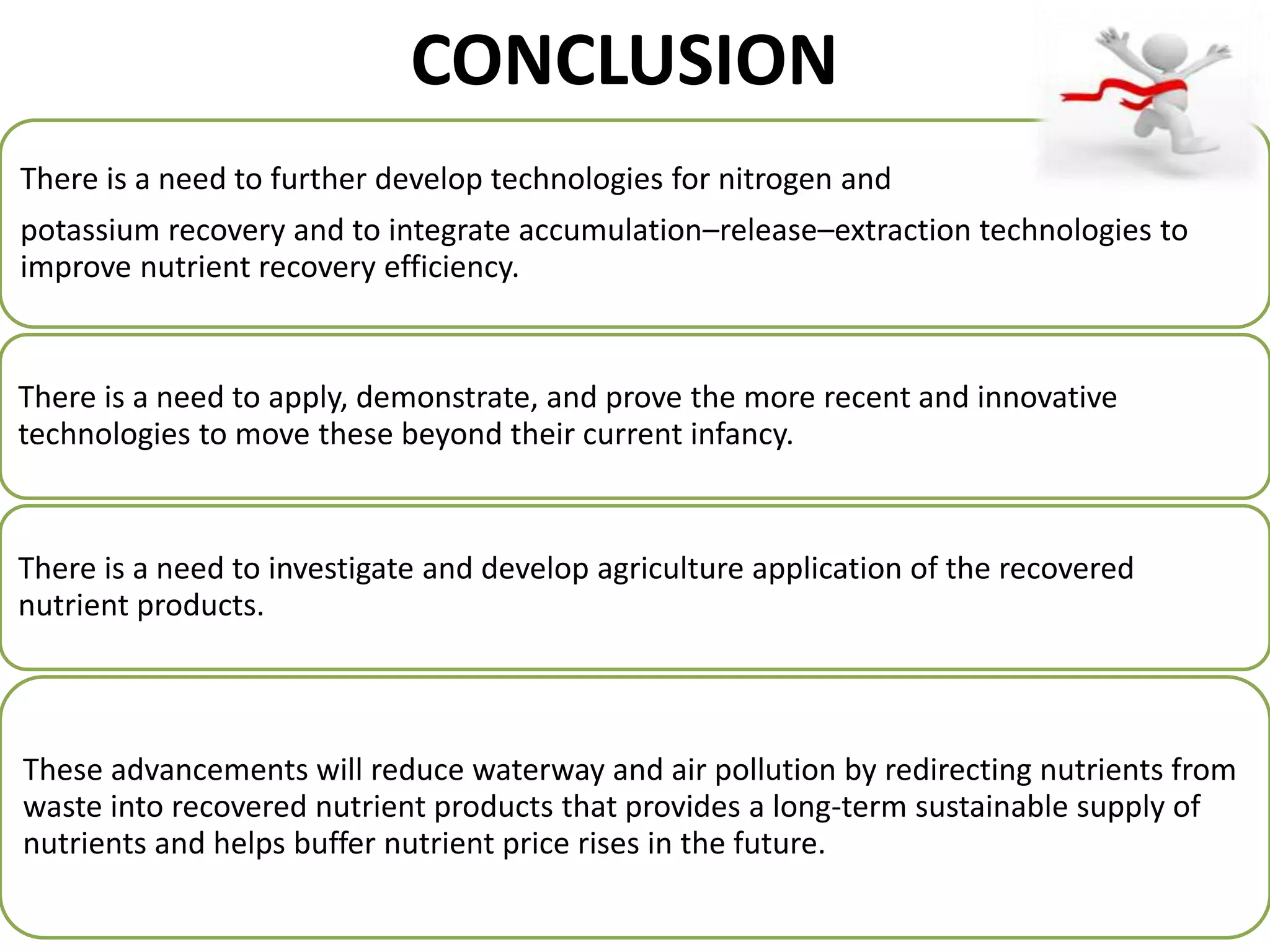
CONCLUSION
There is a need to further develop technologies for nitrogen and
potassium recovery and to integrate accumulation–release–extraction technologies to
improve nutrient recovery efficiency.
There is a need to apply, demonstrate, and prove the more recent and innovative
technologies to move these beyond their current infancy.
There is a need to investigate and develop agriculture application of the recovered
nutrient products.
These advancements will reduce waterway and air pollution by redirecting nutrients from
waste into recovered nutrient products that provides a long-term sustainable supply of
nutrients and helps buffer nutrient price rises in the future.
REFERENCES
Cai, Ting; Park,Stephen Y; Li, Yebo; Nutrient recovery from wastewater streams by microalgae:
status and prospects, Renewable and Sustainable Energy Reviews 19 (2013) 360–369
Cordell, D., Rosemarin, A., Schroder, J. J., and Smit, A. L. (2011). Towards global phosphorus
security: A systems framework for phosphorus recovery and reuse options. Chemosphere,
84, 747–758.
Mehta,C.M., Khunjar, W.O., Nguyen, Vivi., Tait, S., Batstone, D.J., Technologies to Recover
Nutrients from Waste Streams: A Critical Review, Critical Reviews in Environmental
Science and Technology, 45:385–427, 2015
Wisniewski,C. , Wastewater treatment plants : wastewater resource recovery facilities, Faculté
des Sciences Pharmaceutiques et Biologiques, Nov. 2015
Olufunke Cofie, René van Veenhuizen, Verele de Vreede, Stan Maessen, Waste Management for
Nutrient Recovery: Options and challenges for urban agriculture, Urban Agriculture
magazine ,number 23 ,April 2010
Martin Jr, J. H., Loehr, R. C., and Pilbeam, T. E. (1983). Animal manures as feedstuffs: Nutrient
characteristics. Agric. Wastes, 6(3), 131–166.
Mamo, M., Wortmann, C., and Brubaker, C. (2007). Manure phosphorus fractions: Development
of analytical methods and variation with manure types. Commun. Soil Sci. Plant Anal.,
38(7–8), 935–947.
NUTRIENT RECOVERY FROM WASTES

NUTRIENT RECOVERY FROM WASTES

  • 1.
    Aditya Kumar Baruah AAH-MA7-01 Biologicaland chemical methods for recovery of nutrients from liquid and solid wastes
  • 2.
    Introduction • Nitrogen (N),phosphorus (P), and potassium (K) are critical to intensive agriculture and there are concerns over long-term availability and cost of extraction of these nutrients • P and K are predominantly sourced from mineral deposits, and are nonrenewable and is becoming progressively limited with supply • N is a renewable resource, the process by which N (as ammonia) is industrially synthesized (Haber–Bosch process) is energetically intensive. • Currently there is very little scope for many developing countries to be self- sufficient with respect to supply of N, P & K by conventional fertilizers • Demand for food for increasing global population and to create energy from biomass will drive demand for nutrients from alternative sources upwards into the future.
  • 3.
    • The useof inorganic or synthetic nutrient fertilizers is ubiquitous in modern agriculture • Humans and animals consume nutrients from crops and produce nutrient-rich waste streams from processing food • It is estimated globally that the total P content in excreted human waste (urine and feces) can meet approximately 22% of the demand for P • Limited recycling and inefficient nutrient management, made these nutrients a major contributors to the environmental impact of domestic, agricultural, and industrial waste streams • Greenhouse gases, Methane and nitrous oxide, are generated in large amounts by manure management and excess use of N-based fertilizers & there is strong concern of excess nutrients in waterways causing eutrophication • Along with environmental impact, eutrophication can have major economic impacts by damaging valuable marine fisheries and impairing water bodies used for potable water supply and recreation
  • 4.
  • 5.
    NUTRIENT ACCUMULATION TECHNOLOGIES ProkaryoticAccumulation Chemical Accumulation via Precipitation Adsorption/Ion-Exchange Algae Accumulation Liquid–Liquid Extraction Plant Accumulation Membrane Filtration Magnetic Separation
  • 6.
    Prokaryotic Accumulation • Commonnutrient accumulating microbes are proteobacteria such as polyphosphate-accumulating organisms (PAOs) and purple non-sulfur bacteria and BGA. • 9 PAOs are currently extensively used for phosphorous removal and can accumulate as polyphosphate up to 20–30% of P by weight. • Bacterial-accumulation of P through enhanced biological phosphorus removal (EBPR) is used in sewage treatment plants to remove 80–90% of soluble P from the effluent. • The optimum aerobic P uptake occurs at pH 7–8 and wastewater should contain carbon to P ratios of 5 or higher to enhance accumulation of P. • Pre-fermentation of wastewater to produce volatile fatty acids (VFAs) is often beneficial and sometimes essential for EBPR.
  • 7.
    • Phosphate-rich sludgewith PAOs can be separated from the wastewater by settling, and nutrients can then be released and recovered. • Purple non-sulfur bacteria and cyanobacteria can grow with and without light, and consume water, carbon dioxide or oxidized substrate, and nutrients to produce organic matter and oxygen. • Purple non-sulfur bacteria can be used to treat many kinds of wastewater to produce highly nutrient-rich biomass when compared to activated sludge processes. • Blue–green algae are suitable for luxury uptake of N. The protein concentration reported for cyanobacteria is up to 80% of the dry weight, and consists of 8–12% N and 1% P. • Purple non-sulfur bacteria have a high tolerance to heavy metal exposure, but unfortunately accumulate heavy metals along with nutrients from the wastewater.
  • 8.
    Chemical Accumulation viaPrecipitation • Chemical accumulation of nutrients can be accomplished via coagulation and flocculation • Soluble nutrients and nutrients bound to colloids (0.01–1 µm) are precipitated as solids and separated by settling in clarifiers. • Aluminum- or iron-based coagulants are commonly used for accumulating of P from dilute wastewater • Calcium, natural, and synthetic organic polymers, and prehydrolyzed metal salts such as polyaluminum chloride and polyiron chloride are also used • Metal ions can also be delivered through sacrificial iron or aluminum anode electrodes through electro-coagulation. • The coagulants, when added to water, hydrolyze rapidly and form multicharged polynuclear complexes with enhanced adsorption characteristics • Once suspended particles have flocculated into larger particles (sludge) they can usually be removed from the treated water by sedimentation
  • 9.
    • Disadvantages associatedwith chemical accumulation by precipitation include – high operating costs, – increased salinity in the effluent (mainly as chloride or sulfate), – increased sludge production (up to 35 vol%), – the addition of heavy metals present in the raw coagulant, and – inhibitory effects on the biological process such as anaerobic digestion following the coagulation process. • Advantages are ease of operation, flexibility to changing conditions, and low capital cost to reduce effluent P concentration to less than 1 mg/L
  • 10.
    Adsorption/Ion-Exchange • During adsorptionand ion-exchange, ions are transferred from the solvent to charged surfaces of insoluble, rigid sorbents suspended in a vessel or packed in a column • The sorbents are made from porous materials containing interconnected cavities with a high internal surface area • Adsorption and ion-exchange can accumulate soluble N, P, or K from waste • Spent sorbents are regenerated using low-cost, high concentration aqueous solutions of cations or anions such as sodium, sulfate, or chloride • Adsorption and ion-exchange technology is suitable for waste streams with a range of nutrient concentrations (1–2000 mg/L), but relatively low solids concentrations (<2000 mg/L) • For low strength waste streams such as effluent from sewage treatment plants and artificial lakes where nutrient concentrations are less than 5 mg/L, advanced engineered polymeric sorbents are employed
  • 11.
    • For concentratedwaste streams (>2000 mg/L), typically, red mud, metal oxide/hydroxide, and zirconium sorbents are used for P recovery and modified zeolite and clinoptilolite for N and K recovery. • The potential advantages of this technology are the ability to achieve high P accumulation and low P concentrations in the treated effluent of < 0.1 PO4-P/L. • Advantages - no additional sludge (other than spent media) is produced and the pH of the waste streams remains unaffected. • Challenges- chemicals required for the regeneration of the sorbents, biofouling, large amounts of resin required for complete removal, limited resin life, and competitive foreign ion adsorption • Adsorption/ion-exchange can be categorized as a hybrid nutrient accumulation- nutrient recovery technique because the nutrient-laden sorbent/exchange media can potentially be directly applied as a nutrient product in agriculture.
  • 12.
    Algae Accumulation • Algaehave received significant attention worldwide as a valuable source of biomass for energy because of their high growth rates as compared to terrestrial plants • Reports have suggested that the nutrient content of algal dry biomass could reach up to 2% N and 3.3% P. • Algae-based systems can be- suspended or nonsuspended • In nonsuspended systems, the algae are immobilized on a resin • The surface immobilized algae reduce nutrient load in the waste streams via adsorption and/or precipitation on the surface of the material as well as through nutrient uptake by the biomass. • Nonsuspended systems have been successfully tested in high-nutrient agriculture streams such as dairy, poultry, and swine manure waste
  • 13.
    • Suspended algaeconfigurations are used in facultative and high rate algal ponds. • A tubular photo-bioreactor with suspended algae was found to be the most promising option for producing algal biomass in full-scale applications • As carbon dioxide (CO2) is consumed by algae during photosynthesis, the pH of the waste stream can increase which can encourage further minerals precipitation and volatilization of N as ammonia • Floating algal farming is an emerging nutrient removal/accumulation process from waste streams. • This approach may be most appropriate in coastal regions where nutrients are discharged directly to ocean from agriculture activities • The nutrient-rich algae can be processed with nutrient release techniques such as anaerobic digestion or thermochemical methods, or may be used directly as an animal feed or a fertilizer
  • 14.
  • 15.
    Liquid–Liquid Extraction • Liquid–liquidextraction is a method of separating compounds based on relative solubility in two immiscible liquids, and can be used to recover soluble nutrients • In this process, an extractant is dissolved in an organic phase. This organic phase with extractant is brought into contact with the waste which causes a transfer of nutrients into the organic phase until equilibrium is reached with the aqueous (wastewater) phase • The organic phase laden with nutrients is then brought into contact with another secondary aqueous phase at conditions where the nutrients are highly soluble in the secondary aqueous phase • A mixture of kerosene (organic phase) and benzyldimethylamine (extractant) in a 2:1 ratio worked best for phosphate extraction, and that combined use with 6.0 M sulfuric acid as the secondary aqueous phase provided a high P recovery of >93%
  • 16.
    Schematic representation ofa liquid–liquid extraction process.
  • 17.
    Plant Accumulation • Inthis system, nutrients accumulate as plants grow on the water surface, creating anaerobic conditions in the surrounding water • The anaerobic conditions drive digestion reactions where organic matter is metabolized to produce nutrients that can then be further accumulated by the plants • These plants, however, must be routinely harvested to ensure that the accumulated nutrients are not recycled. • Free-floating plants have a higher capacity for nutrient accumulation as they grow on the surface of the water and the roots are kept suspended in the water column to allow accumulation of the nutrients • Water hyacinths (Eichhornia crassipes), duckweeds (Lemna minor, Landoltia Punctata, and Spirodela polyrrhiza) can tolerate high-nutrient loads and have a high-nutrient removal capacity
  • 18.
    Membrane Filtration • Microfiltration(MF), ultrafiltration (UF), nanofiltration (NF), and reverse osmosis (RO) are all membrane processes which selectively separate constituents from waste. • Nutrients in particulate form >0.1 µm in size (suitable for MF or UF) or in soluble form (suitable for NF or RO) can be selectively removed • The membrane module configurations can be hollow fiber, flat sheet, tubular, or spiral wound. • The waste stream volumes can be reduced by 4–6 times (concentrate with nutrients is 25–16% of the original volume), while retaining all nutrients and may be suitable for irrigation or subsequent recovery processes • The retention of ammonium and nitrate by NF and RO membranes is >80% and it improves with reduction in pH • Disadvantages are mainly the high energy costs involved in membrane filtration as well as accumulation of unwanted contaminants and salts, which generally render concentrate unsuitable for direct reuse.
  • 19.
  • 20.
    Magnetic Separation In thisapproach, soluble nutrients are accumulated from the waste stream by employing adsorption to a carrier material that has magnetic properties. • The nutrients-laden carrier material can be recovered by capturing the magnetic particles with a magnetic field in high gradient magnetic separators (HGMS) • The magnetic carrier can be regenerated via chemical release techniques & this process can simultaneously recover soluble N, P, or K from waste streams using specific adsorbents The magnetic carriers commonly used are magnetite, zirconium ferrate, carbonyl iron, and iron oxide.
  • 21.
  • 22.
    NUTRIENT RELEASE TECHNOLOGIES BiologicalRelease Thermochemical Stabilization and Chemical Release Bioleaching/Extraction
  • 23.
    Biological Release • Anaerobicdigestion is the most commonly used process for stabilization of wastes, organic solids destruction, pathogen destruction, and energy recovery from wastes in the form of biomethane. • The digestion process facilitates the release of nutrients from the biodegradable fraction of the waste. Organic N is converted into ammonium and organic P is hydrolyzed to soluble P. • The optimum operating temperature for anaerobic digestion is 35–40°C for mesophilic bacteria and 55–60°C for thermophilic bacteria. The optimum pH is in the range of 6.5–7.5. • Released nutrients are soluble and tend to form inorganic compounds or adsorb onto solid surfaces in the digestate. • The soluble P content in most municipally digested wastes range from 50 to 500 mg /L and N is often five times higher than soluble P.
  • 24.
    Thermo-chemical Stabilization andChemical Release • Thermochemical processes like thermal hydrolysis, wet oxidation, incineration, gasification, and pyrolysis can greatly reduce the bulk volume of wastes by destroying a large proportion of the carbon. • The char/ash/oil that is produced from the thermochemical processes retains most P and K, but N is lost in the gas stream. • Wet oxidation is carried out at moderate temperatures (180–315°C), and at high pressures of 2–15 MPa. Metals are oxidized to their highest valency and P to P2O5. • Incineration and gasification occurs in the presence of excess oxygen above 800 °C, while pyrolysis operates under a limited supply of oxygen and at relatively low temperatures . • The solid by-products (ash/char) from thermochemical treatment can be further processed thermally in the presence of chloride salts, which convert heavy metals into heavy metal chlorides to be vaporized and removed from the char/ash.
  • 25.
    • Chemical extractioninvolves the addition of acids or bases to char, digester reject, solid waste, or waste streams, at moderate temperatures and/or pressures to release nutrients into a leachate • The chemical extractants typically used are inorganic acids (H2SO4, HCl, HNO3), organic acids (citric and oxalic acids), inorganic chemicals (e.g., ferric chloride solution), and chelating agents (e.g., EDTA) • The Seaborne, Sesal-Phos, Biocon, Sephos, Pasch, Stuttgarter Verfahren, and Loprox/Phoxnan processes dissolve nutrients and heavy metals using acids at a pH below 3, while the Kreprco and Aquareci processes are operated at high temperatures (>100 ◦C) and pressures (>5 bar) for nutrient dissolution. • The dissolved ions (nutrients and heavy metals) are subsequently separated by crystallization (Seaborne, Stuttgarter Verfahren, Sephos, Sesal-Phos, and Krepco), membranes (Loprox/Phoxnan), solvent extraction (Pasch), or ion- exchange (Biocon)
  • 26.
    Bioleaching/Extraction • Bioleaching isa release technology that relies on the solubilization of nutrients and heavy metals from solid substrates either directly by the metabolism of leaching microorganisms or indirectly by the products of metabolism • Microorganisms with potential for bioleaching activity include mesophiles such as Acidithiobacillus thiooxidans and Acidithiobacillus ferrooxidans; thermophiles such as Sulfobacillus thermosulfidoxidans; and heterotrophic microbes such as Acetobacter, Acidophilum, Fusarium, Penicillium, and Aspergillus • These organisms survive acidic environments and carry out oxidation of insoluble iron and sulfur compounds, causing the low pH and the release/solubilizing of previously complexed nutrients and heavy metals. • For bioleaching of nutrients from sewage sludge, phosphate rock, and ash, different energy sources such as FeSO4, FeS2, and elemental sulfur have been provided to a mesophilic mixture containing At. ferrooxidans and At. thiooxidans strains
  • 27.
    NUTRIENT EXTRACTION ANDRECOVERY TECHNOLOGIES Chemical Precipitation/Crystallization Gas-Permeable Membrane and Absorption Liquid–Gas Stripping Electrodialysis (ED)
  • 28.
    Chemical Precipitation/Crystallization • Chemicalprecipitation via crystallization is a phase change process that converts previously dissolved components into a particulate, inorganic compound, for separation from the liquid bulk. • Supersaturated conditions are created in the waste streams through a change in temperature, pH, and/or by the addition of metal ions. • Struvite (MgNH4PO4·6H2O) crystallization is a well-known example of this technique being applied to simultaneously recover N and P from nutrient-rich water. • Chemical precipitation can remove 80–90% of soluble phosphates and 20–30% of soluble ammonia from the waste streams. • Since struvite has a specific gravity of 1.7, the crystals can be readily separated from the liquid bulk by gravity settling, by mechanical separation (filter press) or by the use of an integrated crystallization and separation process. • Alternative products like calcium phosphate, magnesium potassium phosphate, or iron phosphate can be produced in a similar manner.
  • 30.
    Gas-Permeable Membrane andAbsorption • Gas-permeable membranes can be used to recover N as ammonia from the liquid phase • In this process, ammonia is transferred by convection and diffusion from the liquid stream across a membrane. Ammonia volatilizes through a hydrophobic membrane and is either condensed or absorbed into an acidic solution • Following ammonia recovery via membrane concentration, acids such as sulfuric acid are used to recover ammonium as ammonium sulfate • The membranes in this process are typically hydrophobic and may be comprised of silica, ceramic, polyvinylidene fluoride (PVDF), polypropylene (PP), polytetrafluorethylene (PTFE), or polymer composites • Membranes can be constructed in different configurations including hollow fiber, tubular flat sheet, and spiral wound cylinders and can be used in submerged or external configurations.
  • 31.
  • 32.
    Liquid–Gas Stripping • Gasstripping is a physiochemical process that involves the mass transfer of ammonia from the liquid phase to the gas phase. • This transfer is accomplished by contacting the dissolved ammonia with an extractant gas (usually air) and is mainly applicable to situations where the effluent has a relatively high ammonia concentration. • As with gas-permeable separation, air stripping usually requires an elevated temperature (>80 ◦C) and pH (>9.5) to increase the proportion of free ammonia in the treated waste streams and in this way decrease the amount of air required. • Recovery of the stripped ammonia occurs via condensation, absorption, or oxidation to produce a concentrated fertilizer product. • The main challenges to implementing this technology are the relatively high operating cost per unit volume.
  • 33.
    Electrodialysis (ED) • EDis an extraction technology which selectively separates anions and cations across an ion-exchange membrane, driven by an applied electrical field between electrodes. • Cationic species (K+ and NH4 +) move toward the cathode passing through cation-exchange membranes (CEM) which allow only positively charged species. • Anions (e.g., PO4 3−) move toward the anode passing through anion exchange membranes (AEM) which allow only negatively charged species. • ED cells can contain up to several pairs of AEMs and CEMs arranged alternately between the electrodes. • ED has the potential to recover all nutrients but is most applicable for N and K, as P can be effectively removed using other lower cost methods. • ED is also considered to be appropriate for recovering ions from nutrient streams at low nutrient concentrations (below 2000 mg L−1 ) and in fact low nutrient concentrations are preferred due to a lower potential for membrane fouling or scale formation.
  • 34.
    CONCLUSION There is aneed to further develop technologies for nitrogen and potassium recovery and to integrate accumulation–release–extraction technologies to improve nutrient recovery efficiency. There is a need to apply, demonstrate, and prove the more recent and innovative technologies to move these beyond their current infancy. There is a need to investigate and develop agriculture application of the recovered nutrient products. These advancements will reduce waterway and air pollution by redirecting nutrients from waste into recovered nutrient products that provides a long-term sustainable supply of nutrients and helps buffer nutrient price rises in the future.
  • 35.
    REFERENCES Cai, Ting; Park,StephenY; Li, Yebo; Nutrient recovery from wastewater streams by microalgae: status and prospects, Renewable and Sustainable Energy Reviews 19 (2013) 360–369 Cordell, D., Rosemarin, A., Schroder, J. J., and Smit, A. L. (2011). Towards global phosphorus security: A systems framework for phosphorus recovery and reuse options. Chemosphere, 84, 747–758. Mehta,C.M., Khunjar, W.O., Nguyen, Vivi., Tait, S., Batstone, D.J., Technologies to Recover Nutrients from Waste Streams: A Critical Review, Critical Reviews in Environmental Science and Technology, 45:385–427, 2015 Wisniewski,C. , Wastewater treatment plants : wastewater resource recovery facilities, Faculté des Sciences Pharmaceutiques et Biologiques, Nov. 2015 Olufunke Cofie, René van Veenhuizen, Verele de Vreede, Stan Maessen, Waste Management for Nutrient Recovery: Options and challenges for urban agriculture, Urban Agriculture magazine ,number 23 ,April 2010 Martin Jr, J. H., Loehr, R. C., and Pilbeam, T. E. (1983). Animal manures as feedstuffs: Nutrient characteristics. Agric. Wastes, 6(3), 131–166. Mamo, M., Wortmann, C., and Brubaker, C. (2007). Manure phosphorus fractions: Development of analytical methods and variation with manure types. Commun. Soil Sci. Plant Anal., 38(7–8), 935–947.