Nursing standards

Mrs K Rath,
Asst. Professor,
KINS


Standard is a quantitative or qualitative
measure against which someone or
something is judged, compared or used to
service as an example.
 Standards

are professionally developed
expressions of the range of acceptable
variations from a norm of criterion(Avedis Donabedian)


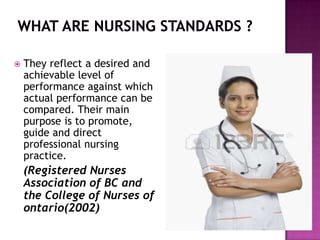
They reflect a desired and
achievable level of
performance against which
actual performance can be
compared. Their main
purpose is to promote,
guide and direct
professional nursing
practice.

(Registered Nurses
Association of BC and
the College of Nurses of
ontario(2002)
 Outline

what the profession expects of its
members.
 Promotes, guides and directs professional
nursing practice
 Provides nurses with a framework for
developing competencies.
 Aids in developing a better understanding and
respect for the various nursing role.
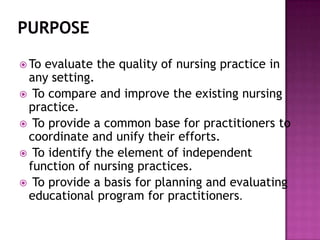
 To

evaluate the quality of nursing practice in
any setting.
 To compare and improve the existing nursing
practice.
 To provide a common base for practitioners to
coordinate and unify their efforts.
 To identify the element of independent
function of nursing practices.
 To provide a basis for planning and evaluating
educational program for practitioners.
 To

inform society of our concern for the
improvement of nursing practice.
 To assist employers to understand what to
expect of Practitioners.
 To identify areas for developing core
curriculum for practicing nurses.
 To provide legal protection for nurses.
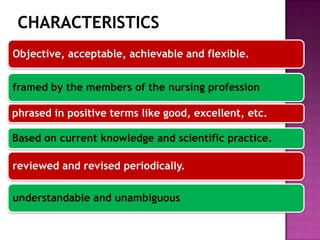
Objective, acceptable, achievable and flexible.

framed by the members of the nursing profession
phrased in positive terms like good, excellent, etc.
Based on current knowledge and scientific practice.
reviewed and revised periodically.
understandable and unambiguous
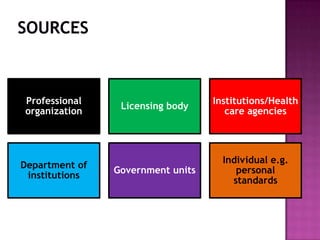
Professional
organization

Department of
institutions

Licensing body

Institutions/Health
care agencies

Government units

Individual e.g.
personal
standards
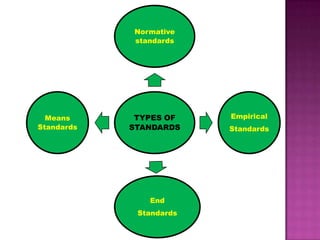
Normative
standards

Means
Standards

TYPES OF
STANDARDS

End
Standards

Empirical

Standards
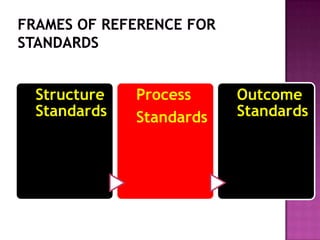
Structure
Standards

Process
Standards

Outcome
Standards
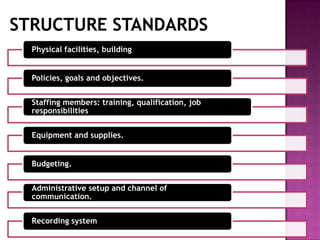
Physical facilities, building
Policies, goals and objectives.
Staffing members: training, qualification, job
responsibilities
Equipment and supplies.
Budgeting.
Administrative setup and channel of
communication.
Recording system
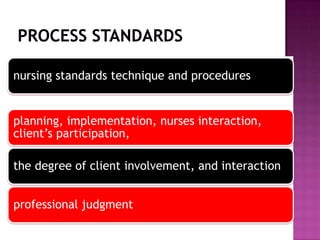
nursing standards technique and procedures

planning, implementation, nurses interaction,
client’s participation,
the degree of client involvement, and interaction
professional judgment
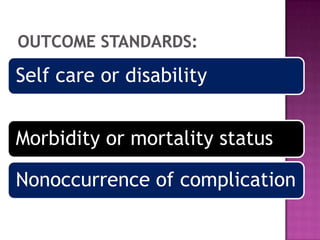
Self care or disability
Morbidity or mortality status

Nonoccurrence of complication
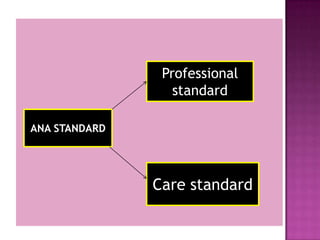
Professional
standard
ANA STANDARD

Care standard


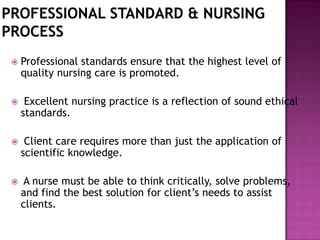
Professional standards ensure that the highest level of
quality nursing care is promoted.



Excellent nursing practice is a reflection of sound ethical
standards.



Client care requires more than just the application of
scientific knowledge.



A nurse must be able to think critically, solve problems,
and find the best solution for client’s needs to assist
clients.
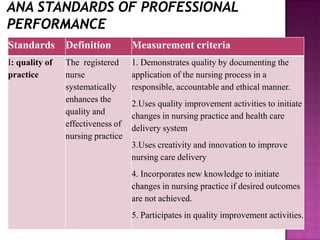
Standards Definition

Measurement criteria

I: quality of
practice

1. Demonstrates quality by documenting the
application of the nursing process in a
responsible, accountable and ethical manner.

The registered
nurse
systematically
enhances the
quality and
effectiveness of
nursing practice

2.Uses quality improvement activities to initiate
changes in nursing practice and health care
delivery system
3.Uses creativity and innovation to improve
nursing care delivery
4. Incorporates new knowledge to initiate
changes in nursing practice if desired outcomes
are not achieved.
5. Participates in quality improvement activities.
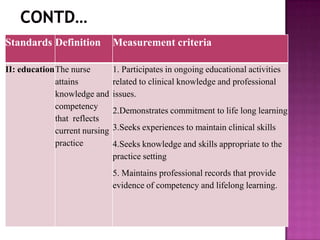
Standards Definition

Measurement criteria

II: educationThe nurse
attains
knowledge and
competency
that reflects
current nursing
practice

1. Participates in ongoing educational activities
related to clinical knowledge and professional
issues.
2.Demonstrates commitment to life long learning
3.Seeks experiences to maintain clinical skills
4.Seeks knowledge and skills appropriate to the
practice setting
5. Maintains professional records that provide
evidence of competency and lifelong learning.
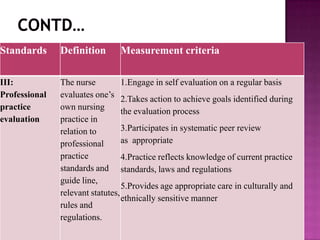
Standards

Definition

Measurement criteria

III:
Professional
practice
evaluation

The nurse
1.Engage in self evaluation on a regular basis
evaluates one’s 2.Takes action to achieve goals identified during
own nursing
the evaluation process
practice in
3.Participates in systematic peer review
relation to
as appropriate
professional
practice
4.Practice reflects knowledge of current practice
standards and standards, laws and regulations
guide line,
5.Provides age appropriate care in culturally and
relevant statutes,
ethnically sensitive manner
rules and
regulations.
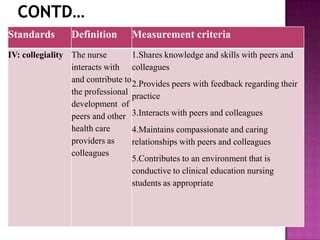
Standards

Definition

Measurement criteria

IV: collegiality The nurse
1.Shares knowledge and skills with peers and
interacts with colleagues
and contribute to 2.Provides peers with feedback regarding their
the professional practice
development of
peers and other 3.Interacts with peers and colleagues
health care
4.Maintains compassionate and caring
providers as
relationships with peers and colleagues
colleagues
5.Contributes to an environment that is
conductive to clinical education nursing
students as appropriate
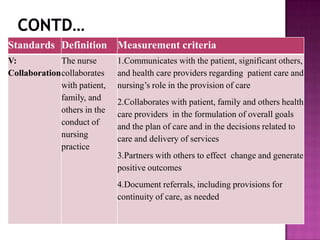
Standards Definition Measurement criteria
V:
The nurse
Collaboration collaborates
with patient,
family, and
others in the
conduct of
nursing
practice

1.Communicates with the patient, significant others,
and health care providers regarding patient care and
nursing’s role in the provision of care
2.Collaborates with patient, family and others health
care providers in the formulation of overall goals
and the plan of care and in the decisions related to
care and delivery of services
3.Partners with others to effect change and generate
positive outcomes

4.Document referrals, including provisions for
continuity of care, as needed
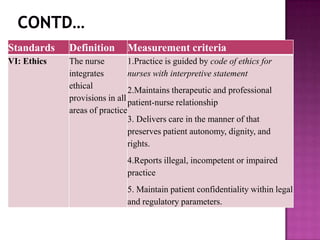
Standards

Definition

Measurement criteria

VI: Ethics

The nurse
1.Practice is guided by code of ethics for
integrates
nurses with interpretive statement
ethical
2.Maintains therapeutic and professional
provisions in all patient-nurse relationship
areas of practice
3. Delivers care in the manner of that
preserves patient autonomy, dignity, and
rights.
4.Reports illegal, incompetent or impaired
practice

5. Maintain patient confidentiality within legal
and regulatory parameters.
Standards

Definition

Measurement criteria

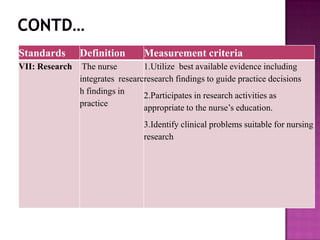
VII: Research

The nurse
1.Utilize best available evidence including
integrates researcresearch findings to guide practice decisions
h findings in
2.Participates in research activities as
practice
appropriate to the nurse’s education.
3.Identify clinical problems suitable for nursing
research
Standards

Definition

Measurement criteria

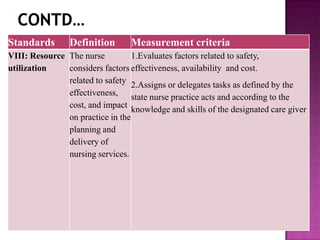
VIII: Resource The nurse
1.Evaluates factors related to safety,
utilization
considers factors effectiveness, availability and cost.
related to safety 2.Assigns or delegates tasks as defined by the
effectiveness, state nurse practice acts and according to the
cost, and impact knowledge and skills of the designated care giver
on practice in the
planning and
delivery of
nursing services.
Standards

Definition

Measurement criteria

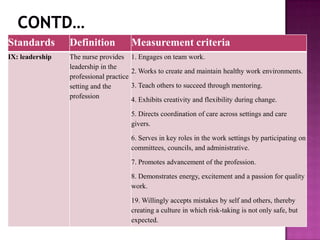
IX: leadership

The nurse provides
leadership in the
professional practice
setting and the
profession

1. Engages on team work.
2. Works to create and maintain healthy work environments.
3. Teach others to succeed through mentoring.
4. Exhibits creativity and flexibility during change.
5. Directs coordination of care across settings and care
givers.
6. Serves in key roles in the work settings by participating on
committees, councils, and administrative.
7. Promotes advancement of the profession.
8. Demonstrates energy, excitement and a passion for quality
work.
19. Willingly accepts mistakes by self and others, thereby
creating a culture in which risk-taking is not only safe, but
expected.


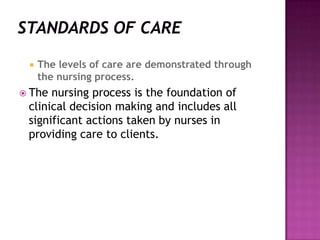
The levels of care are demonstrated through
the nursing process.

 The

nursing process is the foundation of
clinical decision making and includes all
significant actions taken by nurses in
providing care to clients.
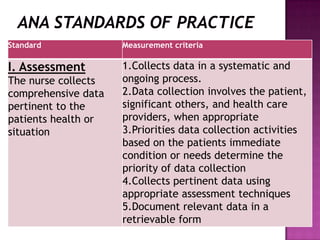
Standard

Measurement criteria

I. Assessment

1.Collects data in a systematic and
ongoing process.
2.Data collection involves the patient,
significant others, and health care
providers, when appropriate
3.Priorities data collection activities
based on the patients immediate
condition or needs determine the
priority of data collection
4.Collects pertinent data using
appropriate assessment techniques
5.Document relevant data in a
retrievable form

The nurse collects
comprehensive data
pertinent to the
patients health or
situation
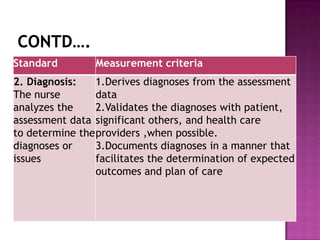
Standard

Measurement criteria

2. Diagnosis:
1.Derives diagnoses from the assessment
The nurse
data
analyzes the
2.Validates the diagnoses with patient,
assessment data significant others, and health care
to determine the providers ,when possible.
diagnoses or
3.Documents diagnoses in a manner that
issues
facilitates the determination of expected
outcomes and plan of care
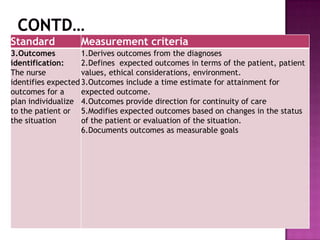
Standard

Measurement criteria

3.Outcomes
1.Derives outcomes from the diagnoses
identification:
2.Defines expected outcomes in terms of the patient, patient
The nurse
values, ethical considerations, environment.
identifies expected 3.Outcomes include a time estimate for attainment for
outcomes for a
expected outcome.
plan individualize 4.Outcomes provide direction for continuity of care
to the patient or 5.Modifies expected outcomes based on changes in the status
the situation
of the patient or evaluation of the situation.
6.Documents outcomes as measurable goals
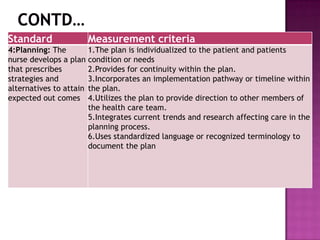
Standard

Measurement criteria

4:Planning: The
1.The plan is individualized to the patient and patients
nurse develops a plan condition or needs
that prescribes
2.Provides for continuity within the plan.
strategies and
3.Incorporates an implementation pathway or timeline within
alternatives to attain the plan.
expected out comes 4.Utilizes the plan to provide direction to other members of
the health care team.
5.Integrates current trends and research affecting care in the
planning process.
6.Uses standardized language or recognized terminology to
document the plan
Standard

Measurement criteria

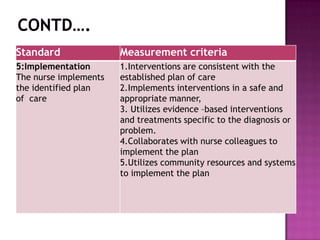
5:Implementation
The nurse implements
the identified plan
of care

1.Interventions are consistent with the
established plan of care
2.Implements interventions in a safe and
appropriate manner,
3. Utilizes evidence –based interventions
and treatments specific to the diagnosis or
problem.
4.Collaborates with nurse colleagues to
implement the plan
5.Utilizes community resources and systems
to implement the plan
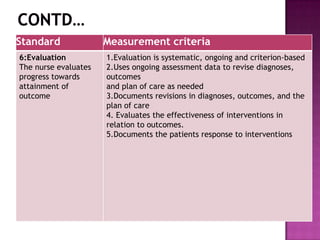
Standard
6:Evaluation
The nurse evaluates
progress towards
attainment of
outcome

Measurement criteria
1.Evaluation is systematic, ongoing and criterion-based
2.Uses ongoing assessment data to revise diagnoses,
outcomes
and plan of care as needed
3.Documents revisions in diagnoses, outcomes, and the
plan of care
4. Evaluates the effectiveness of interventions in
relation to outcomes.
5.Documents the patients response to interventions
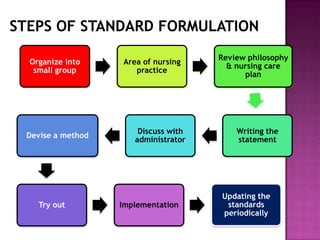
Organize into
small group

Devise a method

Try out

Area of nursing
practice

Discuss with
administrator

Implementation

Review philosophy
& nursing care
plan

Writing the
statement

Updating the
standards
periodically
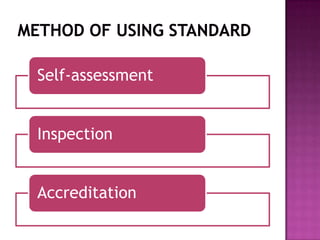
Self-assessment
Inspection

Accreditation
Nursing standards1
Nursing standards1

Nursing standards1

  • 1.
    Nursing standards Mrs KRath, Asst. Professor, KINS
  • 2.
     Standard is aquantitative or qualitative measure against which someone or something is judged, compared or used to service as an example.
  • 3.
     Standards are professionallydeveloped expressions of the range of acceptable variations from a norm of criterion(Avedis Donabedian)
  • 4.
     They reflect adesired and achievable level of performance against which actual performance can be compared. Their main purpose is to promote, guide and direct professional nursing practice. (Registered Nurses Association of BC and the College of Nurses of ontario(2002)
  • 5.
     Outline what theprofession expects of its members.  Promotes, guides and directs professional nursing practice  Provides nurses with a framework for developing competencies.  Aids in developing a better understanding and respect for the various nursing role.
  • 6.
     To evaluate thequality of nursing practice in any setting.  To compare and improve the existing nursing practice.  To provide a common base for practitioners to coordinate and unify their efforts.  To identify the element of independent function of nursing practices.  To provide a basis for planning and evaluating educational program for practitioners.
  • 7.
     To inform societyof our concern for the improvement of nursing practice.  To assist employers to understand what to expect of Practitioners.  To identify areas for developing core curriculum for practicing nurses.  To provide legal protection for nurses.
  • 8.
    Objective, acceptable, achievableand flexible. framed by the members of the nursing profession phrased in positive terms like good, excellent, etc. Based on current knowledge and scientific practice. reviewed and revised periodically. understandable and unambiguous
  • 9.
  • 10.
  • 11.
  • 12.
    Physical facilities, building Policies,goals and objectives. Staffing members: training, qualification, job responsibilities Equipment and supplies. Budgeting. Administrative setup and channel of communication. Recording system
  • 13.
    nursing standards techniqueand procedures planning, implementation, nurses interaction, client’s participation, the degree of client involvement, and interaction professional judgment
  • 14.
    Self care ordisability Morbidity or mortality status Nonoccurrence of complication
  • 15.
  • 16.
     Professional standards ensurethat the highest level of quality nursing care is promoted.  Excellent nursing practice is a reflection of sound ethical standards.  Client care requires more than just the application of scientific knowledge.  A nurse must be able to think critically, solve problems, and find the best solution for client’s needs to assist clients.
  • 17.
    Standards Definition Measurement criteria I:quality of practice 1. Demonstrates quality by documenting the application of the nursing process in a responsible, accountable and ethical manner. The registered nurse systematically enhances the quality and effectiveness of nursing practice 2.Uses quality improvement activities to initiate changes in nursing practice and health care delivery system 3.Uses creativity and innovation to improve nursing care delivery 4. Incorporates new knowledge to initiate changes in nursing practice if desired outcomes are not achieved. 5. Participates in quality improvement activities.
  • 18.
    Standards Definition Measurement criteria II:educationThe nurse attains knowledge and competency that reflects current nursing practice 1. Participates in ongoing educational activities related to clinical knowledge and professional issues. 2.Demonstrates commitment to life long learning 3.Seeks experiences to maintain clinical skills 4.Seeks knowledge and skills appropriate to the practice setting 5. Maintains professional records that provide evidence of competency and lifelong learning.
  • 19.
    Standards Definition Measurement criteria III: Professional practice evaluation The nurse 1.Engagein self evaluation on a regular basis evaluates one’s 2.Takes action to achieve goals identified during own nursing the evaluation process practice in 3.Participates in systematic peer review relation to as appropriate professional practice 4.Practice reflects knowledge of current practice standards and standards, laws and regulations guide line, 5.Provides age appropriate care in culturally and relevant statutes, ethnically sensitive manner rules and regulations.
  • 20.
    Standards Definition Measurement criteria IV: collegialityThe nurse 1.Shares knowledge and skills with peers and interacts with colleagues and contribute to 2.Provides peers with feedback regarding their the professional practice development of peers and other 3.Interacts with peers and colleagues health care 4.Maintains compassionate and caring providers as relationships with peers and colleagues colleagues 5.Contributes to an environment that is conductive to clinical education nursing students as appropriate
  • 21.
    Standards Definition Measurementcriteria V: The nurse Collaboration collaborates with patient, family, and others in the conduct of nursing practice 1.Communicates with the patient, significant others, and health care providers regarding patient care and nursing’s role in the provision of care 2.Collaborates with patient, family and others health care providers in the formulation of overall goals and the plan of care and in the decisions related to care and delivery of services 3.Partners with others to effect change and generate positive outcomes 4.Document referrals, including provisions for continuity of care, as needed
  • 22.
    Standards Definition Measurement criteria VI: Ethics Thenurse 1.Practice is guided by code of ethics for integrates nurses with interpretive statement ethical 2.Maintains therapeutic and professional provisions in all patient-nurse relationship areas of practice 3. Delivers care in the manner of that preserves patient autonomy, dignity, and rights. 4.Reports illegal, incompetent or impaired practice 5. Maintain patient confidentiality within legal and regulatory parameters.
  • 23.
    Standards Definition Measurement criteria VII: Research Thenurse 1.Utilize best available evidence including integrates researcresearch findings to guide practice decisions h findings in 2.Participates in research activities as practice appropriate to the nurse’s education. 3.Identify clinical problems suitable for nursing research
  • 24.
    Standards Definition Measurement criteria VIII: ResourceThe nurse 1.Evaluates factors related to safety, utilization considers factors effectiveness, availability and cost. related to safety 2.Assigns or delegates tasks as defined by the effectiveness, state nurse practice acts and according to the cost, and impact knowledge and skills of the designated care giver on practice in the planning and delivery of nursing services.
  • 25.
    Standards Definition Measurement criteria IX: leadership Thenurse provides leadership in the professional practice setting and the profession 1. Engages on team work. 2. Works to create and maintain healthy work environments. 3. Teach others to succeed through mentoring. 4. Exhibits creativity and flexibility during change. 5. Directs coordination of care across settings and care givers. 6. Serves in key roles in the work settings by participating on committees, councils, and administrative. 7. Promotes advancement of the profession. 8. Demonstrates energy, excitement and a passion for quality work. 19. Willingly accepts mistakes by self and others, thereby creating a culture in which risk-taking is not only safe, but expected.
  • 26.
     The levels ofcare are demonstrated through the nursing process.  The nursing process is the foundation of clinical decision making and includes all significant actions taken by nurses in providing care to clients.
  • 27.
    Standard Measurement criteria I. Assessment 1.Collectsdata in a systematic and ongoing process. 2.Data collection involves the patient, significant others, and health care providers, when appropriate 3.Priorities data collection activities based on the patients immediate condition or needs determine the priority of data collection 4.Collects pertinent data using appropriate assessment techniques 5.Document relevant data in a retrievable form The nurse collects comprehensive data pertinent to the patients health or situation
  • 28.
    Standard Measurement criteria 2. Diagnosis: 1.Derivesdiagnoses from the assessment The nurse data analyzes the 2.Validates the diagnoses with patient, assessment data significant others, and health care to determine the providers ,when possible. diagnoses or 3.Documents diagnoses in a manner that issues facilitates the determination of expected outcomes and plan of care
  • 29.
    Standard Measurement criteria 3.Outcomes 1.Derives outcomesfrom the diagnoses identification: 2.Defines expected outcomes in terms of the patient, patient The nurse values, ethical considerations, environment. identifies expected 3.Outcomes include a time estimate for attainment for outcomes for a expected outcome. plan individualize 4.Outcomes provide direction for continuity of care to the patient or 5.Modifies expected outcomes based on changes in the status the situation of the patient or evaluation of the situation. 6.Documents outcomes as measurable goals
  • 30.
    Standard Measurement criteria 4:Planning: The 1.Theplan is individualized to the patient and patients nurse develops a plan condition or needs that prescribes 2.Provides for continuity within the plan. strategies and 3.Incorporates an implementation pathway or timeline within alternatives to attain the plan. expected out comes 4.Utilizes the plan to provide direction to other members of the health care team. 5.Integrates current trends and research affecting care in the planning process. 6.Uses standardized language or recognized terminology to document the plan
  • 31.
    Standard Measurement criteria 5:Implementation The nurseimplements the identified plan of care 1.Interventions are consistent with the established plan of care 2.Implements interventions in a safe and appropriate manner, 3. Utilizes evidence –based interventions and treatments specific to the diagnosis or problem. 4.Collaborates with nurse colleagues to implement the plan 5.Utilizes community resources and systems to implement the plan
  • 32.
    Standard 6:Evaluation The nurse evaluates progresstowards attainment of outcome Measurement criteria 1.Evaluation is systematic, ongoing and criterion-based 2.Uses ongoing assessment data to revise diagnoses, outcomes and plan of care as needed 3.Documents revisions in diagnoses, outcomes, and the plan of care 4. Evaluates the effectiveness of interventions in relation to outcomes. 5.Documents the patients response to interventions
  • 33.
    Organize into small group Devisea method Try out Area of nursing practice Discuss with administrator Implementation Review philosophy & nursing care plan Writing the statement Updating the standards periodically
  • 34.