Introduction to  Database Design July 2005 Ken Nunes knunes @ sdsc.edu
Database Design Agenda General Design Considerations Entity-Relationship Model Tutorial Normalization Star Schemas Additional Information Q&A
General Design Considerations Users Legacy Systems/Data Application Requirements
Users Who are they? Administrative Scientific Technical Impact Access Controls Interfaces Service levels
Legacy Systems/Data What systems are currently in  place? Where does the data come  from? How is it generated? What format is it in? What is the data used for? Which parts of the system must remain static?
Application Requirements What kind of database? OnLine Analytical Processing (OLAP) OnLine Transactional Processing (OLTP) Budget Platform / Vendor Workflow? order of operations error handling reporting
Entity - Relationship Model A logical design method which emphasizes simplicity and readability. Basic objects of the model are: Entities Relationships Attributes
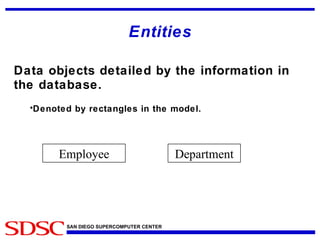
Entities Data objects detailed by the information in the database. Denoted by rectangles in the model. Employee Department
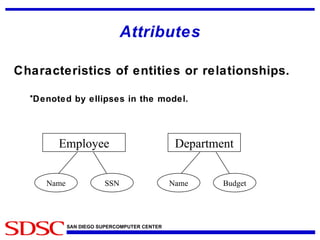
Attributes Characteristics of entities or relationships. Denoted by ellipses in the model.   Name SSN Employee Department Name Budget
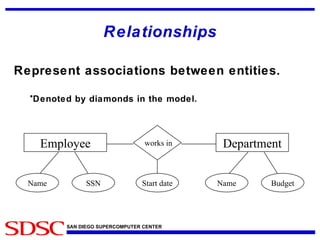
Relationships Represent associations between entities. Denoted by diamonds in the model.   Name SSN Employee Department Name Budget works in Start date
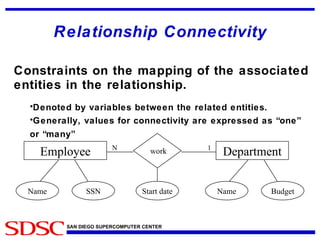
Relationship Connectivity Constraints on the mapping of the associated entities in the relationship. Denoted by variables between the related entities. Generally, values for connectivity are expressed as “one” or “many”   Name SSN Employee Department Name Budget work 1 N Start date
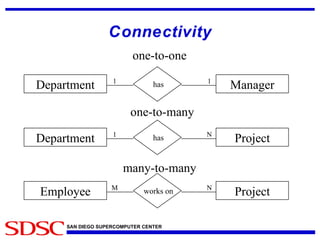
Connectivity Department Manager has 1 1 Department Project has N 1 Employee Project works on N M one-to-one one-to-many many-to-many
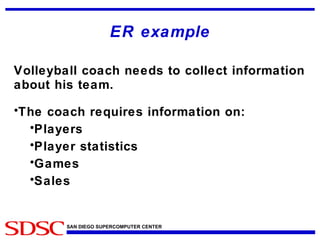
ER example Volleyball coach needs to collect information about his team. The coach requires information on: Players Player statistics Games Sales
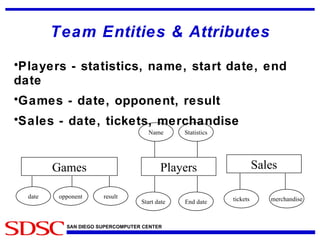
Team Entities & Attributes Players - statistics, name, start date, end date Games - date, opponent, result Sales - date, tickets, merchandise Players Sales Start date End date Statistics Name tickets merchandise Games opponent date result
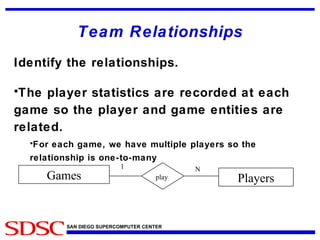
Team Relationships Identify the relationships. The player statistics are recorded at each game so the player and game entities are related. For each game, we have multiple players so the relationship is one-to-many Players Games N 1 play
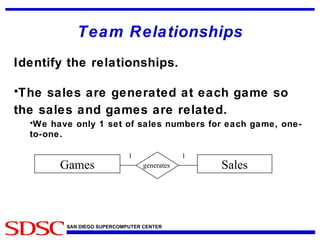
Team Relationships Identify the relationships. The sales are generated at each game so the sales and games are related. We have only 1 set of sales numbers for each game, one-to-one. Games Sales generates  1 1
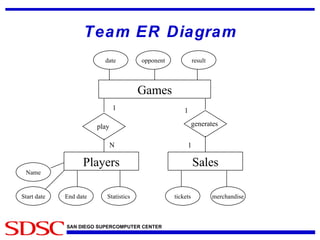
Team ER Diagram Players Games Sales play  generates  N 1 1 1 Start date End date Statistics Name tickets merchandise opponent date result
Logical Design to Physical Design Creating relational SQL schemas from entity-relationship models. Transform each entity into a table with the key and its attributes. Transform each relationship as either a relationship table  (many-to-many) or a “foreign key” (one-to-many and many-to-many).
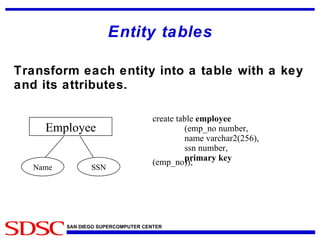
Entity tables Transform each entity into a table with a key and its attributes. Name SSN Employee create table  employee (emp_no number, name varchar2(256), ssn number, primary key  (emp_no));
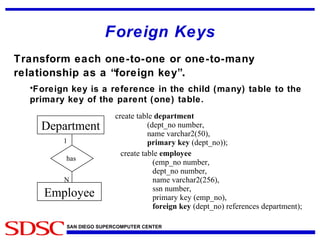
Foreign Keys Transform each one-to-one or one-to-many relationship as a “foreign key” . Foreign key is a reference in the child (many) table to the primary key of the parent (one) table. create table  employee (emp_no number, dept_no number, name varchar2(256), ssn number, primary key (emp_no), foreign key  (dept_no) references department); Employee Department has  1 N create table  department (dept_no number, name varchar2(50), primary key  (dept_no));
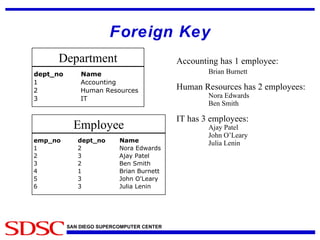
Foreign Key Department Employee Accounting has 1 employee: Brian Burnett Human Resources has 2 employees: Nora Edwards Ben Smith IT has 3 employees: Ajay Patel John O’Leary Julia Lenin
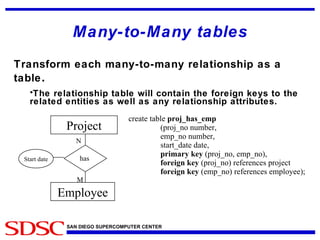
Many-to-Many tables Transform each many-to-many relationship as a table . The relationship table will contain the foreign keys to the related entities as well as any relationship attributes. create table  proj_has_emp (proj_no number, emp_no number, start_date date, primary key  (proj_no, emp_no), foreign key  (proj_no) references project foreign key  (emp_no) references employee); Employee Project has  N M Start date
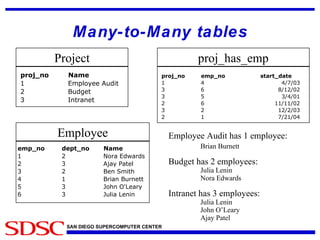
Many-to-Many tables Project Employee proj_has_emp Employee Audit has 1 employee: Brian Burnett Budget has 2 employees: Julia Lenin Nora Edwards Intranet has 3 employees: Julia Lenin John O’Leary Ajay Patel
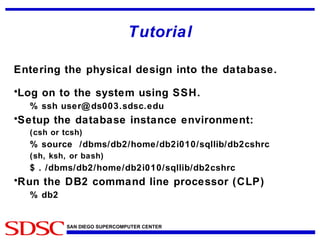
Tutorial Entering the physical design into the database. Log on to the system using SSH. % ssh user@ds003.sdsc.edu Setup the database instance environment: (csh or tcsh) % source  /dbms/db2/home/db2i010/sqllib/db2cshrc  (sh, ksh, or bash) $ . /dbms/db2/home/db2i010/sqllib/db2cshrc Run the DB2 command line processor (CLP) % db2
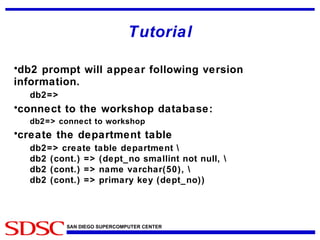
Tutorial db2 prompt will appear following version information. db2=> connect to the workshop database: db2=> connect to workshop create the department table db2=> create table department \ db2 (cont.) => (dept_no smallint not null, \ db2 (cont.) => name varchar(50), \ db2 (cont.) => primary key (dept_no))
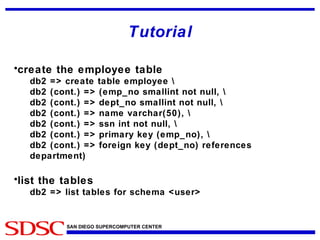
Tutorial create the employee table db2 => create table employee \ db2 (cont.) => (emp_no smallint not null, \ db2 (cont.) => dept_no smallint not null, \ db2 (cont.) => name varchar(50), \ db2 (cont.) => ssn int not null, \ db2 (cont.) => primary key (emp_no), \ db2 (cont.) => foreign key (dept_no) references department) list the tables db2 => list tables for schema <user>
Normalization A logical design method which minimizes data redundancy and reduces design flaws. Consists of applying various “normal” forms to the database design. The normal forms break down large tables into smaller subsets.
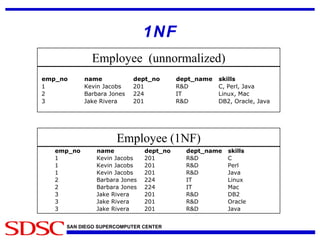
First Normal Form (1NF) Each attribute must be atomic No repeating columns within a row. No multi-valued columns. 1NF simplifies attributes Queries become easier.
1NF Employee  (unnormalized) Employee (1NF)
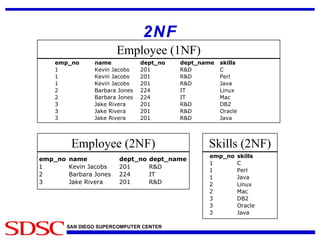
Second Normal Form (2NF) Each attribute must be functionally dependent on the primary key. Functional dependence - the property of one or more attributes that uniquely determines the value of other attributes. Any non-dependent attributes are moved into a smaller (subset) table. 2NF improves data integrity. Prevents update, insert, and delete anomalies.
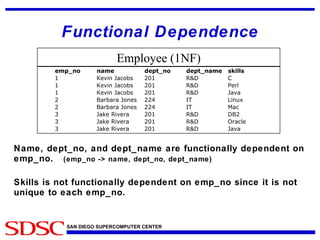
Functional Dependence Name, dept_no, and dept_name are functionally dependent on emp_no.  (emp_no -> name, dept_no, dept_name) Skills is not functionally dependent on emp_no since it is not unique to each emp_no. Employee (1NF)
2NF Employee (1NF) Employee (2NF) Skills (2NF)
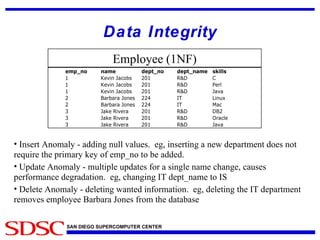
Data Integrity Insert Anomaly - adding null values.  eg, inserting a new department does not require the primary key of emp_no to be added.  Update Anomaly - multiple updates for a single name change, causes performance degradation.  eg, changing IT dept_name to IS Delete Anomaly - deleting wanted information.  eg, deleting the IT department removes employee Barbara Jones from the database Employee (1NF)
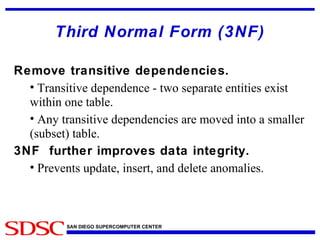
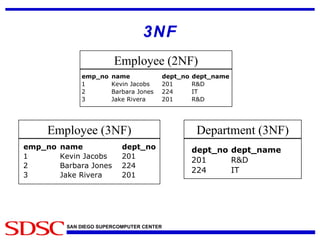
Third Normal Form (3NF) Remove transitive dependencies. Transitive dependence - two separate entities exist within one table. Any transitive dependencies are moved into a smaller (subset) table. 3NF  further improves data integrity. Prevents update, insert, and delete anomalies.
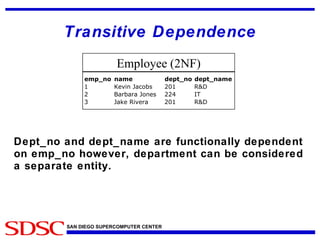
Transitive Dependence Dept_no and dept_name are functionally dependent on emp_no however, department can be considered a separate entity. Employee (2NF)
3NF Employee (2NF) Employee (3NF) Department (3NF)
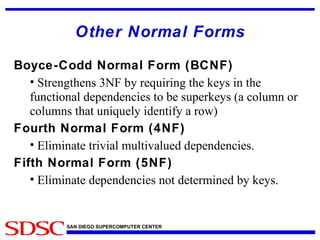
Other Normal Forms Boyce-Codd Normal Form (BCNF) Strengthens 3NF by requiring the keys in the functional dependencies to be superkeys (a column or columns that uniquely identify a row) Fourth Normal Form (4NF) Eliminate trivial multivalued dependencies. Fifth Normal Form (5NF) Eliminate dependencies not determined by keys.
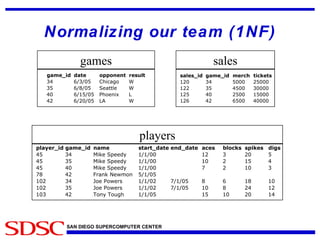
Normalizing our team (1NF) players games sales
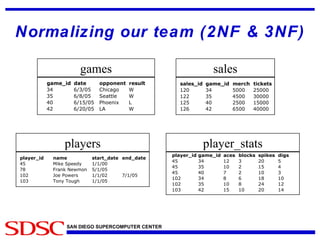
Normalizing our team (2NF & 3NF) players games sales player_stats
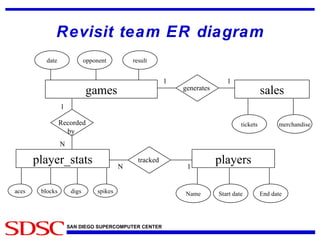
Revisit team ER diagram games sales generates  1 1 tickets merchandise opponent date result player_stats tracked  Recorded by  1 N N aces blocks digs players Start date End date Name 1 spikes
Star Schemas Designed for data retrieval Best for use in decision support tasks such as Data Warehouses and Data Marts. Denormalized - allows for faster querying due to less joins.  Slow performance for insert, delete, and update transactions. Comprised of two types tables: facts and dimensions.
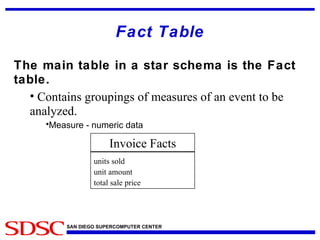
Fact Table The main table in a star schema is the Fact table. Contains groupings of measures of an event to be analyzed. Measure - numeric data Invoice Facts units sold unit amount total sale price
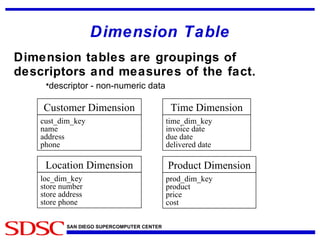
Dimension Table Dimension tables are groupings of descriptors and measures of the fact. descriptor - non-numeric data Customer Dimension cust_dim_key name address phone Time Dimension time_dim_key invoice date due date delivered date Location Dimension loc_dim_key store number store address store phone Product Dimension prod_dim_key product price cost
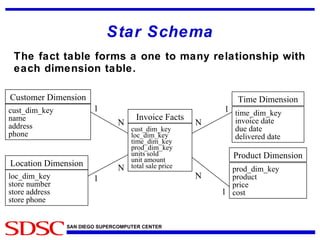
Star Schema The fact table forms a one to many relationship with each dimension table.  Customer Dimension cust_dim_key name address phone Time Dimension time_dim_key invoice date due date delivered date Location Dimension loc_dim_key store number store address store phone Product Dimension prod_dim_key product price cost Invoice Facts cust_dim_key loc_dim_key time_dim_key prod_dim_key units sold unit amount total sale price 1 1 1 1 N N N N
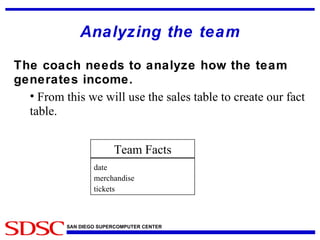
Analyzing the team Team Facts date merchandise tickets The coach needs to analyze how the team generates income. From this we will use the sales table to create our fact table.
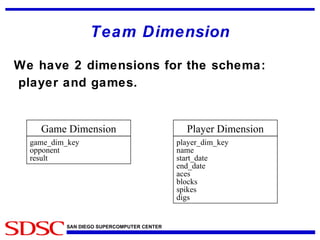
Team Dimension Player Dimension player_dim_key name start_date end_date aces blocks spikes digs We have 2 dimensions for the schema: player and games. Game Dimension game_dim_key opponent result
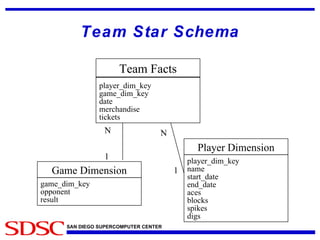
Team Star Schema Player Dimension player_dim_key name start_date end_date aces blocks spikes digs Team Facts player_dim_key game_dim_key date merchandise tickets 1 N Game Dimension game_dim_key opponent result 1 N
Books and Reference Database Design for Mere Mortals,  Michael J. Hernandez Information Modeling and Relational Databases, Terry Halpin  Database  Modeling and Design,  Toby J. Teorey
Continuing Education UCSD Extension Data Management Courses DBA Certificate Program Database Application Developer Certificate Program
Data Central The Data Services Group provides  Data Allocations  for the scientific community. http://datacentral.sdsc.edu/ Tools and expertise for making data collections available to the broader scientific community. Provide disk, tape, and database storage resources.

Nunes database

  • 1.
    Introduction to Database Design July 2005 Ken Nunes knunes @ sdsc.edu
  • 2.
    Database Design AgendaGeneral Design Considerations Entity-Relationship Model Tutorial Normalization Star Schemas Additional Information Q&A
  • 3.
    General Design ConsiderationsUsers Legacy Systems/Data Application Requirements
  • 4.
    Users Who arethey? Administrative Scientific Technical Impact Access Controls Interfaces Service levels
  • 5.
    Legacy Systems/Data Whatsystems are currently in place? Where does the data come from? How is it generated? What format is it in? What is the data used for? Which parts of the system must remain static?
  • 6.
    Application Requirements Whatkind of database? OnLine Analytical Processing (OLAP) OnLine Transactional Processing (OLTP) Budget Platform / Vendor Workflow? order of operations error handling reporting
  • 7.
    Entity - RelationshipModel A logical design method which emphasizes simplicity and readability. Basic objects of the model are: Entities Relationships Attributes
  • 8.
    Entities Data objectsdetailed by the information in the database. Denoted by rectangles in the model. Employee Department
  • 9.
    Attributes Characteristics ofentities or relationships. Denoted by ellipses in the model. Name SSN Employee Department Name Budget
  • 10.
    Relationships Represent associationsbetween entities. Denoted by diamonds in the model. Name SSN Employee Department Name Budget works in Start date
  • 11.
    Relationship Connectivity Constraintson the mapping of the associated entities in the relationship. Denoted by variables between the related entities. Generally, values for connectivity are expressed as “one” or “many” Name SSN Employee Department Name Budget work 1 N Start date
  • 12.
    Connectivity Department Managerhas 1 1 Department Project has N 1 Employee Project works on N M one-to-one one-to-many many-to-many
  • 13.
    ER example Volleyballcoach needs to collect information about his team. The coach requires information on: Players Player statistics Games Sales
  • 14.
    Team Entities &Attributes Players - statistics, name, start date, end date Games - date, opponent, result Sales - date, tickets, merchandise Players Sales Start date End date Statistics Name tickets merchandise Games opponent date result
  • 15.
    Team Relationships Identifythe relationships. The player statistics are recorded at each game so the player and game entities are related. For each game, we have multiple players so the relationship is one-to-many Players Games N 1 play
  • 16.
    Team Relationships Identifythe relationships. The sales are generated at each game so the sales and games are related. We have only 1 set of sales numbers for each game, one-to-one. Games Sales generates 1 1
  • 17.
    Team ER DiagramPlayers Games Sales play generates N 1 1 1 Start date End date Statistics Name tickets merchandise opponent date result
  • 18.
    Logical Design toPhysical Design Creating relational SQL schemas from entity-relationship models. Transform each entity into a table with the key and its attributes. Transform each relationship as either a relationship table (many-to-many) or a “foreign key” (one-to-many and many-to-many).
  • 19.
    Entity tables Transformeach entity into a table with a key and its attributes. Name SSN Employee create table employee (emp_no number, name varchar2(256), ssn number, primary key (emp_no));
  • 20.
    Foreign Keys Transformeach one-to-one or one-to-many relationship as a “foreign key” . Foreign key is a reference in the child (many) table to the primary key of the parent (one) table. create table employee (emp_no number, dept_no number, name varchar2(256), ssn number, primary key (emp_no), foreign key (dept_no) references department); Employee Department has 1 N create table department (dept_no number, name varchar2(50), primary key (dept_no));
  • 21.
    Foreign Key DepartmentEmployee Accounting has 1 employee: Brian Burnett Human Resources has 2 employees: Nora Edwards Ben Smith IT has 3 employees: Ajay Patel John O’Leary Julia Lenin
  • 22.
    Many-to-Many tables Transformeach many-to-many relationship as a table . The relationship table will contain the foreign keys to the related entities as well as any relationship attributes. create table proj_has_emp (proj_no number, emp_no number, start_date date, primary key (proj_no, emp_no), foreign key (proj_no) references project foreign key (emp_no) references employee); Employee Project has N M Start date
  • 23.
    Many-to-Many tables ProjectEmployee proj_has_emp Employee Audit has 1 employee: Brian Burnett Budget has 2 employees: Julia Lenin Nora Edwards Intranet has 3 employees: Julia Lenin John O’Leary Ajay Patel
  • 24.
    Tutorial Entering thephysical design into the database. Log on to the system using SSH. % ssh user@ds003.sdsc.edu Setup the database instance environment: (csh or tcsh) % source /dbms/db2/home/db2i010/sqllib/db2cshrc (sh, ksh, or bash) $ . /dbms/db2/home/db2i010/sqllib/db2cshrc Run the DB2 command line processor (CLP) % db2
  • 25.
    Tutorial db2 promptwill appear following version information. db2=> connect to the workshop database: db2=> connect to workshop create the department table db2=> create table department \ db2 (cont.) => (dept_no smallint not null, \ db2 (cont.) => name varchar(50), \ db2 (cont.) => primary key (dept_no))
  • 26.
    Tutorial create theemployee table db2 => create table employee \ db2 (cont.) => (emp_no smallint not null, \ db2 (cont.) => dept_no smallint not null, \ db2 (cont.) => name varchar(50), \ db2 (cont.) => ssn int not null, \ db2 (cont.) => primary key (emp_no), \ db2 (cont.) => foreign key (dept_no) references department) list the tables db2 => list tables for schema <user>
  • 27.
    Normalization A logicaldesign method which minimizes data redundancy and reduces design flaws. Consists of applying various “normal” forms to the database design. The normal forms break down large tables into smaller subsets.
  • 28.
    First Normal Form(1NF) Each attribute must be atomic No repeating columns within a row. No multi-valued columns. 1NF simplifies attributes Queries become easier.
  • 29.
    1NF Employee (unnormalized) Employee (1NF)
  • 30.
    Second Normal Form(2NF) Each attribute must be functionally dependent on the primary key. Functional dependence - the property of one or more attributes that uniquely determines the value of other attributes. Any non-dependent attributes are moved into a smaller (subset) table. 2NF improves data integrity. Prevents update, insert, and delete anomalies.
  • 31.
    Functional Dependence Name,dept_no, and dept_name are functionally dependent on emp_no. (emp_no -> name, dept_no, dept_name) Skills is not functionally dependent on emp_no since it is not unique to each emp_no. Employee (1NF)
  • 32.
    2NF Employee (1NF)Employee (2NF) Skills (2NF)
  • 33.
    Data Integrity InsertAnomaly - adding null values. eg, inserting a new department does not require the primary key of emp_no to be added. Update Anomaly - multiple updates for a single name change, causes performance degradation. eg, changing IT dept_name to IS Delete Anomaly - deleting wanted information. eg, deleting the IT department removes employee Barbara Jones from the database Employee (1NF)
  • 34.
    Third Normal Form(3NF) Remove transitive dependencies. Transitive dependence - two separate entities exist within one table. Any transitive dependencies are moved into a smaller (subset) table. 3NF further improves data integrity. Prevents update, insert, and delete anomalies.
  • 35.
    Transitive Dependence Dept_noand dept_name are functionally dependent on emp_no however, department can be considered a separate entity. Employee (2NF)
  • 36.
    3NF Employee (2NF)Employee (3NF) Department (3NF)
  • 37.
    Other Normal FormsBoyce-Codd Normal Form (BCNF) Strengthens 3NF by requiring the keys in the functional dependencies to be superkeys (a column or columns that uniquely identify a row) Fourth Normal Form (4NF) Eliminate trivial multivalued dependencies. Fifth Normal Form (5NF) Eliminate dependencies not determined by keys.
  • 38.
    Normalizing our team(1NF) players games sales
  • 39.
    Normalizing our team(2NF & 3NF) players games sales player_stats
  • 40.
    Revisit team ERdiagram games sales generates 1 1 tickets merchandise opponent date result player_stats tracked Recorded by 1 N N aces blocks digs players Start date End date Name 1 spikes
  • 41.
    Star Schemas Designedfor data retrieval Best for use in decision support tasks such as Data Warehouses and Data Marts. Denormalized - allows for faster querying due to less joins. Slow performance for insert, delete, and update transactions. Comprised of two types tables: facts and dimensions.
  • 42.
    Fact Table Themain table in a star schema is the Fact table. Contains groupings of measures of an event to be analyzed. Measure - numeric data Invoice Facts units sold unit amount total sale price
  • 43.
    Dimension Table Dimensiontables are groupings of descriptors and measures of the fact. descriptor - non-numeric data Customer Dimension cust_dim_key name address phone Time Dimension time_dim_key invoice date due date delivered date Location Dimension loc_dim_key store number store address store phone Product Dimension prod_dim_key product price cost
  • 44.
    Star Schema Thefact table forms a one to many relationship with each dimension table. Customer Dimension cust_dim_key name address phone Time Dimension time_dim_key invoice date due date delivered date Location Dimension loc_dim_key store number store address store phone Product Dimension prod_dim_key product price cost Invoice Facts cust_dim_key loc_dim_key time_dim_key prod_dim_key units sold unit amount total sale price 1 1 1 1 N N N N
  • 45.
    Analyzing the teamTeam Facts date merchandise tickets The coach needs to analyze how the team generates income. From this we will use the sales table to create our fact table.
  • 46.
    Team Dimension PlayerDimension player_dim_key name start_date end_date aces blocks spikes digs We have 2 dimensions for the schema: player and games. Game Dimension game_dim_key opponent result
  • 47.
    Team Star SchemaPlayer Dimension player_dim_key name start_date end_date aces blocks spikes digs Team Facts player_dim_key game_dim_key date merchandise tickets 1 N Game Dimension game_dim_key opponent result 1 N
  • 48.
    Books and ReferenceDatabase Design for Mere Mortals, Michael J. Hernandez Information Modeling and Relational Databases, Terry Halpin Database Modeling and Design, Toby J. Teorey
  • 49.
    Continuing Education UCSDExtension Data Management Courses DBA Certificate Program Database Application Developer Certificate Program
  • 50.
    Data Central TheData Services Group provides Data Allocations for the scientific community. http://datacentral.sdsc.edu/ Tools and expertise for making data collections available to the broader scientific community. Provide disk, tape, and database storage resources.

Editor's Notes

  • #3 Name and level of experience with topic.
  • #4 Name and level of experience with topic.
  • #5 Entities denote people, places, things, or event of informational interest. Nouns. Entities should contain descriptive information.
  • #9 Entities denote people, places, things, or event of informational interest. Nouns. Entities should contain descriptive information.
  • #10 Provide details about the entities, Entity of person, attribute is name, hair color
  • #12 Each department can have multiple employees.
  • #13 Each department can have multiple employees.
  • #19 Provide details about the entities, Entity of person, attribute is name, hair color
  • #20 Provide details about the entities, Entity of person, attribute is name, hair color
  • #21 Provide details about the entities, Entity of person, attribute is name, hair color
  • #23 Provide details about the entities, Entity of person, attribute is name, hair color
  • #25 Teragrid: ssh user@tg-login.sdsc.teragrid.org Echo $DB2INSTANCE -&gt; null then run: soft add +db2 db2
  • #26 List database directory Get authorizations List tables for schema &lt;user&gt;
  • #27 List database directory Get authorizations List tables for schema &lt;user&gt;
  • #28 Accomplish normalization by analyzing the interdependencies among attributes in tables and taking subsets of larger tables to form smaller ones. The subsets are created from examining the interdependencies among the table attributes.
  • #36 Note, dept_name is functionally dependent on dept_no. Dept_no is functionally dependent on emp_no, so via the middle step of dept_no, dept_name is functionally dependent on emp_no. (emp_no -&gt; dept_no , dept_no -&gt; dept_name, thus emp_no -&gt; dept_name)
  • #45 which provides an intuitive schema for querying information.