D Nagesh Kumar, IISc Optimization Methods: M5L11
Dynamic Programming
Introduction
D Nagesh Kumar, IISc Optimization Methods: M5L12
Introduction and Objectives
Introduction
Complex problems are sometimes solved quickly if approached in a
sequential manner
Dynamic Programming : Sequential or multistage decision making
process
Basic approach behind dynamic programming: Solution is found out in
multi stages
Works in a “divide and conquer” manner
Objectives
To discuss the Sequential Optimization an Multistage Decision
Process
To represent a Multistage Decision Process
To describe the concept of sub-optimization and principle of optimality
D Nagesh Kumar, IISc Optimization Methods: M5L13
Sequential Optimization
Problem is divided into smaller sub-problems
Optimize these sub-problems without losing the integrity of the
original problem
Decisions are made sequentially
Also called multistage decision problems since decisions are
made at a number of stages
A N variable problem is represented by N single variable
problems
These problems are solved successively to get the optimal
value of the original problem
D Nagesh Kumar, IISc Optimization Methods: M5L14
Sequential Optimization …contd.
Serial multistage decision process: Single variable problems
are connected in series so that the output of one stage will be
the input to the succeeding stage
For example, consider a water allocation problem to N users
The objective function is to maximize the total net benefit from
all users
The problem can be solved by considering each user
separately and optimizing the individual net benefits, subject to
constraints and then adding up the benefits from all users to get
the total optimal benefit
D Nagesh Kumar, IISc Optimization Methods: M5L15
Representation of Multistage Decision
Process
Consider a single stage decision process
Here
S1 is the input state variable
S2 is the output state variable
X1 is the decision variables and
NB1 is the net benefit
The transformation function for the input and output is
S2 = g(X1, S1)
Net benefits are expressed as a function of decision variables and
input variable
NB1 = h(X1, S1)
Stage 1
Input S1
Net Benefit, NB1
Decision variable, X1
Output S2
D Nagesh Kumar, IISc Optimization Methods: M5L16
Representation of Multistage Decision Process
…contd.
Now, consider a serial multistage decision process consisting of T
stages
For the tth stage the stage transformation and the benefit functions are
St+1 = g(Xt, St)
NBt = h(Xt, St)
Stage 1 Stage t Stage T
St
NBt
Xt
St+1S1 S2
NB1 NBT
X1 XT
ST ST+1
D Nagesh Kumar, IISc Optimization Methods: M5L17
Representation of Multistage Decision Process
…contd.
Objective of this multistage problem is to find the optimum values of all
decision variables X1, X2,…, XT such that the individual net benefits of
each stage that is expressed by some objective function, f(NBt) and
the total net benefit which is expressed by f(NB1, NB2,…, NBT) should
be maximized
Dynamic programming can be applied to this multistage problem if the
objective function is separable and monotonic
An objective function is separable, if it can be decomposed and
expressed as a sum or product of individual net benefits of each stage
or
( )∑ ∑= =
==
T
t
T
t
ttt SXhNBf
1 1
,
( )∏∏ ==
==
T
t
tt
T
t
t SXhNBf
11
,
D Nagesh Kumar, IISc Optimization Methods: M5L18
Representation of Multistage Decision Process
…contd.
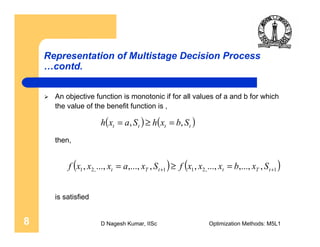
An objective function is monotonic if for all values of a and b for which
the value of the benefit function is ,
then,
is satisfied
( ) ( )tttt SbxhSaxh ,, =≥=
( ) ( )1,211,21 ,,...,...,,,,...,...,, ++ =≥= tTttTt SxbxxxfSxaxxxf
D Nagesh Kumar, IISc Optimization Methods: M5L19
Types of Multistage Decision Process
A serial multistage problem can be divided into three categories
Initial value problem
Value of the initial state variable, S1 is given
Final value problem
Value of the final state variable, ST is given
Final value problem can be transformed into an initial value
problem by reversing the direction of the state variable, St
Boundary value problem.
Values of both the initial and final state variables, S1 and ST
are given
D Nagesh Kumar, IISc Optimization Methods: M5L110
Concept of Sub-Optimization
Consider the objective function consisting of T decision variables x1, x2,
…, xT
satisfying the equations,
St+1 = g(Xt, St)
NBt = h(Xt, St) for t = 1,2,…,T
To solve this problem through dynamic programming, the concepts of
sub-optimization and principle of optimality are used
( )∑ ∑= =
==
T
t
T
t
ttt SXhNBf
1 1
,
D Nagesh Kumar, IISc Optimization Methods: M5L111
Concept of Sub-Optimization …contd.
Consider the design of a water tank in which the cost of construction is
to be minimized
Capacity of the tank to be designed is K
Main components of a water tank include (i) tank (ii) columns to
support the tank and (iii) the foundation
Optimization can be done by breaking the system into individual parts
and optimizing each part separately
While breaking and sub-optimizing, a logical procedure should be
used; otherwise this approach can lead to a poor solution
D Nagesh Kumar, IISc Optimization Methods: M5L112
Concept of Sub-Optimization …contd.
For example, sub-optimization of columns without considering
the other two components may cause the use of heavy
concrete columns with less reinforcement, since the cost of
steel is high
But while considering the sub-optimization of foundation
component, the cost becomes higher as the foundation should
be strong enough to carry these heavy columns
Thus, the sub-optimization of columns before considering the
sub-optimization of foundation will adversely affect the overall
design
D Nagesh Kumar, IISc Optimization Methods: M5L113
Concept of Sub-Optimization …contd.
In most of the serial systems sub-optimization can start from the last
component (or first component) since it does not influence the other
components
Thus, for the above problem, foundation can be suboptimized
independently
Then, the last two components (columns and foundation) are
considered as a single component and sub-optimization is done
without affecting other components
This process can be repeated for any number of end components
D Nagesh Kumar, IISc Optimization Methods: M5L114
Process of sub-optimization
Tank Columns Foundation
Original System
Tank Columns Foundation
Suboptimize design of
Foundation component
Tank Columns Foundation
Optimize complete system
Suboptimize design of
Foundation & Columns together
Tank Columns Foundation
D Nagesh Kumar, IISc Optimization Methods: M5L115
Principle of Optimality
Belman stated the principle of optimality which
explains the process of multi stage optimization as:
“An optimal policy (or a set of decisions) has the property that
whatever the initial state and initial decision are, the remaining
decisions must constitute an optimal policy with regard to the state
resulting from the first decision.”
D Nagesh Kumar, IISc Optimization Methods: M5L116
Thank You

Numerical analysis m5 l1slides

  • 1.
    D Nagesh Kumar,IISc Optimization Methods: M5L11 Dynamic Programming Introduction
  • 2.
    D Nagesh Kumar,IISc Optimization Methods: M5L12 Introduction and Objectives Introduction Complex problems are sometimes solved quickly if approached in a sequential manner Dynamic Programming : Sequential or multistage decision making process Basic approach behind dynamic programming: Solution is found out in multi stages Works in a “divide and conquer” manner Objectives To discuss the Sequential Optimization an Multistage Decision Process To represent a Multistage Decision Process To describe the concept of sub-optimization and principle of optimality
  • 3.
    D Nagesh Kumar,IISc Optimization Methods: M5L13 Sequential Optimization Problem is divided into smaller sub-problems Optimize these sub-problems without losing the integrity of the original problem Decisions are made sequentially Also called multistage decision problems since decisions are made at a number of stages A N variable problem is represented by N single variable problems These problems are solved successively to get the optimal value of the original problem
  • 4.
    D Nagesh Kumar,IISc Optimization Methods: M5L14 Sequential Optimization …contd. Serial multistage decision process: Single variable problems are connected in series so that the output of one stage will be the input to the succeeding stage For example, consider a water allocation problem to N users The objective function is to maximize the total net benefit from all users The problem can be solved by considering each user separately and optimizing the individual net benefits, subject to constraints and then adding up the benefits from all users to get the total optimal benefit
  • 5.
    D Nagesh Kumar,IISc Optimization Methods: M5L15 Representation of Multistage Decision Process Consider a single stage decision process Here S1 is the input state variable S2 is the output state variable X1 is the decision variables and NB1 is the net benefit The transformation function for the input and output is S2 = g(X1, S1) Net benefits are expressed as a function of decision variables and input variable NB1 = h(X1, S1) Stage 1 Input S1 Net Benefit, NB1 Decision variable, X1 Output S2
  • 6.
    D Nagesh Kumar,IISc Optimization Methods: M5L16 Representation of Multistage Decision Process …contd. Now, consider a serial multistage decision process consisting of T stages For the tth stage the stage transformation and the benefit functions are St+1 = g(Xt, St) NBt = h(Xt, St) Stage 1 Stage t Stage T St NBt Xt St+1S1 S2 NB1 NBT X1 XT ST ST+1
  • 7.
    D Nagesh Kumar,IISc Optimization Methods: M5L17 Representation of Multistage Decision Process …contd. Objective of this multistage problem is to find the optimum values of all decision variables X1, X2,…, XT such that the individual net benefits of each stage that is expressed by some objective function, f(NBt) and the total net benefit which is expressed by f(NB1, NB2,…, NBT) should be maximized Dynamic programming can be applied to this multistage problem if the objective function is separable and monotonic An objective function is separable, if it can be decomposed and expressed as a sum or product of individual net benefits of each stage or ( )∑ ∑= = == T t T t ttt SXhNBf 1 1 , ( )∏∏ == == T t tt T t t SXhNBf 11 ,
  • 8.
    D Nagesh Kumar,IISc Optimization Methods: M5L18 Representation of Multistage Decision Process …contd. An objective function is monotonic if for all values of a and b for which the value of the benefit function is , then, is satisfied ( ) ( )tttt SbxhSaxh ,, =≥= ( ) ( )1,211,21 ,,...,...,,,,...,...,, ++ =≥= tTttTt SxbxxxfSxaxxxf
  • 9.
    D Nagesh Kumar,IISc Optimization Methods: M5L19 Types of Multistage Decision Process A serial multistage problem can be divided into three categories Initial value problem Value of the initial state variable, S1 is given Final value problem Value of the final state variable, ST is given Final value problem can be transformed into an initial value problem by reversing the direction of the state variable, St Boundary value problem. Values of both the initial and final state variables, S1 and ST are given
  • 10.
    D Nagesh Kumar,IISc Optimization Methods: M5L110 Concept of Sub-Optimization Consider the objective function consisting of T decision variables x1, x2, …, xT satisfying the equations, St+1 = g(Xt, St) NBt = h(Xt, St) for t = 1,2,…,T To solve this problem through dynamic programming, the concepts of sub-optimization and principle of optimality are used ( )∑ ∑= = == T t T t ttt SXhNBf 1 1 ,
  • 11.
    D Nagesh Kumar,IISc Optimization Methods: M5L111 Concept of Sub-Optimization …contd. Consider the design of a water tank in which the cost of construction is to be minimized Capacity of the tank to be designed is K Main components of a water tank include (i) tank (ii) columns to support the tank and (iii) the foundation Optimization can be done by breaking the system into individual parts and optimizing each part separately While breaking and sub-optimizing, a logical procedure should be used; otherwise this approach can lead to a poor solution
  • 12.
    D Nagesh Kumar,IISc Optimization Methods: M5L112 Concept of Sub-Optimization …contd. For example, sub-optimization of columns without considering the other two components may cause the use of heavy concrete columns with less reinforcement, since the cost of steel is high But while considering the sub-optimization of foundation component, the cost becomes higher as the foundation should be strong enough to carry these heavy columns Thus, the sub-optimization of columns before considering the sub-optimization of foundation will adversely affect the overall design
  • 13.
    D Nagesh Kumar,IISc Optimization Methods: M5L113 Concept of Sub-Optimization …contd. In most of the serial systems sub-optimization can start from the last component (or first component) since it does not influence the other components Thus, for the above problem, foundation can be suboptimized independently Then, the last two components (columns and foundation) are considered as a single component and sub-optimization is done without affecting other components This process can be repeated for any number of end components
  • 14.
    D Nagesh Kumar,IISc Optimization Methods: M5L114 Process of sub-optimization Tank Columns Foundation Original System Tank Columns Foundation Suboptimize design of Foundation component Tank Columns Foundation Optimize complete system Suboptimize design of Foundation & Columns together Tank Columns Foundation
  • 15.
    D Nagesh Kumar,IISc Optimization Methods: M5L115 Principle of Optimality Belman stated the principle of optimality which explains the process of multi stage optimization as: “An optimal policy (or a set of decisions) has the property that whatever the initial state and initial decision are, the remaining decisions must constitute an optimal policy with regard to the state resulting from the first decision.”
  • 16.
    D Nagesh Kumar,IISc Optimization Methods: M5L116 Thank You