PRESENTATION Topic : “DYNAMIC PROGRAMMING”
Prepared By: Pintu Ram
Course: B.Sc.(Hons.)C.S. Sem : 2nd Roll no : 2k17/CS/72
Submitted to : Mr. Ashish Jha
College Of Vocational Studies
INDEX
WHAT IS DYNNAMIC PROGRAMMMING
WHAT IS OPTIMIZATION PROBLEM
WHAT IS OPTIMAL SOLUTION
PRICIPLE OF OPTIMALITY
DYNAMIC PROGRAMMING ALGORITHM
ADVANTAGE OF DYNAMIC PROGRAMMING
DISADVANTAGE OF DYNAMIC
PROGRAMMING
EXAMPLE OF DYNAMIC PROGRAMMING
WHAT IS DYNAMIC PROGARMMING
DEFINITION:
Dynamic Programming is a general algorithm
design technique for solving a complicated
problem defined by recurrences with overlapping
sub problems.
Invented by : “American mathematician”
“Richard Bellman”
in 1950
Dp and dcp
DP:> Dynamic Programming
DCP:> Divide and Conquer Programming
DP likes DCP.
But, Some difference
DCP :applies when sub problems does not overlap.
(repeatedly works)/(top down)
DP :applies when sub problems overlap.
(avoids repeatedly works)(bottom up)
Optimization problem
Dynamic Programming is generally applied for
solving optimization problems.
OPTIMIZATION PROBLEM:
Such problems that can have many possible
solutions and each solution has a
value and we wish to find a solution with
optimal value (minimum and maximum).
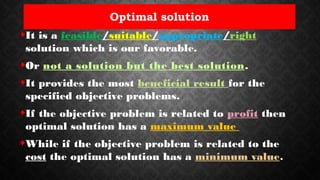
Optimal solution
It is a feasible/suitable/appropriate/right
solution which is our favorable.
Or not a solution but the best solution.
It provides the most beneficial result for the
specified objective problems.
If the objective problem is related to profit then
optimal solution has a maximum value
While if the objective problem is related to the
cost the optimal solution has a minimum value.
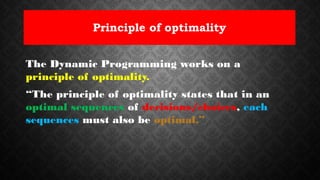
Principle of optimality
The Dynamic Programming works on a
principle of optimality.
“The principle of optimality states that in an
optimal sequences of decisions/choices, each
sequences must also be optimal.”
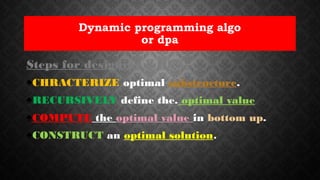
Dynamic programming algo
or dpa
Steps for designing a DPA:
â™ CHRACTERIZE optimal substructure.
â™ RECURSIVELY define the. optimal value
â™ COMPUTE the optimal value in bottom up.
â™ CONSTRUCT an optimal solution.
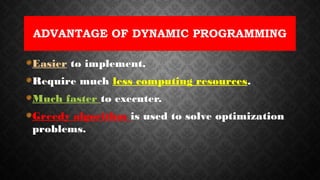
ADVANTAGE OF DYNAMIC PROGRAMMING
Easier to implement.
Require much less computing resources.
Much faster to executer.
Greedy algorithm is used to solve optimization
problems.
DISADVANTAGE OF DYNAMIC
PROGRAMMING
It does not always reach to the global solution.
Or,
Even the global solution is not found, most of
the times is lose, and in this case the sub
optimal solution is the best solution.
EXAMPLE OF DYNAIMC PROGRAMMING
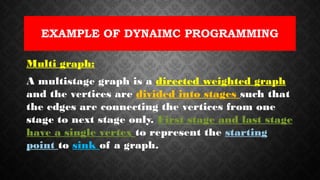
Multi graph:
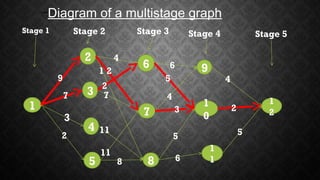
A multistage graph is a directed weighted graph
and the vertices are divided into stages such that
the edges are connecting the vertices from one
stage to next stage only. First stage and last stage
have a single vertex to represent the starting
point to sink of a graph.
Objective of problem
We have to selecting the path which
is giving us the minimum cost.
–Diagram of a multistage graph
–
1
2
1
2
1
1
1
0
9
5
4
3
8
7
6
9
6
4
2
5
68
2
7
3
21
2
7
11
11
5
4
5
3
Stage 1 Stage 2 Stage 3 Stage 4 Stage 5
4
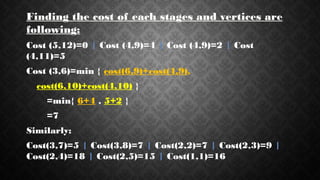
Finding the cost of each stages and vertices are
following:
Cost (5,12)=0 | Cost (4,9)=4 | Cost (4,9)=2 | Cost
(4,11)=5
Cost (3,6)=min { cost(6,9)+cost(4,9),
cost(6,10)+cost(4,10) }
=min{ 6+4 , 5+2 }
=7
Similarly:
Cost(3,7)=5 | Cost(3,8)=7 | Cost(2,2)=7 | Cost(2,3)=9 |
Cost(2,4)=18 | Cost(2,5)=15 | Cost(1,1)=16
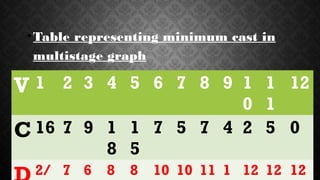
•Table representing minimum cast in
multistage graph
V 1 2 3 4 5 6 7 8 9 1
0
1
1
12
C 16 7 9 1
8
1
5
7 5 7 4 2 5 0
2/ 7 6 8 8 10 10 11 1 12 12 12
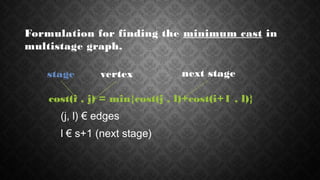
Formulation for finding the minimum cast in
multistage graph.
cost(i , j) = min{cost(j , l)+cost(i+1 , l)}
(j, l) € edges
l € s+1 (next stage)
stage vertex next stage
Thank you

Pintu ram

  • 1.
    PRESENTATION Topic :“DYNAMIC PROGRAMMING” Prepared By: Pintu Ram Course: B.Sc.(Hons.)C.S. Sem : 2nd Roll no : 2k17/CS/72 Submitted to : Mr. Ashish Jha College Of Vocational Studies
  • 2.
    INDEX WHAT IS DYNNAMICPROGRAMMMING WHAT IS OPTIMIZATION PROBLEM WHAT IS OPTIMAL SOLUTION PRICIPLE OF OPTIMALITY DYNAMIC PROGRAMMING ALGORITHM ADVANTAGE OF DYNAMIC PROGRAMMING DISADVANTAGE OF DYNAMIC PROGRAMMING EXAMPLE OF DYNAMIC PROGRAMMING
  • 3.
    WHAT IS DYNAMICPROGARMMING DEFINITION: Dynamic Programming is a general algorithm design technique for solving a complicated problem defined by recurrences with overlapping sub problems. Invented by : “American mathematician” “Richard Bellman” in 1950
  • 4.
    Dp and dcp DP:>Dynamic Programming DCP:> Divide and Conquer Programming DP likes DCP. But, Some difference DCP :applies when sub problems does not overlap. (repeatedly works)/(top down) DP :applies when sub problems overlap. (avoids repeatedly works)(bottom up)
  • 5.
    Optimization problem Dynamic Programmingis generally applied for solving optimization problems. OPTIMIZATION PROBLEM: Such problems that can have many possible solutions and each solution has a value and we wish to find a solution with optimal value (minimum and maximum).
  • 6.
    Optimal solution It isa feasible/suitable/appropriate/right solution which is our favorable. Or not a solution but the best solution. It provides the most beneficial result for the specified objective problems. If the objective problem is related to profit then optimal solution has a maximum value While if the objective problem is related to the cost the optimal solution has a minimum value.
  • 7.
    Principle of optimality TheDynamic Programming works on a principle of optimality. “The principle of optimality states that in an optimal sequences of decisions/choices, each sequences must also be optimal.”
  • 8.
    Dynamic programming algo ordpa Steps for designing a DPA: â™ CHRACTERIZE optimal substructure. â™ RECURSIVELY define the. optimal value â™ COMPUTE the optimal value in bottom up. â™ CONSTRUCT an optimal solution.
  • 9.
    ADVANTAGE OF DYNAMICPROGRAMMING Easier to implement. Require much less computing resources. Much faster to executer. Greedy algorithm is used to solve optimization problems.
  • 10.
    DISADVANTAGE OF DYNAMIC PROGRAMMING Itdoes not always reach to the global solution. Or, Even the global solution is not found, most of the times is lose, and in this case the sub optimal solution is the best solution.
  • 11.
    EXAMPLE OF DYNAIMCPROGRAMMING Multi graph: A multistage graph is a directed weighted graph and the vertices are divided into stages such that the edges are connecting the vertices from one stage to next stage only. First stage and last stage have a single vertex to represent the starting point to sink of a graph.
  • 12.
    Objective of problem Wehave to selecting the path which is giving us the minimum cost.
  • 13.
    –Diagram of amultistage graph – 1 2 1 2 1 1 1 0 9 5 4 3 8 7 6 9 6 4 2 5 68 2 7 3 21 2 7 11 11 5 4 5 3 Stage 1 Stage 2 Stage 3 Stage 4 Stage 5 4
  • 14.
    Finding the costof each stages and vertices are following: Cost (5,12)=0 | Cost (4,9)=4 | Cost (4,9)=2 | Cost (4,11)=5 Cost (3,6)=min { cost(6,9)+cost(4,9), cost(6,10)+cost(4,10) } =min{ 6+4 , 5+2 } =7 Similarly: Cost(3,7)=5 | Cost(3,8)=7 | Cost(2,2)=7 | Cost(2,3)=9 | Cost(2,4)=18 | Cost(2,5)=15 | Cost(1,1)=16
  • 15.
    •Table representing minimumcast in multistage graph V 1 2 3 4 5 6 7 8 9 1 0 1 1 12 C 16 7 9 1 8 1 5 7 5 7 4 2 5 0 2/ 7 6 8 8 10 10 11 1 12 12 12
  • 16.
    Formulation for findingthe minimum cast in multistage graph. cost(i , j) = min{cost(j , l)+cost(i+1 , l)} (j, l) € edges l € s+1 (next stage) stage vertex next stage
  • 17.