NUMBER SYSTEM
CONTENT
• Acknowledgement
• Introduction
• Types of number
• Introduction to whole number
• Properties of whole number
• Commutative property of addition and multiplication
• Associative property
• Distributive property
• Introduction to integer
• Line represantion of integer
ACKNOWLEDGEMENT
• We would like to thank Shipra ma’am for giving us an
opportunity to express ourselves by this power point
presentation.
INTRODUCTION
• A number system defines a set of values used to represent a quantity .we talk about
the number of people attending school ,number of modules taken per student etc.
Quantifying items and values in relation to each other is helpful for us to make sense
of our environment.
The study of numbers is not only related to computers .We apply numbers everyday
,and knowing how numbers work ,will give us an insight of how computers manipulate
and store numbers.
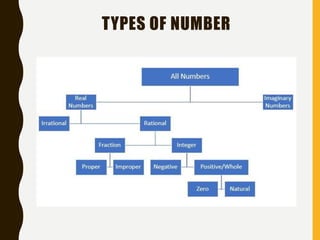
TYPES OF NUMBER
INTRODUCTION TO WHOLE NUMBER
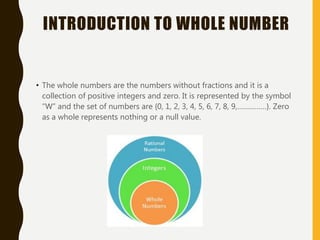
• The whole numbers are the numbers without fractions and it is a
collection of positive integers and zero. It is represented by the symbol
“W” and the set of numbers are {0, 1, 2, 3, 4, 5, 6, 7, 8, 9,……………}. Zero
as a whole represents nothing or a null value.
PROPERTIES OF WHOLE NUMBER
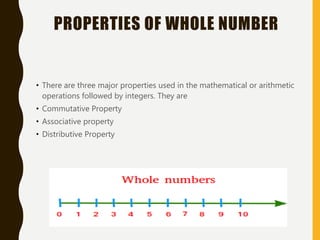
• There are three major properties used in the mathematical or arithmetic
operations followed by integers. They are
• Commutative Property
• Associative property
• Distributive Property
COMMUTATIVE PROPERTY
• The sum of two whole numbers remains the same if the order of
numbers is changed. Let a and b be two whole numbers, then
a + b = b + a
This property is called the commutative property of addition.
ASSOCIATIVE PROPERTY
• The sum of three whole numbers remains the same even if the grouping
is changed. Let a, b, and c be three whole numbers, then
• (a + b) + c = a + (b + c)
• This property is called the associative property of addition.
DISTRIBUTIVE PROPERTY
• The distributive property of multiplication states that when multiplying
a number by the sum/difference of 2 numbers.
• The final value is equal to the sum/difference of each addend multiplied
by the third number. Use the distributive property to remove the
parentheses.
INTRODUCTION TO INTEGER
• Integer is a Latin word that means whole. An integer may comprise a set
of whole numbers that include zero, positive number and negative
number. Integers, however, do not include decimals, percentages,
and fractions. For understanding the basics of integers we need to
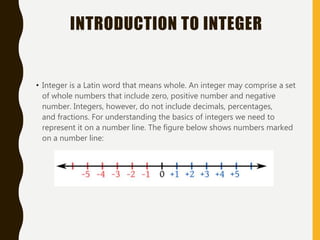
represent it on a number line. The figure below shows numbers marked
on a number line:
LINE REPRESANTION OF INTEGERS
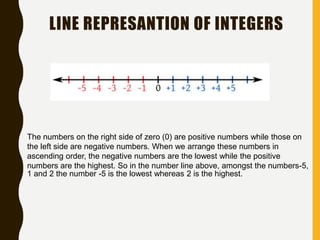
The numbers on the right side of zero (0) are positive numbers while those on
the left side are negative numbers. When we arrange these numbers in
ascending order, the negative numbers are the lowest while the positive
numbers are the highest. So in the number line above, amongst the numbers-5,
1 and 2 the number -5 is the lowest whereas 2 is the highest.
THANK YOU

Number system(Types of numbers, whole number, its properties, integer and its representation)

  • 1.
  • 2.
    CONTENT • Acknowledgement • Introduction •Types of number • Introduction to whole number • Properties of whole number • Commutative property of addition and multiplication • Associative property • Distributive property • Introduction to integer • Line represantion of integer
  • 3.
    ACKNOWLEDGEMENT • We wouldlike to thank Shipra ma’am for giving us an opportunity to express ourselves by this power point presentation.
  • 4.
    INTRODUCTION • A numbersystem defines a set of values used to represent a quantity .we talk about the number of people attending school ,number of modules taken per student etc. Quantifying items and values in relation to each other is helpful for us to make sense of our environment. The study of numbers is not only related to computers .We apply numbers everyday ,and knowing how numbers work ,will give us an insight of how computers manipulate and store numbers.
  • 5.
  • 6.
    INTRODUCTION TO WHOLENUMBER • The whole numbers are the numbers without fractions and it is a collection of positive integers and zero. It is represented by the symbol “W” and the set of numbers are {0, 1, 2, 3, 4, 5, 6, 7, 8, 9,……………}. Zero as a whole represents nothing or a null value.
  • 7.
    PROPERTIES OF WHOLENUMBER • There are three major properties used in the mathematical or arithmetic operations followed by integers. They are • Commutative Property • Associative property • Distributive Property
  • 8.
    COMMUTATIVE PROPERTY • Thesum of two whole numbers remains the same if the order of numbers is changed. Let a and b be two whole numbers, then a + b = b + a This property is called the commutative property of addition.
  • 9.
    ASSOCIATIVE PROPERTY • Thesum of three whole numbers remains the same even if the grouping is changed. Let a, b, and c be three whole numbers, then • (a + b) + c = a + (b + c) • This property is called the associative property of addition.
  • 10.
    DISTRIBUTIVE PROPERTY • Thedistributive property of multiplication states that when multiplying a number by the sum/difference of 2 numbers. • The final value is equal to the sum/difference of each addend multiplied by the third number. Use the distributive property to remove the parentheses.
  • 11.
    INTRODUCTION TO INTEGER •Integer is a Latin word that means whole. An integer may comprise a set of whole numbers that include zero, positive number and negative number. Integers, however, do not include decimals, percentages, and fractions. For understanding the basics of integers we need to represent it on a number line. The figure below shows numbers marked on a number line:
  • 12.
    LINE REPRESANTION OFINTEGERS The numbers on the right side of zero (0) are positive numbers while those on the left side are negative numbers. When we arrange these numbers in ascending order, the negative numbers are the lowest while the positive numbers are the highest. So in the number line above, amongst the numbers-5, 1 and 2 the number -5 is the lowest whereas 2 is the highest.
  • 13.