Whole Numbers
1. Counting numbers are called natural numbers. Natural numbers are denoted by N and given by
N = {1, 2, 3, 4,...}
2. Natural numbers included with '0' are called whole numbers. Whole numbers are represented byW
and given by W = {0, 1, 2, 3, 4,...}
3. A number which comes after a given number is called its successor.
Successor = given number +1
4. A number which comes before a given number is called its predecessor.
Predecessor = given number –1
5. Every whole number has a successor. Every whole number except 0, has apredecessor.
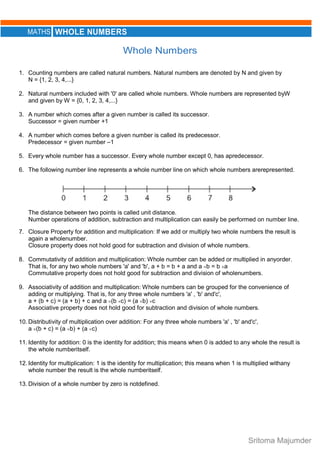
6. The following number line represents a whole number line on which whole numbers arerepresented.
The distance between two points is called unit distance.
Number operations of addition, subtraction and multiplication can easily be performed on number line.
7. Closure Property for addition and multiplication: If we add or multiply two whole numbers the result is
again a wholenumber.
Closure property does not hold good for subtraction and division of whole numbers.
8. Commutativity of addition and multiplication: Whole number can be added or multiplied in anyorder.
That is, for any two whole numbers 'a' and 'b', a + b = b + a and a b = b a
Commutative property does not hold good for subtraction and division of wholenumbers.
9. Associativity of addition and multiplication: Whole numbers can be grouped for the convenience of
adding or multiplying. That is, for any three whole numbers 'a' , 'b' and'c',
a + (b + c) = (a + b) + c and a (b c) = (a b) c
Associative property does not hold good for subtraction and division of whole numbers.
10. Distributivity of multiplication over addition: For any three whole numbers 'a' , 'b' and'c',
a (b + c) = (a b) + (a c)
11. Identity for addition: 0 is the identity for addition; this means when 0 is added to any whole the result is
the whole numberitself.
12. Identity for multiplication: 1 is the identity for multiplication; this means when 1 is multiplied withany
whole number the result is the whole numberitself.
13. Division of a whole number by zero is notdefined.
WHOLE NUMBERS
MATHS

CBSE Grade 6 Mathematics Whole Numbers Notes

  • 2.
    Whole Numbers 1. Countingnumbers are called natural numbers. Natural numbers are denoted by N and given by N = {1, 2, 3, 4,...} 2. Natural numbers included with '0' are called whole numbers. Whole numbers are represented byW and given by W = {0, 1, 2, 3, 4,...} 3. A number which comes after a given number is called its successor. Successor = given number +1 4. A number which comes before a given number is called its predecessor. Predecessor = given number –1 5. Every whole number has a successor. Every whole number except 0, has apredecessor. 6. The following number line represents a whole number line on which whole numbers arerepresented. The distance between two points is called unit distance. Number operations of addition, subtraction and multiplication can easily be performed on number line. 7. Closure Property for addition and multiplication: If we add or multiply two whole numbers the result is again a wholenumber. Closure property does not hold good for subtraction and division of whole numbers. 8. Commutativity of addition and multiplication: Whole number can be added or multiplied in anyorder. That is, for any two whole numbers 'a' and 'b', a + b = b + a and a b = b a Commutative property does not hold good for subtraction and division of wholenumbers. 9. Associativity of addition and multiplication: Whole numbers can be grouped for the convenience of adding or multiplying. That is, for any three whole numbers 'a' , 'b' and'c', a + (b + c) = (a + b) + c and a (b c) = (a b) c Associative property does not hold good for subtraction and division of whole numbers. 10. Distributivity of multiplication over addition: For any three whole numbers 'a' , 'b' and'c', a (b + c) = (a b) + (a c) 11. Identity for addition: 0 is the identity for addition; this means when 0 is added to any whole the result is the whole numberitself. 12. Identity for multiplication: 1 is the identity for multiplication; this means when 1 is multiplied withany whole number the result is the whole numberitself. 13. Division of a whole number by zero is notdefined. WHOLE NUMBERS MATHS