SHINGLEE PUBLISHERS PTE LTD
120 Hillview Avenue #05-06/07
Kewalram Hillview Singapore 669594
Tel: 6760 1388 Fax: 6762 5684
e-mail: info@shinglee.com.sg
http://www.shinglee.com.sg
All rights reserved. No part of this publication may be reproduced in any form or stored in a
retrieval system or transmitted in any form or by any means, electronic, mechanical, photocopying,
recording or otherwise, without the prior permission in writing of the Publishers.
First Published 2016
ISBN 978 981 288 015 4
Printed in Singapore
PREFACE
O Level Mathematics Topical Revision Notes has been written in accordance with
the latest syllabus issued by the Ministry of Education, Singapore.
This book is divided into 21 units, each covering a topic as laid out in the syllabus.
Important concepts and formulae are highlighted in each unit, with relevant worked
examples to help students learn how to apply theoretical knowledge to examination
questions.
To make this book suitable for N(A) Level students, sections not applicable for
the N(A) Level examination are indicated with a bar ( ).
We believe this book will be of great help to teachers teaching the subject and students
preparing for their O Level and N(A) Level Mathematics examinations.
Preface  iii
CONTENTS
Unit 1.1	 Numbers and the Four Operations	 1
Unit 1.2	 Ratio, Rate and Proportion	 15
Unit 1.3	Percentage	 21
Unit 1.4	Speed	 24
Unit 1.5	 Algebraic Representation and Formulae	 28
Unit 1.6	 Algebraic Manipulation	 33
Unit 1.7	 Functions and Graphs	 41
Unit 1.8	 Solutions of Equations and Inequalities	 51
Unit 1.9	 Applications of Mathematics in Practical Situations	 64
Unit 1.10	 Set Language and Notation	 77
Unit 1.11	Matrices	 85
Unit 2.1	 Angles, Triangles and Polygons	 91
Unit 2.2	 Congruence and Similarity	 103
Unit 2.3	 Properties of Circles	 113
Unit 2.4	 Pythagoras’ Theorem and Trigonometry	 119
Unit 2.5	Mensuration	 129
Unit 2.6	 Coordinate Geometry	 138
Unit 2.7	 Vectors in Two Dimensions	 143
Unit 3.1	 Data Handling	 151
Unit 3.2	 Data Analysis	 156
Unit 3.3	Probability	 167
Mathematical Formulae	 176
iv  Contents
1Numbers and the Four Operations
Numbers
1.	 The set of natural numbers,  = {1, 2, 3, …}
2.	 The set of whole numbers, W = {0, 1, 2, 3, …}
3.	 The set of integers, Z = {…, –2, –1, 0, 1, 2, …}
4.	 The set of positive integers, Z+
= {1, 2, 3, …}
5.	 The set of negative integers, Z–
= {–1, –2, –3, …}
6.	 The set of rational numbers, Q = {
a
b
, a, b  Z, b ≠ 0}
7.	 An irrational number is a number which cannot be expressed in the form
a
b
, where 	
	 a, b are integers and b ≠ 0.
8.	 The set of real numbers R is the set of rational and irrational numbers.
9.
	 Real
Numbers
Rational
Numbers
Irrational Numbers
e.g. π2,
Integers Fractions
e.g. 22
7
Zero
Negative
{..., –3, –2, –1} Positive
{1, 2, 3, ...}
Natural Numbers
Whole Numbers
	
UNIT
1.1
Numbers and
the Four Operations
2 UNIT 1.1
	 Example 1
	 The temperature at the bottom of a mountain was 22 °C and the temperature at the 	
	 top was –7 °C. Find
	 (a)	 the difference between the two temperatures,	
	 (b)	 the average of the two temperatures.	
	 Solution
	 (a) 	Difference between the temperatures = 22 – (–7)
							 = 22 + 7
							 = 29 °C
	 (b) 	Average of the temperatures =
22+(−7)
2
						 =
22 − 7
2
						 =
15
2
						 = 7.5 °C
………………………………………………………………………………
Prime Factorisation
10.	 A prime number is a number that can only be divided exactly by 1 and itself.
	 However, 1 is not considered as a prime number.
	 e.g. 2, 3, 5, 7, 11, 13, …
11.	 Prime factorisation is the process of expressing a composite number as a product of
	 its prime factors.
3Numbers and the Four Operations
	 Example 2
	 Express 30 as a product of its prime factors.
	 Solution
	 Factors of 30: 1, 2, 3, 5, 6, 10, 15, 30
	 Of these, 2, 3, 5 are prime factors.
	
	
2 30
3 15
5 5
1
	 ∴ 30 = 2 × 3 × 5
	 Example 3
	 Express 220 as a product of its prime factors.
	 Solution
	
220
2 110
2 55
5 11
	  220 = 22
× 5 × 11
………………………………………………………………………………
Factors and Multiples
12.	 The highest common factor (HCF) of two or more numbers is the largest factor that
	 is common to all the numbers.
4 UNIT 1.1
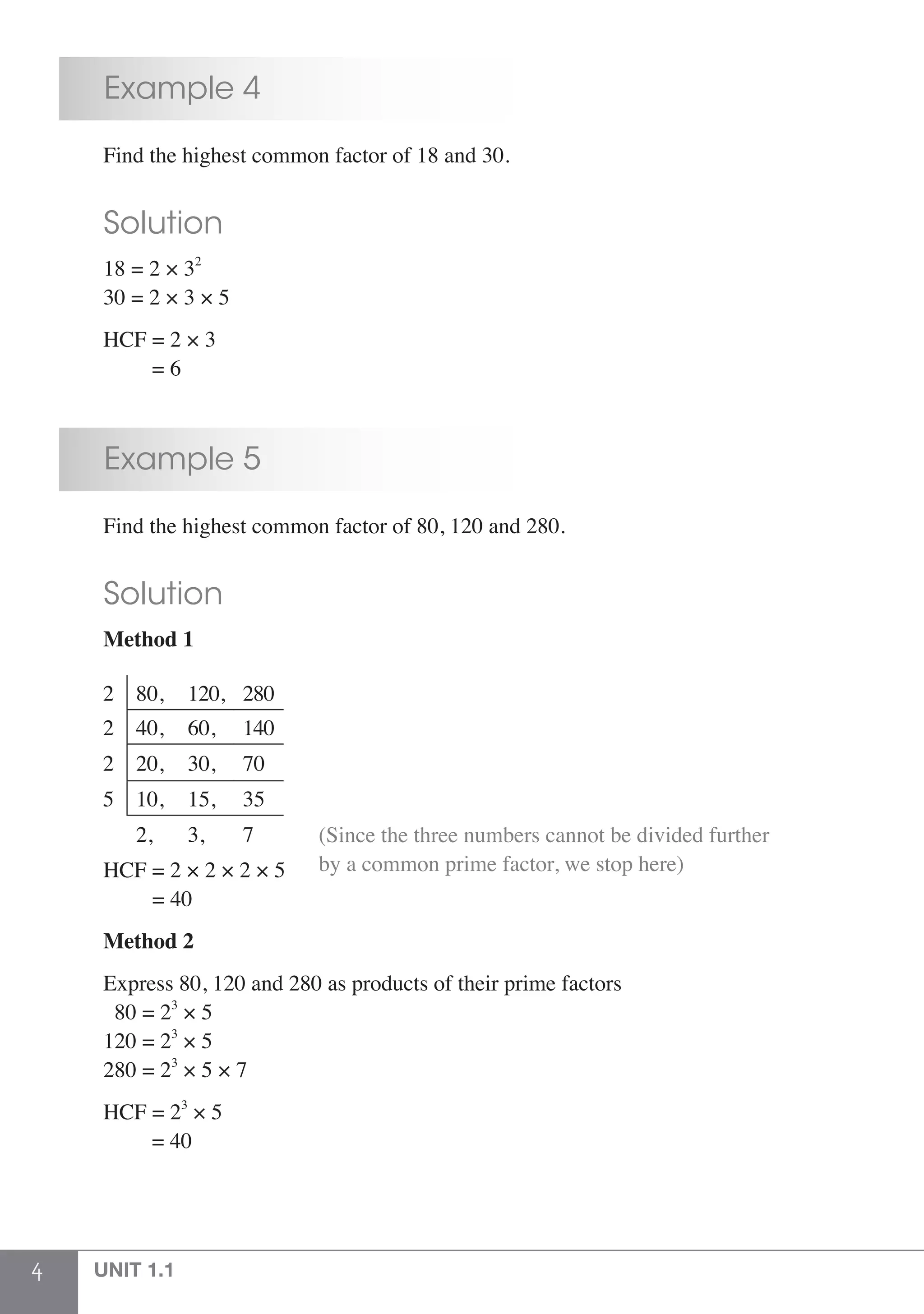
	 Example 4
	 Find the highest common factor of 18 and 30.
	 Solution
	 18 = 2 × 32
	 30 = 2 × 3 × 5
	 HCF = 2 × 3
	 = 6
	 Example 5
	 Find the highest common factor of 80, 120 and 280.
	 Solution
	 Method 1
2 80, 120, 280
2 40, 60, 140
2 20, 30, 70
5 10, 15, 35
2, 3, 7
						
	 HCF = 2 × 2 × 2 × 5
(Since the three numbers cannot be divided further
by a common prime factor, we stop here)
	 = 40
	 Method 2
	 Express 80, 120 and 280 as products of their prime factors
	 80 = 23
× 5
	 120 = 23
× 5
	 280 = 23
× 5 × 7
	 HCF = 23
× 5
		 = 40
5Numbers and the Four Operations
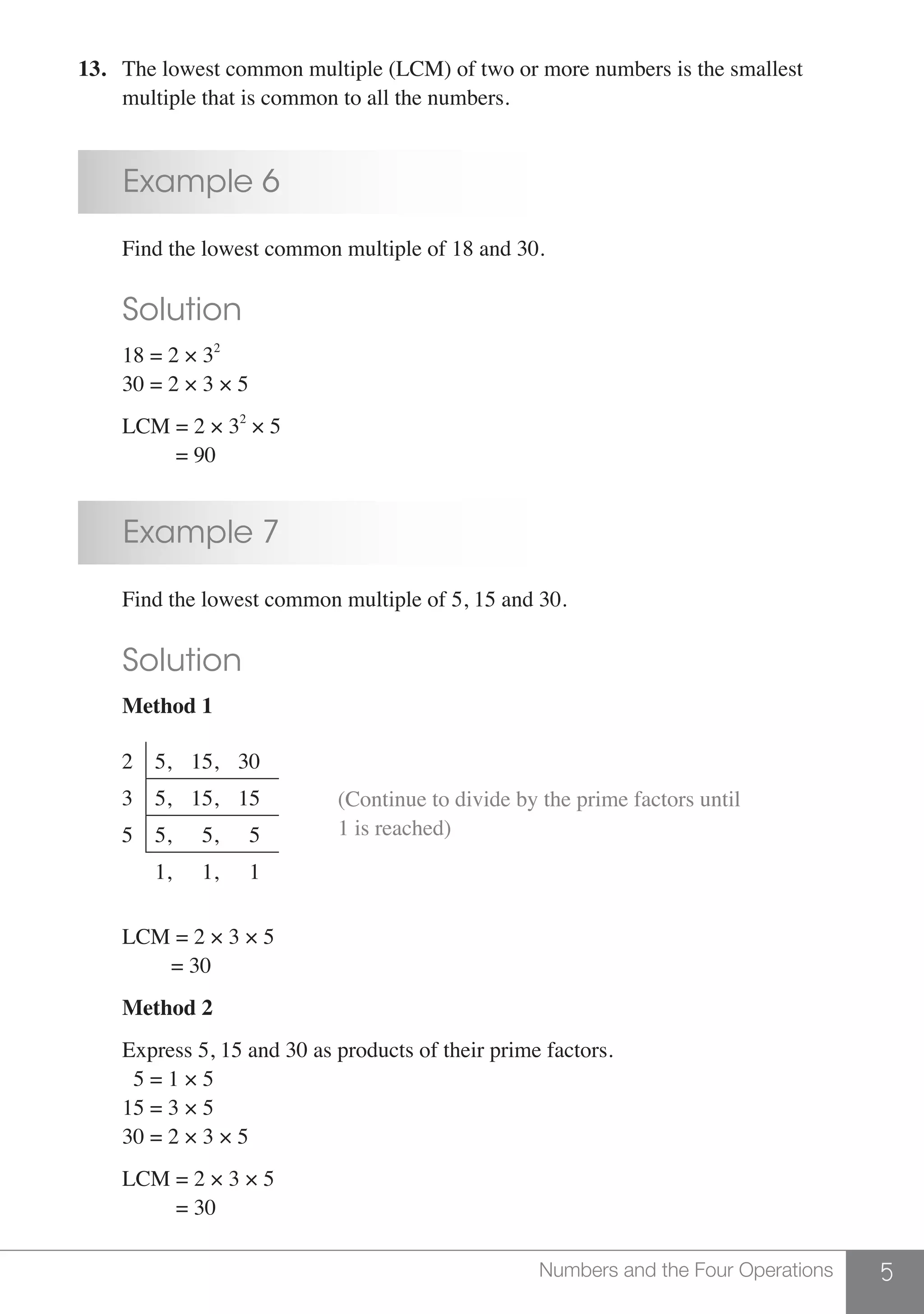
13.	 The lowest common multiple (LCM) of two or more numbers is the smallest
	 multiple that is common to all the numbers.
	 Example 6
	 Find the lowest common multiple of 18 and 30.
	 Solution
	 18 = 2 × 32
	 30 = 2 × 3 × 5
	
	 LCM = 2 × 32
× 5
	 = 90
	 Example 7
	 Find the lowest common multiple of 5, 15 and 30.
	 Solution
	 Method 1
2 5, 15, 30
3 5, 15, 15
5 5, 5, 5
1, 1, 1
						
(Continue to divide by the prime factors until
1 is reached)
	 LCM = 2 × 3 × 5
	 = 30
	 Method 2
	 Express 5, 15 and 30 as products of their prime factors.
	 5 = 1 × 5
	 15 = 3 × 5
	 30 = 2 × 3 × 5
	 LCM = 2 × 3 × 5
		 = 30
6 UNIT 1.1
Squares and Square Roots
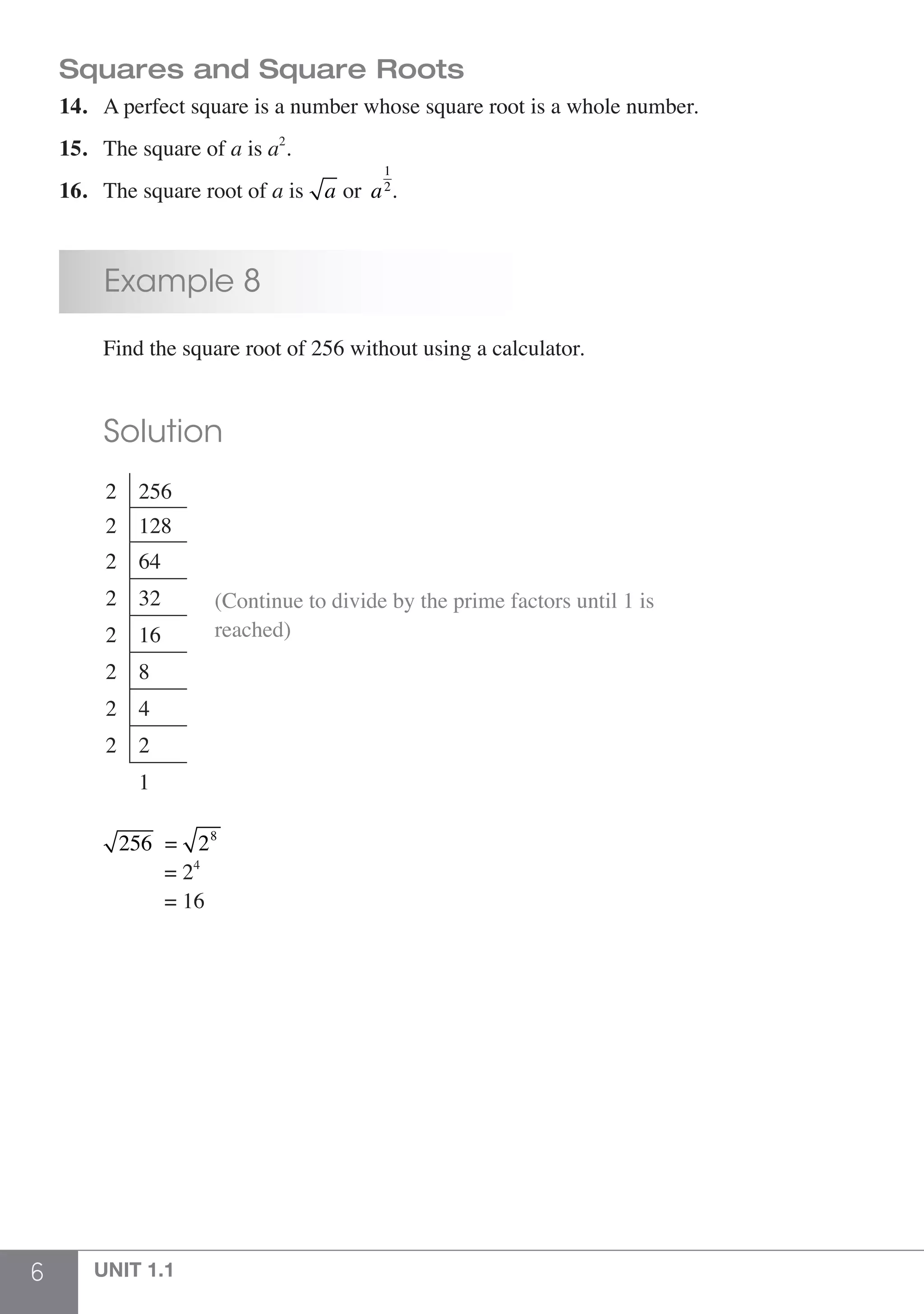
14.	 A perfect square is a number whose square root is a whole number.
15.	 The square of a is a2
.
16.	 The square root of a is a or a
1
2
.
	 Example 8
	 Find the square root of 256 without using a calculator.
	 Solution
	 2 256
2 128
2 64
2 32
2 16
2 8
2 4
2 2
1
(Continue to divide by the prime factors until 1 is
reached)
	 256 = 28
	 = 24
	 = 16
7Numbers and the Four Operations
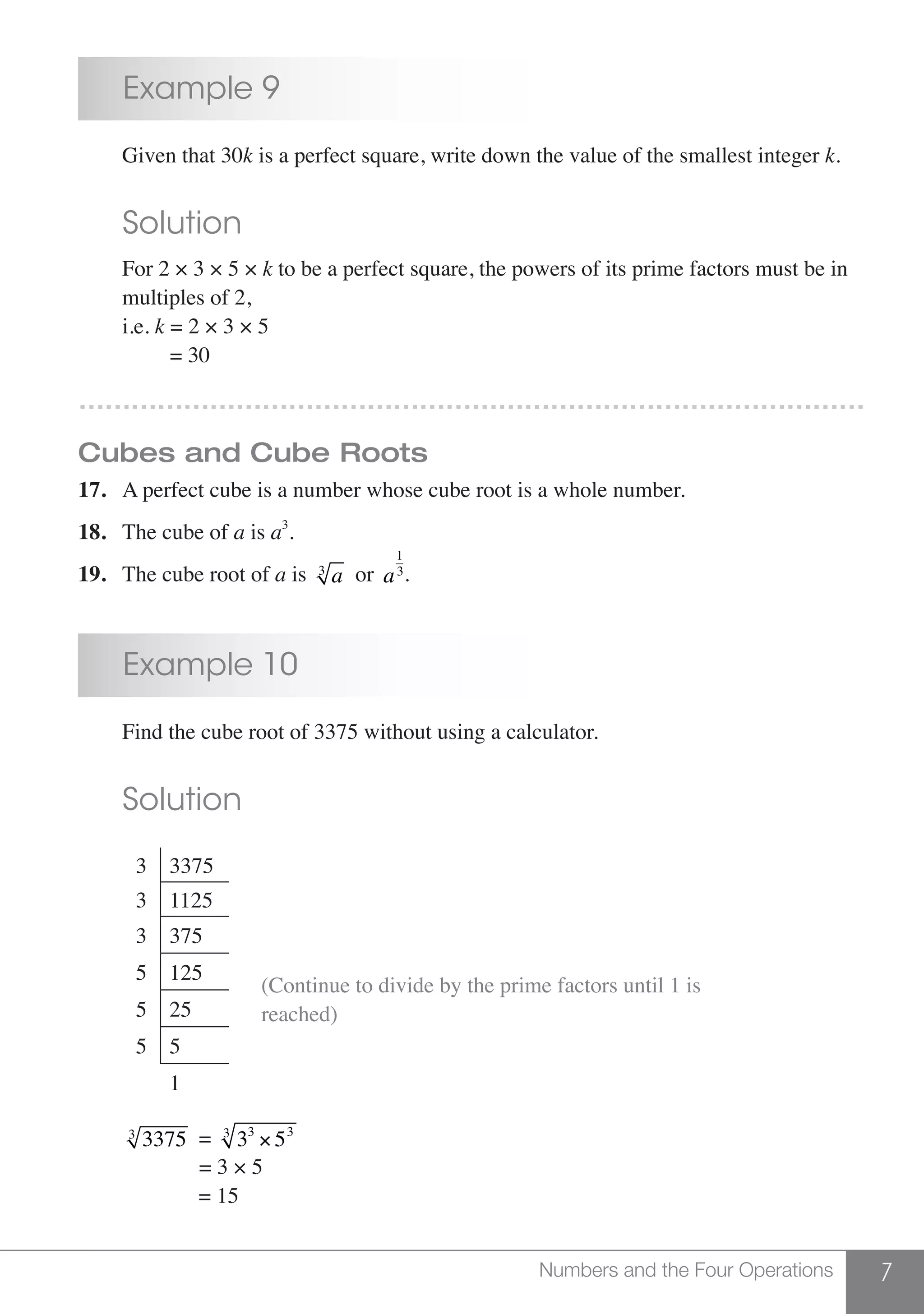
	 Example 9
	 Given that 30k is a perfect square, write down the value of the smallest integer k.
	 Solution
	 For 2 × 3 × 5 × k to be a perfect square, the powers of its prime factors must be in
	 multiples of 2,
	 i.e. k = 2 × 3 × 5
		 = 30
………………………………………………………………………………
Cubes and Cube Roots
17.	 A perfect cube is a number whose cube root is a whole number.
18.	 The cube of a is a3
.
19.	 The cube root of a is a3 or a
1
3.
	 Example 10
	 Find the cube root of 3375 without using a calculator.
	 Solution
	
	
3 3375
3 1125
3 375
5 125
5 25
5 5
1
	
		 	
(Continue to divide by the prime factors until 1 is
reached)
	 33753 = 33
× 533
	 = 3 × 5
	 = 15
8 UNIT 1.1
Reciprocal
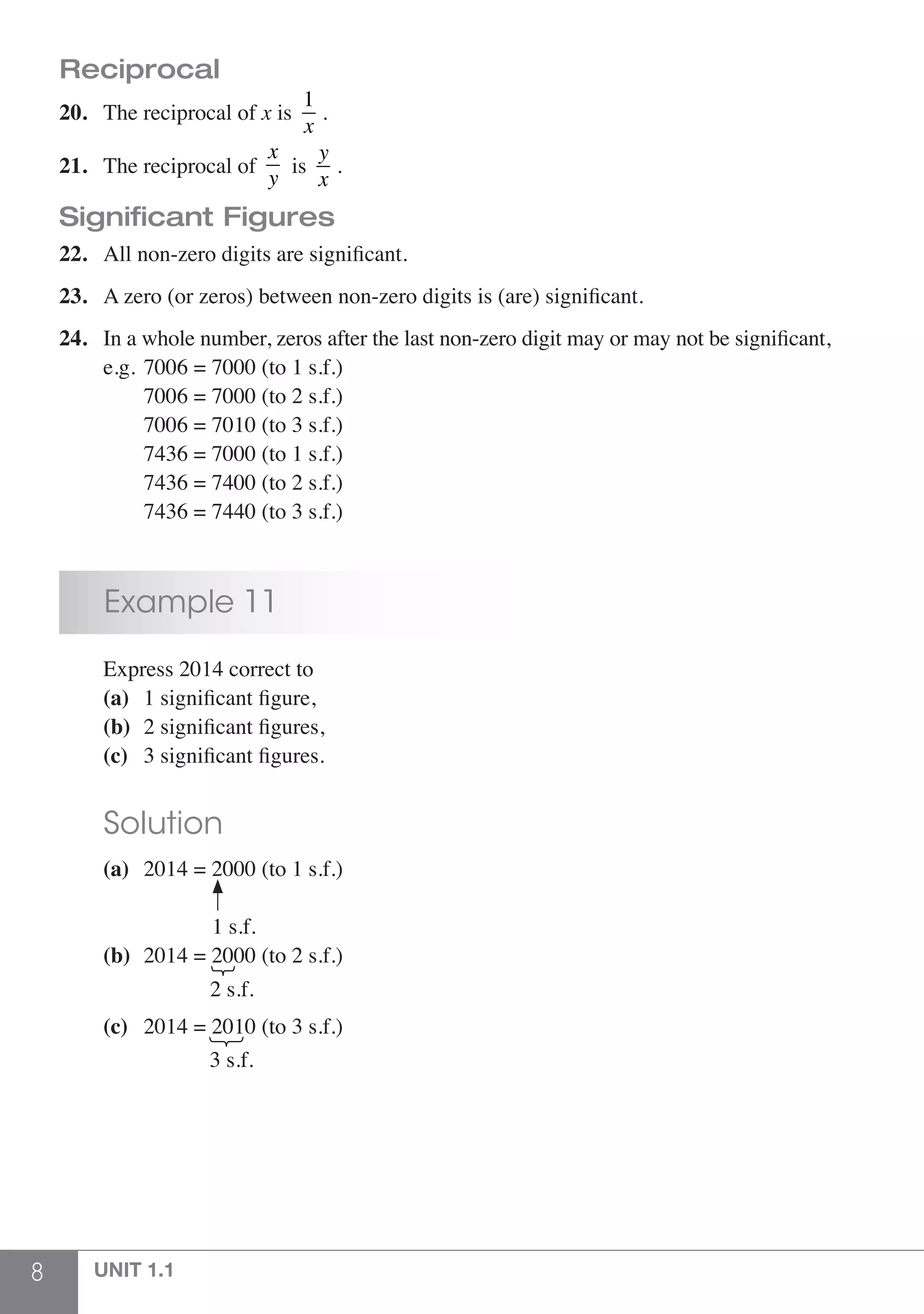
20.	 The reciprocal of x is
1
x
.
21.	The reciprocal of
x
y
is
y
x
.
Significant Figures
22.	 All non-zero digits are significant.
23.	 A zero (or zeros) between non-zero digits is (are) significant.
24.	 In a whole number, zeros after the last non-zero digit may or may not be significant,
	 e.g. 	7006 = 7000 (to 1 s.f.)
		 7006 = 7000 (to 2 s.f.)
		 7006 = 7010 (to 3 s.f.)
		 7436 = 7000 (to 1 s.f.)
		 7436 = 7400 (to 2 s.f.)
		 7436 = 7440 (to 3 s.f.)
	 Example 11
	 Express 2014 correct to
	 (a)	 1 significant figure,
	 (b)	 2 significant figures,
	 (c)	 3 significant figures.
	 Solution
	 (a)	 2014 = 2000 (to 1 s.f.)	
			
		 1 s.f.
	 (b)	 2014 = 2000 (to 2 s.f.)	
			 2 s.f.		
	 (c)	 2014 = 2010 (to 3 s.f.)	
			 3 s.f.
9Numbers and the Four Operations
25.	 In a decimal, zeros before the first non-zero digit are not significant,
	 e.g.	0.006 09 = 0.006 (to 1 s.f.)
		 0.006 09 = 0.0061 (to 2 s.f.)
		 6.009 = 6.01 (to 3 s.f.)
26.	 In a decimal, zeros after the last non-zero digit are significant.
	 Example 12
	 (a)	 Express 2.0367 correct to 3 significant figures.
	 (b)	 Express 0.222 03 correct to 4 significant figures.
	 Solution
	 (a)	 2.0367 = 2.04	
	 (b)	 0.222 03 = 0.2220
				 4 s.f.
………………………………………………………………………………
Decimal Places
27.	 Include one extra figure for consideration. Simply drop the extra figure if it is less
	 than 5. If it is 5 or more, add 1 to the previous figure before dropping the extra
	 figure,
	 e.g.	0.7374 = 0.737 (to 3 d.p.)
		 5.0306 = 5.031 (to 3 d.p.)
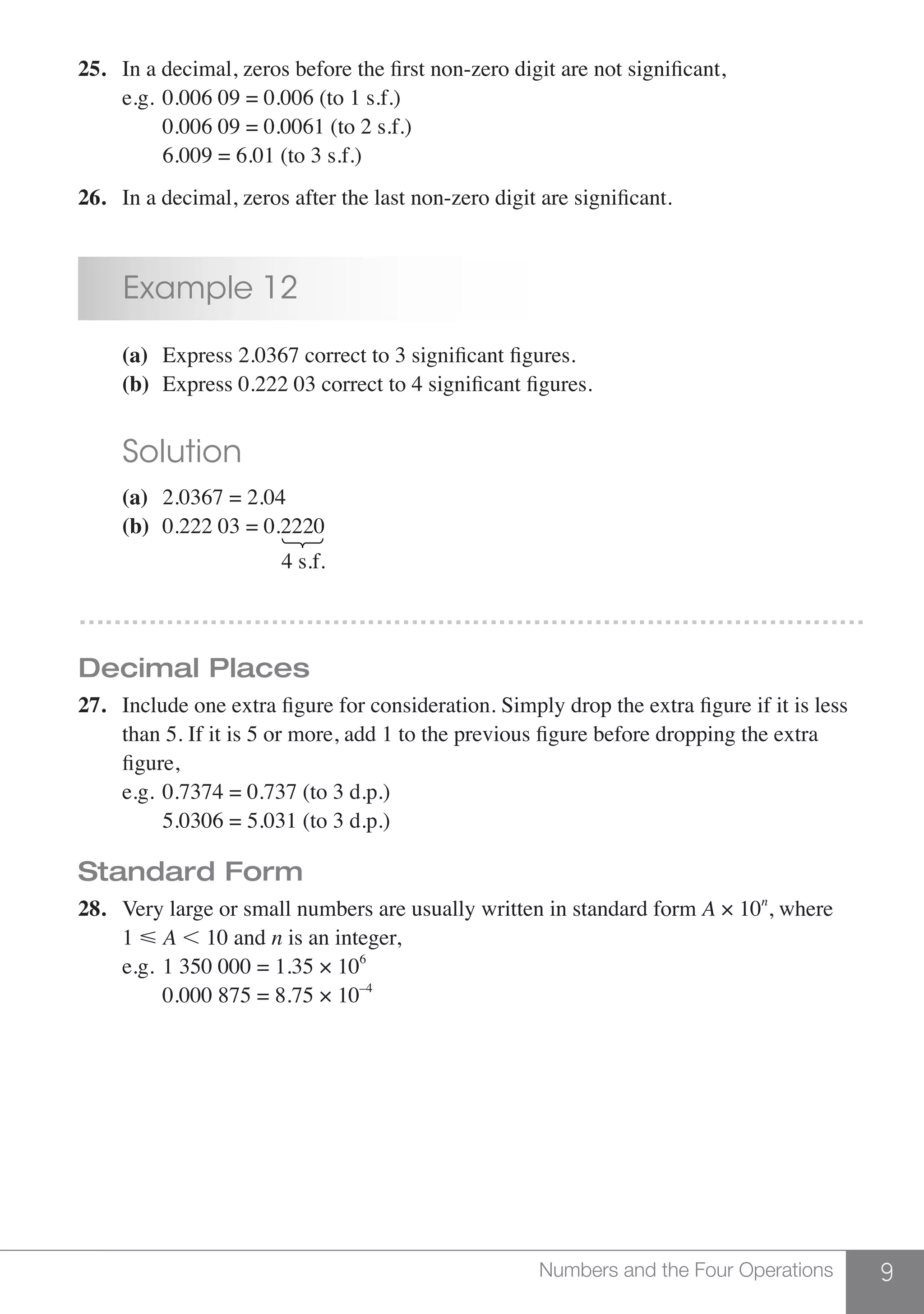
Standard Form
28.	 Very large or small numbers are usually written in standard form A × 10n
, where
	1  A , 10 and n is an integer,
	 e.g.	1 350 000 = 1.35 × 10⁶
		 0.000 875 = 8.75 × 10⁻⁴
10 UNIT 1.1
	 Example 13
	 The population of a country in 2012 was 4.05 million. In 2013, the population
	 increased by 1.1 × 10⁵
. Find the population in 2013.
	 Solution
	 4.05 million = 4.05 × 10⁶
	 Population in 2013 = 4.05 × 10⁶
+ 1.1 × 105
				 = 4.05 × 10⁶
+ 0.11 × 106
				 = (4.05 + 0.11) × 106
				 = 4.16 × 10⁶
………………………………………………………………………………
Estimation
29.	 We can estimate the answer to a complex calculation by replacing numbers with
	 approximate values for simpler calculation.
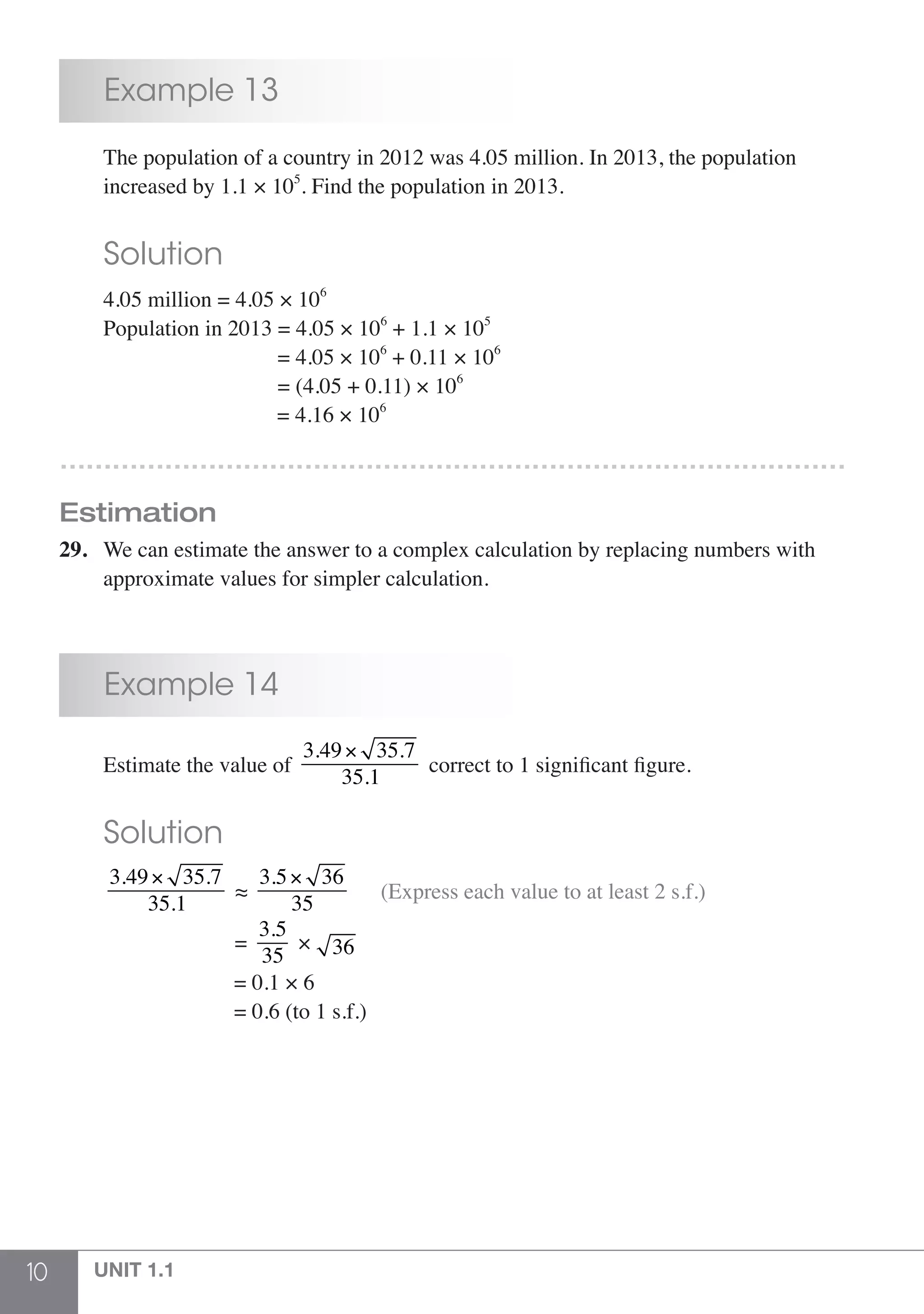
	 Example 14
	 Estimate the value of
3.49× 35.7
35.1
correct to 1 significant figure.
	 Solution
	
3.49× 35.7
35.1
≈
3.5× 36
35
(Express each value to at least 2 s.f.)
				 =
3.5
35
× 36
				 = 0.1 × 6
				 = 0.6 (to 1 s.f.)
11Numbers and the Four Operations
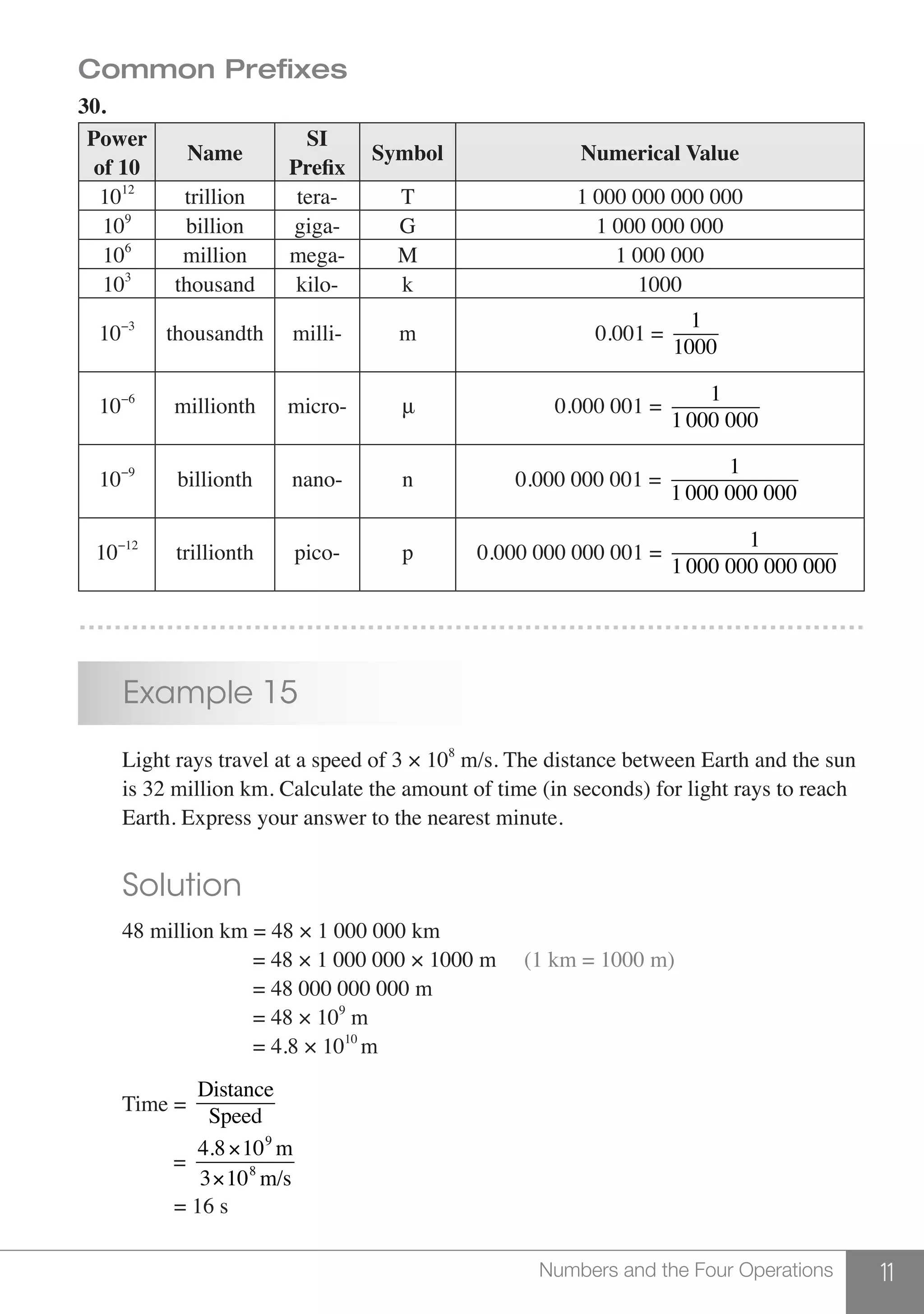
Common Prefixes
30.	
Power
of 10
Name
SI
Prefix
Symbol Numerical Value
1012
trillion tera- T 1 000 000 000 000
109
billion giga- G 1 000 000 000
106
million mega- M 1 000 000
103
thousand kilo- k 1000
10−3
thousandth milli- m 0.001 =
1
1000
10−6
millionth micro- μ 0.000 001 =
1
1 000 000
10−9
billionth nano- n 0.000 000 001 =
1
1 000 000 000
10−12
trillionth pico- p 0.000 000 000 001 =
1
1 000 000 000 000
………………………………………………………………………………
	 Example 15
	 Light rays travel at a speed of 3 × 10⁸
m/s. The distance between Earth and the sun
	 is 32 million km. Calculate the amount of time (in seconds) for light rays to reach
	 Earth. Express your answer to the nearest minute.
	 Solution
	 48 million km = 48 × 1 000 000 km
				 = 48 × 1 000 000 × 1000 m (1 km = 1000 m)
				 = 48 000 000 000 m
				 = 48 × 109
m
				 = 4.8 × 10¹⁰
m
	 Time =
Distance
Speed
	 =
4.8×10⁹
m
3×10⁸
m/s
	 = 16 s
12 UNIT 1.1
Laws of Arithmetic
31.	 a + b = b + a (Commutative Law)
	 a × b = b × a
	(p + q) + r = p + (q + r) (Associative Law)
	(p × q) × r = p × (q × r)
	 p × (q + r) = p × q + p × r (Distributive Law)
32.	 When we have a few operations in an equation, take note of the order of operations
	 as shown.
	 Step 1: 	 Work out the expression in the brackets first. When there is more than
			 1 pair of brackets, work out the expression in the innermost brackets first.
	 Step 2: 	 Calculate the powers and roots.
	 Step 3: 	 Divide and multiply from left to right.
	 Step 4: 	 Add and subtract from left to right.
	 Example 16
	 Calculate the value of the following.
	 (a)	 2 + (52
– 4) ÷ 3		 (b)	 14 – [45 – (26 + 16)] ÷ 5
	 Solution
	 (a)	 2 + (52
– 4) ÷ 3 = 2 + (25 – 4) ÷ 3	 (Power)
				 = 2 + 21 ÷ 3		 (Brackets)
				 = 2 + 7		 (Divide)
				 = 9			 (Add)
	 (b)	 14 – [45 – (26 + 16)] ÷ 5 = 14 – [45 – (26 + 4)] ÷ 5	(Roots)
				 = 14 – [45 – 30] ÷ 5	 (Innermost brackets)
					 = 14 – 15 ÷ 5		 (Brackets)
				 = 14 – 3			 (Divide)
				 = 11				 (Subtract)
………………………………………………………………………………
33.	 positive number × positive number = positive number
	 negative number × negative number = positive number
	 negative number × positive number = negative number
	 positive number ÷ positive number = positive number
	 negative number ÷ negative number = positive number
	 positive number ÷ negative number = negative number
13Numbers and the Four Operations
	 Example 17
	 Simplify (–1) × 3 – (–3)( –2) ÷ (–2).
	 Solution
	 (–1) × 3 – (–3)( –2) ÷ (–2) = –3 – 6 ÷ (–2)
						 = –3 – (–3)
						 = 0
………………………………………………………………………………
Laws of Indices
34.	 Law 1 of Indices:	 am
× an
= am + n
	
	 Law 2 of Indices:	 am
÷ an
= am – n
, if a ≠ 0
	 Law 3 of Indices:	 (am
)n
= amn
	 Law 4 of Indices:	 an
× bn
= (a × b)n
	 Law 5 of Indices:	 an
÷ bn
=
a
b
⎛
⎝
⎜
⎞
⎠
⎟
n
, if b ≠ 0
	 Example 18
	 (a)	 Given that 518
÷ 125 = 5k
, find k.
	 (b)	 Simplify 3 ÷ 6p–4
.
	 Solution
	 (a)		 518
÷ 125 = 5k
			 518
÷ 53
= 5k
			 518 – 3
= 5k
			 515
= 5k
			  k = 15
	 (b) 	3 ÷ 6p–4
=
3
6 p−4
			 =
p4
2
14 UNIT 1.1
Zero Indices
35.	If a is a real number and a ≠ 0, a0
= 1.
Negative Indices
36.	If a is a real number and a ≠ 0, a−n
=
1
an .
Fractional Indices
37.	If n is a positive integer, a
1
n
= an
, where a > 0.
38.	If m and n are positive integers, a
m
n
= amn
= an
( )
m
, where a > 0.
	 Example 19
	Simplify
3y2
5x
÷
3x2
y
20xy
and express your answer in positive indices.
	 Solution
	 3y2
5x
÷
3x2
y
20xy
=
3y2
5x
×
20xy
3x2
y
=
3
5
y2
x−1
×
20
3
x−1
= 4x−2
y2
=
4y2
x2
1 4
1 1
15Ratio, Rate and Proportion
Ratio
1.	 The ratio of a to b, written as a : b, is a ÷ b or
a
b
, where b ≠ 0 and a, b  Z+
.
2.	 A ratio has no units.
	 Example 1
	 In a stationery shop, the cost of a pen is $1.50 and the cost of a pencil is 90 cents.
	 Express the ratio of their prices in the simplest form.
	 Solution
	 We have to first convert the prices to the same units.
					 $1.50 = 150 cents
	 Price of pen : Price of pencil = 150 : 90
			 	 		 = 5 : 3
Map Scales
3.	 If the linear scale of a map is 1 : r, it means that 1 cm on the map represents r cm
	 on the actual piece of land.
4.	 If the linear scale of a map is 1 : r, the corresponding area scale of the map is 1 : r2
.
UNIT
1.2
Ratio, Rate and Proportion
16 UNIT 1.2
	 Example 2
	 In the map of a town, 10 km is represented by 5 cm.
	 (a)	 What is the actual distance if it is represented by a line of length 2 cm on the
		map?
	 (b)	 Express the map scale in the ratio 1 : n.
	 (c)	 Find the area of a plot of land that is represented by 10 cm2
.
	 Solution
	 (a)	 Given that the scale is	5 cm	 :	 10 km
			 =	1 cm 	: 	2 km
		 Therefore,	 2 cm 	: 	4 km
	 (b)	 Since	1 cm 	:	 2 km,
				 1 cm	 :	 2000 m
			 	1 cm	 :	 200 000 cm
(Convert to the same units)
		 Therefore, the map scale is 1 : 200 000.
	 (c)		 1 cm	 :	 2 km
			 1 cm2
	 :	 4 km2
	
			 10 cm2
	 : 10 × 4 = 40 km2
		
Therefore, the area of the plot of land is 40 km2
.
17Ratio, Rate and Proportion
	 Example 3
	 A length of 8 cm on a map represents an actual distance of 2 km. Find
	 (a)	 the actual distance represented by 25.6 cm on the map, giving your answer
		 in km,
	 (b) 	the area on the map, in cm2
, which represents an actual area of 2.4 km2
,
	 (c) 	 the scale of the map in the form 1 : n.
	 Solution
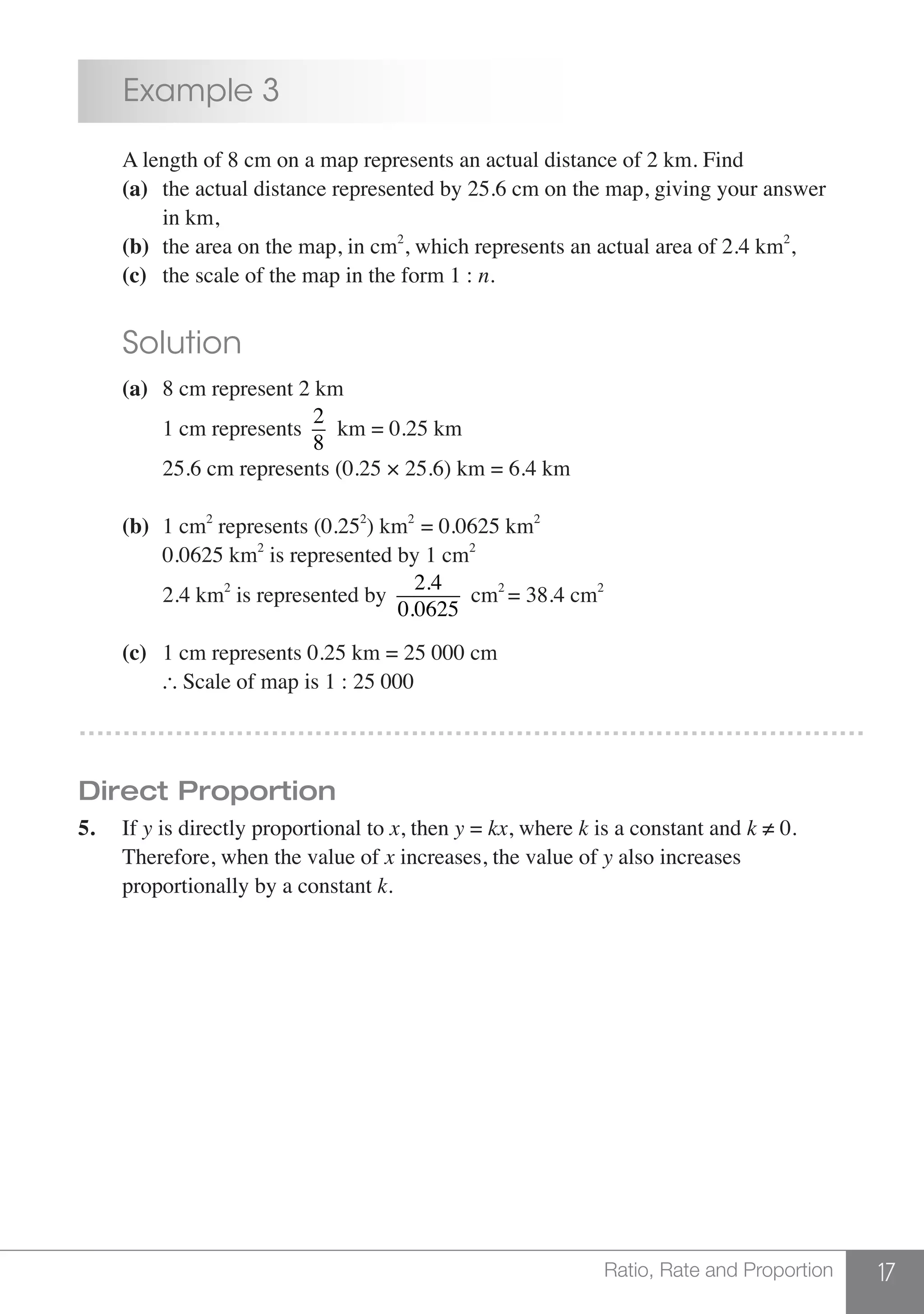
	 (a) 	8 cm represent 2 km
		 1 cm represents
2
8
km = 0.25 km
		 25.6 cm represents (0.25 × 25.6) km = 6.4 km
	 (b)	 1 cm2
represents (0.252
) km2
= 0.0625 km2
		 0.0625 km2
is represented by 1 cm2
		 2.4 km2
is represented by
2.4
0.0625
cm2
= 38.4 cm2
	 (c) 	 1 cm represents 0.25 km = 25 000 cm
		 Scale of map is 1 : 25 000
………………………………………………………………………………
Direct Proportion
5.	If y is directly proportional to x, then y = kx, where k is a constant and k ≠ 0.
	 Therefore, when the value of x increases, the value of y also increases
	 proportionally by a constant k.
18 UNIT 1.2
	 Example 4
	 Given that y is directly proportional to x, and y = 5 when x = 10, find y in terms of x.
	 Solution
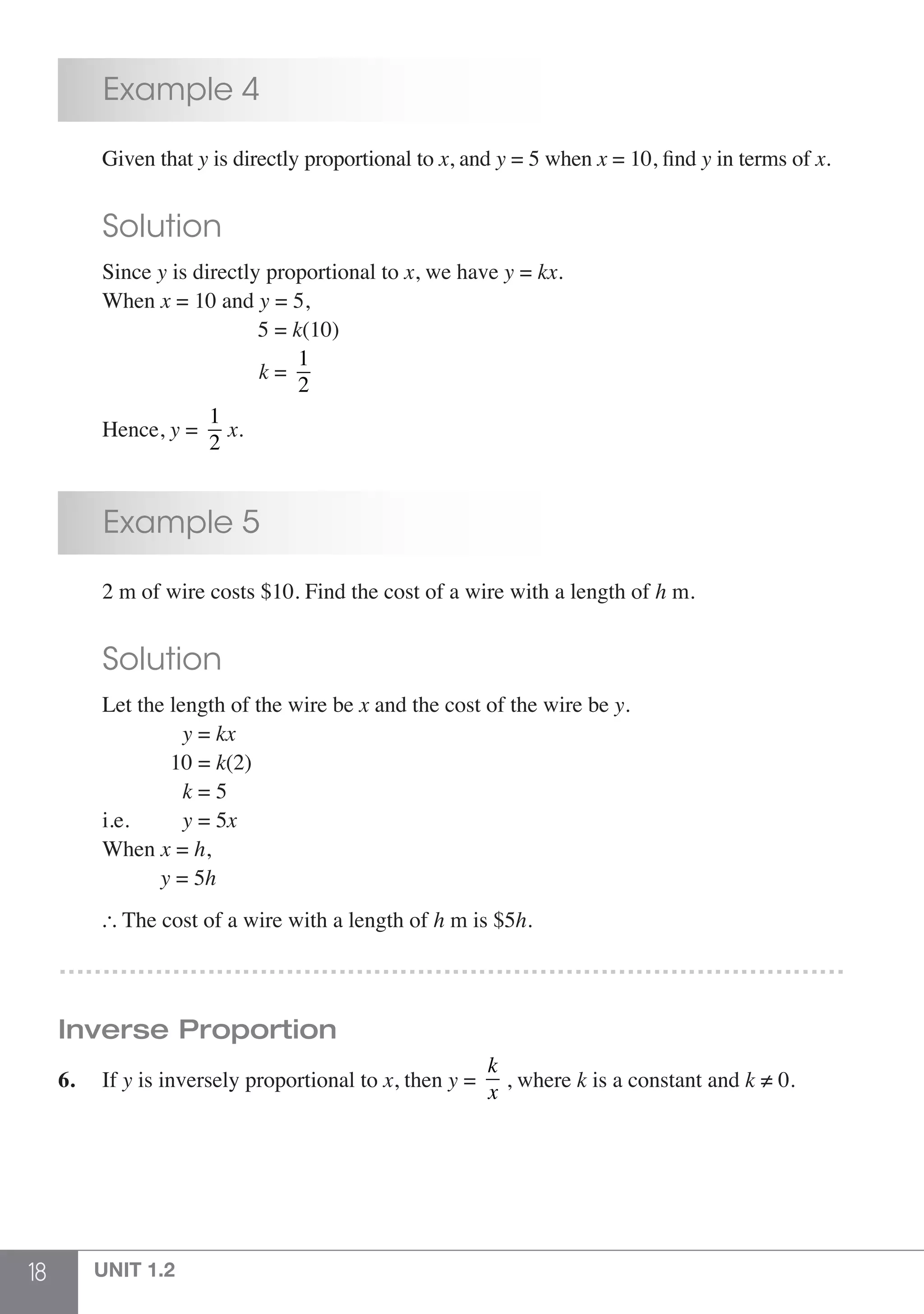
	Since y is directly proportional to x, we have y = kx.
	When x = 10 and y = 5,
			 5 = k(10)
			 k =
1
2
	Hence, y =
1
2
x.
	 Example 5
	 2 m of wire costs $10. Find the cost of a wire with a length of h m.
	 Solution
	 Let the length of the wire be x and the cost of the wire be y.
	 		 y = kx
		 10 = k(2)
			k = 5
	 i.e. 		 y = 5x
	When x = h,
		 y = 5h
	  The cost of a wire with a length of h m is $5h.
………………………………………………………………………………
Inverse Proportion
6.	If y is inversely proportional to x, then y =
k
x
, where k is a constant and k ≠ 0.
19Ratio, Rate and Proportion
	 Example 6
	 Given that y is inversely proportional to x, and y = 5 when x = 10, find y in terms of x.
	 Solution
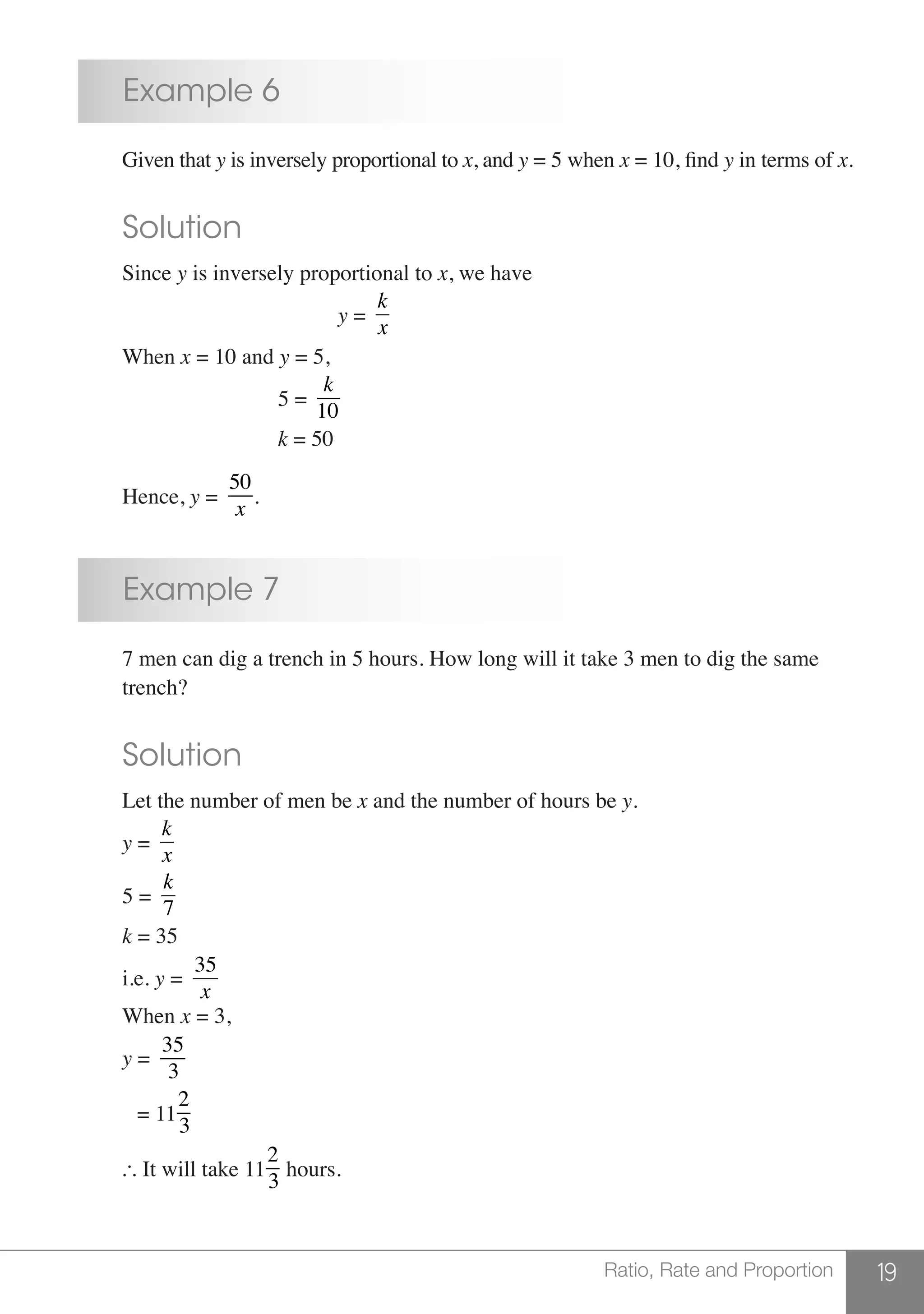
	Since y is inversely proportional to x, we have
						 y =
k
x
	When x = 10 and y = 5,
				 5 =
k
10
				 k = 50
	Hence, y =
50
x
.
	 Example 7
	 7 men can dig a trench in 5 hours. How long will it take 3 men to dig the same
	trench?
	 Solution
	 Let the number of men be x and the number of hours be y.
	 y =
k
x
	5 =
k
7
	 k = 35
	i.e. y =
35
x
	When x = 3,
	 y =
35
3
	 = 1111
2
3
	  It will take 1111
2
3
hours.
20 UNIT 1.2
Equivalent Ratio
7.	 To attain equivalent ratios involving fractions, we have to multiply or divide the
	 numbers of the ratio by the LCM.
	 Example 8
	
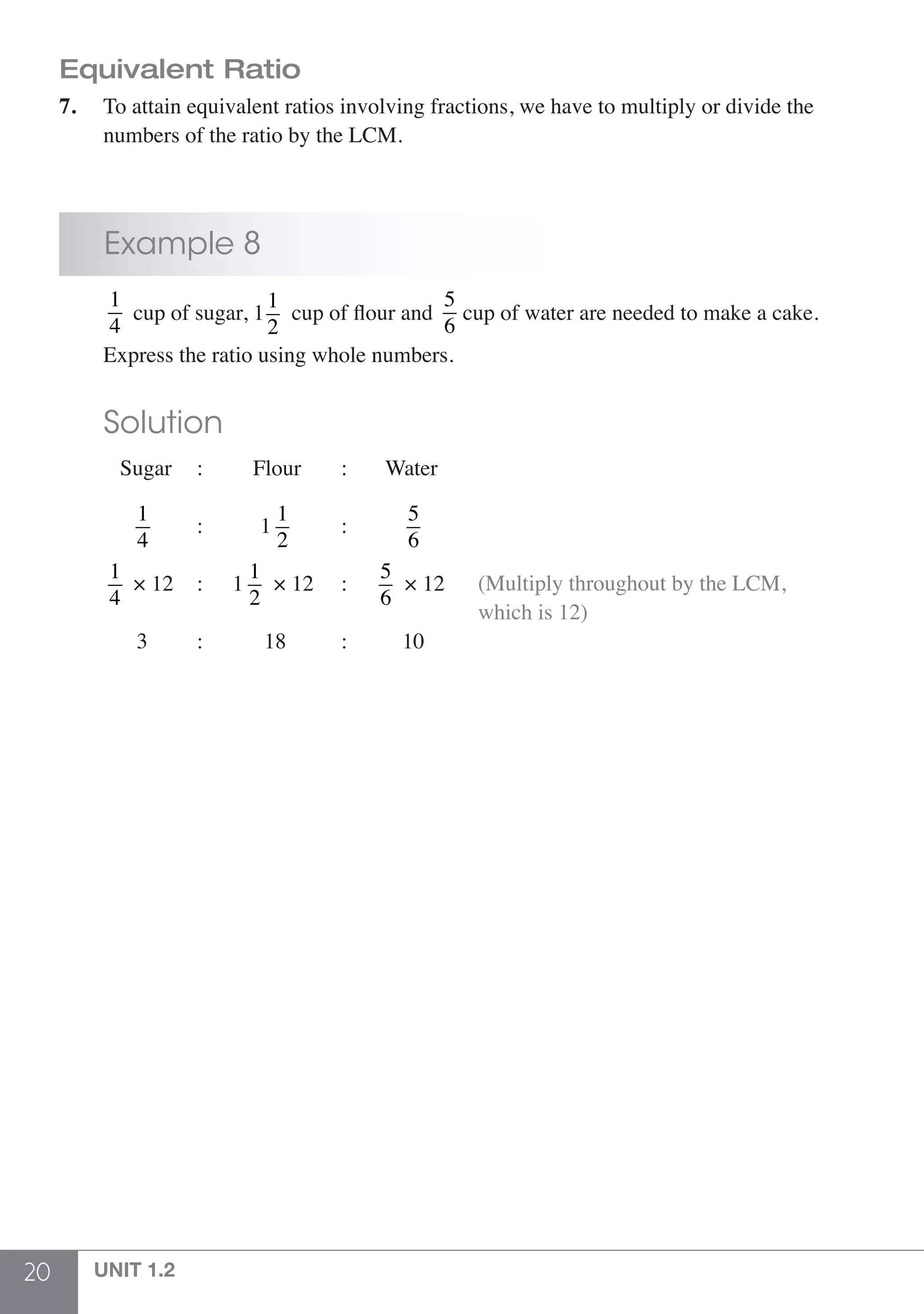
1
4
cup of sugar, 1
1
2
cup of flour and
5
6
cup of water are needed to make a cake. 	
	 Express the ratio using whole numbers.
	 Solution
	 Sugar	 : Flour 	 :	 Water
	
1
4
	 :	 1
1
2
	:	
5
6
	
1
4
× 12 	 :	 1
1
2
× 12	 :	
5
6
× 12 (Multiply throughout by the LCM,
which is 12)
	 3 	: 18 	 :	 10
21Percentage
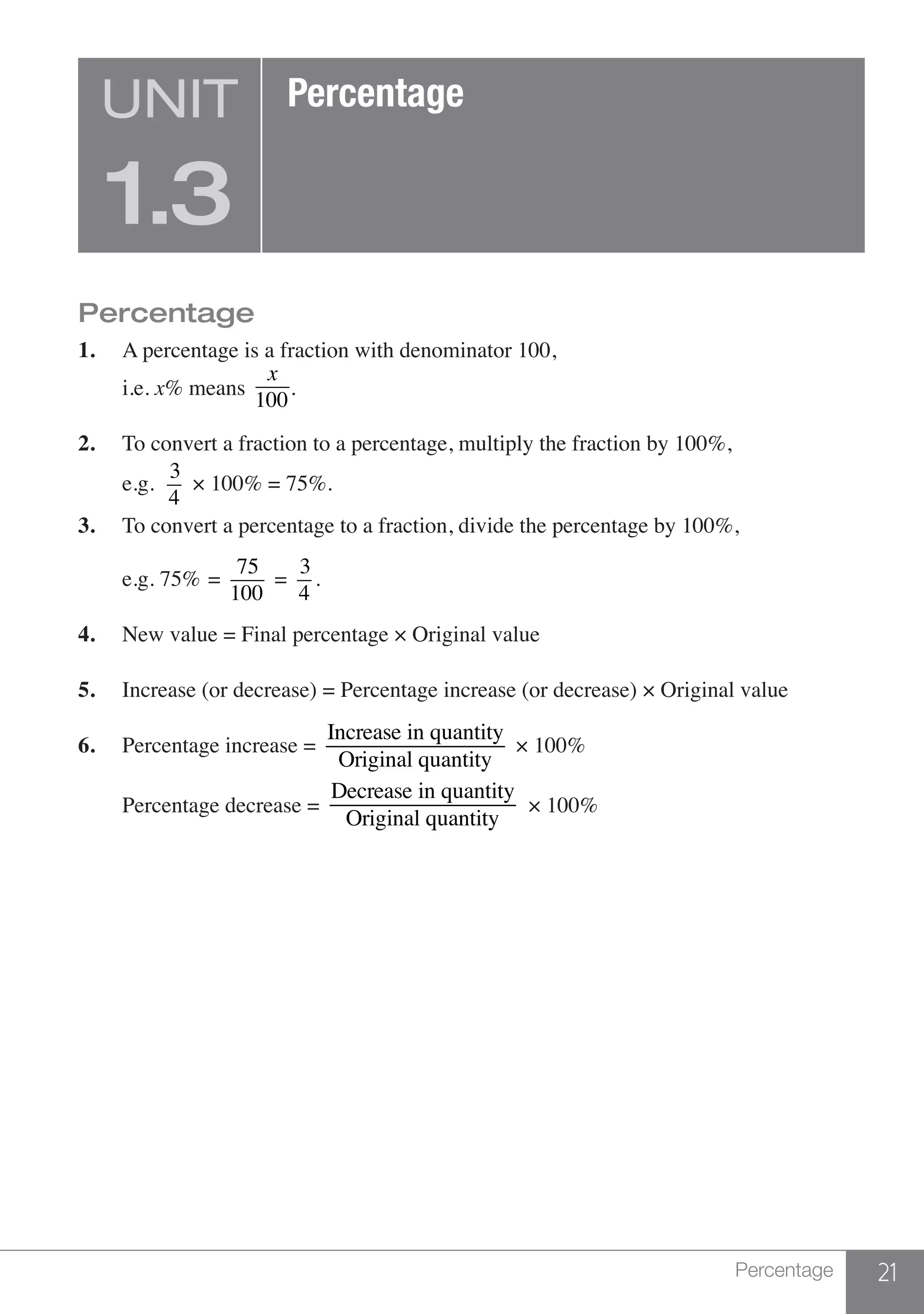
Percentage
1.	 A percentage is a fraction with denominator 100,
	i.e. x% means
x
100
.
2.	 To convert a fraction to a percentage, multiply the fraction by 100%,
	e.g.	
3
4
× 100% = 75%.
3.	 To convert a percentage to a fraction, divide the percentage by 100%,
	 e.g. 75%	 =
75
100
=
3
4
.
4.	 New value = Final percentage × Original value
5.	 Increase (or decrease) = Percentage increase (or decrease) × Original value
6.	 Percentage increase =
Increase in quantity
Original quantity
× 100%
	Percentage decrease =
Decrease in quantity
Original quantity
× 100%
UNIT
1.3
Percentage
22 UNIT 1.3
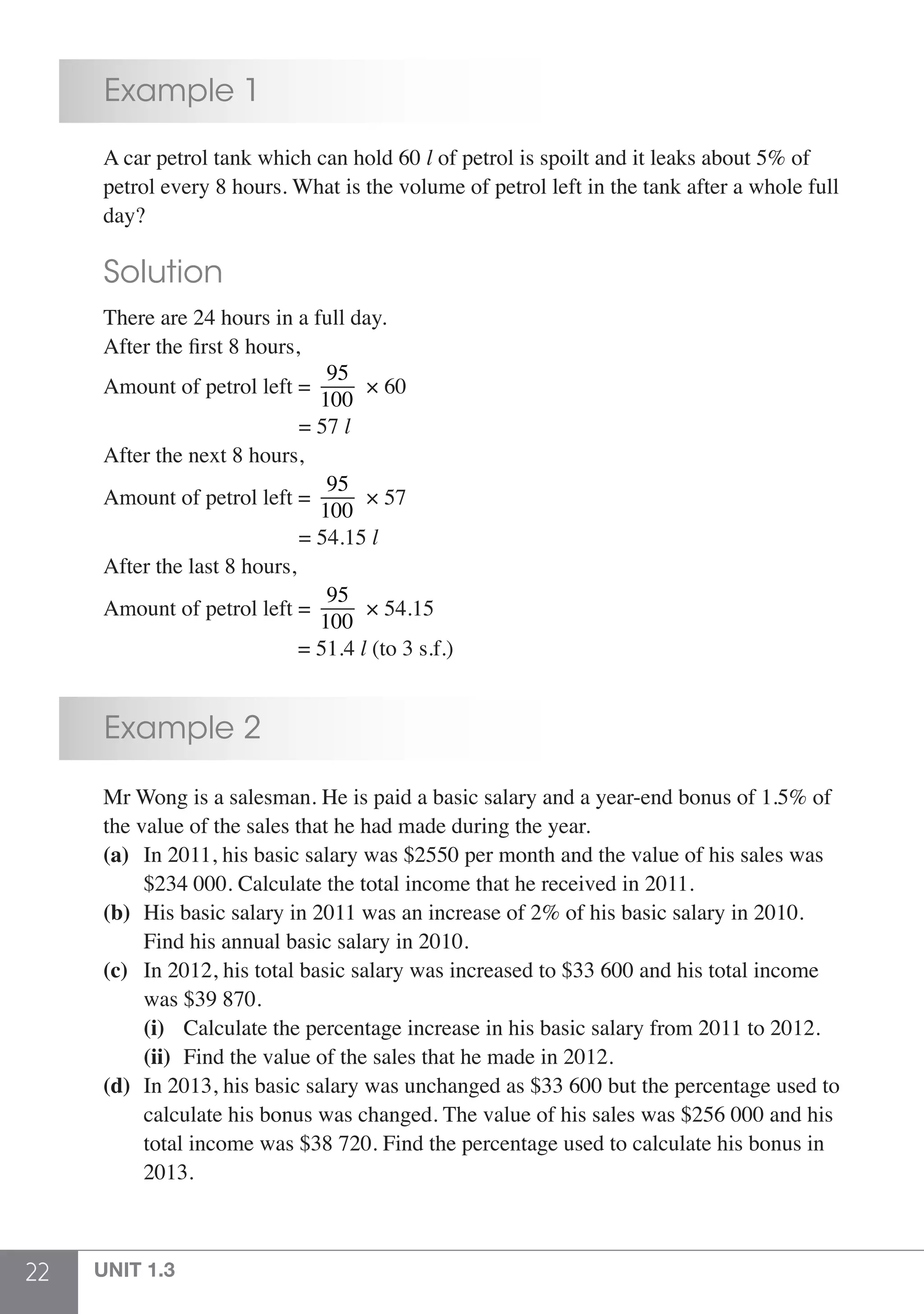
	 Example 1
	 A car petrol tank which can hold 60 l of petrol is spoilt and it leaks about 5% of
	 petrol every 8 hours. What is the volume of petrol left in the tank after a whole full
	day?
	 Solution
	 There are 24 hours in a full day.
	 After the first 8 hours,
	 Amount of petrol left =
95
100
× 60
					 = 57 l
	 After the next 8 hours,
	 Amount of petrol left =
95
100
× 57
					 = 54.15 l
	 After the last 8 hours,
	 Amount of petrol left =
95
100
× 54.15
					 = 51.4 l (to 3 s.f.)
	 Example 2
	 Mr Wong is a salesman. He is paid a basic salary and a year-end bonus of 1.5% of
	 the value of the sales that he had made during the year.
	 (a)	 In 2011, his basic salary was $2550 per month and the value of his sales was
		 $234 000. Calculate the total income that he received in 2011.
	 (b)	 His basic salary in 2011 was an increase of 2% of his basic salary in 2010. 	
		 Find his annual basic salary in 2010.
	 (c)	 In 2012, his total basic salary was increased to $33 600 and his total income
		 was $39 870.
		(i)	 Calculate the percentage increase in his basic salary from 2011 to 2012.
		(ii)	 Find the value of the sales that he made in 2012.
	 (d)	 In 2013, his basic salary was unchanged as $33 600 but the percentage used to
		 calculate his bonus was changed. The value of his sales was $256 000 and his
		 total income was $38 720. Find the percentage used to calculate his bonus in
		2013.
23Percentage
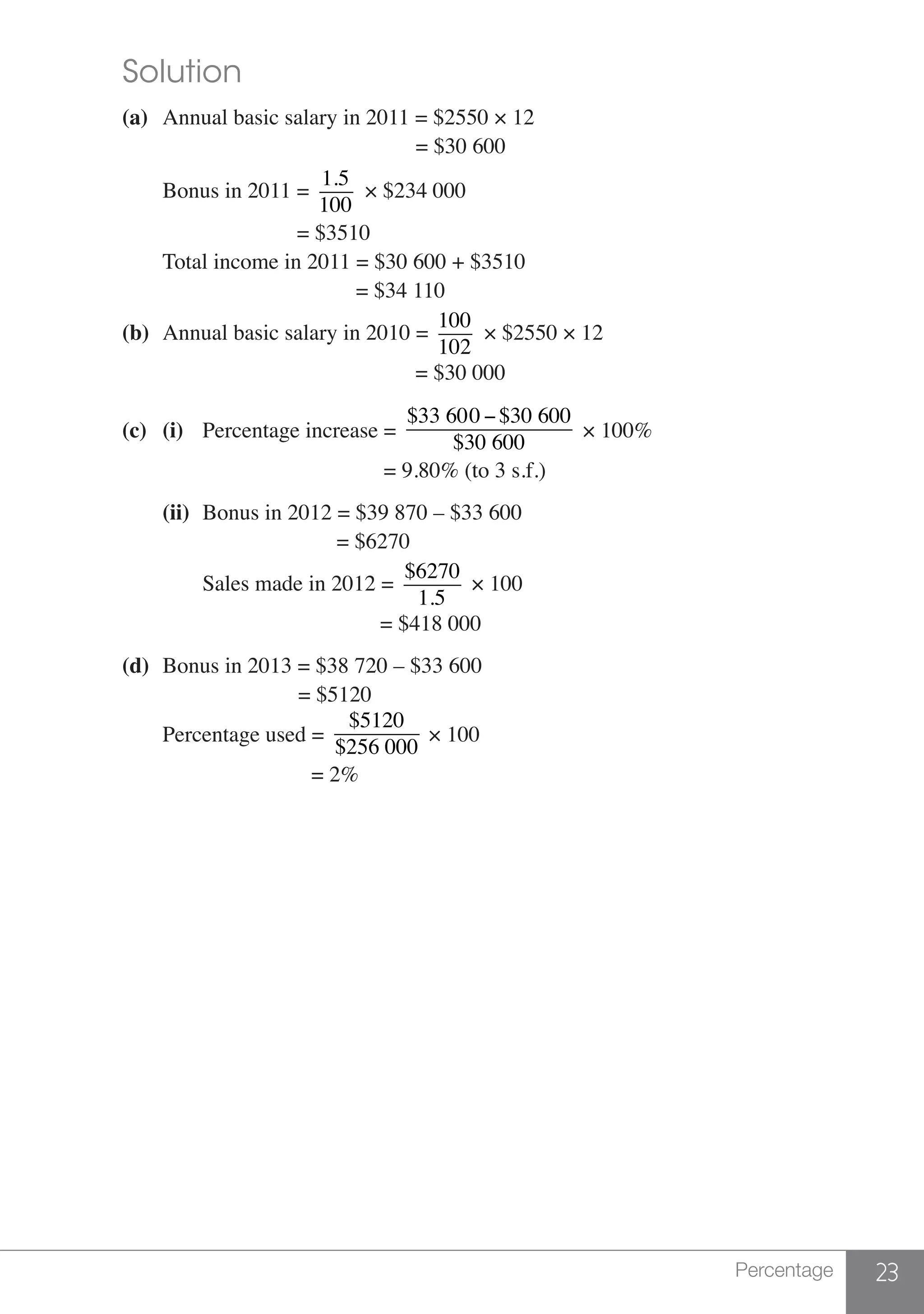
	 Solution
	 (a)	 Annual basic salary in 2011 = $2550 × 12
						 = $30 600
		 Bonus in 2011 =
1.5
100
× $234 000
					 = $3510
		 Total income in 2011 = $30 600 + $3510
						 = $34 110
	 (b)	 Annual basic salary in 2010 =
100
102
× $2550 × 12
		 = $30 000
	 (c)	(i)	 Percentage increase =
$33 600 −$30 600
$30 600
× 100%
	 					 = 9.80% (to 3 s.f.)
		(ii)	 Bonus in 2012 = $39 870 – $33 600
					 = $6270
			 Sales made in 2012 =
$6270
1.5
× 100
			 = $418 000
	 (d)	 Bonus in 2013 = $38 720 – $33 600		
					 = $5120
		 Percentage used =
$5120
$256 000
× 100
				 = 2%
24 UNIT 1.4
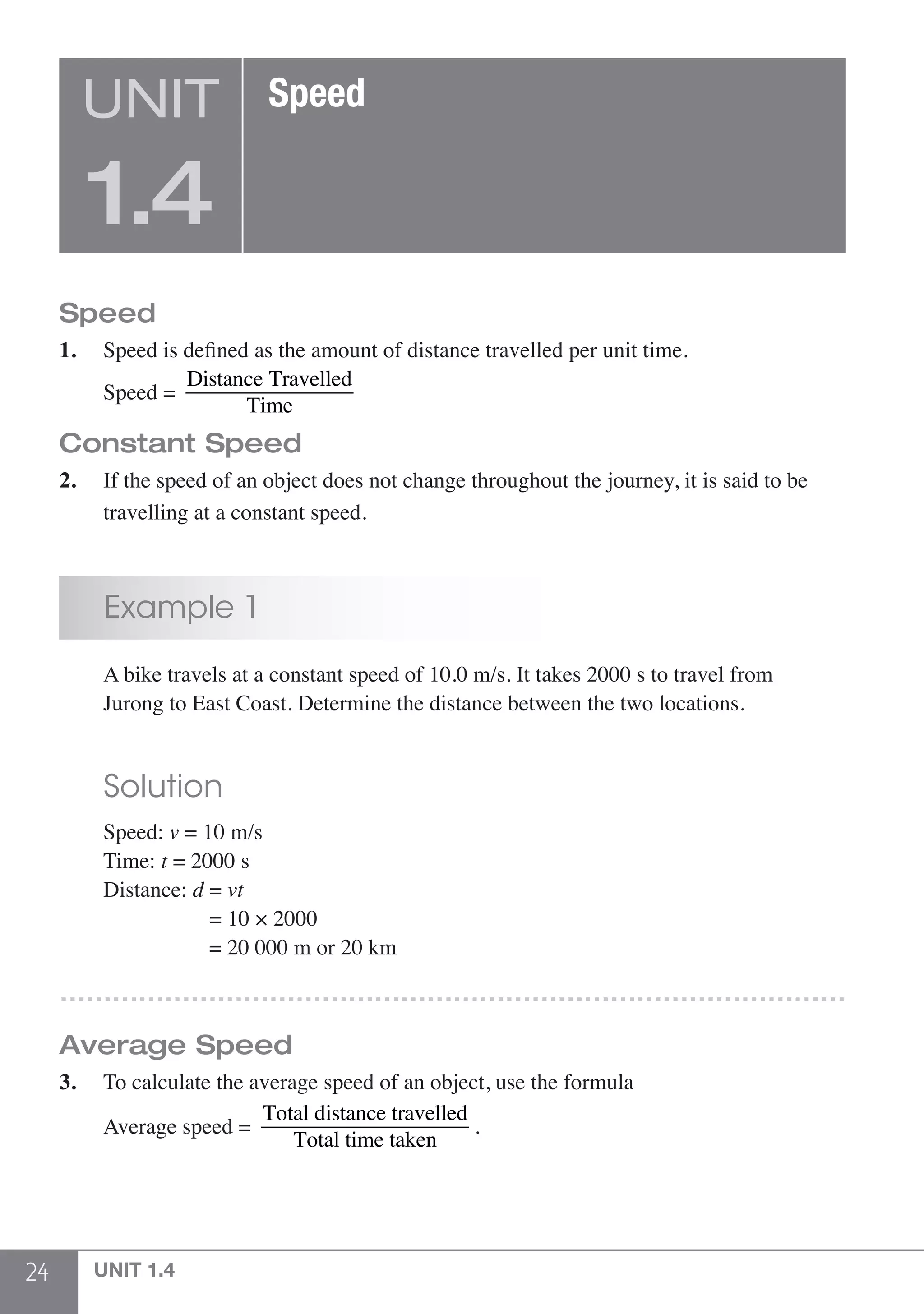
Speed
1.	 Speed is defined as the amount of distance travelled per unit time.
	Speed =
Distance Travelled
Time
Constant Speed
2.	 If the speed of an object does not change throughout the journey, it is said to be
	 travelling at a constant speed.
	 Example 1
	 A bike travels at a constant speed of 10.0 m/s. It takes 2000 s to travel from
	 Jurong to East Coast. Determine the distance between the two locations.
	 Solution
	Speed: v = 10 m/s
	 Time: t = 2000 s
	 Distance: d = vt
	 	             = 10 × 2000
	      	            = 20 000 m or 20 km
………………………………………………………………………………
Average Speed
3.	 To calculate the average speed of an object, use the formula
	 Average speed =
Total distance travelled
Total time taken
.
UNIT
1.4
Speed
25Speed
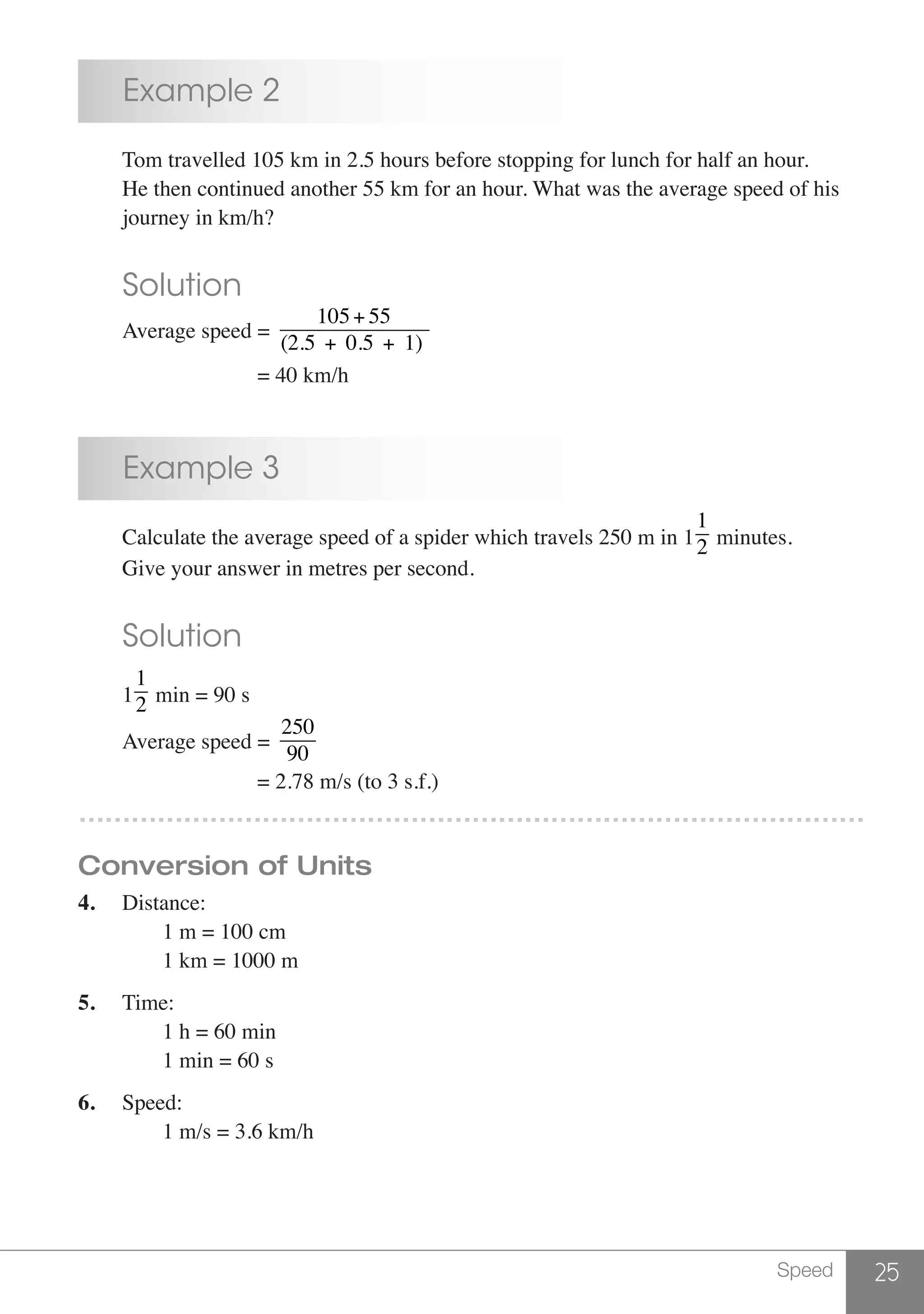
	 Example 2
	 Tom travelled 105 km in 2.5 hours before stopping for lunch for half an hour.
	 He then continued another 55 km for an hour. What was the average speed of his
	 journey in km/h?
	 Solution
	 Average speed =
105+ 55
(2.5 + 0.5 + 1)
			 = 40 km/h
	 Example 3
	 Calculate the average speed of a spider which travels 250 m in 11
1
2 minutes.
	 Give your answer in metres per second.
	 Solution
	 11
1
2 min = 90 s
	 Average speed =
250
90
	 = 2.78 m/s (to 3 s.f.)
………………………………………………………………………………
Conversion of Units
4.	 Distance:
	 	 1 m = 100 cm
	 	 1 km = 1000 m
5.	 Time:
	 	 1 h = 60 min
	 	 1 min = 60 s
6.	Speed:
	 	 1 m/s = 3.6 km/h
26 UNIT 1.4
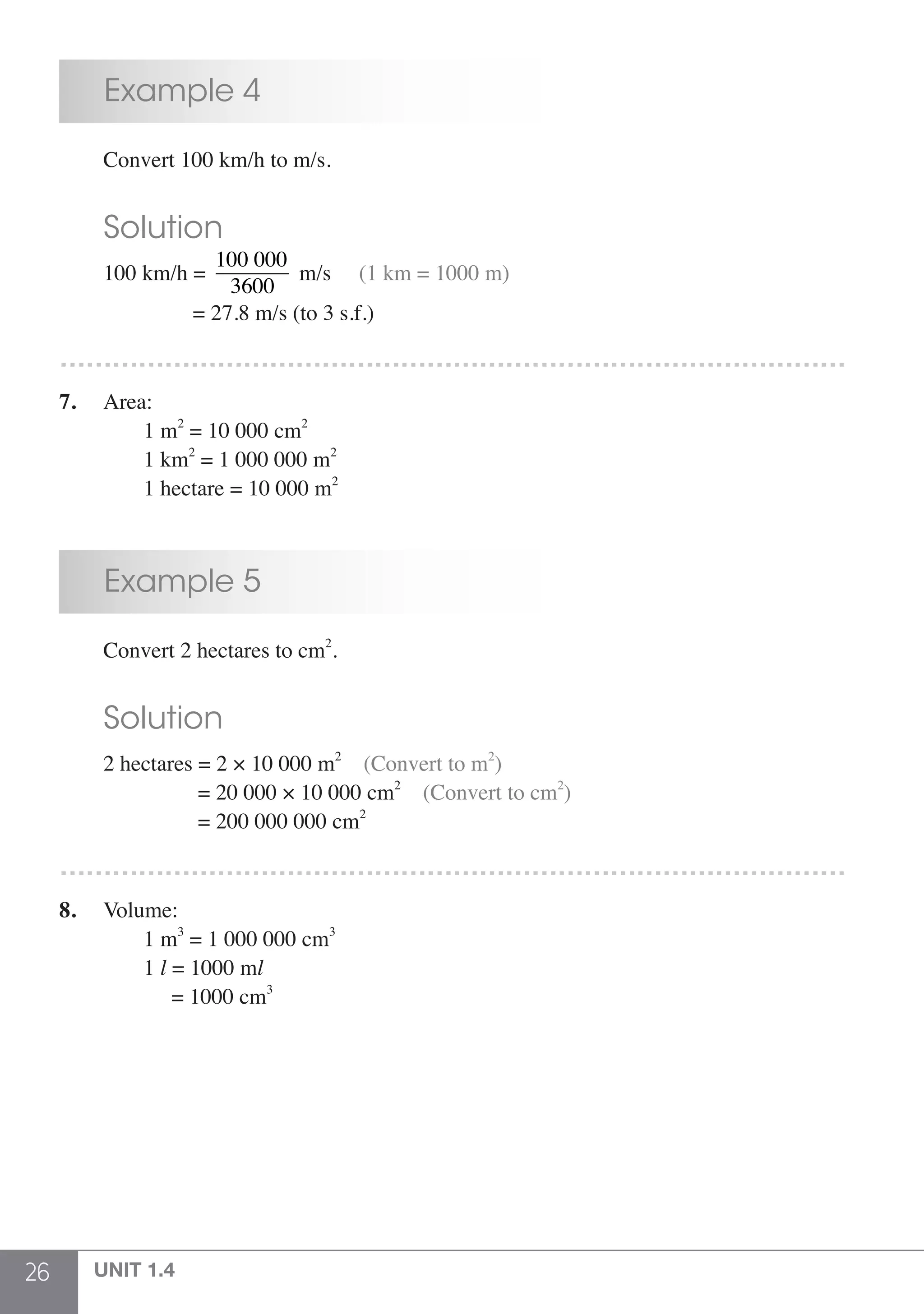
	 Example 4
	 Convert 100 km/h to m/s.
	 Solution
	 100 km/h =
100 000
3600
m/s     (1 km = 1000 m)
			 = 27.8 m/s (to 3 s.f.)
………………………………………………………………………………
7.	 Area:
	 	 1 m2
= 10 000 cm2
	 	 1 km2
= 1 000 000 m2
	 	 1 hectare = 10 000 m2
	 Example 5
	 Convert 2 hectares to cm2
.
	 Solution
	 2 hectares = 2 × 10 000 m2
(Convert to m2
)
	 	           = 20 000 × 10 000 cm2
(Convert to cm2
)
	 	 	   = 200 000 000 cm2
………………………………………………………………………………
8.	 Volume:
	 	 1 m3
= 1 000 000 cm3
	 	 1 l = 1000 ml
	 	      = 1000 cm3
27Speed
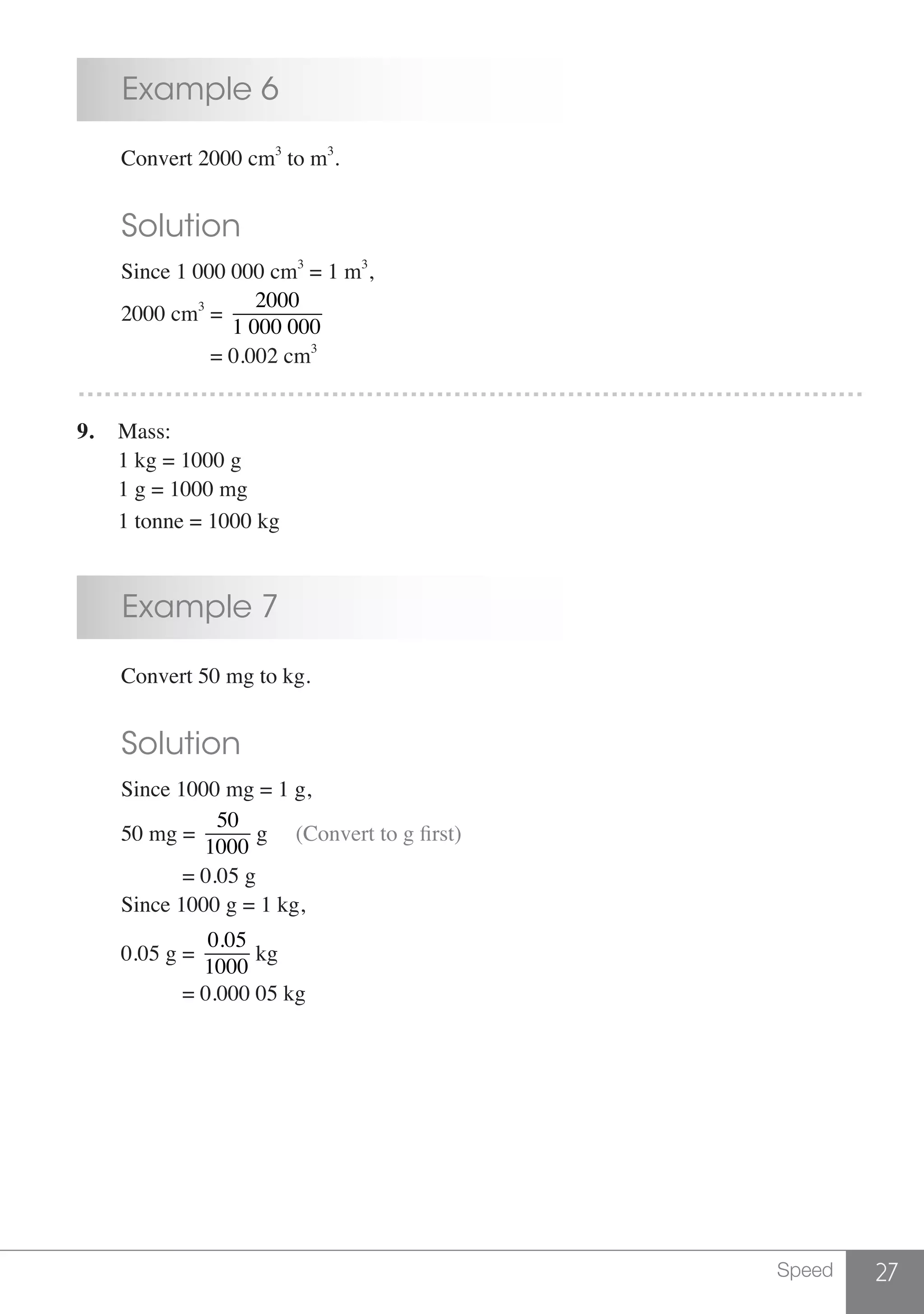
	 Example 6
	 Convert 2000 cm3
to m3
.
	 Solution
	 Since 1 000 000 cm3
= 1 m3
,
	 2000 cm3
=
2000
1 000 000
	 = 0.002 cm3
………………………………………………………………………………
9.	 Mass:
	 1 kg = 1000 g
	 1 g = 1000 mg
	 1 tonne = 1000 kg
	 Example 7
	 Convert 50 mg to kg.
	 Solution
	 Since 1000 mg = 1 g,
	 50 mg =
50
1000
g	 (Convert to g first)
		 = 0.05 g
	 Since 1000 g = 1 kg,
	 0.05 g =
0.05
1000
kg
	 = 0.000 05 kg
28 UNIT 1.5
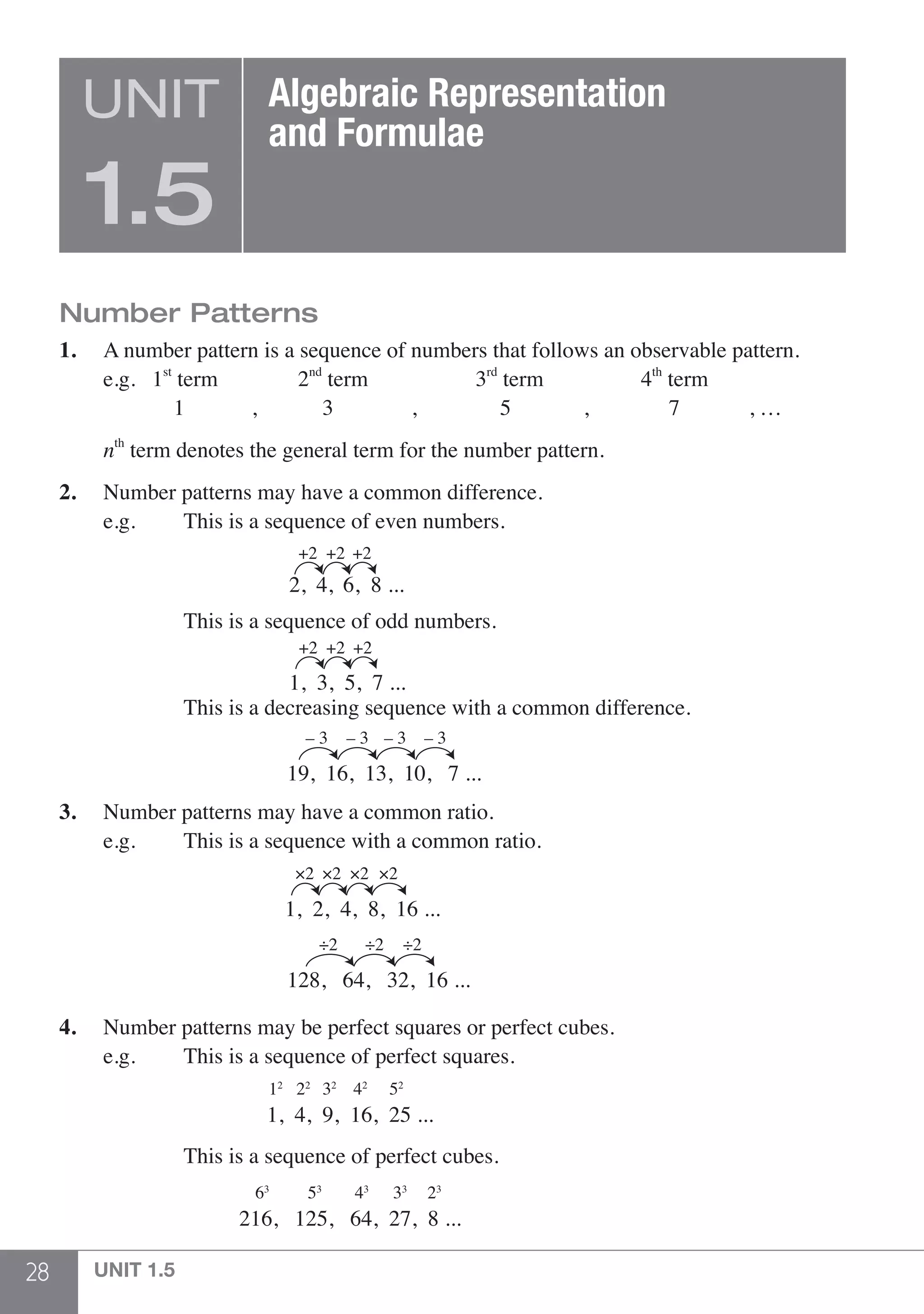
Number Patterns
1.	 A number pattern is a sequence of numbers that follows an observable pattern.
	 e.g. 1st
term	 2nd
term	 3rd
term	 4th
term
		 1 ,	 3 , 5	 ,	 7	 , …
	 nth
term denotes the general term for the number pattern.
2.	 Number patterns may have a common difference.
	 e.g. 		 This is a sequence of even numbers.
			 2, 4, 6, 8 ...
+2 +2 +2
			 This is a sequence of odd numbers.
			 1, 3, 5, 7 ...
+2 +2 +2
			 This is a decreasing sequence with a common difference.
					 19, 16, 13, 10, 7 ...
– 3 – 3 – 3 – 3
3.	 Number patterns may have a common ratio.
	 e.g.		 This is a sequence with a common ratio.
	
					
1, 2, 4, 8, 16 ...
×2 ×2 ×2 ×2
					
128, 64, 32, 16 ...
÷2 ÷2 ÷2
4.	 Number patterns may be perfect squares or perfect cubes.
	 e.g.		 This is a sequence of perfect squares.
			 1, 4, 9, 16, 25 ...
12
22
32
42
52
			 This is a sequence of perfect cubes.
			 216, 125, 64, 27, 8 ...
63
53
43
33
23
UNIT
1.5
Algebraic Representation
and Formulae
29Algebraic Representation and Formulae
	 Example 1
	 How many squares are there on a 8 × 8 chess board?
	 Solution
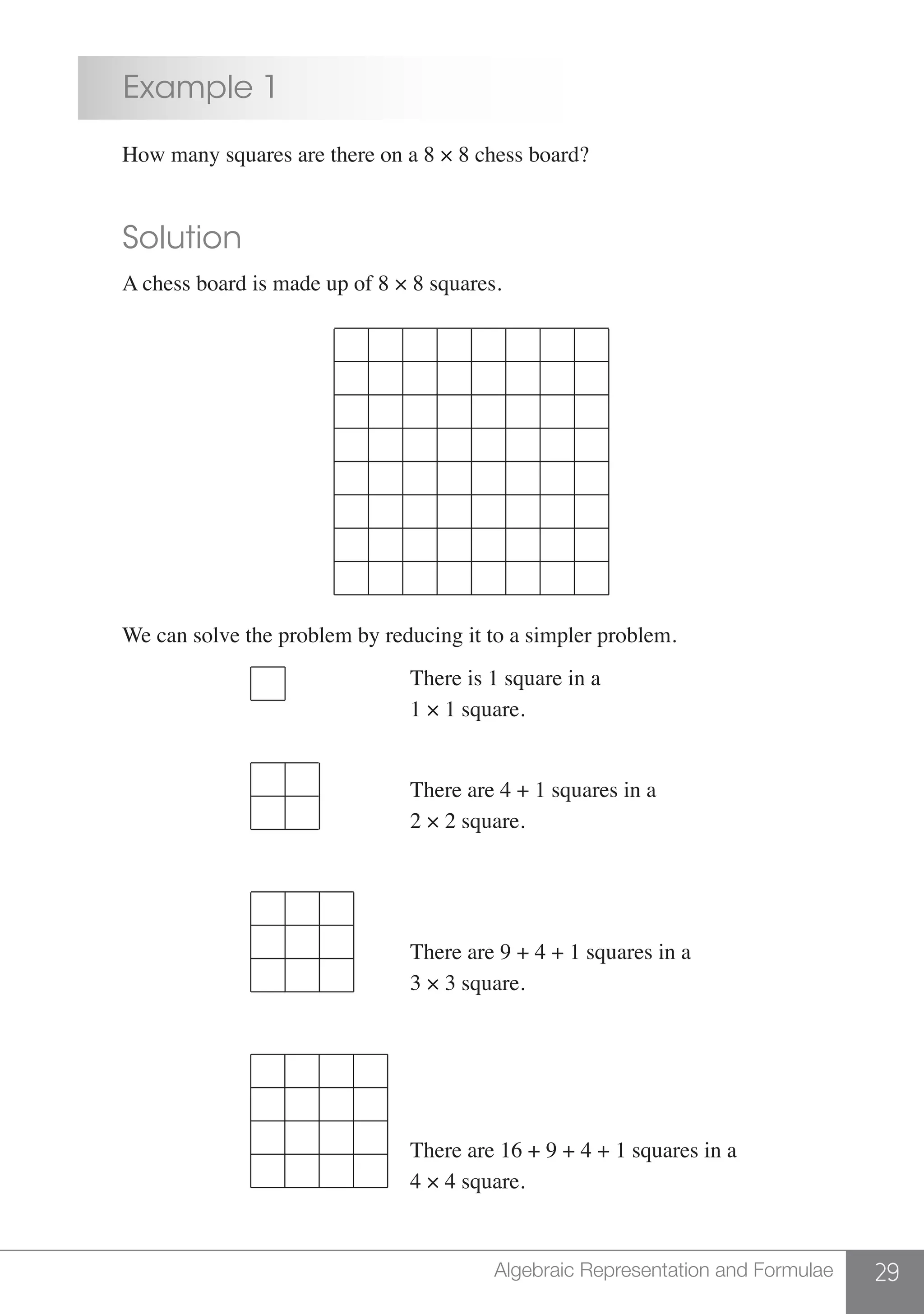
	 A chess board is made up of 8 × 8 squares.
	
	 We can solve the problem by reducing it to a simpler problem.
	
	
There is 1 square in a
1 × 1 square.
There are 4 + 1 squares in a
2 × 2 square.
There are 9 + 4 + 1 squares in a
3 × 3 square.
There are 16 + 9 + 4 + 1 squares in a
4 × 4 square.
30 UNIT 1.5
	 Study the pattern in the table.
	
Size of square Number of squares
1 × 1 1 = 12
2 × 2 4 + 1 = 22
+ 12
3 × 3 9 + 4 + 1 = 32
+ 22
+ 12
4 × 4 16 + 9 + 4 + 1 = 42
+ 32
+ 22
+ 12
.
.
.
.
.
.
8 × 8 82
+ 72
+ 62
+... + 12
	
	  The chess board has 82
+ 72
+ 62
+ … + 12
= 204 squares.
	 Example 2
	 Find the value of 1+
1
2
+
1
4
+
1
8
+
1
16
+….
	 Solution
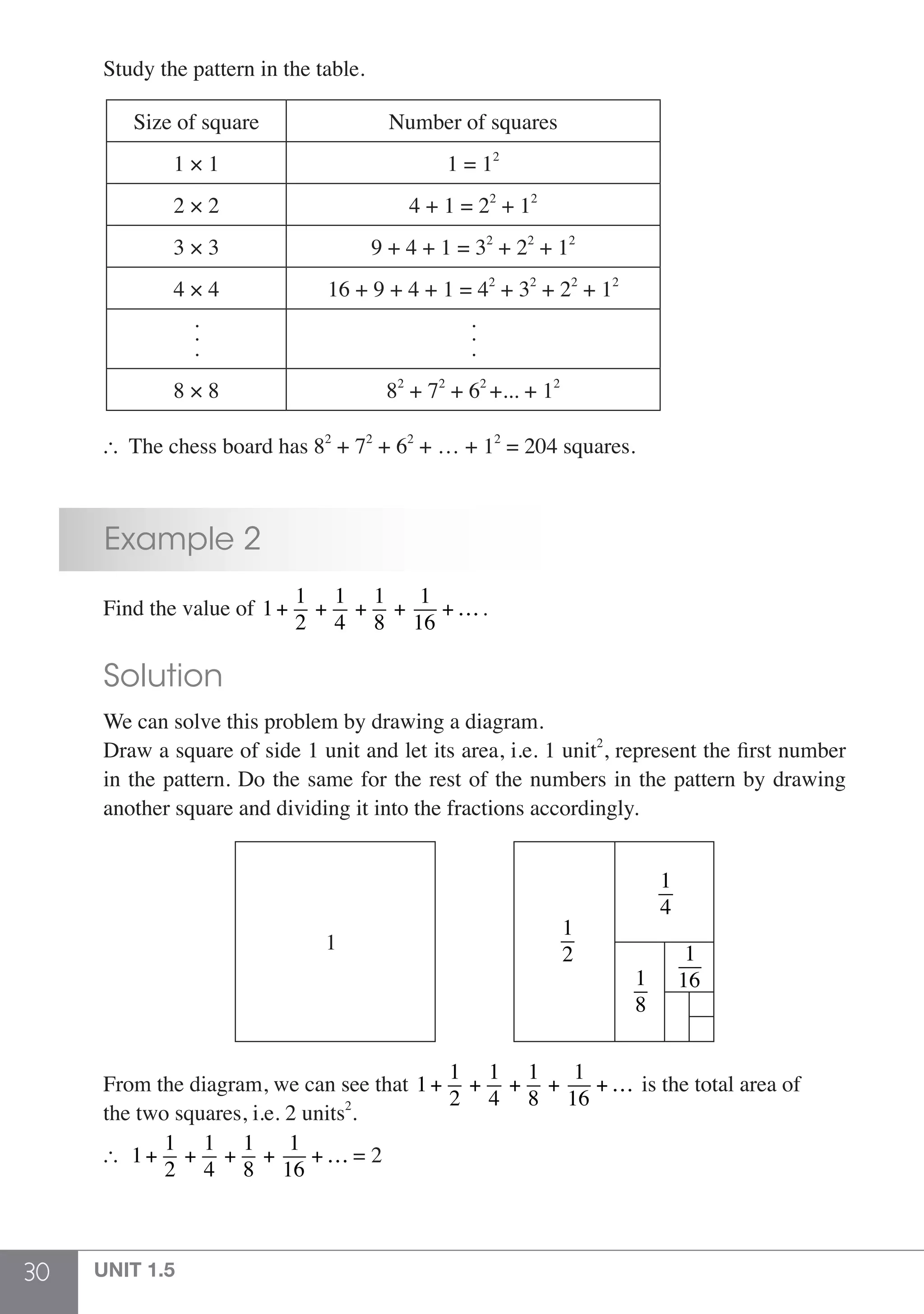
	 We can solve this problem by drawing a diagram.
	 Draw a square of side 1 unit and let its area, i.e. 1 unit2
, represent the first number
	 in the pattern. Do the same for the rest of the numbers in the pattern by drawing
	 another square and dividing it into the fractions accordingly.
	 1
2
1
1
4
1
8
1
16
	 From the diagram, we can see that 1+
1
2
+
1
4
+
1
8
+
1
16
+… is the total area of
	 the two squares, i.e. 2 units2
.
	  1+
1
2
+
1
4
+
1
8
+
1
16
+… = 2
31Algebraic Representation and Formulae
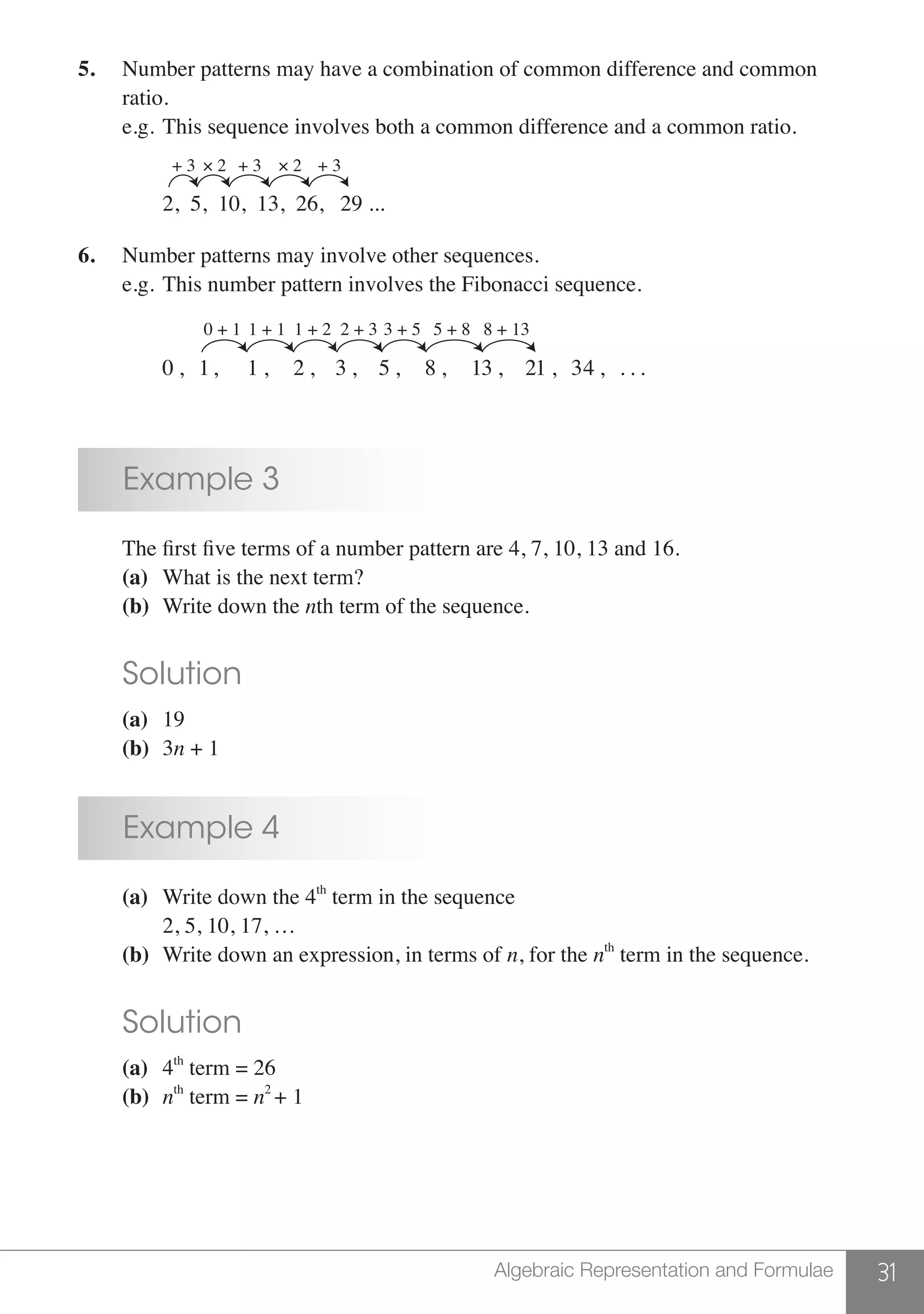
5.	 Number patterns may have a combination of common difference and common
	ratio.
	 e.g.	This sequence involves both a common difference and a common ratio.
		2, 5, 10, 13, 26, 29 ...
+ 3 + 3 + 3× 2× 2
6.	 Number patterns may involve other sequences.
	 e.g.	This number pattern involves the Fibonacci sequence.
		
0 , 1, 1 , 2 , 3 , 5 , 8 , 13 , 21 , 34 , . . .
0 + 1 1 + 1 1 + 2 2 + 3 3 + 5 5 + 8 8 + 13
	 Example 3
	 The first five terms of a number pattern are 4, 7, 10, 13 and 16.
	 (a)	 What is the next term?
	 (b)	 Write down the nth term of the sequence.
	 Solution
	 (a)	19
	 (b)	3n + 1
	 Example 4
	 (a)	 Write down the 4th
term in the sequence
		 2, 5, 10, 17, …
	 (b)	 Write down an expression, in terms of n, for the nth
term in the sequence.
	 Solution
	 (a) 	4th
term = 26
	 (b) 	nth
term = n2
+ 1
32 UNIT 1.5
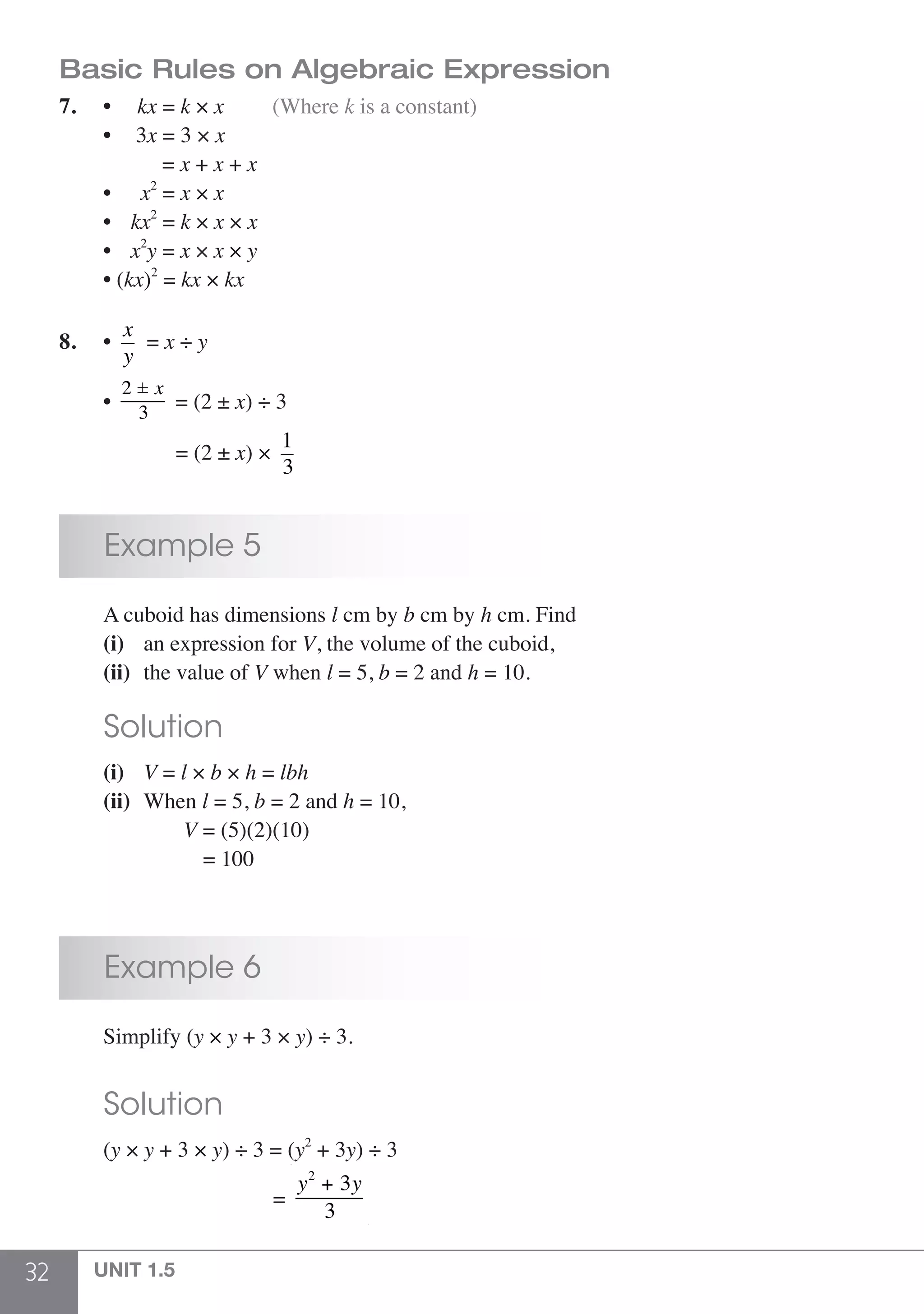
Basic Rules on Algebraic Expression
7. 	 • kx = k × x		 (Where k is a constant)
	• 3x = 3 × x
	 = x + x + x
	 • x2
= x × x
	 • kx2
= k × x × x
	 • x2
y = x × x × y
	 • (kx)2
= kx × kx
8.	 •
x
y
= x ÷ y
	 •
2 ± x
3
= (2 ± x) ÷ 3
	 = (2 ± x) ×
1
3
	 Example 5
	 A cuboid has dimensions l cm by b cm by h cm. Find
	 (i)	 an expression for V, the volume of the cuboid,
	 (ii)	 the value of V when l = 5, b = 2 and h = 10.
	 Solution
	 (i)	 V = l × b × h = lbh
	 (ii)	When l = 5, b = 2 and h = 10,
			V = (5)(2)(10)
			 = 100
	 Example 6
	 Simplify (y × y + 3 × y) ÷ 3.
	 Solution
	(y × y + 3 × y) ÷ 3 = (y2
+ 3y) ÷ 3
	 =
y2
+ 3y
3
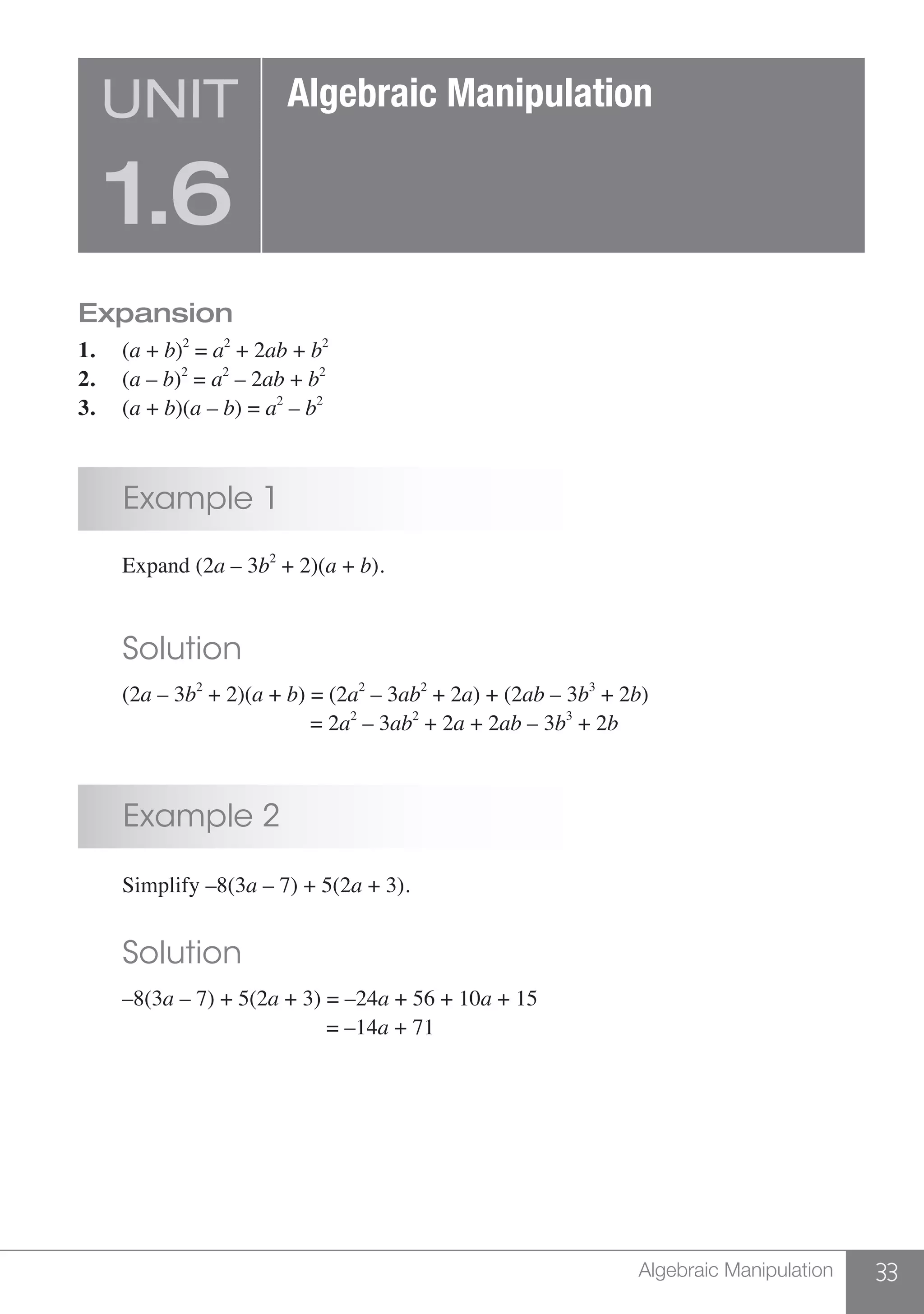
33Algebraic Manipulation
Expansion
1.	(a + b)2
= a2
+ 2ab + b2
2.	(a – b)2
= a2
– 2ab + b2
3.	(a + b)(a – b) = a2
– b2
	 Example 1
	 Expand (2a – 3b2
+ 2)(a + b).
	 Solution
	(2a – 3b2
+ 2)(a + b) = (2a2
– 3ab2
+ 2a) + (2ab – 3b3
+ 2b)
					 = 2a2
– 3ab2
+ 2a + 2ab – 3b3
+ 2b
	 Example 2
	 Simplify –8(3a – 7) + 5(2a + 3).
	 Solution
	–8(3a – 7) + 5(2a + 3) = –24a + 56 + 10a + 15
					 = –14a + 71
UNIT
1.6
Algebraic Manipulation
34 UNIT 1.6
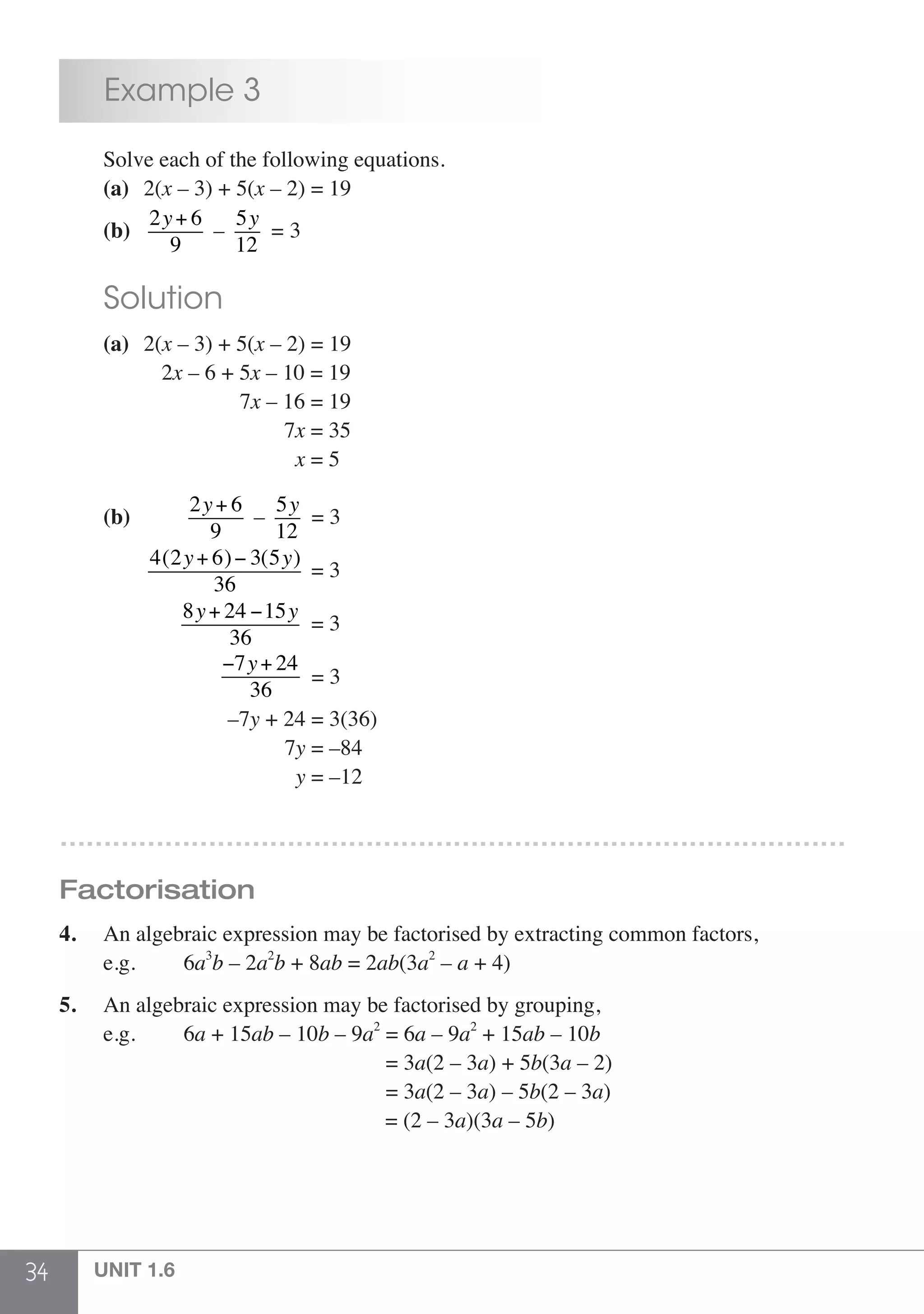
	 Example 3
	 Solve each of the following equations.
	 (a)	2(x – 3) + 5(x – 2) = 19
	 (b)	
2y+ 6
9
–
5y
12
= 3
	 Solution
	 (a)	2(x – 3) + 5(x – 2) = 19
		 2x – 6 + 5x – 10 = 19
		 7x – 16 = 19
		 7x = 35
		 x = 5
		
	 (b)	
2y+ 6
9
–
5y
12
= 3
		
4(2y+ 6)− 3(5y)
36
= 3
		
8y+ 24 −15y
36
= 3
		
−7y+ 24
36
= 3
		 –7y + 24 = 3(36)
		 7y = –84
		 y = –12
………………………………………………………………………………
Factorisation
4.	 An algebraic expression may be factorised by extracting common factors,
	 e.g. 		 6a3
b – 2a2
b + 8ab = 2ab(3a2
– a + 4)
5.	 An algebraic expression may be factorised by grouping,
	 e.g. 		 6a + 15ab – 10b – 9a2
= 6a – 9a2
+ 15ab – 10b
						 = 3a(2 – 3a) + 5b(3a – 2)
					 = 3a(2 – 3a) – 5b(2 – 3a)
						 = (2 – 3a)(3a – 5b)
35Algebraic Manipulation
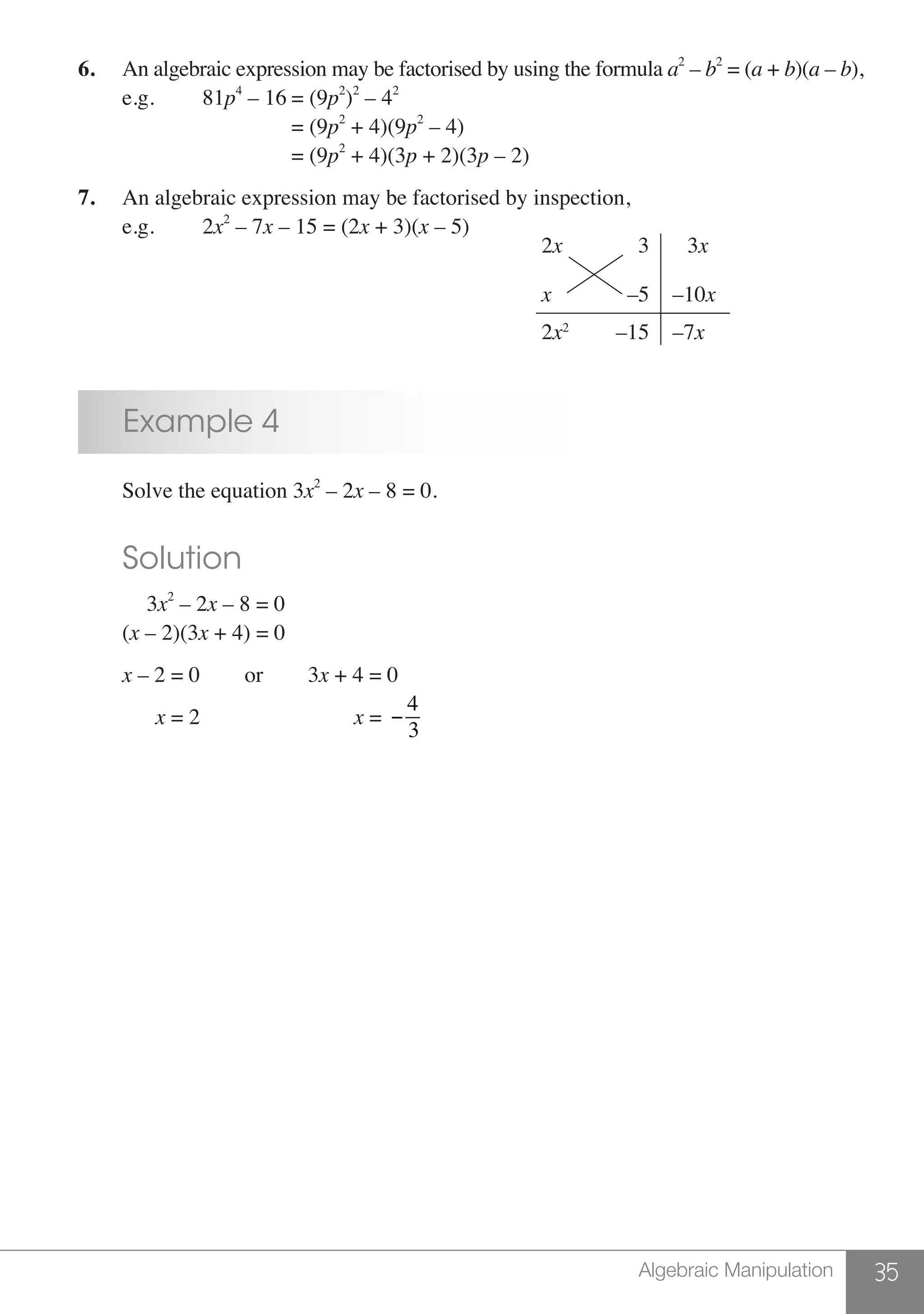
6.	 An algebraic expression may be factorised by using the formula a2
– b2
= (a + b)(a – b),
	 e.g. 		 81p4
– 16	= (9p2
)2
– 42
			 	 = (9p2
+ 4)(9p2
– 4)
		 	 = (9p2
+ 4)(3p + 2)(3p – 2)
7.	 An algebraic expression may be factorised by inspection,
	 e.g. 		 2x2
– 7x – 15 = (2x + 3)(x – 5)
3x
–10x
–7x
2x
x
2x2
3
–5
–15
	 Example 4
	 Solve the equation 3x2
– 2x – 8 = 0.
	 Solution
	 3x2
– 2x – 8 = 0
	(x – 2)(3x + 4) = 0
	 x – 2 = 0		 or	 3x + 4 = 0
	 x = 2		 x = −
4
3
36 UNIT 1.6
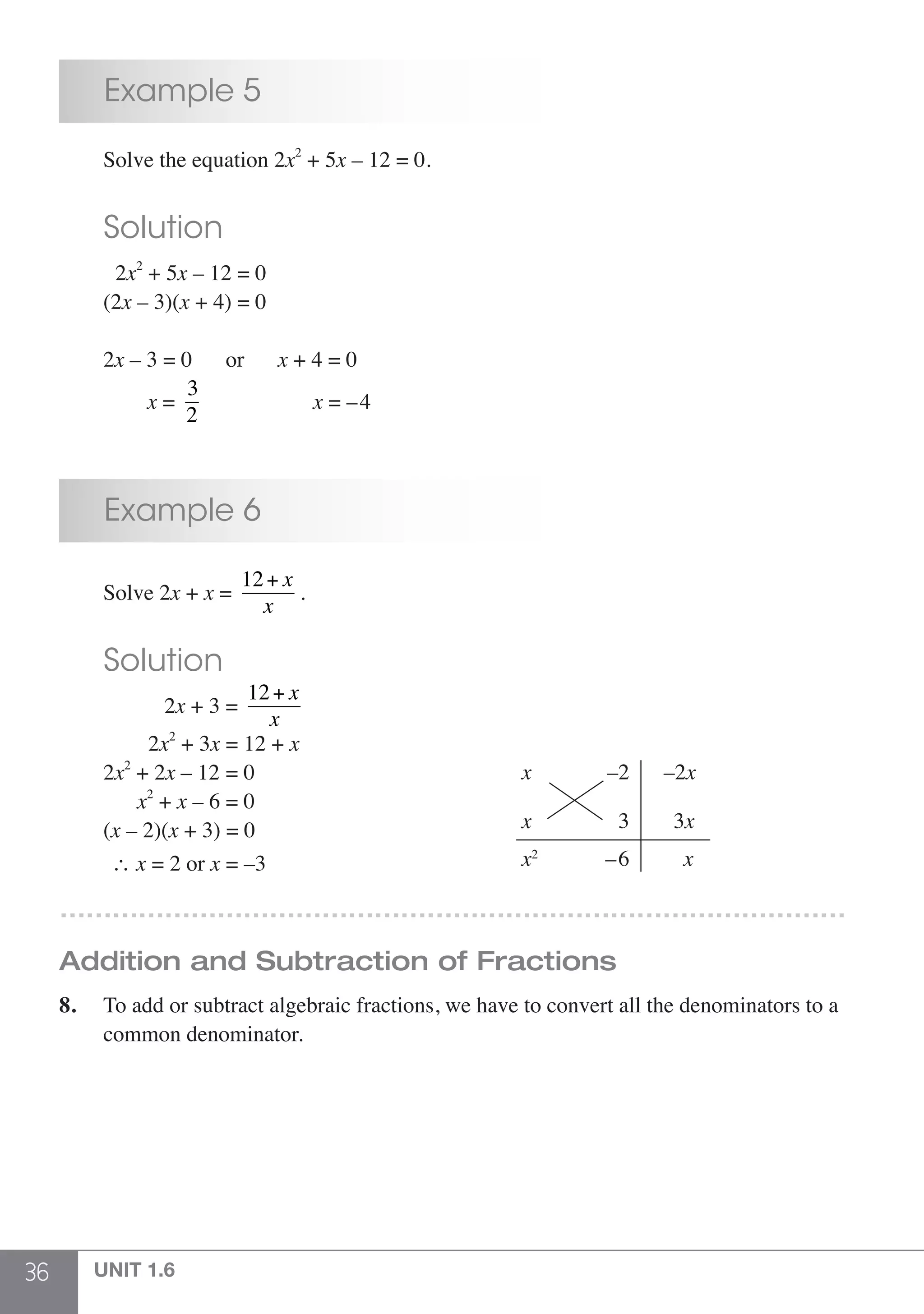
	 Example 5
	 Solve the equation 2x2
+ 5x – 12 = 0.
	 Solution
	 2x2
+ 5x – 12 = 0
	(2x – 3)(x + 4) = 0
	2x – 3 = 0	 or	 x + 4 = 0
x =
3
2
		 x = –4
	 Example 6
	 Solve 2x + x =
12+ x
x
.
	 Solution
	 2x + 3 =
12+ x
x
	 2x2
+ 3x = 12 + x
	2x2
+ 2x – 12 = 0
	 x2
+ x – 6 = 0
	(x – 2)(x + 3) = 0
–2x
3x
x
x
x
x2
–2
3
–6	 ∴ x = 2 or x = –3
………………………………………………………………………………
Addition and Subtraction of Fractions
8.	 To add or subtract algebraic fractions, we have to convert all the denominators to a
	 common denominator.
37Algebraic Manipulation
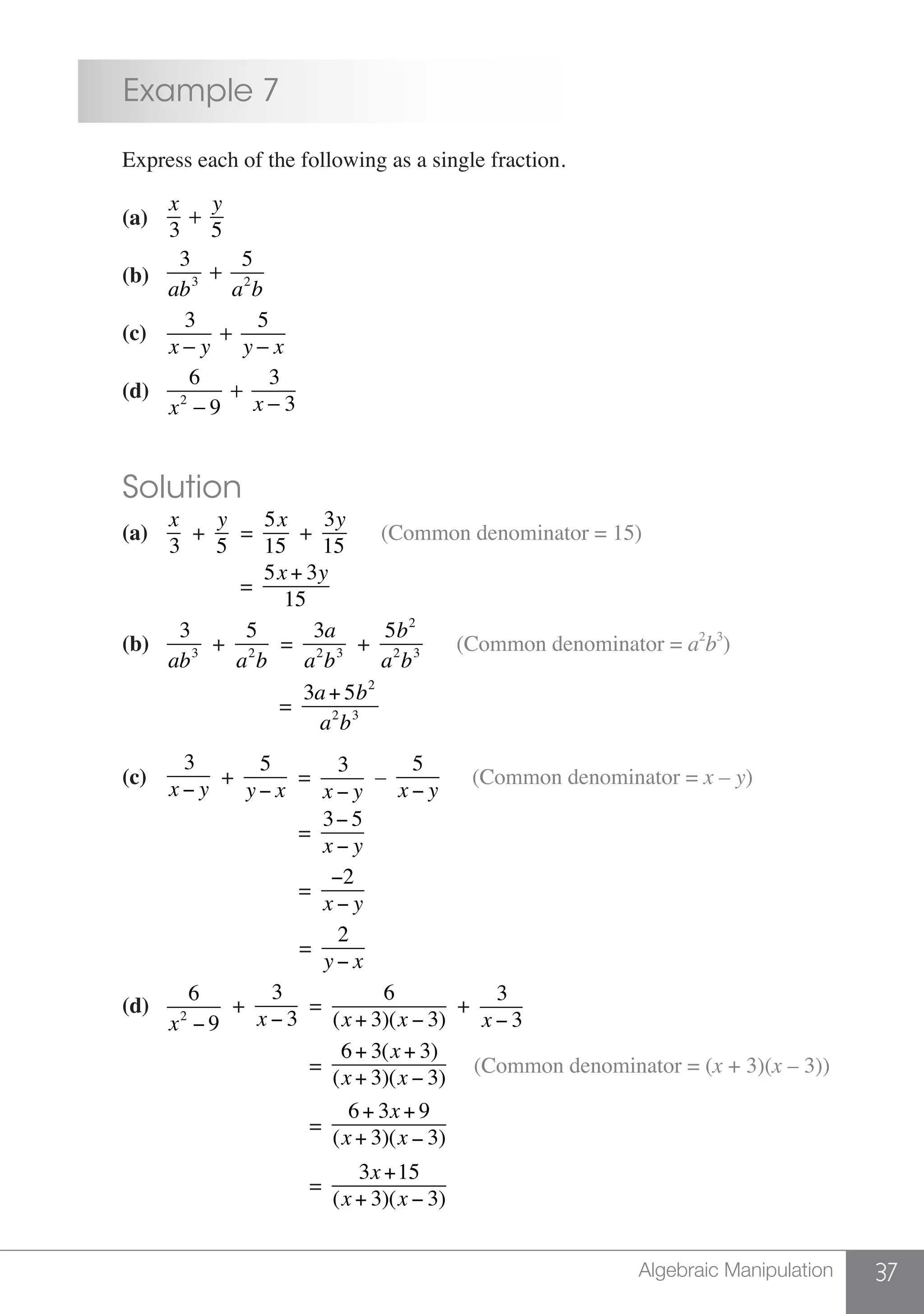
	 Example 7
	 Express each of the following as a single fraction.
	 (a)	
x
3
+
y
5
	
	(b)	
3
ab3
+
5
a2
b
	
	(c)	
3
x − y
+
5
y − x
	
	(d)	
6
x2
− 9
+
3
x − 3 	
	 Solution
	 (a)	
x
3
+
y
5
=
5x
15
+
3y
15
(Common denominator = 15)
		 =
5x+ 3y
15
	 (b)	
3
ab3 +
5
a2
b
=
3a
a2
b3 +
5b2
a2
b3 (Common denominator = a2
b3
)	
				 =
3a+ 5b2
a2
b3
	 (c)	
3
x − y
+
5
y− x
=
3
x − y
–
5
x − y
	 (Common denominator = x – y)
		 =
3− 5
x − y
					 =
−2
x − y
					 =
2
y− x
	 (d)	
6
x2
− 9
+
3
x − 3
=
6
(x+ 3)(x − 3)
+
3
x − 3
					 =
6+ 3(x + 3)
(x+ 3)(x − 3)
(Common denominator = (x + 3)(x – 3))	
			 =
6+ 3x + 9
(x+ 3)(x − 3)
					 =
3x +15
(x+ 3)(x − 3)
38 UNIT 1.6
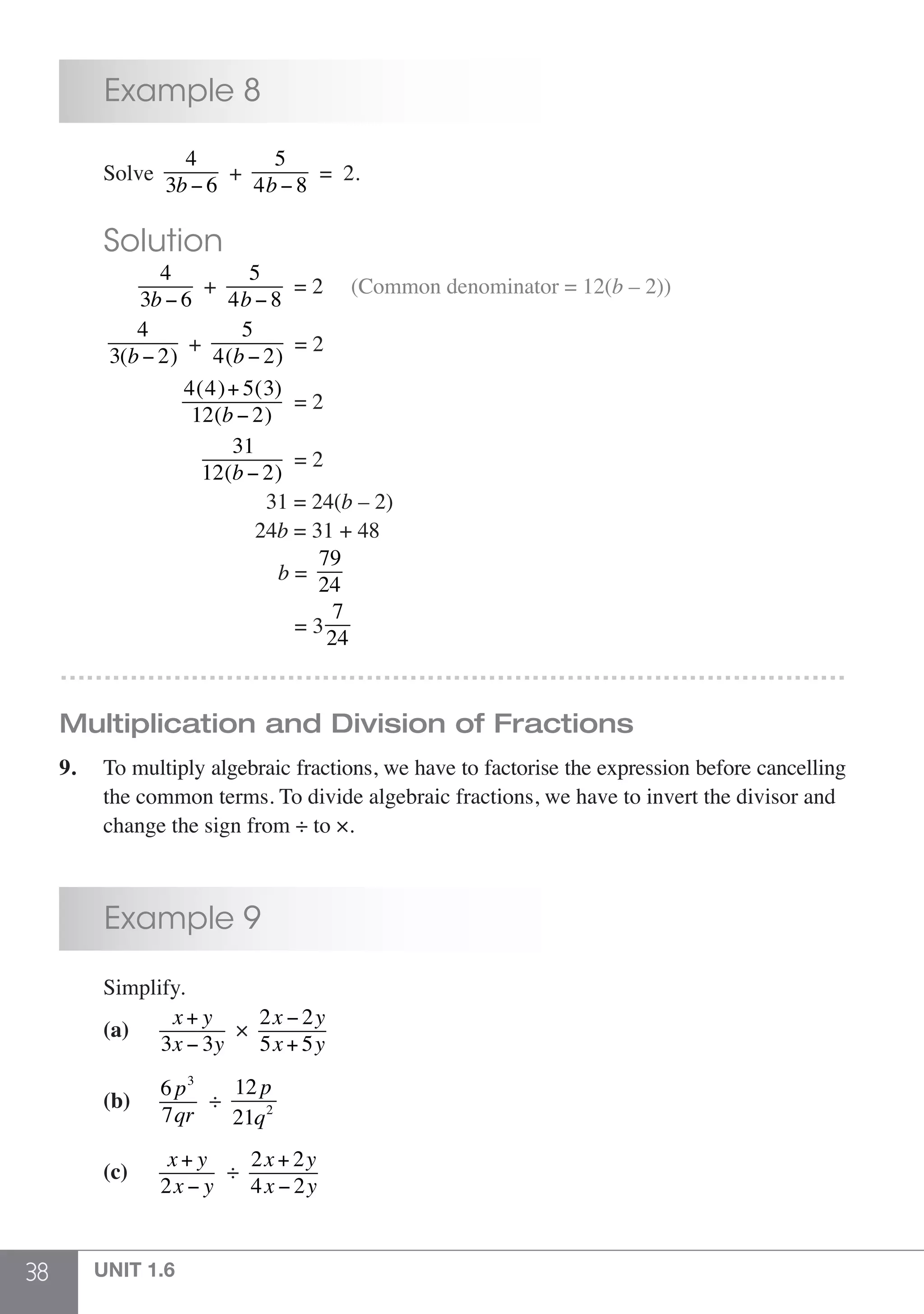
	 Example 8
	Solve
4
3b − 6
+
5
4b − 8
= 2.
	 Solution
	
4
3b − 6
+
5
4b − 8
= 2 (Common denominator = 12(b – 2))
	
4
3(b − 2)
+
5
4(b − 2)
= 2
	
4(4)+ 5(3)
12(b − 2)
= 2
	
31
12(b − 2)
= 2
	 31 = 24(b – 2)
	 24b = 31 + 48
	 b =
79
24
	 = 33
7
24
………………………………………………………………………………
Multiplication and Division of Fractions
9.	 To multiply algebraic fractions, we have to factorise the expression before cancelling
	 the common terms. To divide algebraic fractions, we have to invert the divisor and
	 change the sign from ÷ to ×.
	 Example 9
	Simplify.
	 (a)	
x+ y
3x − 3y
×
2x − 2y
5x+ 5y
							
	 (b)	
6 p3
7qr
÷
12 p
21q2
	 (c)	
x+ y
2x − y
÷
2x+ 2y
4x − 2y
39Algebraic Manipulation
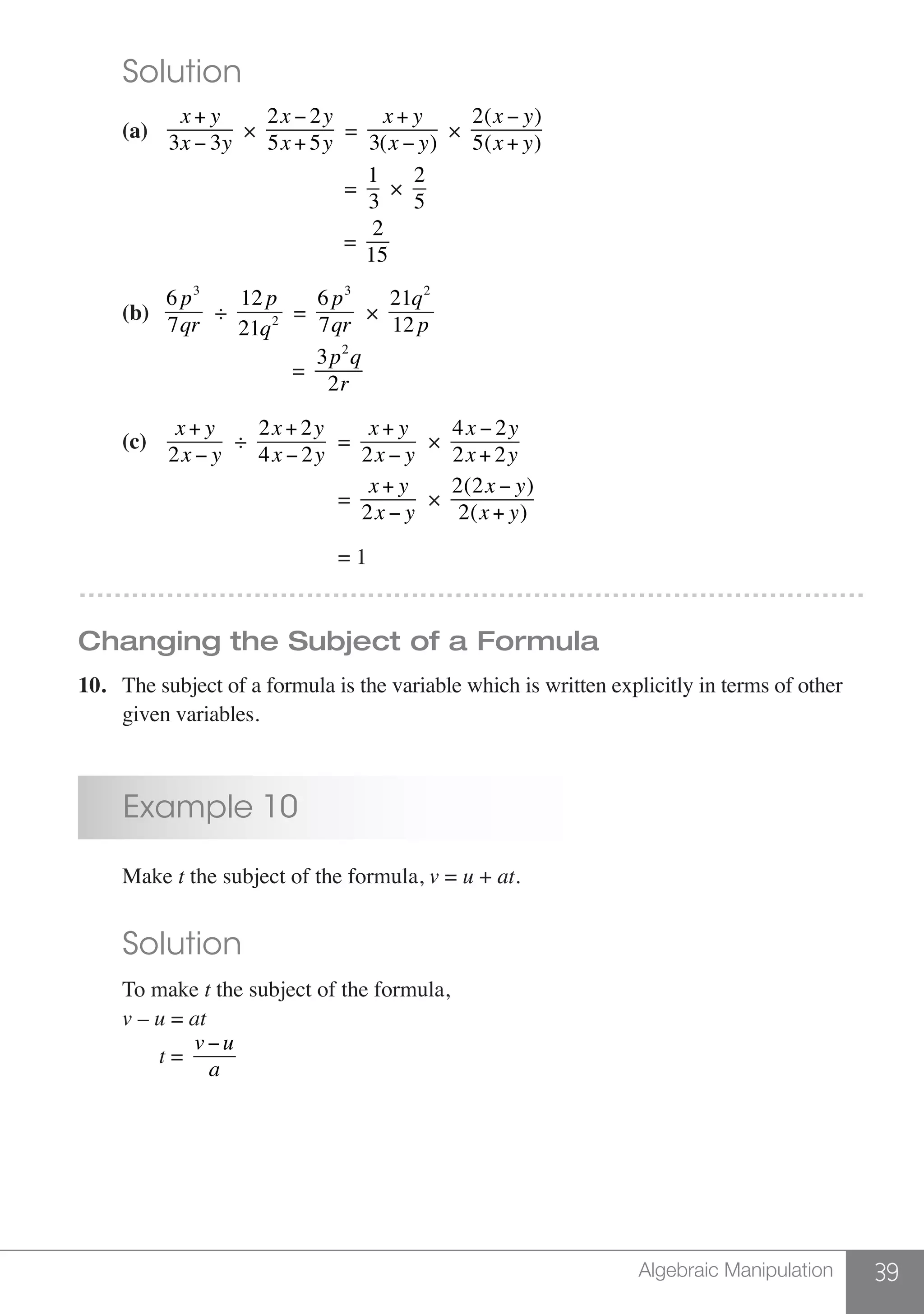
	 Solution
	 (a)	
x+ y
3x − 3y
×
2x − 2y
5x+ 5y
=
x+ y
3(x − y)
×
2(x − y)
5(x+ y)
						 =
1
3
×
2
5
						 =
2
15
	 (b)
6 p3
7qr
÷
12 p
21q2 =
6 p3
7qr
×
21q2
12 p
					 =
3p2
q
2r
	 (c)	
x+ y
2x − y
÷
2x+ 2y
4x − 2y
=
x+ y
2x − y
×
4x − 2y
2x+ 2y
						=
x+ y
2x − y
×
2(2x − y)
2(x+ y)
						= 1
………………………………………………………………………………
Changing the Subject of a Formula
10.	 The subject of a formula is the variable which is written explicitly in terms of other
	 given variables.
	 Example 10
	Make t the subject of the formula, v = u + at.
	 Solution
	 To make t the subject of the formula,
	 v – u = at
	 t =
v−u
a
40 UNIT 1.6
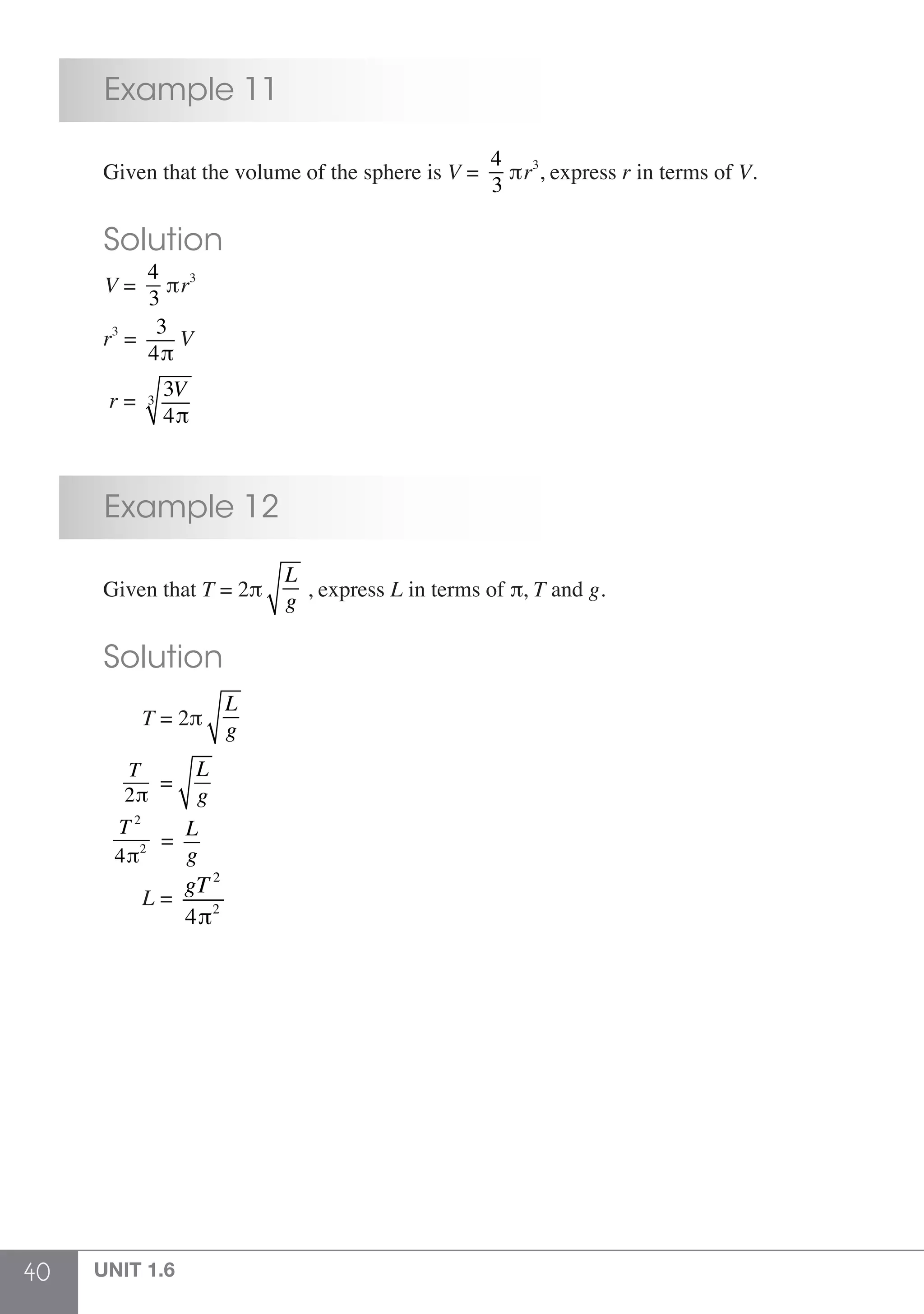
	 Example 11
	 Given that the volume of the sphere is V =
4
3
πr3
, express r in terms of V.
	 Solution
	V =
4
3
πr3
	 r3
=
3
4π
V
	 r =
3V
4π
3
	 Example 12
	 Given that T = 2π
L
g
, express L in terms of π, T and g.
	 Solution
	 T = 2π
L
g
	
T
2π
=
L
g
	
T 2
4π2 =
L
g
	 L =
gT 2
4π2
41Functions and Graphs
Linear Graphs
1.	 The equation of a straight line is given by y = mx + c, where m = gradient of the
	 straight line and c = y-intercept.
2.	 The gradient of the line (usually represented by m) is given as
	 m =
vertical change
horizontal change
or
rise
run
.
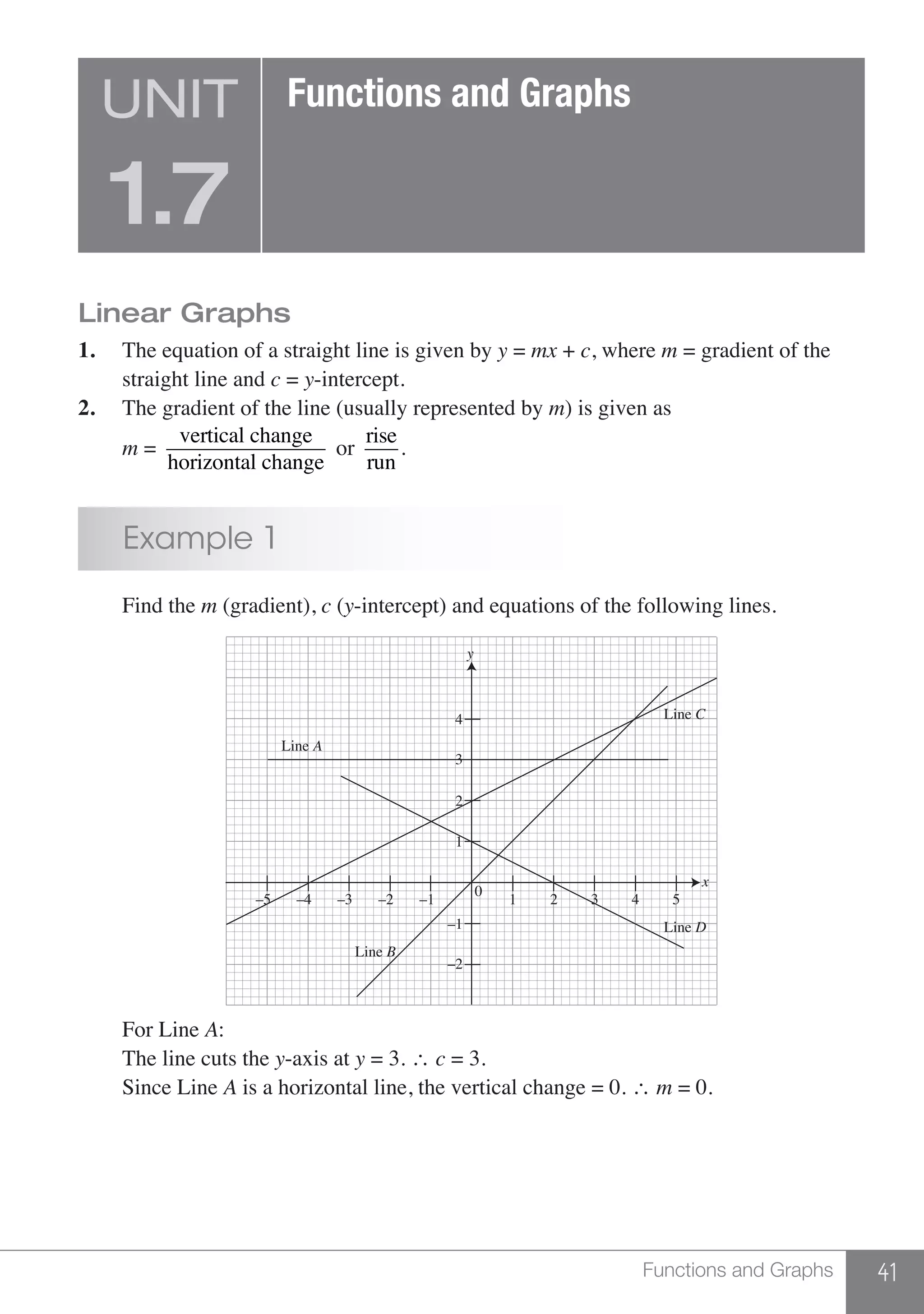
	 Example 1
	 Find the m (gradient), c (y-intercept) and equations of the following lines.
Line C
Line D
Line B
Line A
y
x
–1
–2
–1
1
2
3
4
–2–3–4–5 1
0
2 3 4 5
	 For Line A:
	 The line cuts the y-axis at y = 3. ∴ c = 3.
	 Since Line A is a horizontal line, the vertical change = 0. ∴ m = 0.
	
UNIT
1.7
Functions and Graphs
42 UNIT 1.7
	 For Line B:
	 The line cuts the y-axis at y = 0. ∴ c = 0.
	 Vertical change = 1, horizontal change = 1.
	 ∴ m =
1
1
= 1
	 For Line C:
	 The line cuts the y-axis at y = 2. ∴ c = 2.
	 Vertical change = 2, horizontal change = 4.
	 ∴ m =
2
4
=
1
2
	 For Line D:
	 The line cuts the y-axis at y = 1. ∴ c = 1.
	 Vertical change = 1, horizontal change = –2.
	 ∴ m =
1
−2
= –
1
2
	
	
Line m c Equation
A 0 3 y = 3
B 1 0 y = x
C 1
2
2 y =
1
2
x + 2
D –
1
2
1 y = –
1
2
x + 1
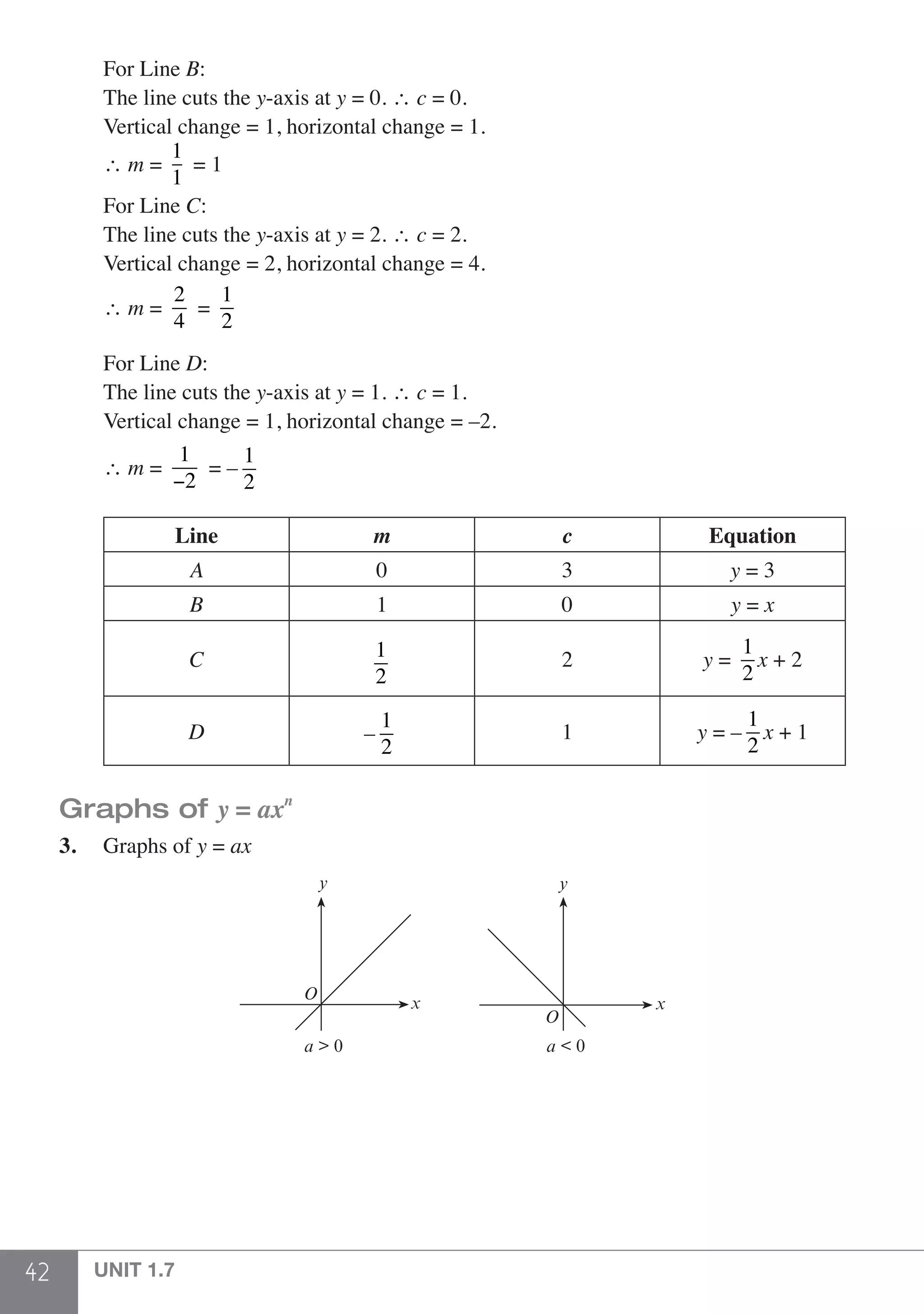
Graphs of y = axn
3.	 Graphs of y = ax
y
x
O
y
x
O
a < 0a > 0
43Functions and Graphs
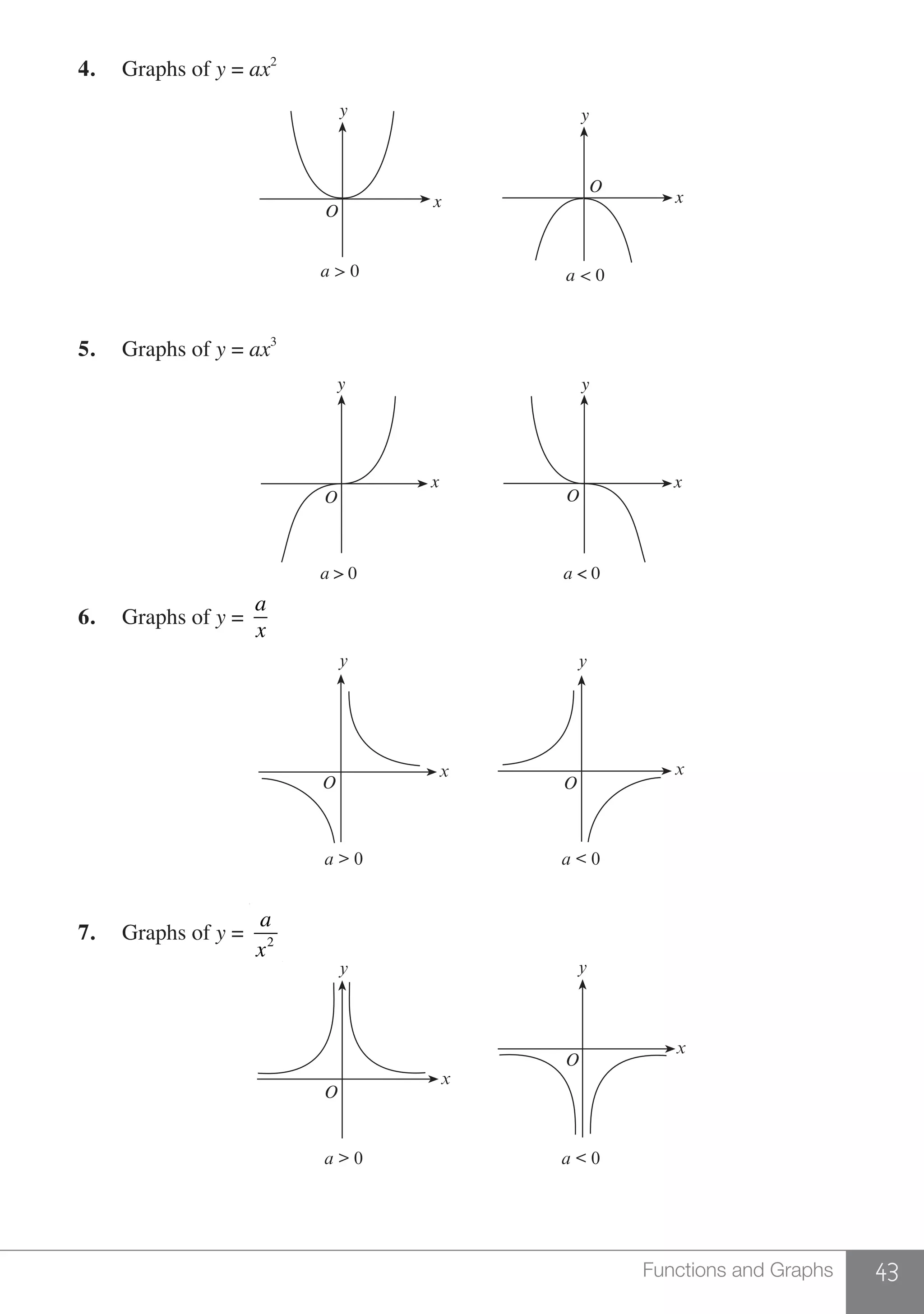
4.	 Graphs of y = ax2
y
x
O
y
x
O
a < 0a > 0
5.	 Graphs of y = ax3
a < 0a > 0
y
x
O
y
x
O
6.	 Graphs of y =
a
x
a < 0a > 0
y
x
O
x
O
y
7.	 Graphs of y =
a
x2
a < 0a > 0
y
x
O
y
x
O
44 UNIT 1.7
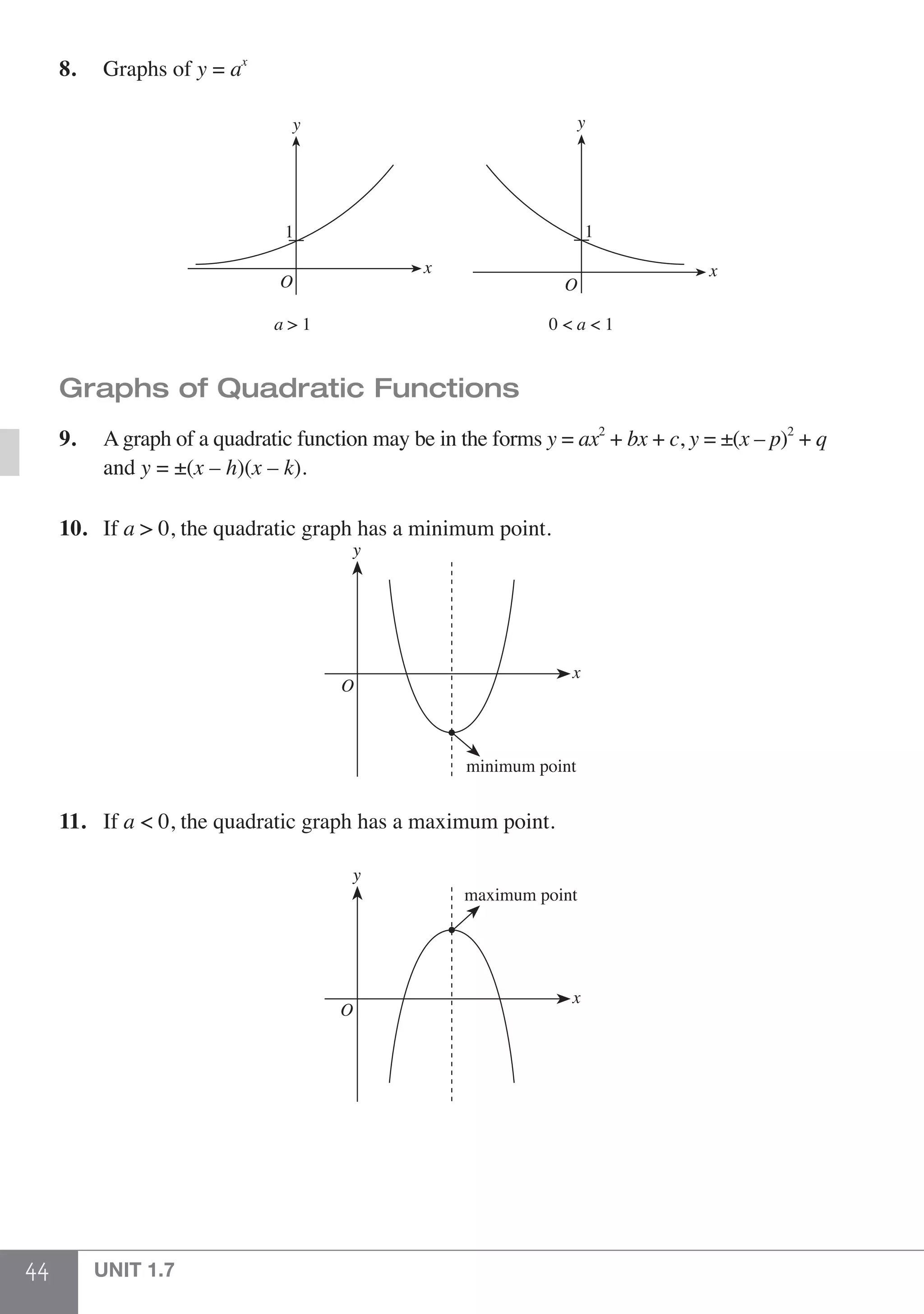
8.	 Graphs of y = ax
0 < a < 1a > 1
y
x
1
O
y
x
O
1
Graphs of Quadratic Functions
9.	 A graph of a quadratic function may be in the forms y = ax2
+ bx + c, y = ±(x – p)2
+ q
	and y = ±(x – h)(x – k).
10.	If a > 0, the quadratic graph has a minimum point.
yy
O
x
minimum point
11.	If a < 0, the quadratic graph has a maximum point.
yy
x
maximum point
O
45Functions and Graphs
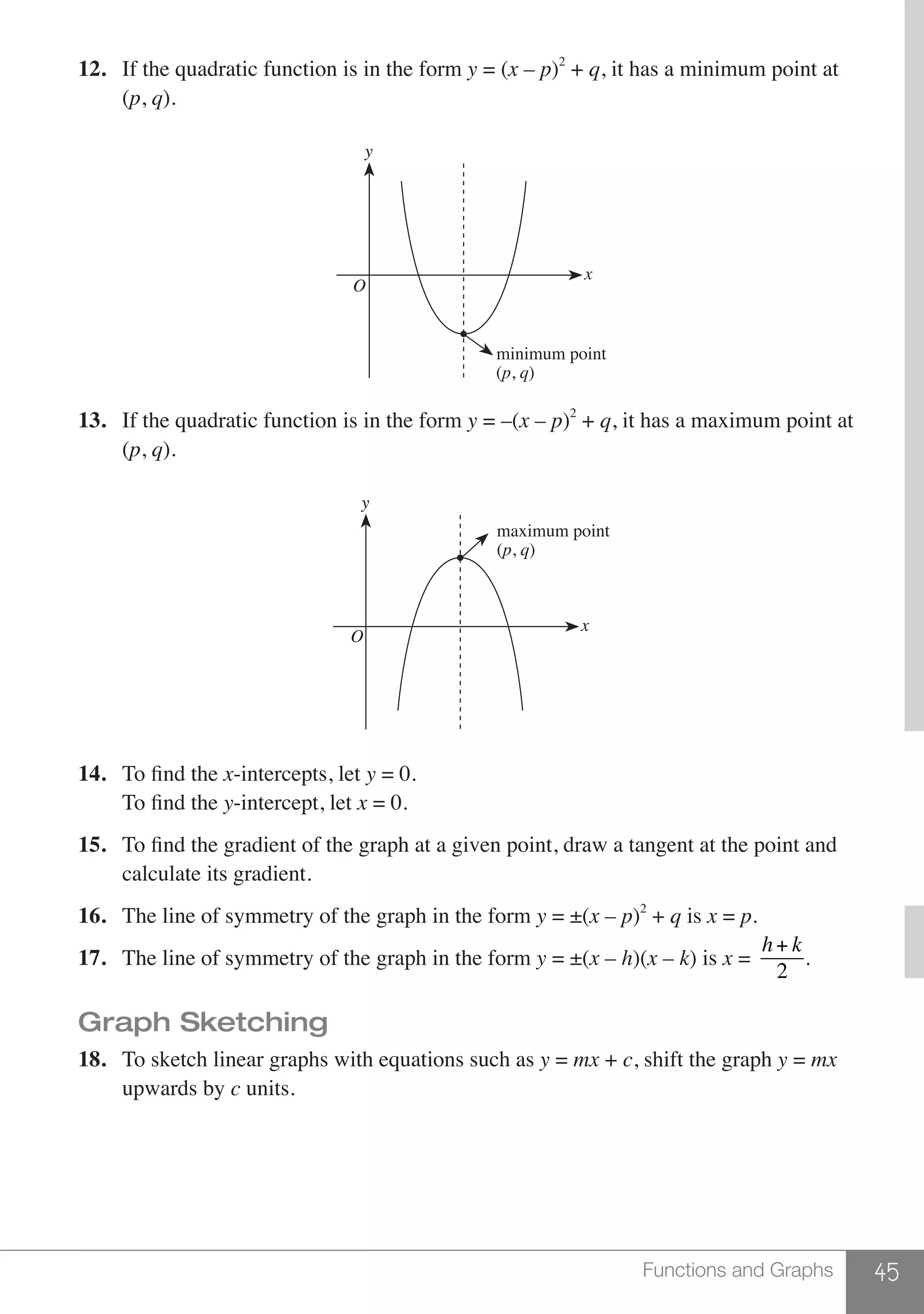
12.	 If the quadratic function is in the form y = (x – p)2
+ q, it has a minimum point at
	(p, q).
yy
x
minimum point
O
(p, q)
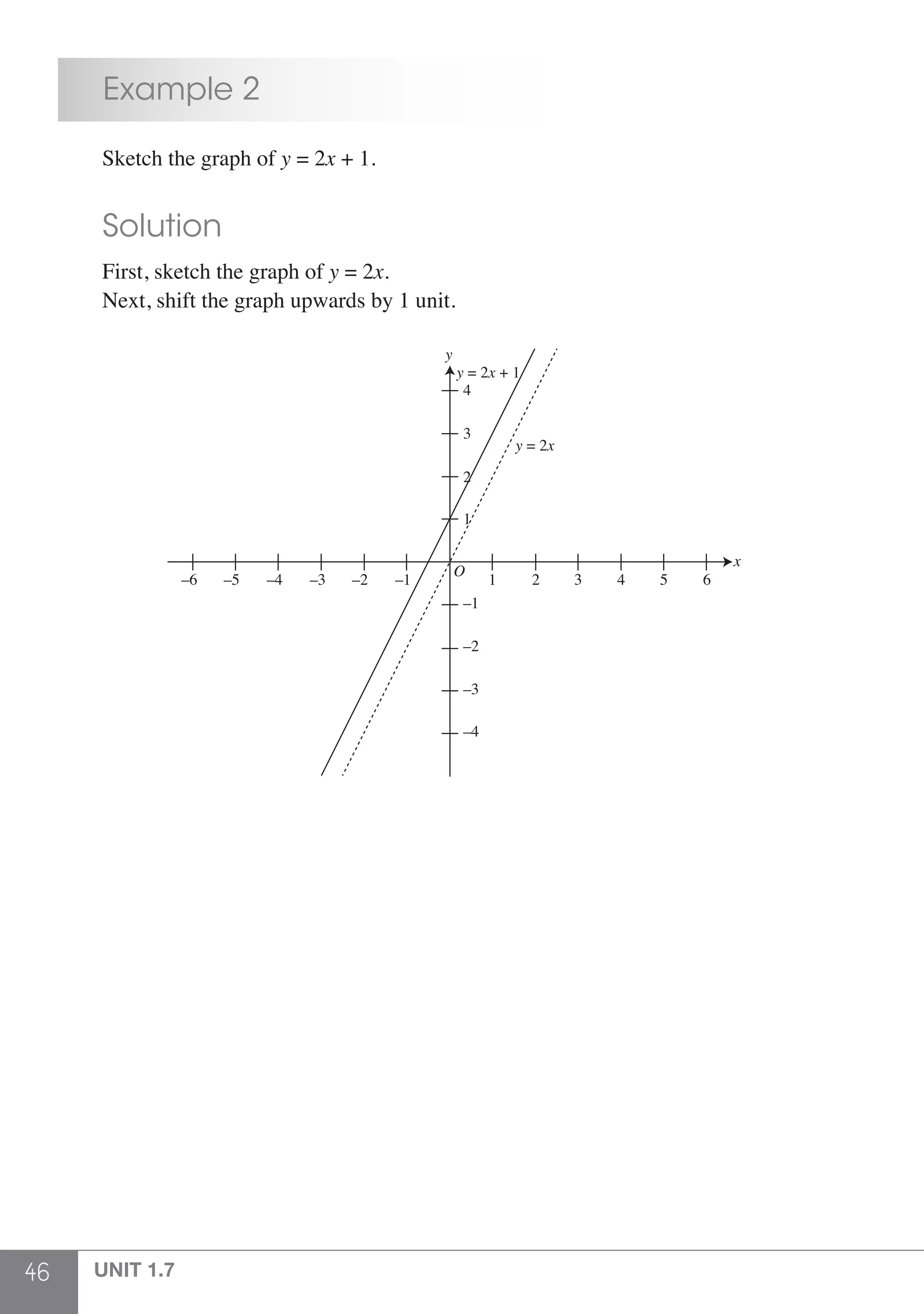
13.	 If the quadratic function is in the form y = –(x – p)2
+ q, it has a maximum point at
	(p, q).
yy
x
maximum point
O
(p, q)
14.	 To find the x-intercepts, let y = 0.
	 To find the y-intercept, let x = 0.
15.	 To find the gradient of the graph at a given point, draw a tangent at the point and
	 calculate its gradient.
16.	 The line of symmetry of the graph in the form y = ±(x – p)2
+ q is x = p.
17.	 The line of symmetry of the graph in the form y = ±(x – h)(x – k) is x =
h+ k
2
.
Graph Sketching
18.	 To sketch linear graphs with equations such as y = mx + c, shift the graph y = mx
	 upwards by c units.
46 UNIT 1.7
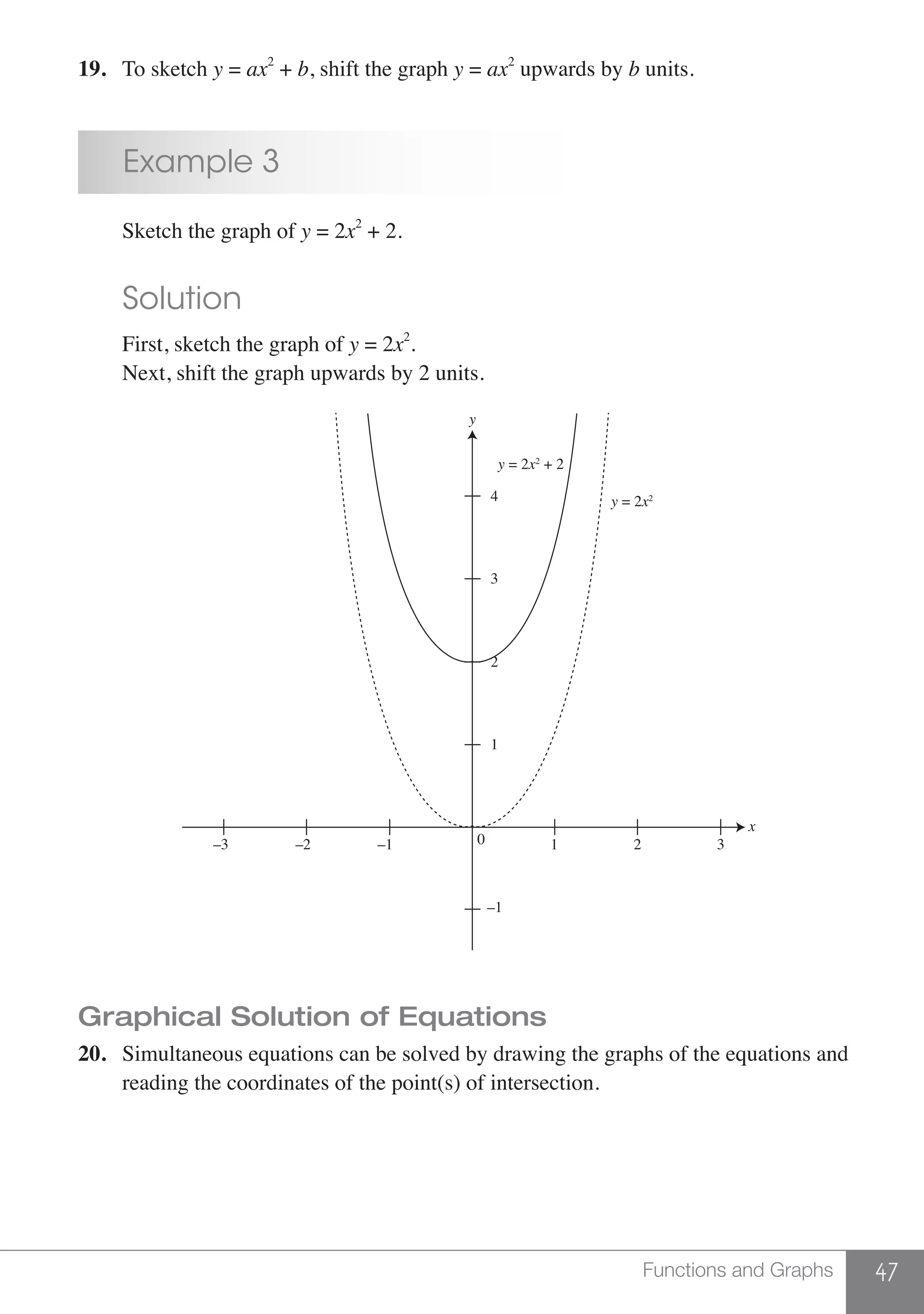
	 Example 2
	 Sketch the graph of y = 2x + 1.
	 Solution
	 First, sketch the graph of y = 2x.
	 Next, shift the graph upwards by 1 unit.
y = 2x
y = 2x + 1
y
x
–1 1 2
1
O
2
–1
–2
–3
–4
3
4
3 4 5 6–2–3–4–5–6
47Functions and Graphs
19.	 To sketch y = ax2
+ b, shift the graph y = ax2
upwards by b units.
	 Example 3
	 Sketch the graph of y = 2x2
+ 2.
	 Solution
	 First, sketch the graph of y = 2x2
.
	 Next, shift the graph upwards by 2 units.
	
y
x
–1
–1
–2 1 2
1
0
2
3
y = 2x2
+ 2
y = 2x24
3–3
Graphical Solution of Equations
20.	 Simultaneous equations can be solved by drawing the graphs of the equations and
	 reading the coordinates of the point(s) of intersection.
48 UNIT 1.7
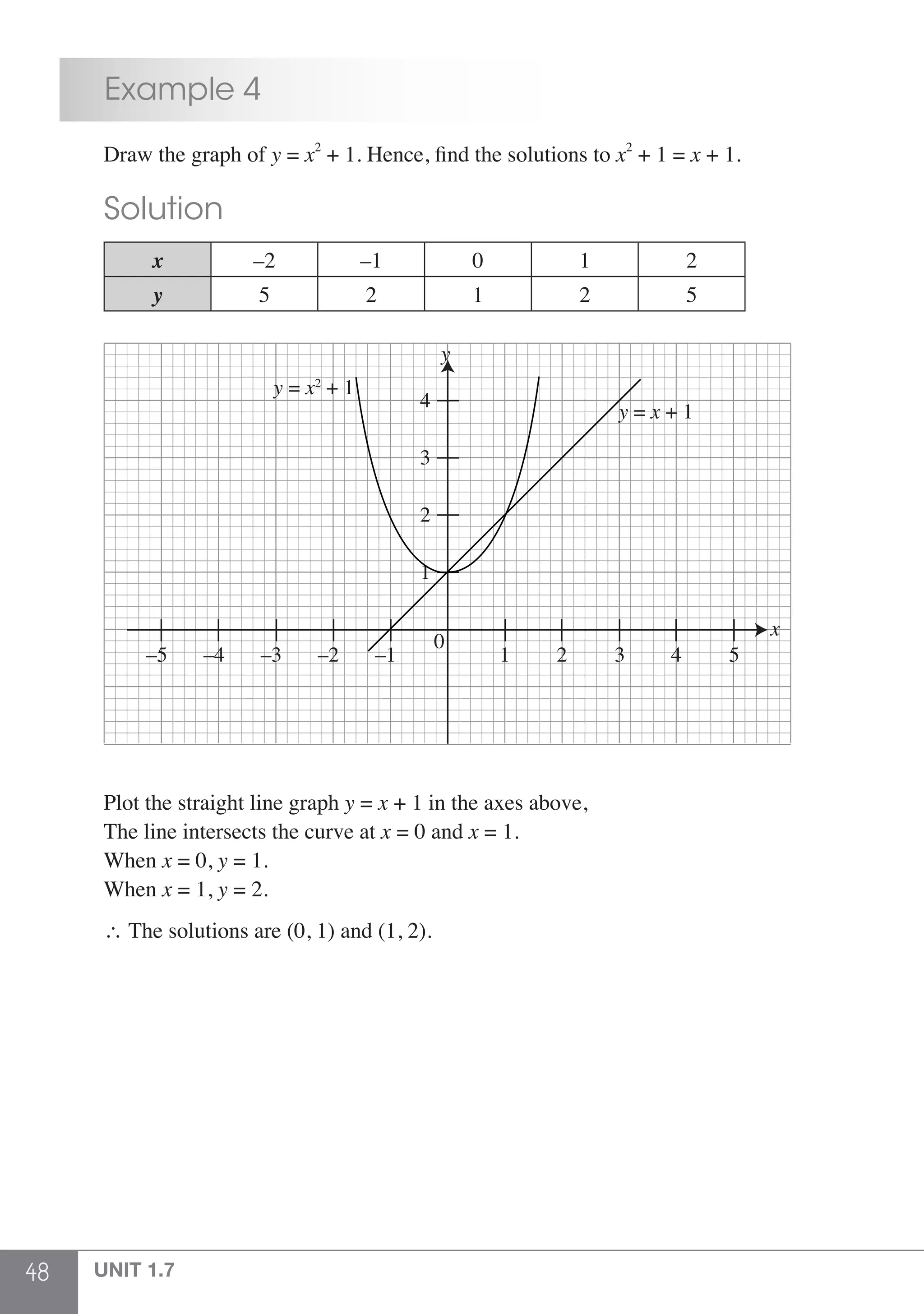
	 Example 4
	 Draw the graph of y = x2
+ 1. Hence, find the solutions to x2
+ 1 = x + 1.
	 Solution
	 x –2 –1 0 1 2
y 5 2 1 2 5
	
y = x2
+ 1
y = x + 1
y
x
4
3
2
–1–2 1
0
2 3 4 5–3–4–5
1
	 Plot the straight line graph y = x + 1 in the axes above,
	 The line intersects the curve at x = 0 and x = 1.
	When x = 0, y = 1.
	When x = 1, y = 2.
	 ∴ The solutions are (0, 1) and (1, 2).
49Functions and Graphs
	 Example 5
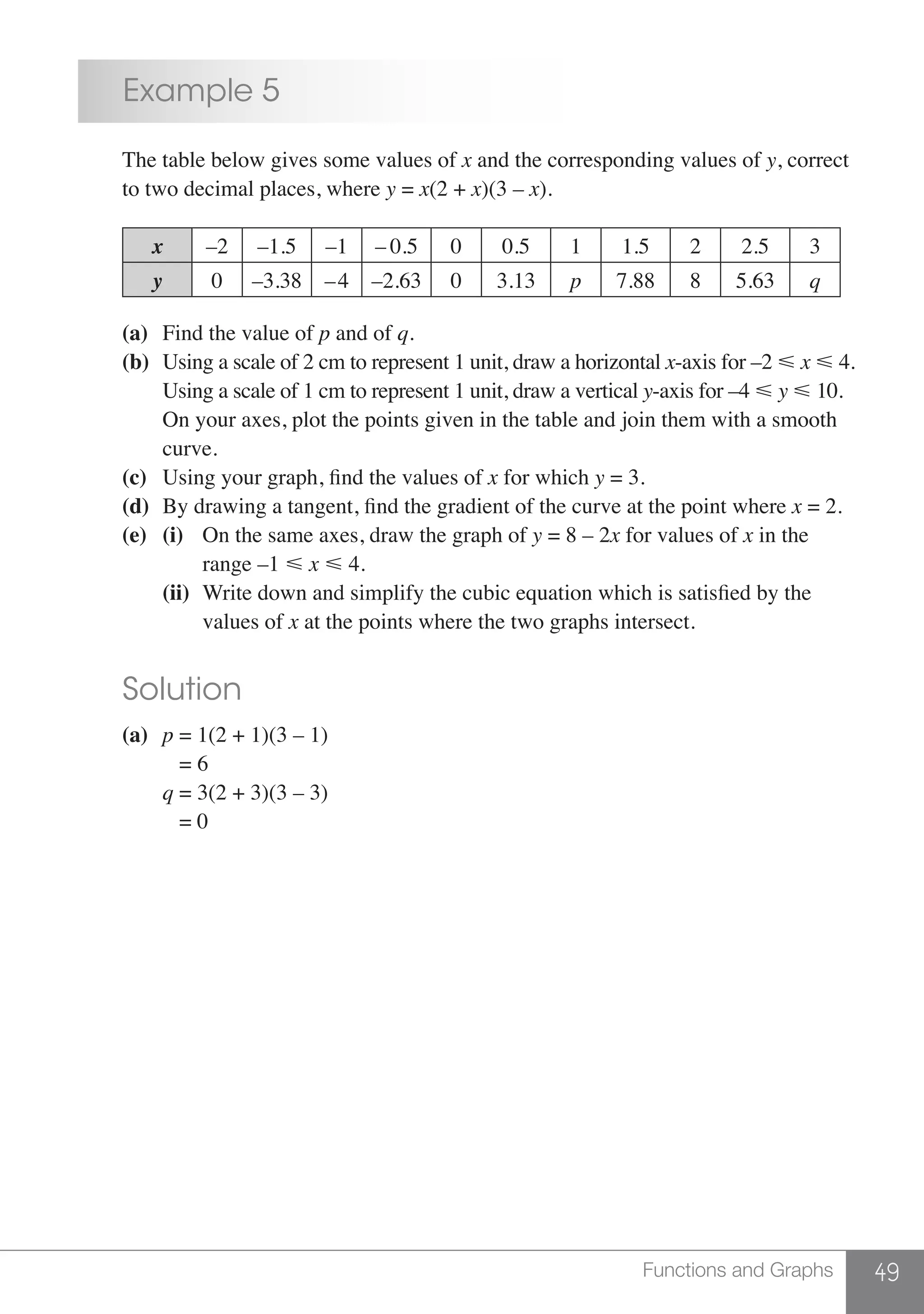
	 The table below gives some values of x and the corresponding values of y, correct
	 to two decimal places, where y = x(2 + x)(3 – x).
	
	
x –2 –1.5 –1 – 0.5 0 0.5 1 1.5 2 2.5 3
y 0 –3.38 –4 –2.63 0 3.13 p 7.88 8 5.63 q
	 (a)	 Find the value of p and of q.
	 (b)	 Using a scale of 2 cm to represent 1 unit, draw a horizontal x-axis for –2 < x < 4.
		 Using a scale of 1 cm to represent 1 unit, draw a vertical y-axis for –4 < y < 10.
		 On your axes, plot the points given in the table and join them with a smooth
		 curve.
	 (c)	 Using your graph, find the values of x for which y = 3.
	 (d)	 By drawing a tangent, find the gradient of the curve at the point where x = 2.
	 (e)	(i)	 On the same axes, draw the graph of y = 8 – 2x for values of x in the
			 range –1 < x < 4.
		(ii)	 Write down and simplify the cubic equation which is satisfied by the
			 values of x at the points where the two graphs intersect.
	 Solution
	 (a)	 p = 1(2 + 1)(3 – 1)
		 = 6
		q = 3(2 + 3)(3 – 3)
		 = 0
50 UNIT 1.7
	 (b)	
		
y
x
–4
–2
–1 1 2 3 4
0
–2
2
4
6
8
10
(e)(i) y = 8 + 2x
y = x(2 + x)(3 – x)
y = 3
0.48 2.75
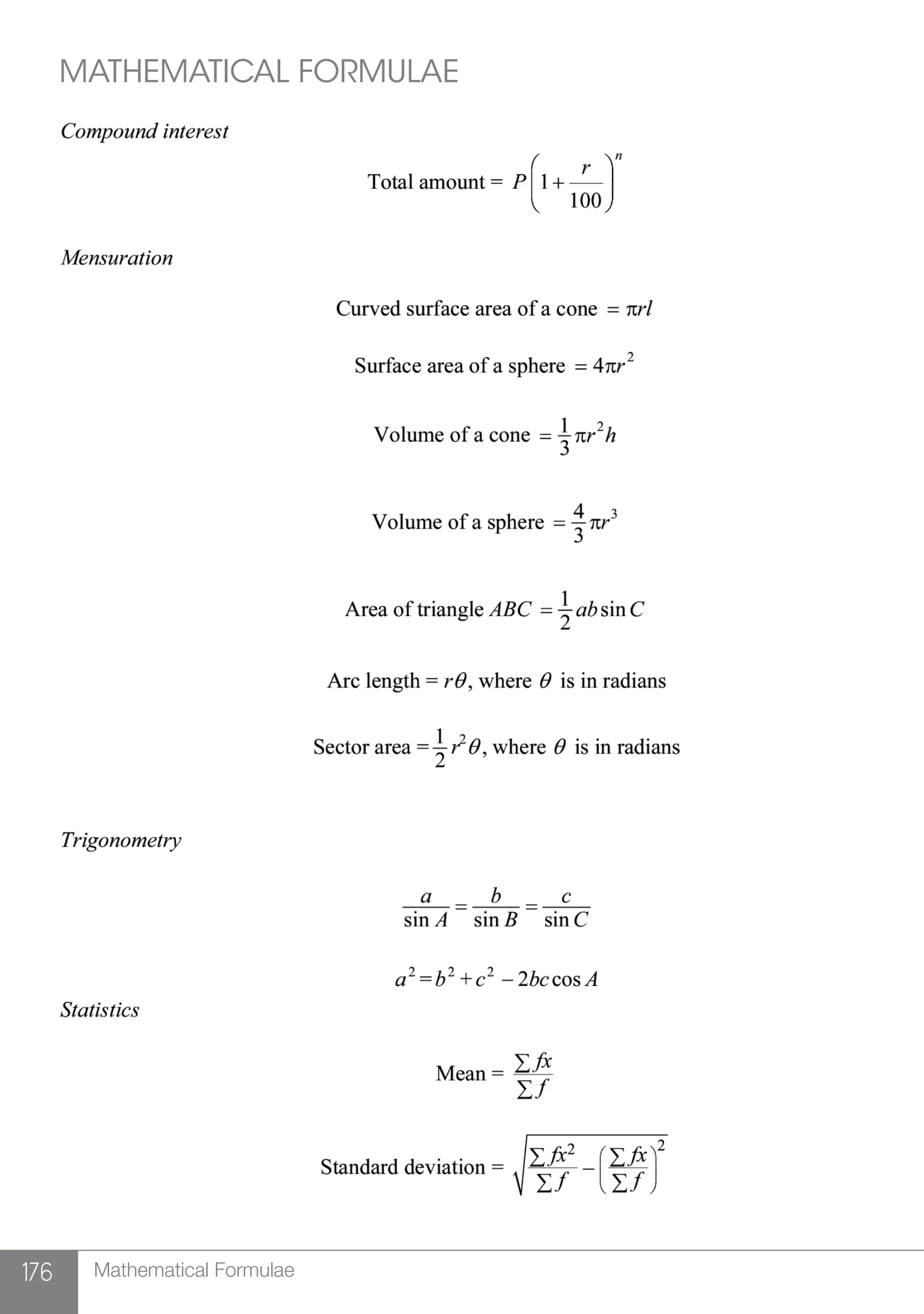
	 (c)	 From the graph, x = 0.48 and 2.75 when y = 3.
	 (d)	 Gradient of tangent =
7 − 9
2.5 −1.5
		 = –2
	 (e)	(ii)	 x(2 + x)(3 – x) = 8 – 2x
			 x(6 + x – x2
) = 8 – 2x
			 6x + x2
– x3
= 8 – 2x
			x3
– x2
– 8x + 8 = 0
51Solutions of Equations and Inequalities
Quadratic Formula
1.	 To solve the quadratic equation ax2
+ bx + c = 0, where a ≠ 0, use the formula
	 x =
−b± b2
− 4ac
2a
.
	 Example 1
	 Solve the equation 3x2
– 3x – 2 = 0.
	 Solution
	 Determine the values of a, b and c.
	 a = 3, b = –3, c = –2
	 x =
−(−3)± (−3)2
− 4(3)(−2)
2(3)
	 =
3± 9 −(−24)
6
	 =
3± 33
6
	 = 1.46 or –0.457 (to 3 s. f.)
UNIT
1.8
Solutions of Equations
and Inequalities
52 UNIT 1.8
	 Example 2
	 Using the quadratic formula, solve the equation 5x2
+ 9x – 4 = 0.
	 Solution
	 In 5x2
+ 9x – 4 = 0, a = 5, b = 9, c = –4.
	 x =
−9± 92
− 4(5)(−4)
2(5)
	 =
−9± 161
10
	 = 0.369 or –2.17 (to 3 s.f.)
	 Example 3
	 Solve the equation 6x2
+ 3x – 8 = 0.
	 Solution
	 In 6x2
+ 3x – 8 = 0, a = 6, b = 3, c = –8.
	 x =
−3± 32
− 4(6)(−8)
2(6)
	 =
−3± 201
12
	 = 0.931 or –1.43 (to 3 s.f.)
53Solutions of Equations and Inequalities
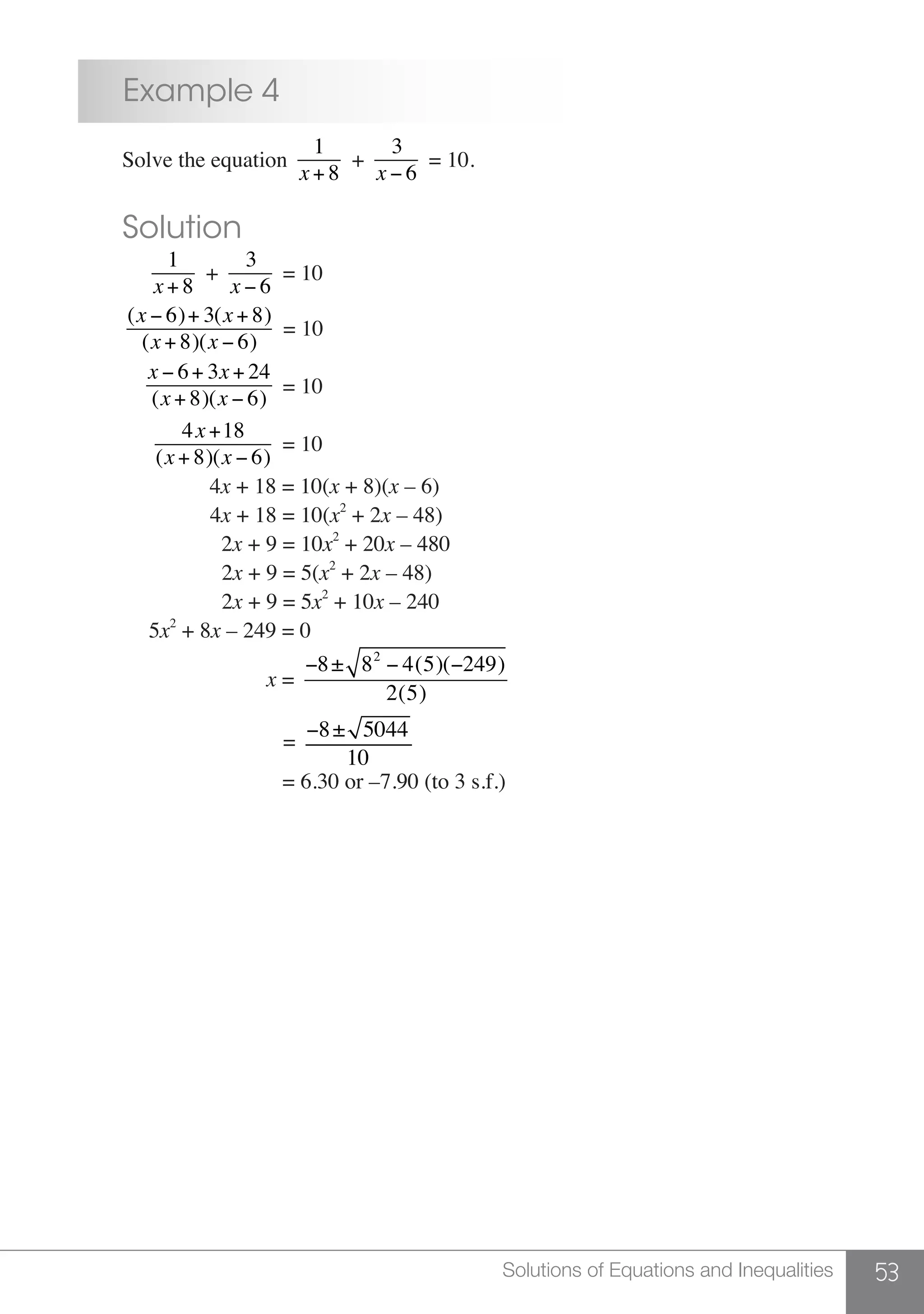
	 Example 4
	 Solve the equation
1
x+ 8
+
3
x − 6
= 10.
	 Solution
	
1
x+ 8
+
3
x − 6
= 10
	
(x − 6)+ 3(x + 8)
(x+ 8)(x − 6)
= 10
	
x − 6+ 3x + 24
(x+ 8)(x − 6)
= 10
	
4x+18
(x+ 8)(x − 6)
= 10
	 4x + 18 = 10(x + 8)(x – 6)
			 4x + 18 = 10(x2
+ 2x – 48)
			 2x + 9 = 10x2
+ 20x – 480
	 2x + 9 = 5(x2
+ 2x – 48)
	 2x + 9 = 5x2
+ 10x – 240
	 5x2
+ 8x – 249 = 0
	 x =
−8± 82
− 4(5)(−249)
2(5)
				 =
−8± 5044
10
				 = 6.30 or –7.90 (to 3 s.f.)
54 UNIT 1.8
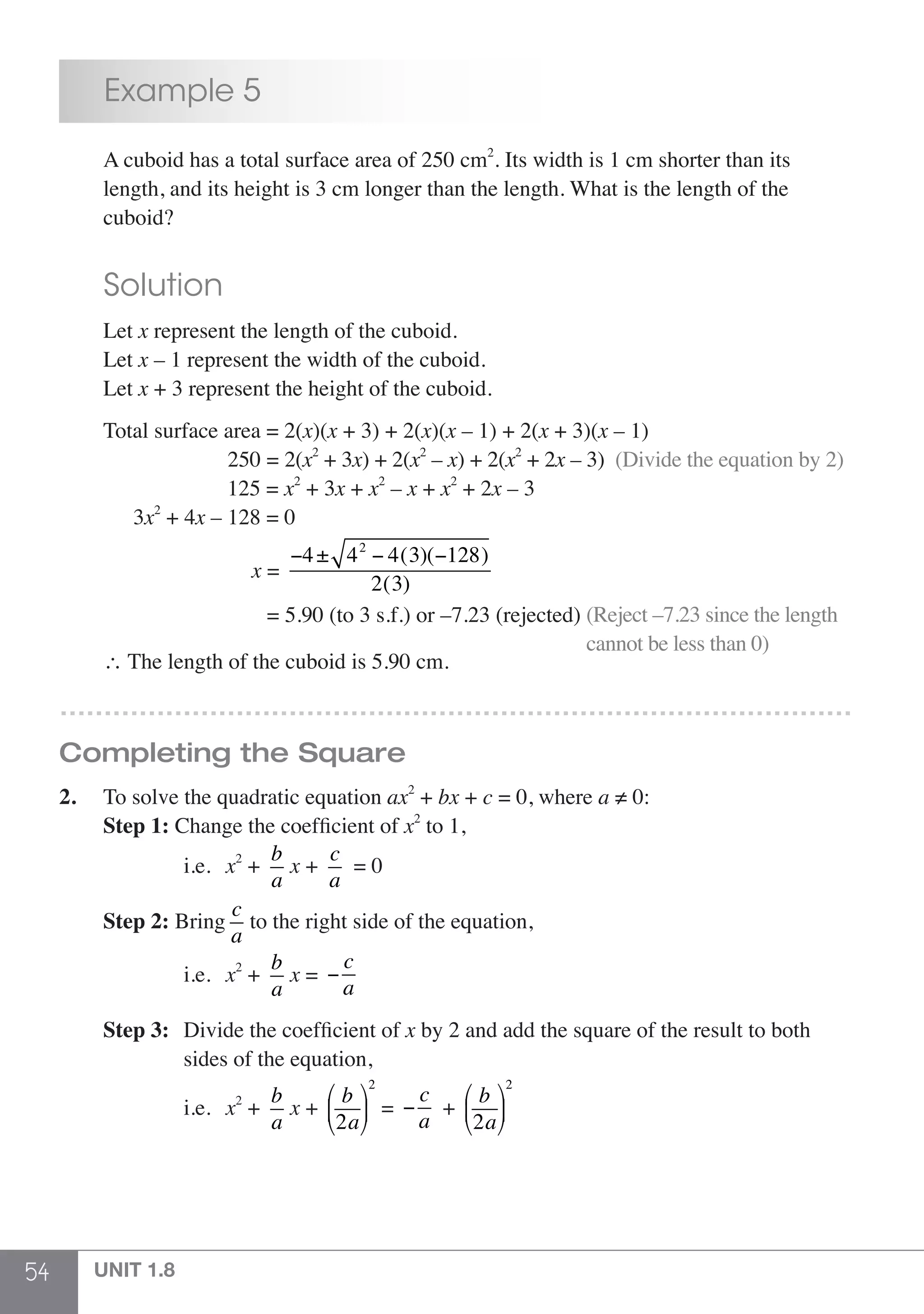
	 Example 5
	 A cuboid has a total surface area of 250 cm2
. Its width is 1 cm shorter than its
	 length, and its height is 3 cm longer than the length. What is the length of the
	cuboid?
	 Solution
	Let x represent the length of the cuboid.
	Let x – 1 represent the width of the cuboid.
	Let x + 3 represent the height of the cuboid.
	 Total surface area = 2(x)(x + 3) + 2(x)(x – 1) + 2(x + 3)(x – 1)
	 250 = 2(x2
+ 3x) + 2(x2
– x) + 2(x2
+ 2x – 3) (Divide the equation by 2)
				 125 = x2
+ 3x + x2
– x + x2
+ 2x – 3
	 3x2
+ 4x – 128 = 0
	 x =
−4± 42
− 4(3)(−128)
2(3)
				 = 5.90 (to 3 s.f.) or –7.23 (rejected) (Reject –7.23 since the length
cannot be less than 0)
	 ∴ The length of the cuboid is 5.90 cm.
………………………………………………………………………………
Completing the Square
2.	 To solve the quadratic equation ax2
+ bx + c = 0, where a ≠ 0:
	 Step 1: Change the coefficient of x2
to 1,
			i.e.	x2
+
b
a
x +
c
a
= 0
	 Step 2: Bring
c
a
to the right side of the equation,
			i.e.	 x2
+
b
a
x = −
c
a
	 Step 3:	 Divide the coefficient of x by 2 and add the square of the result to both
			 sides of the equation,
			i.e.	x2
+
b
a
x +
b
2a
⎛
⎝
⎜
⎞
⎠
⎟
2
= −
c
a
+
b
2a
⎛
⎝
⎜
⎞
⎠
⎟
2
55Solutions of Equations and Inequalities
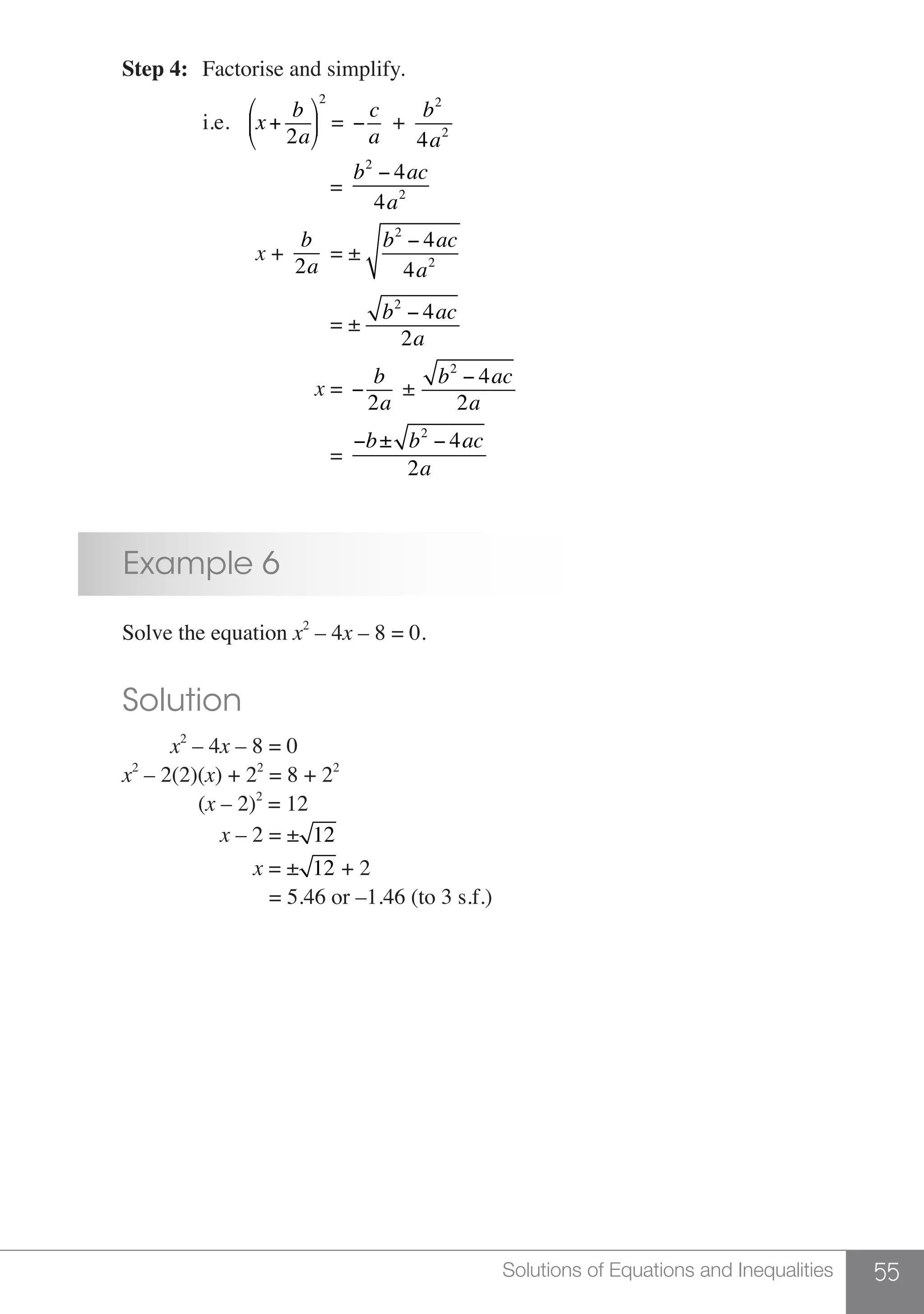
	 Step 4:	 Factorise and simplify.
			i.e.	x+
b
2a
⎛
⎝
⎜
⎞
⎠
⎟
2
= −
c
a
+
b2
4a2
	
					 =
b2
− 4ac
4a2
	
				 x +
b
2a
= ±
b2
− 4ac
4a2
	
				 = ±
b2
− 4ac
2a
				 x = −
b
2a
±
b2
− 4ac
2a
					 =
−b± b2
− 4ac
2a
	 Example 6
	 Solve the equation x2
– 4x – 8 = 0.
	 Solution
	 x2
– 4x – 8 = 0
	 x2
– 2(2)(x) + 22
= 8 + 22
	 (x – 2)2
= 12
	 x – 2 = ± 12
	 x = ± 12 + 2
	 = 5.46 or –1.46 (to 3 s.f.)
56 UNIT 1.8
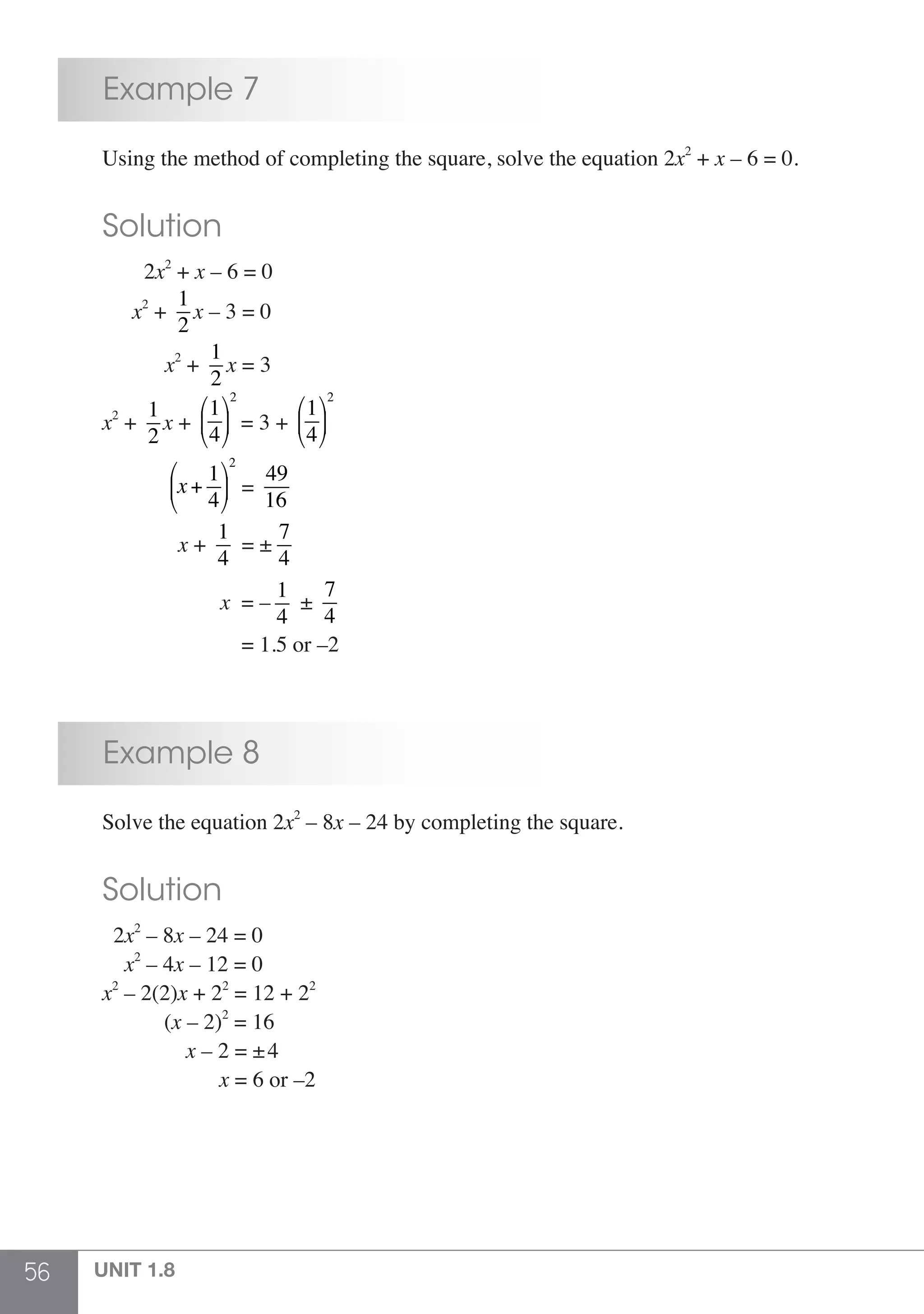
	 Example 7
	 Using the method of completing the square, solve the equation 2x2
+ x – 6 = 0.
	 Solution
	 2x2
+ x – 6 = 0
	 x2
+
1
2
x – 3 = 0
	 x2
+
1
2
x = 3
	 x2
+
1
2
x +
1
4
⎛
⎝
⎜
⎞
⎠
⎟
2
= 3 +
1
4
⎛
⎝
⎜
⎞
⎠
⎟
2
	 x+
1
4
⎛
⎝
⎜
⎞
⎠
⎟
2
=
49
16
	 x +
1
4
= ±
7
4
	 x = –
1
4
±
7
4
	 = 1.5 or –2
	 Example 8
	 Solve the equation 2x2
– 8x – 24 by completing the square.
	 Solution
	 2x2
– 8x – 24 = 0
	 x2
– 4x – 12 = 0
	 x2
– 2(2)x + 22
= 12 + 22
	 (x – 2)2
= 16
	 x – 2 = ±4
	 x = 6 or –2
57Solutions of Equations and Inequalities
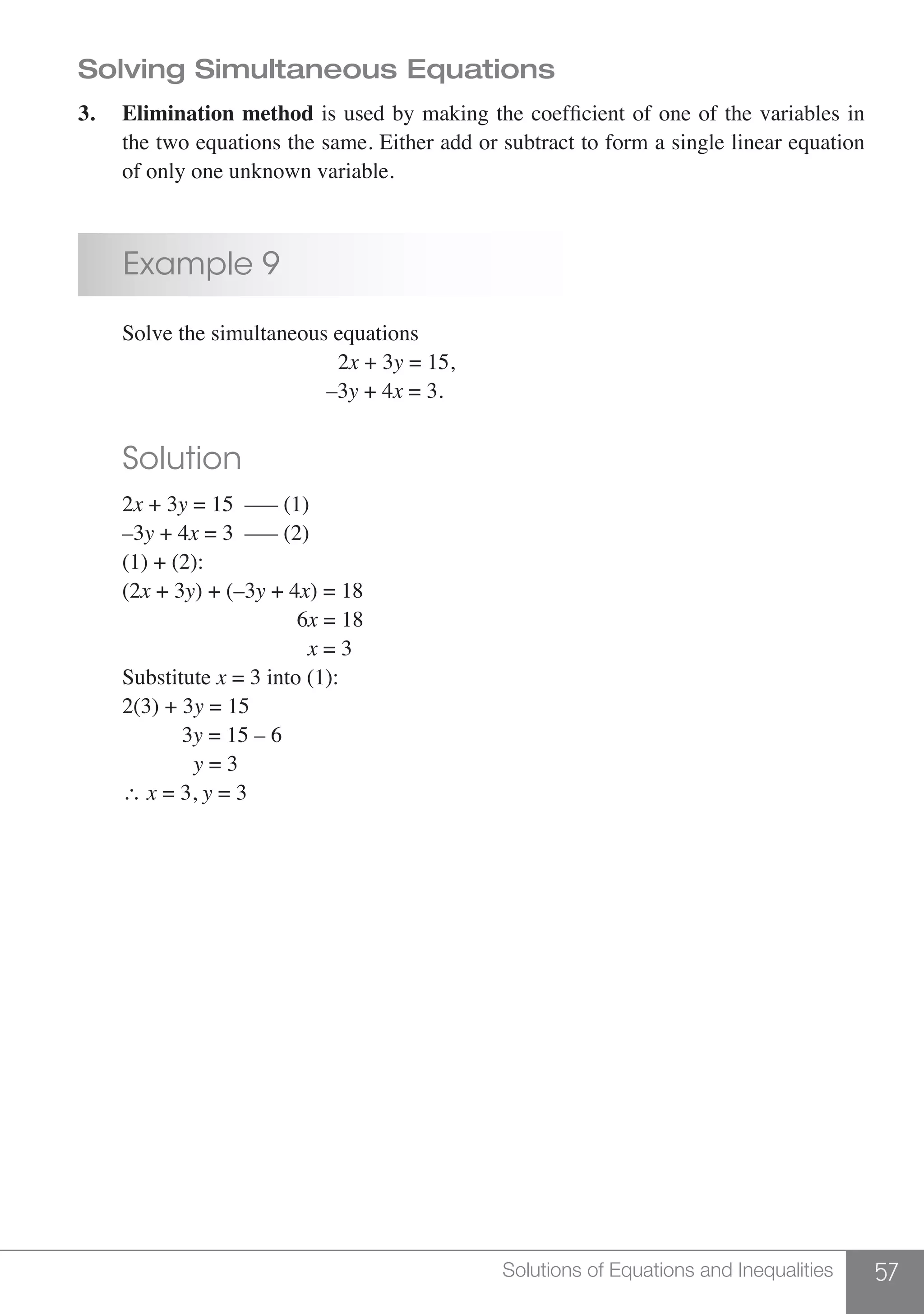
Solving Simultaneous Equations
3.	 Elimination method is used by making the coefficient of one of the variables in
	 the two equations the same. Either add or subtract to form a single linear equation
	 of only one unknown variable.
	 Example 9
	 Solve the simultaneous equations
						2x + 3y = 15,
					 –3y + 4x = 3.
	 Solution
	2x + 3y = 15	 ––– (1)
	–3y + 4x = 3	 ––– (2)
	 (1) + (2):	
	(2x + 3y) + (–3y + 4x) = 18
					 6x = 18
					 x = 3
	Substitute x = 3 into (1):
	 2(3) + 3y = 15
	 3y = 15 – 6
	 y = 3
	 ∴ x = 3, y = 3
58 UNIT 1.8
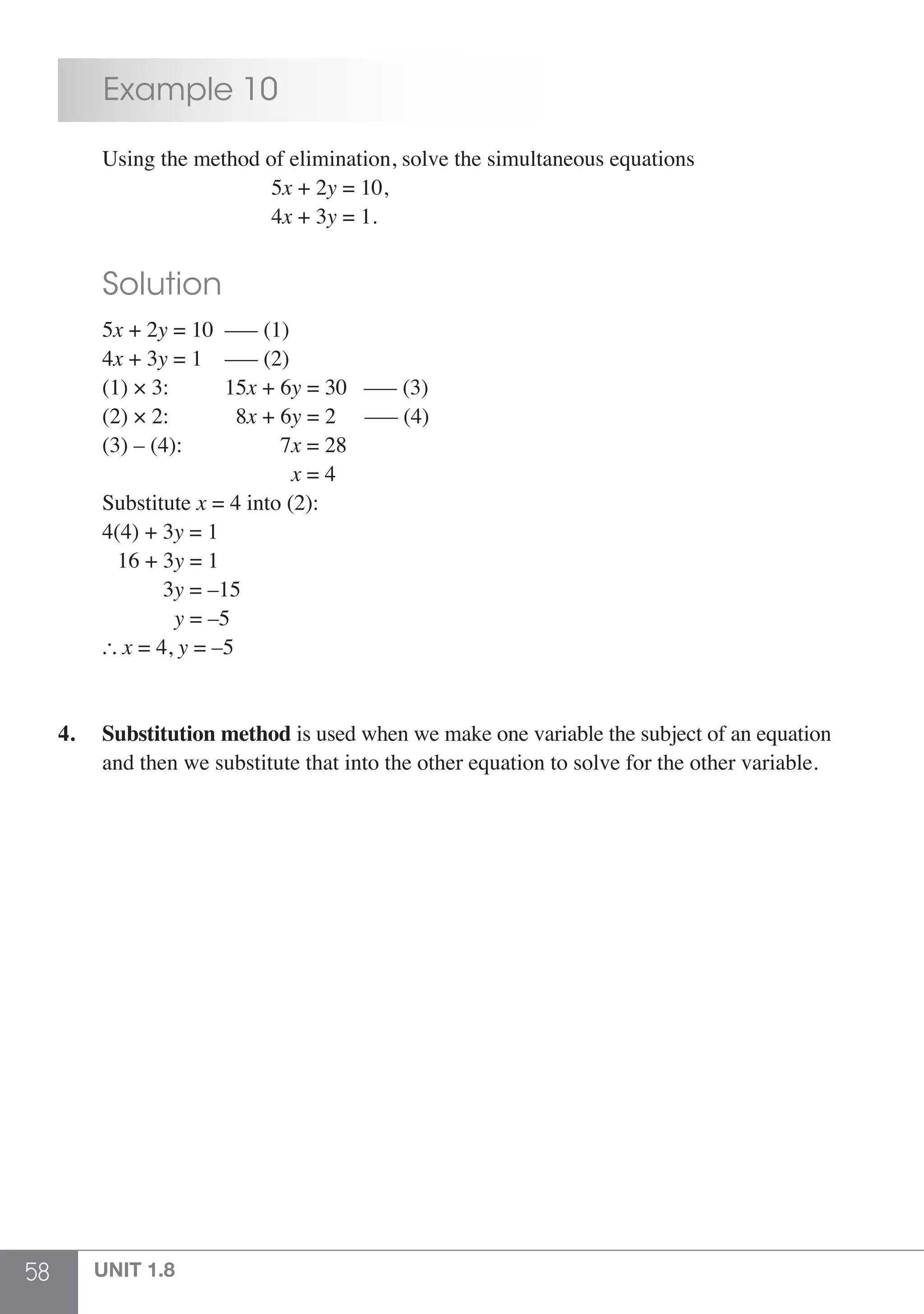
	 Example 10
	 Using the method of elimination, solve the simultaneous equations
					 5x + 2y = 10,
					 4x + 3y = 1.
	 Solution
	5x + 2y = 10	 ––– (1)
	4x + 3y = 1	 ––– (2)
	 (1) × 3:		 15x + 6y = 30 ––– (3)
	 (2) × 2: 		 8x + 6y = 2 	 ––– (4)
	 (3) – (4):	 7x = 28
				 x = 4
	Substitute x = 4 into (2):
	 4(4) + 3y = 1
	 16 + 3y = 1
		 3y = –15
		 y = –5
	  x = 4, y = –5
4.	 Substitution method is used when we make one variable the subject of an equation
	 and then we substitute that into the other equation to solve for the other variable.
59Solutions of Equations and Inequalities
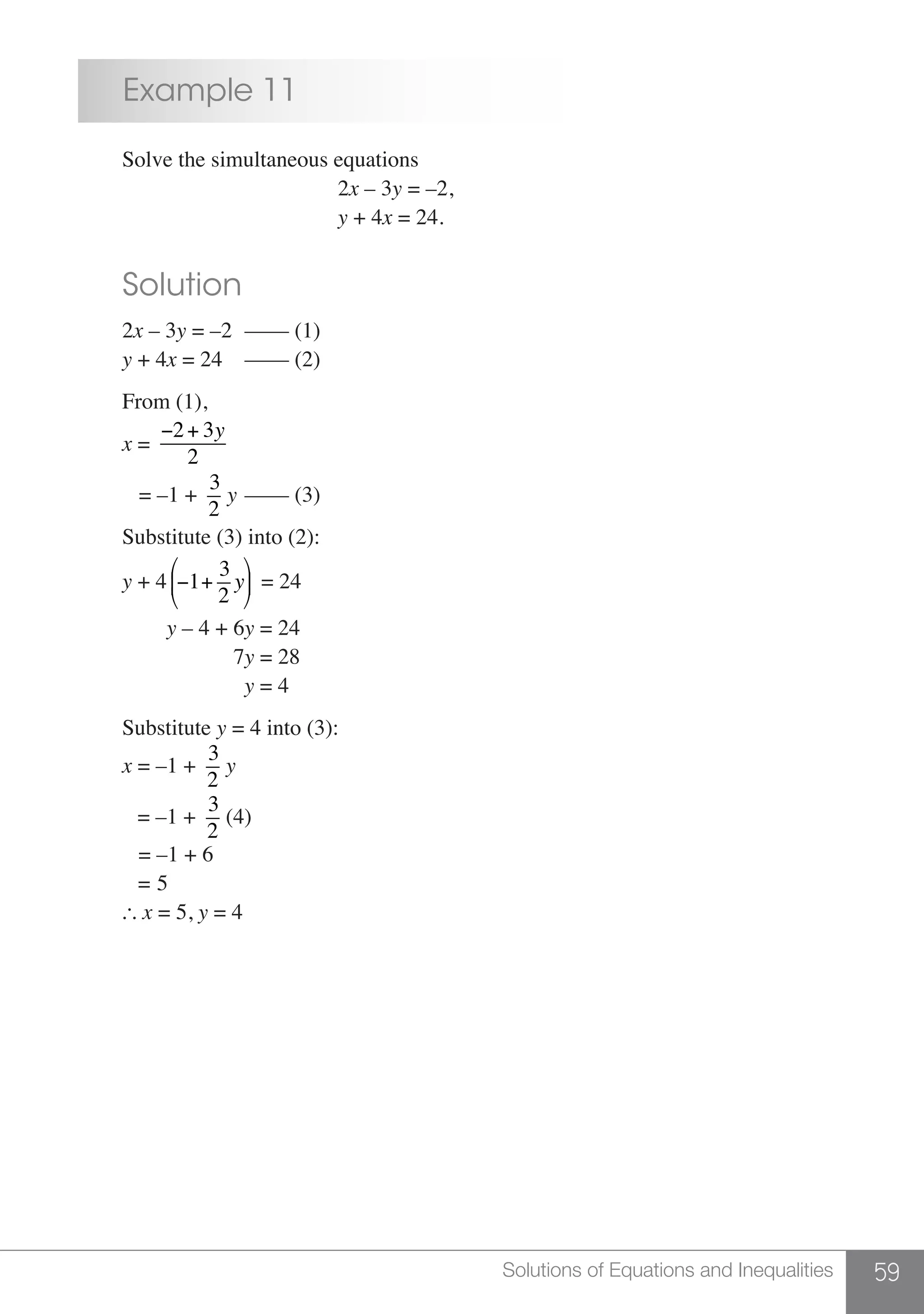
	 Example 11
	 Solve the simultaneous equations
						2x – 3y = –2,
						 y + 4x = 24.
	 Solution
	2x – 3y = –2	 –––– (1)
	 y + 4x = 24	 –––– (2)
	 From (1),
	 x =
−2+ 3y
2
	 = –1 +
3
2
y	–––– (3)
	 Substitute (3) into (2):
	 y + 4 −1+
3
2
y
⎛
⎝
⎜
⎞
⎠
⎟ = 24
	 y – 4 + 6y = 24
	 7y = 28
		 y = 4
	Substitute y = 4 into (3):
	x = –1 +
3
2
y
	 = –1 +
3
2
(4)
	 = –1 + 6
	 = 5
	  x = 5, y = 4
60 UNIT 1.8
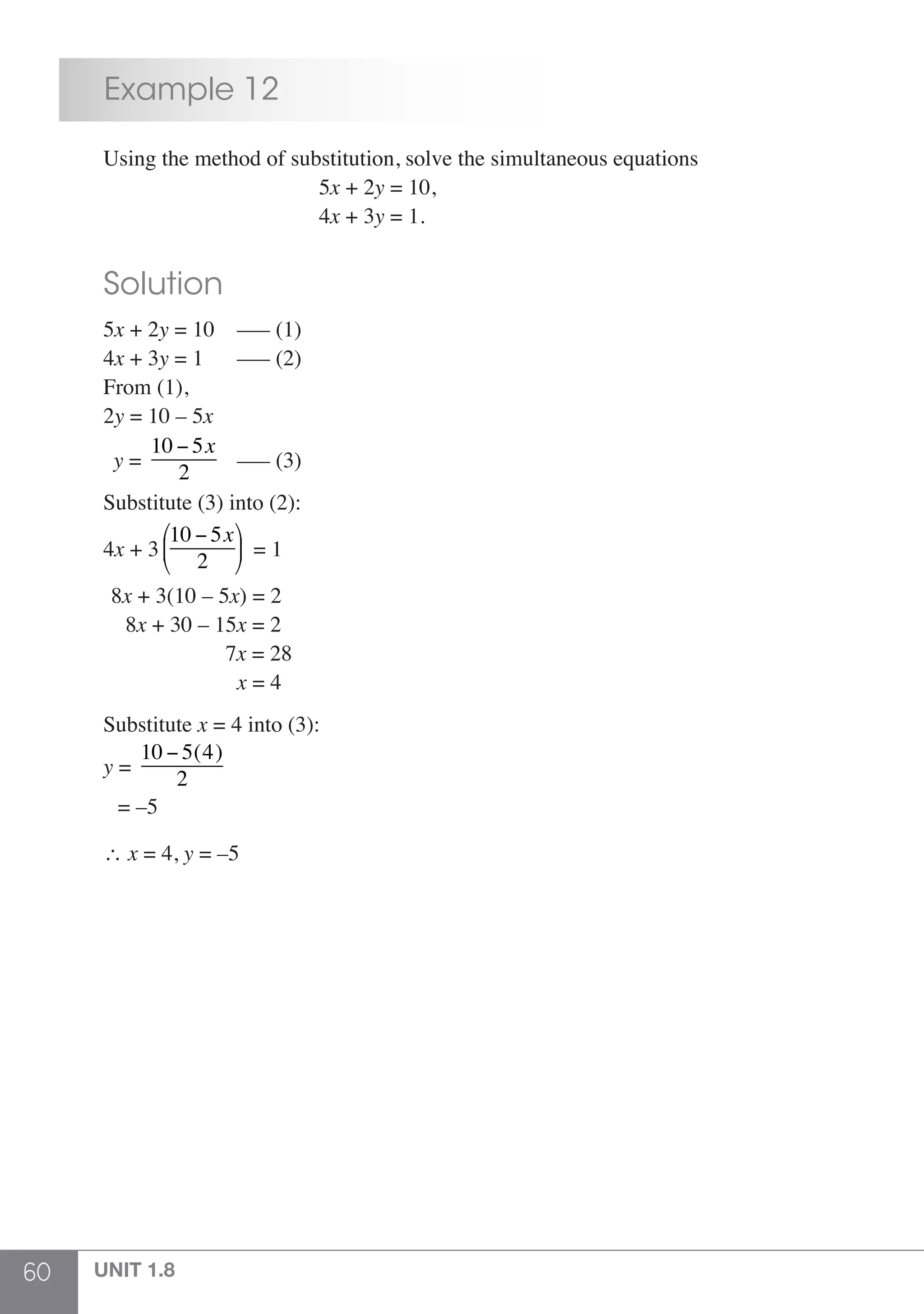
	 Example 12
	 Using the method of substitution, solve the simultaneous equations
						5x + 2y = 10,
						4x + 3y = 1.
	 Solution
	5x + 2y = 10 ––– (1)
	4x + 3y = 1 ––– (2)
	 From (1),
	2y = 10 – 5x
	 y =
10 − 5x
2
	 ––– (3)		
	 Substitute (3) into (2):
	4x + 3
10 − 5x
2
⎛
⎝
⎜
⎞
⎠
⎟ = 1
	 8x + 3(10 – 5x) = 2
	 8x + 30 – 15x = 2
	 7x = 28
				 x = 4
	
	Substitute x = 4 into (3):
	 y =
10 − 5(4)
2
	 = –5
	 ∴ x = 4, y = –5
61Solutions of Equations and Inequalities
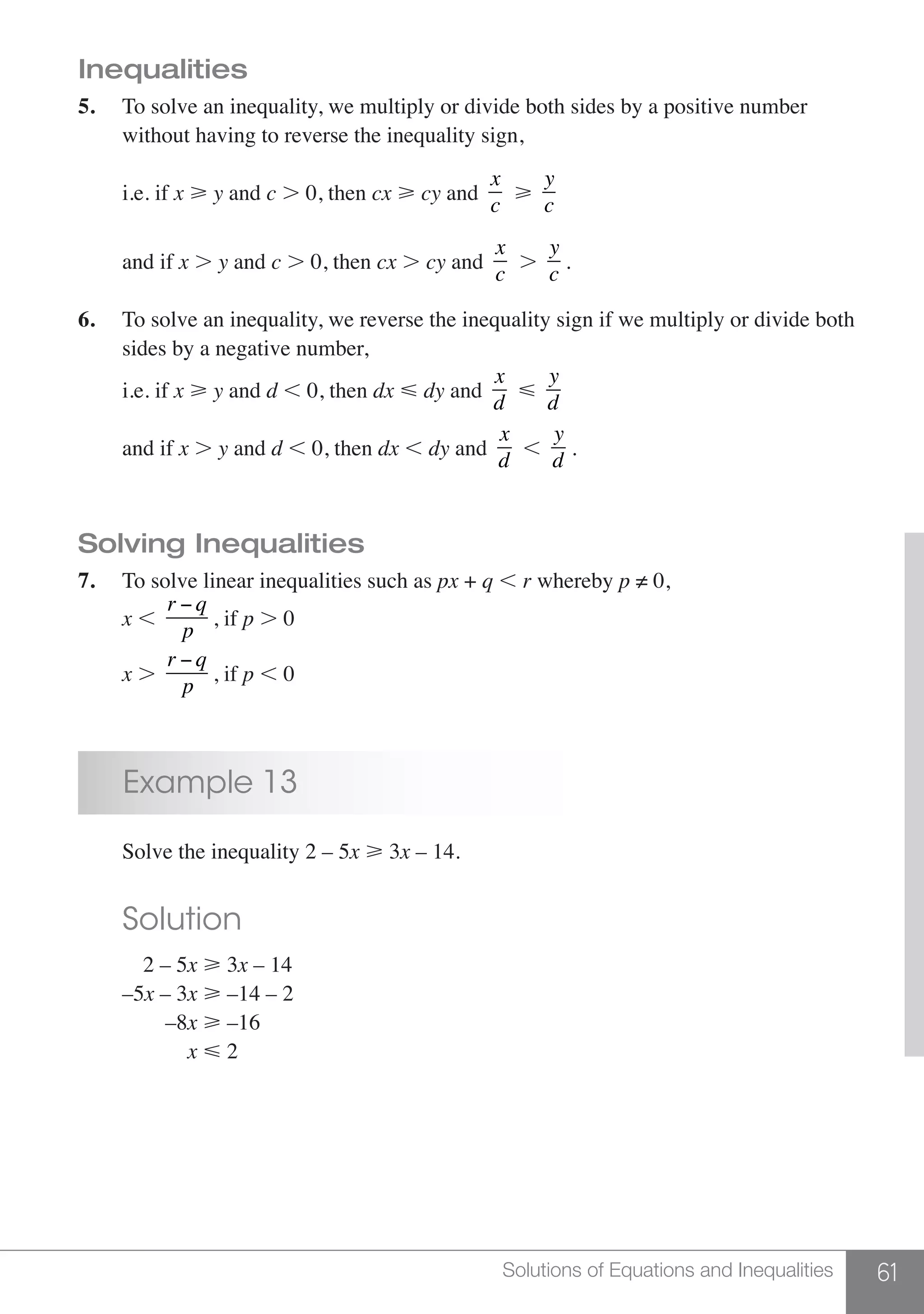
Inequalities
5.	 To solve an inequality, we multiply or divide both sides by a positive number
	 without having to reverse the inequality sign,
	 i.e. if x  y and c . 0, then cx  cy and
x
c

y
c
	
and if x . y and c . 0, then cx . cy and
x
c
.
y
c
.
6.	 To solve an inequality, we reverse the inequality sign if we multiply or divide both
	 sides by a negative number,
	 i.e. if x  y and d , 0, then dx  dy and
x
d

y
d
	 and if x . y and d , 0, then dx , dy and
x
d
,
y
d
.
Solving Inequalities
7.	 To solve linear inequalities such as px + q , r whereby p ≠ 0,
	 x ,
r − q
p
, if p . 0
	 x .
r − q
p
, if p , 0
	 Example 13
	 Solve the inequality 2 – 5x > 3x – 14.
	 Solution
	 2 – 5x > 3x – 14
	–5x – 3x > –14 – 2
	 –8x > –16
	 x < 2
62 UNIT 1.8
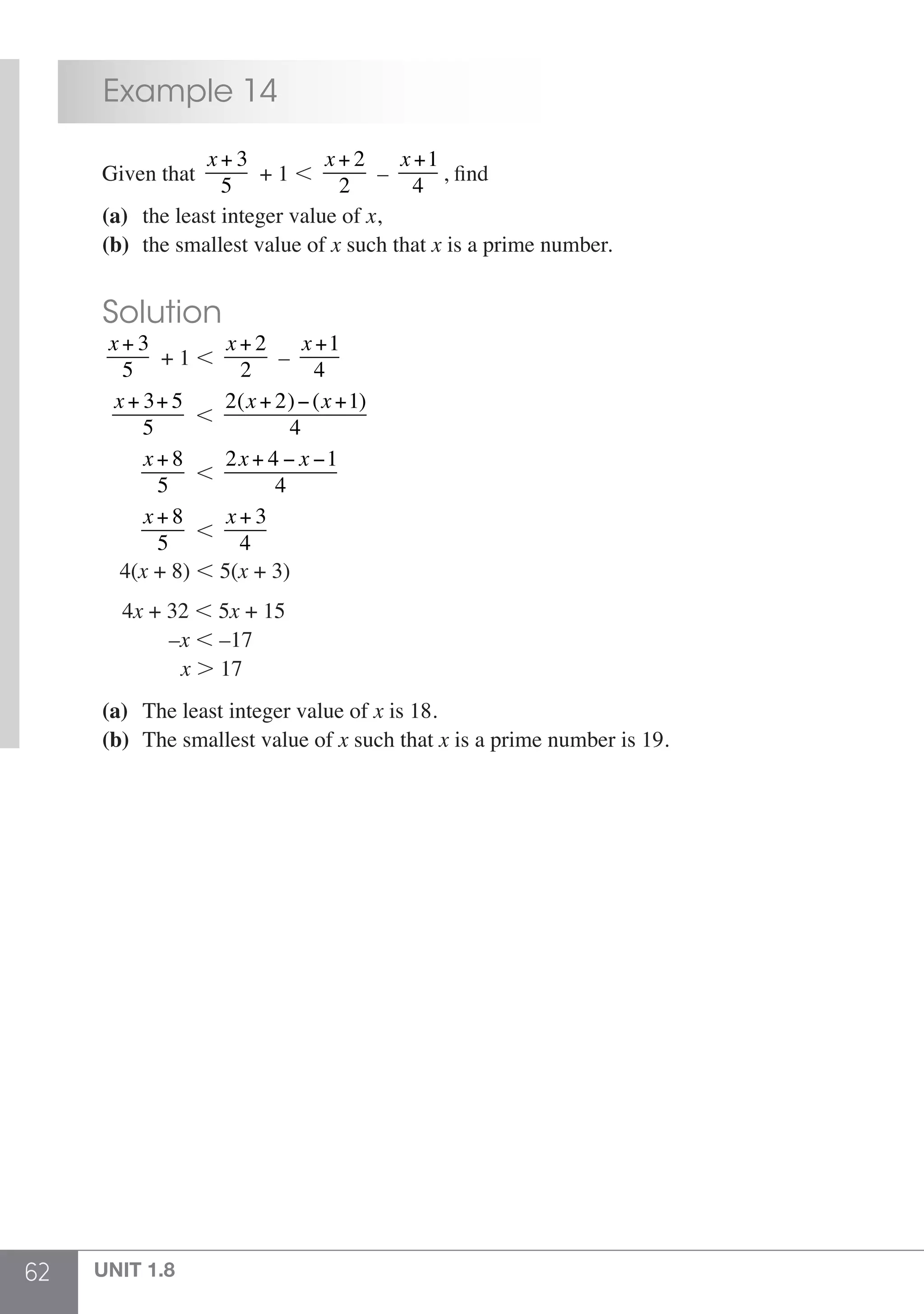
	 Example 14
	 Given that
x+ 3
5
+ 1 ,
x+ 2
2
–
x+1
4
, find
	 (a)	 the least integer value of x,
	 (b) 	the smallest value of x such that x is a prime number.
	 Solution
	
x+ 3
5
+ 1 ,
x+ 2
2
–
x+1
4
	
x+ 3+ 5
5
,
2(x + 2)−(x +1)
4
	
x+ 8
5
,
2x+ 4 − x −1
4
	
x+ 8
5
,
x+ 3
4
	 4(x + 8) , 5(x + 3)
	 4x + 32 , 5x + 15
	 –x , –17
	 x . 17
	 (a)	 The least integer value of x is 18.
	 (b) 	The smallest value of x such that x is a prime number is 19.
63Solutions of Equations and Inequalities
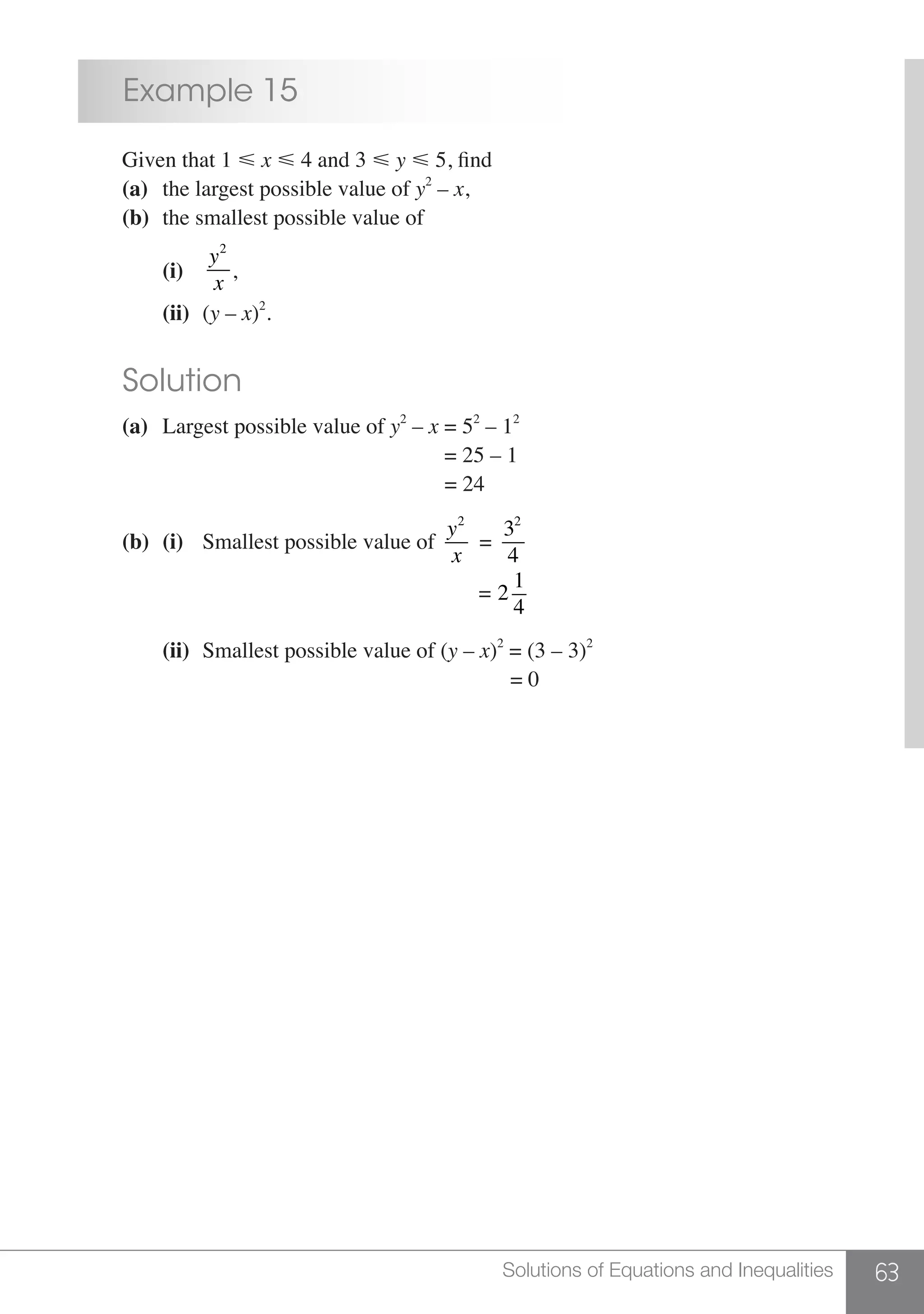
	 Example 15
	 Given that 1  x  4 and 3  y  5, find
	 (a)	 the largest possible value of y2
– x,
	 (b) 	the smallest possible value of
		(i)	
y2
x
,
		(ii) 	(y – x)2
.
	 Solution
	 (a)	 Largest possible value of y2
– x = 52
– 12
						 = 25 – 1
				 = 24
	 (b)	 (i)	 Smallest possible value of
y2
x
=
32
4
							 = 2
1
4
		(ii)	 Smallest possible value of (y – x)2
= (3 – 3)2
							 = 0
64 UNIT 1.9
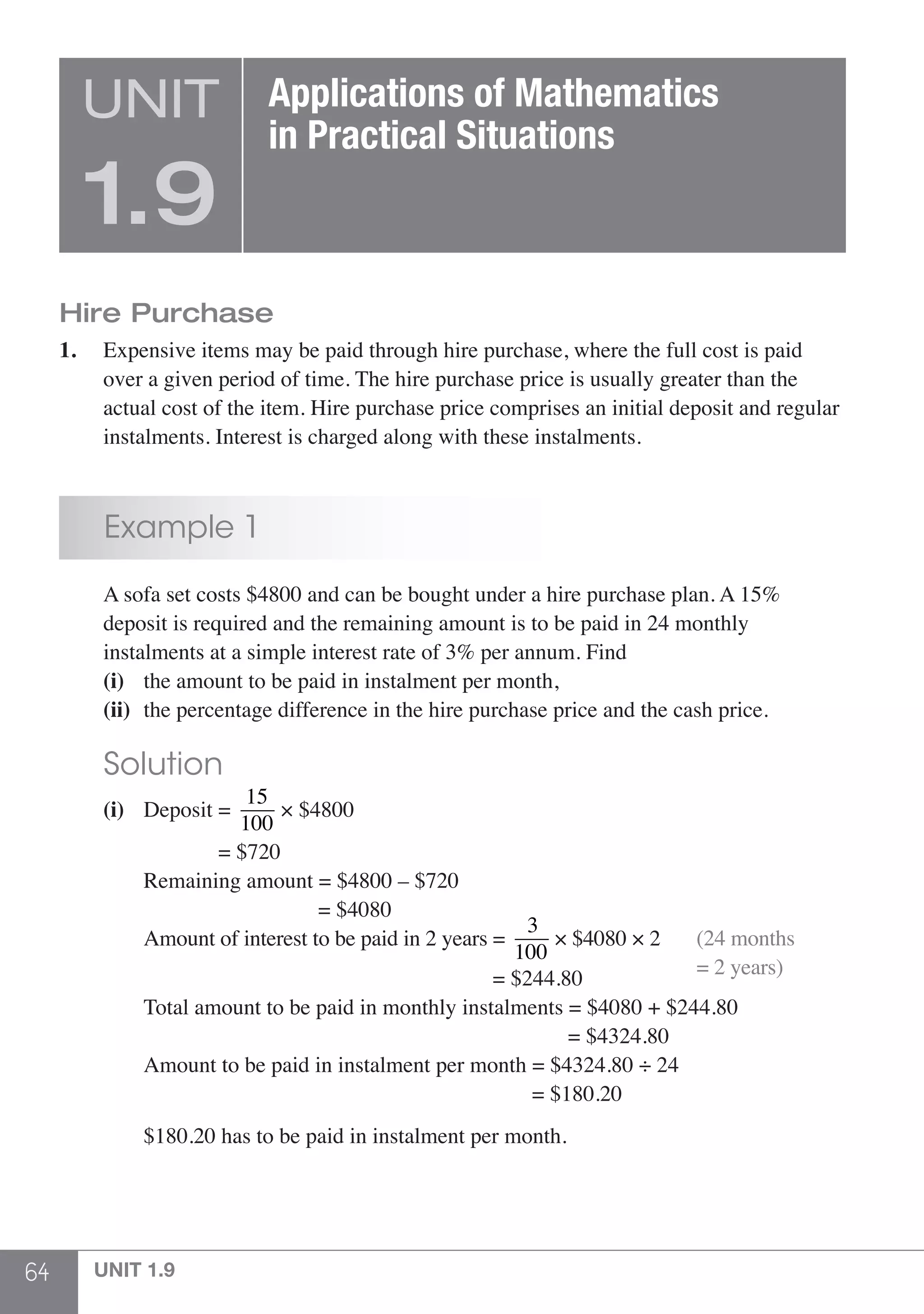
Hire Purchase
1.	 Expensive items may be paid through hire purchase, where the full cost is paid
	 over a given period of time. The hire purchase price is usually greater than the
	 actual cost of the item. Hire purchase price comprises an initial deposit and regular
	 instalments. Interest is charged along with these instalments.
	 Example 1
	 A sofa set costs $4800 and can be bought under a hire purchase plan. A 15%
	 deposit is required and the remaining amount is to be paid in 24 monthly
	 instalments at a simple interest rate of 3% per annum. Find
	 (i)	 the amount to be paid in instalment per month,
	 (ii)	 the percentage difference in the hire purchase price and the cash price.
	 Solution
	 (i)	 Deposit =
15
100
× $4800
			 = $720
		 Remaining amount = $4800 – $720
					 = $4080
		 Amount of interest to be paid in 2 years =
3
100
× $4080 × 2
								 = $244.80	
(24 months
= 2 years)
		 Total amount to be paid in monthly instalments = $4080 + $244.80
								 = $4324.80
		 Amount to be paid in instalment per month = $4324.80 ÷ 24
							 = $180.20
		
		 $180.20 has to be paid in instalment per month.
UNIT
1.9
Applications of Mathematics
in Practical Situations
65Applications of Mathematics in Practical Situations
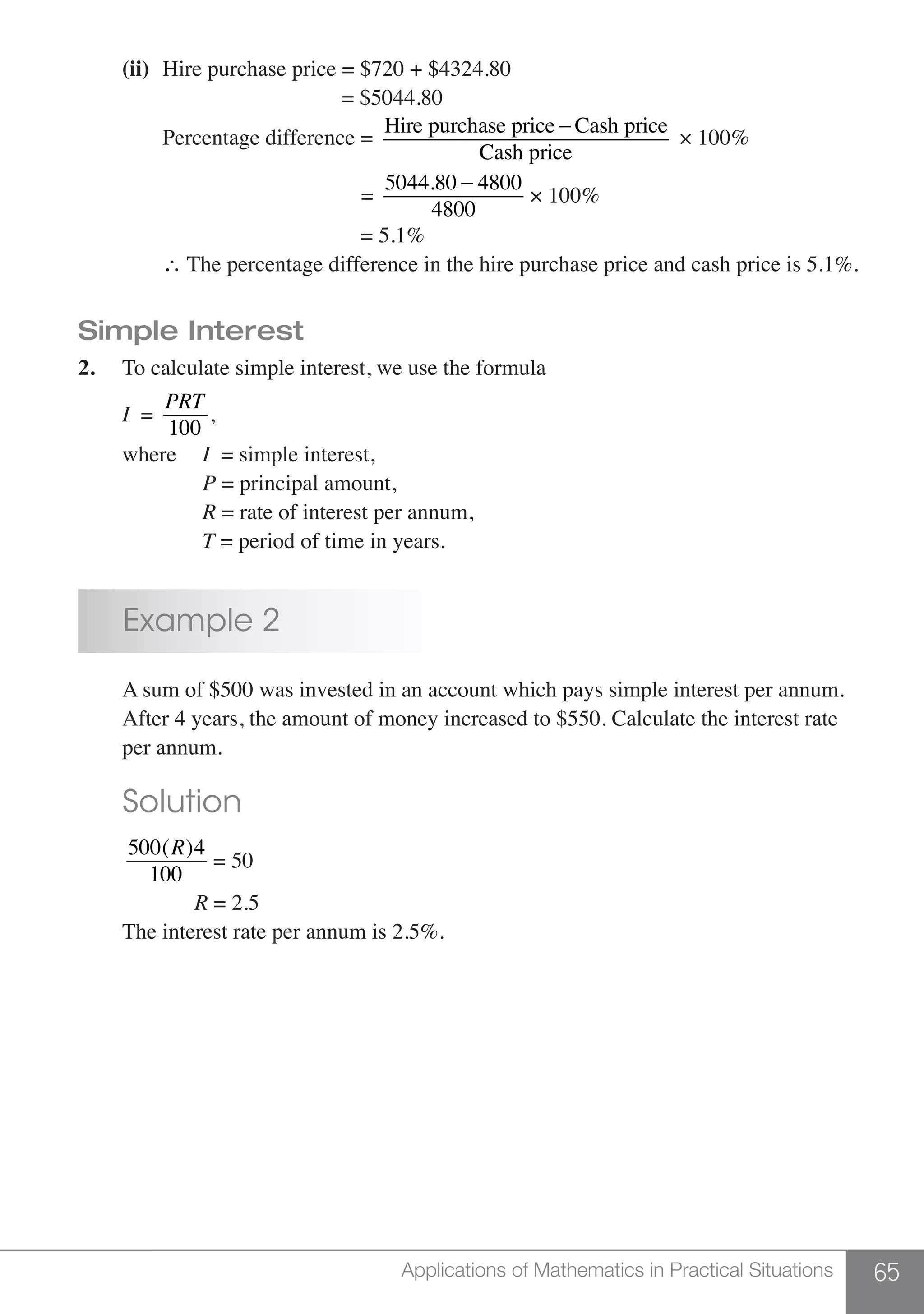
	 (ii)	 Hire purchase price = $720 + $4324.80
						 = $5044.80
		 Percentage difference =
Hire purchase price − Cash price
Cash price
× 100%
					 =
5044.80 − 4800
4800
× 100%
					 = 5.1%
		∴ The percentage difference in the hire purchase price and cash price is 5.1%.
Simple Interest
2.	 To calculate simple interest, we use the formula
	 I =
PRT
100
,
	 where 	 I = simple interest,
			P = principal amount,
			R = rate of interest per annum,
			T = period of time in years.
	 Example 2
	 A sum of $500 was invested in an account which pays simple interest per annum.
	 After 4 years, the amount of money increased to $550. Calculate the interest rate 	
	 per annum.		
	 Solution
	
500(R)4
100
= 50
		 R = 2.5
	 The interest rate per annum is 2.5%.
66 UNIT 1.9
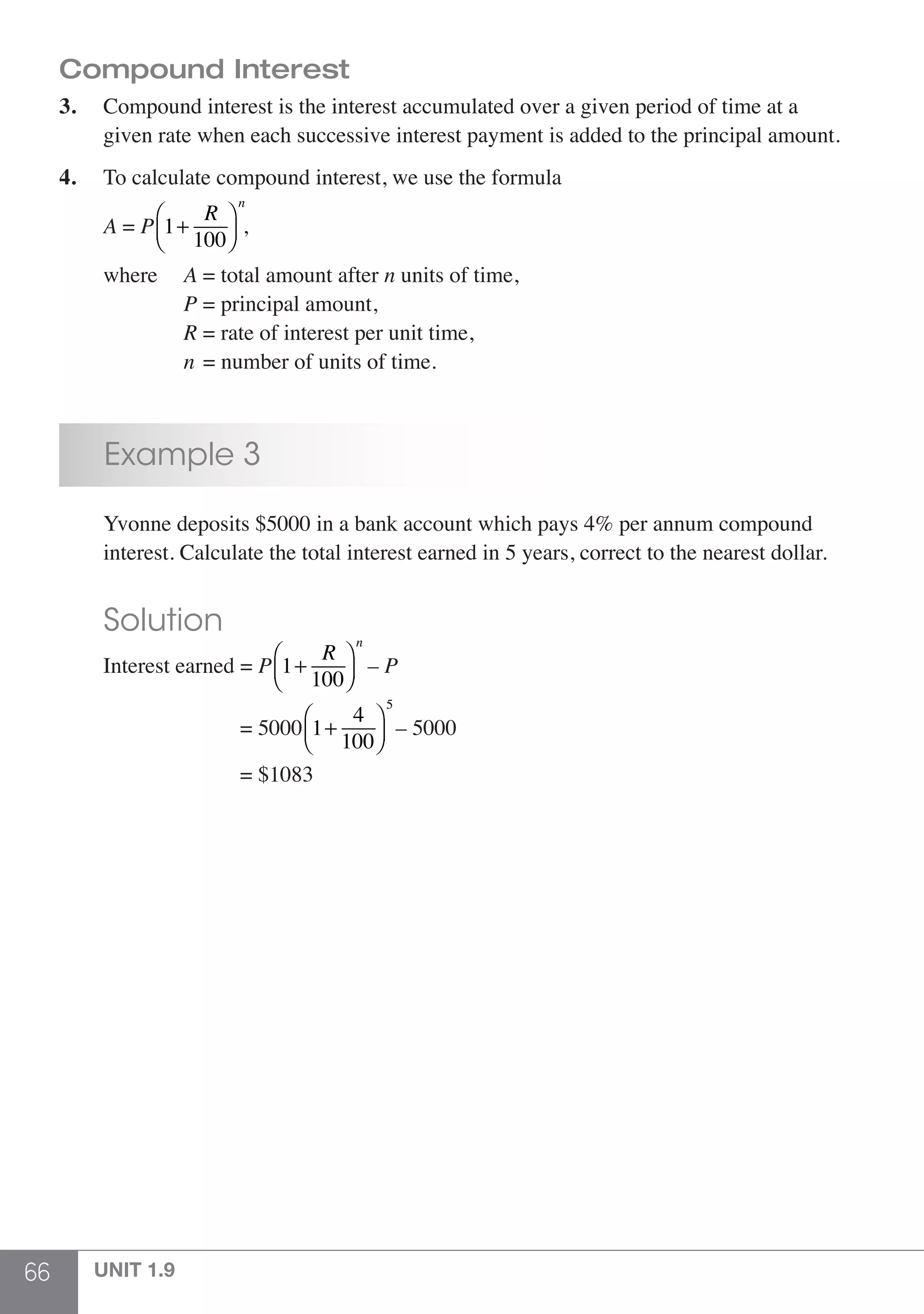
Compound Interest
3.	 Compound interest is the interest accumulated over a given period of time at a
	 given rate when each successive interest payment is added to the principal amount.
4.	 To calculate compound interest, we use the formula
	 A = P 1+
R
100
⎛
⎝⎜
⎞
⎠⎟
n
,
	 where 	 A = total amount after n units of time,
			P = principal amount,
			R = rate of interest per unit time,
			n = number of units of time.
	 Example 3
	 Yvonne deposits $5000 in a bank account which pays 4% per annum compound
	 interest. Calculate the total interest earned in 5 years, correct to the nearest dollar.
	 Solution
	 Interest earned = P 1+
R
100
⎛
⎝⎜
⎞
⎠⎟
n
– P
				 = 5000 1+
4
100
⎛
⎝⎜
⎞
⎠⎟
5
– 5000
				 = $1083
67Applications of Mathematics in Practical Situations
	 Example 4
	 Brian wants to place $10 000 into a fixed deposit account for 3 years. Bank X
	 offers a simple interest rate of 1.2% per annum and Bank Y offers an interest
	 rate of 1.1% compounded annually. Which bank should Brian choose to yield a
	 better interest?
	 Solution
	 Interest offered by Bank X:	 I =
PRT
100
							 =
(10 000)(1.2)(3)
100
							 = $360
	 Interest offered by Bank Y:	 I = P 1+
R
100
⎛
⎝⎜
⎞
⎠⎟
n
– P
							 = 10 000 1+
1.1
100
⎛
⎝⎜
⎞
⎠⎟
3
– 10 000
							 = $333.64 (to 2 d.p.)
	 ∴ Brian should choose Bank X.
Money Exchange
5.	 To change local currency to foreign currency, a given unit of the local currency is
	 multiplied by the exchange rate.
	 e.g.	To change Singapore dollars to foreign currency,
		 Foreign currency = Singapore dollars × Exchange rate
	 Example 5
	 Mr Lim exchanged S$800 for Australian dollars. Given S$1 = A$0.9611, how
	 much did he receive in Australian dollars?
	 Solution
	 800 × 0.9611 = 768.88
	 Mr Lim received A$768.88.
68 UNIT 1.9
	 Example 6
	 A tourist wanted to change S$500 into Japanese Yen. The exchange rate at that
	 time was ¥100 = S$1.0918. How much will he receive in Japanese Yen?
	 Solution
	
500
1.0918
× 100 = 45 795.933
				 ≈ 45 795.93	 (Always leave answers involving money to the 	
							 nearest cent unless stated otherwise)
	 He will receive ¥45 795.93.
6.	 To convert foreign currency to local currency, a given unit of the foreign currency 	
	 is divided by the exchange rate.
	 e.g.	To change foreign currency to Singapore dollars,
		 Singapore dollars = Foreign currency ÷ Exchange rate
	 Example 7
	 Sarah buys a dress in Thailand for 200 Baht. Given that S$1 = 25 Thai baht, how
	 much does the dress cost in Singapore dollars?
	 Solution
	 200 ÷ 25 = 8
	 The dress costs S$8.
Profit and Loss
7.	 Profit = Selling price – Cost price
8.	 Loss = Cost price – Selling price
69Applications of Mathematics in Practical Situations
	 Example 8
	 Mrs Lim bought a piece of land and sold it a few years later. She sold the land at
	 $3 million at a loss of 30%. How much did she pay for the land initially? Give 	
	 your answer correct to 3 significant figures.
	 Solution
	 3 000 000 ×
100
70
= 4 290 000 (to 3 s.f.)
	Mrs Lim initially paid $4 290 000 for the land.
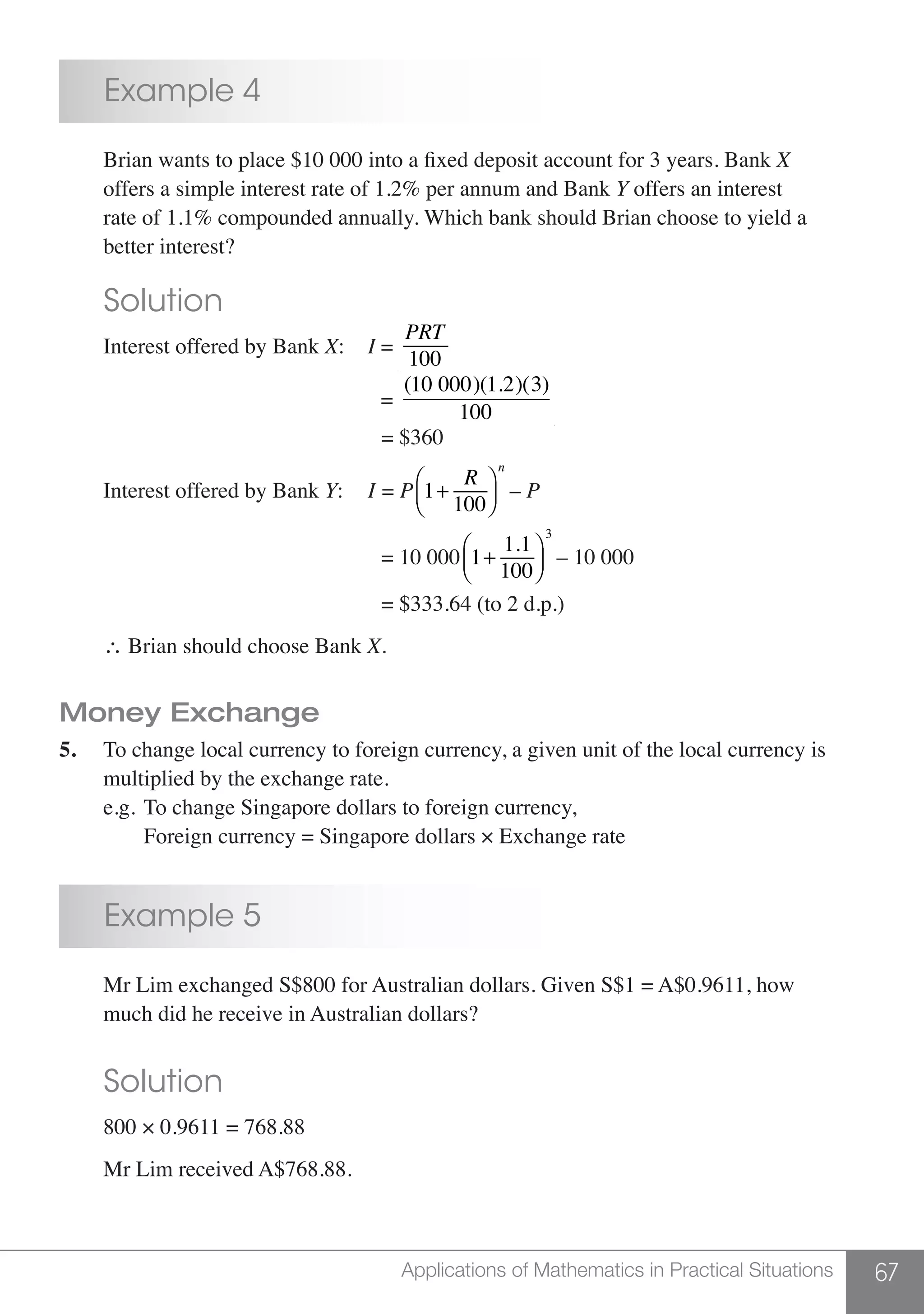
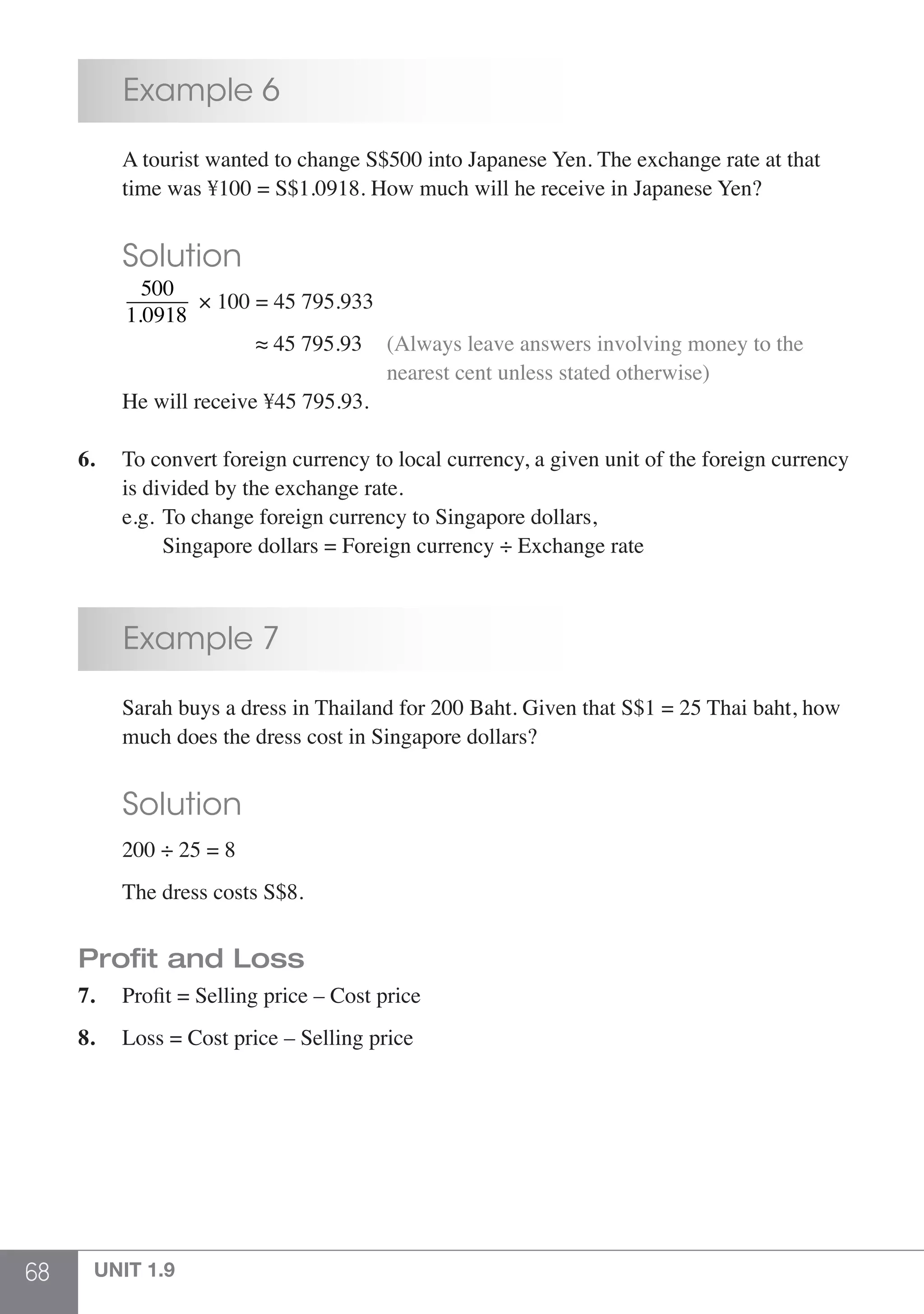
Distance-Time Graphs
rest
uniform
speed
Time
Time
Distance
O
Distance
O
varying
speed
9.	 The gradient of a distance-time graph gives the speed of the object.
10.	 A straight line indicates motion with uniform speed.
	 A curve indicates motion with varying speed.
	 A straight line parallel to the time-axis indicates that the object is stationary.
11.	 Average speed =
Total distance travelled
Total time taken
70 UNIT 1.9
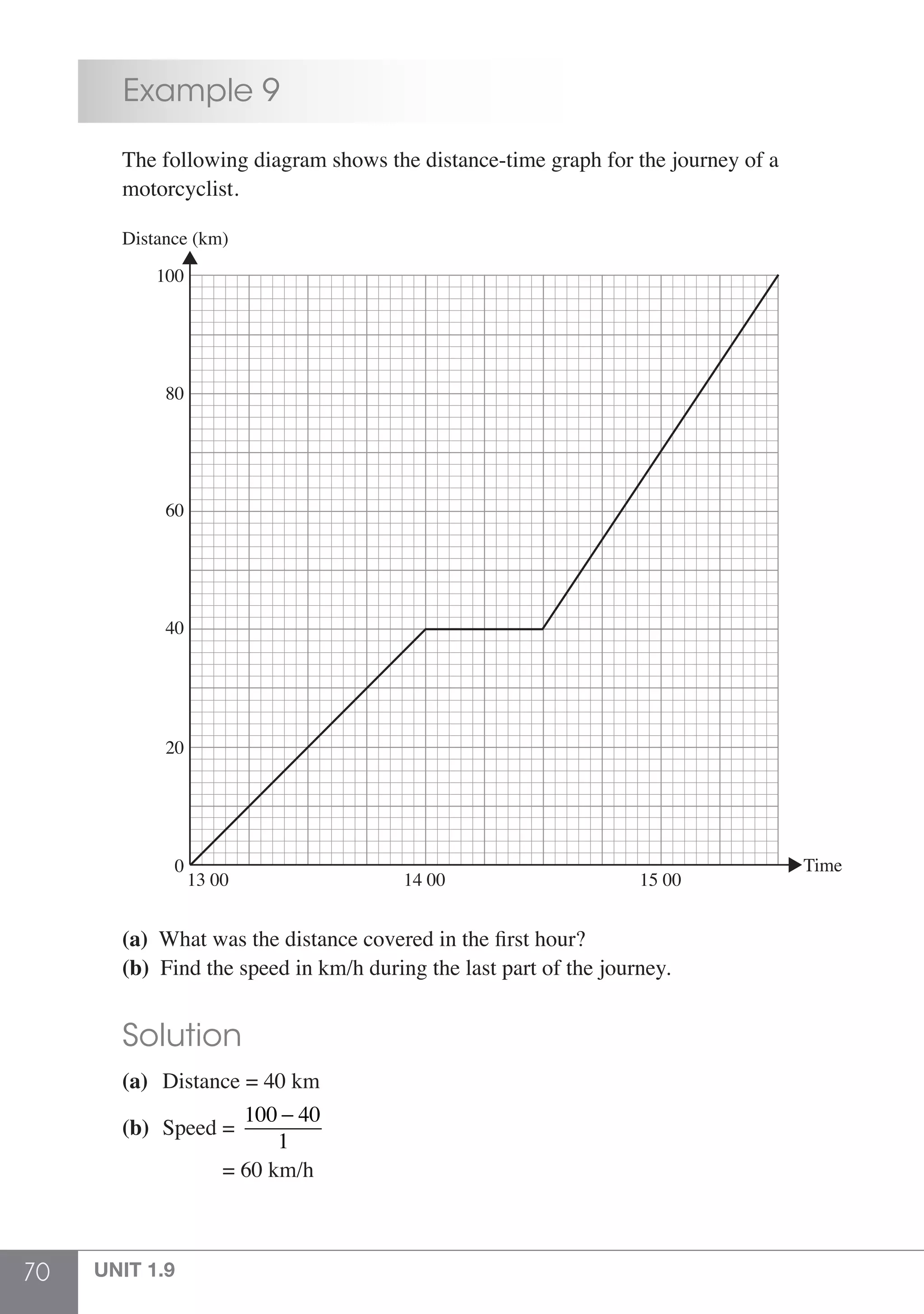
	 Example 9
	 The following diagram shows the distance-time graph for the journey of a 		
	motorcyclist.
	
Distance (km)
100
80
60
40
20
13 00 14 00 15 00
Time0
	 (a)  What was the distance covered in the first hour?
	 (b) Find the speed in km/h during the last part of the journey.
	 Solution
	 (a)	 Distance = 40 km
	 (b)	 Speed =
100 − 40
1
			 = 60 km/h
71Applications of Mathematics in Practical Situations
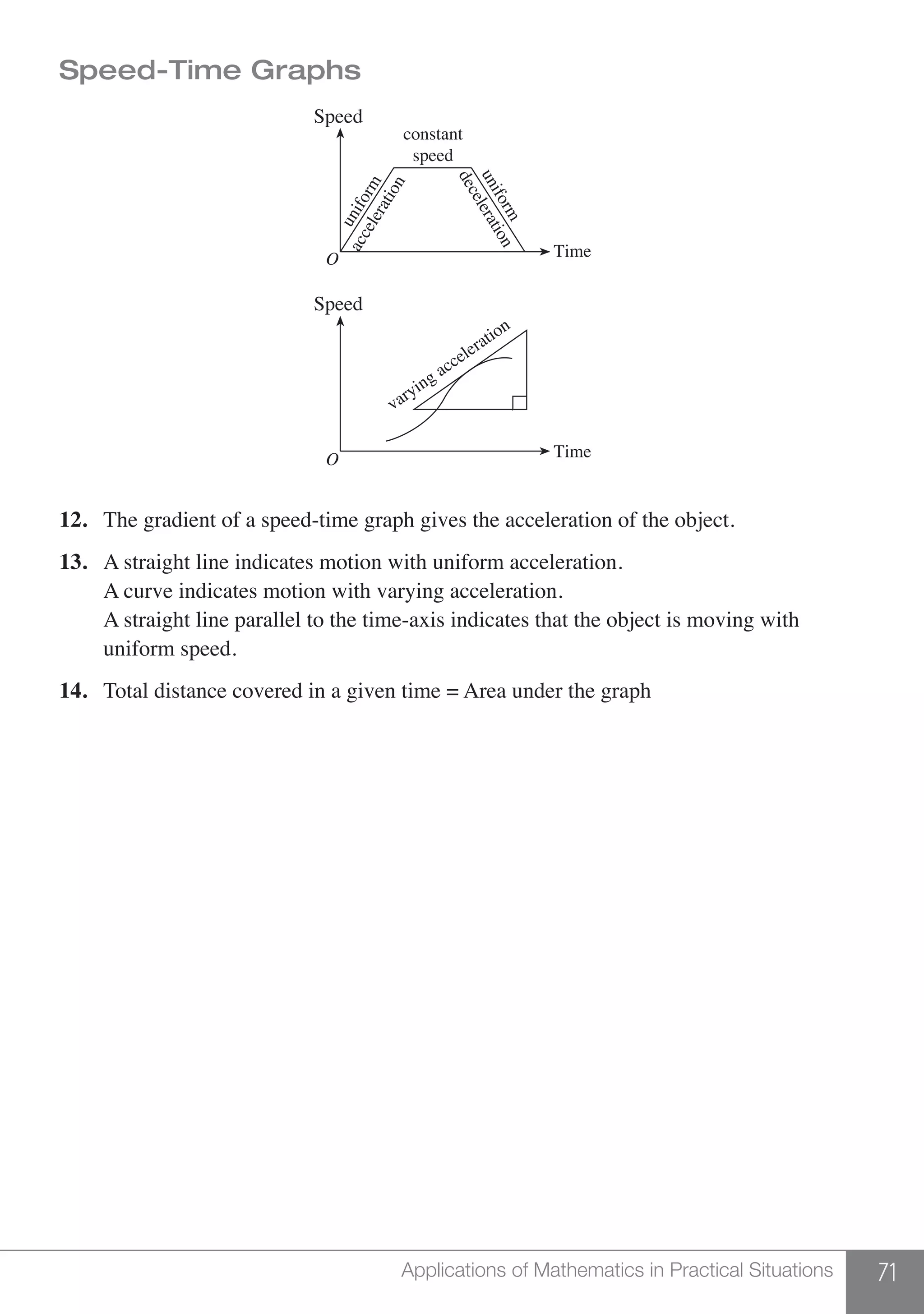
Speed-Time Graphs
uniform
deceleration
uniform
acceleration
constant
speed
varying acceleration
Speed
Speed
TimeO
O Time
12.	 The gradient of a speed-time graph gives the acceleration of the object.
13.	 A straight line indicates motion with uniform acceleration.
	 A curve indicates motion with varying acceleration.
	 A straight line parallel to the time-axis indicates that the object is moving with
	 uniform speed.
14.	 Total distance covered in a given time = Area under the graph
72 UNIT 1.9
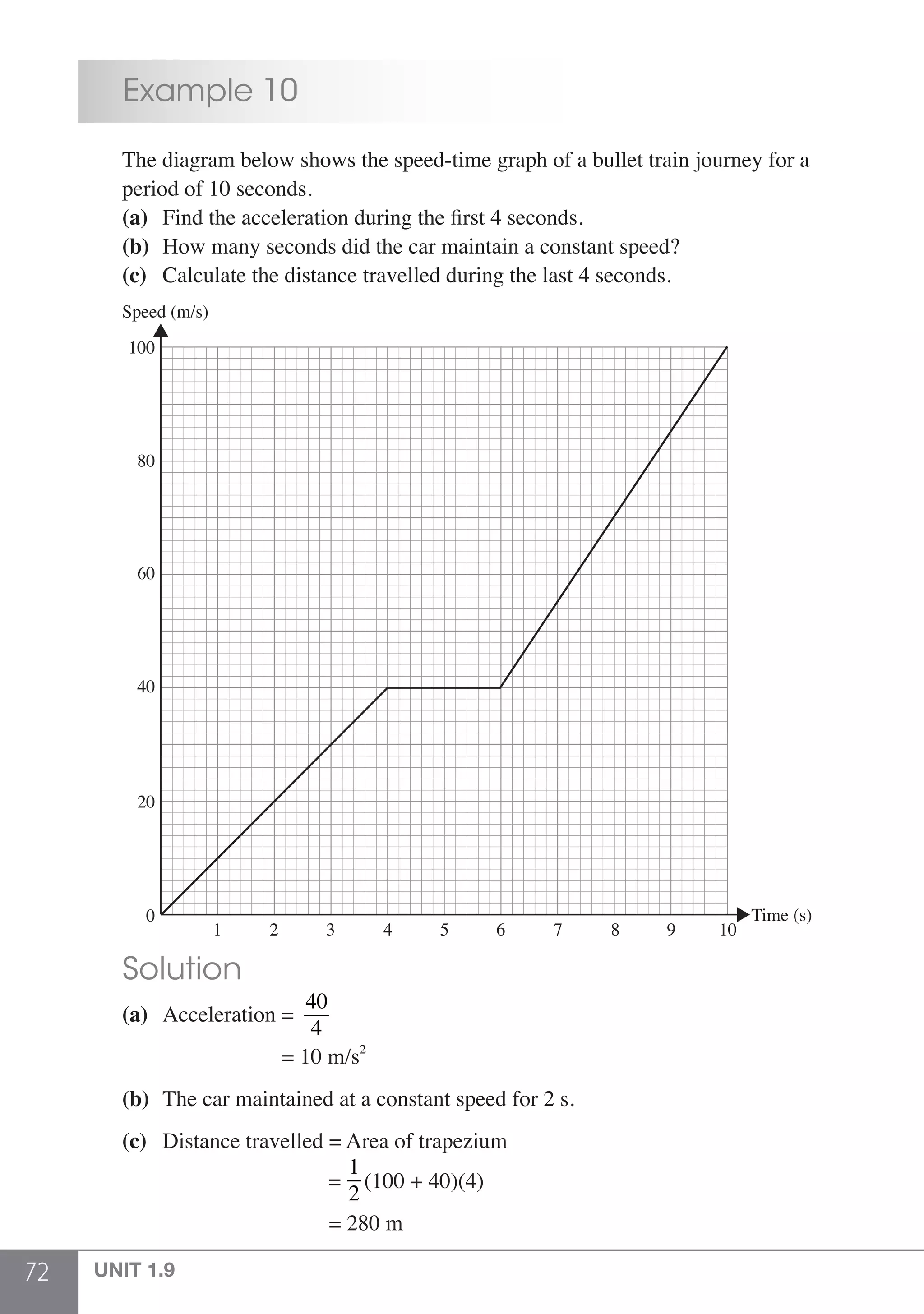
	 Example 10
	 The diagram below shows the speed-time graph of a bullet train journey for a
	 period of 10 seconds.
	 (a)	 Find the acceleration during the first 4 seconds.
	 (b)	 How many seconds did the car maintain a constant speed?
	 (c)	 Calculate the distance travelled during the last 4 seconds.
	
Speed (m/s)
100
80
60
40
20
1 2 3 4 5 6 7 8 9 10
Time (s)0
	 Solution
	 (a)	 Acceleration =
40
4
				 = 10 m/s2
	 (b)	 The car maintained at a constant speed for 2 s.
	 (c)	 Distance travelled = Area of trapezium
					 =
1
2
(100 + 40)(4)
					 = 280 m
73Applications of Mathematics in Practical Situations
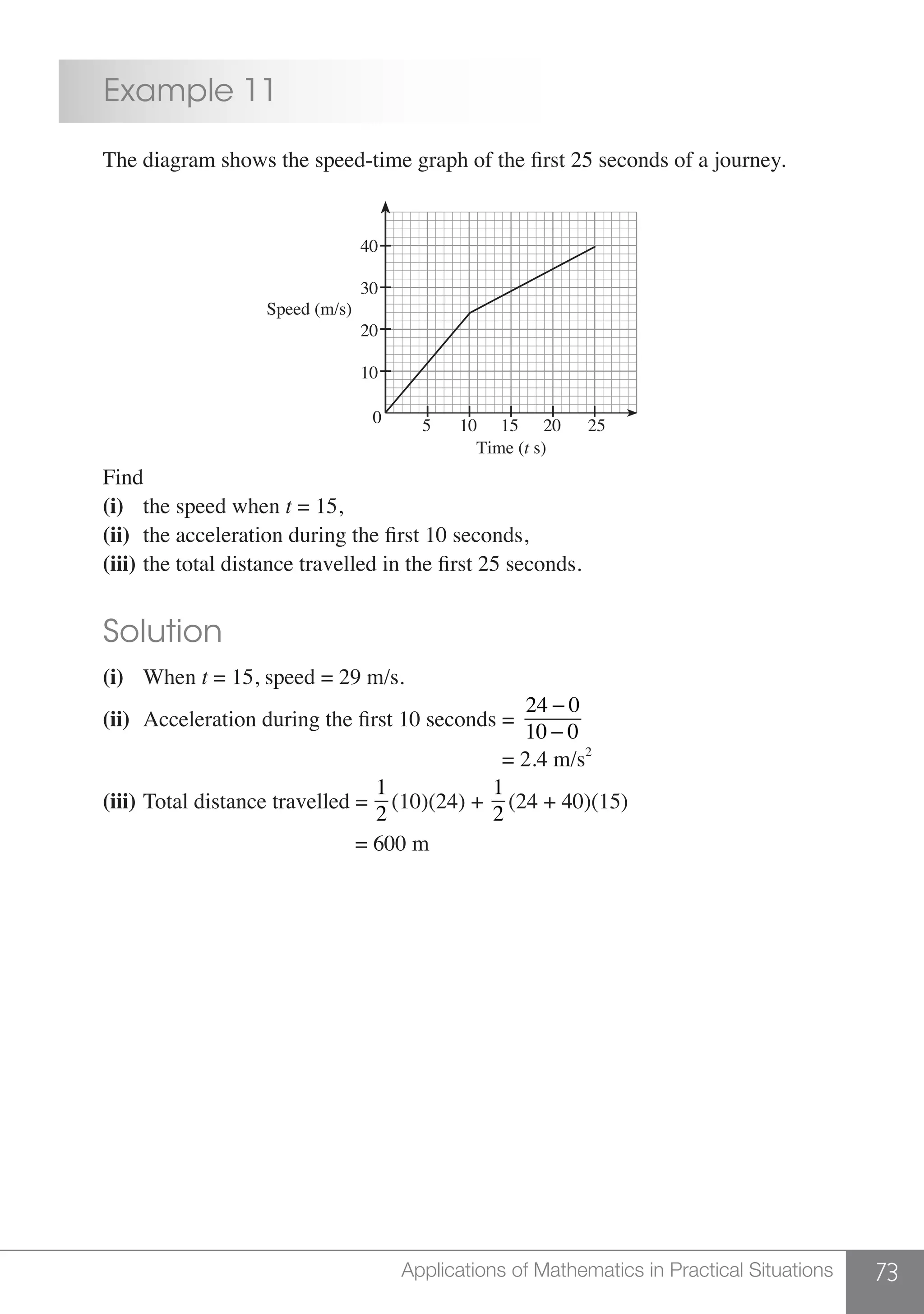
	 Example 11
	 The diagram shows the speed-time graph of the first 25 seconds of a journey.
5 10 15 20 25
40
30
20
10
0
Speed (m/s)
Time (t s)
	Find
	(i)	 the speed when t = 15,
	 (ii) 	the acceleration during the first 10 seconds,
	 (iii) 	the total distance travelled in the first 25 seconds.
	 Solution
	 (i)	When t = 15, speed = 29 m/s.
	(ii)	 Acceleration during the first 10 seconds =
24 − 0
10 − 0
										 = 2.4 m/s2
	(iii)	Total distance travelled =
1
2
(10)(24) +
1
2
(24 + 40)(15)
						 = 600 m
74 UNIT 1.9
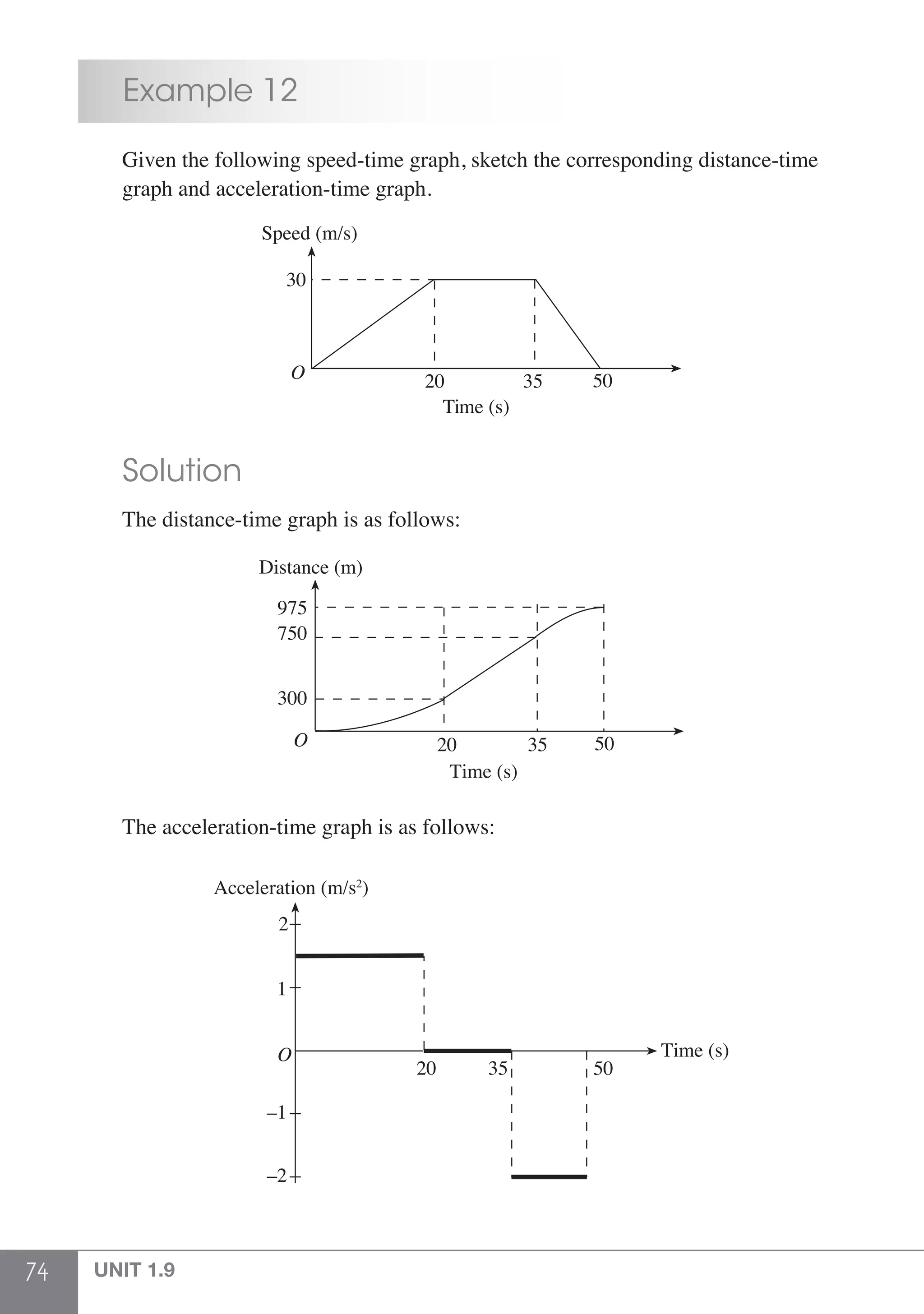
	 Example 12
	 Given the following speed-time graph, sketch the corresponding distance-time
	 graph and acceleration-time graph.
30
O 20 35 50
Time (s)
Speed (m/s)
	 Solution
	 The distance-time graph is as follows:
750
O 20 35 50
300
975
Distance (m)
Time (s)
	 The acceleration-time graph is as follows:
O
20 35 50
–2
1
2
–1
Acceleration (m/s2
)
Time (s)
75Applications of Mathematics in Practical Situations
Water Level – Time Graphs
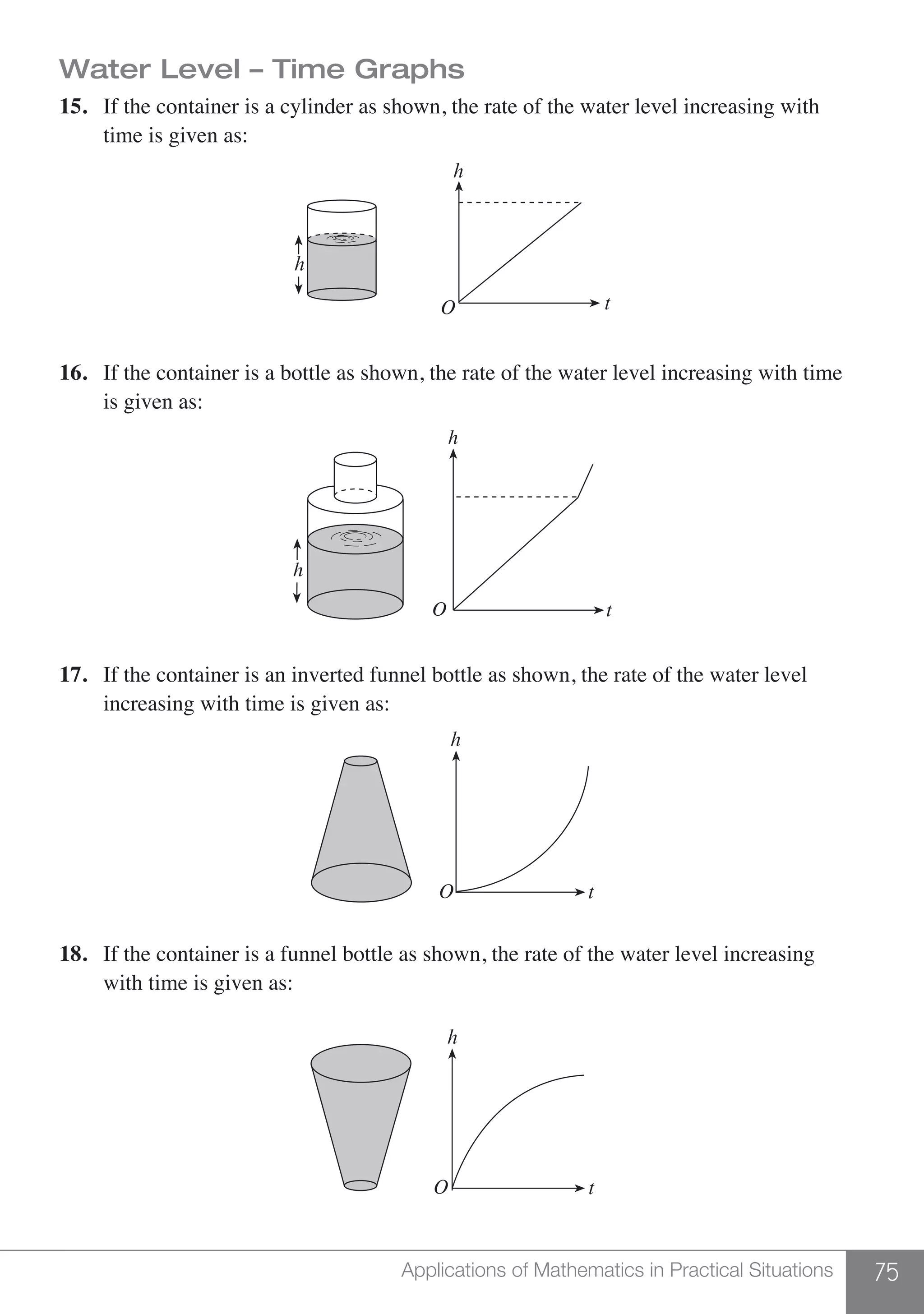
15.	 If the container is a cylinder as shown, the rate of the water level increasing with
	 time is given as:
O
h
t
h
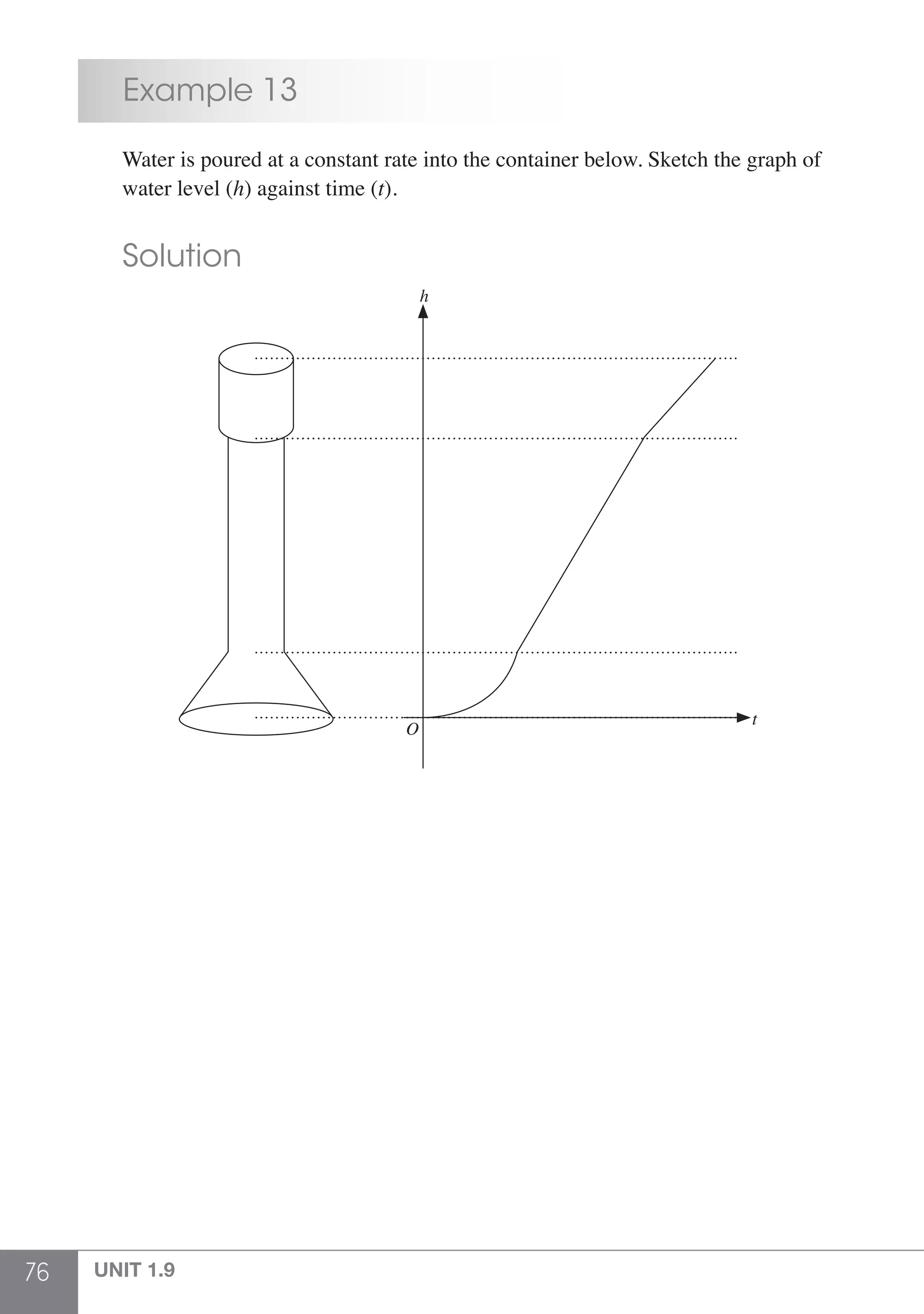
16.	 If the container is a bottle as shown, the rate of the water level increasing with time
	 is given as:
O
h
t
h
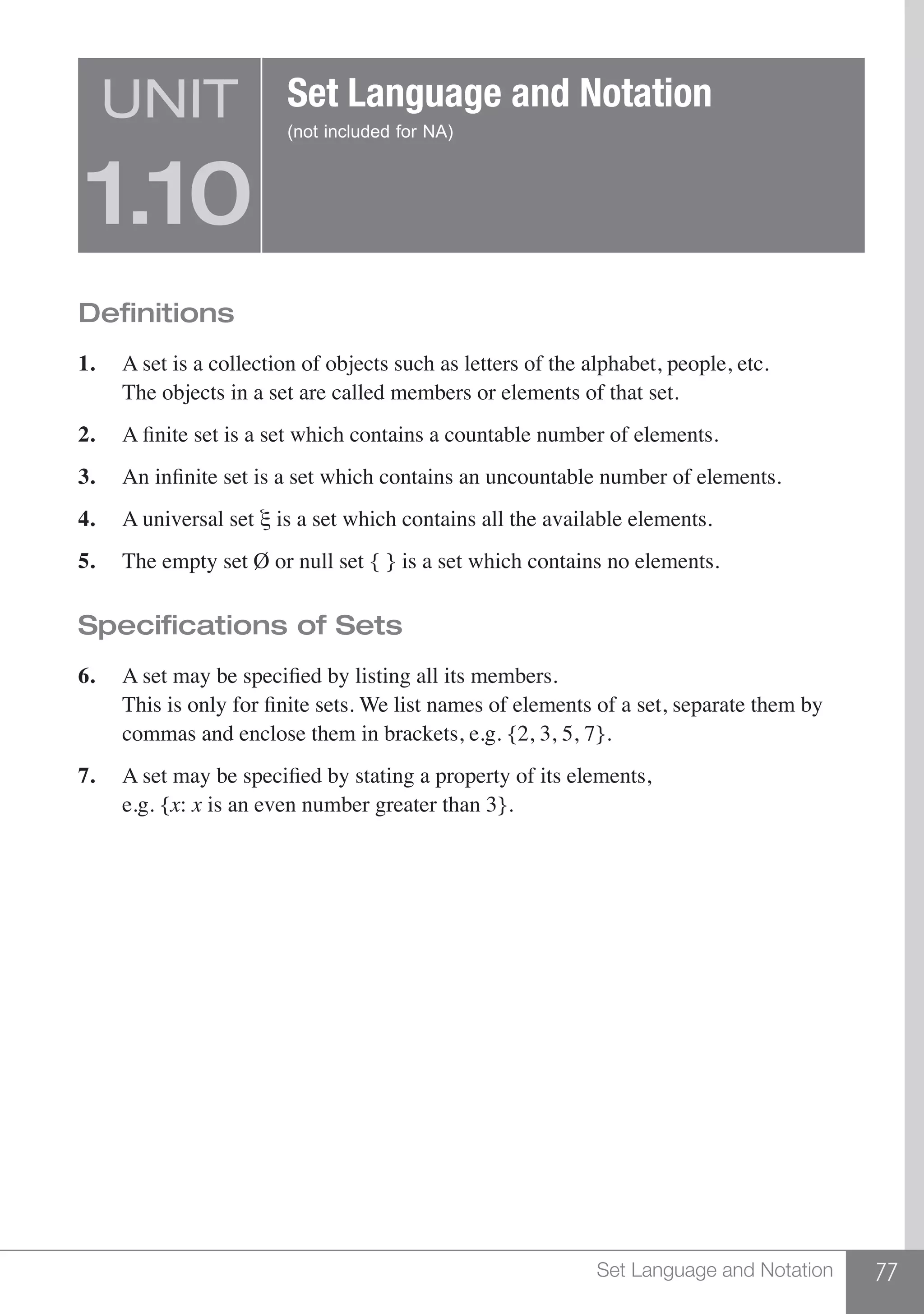
17.	 If the container is an inverted funnel bottle as shown, the rate of the water level
	 increasing with time is given as:
O
h
t
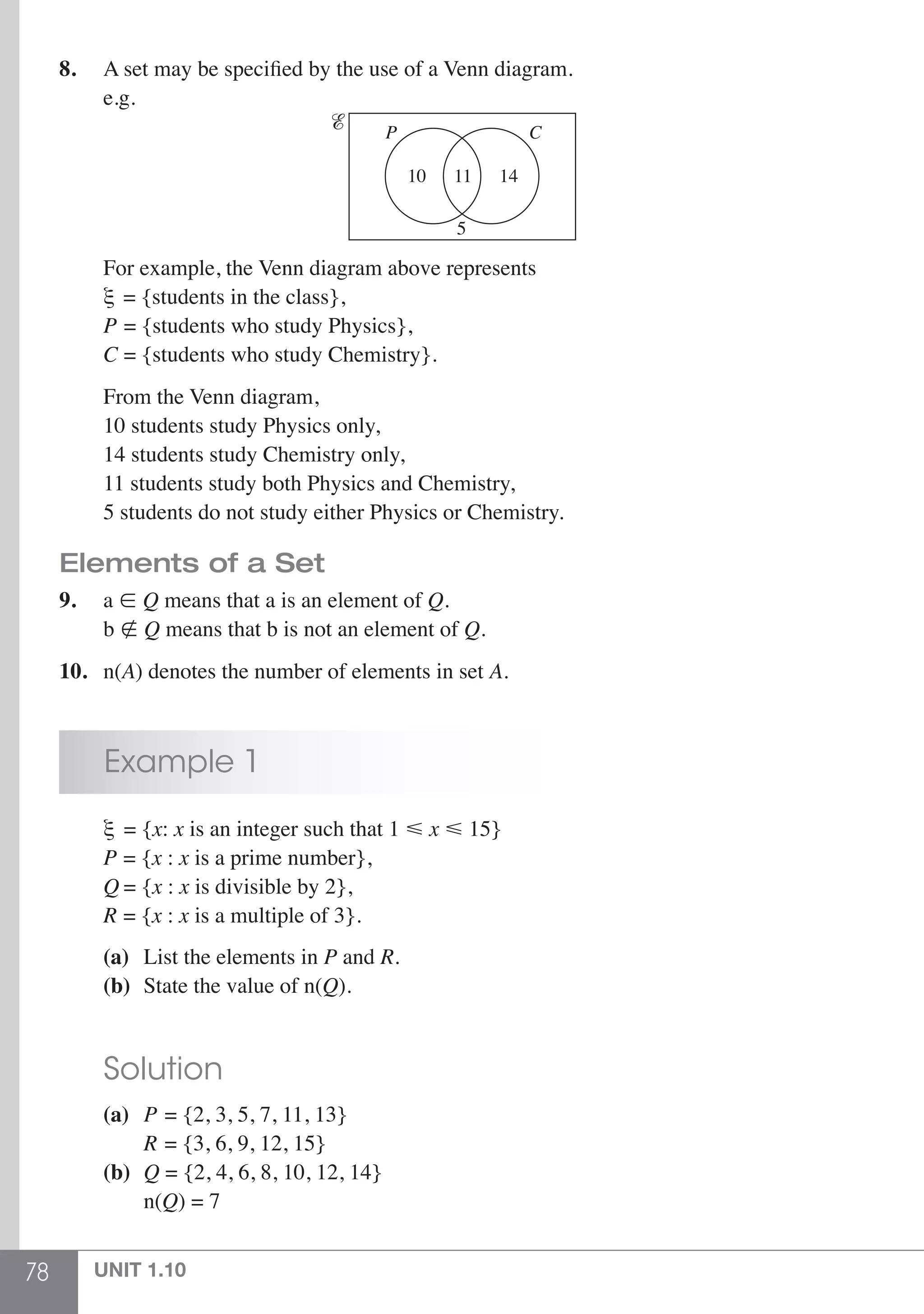
18.	 If the container is a funnel bottle as shown, the rate of the water level increasing
	 with time is given as:
O
h
t
76 UNIT 1.9
	 Example 13
	 Water is poured at a constant rate into the container below. Sketch the graph of
	 water level (h) against time (t).
	 Solution
	 h
t
O
77Set Language and Notation
Definitions
1.	 A set is a collection of objects such as letters of the alphabet, people, etc.
	 The objects in a set are called members or elements of that set.
2.	 A finite set is a set which contains a countable number of elements.
3.	 An infinite set is a set which contains an uncountable number of elements.
4.	 A universal set ξ is a set which contains all the available elements.
5.	 The empty set Ø or null set { } is a set which contains no elements.
Specifications of Sets
6.	 A set may be specified by listing all its members.	
	 This is only for finite sets. We list names of elements of a set, separate them by
	 commas and enclose them in brackets, e.g. {2, 3, 5, 7}.
7.	 A set may be specified by stating a property of its elements,	
	 e.g. {x: x is an even number greater than 3}.
UNIT
1.10
Set Language and Notation
(not included for NA)
78 UNIT 1.10
8.	 A set may be specified by the use of a Venn diagram.
	 e.g.
P C
1110 14
5
Ᏹ
	 For example, the Venn diagram above represents
	 ξ  = {students in the class},
	 P = {students who study Physics},
	 C = {students who study Chemistry}.
	 From the Venn diagram,
	 10 students study Physics only,
	 14 students study Chemistry only,
	 11 students study both Physics and Chemistry,
	 5 students do not study either Physics or Chemistry.
Elements of a Set
9.	a  Q means that a is an element of Q.	
	b  Q means that b is not an element of Q.
10.	n(A) denotes the number of elements in set A.
	 Example 1
	 ξ  = {x: x is an integer such that 1 < x < 15}
	 P = {x : x is a prime number},
	 Q = {x : x is divisible by 2},
	 R = {x : x is a multiple of 3}.
	 (a)	 List the elements in P and R.
	 (b)	 State the value of n(Q).
	 Solution
	 (a)	 P = {2, 3, 5, 7, 11, 13}
		R = {3, 6, 9, 12, 15}
	 (b)	 Q = {2, 4, 6, 8, 10, 12, 14}
		n(Q) = 7
79Set Language and Notation
Equal Sets
11.	 If two sets contain the exact same elements, we say that the two sets are equal sets.	
	 For example, if A = {1, 2, 3}, B = {3, 1, 2} and C = {a, b, c}, then A and B are
	 equal sets but A and C are not equal sets.
Subsets
12.	 A  B means that A is a subset of B.	
	 Every element of set A is also an element of set B.
13.	 A  B means that A is a proper subset of B.	
	 Every element of set A is also an element of set B, but A cannot be equal to B.
14.	 A  B means A is not a subset of B.
15.	 A  B means A is not a proper subset of B.
Complement Sets
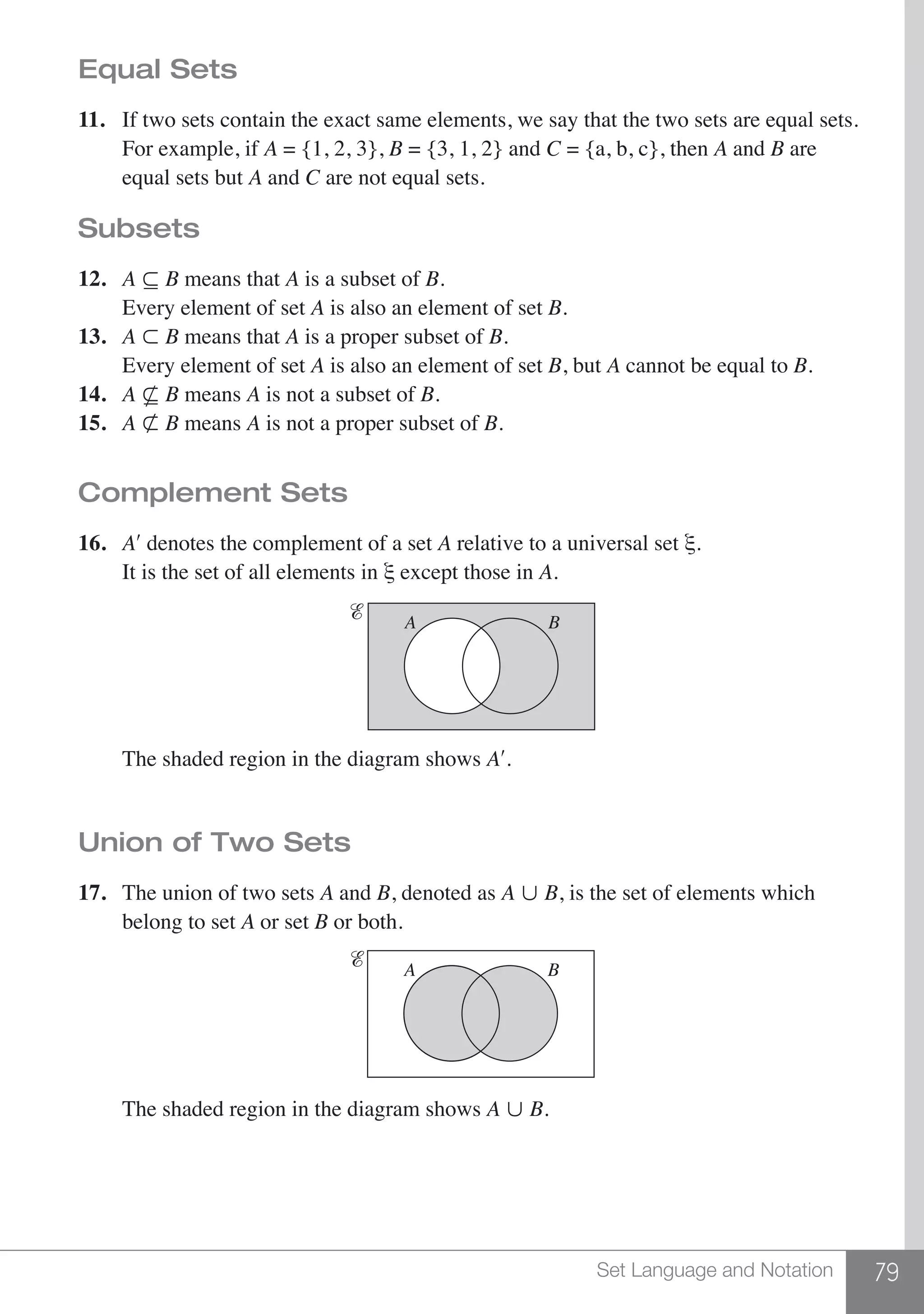
16.	 A′ denotes the complement of a set A relative to a universal set ξ.	
	 It is the set of all elements in ξ except those in A.	
A BᏱ
	 The shaded region in the diagram shows A′.
Union of Two Sets
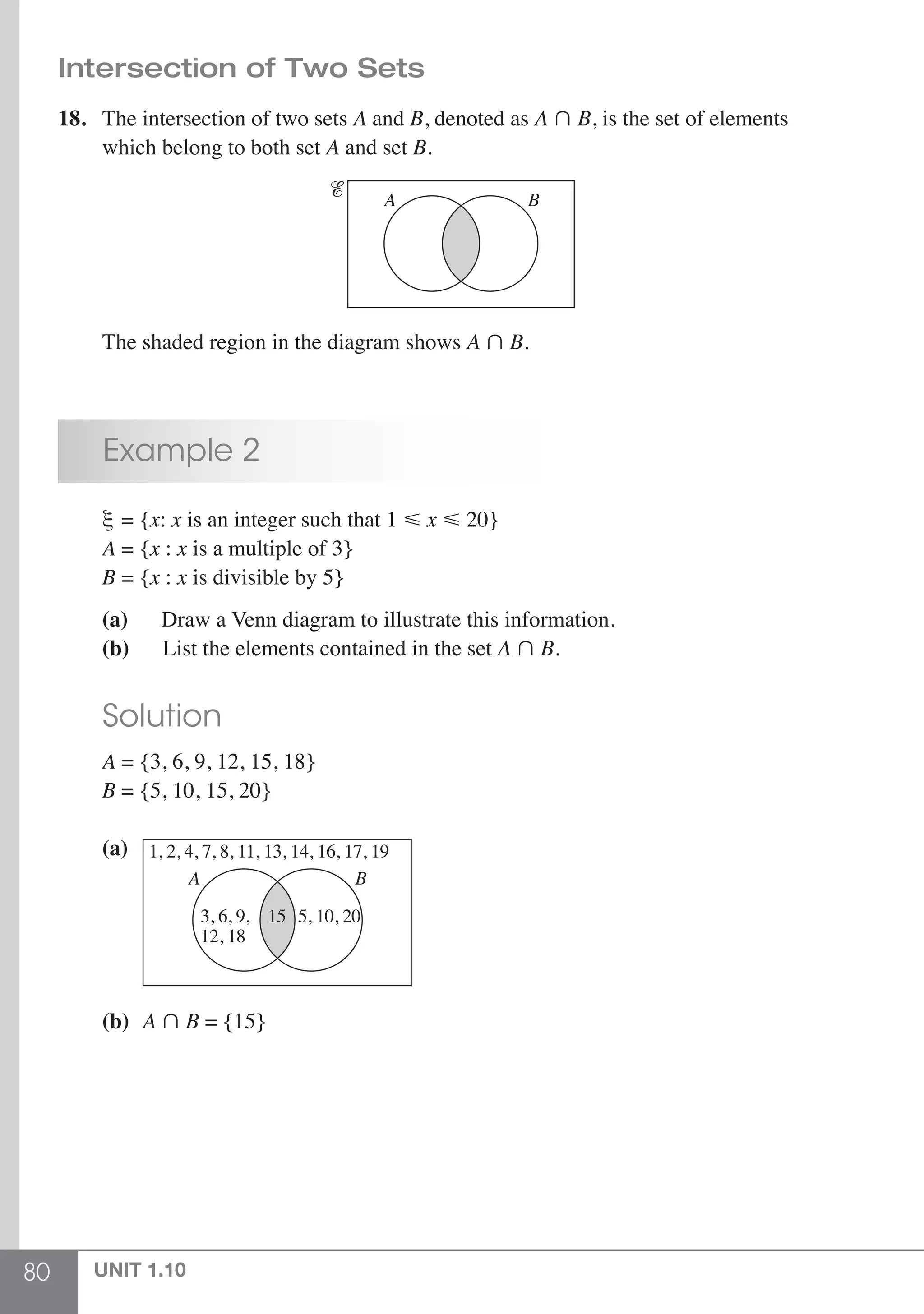
17.	 The union of two sets A and B, denoted as A  B, is the set of elements which
	 belong to set A or set B or both. 					
A BᏱ
	 The shaded region in the diagram shows A  B.
80 UNIT 1.10
Intersection of Two Sets
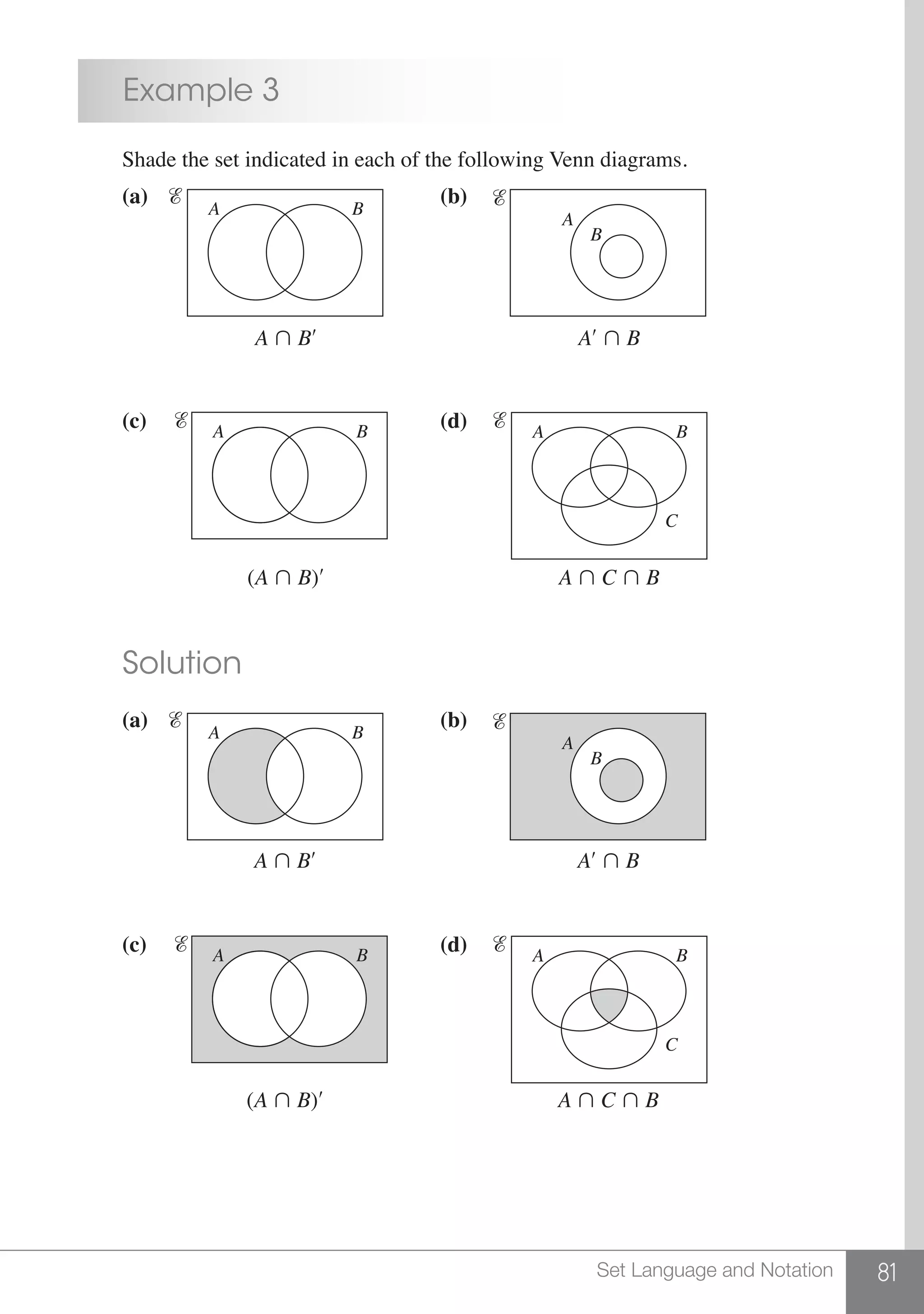
18.	 The intersection of two sets A and B, denoted as A  B, is the set of elements 	
	 which belong to both set A and set B.					
A BᏱ
	 The shaded region in the diagram shows A  B.
	 Example 2
	 ξ  = {x: x is an integer such that 1 < x < 20}
	 A = {x : x is a multiple of 3}
	 B = {x : x is divisible by 5}
	 (a)      Draw a Venn diagram to illustrate this information.
	 (b) List the elements contained in the set A  B.
	 Solution
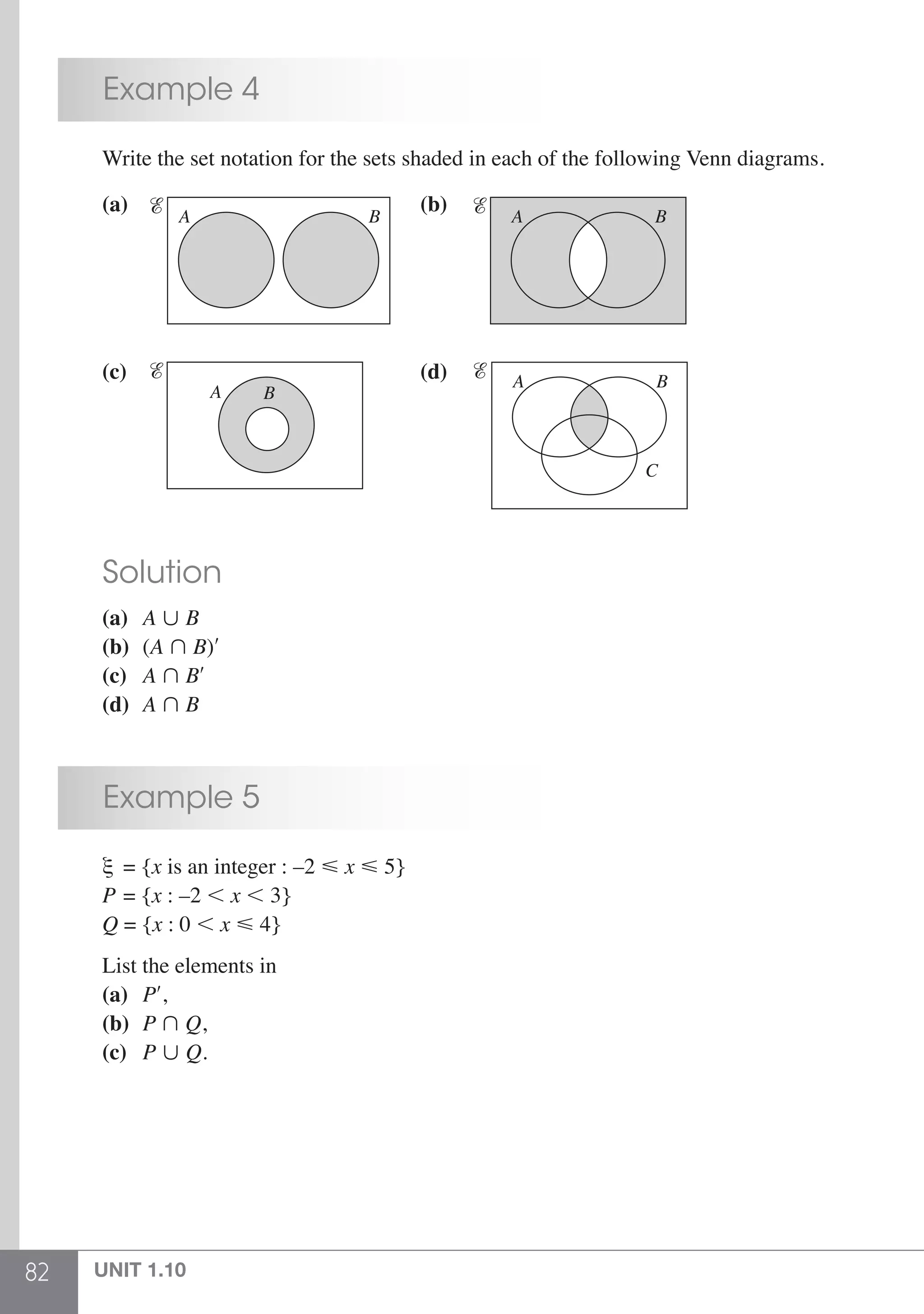
	 A = {3, 6, 9, 12, 15, 18}
	 B = {5, 10, 15, 20}
	 (a)	 1, 2, 4, 7, 8, 11, 13, 14, 16, 17, 19
3, 6, 9,
12, 18
5, 10, 20
A B
15
		
	 (b)	 A  B = {15}
81Set Language and Notation
	 Example 3
	 Shade the set indicated in each of the following Venn diagrams.


A
Ᏹ
B
A
B
Ᏹ
A B
Ᏹ A B
C
Ᏹ
(a) (b)
(c) (d)
A  B′
(A  B)′
A′  B
A  C  B
	
	 Solution
	
	
A
Ᏹ
B
A
B
Ᏹ
A B
Ᏹ A B
C
Ᏹ
(a) (b)
(c) (d)
A  B′
(A  B)′
A′  B
A  C  B
82 UNIT 1.10
	 Example 4
	 Write the set notation for the sets shaded in each of the following Venn diagrams.
	
(a) (b)
(c) (d)
A BᏱ A BᏱ
A B
Ᏹ A B
C
Ᏹ
	 Solution
	 (a)	 A  B
	 (b) 	(A  B)′
	 (c) 	 A  B′
	 (d) 	A  B
	 Example 5
	 ξ  = {x is an integer : –2  x  5}
	 P = {x : –2 , x , 3}
	 Q = {x : 0 , x  4}
	 List the elements in
	 (a)	 P′,
	 (b)	 P  Q,
	 (c)	 P  Q.
83Set Language and Notation
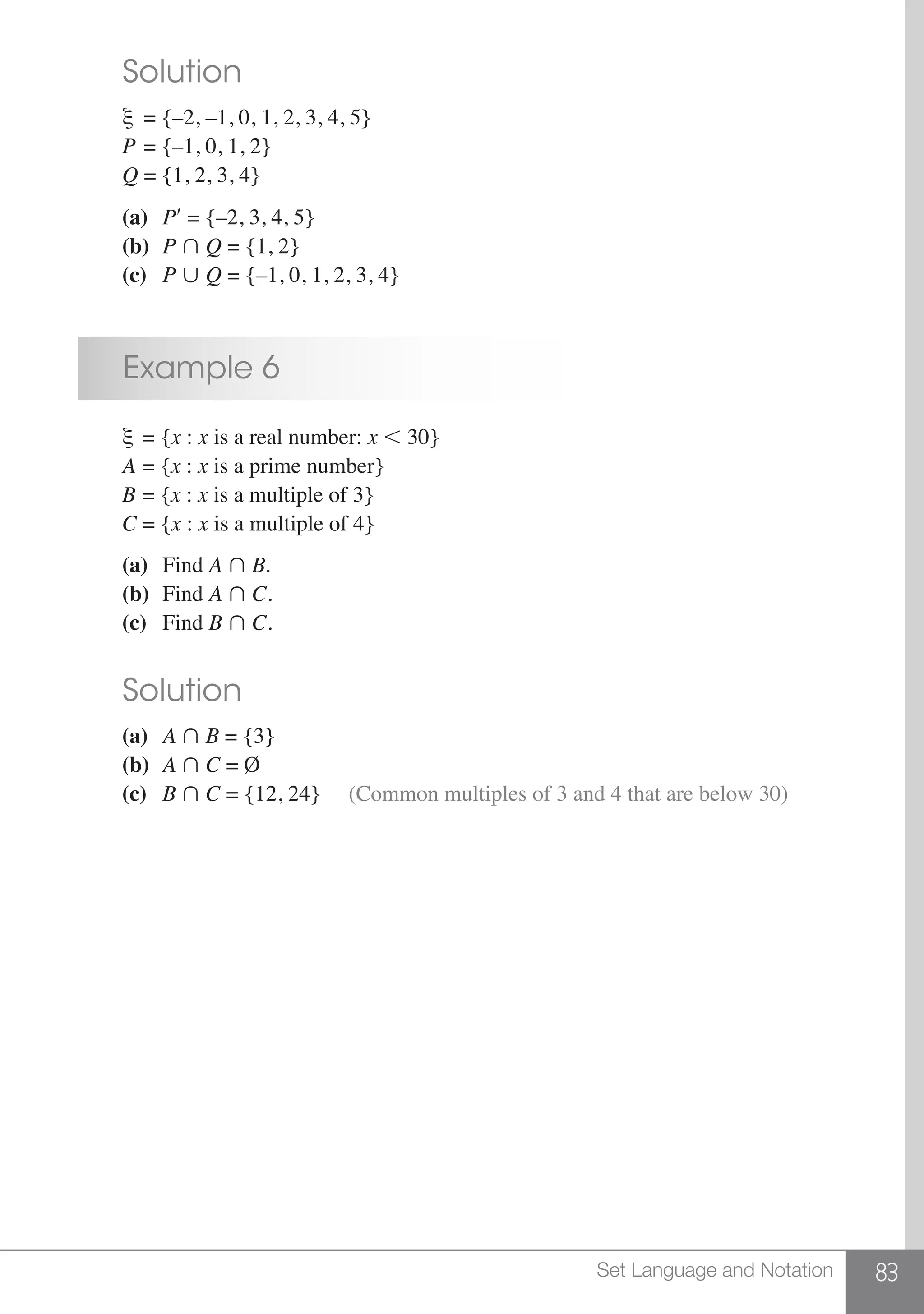
	 Solution
	 ξ  = {–2, –1, 0, 1, 2, 3, 4, 5}
	 P = {–1, 0, 1, 2}
	 Q = {1, 2, 3, 4}
	(a)	 P′ = {–2, 3, 4, 5}
	 (b)	 P  Q = {1, 2}
	 (c)	 P  Q = {–1, 0, 1, 2, 3, 4}
	 Example 6
	 ξ = {x : x is a real number: x , 30}
	 A = {x : x is a prime number}
	 B = {x : x is a multiple of 3}
	 C = {x : x is a multiple of 4}
	 (a)	Find A  B.
	 (b)	Find A  C.
	 (c)	Find B  C.
	 Solution
	 (a)	 A  B = {3}	
	 (b)	 A  C = Ø
	 (c)	 B  C = {12, 24}     (Common multiples of 3 and 4 that are below 30)
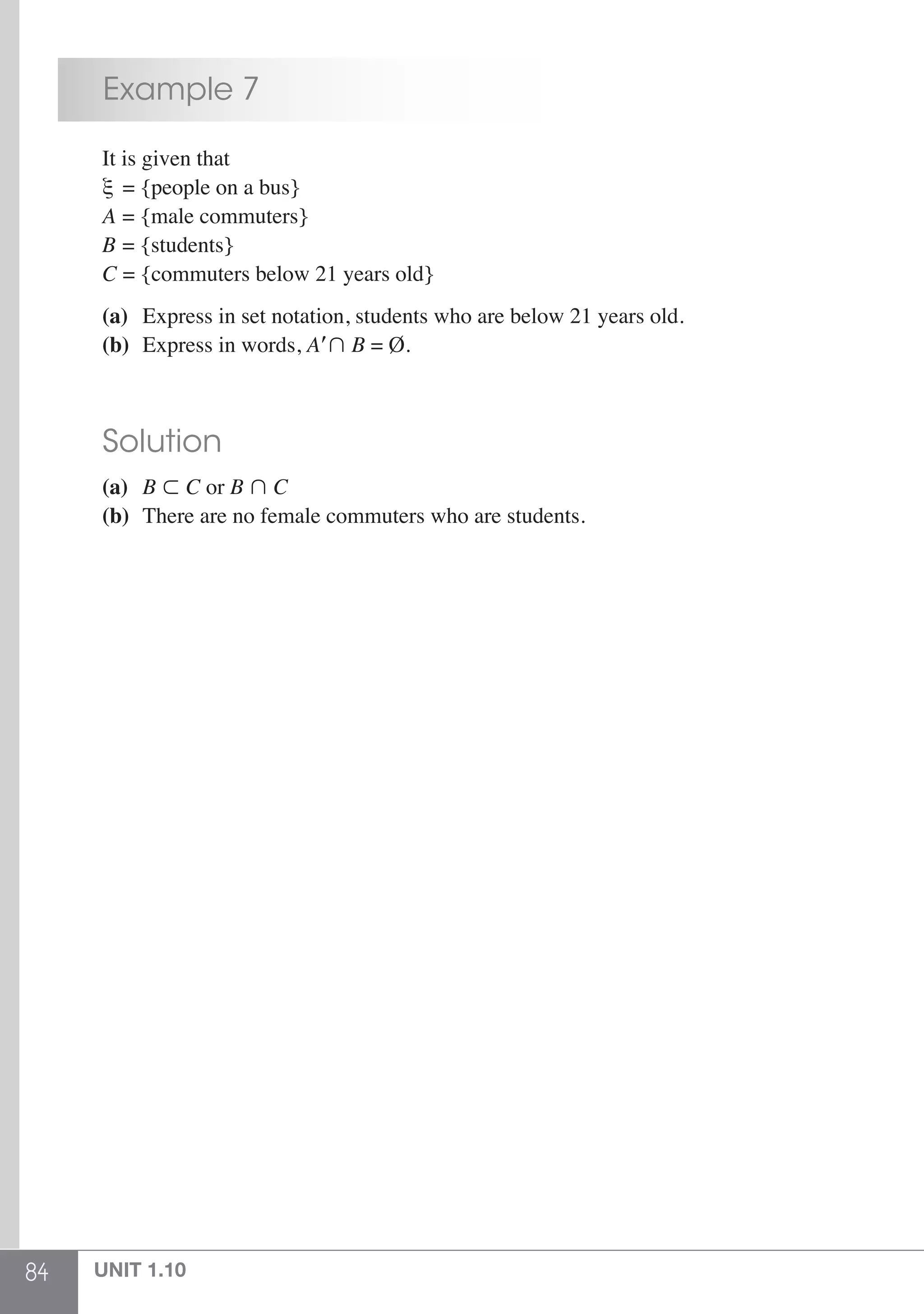
84 UNIT 1.10
	 Example 7
	 It is given that
	 ξ = {people on a bus}
	 A = {male commuters}
	 B = {students}
	 C = {commuters below 21 years old}
	 (a)	 Express in set notation, students who are below 21 years old.
	 (b)	 Express in words, A B = Ø.
	 Solution
	 (a)	 B  C or B  C	
	 (b)	 There are no female commuters who are students.
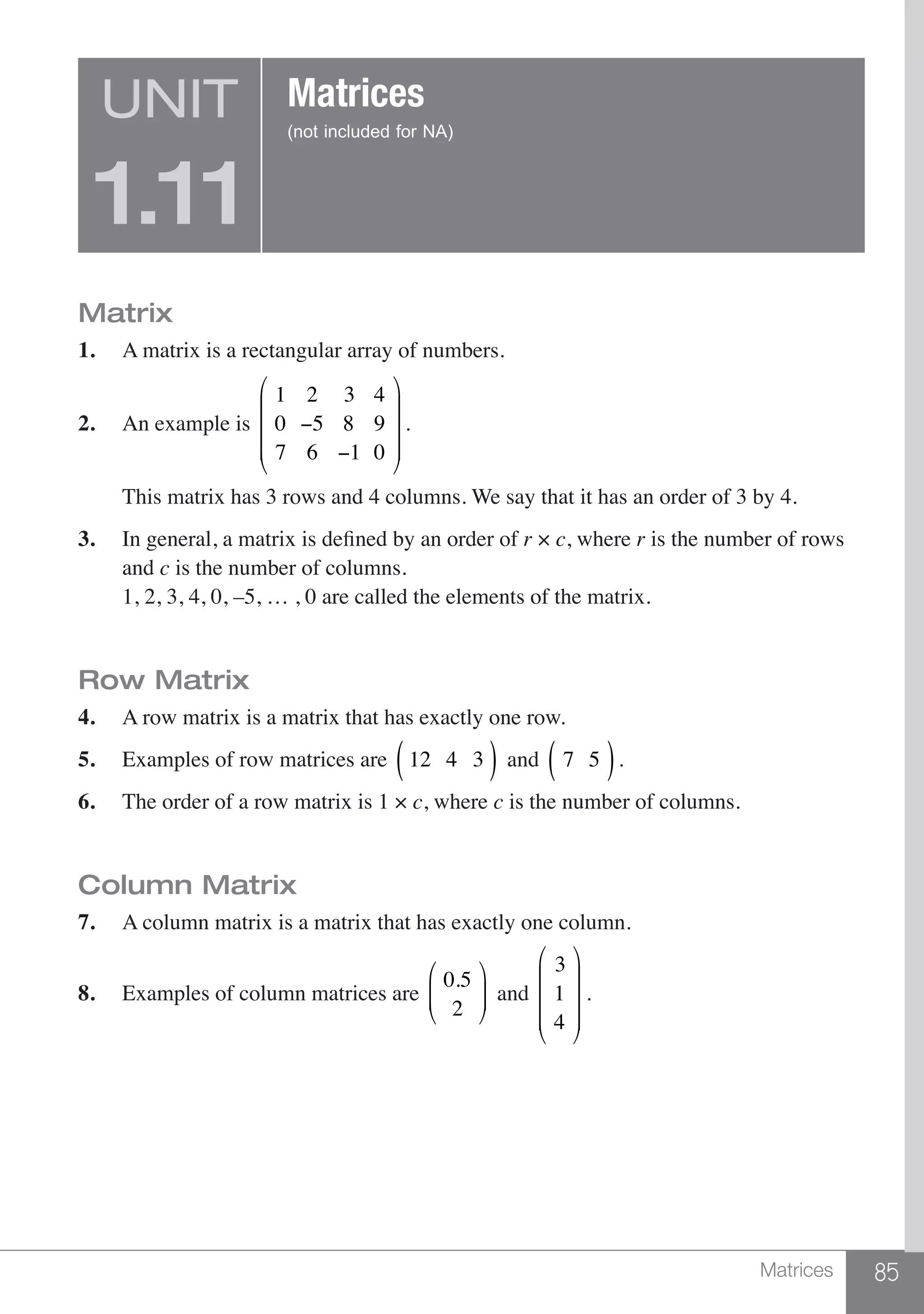
85Matrices
Matrix
1.	 A matrix is a rectangular array of numbers.
2.	 An example is
1 2 3 4
0 −5 8 9
7 6 −1 0
⎛
⎝
⎜
⎜
⎜
⎞
⎠
⎟
⎟
⎟
.
	 This matrix has 3 rows and 4 columns. We say that it has an order of 3 by 4.
3.	 In general, a matrix is defined by an order of r × c, where r is the number of rows
	and c is the number of columns.
	 1, 2, 3, 4, 0, –5, … , 0 are called the elements of the matrix.
Row Matrix
4.	 A row matrix is a matrix that has exactly one row.
5.	 Examples of row matrices are 12 4 3( ) and 7 5( ).
6.	 The order of a row matrix is 1 × c, where c is the number of columns.
Column Matrix
7.	 A column matrix is a matrix that has exactly one column.
8.	 Examples of column matrices are
0.5
2
⎛
⎝
⎜⎜
⎞
⎠
⎟⎟ and
3
1
4
⎛
⎝
⎜
⎜
⎜
⎞
⎠
⎟
⎟
⎟
.
UNIT
1.11
Matrices
(not included for NA)
86 UNIT 1.11
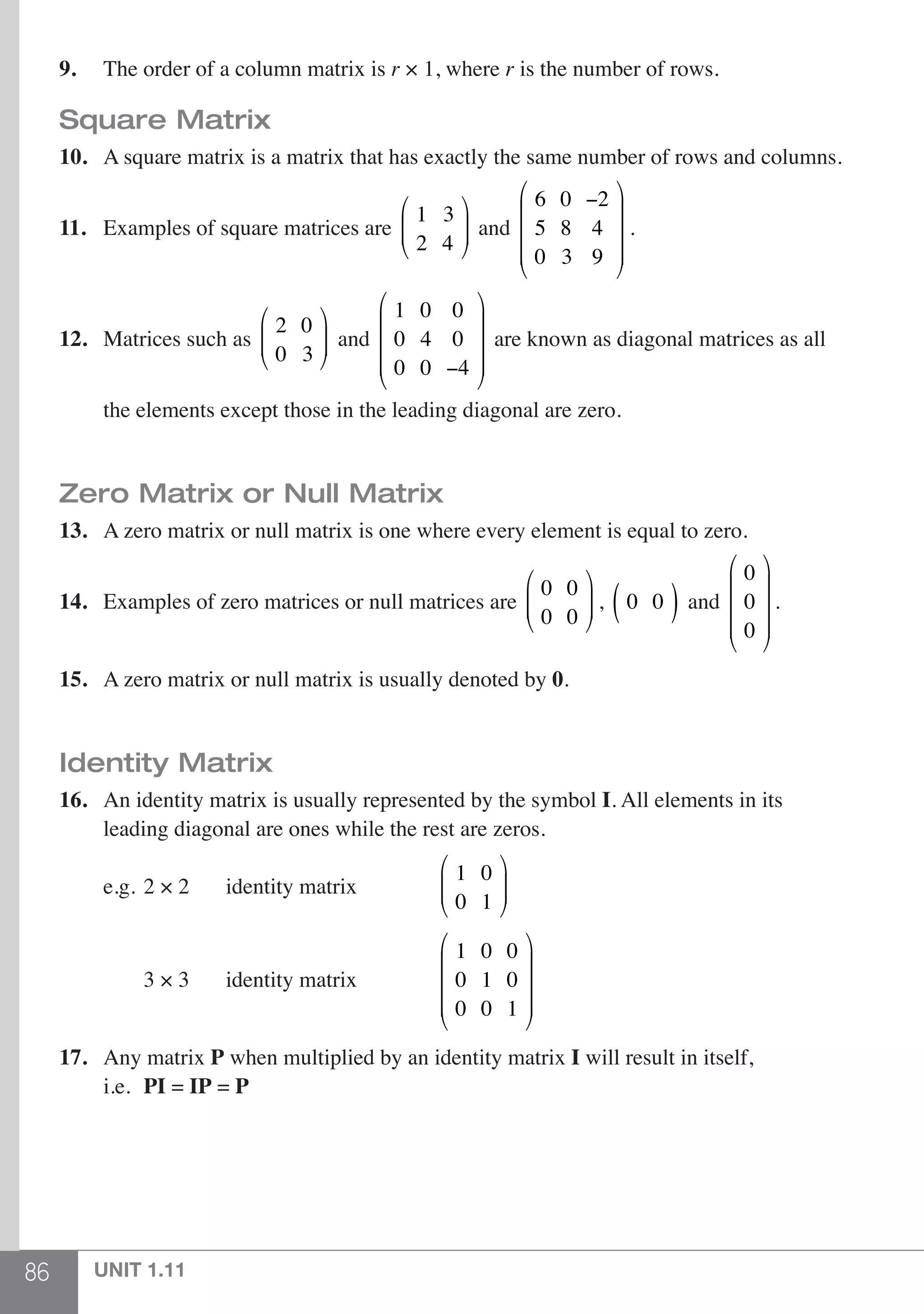
9.	The order of a column matrix is r × 1, where r is the number of rows.
Square Matrix
10.	 A square matrix is a matrix that has exactly the same number of rows and columns.
11.	 Examples of square matrices are
1 3
2 4
⎛
⎝
⎜⎜
⎞
⎠
⎟⎟ and
6 0 −2
5 8 4
0 3 9
⎛
⎝
⎜
⎜
⎜
⎞
⎠
⎟
⎟
⎟
.
12.	 Matrices such as
2 0
0 3
⎛
⎝
⎜⎜
⎞
⎠
⎟⎟ and
1 0 0
0 4 0
0 0 −4
⎛
⎝
⎜
⎜
⎜
⎞
⎠
⎟
⎟
⎟
are known as diagonal matrices as all
	 the elements except those in the leading diagonal are zero.
Zero Matrix or Null Matrix
13.	 A zero matrix or null matrix is one where every element is equal to zero.
14.	 Examples of zero matrices or null matrices are
0 0
0 0
⎛
⎝
⎜⎜
⎞
⎠
⎟⎟ , 0 0( ) and
0
0
0
⎛
⎝
⎜
⎜
⎜
⎞
⎠
⎟
⎟
⎟
.
15.	 A zero matrix or null matrix is usually denoted by 0.
Identity Matrix
16.	 An identity matrix is usually represented by the symbol I. All elements in its
	 leading diagonal are ones while the rest are zeros.
	 e.g.	2 × 2	 identity matrix	
1 0
0 1
⎛
⎝
⎜⎜
⎞
⎠
⎟⎟ 		
		 3 × 3	 identity matrix	
1 0 0
0 1 0
0 0 1
⎛
⎝
⎜
⎜
⎜
⎞
⎠
⎟
⎟
⎟
		
17.	Any matrix P when multiplied by an identity matrix I will result in itself,
	i.e.	PI = IP = P
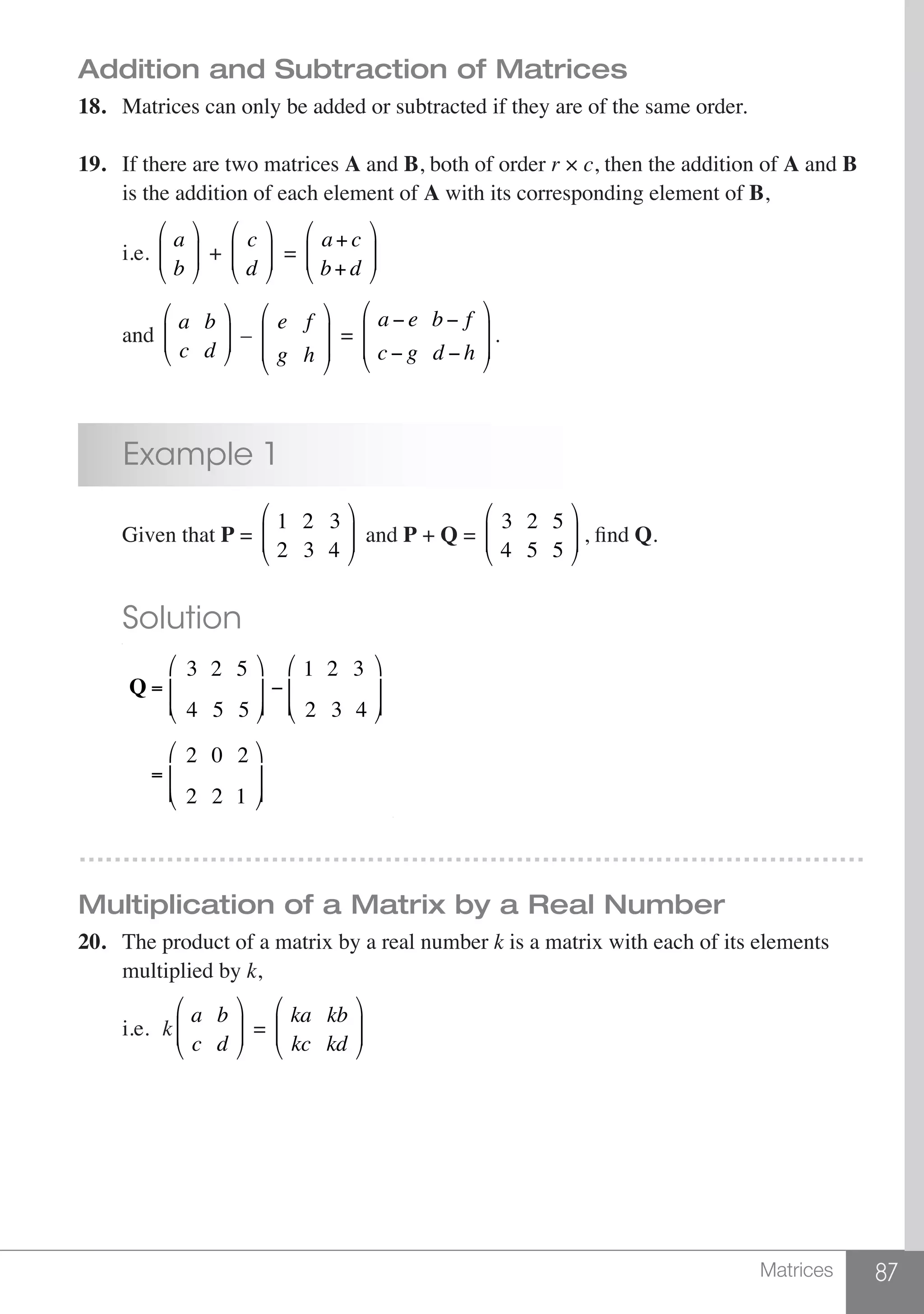
87Matrices
Addition and Subtraction of Matrices
18.	 Matrices can only be added or subtracted if they are of the same order.
19.	 If there are two matrices A and B, both of order r × c, then the addition of A and B
	 is the addition of each element of A with its corresponding element of B,
	 i.e.
a
b
⎛
⎝
⎜⎜
⎞
⎠
⎟⎟ +
c
d
⎛
⎝
⎜⎜
⎞
⎠
⎟⎟ =
a+ c
b+ d
⎛
⎝
⎜⎜
⎞
⎠
⎟⎟
	 and
a b
c d
⎛
⎝
⎜⎜
⎞
⎠
⎟⎟ –
e f
g h
⎛
⎝
⎜
⎜
⎞
⎠
⎟
⎟
=
a − e b − f
c− g d − h
⎛
⎝
⎜
⎜
⎞
⎠
⎟
⎟
.
	 Example 1
	 Given that P =
1 2 3
2 3 4
⎛
⎝
⎜⎜
⎞
⎠
⎟⎟ and P + Q =
3 2 5
4 5 5
⎛
⎝
⎜⎜
⎞
⎠
⎟⎟ , find Q.
	 Solution
	
Q =
3 2 5
4 5 5
⎛
⎝
⎜
⎜
⎞
⎠
⎟
⎟
−
1 2 3
2 3 4
⎛
⎝
⎜
⎜
⎞
⎠
⎟
⎟
=
2 0 2
2 2 1
⎛
⎝
⎜
⎜
⎞
⎠
⎟
⎟
………………………………………………………………………………
Multiplication of a Matrix by a Real Number
20.	 The product of a matrix by a real number k is a matrix with each of its elements
	 multiplied by k,
	i.e.	k
a b
c d
⎛
⎝
⎜⎜
⎞
⎠
⎟⎟ =
ka kb
kc kd
⎛
⎝
⎜⎜
⎞
⎠
⎟⎟
88 UNIT 1.11
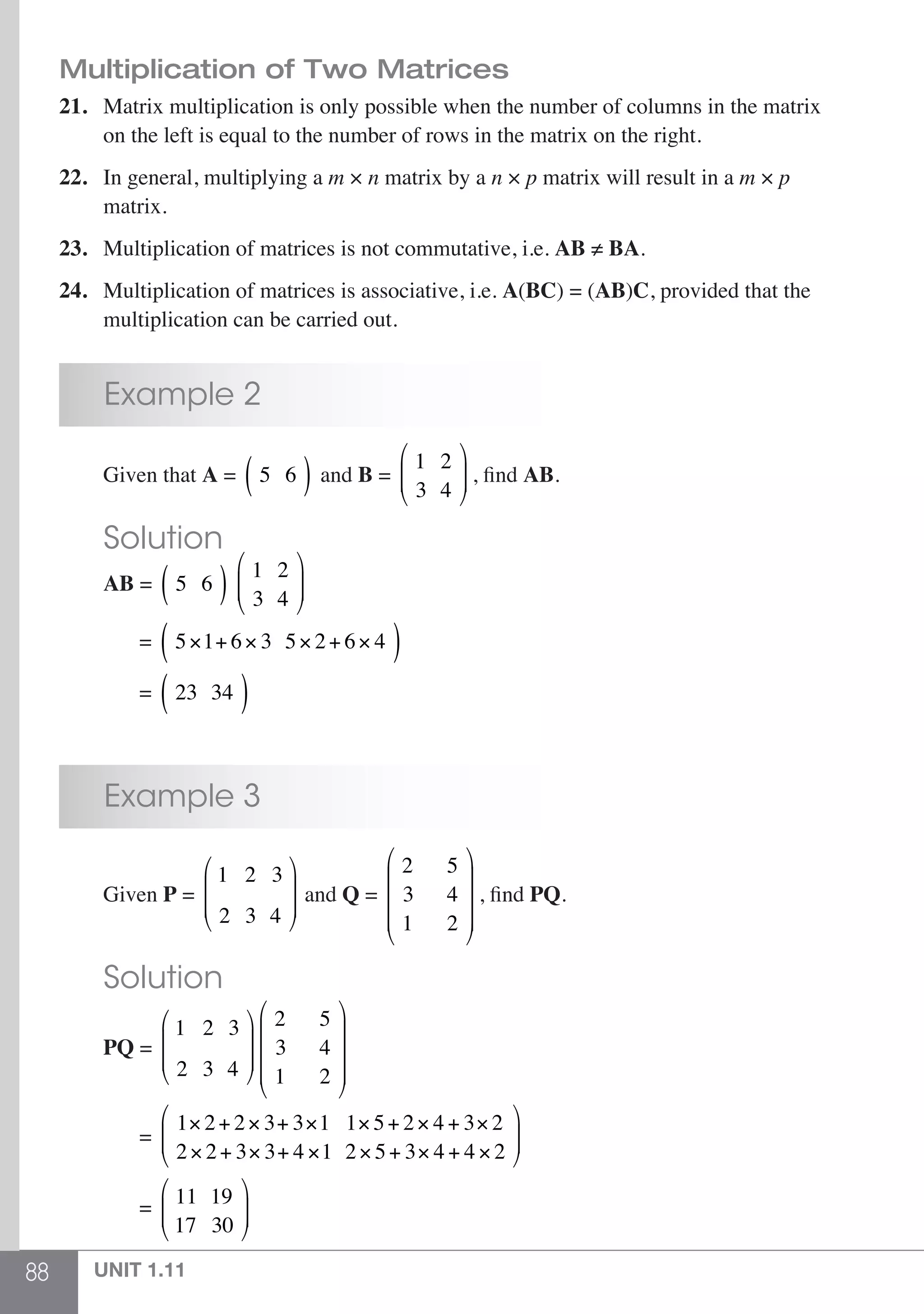
Multiplication of Two Matrices
21.	 Matrix multiplication is only possible when the number of columns in the matrix
	 on the left is equal to the number of rows in the matrix on the right.
22.	 In general, multiplying a m × n matrix by a n × p matrix will result in a m × p
	matrix.
23.	 Multiplication of matrices is not commutative, i.e. AB ≠ BA.
24.	 Multiplication of matrices is associative, i.e. A(BC) = (AB)C, provided that the
	 multiplication can be carried out.
	 Example 2
	 Given that A = 5 6( ) and B =
1 2
3 4
⎛
⎝
⎜⎜
⎞
⎠
⎟⎟ , find AB.
	 Solution
	 AB = 5 6( ) 1 2
3 4
⎛
⎝
⎜⎜
⎞
⎠
⎟⎟
	 = 5×1+ 6× 3 5× 2+ 6× 4( )
	 = 23 34( )
	 Example 3
	Given P =
1 2 3
2 3 4
⎛
⎝
⎜
⎜
⎞
⎠
⎟
⎟ and Q =
2
3
1
5
4
2
⎛
⎝
⎜
⎜
⎜
⎞
⎠
⎟
⎟
⎟
, find PQ.
	 Solution
	 PQ =
1 2 3
2 3 4
⎛
⎝
⎜
⎜
⎞
⎠
⎟
⎟
2
3
1
5
4
2
⎛
⎝
⎜
⎜
⎜
⎞
⎠
⎟
⎟
⎟
	 =
1× 2+ 2× 3+ 3×1 1× 5+ 2× 4 + 3× 2
2× 2+ 3× 3+ 4 ×1 2× 5+ 3× 4 + 4 × 2
⎛
⎝
⎜⎜
⎞
⎠
⎟⎟
	 = 11 19
17 30
⎛
⎝
⎜⎜
⎞
⎠
⎟⎟
89Matrices
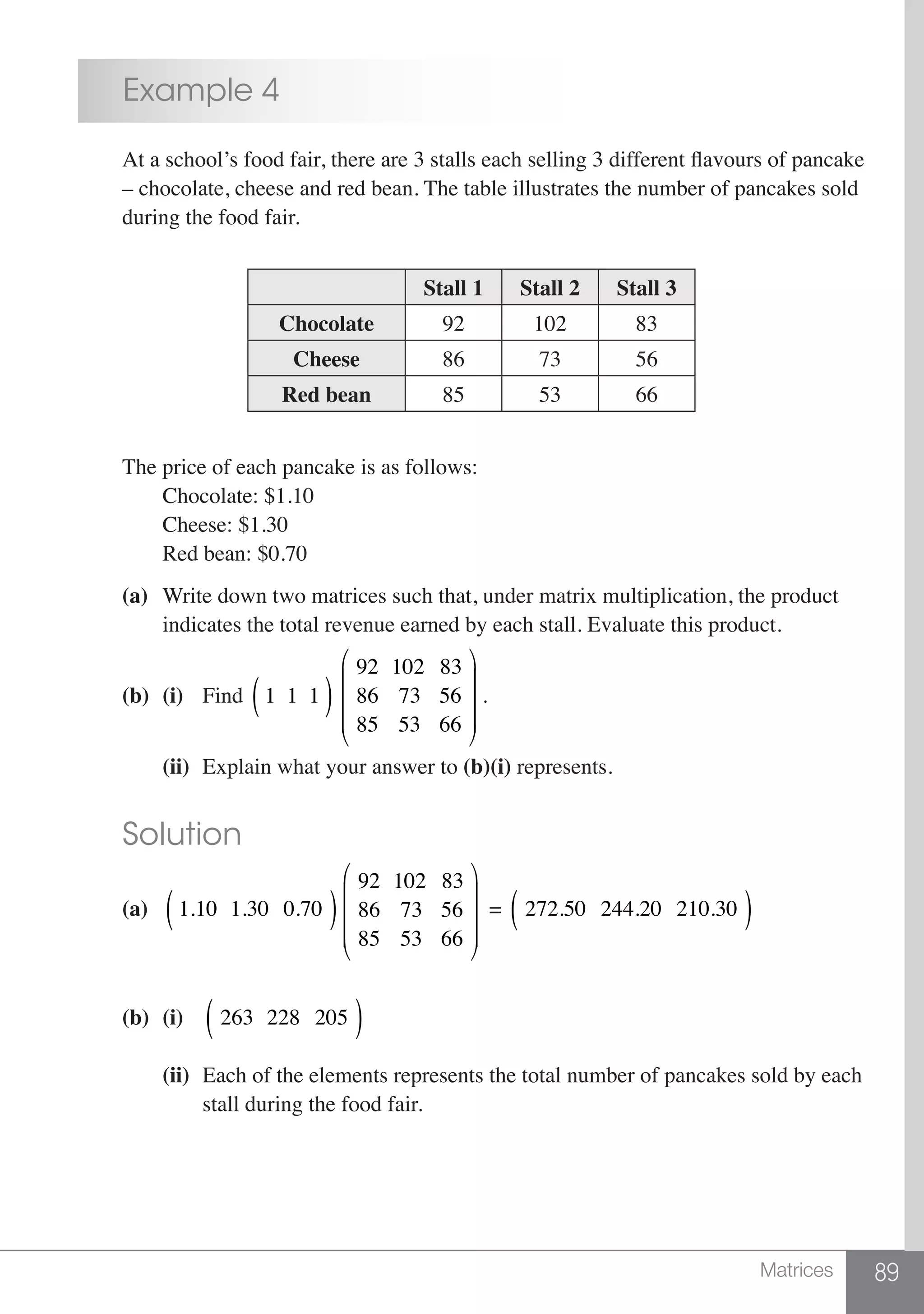
	 Example 4
	 At a school’s food fair, there are 3 stalls each selling 3 different flavours of pancake
	 – chocolate, cheese and red bean. The table illustrates the number of pancakes sold
	 during the food fair.
Stall 1 Stall 2 Stall 3
Chocolate 92 102 83
Cheese 86 73 56
Red bean 85 53 66
	 The price of each pancake is as follows:
		 Chocolate: $1.10
		 Cheese: $1.30
		 Red bean: $0.70
	 (a)	 Write down two matrices such that, under matrix multiplication, the product
		 indicates the total revenue earned by each stall. Evaluate this product.
	 (b)	(i)	 Find 1 1 1( )
92 102 83
86 73 56
85 53 66
⎛
⎝
⎜
⎜
⎜
⎞
⎠
⎟
⎟
⎟
.
	 	(ii)	 Explain what your answer to (b)(i) represents.
	 Solution
	 (a)	 1.10 1.30 0.70( )
92 102 83
86 73 56
85 53 66
⎛
⎝
⎜
⎜
⎜
⎞
⎠
⎟
⎟
⎟
= 272.50 244.20 210.30( )
	 (b)	 (i)	 263 228 205( )	
		(ii)	 Each of the elements represents the total number of pancakes sold by each
			 stall during the food fair.
90 UNIT 1.11
	 Example 5
	 A BBQ caterer distributes 3 types of satay – chicken, mutton and beef to 4 families.
	 The price of each stick of chicken, mutton and beef satay is $0.32, $0.38 and $0.28
	respectively.
	 Mr Wong orders 25 sticks of chicken satay, 60 sticks of mutton satay and 15 sticks
	 of beef satay.
	 Mr Lim orders 30 sticks of chicken satay and 45 sticks of beef satay.
	 Mrs Tan orders 70 sticks of mutton satay and 25 sticks of beef satay.
	 Mrs Koh orders 60 sticks of chicken satay, 50 sticks of mutton satay and 40 sticks
	 of beef satay.
	 (i)	 Express the above information in the form of a matrix A of order 4 by 3 and a
		matrix B of order 3 by 1 so that the matrix product AB gives the total amount
		 paid by each family.
	 (ii)	 Evaluate AB.
	 (iii) 	Find the total amount earned by the caterer.
	 Solution
	 (i)	 A =
25 60 15
30 0 45
0 70 25
60 50 40
⎛
⎝
⎜
⎜
⎜
⎜
⎞
⎠
⎟
⎟
⎟
⎟
B =
0.32
0.38
0.28
⎛
⎝
⎜
⎜
⎜
⎞
⎠
⎟
⎟
⎟
	(ii)	 AB =
25 60 15
30 0 45
0 70 25
60 50 40
⎛
⎝
⎜
⎜
⎜
⎜
⎞
⎠
⎟
⎟
⎟
⎟
0.32
0.38
0.28
⎛
⎝
⎜
⎜
⎜
⎞
⎠
⎟
⎟
⎟
=
35
22.2
33.6
49.4
⎛
⎝
⎜
⎜
⎜
⎜
⎞
⎠
⎟
⎟
⎟
⎟
	(iii)	Total amount earned = $35 + $22.20 + $33.60 + $49.40
						 = $140.20
91Angles, Triangles and Polygons
Types of Angles
1.	 In a polygon, there may be four types of angles – acute angle, right angle, obtuse
	 angle and reflex angle.
x
x = 90°x < 90°
180° < x < 360°90° < x < 180°
Obtuse angle Reflex angle
Acute angle Right angle
x
x
x
2.	 If the sum of two angles is 90°, they are called complementary angles.
∠x + ∠y = 90°
y
x
UNIT
2.1
Angles, Triangles and Polygons
92 UNIT 2.1
3.	 If the sum of two angles is 180°, they are called supplementary angles.
∠x + ∠y = 180°
y
x
Geometrical Properties of Angles
4.	If ACB is a straight line, then ∠a + ∠b = 180° (adj. ∠s on a str. line).
a b
BA
C
5.	 The sum of angles at a point is 360°, i.e. ∠a + ∠b + ∠c + ∠d + ∠e = 360°
	(∠s at a pt.).
a
c
d
e
b
6.	 If two straight lines intersect, then ∠a = ∠b and ∠c = ∠d (vert. opp. ∠s).
a
d
c
b
93Angles, Triangles and Polygons
7.	 If the lines PQ and RS are parallel, then
		∠a = ∠b (alt. ∠s),
		∠c = ∠b (corr. ∠s),
		∠b + ∠d = 180° (int. ∠s).
a
c
b
d
P
R
Q
S
Properties of Special Quadrilaterals
8.	 The sum of the interior angles of a quadrilateral is 360°.
9.	 The diagonals of a rectangle bisect each other and are equal in length.
10.	 The diagonals of a square bisect each other at 90° and are equal in length. They
	 bisect the interior angles.
94 UNIT 2.1
11.	 The diagonals of a parallelogram bisect each other.
12.	 The diagonals of a rhombus bisect each other at 90°. They bisect the interior angles.
13.	 The diagonals of a kite cut each other at 90°. One of the diagonals bisects the
	 interior angles.
14.	 At least one pair of opposite sides of a trapezium are parallel to each other.
95Angles, Triangles and Polygons
Geometrical Properties of Polygons
15.	 The sum of the interior angles of a triangle is 180°, i.e. ∠a + ∠b + ∠c = 180°	
	(∠ sum of Δ).
A
B C D
cb
a
16.	 If the side BC of ΔABC is produced to D, then ∠ACD = ∠a + ∠b (ext. ∠ of Δ).
17.	 The sum of the interior angles of an n-sided polygon is (n – 2) × 180°.
	 Each interior angle of a regular n-sided polygon =
(n − 2)×180°
n
B
C
D
AInterior angles
G
F
E
	 (a)	 A triangle is a polygon with 3 sides.
	 	 Sum of interior angles = (3 – 2) × 180° = 180°
96 UNIT 2.1
	 (b)	 A quadrilateral is a polygon with 4 sides.	
	 	 Sum of interior angles = (4 – 2) × 180° = 360°
	 (c)	 A pentagon is a polygon with 5 sides.
	 	 Sum of interior angles = (5 – 2) × 180° = 540°
	
 
	 (d) 	A hexagon is a polygon with 6 sides.
	 	 Sum of interior angles = (6 – 2) × 180° = 720°
97Angles, Triangles and Polygons
18.	 The sum of the exterior angles of an n-sided polygon is 360°.
	 Each exterior angle of a regular n-sided polygon =
360°
n
Exterior angles
D
C
B
E
F
G
A
	 Example 1
	 Three interior angles of a polygon are 145°, 120° and 155°.  The remaining
	 interior angles are 100° each.  Find the number of sides of the polygon.
	 Solution
	 360° – (180° – 145°) – (180° – 120°) – (180° – 155°) = 360° – 35° – 60° – 25°
								 = 240°
	
240°
(180°−100°)
= 3
	 Total number of sides = 3 + 3
					 = 6
98 UNIT 2.1
	 Example 2
	 The diagram shows part of a regular polygon with n sides. Each exterior angle of
	 this polygon is 24°.
P
Q
R S
T
	 Find
	 (i)	 the value of n,			 (ii) 	 PQR,
	 (iii)	PRS,				 (iv) 	 PSR.
	 Solution
	 (i) 	 Exterior angle =
360°
n
			 24° =
360°
n
				 n =
360°
24°
				 = 15
	 (ii) 	PQR = 180° – 24°
			 = 156°
	 (iii) 	PRQ =
180°−156°
2
			 = 12° (base ∠s of isos. Δ)
		 PRS = 156° – 12°
			 = 144°
	 (iv) 	PSR = 180° – 156°
	 	 	 = 24° (int. ∠s, QR // PS)
99Angles, Triangles and Polygons
Properties of Triangles
19.	 In an equilateral triangle, all three sides are equal. All three angles are the same,
	 each measuring 60°.
60°
60° 60°
20.	 An isosceles triangle consists of two equal sides. Its two base angles are equal.
40°
70° 70°
21.	 In an acute-angled triangle, all three angles are acute.
60°
80° 40°
100 UNIT 2.1
22.	 A right-angled triangle has one right angle.
50°
40°
23.	 An obtuse-angled triangle has one angle that is obtuse.
130°
20°
30°
Perpendicular Bisector
24.	 If the line XY is the perpendicular bisector of a line segment PQ, then XY is
	 perpendicular to PQ and XY passes through the midpoint of PQ.
	 Steps to construct a perpendicular bisector of line PQ:
	 1. 	 Draw PQ.
	 2. 	 Using a compass, choose a radius that is more than half the length of PQ.
	 3. 	 Place the compass at P and mark arc 1 and arc 2 (one above and the other
		 below the line PQ).
	 4. 	 Place the compass at Q and mark arc 3 and arc 4 (one above and the other
		 below the line PQ).
	 5. 	 Join the two intersection points of the arcs to get the perpendicular bisector.
arc 4
arc 3
arc 2
arc 1
SP Q
Y
X
101Angles, Triangles and Polygons
25.	 Any point on the perpendicular bisector of a line segment is equidistant from the
	 two end points of the line segment.
Angle Bisector
26.	 If the ray AR is the angle bisector of BAC, then CAR = RAB.
	 Steps to construct an angle bisector of CAB:
	 1. 	 Using a compass, choose a radius that is less than or equal to the length of AC.
	 2. 	 Place the compass at A and mark two arcs (one on line AC and the other AB).
	 3. 	 Mark the intersection points between the arcs and the two lines as X and Y.
	 4. 	 Place compass at X and mark arc 2 (between the space of line AC and AB).
	 5. 	 Place compass at Y and mark arc 1 (between the space of line AC and AB)
	 	 that will intersect arc 2. Label the intersection point R.
	 6. 	 Join R and A to bisect CAB.
BA Y
X
C
R
arc 2
arc 1
27.	 Any point on the angle bisector of an angle is equidistant from the two sides of the
	 angle.
102 UNIT 2.1
	 Example 3
	 Draw a quadrilateral ABCD in which the base AB = 3 cm, ABC = 80°, BC = 4 cm,
	BAD = 110° and BCD = 70°.
	(a)	 Measure and write down the length of CD.
	 (b) 	On your diagram, construct
		(i) 	 the perpendicular bisector of AB,
		(ii) 	the bisector of angle ABC.
	 (c)	 These two bisectors meet at T.
	 	 Complete the statement below.
		 The point T is equidistant from the lines _______________ and _______________	
		and equidistant from the points _______________and _______________.
	 Solution
	 (a)	 CD = 3.5 cm
70°
80°
C
D
T
AB
110°
b(ii)
b(i)
	 (c) 	 The point T is equidistant from the lines AB and BC and equidistant from the
		points A and B.
103Congruence and Similarity
Congruent Triangles
1.	If AB = PQ, BC = QR and CA = RP, then ΔABC is congruent to ΔPQR	
	 (SSS Congruence Test).
A
B C
P
Q R
2.	If AB = PQ, AC = PR and BAC = QPR, then ΔABC is congruent to ΔPQR 	
	 (SAS Congruence Test).
A
B C
P
Q R
UNIT
2.2
Congruence and Similarity
104 UNIT 2.2
3.	If ABC = PQR, ACB = PRQ and BC = QR, then ΔABC is congruent to ΔPQR 	
	 (ASA Congruence Test).
A
B C
P
Q R
	If BAC = QPR, ABC = PQR and BC = QR, then ΔABC is congruent to ΔPQR
	 (AAS Congruence Test).
A
B C
P
Q R
4.	If AC = XZ, AB = XY or BC = YZ, and ABC = XYZ = 90°, then ΔABC is congruent
	 to ΔXYZ (RHS Congruence Test).
A
BC
X
Z Y
Similar Triangles
5.	 Two figures or objects are similar if:
	 (a)	 the corresponding sides are proportional and,
	 (b)	 the corresponding angles are equal.
105Congruence and Similarity
6.	If BAC = QPR and ABC = PQR, then ΔABC is similar to ΔPQR
	 (AA Similarity Test).
P
Q
R
A
B
C
7.	If
PQ
AB
=
QR
BC
=
RP
CA
, then ΔABC is similar to ΔPQR (SSS Similarity Test).
A
B
C
P
Q
R
km
kn
kl
m
n
l
8.	If
PQ
AB
=
QR
BC
and ABC = PQR, then ΔABC is similar to ΔPQR
	 (SAS Similarity Test).
A
B
C
P
Q
Rkn
kl
n
l
106 UNIT 2.2
Scale Factor and Enlargement
9.	 Scale factor =
Length of image
Length of object
10.	 We multiply the distance between each point in an object by a scale factor to
	 produce an image. When the scale factor is greater than 1, the image produced is
	 greater than the object. When the scale factor is between 0 and 1, the image
	 produced is smaller than the object.
	 e.g. Taking ΔPQR as the object and ΔP′Q′R′ as the image,
	 ΔP′Q′R′ is an enlargement of ΔPQR with a scale factor of 3.
	
2 cm 6 cm
3 cm
1 cm
R Q Rʹ
Pʹ
Qʹ
P
	 Scale factor =
P′R′
PR
=
R′Q′
RQ
= 3
	If we take ΔP′Q′R′ as the object and ΔPQR as the image,
	 ΔPQR is an enlargement of ΔP′Q′R′ with a scale factor of
1
3
.
	 Scale factor =
PR
P′R′
=
RQ
R′Q′
=
1
3
Similar Plane Figures
11.	 The ratio of the corresponding sides of two similar figures is l1 : l2 .
	 The ratio of the area of the two figures is then l1
2
:l2
2
.
	 e.g. ∆ABC is similar to ∆APQ.
	
AB
AP
=
AC
AQ
=
BC
PQ
	
Area of ΔABC
Area of ΔAPQ
=
AB
AP
⎛
⎝
⎜
⎞
⎠
⎟
2
				 =
AC
AQ
⎛
⎝
⎜
⎞
⎠
⎟
2
						
				 =
BC
PQ
⎛
⎝
⎜
⎞
⎠
⎟
2
A
B C
QP
107Congruence and Similarity
	 Example 1
	 In the figure, NM is parallel to BC and LN is parallel to CA.
A
N
X
B
M
L C
	 (a)	 Prove that ΔANM is similar to ΔNBL.
	 (b) 	Given that
AN
NB
=
2
3
, find the numerical value of each of the following
		ratios.
		(i)	
Area of ΔANM
Area of ΔNBL
	
		
(ii)	
NM
BC
	
	
		(iii)	
Area of trapezium BNMC
Area of ΔABC
	
		(iv)	
NX
MC
	
	 Solution
	 (a)	Since ANM = NBL (corr. ∠s, MN // LB) and NAM = BNL (corr. ∠s, LN // MA), 	
		 ΔANM is similar to ΔNBL (AA Similarity Test).
	 (b) 	(i)	
Area of ΔANM
Area of ΔNBL
=
AN
NB
⎛
⎝
⎜
⎞
⎠
⎟
2
	
						 =
2
3
⎛
⎝
⎜
⎞
⎠
⎟
2
						 =
4
9
	
		(ii)	 ΔANM is similar to ΔABC.
			
NM
BC
=
AN
AB
=
2
5
108 UNIT 2.2
		(iii)	
Area of ΔANM
Area of ΔABC
=
NM
BC
⎛
⎝
⎜
⎞
⎠
⎟
2
						 =
2
5
⎛
⎝
⎜
⎞
⎠
⎟
2
						 =
4
25
			
Area of trapezium BNMC
Area of ΔABC
=
Area of ΔABC − Area of ΔANM
Area of ΔABC
						 =
25 − 4
25
						 =
21
25
		(iv) 	ΔNMX is similar to ΔLBX and MC = NL.
			
NX
LX
=
NM
LB
=
NM
BC – LC
=
2
3
			 i.e.
NX
NL
=
2
5
			
NX
MC
=
2
5
109Congruence and Similarity
	 Example 2
	 Triangle A and triangle B are similar. The length of one side of triangle A is
1
4
the
	 length of the corresponding side of triangle B. Find the ratio of the areas of the two
	 triangles.
	 Solution
	Let x be the length of triangle A.
	 Let 4x be the length of triangle B.
	
Area of triangle A
Area of triangle B
=
Length of triangle A
Length of triangle B
⎛
⎝
⎜
⎞
⎠
⎟
2
					 =
x
4x
⎛
⎝
⎜
⎞
⎠
⎟
2
					 =
1
16
Similar Solids
X
Y
h1
A1
l1
h2
A2
l2
12.	If X and Y are two similar solids, then the ratio of their lengths is equal to the ratio
	 of their heights,
	i.e.
l1
l2
=
h1
h2
.
13.	If X and Y are two similar solids, then the ratio of their areas is given by
	
A1
A2
=
h1
h2
⎛
⎝
⎜
⎞
⎠
⎟
2
=
l1
l2
⎛
⎝
⎜
⎞
⎠
⎟
2
.
14.	If X and Y are two similar solids, then the ratio of their volumes is given by
	
V1
V2
=
h1
h2
⎛
⎝
⎜
⎞
⎠
⎟
3
=
l1
l2
⎛
⎝
⎜
⎞
⎠
⎟
3
.
110 UNIT 2.2
	 Example 3
	 The volumes of two glass spheres are 125 cm3
and 216 cm3
. Find the ratio of the
	 larger surface area to the smaller surface area.
	 Solution
	Since
V1
V2
=
125
216
,
	
r1
r2
=
125
216
3
	 =
5
6
	
A1
A2
=
5
6
⎛
⎝
⎜
⎞
⎠
⎟
2
	 =
25
36
	  The ratio is 36 : 25.
111Congruence and Similarity
	 Example 4
	 The surface area of a small plastic cone is 90 cm2
. The surface area of a similar,
	 larger plastic cone is 250 cm2
. Calculate the volume of the large cone if the volume
	 of the small cone is 125 cm3
.
	 Solution
	
Area of small cone
Area of large cone
=
90
250
					 =
9
25
	
Area of small cone
Area of large cone
=
Radius of small cone
Radius of large cone
⎛
⎝
⎜
⎞
⎠
⎟
2
					 =
9
25
	
Radius of small cone
Radius of large cone
=
3
5
	
Volume of small cone
Volume of large cone
=
Radius of small cone
Radius of large cone
⎛
⎝
⎜
⎞
⎠
⎟
3
	
125
Volume of large cone
=
3
5
⎛
⎝
⎜
⎞
⎠
⎟
3
	 Volume of large cone = 579 cm3
(to 3 s.f.)
………………………………………………………………………………
15.	 If X and Y are two similar solids with the same density, then the ratio of their
	 masses is given by
m1
m2
=
h1
h2
⎛
⎝⎜
⎞
⎠⎟
3
=
l1
l2
⎛
⎝⎜
⎞
⎠⎟
3
.
112 UNIT 2.2
Triangles Sharing the Same Height
16.	 If ΔABC and ΔABD share the same height h, then
b1
h
A
B C D
b2
	
Area of ΔABC
Area of ΔABD
=
1
2
b1h
1
2
b2h
		
	 =
b1
b2
	 Example 5
	 In the diagram below, PQR is a straight line, PQ = 2 cm and PR = 8 cm. ΔOPQ
	 and ΔOPR share the same height, h. Find the ratio of the area of ΔOPQ to the area
	 of ΔOQR.
	 Solution
	 Both triangles share the same height, h.
	
Area of ΔOPQ
Area of ΔOQR
=
1
2
× PQ× h
1
2
×QR× h
				 =
PQ
QR
		
P Q R
O
h
				 =
2
6
				 =
1
3
113Properties of Circles
Symmetric Properties of Circles		
1.	 The perpendicular bisector of a chord AB of a circle passes through the centre of
	 the circle, i.e. AM = MB ⇔ OM ⊥ AB.
A
O
BM
2.	 If the chords AB and CD are equal in length, then they are equidistant from the
	 centre, i.e. AB = CD ⇔ OH = OG.
A
O
B
DC
G
H
UNIT
2.3
Properties of Circles
114 UNIT 2.3
3.	 The radius OA of a circle is perpendicular to the tangent at the point of contact,
	i.e. OAC = 90°.
A
B
O
C
4.	If TA and TB are tangents from T to a circle centre O, then
	 (i)	 TA = TB,
	 (ii)	 ∠a = ∠b,
	 (iii)	OT bisects ATB.	
A
B
O
T
a
b
115Properties of Circles
	 Example 1
	 In the diagram, O is the centre of the circle with chords AB and CD. ON = 5 cm
	and CD = 5 cm. OCD = 2OBA. Find the length of AB.
M
O
N D
C
A B
	 Solution
	 Radius = OC = OD
	Radius = 52
+ 2.52
	 = 5.590 cm (to 4 s.f.)
	 tan OCD =
ON
AN
			 =
5
2.5
	 OCD = 63.43° (to 2 d.p.)
2.5 cm
5 cm
N
O
C D
	 OBA = 63.43° ÷ 2
			 = 31.72°
	 OB = radius
	 = 5.59 cm
	 cos OBA =
BM
OB
	 cos 31.72° =
BM
5.59
		 BM = 5.59 × cos 31.72° 31.72°
O
MB A
			 = 4.755 cm (to 4 s.f.)
	 AB = 2 × 4.755
			 = 9.51 cm
116 UNIT 2.3
Angle Properties of Circles
5.	 An angle at the centre of a circle is twice that of any angle at the circumference
	 subtended by the same arc, i.e. ∠AOB = 2 × ∠APB.
a
A B
O
2a
A
a
B
O
2a
A
a
B
O
2a
A
a
B
P
P
P
P
O
2a
6. 	 An angle in a semicircle is always equal to 90°, i.e. AOB is a diameter ⇔ ∠APB = 90°.
P
A
B
O
7.	 Angles in the same segment are equal, i.e. ∠APB = ∠AQB.
B
A
a
P
Q
a
117Properties of Circles
8.	 Angles in opposite segments are supplementary, i.e. ∠a + ∠c = 180°; ∠b + ∠d = 180°.
A C
D
B
O
a
b
d
c
	 Example 2
	 In the diagram, A, B, C, D and E lie on a circle and AC = EC. The lines BC, AD and
	 EF are parallel. AEC = 75° and DAC = 20°.
	Find
	 (i)	 ACB,		 (ii)	 ABC,
	 (iii) 	BAC,		 (iv) 	 EAD,
	 (v) 	FED.
							
A
20˚
75˚
E
D
CB
F
	 Solution
	 (i) 	 ACB = DAC
		 = 20° (alt. ∠s, BC // AD)
	 (ii) 	ABC + AEC = 180° (∠s in opp. segments)
		 ABC + 75° = 180°
		 ABC = 180° – 75°
				 = 105°
	 (iii)	BAC = 180° – 20° – 105° (∠ sum of Δ)
		 = 55°
	 (iv)	EAC = AEC = 75° (base ∠s of isos. Δ)
		EAD = 75° – 20°
		 = 55°
	 (v)	 ECA = 180° – 2 × 75°
		 = 30° (∠ sum of Δ)
		EDA = ECA = 30° (∠s in same segment)
		FED = EDA = 30° (alt. ∠s, EF // AD)
118 UNIT 2.3
9.	 The exterior angle of a cyclic quadrilateral is equal to the opposite interior angle,
	i.e. ∠ADC = 180° – ∠ABC (∠s in opp. segments)
	 ∠ADE = 180° – (180° – ∠ABC) = ∠ABC
D
E
C
B
A
a
a
		 Example 3
	 In the diagram, O is the centre of the circle and ∠RPS = 35°. Find the following
	angles:
	 (a)	 ∠ROS,
	 (b)	 ∠ORS.
						
35°
R
S
Q
P
O
	 Solution
	 (a)	 ∠ROS = 70° 	 (∠ at centre = 2 ∠ at circumference)
	 (b)	 ∠OSR = 180° – 90° – 35° (rt. ∠ in a semicircle)
		 = 55°
		∠ORS = 180° – 70° – 55° (∠ sum of Δ)
		 = 55°
		Alternatively,
		∠ORS = ∠OSR
	 = 55° (base ∠s of isos. Δ)
119Pythagoras’ Theorem and Trigonometry
Pythagoras’ Theorem
A
c
b
aC B
1.	 For a right-angled triangle ABC, if ∠C = 90°, then AB2
= BC2
+ AC2
,
	i.e. c2
= a2
+ b2
.
2.	 For a triangle ABC, if AB2
= BC2
+ AC2
, then ∠C = 90°.
Trigonometric Ratios of Acute Angles
A
opposite
hypotenuse
adjacent
C B
3.	 The side opposite the right angle C is called the hypotenuse.
	 It is the longest side of a right-angled triangle.
UNIT
2.4
Pythagoras’ Theorem
and Trigonometry
120 UNIT 2.4
4.	 In a triangle ABC, if ∠C = 90°,
	 then		
AC
AB
=
opp
adj
is called the sine of ∠B, or sin B =
opp
hyp
,
			
BC
AB
=
adj
hyp
is called the cosine of ∠B, or cos B =
adj
hyp
,
			
AC
BC
=
opp
adj
is called the tangent of ∠B, or tan B =
opp
adj
.
Trigonometric Ratios of Obtuse Angles
5.	When θ is obtuse, i.e. 90° , θ , 180°,
		 sin θ = sin (180° – θ),
		cos θ = –cos (180° – θ).
		 tan θ = –tan (180° – θ).
	
Area of a Triangle
6.	 Area of ΔABC =
1
2
ab sin C
	
A C
B
b
a
Sine Rule
7.	 In any ΔABC, the Sine Rule states that
a
sin A
=
b
sin B
=
c
sinC
or
sin A
a
=
sin B
b
=
sinC
c
.
8.	 The Sine Rule can be used to solve a triangle if the following are given:
	 •	 two angles and the length of one side; or
	 •	 the lengths of two sides and one non-included angle.
121Pythagoras’ Theorem and Trigonometry
Cosine Rule
9.	 In any ΔABC, the Cosine Rule states that a2
= b2
+ c2
– 2bc cos A		
							 b2
= a2
+ c2
– 2ac cos B
			 c2
= a2
+ b2
– 2ab cos C
							 or cos A =
b2
+ c2
− a2
2bc
							 cos B =
a2
+ c2
−b2
2ac
							 cos C =
a2
+b2
− c2
2ab
.
10.	 The Cosine Rule can be used to solve a triangle if the following are given:
	 •	 the lengths of all three sides; or
	 •	 the lengths of two sides and an included angle.
Angles of Elevation and Depression
			
Q
B
P
X Y
A
11.	 The angle A measured from the horizontal level XY is called the angle of elevation
	of Q from X.
12.	 The angle B measured from the horizontal level PQ is called the angle of depression of
	 X from Q.
122 UNIT 2.4
	 Example 1
	 In the figure, A, B and C lie on level ground such that AB = 65 m, BC = 50 m and
	AC = 60 m. T is vertically above C such that TC = 30 m.
BA
60 m
65 m
50 m
30 m
C
T
	Find
	 (i)	 ACB,
	 (ii) 	the angle of elevation of T from A.
	 Solution
	 (i) 	 Using cosine rule,
		 AB2
= AC2
+ BC2
– 2(AC)(BC) cos ACB
		 652
= 602
+ 502
– 2(60)(50) cos ACB
		cos ACB =
1875
6000
		 ACB = 71.8° (to 1 d.p.)
	 (ii) 	In ΔATC,
				tan TAC =
30
60
				 TAC = 26.6° (to 1 d.p.)
		 Angle of elevation of T from A is 26.6°
123Pythagoras’ Theorem and Trigonometry
Bearings
13.	 The bearing of a point A from another point O is an angle measured from the north,
	at O, in a clockwise direction and is written as a three-digit number.
	e.g.
N
N N
B
C
A
O
O O
135° 230°40°
	 The bearing of A from O is 040°.
	 The bearing of B from O is 135°.
	 The bearing of C from O is 230°.
124 UNIT 2.4
	 Example 2
	 The bearing of A from B is 290°. The bearing of C from B is 040°. AB = BC.
A
N
C
B
290˚
40˚
	Find
	 (i)	 BCA,
	 (ii) 	the bearing of A from C.
	 Solution
N
40°
70°
40°
N
CA
B
	 (i)	 BCA =
180°− 70°− 40°
2
			 = 35°
	 (ii) 	Bearing of A from C = 180° + 40° + 35°
						 = 255°
125Pythagoras’ Theorem and Trigonometry
Three-Dimensional Problems
14.	 The basic technique used to solve a three-dimensional problem is to reduce it to a
	 problem in a plane.
	 Example 3
	 A B
D C
V
N
12
10
8
	 The figure shows a pyramid with a rectangular base, ABCD, and vertex V. The
	 slant edges VA, VB, VC and VD are all equal in length and the diagonals of the base
	 intersect at N. AB = 8 cm, AC = 10 cm and VN = 12 cm.
	 (i)	 Find the length of BC.
	 (ii) 	Find the length of VC.
	 (iii) 	Write down the tangent of the angle between VN and VC.
	 Solution
	 (i)	
		
C
BA
10 cm
8 cm
	
		 Using Pythagoras’ Theorem,
		AC2
= AB2
+ BC2
		 102
= 82
+ BC2
		BC2
= 36
		 BC = 6 cm
126 UNIT 2.4
	 (ii) 	CN =
1
2
AC
		 = 5 cm
		 	
		
N
V
C
12 cm
5 cm
		 Using Pythagoras’ Theorem,
		VC2
= VN2
+ CN2
		 = 122
+ 52
		 = 169
		 VC = 13 cm
	 (iii) 	The angle between VN and VC is CVN.
	 	 In ΔVNC,
	
		tan CVN =
CN
VN
			 =
5
12
127Pythagoras’ Theorem and Trigonometry
	 Example 4
	 The diagram shows a right-angled triangular prism.
	Find
	 (a)	 SPT,
	 (b)	 PU.
	
T U
P Q
RS
10 cm
20 cm
8 cm	
	 Solution
	 (a)
T
SP 10 cm
8 cm
		
		 tan SPT =
ST
PS
		 =
8
10
		 SPT = 38.7° (to 1 d.p.)
128 UNIT 2.4
	 (b)	
P Q
R
10 cm
20 cm
		
		PR2
= PQ2
+ QR2
		 = 202
+ 102
		 = 500
		 PR = 22.36 cm (to 4 s.f.)
P R
U
8 cm
22.36 cm
		
		 PU2
= PR2
+ UR2
		 = 22.362
+ 82
		 PU = 23.7 cm (to 3 s.f.)
129Mensuration
Perimeter and Area of Figures
1.
Figure Diagram Formulae
Square l
l
Area = l2
Perimeter = 4l
Rectangle
l
b Area = l × b
Perimeter = 2(l + b)
Triangle h
b
Area =
1
2
× base × height
	=
1
2
× b × h
Parallelogram
b
h Area = base × height
	= b × h
Trapezium h
b
a
Area =
1
2
(a + b) h
Rhombus
b
h
Area = b × h
UNIT
2.5
Mensuration
130 UNIT 2.5
Figure Diagram Formulae
Circle
r Area = πr2
Circumference = 2πr
Annulus
r
R
Area = π(R2
– r2
)
Sector
s
O
r
θ
Arc length s =
θ°
360°
× 2πr
		 (where θ is in degrees)	
= rθ (where θ is in radians)
Area =
θ°
360°
× πr2
(where θ is in degrees)
	 =
1
2
r2
θ(where θ is in radians)
Segment
θ
s
O
r
Area =
1
2
r2
(θ – sin θ)
(where θ is in radians)
131Mensuration
	 Example 1
	 In the figure, O is the centre of the circle of radius 7 cm. AB is a chord and
	 ∠AOB = 2.6 rad. The minor segment of the circle formed by the chord AB is
	shaded.
2.6 rad
7 cmO
B
A
	Find
	 (a)	 the length of the minor arc AB,
	 (b) 	the area of the shaded region.
	 Solution
	 (a) 	Length of minor arc AB = 7(2.6)
						 = 18.2 cm
	 (b) 	Area of shaded region = Area of sector AOB – Area of ΔAOB
						 =
1
2
(7)2
(2.6) –
1
2
(7)2
sin 2.6
						 = 51.1 cm2
(to 3 s.f.)
132 UNIT 2.5
	 Example 2
	 In the figure, the radii of quadrants ABO and EFO are 3 cm and 5 cm respectively.
5 cm
3 cm
E
A
F B O
	 (a)	 Find the arc length of AB, in terms of π.
	 (b)	 Find the perimeter of the shaded region. Give your answer in the form a + bπ.
	 Solution
	 (a)	 Arc length of AB =
3π
2
cm
	 (b)	 Arc length EF =
5π
2
cm
	 	 Perimeter =
3π
2
+
5π
2
+ 2 + 2
		 = (4 + 4π) cm
133Mensuration
Degrees and Radians
2.	 π radians = 180°
	 1 radian =
180°
π
	 1° =
π
180°
radians
3.	 To convert from degrees to radians and from radians to degrees:
Degree Radian
×
×
180°
π
π
180°
Conversion of Units
4.	 Length
	 1 m = 100 cm
	 1 cm = 10 mm
	 Area
	 1 cm2
= 10 mm × 10 mm
	 = 100 mm2
	 1 m2
= 100 cm × 100 cm
= 10 000 cm2
	 Volume
	 1 cm3
= 10 mm × 10 mm × 10 mm
	 = 1000 mm3
	 1 m3
= 100 cm × 100 cm × 100 cm
= 1 000 000 cm3
	 1 litre = 1000 ml
	 = 1000 cm3
134 UNIT 2.5
Volume and Surface Area of Solids
5.
Figure Diagram Formulae
Cuboid h
bl
Volume = l × b × h
Total surface area = 2(lb + lh + bh)
Cylinder h
r
Volume = πr2
h
Curved surface area = 2πrh
Total surface area = 2πrh + 2πr2
Prism
Volume
= Area of cross section × length
Total surface area
= Perimeter of the base × height
+ 2(base area)
Pyramid
h
Volume =
1
3
× base area × h
Cone h l
r
Volume =
1
3
πr2
h
Curved surface area = πrl
(where l is the slant height)
Total surface area = πrl + πr2
135Mensuration
Figure Diagram Formulae
Sphere
r Volume =
4
3
πr3
Surface area = 4πr2
Hemisphere
r Volume =
2
3
πr3
Surface area = 2πr2
+ πr2
	 = 3πr2
	 Example 3
	 (a)	 A sphere has a radius of 10 cm. Calculate the volume of the sphere.
	 (b)	 A cuboid has the same volume as the sphere in part (a). The length and
		 breadth of the cuboid are both 5 cm. Calculate the height of the cuboid.
	 Leave your answers in terms of π.
	 Solution
	 (a)	 Volume =
4π(10)3
3
		 =
4000π
3
cm3
	 (b)	 Volume of cuboid = l × b × h
		
4000π
3
= 5 × 5 × h
		 h =
160π
3
cm
136 UNIT 2.5
	 Example 4
	 The diagram shows a solid which consists of a pyramid with a square base attached
	 to a cuboid. The vertex V of the pyramid is vertically above M and N, the centres of
	 the squares PQRS and ABCD respectively. AB = 30 cm, AP = 40 cm and VN = 20 cm.
	 (a)	Find
		(i) 	 VA,
		(ii) 	VAC.
	 (b) 	Calculate
		(i) 	 the volume,			
QP
R
C
V
A
M
S
D
N
B
		(ii) 	the total surface area
		 of the solid.
	 Solution
	 (a)	(i)	 Using Pythagoras’ Theorem,
			AC2
= AB2
+ BC2
			 = 302
+ 302
			 = 1800
			 AC = 1800 cm
			 AN =
1
2
1800 cm
			 Using Pythagoras’ Theorem,
			VA2
= VN2
+ AN2
			 = 202
+
1
2
1800
⎛
⎝
⎜
⎞
⎠
⎟
2
			 = 850
			 VA = 850
			 = 29.2 cm (to 3 s.f.)
137Mensuration
		(ii)	 VAC = VAN
			 In ΔVAN,
			tan VAN =
VN
AN
			 =
20
1
2
1800
			 = 0.9428 (to 4 s.f.)
			 VAN = 43.3° (to 1 d.p.)
	 (b)	(i)	 Volume of solid = Volume of cuboid + Volume of pyramid
						 = (30)(30)(40) +
1
3
(30)2
(20)
						 = 42 000 cm3
		
		(ii)	Let X be the midpoint of AB.
			 Using Pythagoras’ Theorem,
			VA2
= AX2
+ VX2
			 850 = 152
+ VX2
			VX2
= 625
			 VX = 25 cm
			 Total surface area = 302
+ 4(40)(30) + 4
1
2
⎛
⎝
⎜
⎞
⎠
⎟(30)(25)
			 = 7200 cm2
138 UNIT 2.6
A
B
O
y
x
(x2
, y2
)
(x1
, y1
)
y2
y1
x1
x2
Gradient
1.	 The gradient of the line joining any two points A(x1, y1) and B(x2, y2) is given by
	 m =
y2 − y1
x2 − x1
or
y1 − y2
x1 − x2
.
2.	 Parallel lines have the same gradient.
Distance
3.	 The distance between any two points A(x1, y1) and B(x2, y2) is given by
	 AB = (x2 − x1 )2
+(y2 − y1 )2
.
UNIT
2.6
Coordinate Geometry
139Coordinate Geometry
	 Example 1
	 The gradient of the line joining the points A(x, 9) and B(2, 8) is
1
2
.
	 (a)	 Find the value of x.
	 (b)	 Find the length of AB.
	 Solution
	 (a)	 Gradient =
y2 − y1
x2 − x1
		
8 − 9
2 − x
=
1
2
		 –2 = 2 – x
			 x = 4
	 (b)	 Length of AB = (x2 − x1 )2
+(y2 − y1 )2
			 = (2 − 4)2
+(8 − 9)2
			 = (−2)2
+(−1)2
			 = 5
			 = 2.24 (to 3 s.f.)
………………………………………………………………………………
Equation of a Straight Line
4.	 The equation of the straight line with gradient m and y-intercept c is y = mx + c.
y
x
c
O
gradient m
140 UNIT 2.6
y
x
c
O
y
x
c
O
m > 0
c > 0
m < 0
c > 0
m = 0
x = k
m is undefined
yy
xx
O
O
c
k
m < 0
c = 0
y
x
O
m< 0
c < 0
y
x
O
c
m > 0
c = 0
y
x
O
m > 0
y
x
O
c
c < 0
y = c
141Coordinate Geometry
	 Example 2
	 A line passes through the points A(6, 2) and B(5, 5). Find the equation of the line.
	 Solution
	 Gradient =
y2 − y1
x2 − x1
			=
5 − 2
5 − 6
			= –3
	 Equation of line: y = mx + c
				 y = –3x + c
	 To find c, we substitute x = 6 and
	 y = 2 into the equation above.
	 2 = –3(6) + c
(We can find c by substituting the coordinates
of any point that lies on the line into the equation)
	 c = 20
	 ∴ Equation of line: y = –3x + 20
………………………………………………………………………………
5.	 The equation of a horizontal line is of the form y = c.
6.	 The equation of a vertical line is of the form x = k.
142 UNIT 2.6
	 Example 3
	 The points A, B and C are (8, 7), (11, 3) and (3, –3) respectively.
	 (a)	 Find the equation of the line parallel to AB and passing through C.
	 (b) 	Show that AB is perpendicular to BC.
	 (c) 	 Calculate the area of triangle ABC.
	 Solution
	 (a)	 Gradient of AB =
3− 7
11− 8
					 = −
4
3
		y = −
4
3
x + c
		Substitute x = 3 and y = –3:
		–3 = −
4
3
(3) + c
		–3 = –4 + c
		 c = 1
		∴ Equation of line: y −
4
3
x + 1
	 (b)	 AB = (11− 8)2
+(3− 7)2
	 	 = 5 units
		BC = (3−11)2
+(−3− 3)2
	 	 = 10 units
		AC = (3− 8)2
+(−3− 7)2
	 	 = 125 units
		Since AB2
+ BC2
= 52
+ 102
					 = 125
					 = AC2
,
		 Pythagoras’ Theorem can be applied.
		∴ AB is perpendicular to BC.
	 (c)	 Area of ΔABC =
1
2
(5)(10)
					 = 25 units2
143Vectors in Two Dimensions
Vectors
1.	 A vector has both magnitude and direction but a scalar has magnitude only.
2.	 A vector may be represented by OA
 
,

a or a.
Magnitude of a Vector
3.	 The magnitude of a column vector a =
x
y
⎛
⎝
⎜
⎜
⎞
⎠
⎟
⎟ is given by |a|= x2
+ y2
.
Position Vectors
4.	 If the point P has coordinates (a, b), then the position vector of P, OP
 
, is written
	as OP
 
=
a
b
⎛
⎝
⎜⎜
⎞
⎠
⎟⎟.
P(a, b)
x
y
O a
b
UNIT
2.7
Vectors in Two Dimensions
(not included for NA)
144 UNIT 2.7
Equal Vectors
5.	 Two vectors are equal when they have the same direction and magnitude.
B
A
D
C
AB = CD
Negative Vector
6.	 BA
 
is the negative of AB
 
.
	 BA
 
is a vector having the same magnitude as AB
 
but having direction opposite
	 to that of AB
 
.
	 We can write BA
 
= – AB
 
and AB
 
= – BA
 
.
B
A
B
A
Zero Vector
7.	 A vector whose magnitude is zero is called a zero vector and is denoted by 0.
Sum and Difference of Two Vectors
8.	 The sum of two vectors, a and b, can be determined by using the Triangle Law or 	
	 Parallelogram Law of Vector Addition.
145Vectors in Two Dimensions
9.	 Triangle law of addition: AB
 
+ BC
 
= AC
 
B
A C
10.	 Parallelogram law of addition: AB
 
+AD
 
= AB
 
+ BC
 
= AC
 
B
A
C
D
11.	 The difference of two vectors, a and b, can be determined by using the Triangle
	 Law of Vector Subtraction.
	 AB
 
– AC
 
= CB
 
B
CA
12.	 For any two column vectors a =
p
q
⎛
⎝
⎜
⎜
⎞
⎠
⎟
⎟ and b =
r
s
⎛
⎝
⎜⎜
⎞
⎠
⎟⎟ ,
	 a + b =
p
q
⎛
⎝
⎜
⎜
⎞
⎠
⎟
⎟ +
r
s
⎛
⎝
⎜⎜
⎞
⎠
⎟⎟ =
p+ r
q+ s
⎛
⎝
⎜
⎜
⎞
⎠
⎟
⎟
	and	a – b =
p
q
⎛
⎝
⎜
⎜
⎞
⎠
⎟
⎟ –
r
s
⎛
⎝
⎜⎜
⎞
⎠
⎟⎟ =
p − r
q − s
⎛
⎝
⎜
⎜
⎞
⎠
⎟
⎟ .
146 UNIT 2.7
Scalar Multiple
13.	When k . 0, ka is a vector having the same direction as that of a and magnitude
	 equal to k times that of a.
2a
a
a
1
2
14.	When k , 0, ka is a vector having a direction opposite to that of a and magnitude
	 equal to k times that of a.
2a –2a
–aa
147Vectors in Two Dimensions
	 Example 1
	 In ∆OAB,OA
 
= a andOB
 
= b.
	 O, A and P lie in a straight line, such that OP = 3OA.
	 Q is the point on BP such that 4BQ = PB.
b
a
B
Q
O A P
	 Express in terms of a and b,
	 (i)	 BP
 
,
	 (ii)	 QB
 
. 	
	 Solution
	 (i)	 BP
 
= –b + 3a
	 (ii)	 QB
 
=
1
4 PB
 
		 =
1
4
(–3a + b)
Parallel Vectors
15.	If a = kb, where k is a scalar and k ≠ 0, then a is parallel to b and |a|= k|b|.
16.	If a is parallel to b, then a = kb, where k is a scalar and k ≠ 0.
148 UNIT 2.7
	 Example 2
	 Given that
−15
9
⎛
⎝
⎜⎜
⎞
⎠
⎟⎟ and
w
−3
⎛
⎝
⎜⎜
⎞
⎠
⎟⎟ are parallel vectors, find the value of w.
	 Solution
	Since
−15
9
⎛
⎝
⎜⎜
⎞
⎠
⎟⎟ and
w
−3
⎛
⎝
⎜⎜
⎞
⎠
⎟⎟ are parallel,
	let
−15
9
⎛
⎝
⎜⎜
⎞
⎠
⎟⎟ = k
w
−3
⎛
⎝
⎜⎜
⎞
⎠
⎟⎟, where k is a scalar.
	 9 = –3k
	 k = –3
	 i.e. 	 –15 = –3w
	 w = 5
	 Example 3
	Figure WXYO is a parallelogram.
a + 5b
4a – b
X
Y
W
O
Z
	 (a)	 Express, as simply as possible, in terms of a and/or b,
		(i)	 XY
 
,
	
		(ii)	 WY
 
.
149Vectors in Two Dimensions
	 (b)	 Z is the point such that OZ
 
= –a + 2b.
		(i)	 Determine if WY
 
is parallel to OZ
 
.
		(ii)	 Given that the area of triangle OWY is 36 units2
, find the area of triangle
			OYZ.
	 Solution
	 (a)	(i)	 XY
 
= –OW
 
			 = b – 4a
		(ii)	 WY
 
= WO
 
+ OY
 
			 = b – 4a + a + 5b
			 = –3a + 6b
	 (b)	(i)	 OZ
 
= –a + 2b
		 	 WY
 
= –3a + 6b
			 = 3(–a + 2b)
			Since WY
 
= 3OZ
 
,WY
 
is parallel toOZ
 
.
		(ii)	 ΔOYZ and ΔOWY share a common height h.
		 	
Area of ΔOYZ
Area of ΔOWY
=
1
2
×OZ × h
1
2
×WY × h
						 =
OZ
! "!!
WY
! "!!
						 =
1
3
	
			
Area of ΔOYZ
36
=
1
3
			∴ Area of ΔOYZ = 12 units2
17.	If ma + nb = ha + kb, where m, n, h and k are scalars and a is parallel to b,
	then m = h and n = k.
150 UNIT 2.7
Collinear Points
18.	 If the points A, B and C are such that AB
 
= kBC
 
, then A, B and C are collinear,
	i.e. A, B and C lie on the same straight line.
19.	 To prove that 3 points A, B and C are collinear, we need to show that:
	 AB
 
= k BC
 
or AB
 
= k AC
 
or AC
 
= k BC
 
	 Example 4
	 Show that A, B and C lie in a straight line.
	 OA
 
= p 				 OB
 
= q 			 BC
 
=
1
3
p –
1
3
q
	 Solution
	 AB
 
= q – p
	 BC
 
=
1
3
p –
1
3
q
	 = –
1
3
(q – p)
	 = –
1
3
AB
 
	Thus AB
 
is parallel to BC
 
. Hence, the three points lie in a straight line.
151Data Handling
Bar Graph
1.	 In a bar graph, each bar is drawn having the same width and the length of each bar 	
	 is proportional to the given data.
2.	 An advantage of a bar graph is that the data sets with the lowest frequency and the
	 highest frequency can be easily identified.
	e.g.
70
60
50
Badminton
No.
of students
Table tennis
Type of sports
Students’ Favourite Sport
Soccer
40
30
20
10
0
UNIT
3.1
Data Handling
152 UNIT 3.1
	 Example 1
	 The table shows the number of students who play each of the four types of sports.
Type of sports No. of students
Football 200
Basketball 250
Badminton 150
Table tennis 150
Total 750
	 Represent the information in a bar graph.
	 Solution
	
	
250
200
150
100
50
0
Type of sports
No. of students
Table tennisBadmintonBasketballFootball
153Data Handling
Pie Chart
3.	 A pie chart is a circle divided into several sectors and the angles of the sectors are
	 proportional to the given data.
4.	 An advantage of a pie chart is that the size of each data set in proportion to the
	 entire set of data can be easily observed.
	 Example 2
	 Each member of a class of 45 boys was asked to name his favourite colour.
	 Their choices are represented on a pie chart.
Red
Blue
OthersGreen
63˚
x˚108˚
	 (i)	 If 15 boys said they liked blue, find the value of x.
	 (ii) 	Find the percentage of the class who said they liked red.
	 Solution
	 (i)	 x =
15
45
× 360
		 = 120
	 (ii) 	Percentage of the class who said they liked red =
108°
360°
× 100%
									 = 30%
………………………………………………………………………………
Histogram
5.	 A histogram is a vertical bar chart with no spaces between the bars (or rectangles).
	 The frequency corresponding to a class is represented by the area of a bar whose
	 base is the class interval.
6.	 An advantage of using a histogram is that the data sets with the lowest frequency
	 and the highest frequency can be easily identified.
154 UNIT 3.1
	 Example 3
	 The table shows the masses of the students in the school’s track team.
Mass (m) in kg Frequency
53 , m  55 2
55 , m  57 6
57 , m  59 7
59 , m  61 4
61 , m  63 1
	 Represent the information on a histogram.
	 Solution
	
	
2
4
6
8
Frequency
53 55 57 59 61 63 Mass (kg)
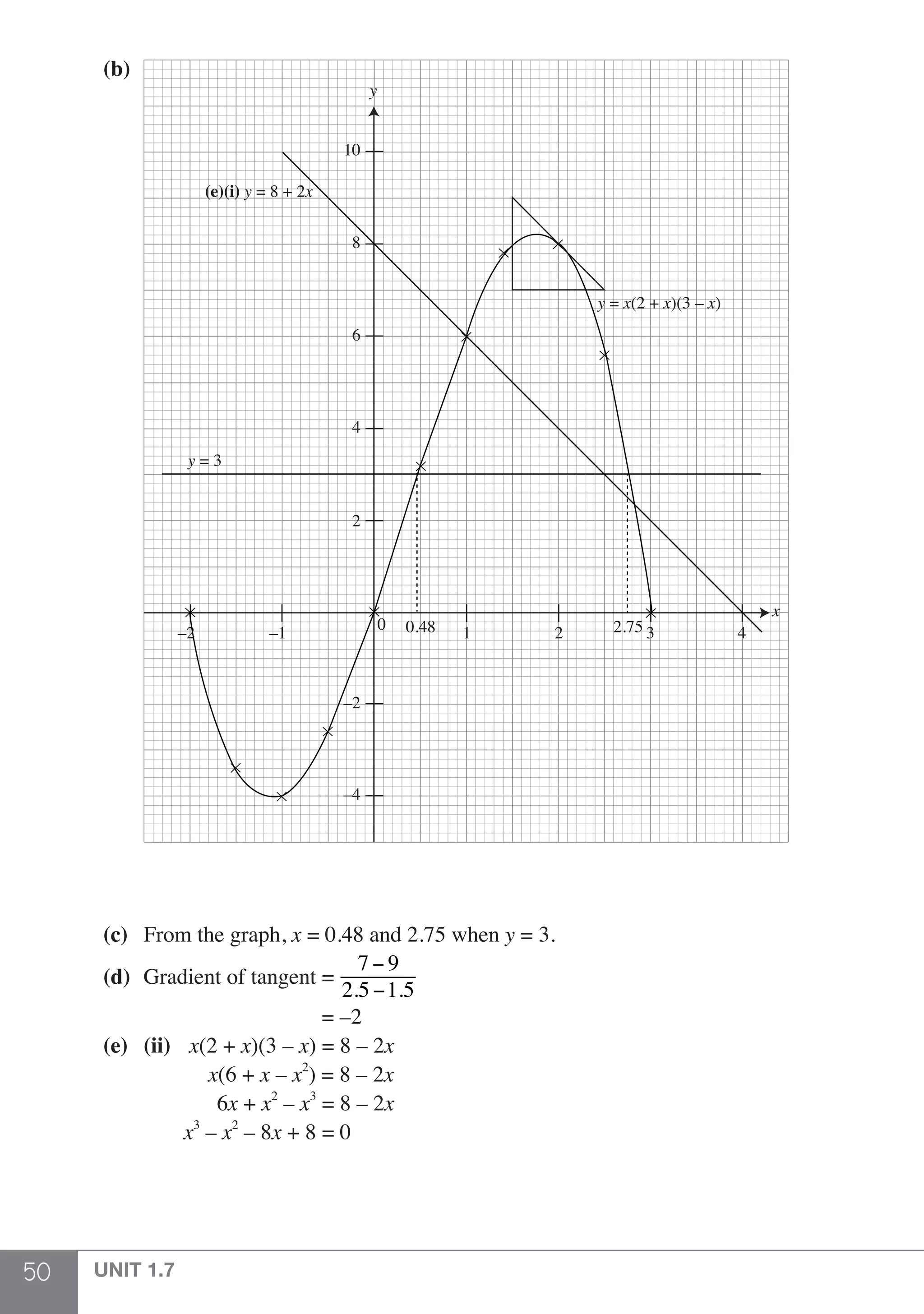
155Data Handling
Line Graph
7.	 A line graph usually represents data that changes with time. Hence, the horizontal
	 axis usually represents a time scale (e.g. hours, days, years).
	e.g.
	
8000
7000
6000
5000
4000
Earnings ($)
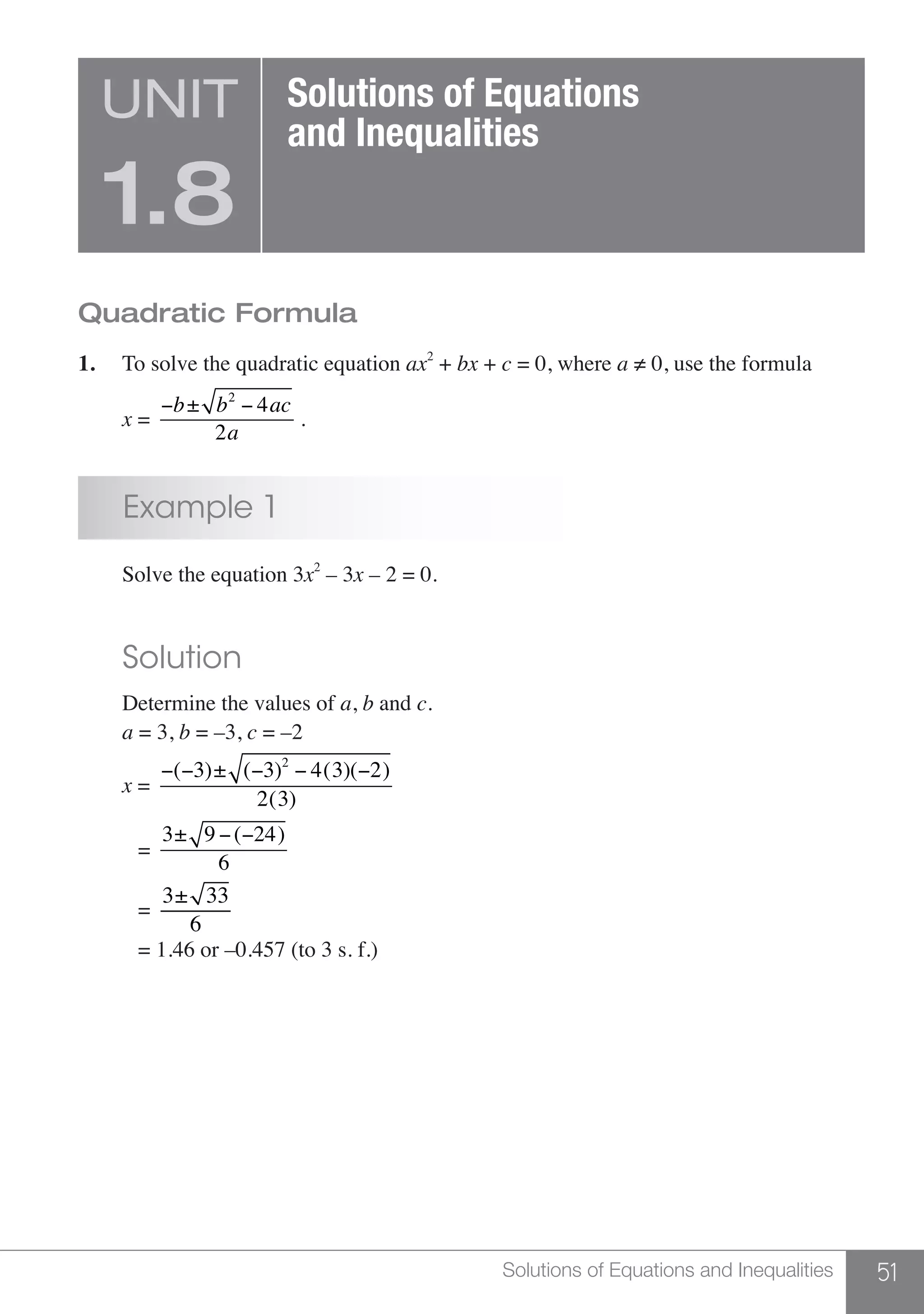
3000
2000
1000
0
February March April May
Month
Monthly Earnings of a Shop
June July
156 UNIT 3.2
Dot Diagram
1.	 A dot diagram consists of a horizontal number line and dots placed above the
	 number line, representing the values in a set of data.
	 Example 1
	 The table shows the number of goals scored by a soccer team during the
	 tournament season.
	
	
Number of goals 0 1 2 3 4 5 6 7
Number of matches 3 9 6 3 2 1 1 1
	 The data can be represented on a dot diagram.
	
0 1 2 3 4 5 6 7
UNIT
3.2
Data Analysis
157Data Analysis
	 Example 2
	 The marks scored by twenty students in a placement test are as follows:
	 42 42 49 31 34 42 40 43 35 38
34 35 39 45 42 42 35 45 40 41
	 (a)	 Illustrate the information on a dot diagram.
	 (b)	 Write down
		(i)	 the lowest score,
	 	(ii)	 the highest score,
	 	(iii)	the modal score.
	 Solution
	 (a)	
30 35 40 45 50	
	 (b)	(i)	 Lowest score = 31
		(ii)	 Highest score = 49
		(iii)	Modal score = 42
………………………………………………………………………………
2.	 An advantage of a dot diagram is that it is an easy way to display small sets of data
	 which do not contain many distinct values.
Stem-and-Leaf Diagram
3.	 In a stem-and-leaf diagram, the stems must be arranged in numerical order and the
	 leaves must be arranged in ascending order.
158 UNIT 3.2
4.	 An advantage of a stem-and-leaf diagram is that the individual data values are
	retained.
	 e.g.	The ages of 15 shoppers are as follows:
32 34 13 29 38
36 14 28 37 13
42 24 20 11 25
		 The data can be represented on a stem-and-leaf diagram.
			
Stem Leaf
1 1 3 3 4
2 0 4 5 8 9
3 2 4 6 7 8
4 2
		 Key: 1 3 means 13 years old
		 The tens are represented as stems and the ones are represented as leaves.
		 The values of the stems and the leaves are arranged in ascending order.
Stem-and-Leaf Diagram with Split Stems
5.	 If a stem-and-leaf diagram has more leaves on some stems, we can break each stem
	 into two halves.
	 e.g.	The stem-and-leaf diagram represents the number of customers in a store.
		
			
Stem Leaf
4 0 3 5 8
5 1 3 3 4 5 6 8 8 9
6 2 5 7
		 Key: 4 0 means 40 customers
		
		 The information can be shown as a stem-and-leaf diagram with split stems.
			
Stem Leaf
4 0 3 5 8
5 1 3 3 4
5 5 6 8 8 9
6 2 5 7
		 Key: 4 0 means 40 customers
159Data Analysis
Back-to-Back Stem-and-Leaf Diagram
6.	 If we have two sets of data, we can use a back-to-back stem-and-leaf diagram with
	 a common stem to represent the data.
	 e.g.	The scores for a quiz of two classes are shown in the table.
		
Class A
55 98 67 84 85 92 75 78 89 64
72 60 86 91 97 58 63 86 92 74
Class B
56 67 92 50 64 83 84 67 90 83
68 75 81 93 99 76 87 80 64 58
		 A back-to-back stem-and-leaf diagram can be constructed based on the given
		data.
		
Leaves for Class B Stem Leaves for Class A
8 6 0 5 5 8
8 7 7 4 4 6 0 3 4 7
6 5 7 2 4 5 8
7 4 3 3 1 0 8 4 5 6 6 9
9 3 2 0 9 1 2 2 7 8
		 Key: 58 means 58 marks
		 Note that the leaves for Class B are arranged in ascending order from the right
		 to the left.
Measures of Central Tendency
7.	 The three common measures of central tendency are the mean, median and mode.
Mean
8.	 The mean of a set of n numbers x1, x2, x3, …, xn is denoted by x.
9.	 For ungrouped data,
	 x =
x1 + x2 + x3 +...+ xn
n
=
∑x
n
.
10.	 For grouped data,
	 x =
∑ fx
∑ f
	 where ƒ is the frequency of data in each class interval and x is the mid-value of the
	interval.
160 UNIT 3.2
Median
11.	 The median is the value of the middle term of a set of numbers arranged in
	 ascending order.
	 Given a set of n terms, if n is odd, the median is the
n+1
2
⎛
⎝
⎜
⎞
⎠
⎟
th
term;
	if n is even, the median is the average of the two middle terms.
						
	 e.g.	Given the set of data: 5, 6, 7, 8, 9.
		 There is an odd number of data.
		 Hence, median is 7.
					
	 e.g.	Given a set of data 5, 6, 7, 8.
		 There is an even number of data.
		 Hence, median is 6.5.
	 Example 3
	 The table records the number of mistakes made by 60 students during an exam.
	 Number of students 24 x 13 y 5
Number of mistakes 5 6 7 8 9
	 (a)	 Show that x + y =18.
	 (b)	 Find an equation of the mean, given that the mean number of mistakes made
	 	 is 6.3. Hence, find the values of x and y.
	 (c)	 State the median number of mistakes made.
	 Solution
	 (a)	 Since there are 60 students in total,
		 24 + x + 13 + y + 5 = 60
		 x + y + 42 = 60
		 x + y = 18
161Data Analysis
	 (b)	 Since the mean number of mistakes made is 6.3,
		 Mean =
Total number of mistakes made by 60 students
Number of students
		 6.3 =
24(5)+ 6x+13(7)+ 8y+ 5(9)
60
		6.3(60) = 120 + 6x + 91 + 8y + 45
		 378 = 256 + 6x + 8y
		6x + 8y = 122
		3x + 4y = 61
	 	 To find the values of x and y, solve the pair of simultaneous equations obtained
		above.
		x + y = 18 ––– (1)
		3x + 4y = 61 ––– (2)
		 3 × (1):
		3x + 3y = 54 ––– (3)
		 (2) – (3): y = 7
		When y = 7, x = 11.
	 (c)	 Since there are 60 students, the 30th
and 31st
students are in the middle. The
		30th
and 31st
students make 6 mistakes each. Therefore, the median number of
		 mistakes made is 6.
Mode
12.	 The mode of a set of numbers is the number with the highest frequency.
13.	 If a set of data has two values which occur the most number of times, we say that
	 the distribution is bimodal.
	 e.g.	Given a set of data: 5, 6, 6, 6, 7, 7, 8, 8, 9.
		 6 occurs the most number of times.
		 Hence, the mode is 6.
162 UNIT 3.2
Standard Deviation
14.	 The standard deviation, s, measures the spread of a set of data from its mean.
15.	 For ungrouped data,
	 s =
∑(x − x)2
n
	 or 	 s =
∑x2
n
− x2
16.	 For grouped data,
	 s =
∑ f (x − x)2
∑ f or 	 s =
∑ fx2
∑ f
−
∑ fx
∑ f
⎛
⎝
⎜
⎞
⎠
⎟
2
	 Example 4
	 The following set of data shows the number of books borrowed by 20 children 	
	 during their visit to the library.
					
	 0, 2, 4, 3, 1, 1, 2, 0, 3, 1
	 1, 2, 1, 1, 2, 3, 2, 2, 1, 2
	 Calculate the standard deviation.
	 Solution
	 Represent the set of data in the table below.
	
	 Number of books borrowed 0 1 2 3 4
Number of children 2 7 7 3 1
	 Standard deviation
	=
∑ fx2
∑ f
−
∑ fx
∑ f
⎛
⎝
⎜
⎞
⎠
⎟
2
	 =
02
(2)+12
(7)+ 22
(7)+ 32
(3)+ 42
(1)
20
−
0(2)+1(7)+ 2(7)+ 3(3)+ 4(1)
20
⎛
⎝
⎜
⎞
⎠
⎟
2
	 =
78
20
−
34
20
⎛
⎝
⎜
⎞
⎠
⎟
2
	 = 1.00 (to 3 s.f.)
163Data Analysis
	 Example 5
	 The mass, in grams, of 80 stones are given in the table.
Mass (m) in grams Frequency
20 , m  30 20
30 , m  40 30
40 , m  50 20
50 , m  60 10
	 Find the mean and the standard deviation of the above distribution.
	 Solution
	 Mid-value (x) Frequency (ƒ) ƒx ƒx2
25 20 500 12 500
35 30 1050 36 750
45 20 900 40 500
55 10 550 30 250
	 Mean =
∑ fx
∑ f
		 =
500 + 1050 + 900 + 550
20 + 30 + 20 + 10
		 =
3000
80
		 = 37.5 g
	 Standard deviation =
∑ fx2
∑ f
−
∑ fx
∑ f
⎛
⎝
⎜
⎞
⎠
⎟
2
					 =
12 500 + 36 750 + 40 500 + 30 250
80
−
3000
80
⎛
⎝⎜
⎞
⎠⎟
2
					 = 1500 − 37.52
					 = 9.68 g (to 3 s.f.)
164 UNIT 3.2
Cumulative Frequency Curve
17.	 The following figure shows a cumulative frequency curve.
CumulativeFrequency
Marks
Upper quartile
Median
Lower
quartile
Q1 Q2 Q3
O 20 40 60 80 100
10
20
30
40
50
60
18.	Q1 is called the lower quartile or the 25th
percentile.
19.	Q2 is called the median or the 50th
percentile.
20.	 Q3 is called the upper quartile or the 75th
percentile.
21.	 Q3 – Q1 is called the interquartile range.
	 Example 6
	 The exam results of 40 students were recorded in the frequency table below.
	
Mass (m) in grams Frequency
0 , m  20 2
20 , m  40 4
40 , m  60 8
60 , m  80 14
80 , m  100 12
	 Construct a cumulative frequency table and the draw a cumulative frequency
	 curve. Hence, find the interquartile range.
165Data Analysis
	 Solution
Mass (m) in grams Cumulative Frequency
x  20 2
x  40 6
x  60 14
x  80 28
x  100 40
10080604020
0
10
20
30
40
y
x
Marks
CumulativeFrequency
Q1 Q3
	 Lower quartile = 46
	 Upper quartile = 84
	 Interquartile range = 84 – 46
	 = 38
166 UNIT 3.2
Box-and-Whisker Plot
22.	 The following figure shows a box-and-whisker plot.
Whisker
lower
limit
upper
limitmedian
Q2
upper
quartile
Q3
lower
quartile
Q1
Whisker
Box
23.	 A box-and-whisker plot illustrates the range, the quartiles and the median of a
	 frequency distribution.
167Probability
1.	 Probability is a measure of chance.
2.	 A sample space is the collection of all the possible outcomes of a probability
	experiment.
	 Example 1
	 A fair six-sided die is rolled. Write down the sample space and state the total
	 number of possible outcomes.
	 Solution
	 A die has the numbers 1, 2, 3, 4, 5 and 6 on its faces,
	 i.e. the sample space consists of the numbers 1, 2, 3, 4, 5 and 6.
	 Total number of possible outcomes = 6
………………………………………………………………………………
3.	 In a probability experiment with m equally likely outcomes, if k of these outcomes
	 favour the occurrence of an event E, then the probability, P(E), of the event
	 happening is given by
	 P(E) =
Number of favourable outcomes for event E
Total number of possible outcomes
=
k
m
.
UNIT
3.3
Probability
168 UNIT 3.3
	 Example 2
	 A card is drawn at random from a standard pack of 52 playing cards.
	 Find the probability of drawing
	 (i)	 a King,
	 (ii)	 a spade.
	 Solution
	 Total number of possible outcomes = 52
	 (i)	 P(drawing a King) =
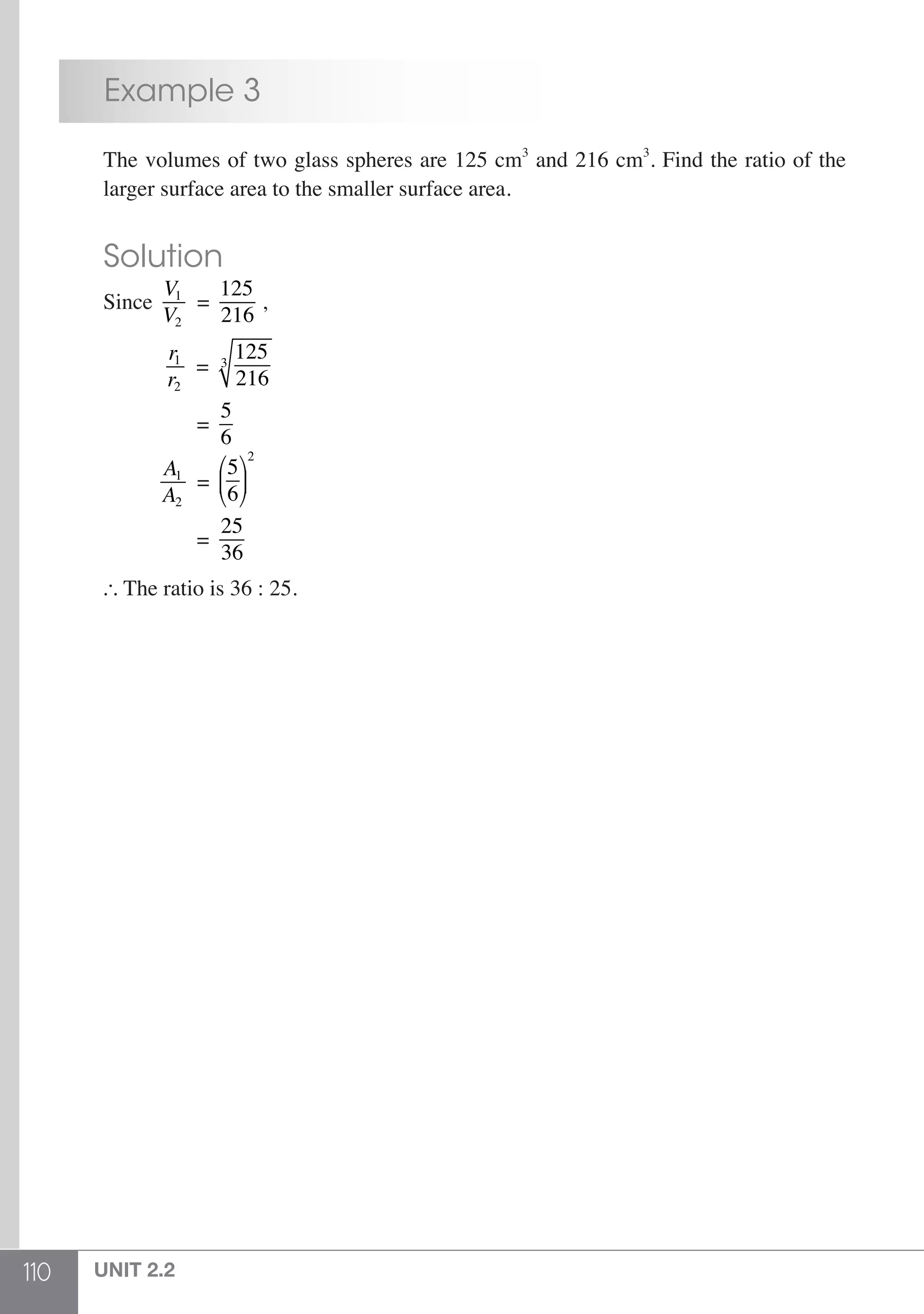
4
52
(There are 4 Kings in a deck.)
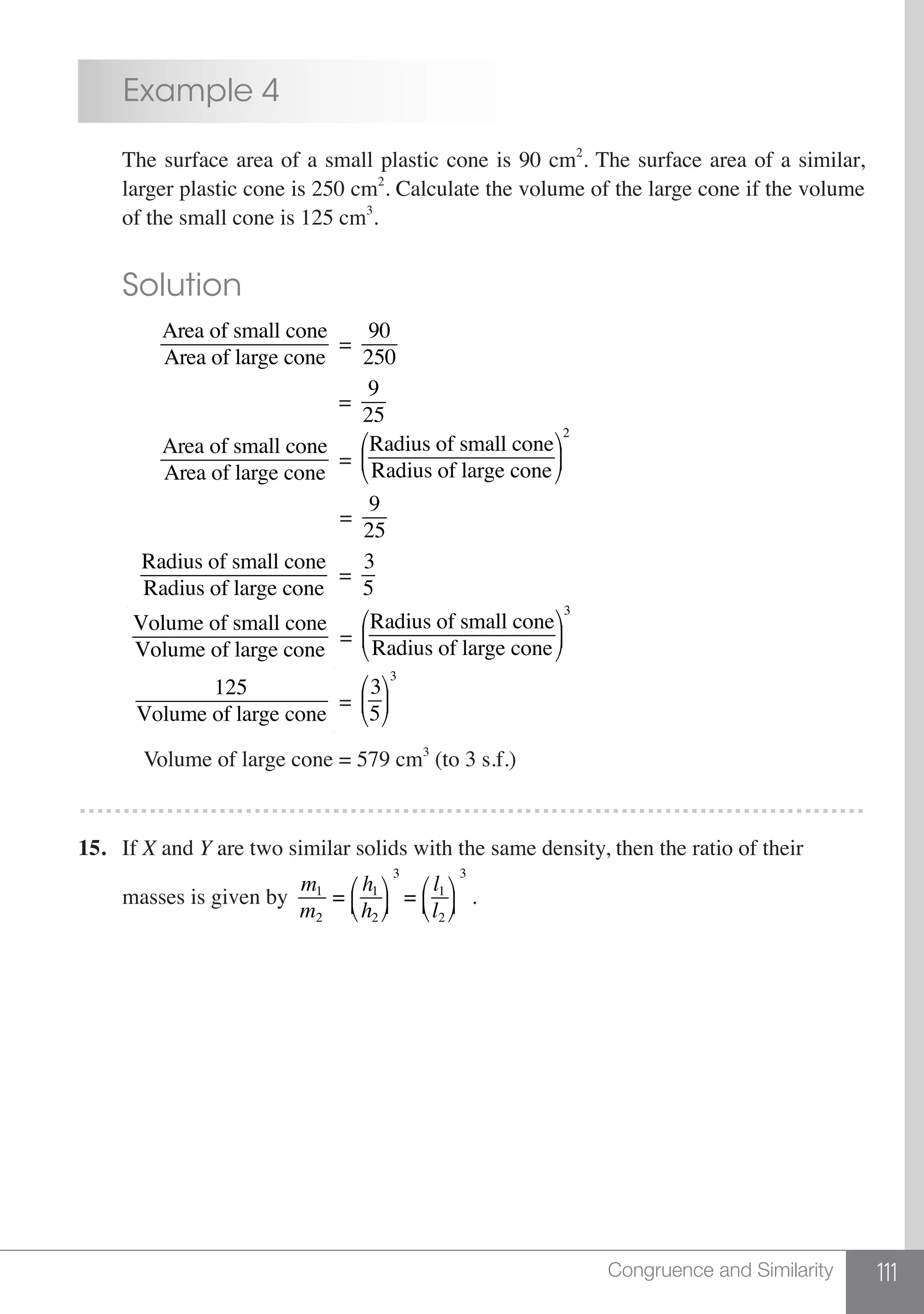
					 =
1
13
	 (ii)	 P(drawing a Spade) =
13
52
(There are 13 spades in a deck.)
………………………………………………………………………………
Properties of Probability
4.	 For any event E, 0  P(E)  1.
5.	If E is an impossible event, then P(E) = 0, i.e. it will never occur.
6.	If E is a certain event, then P(E) = 1, i.e. it will definitely occur.
7.	If E is any event, then P(E′) = 1 – P(E), where P(E′) is the probability that event E
	 does not occur.
Mutually Exclusive Events
8.	 If events A and B cannot occur together, we say that they are mutually exclusive.
9.	If A and B are mutually exclusive events, their sets of sample spaces are disjoint,
	 i.e. P(A  B) = P(A or B) = P(A) + P(B).
169Probability
	 Example 3
	 A card is drawn at random from a standard pack of 52 playing cards. Find the
	 probability of drawing a Queen or an ace.
	 Solution
	 Total number of possible outcomes = 52
	 P(drawing a Queen or an ace) = P(drawing a Queen) + P(drawing an ace)
						 =
4
52
+
4
52
	
						 =
2
13
………………………………………………………………………………
Independent Events
10.	If A and B are independent events, the occurrence of A does not affect that of B,
	 i.e. P(A  B) = P(A and B) = P(A) × P(B).
Possibility Diagrams and Tree Diagrams
11.	 Possibility diagrams and tree diagrams are useful in solving probability problems. 	
	 The diagrams are used to list all possible outcomes of an experiment.
12.	 The sum of probabilities on the branches from the same point is 1.
170 UNIT 3.3
	 Example 4
	 A red fair six-sided die and a blue fair six-sided die are rolled at the same time.
	 (a)	 Using a possibility diagram, show all the possible outcomes.
	 (b) 	Hence, find the probability that
		(i) 	 the sum of the numbers shown is 6,
		(ii) 	the sum of the numbers shown is 10,
		(iii) 	the red die shows a ‘3’ and the blue die shows a ‘5’.
	 Solution
	 (a)	
		
	
1 2 3
Blue die
4 5 6
1
2
3
4
5
6
Reddie
	 (b)	 Total number of possible outcomes = 6 × 6 = 36
		(i)	 There are 5 ways of obtaining a sum of 6, as shown by the squares on the
			diagram.
			 P(sum of the numbers shown is 6) =
5
36
		(ii) 	There are 3 ways of obtaining a sum of 10, as shown by the triangles on
			 the diagram.
	 	 	  P(sum of the numbers shown is 10) =
3
36
								 =
1
12
		(iii) 	P(red die shows a ‘3’) =
1
6
			 P(blue die shows a ‘5’) =
1
6
			 P(red die shows a ‘3’ and blue die shows a ‘5’) =
1
6
×
1
6
									 =
1
36
171Probability
	 Example 5
	 A box contains 8 pieces of dark chocolate and 3 pieces of milk chocolate. Two
	 pieces of chocolate are taken from the box, without replacement. Find the
	 probability that both pieces of chocolate are dark chocolate.
	
	 Solution
			
2nd
piece1st
piece
Dark
Chocolate
Milk
Chocolate
Dark
Chocolate
Dark
Chocolate
Milk
Chocolate
Milk
Chocolate
8
11
3
11
3
10
7
10
8
10
2
10
	 P(both pieces of chocolate are dark chocolate) =
8
11
×
7
10
								 =
28
55
172 UNIT 3.3
	 Example 6
	 A box contains 20 similar marbles. 8 marbles are white and the remaining
	 12 marbles are red. A marble is picked out at random and not replaced. A second
	 marble is then picked out at random.
	 Calculate the probability that
	 (i)	 both marbles will be red,
	 (ii)	 there will be one red marble and one white marble.
	 Solution
	 Use a tree diagram to represent the possible outcomes.
	
White
White
White
Red
Red
Red
12
20
8
20
11
19
8
19
12
19
7
19
1st
marble 2nd
marble
	 (i)	 P(two red marbles) =
12
20
×
11
19
					 =
33
95
	 (ii)	 P(one red marble and one white marble)
		=
12
20
×
8
19
⎛
⎝
⎜
⎞
⎠
⎟ +
8
20
×
12
19
⎛
⎝
⎜
⎞
⎠
⎟ (A red marble may be chosen first, followed by
a white marble, and vice versa)
		=
48
95
173Probability
	 Example 7
	 A class has 40 students. 24 are boys and the rest are girls. Two students were
	 chosen at random from the class. Find the probability that
	 (i)	 both students chosen are boys,
	 (ii)	 a boy and a girl are chosen.
	 Solution
	 Use a tree diagram to represent the possible outcomes.
	
2nd
student1st
student
Boy
Boy
Boy
Girl
Girl
Girl
24
40
16
40
15
39
24
39
16
39
23
39
	 (i)	 P(both are boys) =
24
40
×
23
39
					 =
23
65
	
	 (ii)	 P(one boy and one girl) =
24
40
×
16
39
⎛
⎝
⎜
⎞
⎠
⎟ +
16
40
×
24
39
⎛
⎝
⎜
⎞
⎠
⎟ (A boy may be chosen first,
followed by the girl, and
vice versa)					 =
32
65
174 UNIT 3.3
	 Example 8
	 A box contains 15 identical plates. There are 8 red, 4 blue and 3 white plates.
	 A plate is selected at random and not replaced. A second plate is then selected at
	 random and not replaced. The tree diagram shows the possible outcomes and some
	 of their probabilities.
1st
plate 2nd
plate
Red
Red
Red
Red
White
White
White
White
Blue
BlueBlue
Blue
q
s
r
p
8
15
4
15
7
14
8
14
3
14
8
14
4
14
3
14
	 (a)	 Find the values of p, q, r and s.
	 (b)	 Expressing each of your answers as a fraction in its lowest terms, find the 	
		 probability that
		(i)	 both plates are red,
		(ii)	 one plate is red and one plate is blue.
	 (c)	 A third plate is now selected at random. Find the probability that none of the 	
		 three plates is white.
175Probability
	 Solution
	 (a)	 p = 1 –
8
15
–
4
15
		 =
1
5
		q = 1 –
7
14
–
4
14
		 =
3
14
		r =
4
14
		 =
2
7
		s = 1 –
8
14
–
2
7
		 =
1
7
	 (b)	(i)	 P(both plates are red) =
8
15
×
7
14
						 =
4
15
	
		(ii)	 P(one plate is red and one plate is blue) =
8
15
×
4
14
+
4
15
×
8
14
									 =
32
105
	 (c)	 P(none of the three plates is white) =
8
15
×
11
14
×
10
13
+
4
15
×
11
14
×
10
13
							 =
44
91
176 Mathematical Formulae
MATHEMATICAL FORMULAE
mathematics o level book

mathematics o level book

  • 4.
    SHINGLEE PUBLISHERS PTELTD 120 Hillview Avenue #05-06/07 Kewalram Hillview Singapore 669594 Tel: 6760 1388 Fax: 6762 5684 e-mail: info@shinglee.com.sg http://www.shinglee.com.sg All rights reserved. No part of this publication may be reproduced in any form or stored in a retrieval system or transmitted in any form or by any means, electronic, mechanical, photocopying, recording or otherwise, without the prior permission in writing of the Publishers. First Published 2016 ISBN 978 981 288 015 4 Printed in Singapore
  • 5.
    PREFACE O Level MathematicsTopical Revision Notes has been written in accordance with the latest syllabus issued by the Ministry of Education, Singapore. This book is divided into 21 units, each covering a topic as laid out in the syllabus. Important concepts and formulae are highlighted in each unit, with relevant worked examples to help students learn how to apply theoretical knowledge to examination questions. To make this book suitable for N(A) Level students, sections not applicable for the N(A) Level examination are indicated with a bar ( ). We believe this book will be of great help to teachers teaching the subject and students preparing for their O Level and N(A) Level Mathematics examinations. Preface  iii
  • 6.
    CONTENTS Unit 1.1 Numbersand the Four Operations 1 Unit 1.2 Ratio, Rate and Proportion 15 Unit 1.3 Percentage 21 Unit 1.4 Speed 24 Unit 1.5 Algebraic Representation and Formulae 28 Unit 1.6 Algebraic Manipulation 33 Unit 1.7 Functions and Graphs 41 Unit 1.8 Solutions of Equations and Inequalities 51 Unit 1.9 Applications of Mathematics in Practical Situations 64 Unit 1.10 Set Language and Notation 77 Unit 1.11 Matrices 85 Unit 2.1 Angles, Triangles and Polygons 91 Unit 2.2 Congruence and Similarity 103 Unit 2.3 Properties of Circles 113 Unit 2.4 Pythagoras’ Theorem and Trigonometry 119 Unit 2.5 Mensuration 129 Unit 2.6 Coordinate Geometry 138 Unit 2.7 Vectors in Two Dimensions 143 Unit 3.1 Data Handling 151 Unit 3.2 Data Analysis 156 Unit 3.3 Probability 167 Mathematical Formulae 176 iv  Contents
  • 7.
    1Numbers and theFour Operations Numbers 1. The set of natural numbers,  = {1, 2, 3, …} 2. The set of whole numbers, W = {0, 1, 2, 3, …} 3. The set of integers, Z = {…, –2, –1, 0, 1, 2, …} 4. The set of positive integers, Z+ = {1, 2, 3, …} 5. The set of negative integers, Z– = {–1, –2, –3, …} 6. The set of rational numbers, Q = { a b , a, b  Z, b ≠ 0} 7. An irrational number is a number which cannot be expressed in the form a b , where a, b are integers and b ≠ 0. 8. The set of real numbers R is the set of rational and irrational numbers. 9. Real Numbers Rational Numbers Irrational Numbers e.g. π2, Integers Fractions e.g. 22 7 Zero Negative {..., –3, –2, –1} Positive {1, 2, 3, ...} Natural Numbers Whole Numbers UNIT 1.1 Numbers and the Four Operations
  • 8.
    2 UNIT 1.1 Example 1 The temperature at the bottom of a mountain was 22 °C and the temperature at the top was –7 °C. Find (a) the difference between the two temperatures, (b) the average of the two temperatures. Solution (a) Difference between the temperatures = 22 – (–7) = 22 + 7 = 29 °C (b) Average of the temperatures = 22+(−7) 2 = 22 − 7 2 = 15 2 = 7.5 °C ……………………………………………………………………………… Prime Factorisation 10. A prime number is a number that can only be divided exactly by 1 and itself. However, 1 is not considered as a prime number. e.g. 2, 3, 5, 7, 11, 13, … 11. Prime factorisation is the process of expressing a composite number as a product of its prime factors.
  • 9.
    3Numbers and theFour Operations Example 2 Express 30 as a product of its prime factors. Solution Factors of 30: 1, 2, 3, 5, 6, 10, 15, 30 Of these, 2, 3, 5 are prime factors. 2 30 3 15 5 5 1 ∴ 30 = 2 × 3 × 5 Example 3 Express 220 as a product of its prime factors. Solution 220 2 110 2 55 5 11  220 = 22 × 5 × 11 ……………………………………………………………………………… Factors and Multiples 12. The highest common factor (HCF) of two or more numbers is the largest factor that is common to all the numbers.
  • 10.
    4 UNIT 1.1 Example 4 Find the highest common factor of 18 and 30. Solution 18 = 2 × 32 30 = 2 × 3 × 5 HCF = 2 × 3 = 6 Example 5 Find the highest common factor of 80, 120 and 280. Solution Method 1 2 80, 120, 280 2 40, 60, 140 2 20, 30, 70 5 10, 15, 35 2, 3, 7 HCF = 2 × 2 × 2 × 5 (Since the three numbers cannot be divided further by a common prime factor, we stop here) = 40 Method 2 Express 80, 120 and 280 as products of their prime factors 80 = 23 × 5 120 = 23 × 5 280 = 23 × 5 × 7 HCF = 23 × 5 = 40
  • 11.
    5Numbers and theFour Operations 13. The lowest common multiple (LCM) of two or more numbers is the smallest multiple that is common to all the numbers. Example 6 Find the lowest common multiple of 18 and 30. Solution 18 = 2 × 32 30 = 2 × 3 × 5 LCM = 2 × 32 × 5 = 90 Example 7 Find the lowest common multiple of 5, 15 and 30. Solution Method 1 2 5, 15, 30 3 5, 15, 15 5 5, 5, 5 1, 1, 1 (Continue to divide by the prime factors until 1 is reached) LCM = 2 × 3 × 5 = 30 Method 2 Express 5, 15 and 30 as products of their prime factors. 5 = 1 × 5 15 = 3 × 5 30 = 2 × 3 × 5 LCM = 2 × 3 × 5 = 30
  • 12.
    6 UNIT 1.1 Squaresand Square Roots 14. A perfect square is a number whose square root is a whole number. 15. The square of a is a2 . 16. The square root of a is a or a 1 2 . Example 8 Find the square root of 256 without using a calculator. Solution 2 256 2 128 2 64 2 32 2 16 2 8 2 4 2 2 1 (Continue to divide by the prime factors until 1 is reached) 256 = 28 = 24 = 16
  • 13.
    7Numbers and theFour Operations Example 9 Given that 30k is a perfect square, write down the value of the smallest integer k. Solution For 2 × 3 × 5 × k to be a perfect square, the powers of its prime factors must be in multiples of 2, i.e. k = 2 × 3 × 5 = 30 ……………………………………………………………………………… Cubes and Cube Roots 17. A perfect cube is a number whose cube root is a whole number. 18. The cube of a is a3 . 19. The cube root of a is a3 or a 1 3. Example 10 Find the cube root of 3375 without using a calculator. Solution 3 3375 3 1125 3 375 5 125 5 25 5 5 1 (Continue to divide by the prime factors until 1 is reached) 33753 = 33 × 533 = 3 × 5 = 15
  • 14.
    8 UNIT 1.1 Reciprocal 20. The reciprocal of x is 1 x . 21. The reciprocal of x y is y x . Significant Figures 22. All non-zero digits are significant. 23. A zero (or zeros) between non-zero digits is (are) significant. 24. In a whole number, zeros after the last non-zero digit may or may not be significant, e.g. 7006 = 7000 (to 1 s.f.) 7006 = 7000 (to 2 s.f.) 7006 = 7010 (to 3 s.f.) 7436 = 7000 (to 1 s.f.) 7436 = 7400 (to 2 s.f.) 7436 = 7440 (to 3 s.f.) Example 11 Express 2014 correct to (a) 1 significant figure, (b) 2 significant figures, (c) 3 significant figures. Solution (a) 2014 = 2000 (to 1 s.f.) 1 s.f. (b) 2014 = 2000 (to 2 s.f.) 2 s.f. (c) 2014 = 2010 (to 3 s.f.) 3 s.f.
  • 15.
    9Numbers and theFour Operations 25. In a decimal, zeros before the first non-zero digit are not significant, e.g. 0.006 09 = 0.006 (to 1 s.f.) 0.006 09 = 0.0061 (to 2 s.f.) 6.009 = 6.01 (to 3 s.f.) 26. In a decimal, zeros after the last non-zero digit are significant. Example 12 (a) Express 2.0367 correct to 3 significant figures. (b) Express 0.222 03 correct to 4 significant figures. Solution (a) 2.0367 = 2.04 (b) 0.222 03 = 0.2220 4 s.f. ……………………………………………………………………………… Decimal Places 27. Include one extra figure for consideration. Simply drop the extra figure if it is less than 5. If it is 5 or more, add 1 to the previous figure before dropping the extra figure, e.g. 0.7374 = 0.737 (to 3 d.p.) 5.0306 = 5.031 (to 3 d.p.) Standard Form 28. Very large or small numbers are usually written in standard form A × 10n , where 1  A , 10 and n is an integer, e.g. 1 350 000 = 1.35 × 10⁶ 0.000 875 = 8.75 × 10⁻⁴
  • 16.
    10 UNIT 1.1 Example 13 The population of a country in 2012 was 4.05 million. In 2013, the population increased by 1.1 × 10⁵ . Find the population in 2013. Solution 4.05 million = 4.05 × 10⁶ Population in 2013 = 4.05 × 10⁶ + 1.1 × 105 = 4.05 × 10⁶ + 0.11 × 106 = (4.05 + 0.11) × 106 = 4.16 × 10⁶ ……………………………………………………………………………… Estimation 29. We can estimate the answer to a complex calculation by replacing numbers with approximate values for simpler calculation. Example 14 Estimate the value of 3.49× 35.7 35.1 correct to 1 significant figure. Solution 3.49× 35.7 35.1 ≈ 3.5× 36 35 (Express each value to at least 2 s.f.) = 3.5 35 × 36 = 0.1 × 6 = 0.6 (to 1 s.f.)
  • 17.
    11Numbers and theFour Operations Common Prefixes 30. Power of 10 Name SI Prefix Symbol Numerical Value 1012 trillion tera- T 1 000 000 000 000 109 billion giga- G 1 000 000 000 106 million mega- M 1 000 000 103 thousand kilo- k 1000 10−3 thousandth milli- m 0.001 = 1 1000 10−6 millionth micro- μ 0.000 001 = 1 1 000 000 10−9 billionth nano- n 0.000 000 001 = 1 1 000 000 000 10−12 trillionth pico- p 0.000 000 000 001 = 1 1 000 000 000 000 ……………………………………………………………………………… Example 15 Light rays travel at a speed of 3 × 10⁸ m/s. The distance between Earth and the sun is 32 million km. Calculate the amount of time (in seconds) for light rays to reach Earth. Express your answer to the nearest minute. Solution 48 million km = 48 × 1 000 000 km = 48 × 1 000 000 × 1000 m (1 km = 1000 m) = 48 000 000 000 m = 48 × 109 m = 4.8 × 10¹⁰ m Time = Distance Speed = 4.8×10⁹ m 3×10⁸ m/s = 16 s
  • 18.
    12 UNIT 1.1 Lawsof Arithmetic 31. a + b = b + a (Commutative Law) a × b = b × a (p + q) + r = p + (q + r) (Associative Law) (p × q) × r = p × (q × r) p × (q + r) = p × q + p × r (Distributive Law) 32. When we have a few operations in an equation, take note of the order of operations as shown. Step 1: Work out the expression in the brackets first. When there is more than 1 pair of brackets, work out the expression in the innermost brackets first. Step 2: Calculate the powers and roots. Step 3: Divide and multiply from left to right. Step 4: Add and subtract from left to right. Example 16 Calculate the value of the following. (a) 2 + (52 – 4) ÷ 3 (b) 14 – [45 – (26 + 16)] ÷ 5 Solution (a) 2 + (52 – 4) ÷ 3 = 2 + (25 – 4) ÷ 3 (Power) = 2 + 21 ÷ 3 (Brackets) = 2 + 7 (Divide) = 9 (Add) (b) 14 – [45 – (26 + 16)] ÷ 5 = 14 – [45 – (26 + 4)] ÷ 5 (Roots) = 14 – [45 – 30] ÷ 5 (Innermost brackets) = 14 – 15 ÷ 5 (Brackets) = 14 – 3 (Divide) = 11 (Subtract) ……………………………………………………………………………… 33. positive number × positive number = positive number negative number × negative number = positive number negative number × positive number = negative number positive number ÷ positive number = positive number negative number ÷ negative number = positive number positive number ÷ negative number = negative number
  • 19.
    13Numbers and theFour Operations Example 17 Simplify (–1) × 3 – (–3)( –2) ÷ (–2). Solution (–1) × 3 – (–3)( –2) ÷ (–2) = –3 – 6 ÷ (–2) = –3 – (–3) = 0 ……………………………………………………………………………… Laws of Indices 34. Law 1 of Indices: am × an = am + n Law 2 of Indices: am ÷ an = am – n , if a ≠ 0 Law 3 of Indices: (am )n = amn Law 4 of Indices: an × bn = (a × b)n Law 5 of Indices: an ÷ bn = a b ⎛ ⎝ ⎜ ⎞ ⎠ ⎟ n , if b ≠ 0 Example 18 (a) Given that 518 ÷ 125 = 5k , find k. (b) Simplify 3 ÷ 6p–4 . Solution (a) 518 ÷ 125 = 5k 518 ÷ 53 = 5k 518 – 3 = 5k 515 = 5k  k = 15 (b) 3 ÷ 6p–4 = 3 6 p−4 = p4 2
  • 20.
    14 UNIT 1.1 ZeroIndices 35. If a is a real number and a ≠ 0, a0 = 1. Negative Indices 36. If a is a real number and a ≠ 0, a−n = 1 an . Fractional Indices 37. If n is a positive integer, a 1 n = an , where a > 0. 38. If m and n are positive integers, a m n = amn = an ( ) m , where a > 0. Example 19 Simplify 3y2 5x ÷ 3x2 y 20xy and express your answer in positive indices. Solution 3y2 5x ÷ 3x2 y 20xy = 3y2 5x × 20xy 3x2 y = 3 5 y2 x−1 × 20 3 x−1 = 4x−2 y2 = 4y2 x2 1 4 1 1
  • 21.
    15Ratio, Rate andProportion Ratio 1. The ratio of a to b, written as a : b, is a ÷ b or a b , where b ≠ 0 and a, b  Z+ . 2. A ratio has no units. Example 1 In a stationery shop, the cost of a pen is $1.50 and the cost of a pencil is 90 cents. Express the ratio of their prices in the simplest form. Solution We have to first convert the prices to the same units. $1.50 = 150 cents Price of pen : Price of pencil = 150 : 90 = 5 : 3 Map Scales 3. If the linear scale of a map is 1 : r, it means that 1 cm on the map represents r cm on the actual piece of land. 4. If the linear scale of a map is 1 : r, the corresponding area scale of the map is 1 : r2 . UNIT 1.2 Ratio, Rate and Proportion
  • 22.
    16 UNIT 1.2 Example 2 In the map of a town, 10 km is represented by 5 cm. (a) What is the actual distance if it is represented by a line of length 2 cm on the map? (b) Express the map scale in the ratio 1 : n. (c) Find the area of a plot of land that is represented by 10 cm2 . Solution (a) Given that the scale is 5 cm : 10 km = 1 cm : 2 km Therefore, 2 cm : 4 km (b) Since 1 cm : 2 km, 1 cm : 2000 m 1 cm : 200 000 cm (Convert to the same units) Therefore, the map scale is 1 : 200 000. (c) 1 cm : 2 km 1 cm2 : 4 km2 10 cm2 : 10 × 4 = 40 km2 Therefore, the area of the plot of land is 40 km2 .
  • 23.
    17Ratio, Rate andProportion Example 3 A length of 8 cm on a map represents an actual distance of 2 km. Find (a) the actual distance represented by 25.6 cm on the map, giving your answer in km, (b) the area on the map, in cm2 , which represents an actual area of 2.4 km2 , (c) the scale of the map in the form 1 : n. Solution (a) 8 cm represent 2 km 1 cm represents 2 8 km = 0.25 km 25.6 cm represents (0.25 × 25.6) km = 6.4 km (b) 1 cm2 represents (0.252 ) km2 = 0.0625 km2 0.0625 km2 is represented by 1 cm2 2.4 km2 is represented by 2.4 0.0625 cm2 = 38.4 cm2 (c) 1 cm represents 0.25 km = 25 000 cm  Scale of map is 1 : 25 000 ……………………………………………………………………………… Direct Proportion 5. If y is directly proportional to x, then y = kx, where k is a constant and k ≠ 0. Therefore, when the value of x increases, the value of y also increases proportionally by a constant k.
  • 24.
    18 UNIT 1.2 Example 4 Given that y is directly proportional to x, and y = 5 when x = 10, find y in terms of x. Solution Since y is directly proportional to x, we have y = kx. When x = 10 and y = 5, 5 = k(10) k = 1 2 Hence, y = 1 2 x. Example 5 2 m of wire costs $10. Find the cost of a wire with a length of h m. Solution Let the length of the wire be x and the cost of the wire be y. y = kx 10 = k(2) k = 5 i.e. y = 5x When x = h, y = 5h  The cost of a wire with a length of h m is $5h. ……………………………………………………………………………… Inverse Proportion 6. If y is inversely proportional to x, then y = k x , where k is a constant and k ≠ 0.
  • 25.
    19Ratio, Rate andProportion Example 6 Given that y is inversely proportional to x, and y = 5 when x = 10, find y in terms of x. Solution Since y is inversely proportional to x, we have y = k x When x = 10 and y = 5, 5 = k 10 k = 50 Hence, y = 50 x . Example 7 7 men can dig a trench in 5 hours. How long will it take 3 men to dig the same trench? Solution Let the number of men be x and the number of hours be y. y = k x 5 = k 7 k = 35 i.e. y = 35 x When x = 3, y = 35 3 = 1111 2 3  It will take 1111 2 3 hours.
  • 26.
    20 UNIT 1.2 EquivalentRatio 7. To attain equivalent ratios involving fractions, we have to multiply or divide the numbers of the ratio by the LCM. Example 8 1 4 cup of sugar, 1 1 2 cup of flour and 5 6 cup of water are needed to make a cake. Express the ratio using whole numbers. Solution Sugar : Flour : Water 1 4 : 1 1 2 : 5 6 1 4 × 12 : 1 1 2 × 12 : 5 6 × 12 (Multiply throughout by the LCM, which is 12) 3 : 18 : 10
  • 27.
    21Percentage Percentage 1. A percentageis a fraction with denominator 100, i.e. x% means x 100 . 2. To convert a fraction to a percentage, multiply the fraction by 100%, e.g. 3 4 × 100% = 75%. 3. To convert a percentage to a fraction, divide the percentage by 100%, e.g. 75% = 75 100 = 3 4 . 4. New value = Final percentage × Original value 5. Increase (or decrease) = Percentage increase (or decrease) × Original value 6. Percentage increase = Increase in quantity Original quantity × 100% Percentage decrease = Decrease in quantity Original quantity × 100% UNIT 1.3 Percentage
  • 28.
    22 UNIT 1.3 Example 1 A car petrol tank which can hold 60 l of petrol is spoilt and it leaks about 5% of petrol every 8 hours. What is the volume of petrol left in the tank after a whole full day? Solution There are 24 hours in a full day. After the first 8 hours, Amount of petrol left = 95 100 × 60 = 57 l After the next 8 hours, Amount of petrol left = 95 100 × 57 = 54.15 l After the last 8 hours, Amount of petrol left = 95 100 × 54.15 = 51.4 l (to 3 s.f.) Example 2 Mr Wong is a salesman. He is paid a basic salary and a year-end bonus of 1.5% of the value of the sales that he had made during the year. (a) In 2011, his basic salary was $2550 per month and the value of his sales was $234 000. Calculate the total income that he received in 2011. (b) His basic salary in 2011 was an increase of 2% of his basic salary in 2010. Find his annual basic salary in 2010. (c) In 2012, his total basic salary was increased to $33 600 and his total income was $39 870. (i) Calculate the percentage increase in his basic salary from 2011 to 2012. (ii) Find the value of the sales that he made in 2012. (d) In 2013, his basic salary was unchanged as $33 600 but the percentage used to calculate his bonus was changed. The value of his sales was $256 000 and his total income was $38 720. Find the percentage used to calculate his bonus in 2013.
  • 29.
    23Percentage Solution (a) Annual basic salary in 2011 = $2550 × 12 = $30 600 Bonus in 2011 = 1.5 100 × $234 000 = $3510 Total income in 2011 = $30 600 + $3510 = $34 110 (b) Annual basic salary in 2010 = 100 102 × $2550 × 12 = $30 000 (c) (i) Percentage increase = $33 600 −$30 600 $30 600 × 100% = 9.80% (to 3 s.f.) (ii) Bonus in 2012 = $39 870 – $33 600 = $6270 Sales made in 2012 = $6270 1.5 × 100 = $418 000 (d) Bonus in 2013 = $38 720 – $33 600 = $5120 Percentage used = $5120 $256 000 × 100 = 2%
  • 30.
    24 UNIT 1.4 Speed 1. Speed is defined as the amount of distance travelled per unit time. Speed = Distance Travelled Time Constant Speed 2. If the speed of an object does not change throughout the journey, it is said to be travelling at a constant speed. Example 1 A bike travels at a constant speed of 10.0 m/s. It takes 2000 s to travel from Jurong to East Coast. Determine the distance between the two locations. Solution Speed: v = 10 m/s Time: t = 2000 s Distance: d = vt = 10 × 2000 = 20 000 m or 20 km ……………………………………………………………………………… Average Speed 3. To calculate the average speed of an object, use the formula Average speed = Total distance travelled Total time taken . UNIT 1.4 Speed
  • 31.
    25Speed Example 2 Tom travelled 105 km in 2.5 hours before stopping for lunch for half an hour. He then continued another 55 km for an hour. What was the average speed of his journey in km/h? Solution Average speed = 105+ 55 (2.5 + 0.5 + 1) = 40 km/h Example 3 Calculate the average speed of a spider which travels 250 m in 11 1 2 minutes. Give your answer in metres per second. Solution 11 1 2 min = 90 s Average speed = 250 90 = 2.78 m/s (to 3 s.f.) ……………………………………………………………………………… Conversion of Units 4. Distance: 1 m = 100 cm 1 km = 1000 m 5. Time: 1 h = 60 min 1 min = 60 s 6. Speed: 1 m/s = 3.6 km/h
  • 32.
    26 UNIT 1.4 Example 4 Convert 100 km/h to m/s. Solution 100 km/h = 100 000 3600 m/s (1 km = 1000 m) = 27.8 m/s (to 3 s.f.) ……………………………………………………………………………… 7. Area: 1 m2 = 10 000 cm2 1 km2 = 1 000 000 m2 1 hectare = 10 000 m2 Example 5 Convert 2 hectares to cm2 . Solution 2 hectares = 2 × 10 000 m2 (Convert to m2 ) = 20 000 × 10 000 cm2 (Convert to cm2 ) = 200 000 000 cm2 ……………………………………………………………………………… 8. Volume: 1 m3 = 1 000 000 cm3 1 l = 1000 ml = 1000 cm3
  • 33.
    27Speed Example 6 Convert 2000 cm3 to m3 . Solution Since 1 000 000 cm3 = 1 m3 , 2000 cm3 = 2000 1 000 000 = 0.002 cm3 ……………………………………………………………………………… 9. Mass: 1 kg = 1000 g 1 g = 1000 mg 1 tonne = 1000 kg Example 7 Convert 50 mg to kg. Solution Since 1000 mg = 1 g, 50 mg = 50 1000 g (Convert to g first) = 0.05 g Since 1000 g = 1 kg, 0.05 g = 0.05 1000 kg = 0.000 05 kg
  • 34.
    28 UNIT 1.5 NumberPatterns 1. A number pattern is a sequence of numbers that follows an observable pattern. e.g. 1st term 2nd term 3rd term 4th term 1 , 3 , 5 , 7 , … nth term denotes the general term for the number pattern. 2. Number patterns may have a common difference. e.g. This is a sequence of even numbers. 2, 4, 6, 8 ... +2 +2 +2 This is a sequence of odd numbers. 1, 3, 5, 7 ... +2 +2 +2 This is a decreasing sequence with a common difference. 19, 16, 13, 10, 7 ... – 3 – 3 – 3 – 3 3. Number patterns may have a common ratio. e.g. This is a sequence with a common ratio. 1, 2, 4, 8, 16 ... ×2 ×2 ×2 ×2 128, 64, 32, 16 ... ÷2 ÷2 ÷2 4. Number patterns may be perfect squares or perfect cubes. e.g. This is a sequence of perfect squares. 1, 4, 9, 16, 25 ... 12 22 32 42 52 This is a sequence of perfect cubes. 216, 125, 64, 27, 8 ... 63 53 43 33 23 UNIT 1.5 Algebraic Representation and Formulae
  • 35.
    29Algebraic Representation andFormulae Example 1 How many squares are there on a 8 × 8 chess board? Solution A chess board is made up of 8 × 8 squares. We can solve the problem by reducing it to a simpler problem. There is 1 square in a 1 × 1 square. There are 4 + 1 squares in a 2 × 2 square. There are 9 + 4 + 1 squares in a 3 × 3 square. There are 16 + 9 + 4 + 1 squares in a 4 × 4 square.
  • 36.
    30 UNIT 1.5 Study the pattern in the table. Size of square Number of squares 1 × 1 1 = 12 2 × 2 4 + 1 = 22 + 12 3 × 3 9 + 4 + 1 = 32 + 22 + 12 4 × 4 16 + 9 + 4 + 1 = 42 + 32 + 22 + 12 . . . . . . 8 × 8 82 + 72 + 62 +... + 12  The chess board has 82 + 72 + 62 + … + 12 = 204 squares. Example 2 Find the value of 1+ 1 2 + 1 4 + 1 8 + 1 16 +…. Solution We can solve this problem by drawing a diagram. Draw a square of side 1 unit and let its area, i.e. 1 unit2 , represent the first number in the pattern. Do the same for the rest of the numbers in the pattern by drawing another square and dividing it into the fractions accordingly. 1 2 1 1 4 1 8 1 16 From the diagram, we can see that 1+ 1 2 + 1 4 + 1 8 + 1 16 +… is the total area of the two squares, i.e. 2 units2 .  1+ 1 2 + 1 4 + 1 8 + 1 16 +… = 2
  • 37.
    31Algebraic Representation andFormulae 5. Number patterns may have a combination of common difference and common ratio. e.g. This sequence involves both a common difference and a common ratio. 2, 5, 10, 13, 26, 29 ... + 3 + 3 + 3× 2× 2 6. Number patterns may involve other sequences. e.g. This number pattern involves the Fibonacci sequence. 0 , 1, 1 , 2 , 3 , 5 , 8 , 13 , 21 , 34 , . . . 0 + 1 1 + 1 1 + 2 2 + 3 3 + 5 5 + 8 8 + 13 Example 3 The first five terms of a number pattern are 4, 7, 10, 13 and 16. (a) What is the next term? (b) Write down the nth term of the sequence. Solution (a) 19 (b) 3n + 1 Example 4 (a) Write down the 4th term in the sequence 2, 5, 10, 17, … (b) Write down an expression, in terms of n, for the nth term in the sequence. Solution (a) 4th term = 26 (b) nth term = n2 + 1
  • 38.
    32 UNIT 1.5 BasicRules on Algebraic Expression 7. • kx = k × x (Where k is a constant) • 3x = 3 × x = x + x + x • x2 = x × x • kx2 = k × x × x • x2 y = x × x × y • (kx)2 = kx × kx 8. • x y = x ÷ y • 2 ± x 3 = (2 ± x) ÷ 3 = (2 ± x) × 1 3 Example 5 A cuboid has dimensions l cm by b cm by h cm. Find (i) an expression for V, the volume of the cuboid, (ii) the value of V when l = 5, b = 2 and h = 10. Solution (i) V = l × b × h = lbh (ii) When l = 5, b = 2 and h = 10, V = (5)(2)(10) = 100 Example 6 Simplify (y × y + 3 × y) ÷ 3. Solution (y × y + 3 × y) ÷ 3 = (y2 + 3y) ÷ 3 = y2 + 3y 3
  • 39.
    33Algebraic Manipulation Expansion 1. (a +b)2 = a2 + 2ab + b2 2. (a – b)2 = a2 – 2ab + b2 3. (a + b)(a – b) = a2 – b2 Example 1 Expand (2a – 3b2 + 2)(a + b). Solution (2a – 3b2 + 2)(a + b) = (2a2 – 3ab2 + 2a) + (2ab – 3b3 + 2b) = 2a2 – 3ab2 + 2a + 2ab – 3b3 + 2b Example 2 Simplify –8(3a – 7) + 5(2a + 3). Solution –8(3a – 7) + 5(2a + 3) = –24a + 56 + 10a + 15 = –14a + 71 UNIT 1.6 Algebraic Manipulation
  • 40.
    34 UNIT 1.6 Example 3 Solve each of the following equations. (a) 2(x – 3) + 5(x – 2) = 19 (b) 2y+ 6 9 – 5y 12 = 3 Solution (a) 2(x – 3) + 5(x – 2) = 19 2x – 6 + 5x – 10 = 19 7x – 16 = 19 7x = 35 x = 5 (b) 2y+ 6 9 – 5y 12 = 3 4(2y+ 6)− 3(5y) 36 = 3 8y+ 24 −15y 36 = 3 −7y+ 24 36 = 3 –7y + 24 = 3(36) 7y = –84 y = –12 ……………………………………………………………………………… Factorisation 4. An algebraic expression may be factorised by extracting common factors, e.g. 6a3 b – 2a2 b + 8ab = 2ab(3a2 – a + 4) 5. An algebraic expression may be factorised by grouping, e.g. 6a + 15ab – 10b – 9a2 = 6a – 9a2 + 15ab – 10b = 3a(2 – 3a) + 5b(3a – 2) = 3a(2 – 3a) – 5b(2 – 3a) = (2 – 3a)(3a – 5b)
  • 41.
    35Algebraic Manipulation 6. Analgebraic expression may be factorised by using the formula a2 – b2 = (a + b)(a – b), e.g. 81p4 – 16 = (9p2 )2 – 42 = (9p2 + 4)(9p2 – 4) = (9p2 + 4)(3p + 2)(3p – 2) 7. An algebraic expression may be factorised by inspection, e.g. 2x2 – 7x – 15 = (2x + 3)(x – 5) 3x –10x –7x 2x x 2x2 3 –5 –15 Example 4 Solve the equation 3x2 – 2x – 8 = 0. Solution 3x2 – 2x – 8 = 0 (x – 2)(3x + 4) = 0 x – 2 = 0 or 3x + 4 = 0 x = 2 x = − 4 3
  • 42.
    36 UNIT 1.6 Example 5 Solve the equation 2x2 + 5x – 12 = 0. Solution 2x2 + 5x – 12 = 0 (2x – 3)(x + 4) = 0 2x – 3 = 0 or x + 4 = 0 x = 3 2 x = –4 Example 6 Solve 2x + x = 12+ x x . Solution 2x + 3 = 12+ x x 2x2 + 3x = 12 + x 2x2 + 2x – 12 = 0 x2 + x – 6 = 0 (x – 2)(x + 3) = 0 –2x 3x x x x x2 –2 3 –6 ∴ x = 2 or x = –3 ……………………………………………………………………………… Addition and Subtraction of Fractions 8. To add or subtract algebraic fractions, we have to convert all the denominators to a common denominator.
  • 43.
    37Algebraic Manipulation Example7 Express each of the following as a single fraction. (a) x 3 + y 5 (b) 3 ab3 + 5 a2 b (c) 3 x − y + 5 y − x (d) 6 x2 − 9 + 3 x − 3 Solution (a) x 3 + y 5 = 5x 15 + 3y 15 (Common denominator = 15) = 5x+ 3y 15 (b) 3 ab3 + 5 a2 b = 3a a2 b3 + 5b2 a2 b3 (Common denominator = a2 b3 ) = 3a+ 5b2 a2 b3 (c) 3 x − y + 5 y− x = 3 x − y – 5 x − y (Common denominator = x – y) = 3− 5 x − y = −2 x − y = 2 y− x (d) 6 x2 − 9 + 3 x − 3 = 6 (x+ 3)(x − 3) + 3 x − 3 = 6+ 3(x + 3) (x+ 3)(x − 3) (Common denominator = (x + 3)(x – 3)) = 6+ 3x + 9 (x+ 3)(x − 3) = 3x +15 (x+ 3)(x − 3)
  • 44.
    38 UNIT 1.6 Example 8 Solve 4 3b − 6 + 5 4b − 8 = 2. Solution 4 3b − 6 + 5 4b − 8 = 2 (Common denominator = 12(b – 2)) 4 3(b − 2) + 5 4(b − 2) = 2 4(4)+ 5(3) 12(b − 2) = 2 31 12(b − 2) = 2 31 = 24(b – 2) 24b = 31 + 48 b = 79 24 = 33 7 24 ……………………………………………………………………………… Multiplication and Division of Fractions 9. To multiply algebraic fractions, we have to factorise the expression before cancelling the common terms. To divide algebraic fractions, we have to invert the divisor and change the sign from ÷ to ×. Example 9 Simplify. (a) x+ y 3x − 3y × 2x − 2y 5x+ 5y (b) 6 p3 7qr ÷ 12 p 21q2 (c) x+ y 2x − y ÷ 2x+ 2y 4x − 2y
  • 45.
    39Algebraic Manipulation Solution (a) x+ y 3x − 3y × 2x − 2y 5x+ 5y = x+ y 3(x − y) × 2(x − y) 5(x+ y) = 1 3 × 2 5 = 2 15 (b) 6 p3 7qr ÷ 12 p 21q2 = 6 p3 7qr × 21q2 12 p = 3p2 q 2r (c) x+ y 2x − y ÷ 2x+ 2y 4x − 2y = x+ y 2x − y × 4x − 2y 2x+ 2y = x+ y 2x − y × 2(2x − y) 2(x+ y) = 1 ……………………………………………………………………………… Changing the Subject of a Formula 10. The subject of a formula is the variable which is written explicitly in terms of other given variables. Example 10 Make t the subject of the formula, v = u + at. Solution To make t the subject of the formula, v – u = at t = v−u a
  • 46.
    40 UNIT 1.6 Example 11 Given that the volume of the sphere is V = 4 3 πr3 , express r in terms of V. Solution V = 4 3 πr3 r3 = 3 4π V r = 3V 4π 3 Example 12 Given that T = 2π L g , express L in terms of π, T and g. Solution T = 2π L g T 2π = L g T 2 4π2 = L g L = gT 2 4π2
  • 47.
    41Functions and Graphs LinearGraphs 1. The equation of a straight line is given by y = mx + c, where m = gradient of the straight line and c = y-intercept. 2. The gradient of the line (usually represented by m) is given as m = vertical change horizontal change or rise run . Example 1 Find the m (gradient), c (y-intercept) and equations of the following lines. Line C Line D Line B Line A y x –1 –2 –1 1 2 3 4 –2–3–4–5 1 0 2 3 4 5 For Line A: The line cuts the y-axis at y = 3. ∴ c = 3. Since Line A is a horizontal line, the vertical change = 0. ∴ m = 0. UNIT 1.7 Functions and Graphs
  • 48.
    42 UNIT 1.7 For Line B: The line cuts the y-axis at y = 0. ∴ c = 0. Vertical change = 1, horizontal change = 1. ∴ m = 1 1 = 1 For Line C: The line cuts the y-axis at y = 2. ∴ c = 2. Vertical change = 2, horizontal change = 4. ∴ m = 2 4 = 1 2 For Line D: The line cuts the y-axis at y = 1. ∴ c = 1. Vertical change = 1, horizontal change = –2. ∴ m = 1 −2 = – 1 2 Line m c Equation A 0 3 y = 3 B 1 0 y = x C 1 2 2 y = 1 2 x + 2 D – 1 2 1 y = – 1 2 x + 1 Graphs of y = axn 3. Graphs of y = ax y x O y x O a < 0a > 0
  • 49.
    43Functions and Graphs 4. Graphs of y = ax2 y x O y x O a < 0a > 0 5. Graphs of y = ax3 a < 0a > 0 y x O y x O 6. Graphs of y = a x a < 0a > 0 y x O x O y 7. Graphs of y = a x2 a < 0a > 0 y x O y x O
  • 50.
    44 UNIT 1.7 8. Graphs of y = ax 0 < a < 1a > 1 y x 1 O y x O 1 Graphs of Quadratic Functions 9. A graph of a quadratic function may be in the forms y = ax2 + bx + c, y = ±(x – p)2 + q and y = ±(x – h)(x – k). 10. If a > 0, the quadratic graph has a minimum point. yy O x minimum point 11. If a < 0, the quadratic graph has a maximum point. yy x maximum point O
  • 51.
    45Functions and Graphs 12. If the quadratic function is in the form y = (x – p)2 + q, it has a minimum point at (p, q). yy x minimum point O (p, q) 13. If the quadratic function is in the form y = –(x – p)2 + q, it has a maximum point at (p, q). yy x maximum point O (p, q) 14. To find the x-intercepts, let y = 0. To find the y-intercept, let x = 0. 15. To find the gradient of the graph at a given point, draw a tangent at the point and calculate its gradient. 16. The line of symmetry of the graph in the form y = ±(x – p)2 + q is x = p. 17. The line of symmetry of the graph in the form y = ±(x – h)(x – k) is x = h+ k 2 . Graph Sketching 18. To sketch linear graphs with equations such as y = mx + c, shift the graph y = mx upwards by c units.
  • 52.
    46 UNIT 1.7 Example 2 Sketch the graph of y = 2x + 1. Solution First, sketch the graph of y = 2x. Next, shift the graph upwards by 1 unit. y = 2x y = 2x + 1 y x –1 1 2 1 O 2 –1 –2 –3 –4 3 4 3 4 5 6–2–3–4–5–6
  • 53.
    47Functions and Graphs 19. To sketch y = ax2 + b, shift the graph y = ax2 upwards by b units. Example 3 Sketch the graph of y = 2x2 + 2. Solution First, sketch the graph of y = 2x2 . Next, shift the graph upwards by 2 units. y x –1 –1 –2 1 2 1 0 2 3 y = 2x2 + 2 y = 2x24 3–3 Graphical Solution of Equations 20. Simultaneous equations can be solved by drawing the graphs of the equations and reading the coordinates of the point(s) of intersection.
  • 54.
    48 UNIT 1.7 Example 4 Draw the graph of y = x2 + 1. Hence, find the solutions to x2 + 1 = x + 1. Solution x –2 –1 0 1 2 y 5 2 1 2 5 y = x2 + 1 y = x + 1 y x 4 3 2 –1–2 1 0 2 3 4 5–3–4–5 1 Plot the straight line graph y = x + 1 in the axes above, The line intersects the curve at x = 0 and x = 1. When x = 0, y = 1. When x = 1, y = 2. ∴ The solutions are (0, 1) and (1, 2).
  • 55.
    49Functions and Graphs Example 5 The table below gives some values of x and the corresponding values of y, correct to two decimal places, where y = x(2 + x)(3 – x). x –2 –1.5 –1 – 0.5 0 0.5 1 1.5 2 2.5 3 y 0 –3.38 –4 –2.63 0 3.13 p 7.88 8 5.63 q (a) Find the value of p and of q. (b) Using a scale of 2 cm to represent 1 unit, draw a horizontal x-axis for –2 < x < 4. Using a scale of 1 cm to represent 1 unit, draw a vertical y-axis for –4 < y < 10. On your axes, plot the points given in the table and join them with a smooth curve. (c) Using your graph, find the values of x for which y = 3. (d) By drawing a tangent, find the gradient of the curve at the point where x = 2. (e) (i) On the same axes, draw the graph of y = 8 – 2x for values of x in the range –1 < x < 4. (ii) Write down and simplify the cubic equation which is satisfied by the values of x at the points where the two graphs intersect. Solution (a) p = 1(2 + 1)(3 – 1) = 6 q = 3(2 + 3)(3 – 3) = 0
  • 56.
    50 UNIT 1.7 (b) y x –4 –2 –1 1 2 3 4 0 –2 2 4 6 8 10 (e)(i) y = 8 + 2x y = x(2 + x)(3 – x) y = 3 0.48 2.75 (c) From the graph, x = 0.48 and 2.75 when y = 3. (d) Gradient of tangent = 7 − 9 2.5 −1.5 = –2 (e) (ii) x(2 + x)(3 – x) = 8 – 2x x(6 + x – x2 ) = 8 – 2x 6x + x2 – x3 = 8 – 2x x3 – x2 – 8x + 8 = 0
  • 57.
    51Solutions of Equationsand Inequalities Quadratic Formula 1. To solve the quadratic equation ax2 + bx + c = 0, where a ≠ 0, use the formula x = −b± b2 − 4ac 2a . Example 1 Solve the equation 3x2 – 3x – 2 = 0. Solution Determine the values of a, b and c. a = 3, b = –3, c = –2 x = −(−3)± (−3)2 − 4(3)(−2) 2(3) = 3± 9 −(−24) 6 = 3± 33 6 = 1.46 or –0.457 (to 3 s. f.) UNIT 1.8 Solutions of Equations and Inequalities
  • 58.
    52 UNIT 1.8 Example 2 Using the quadratic formula, solve the equation 5x2 + 9x – 4 = 0. Solution In 5x2 + 9x – 4 = 0, a = 5, b = 9, c = –4. x = −9± 92 − 4(5)(−4) 2(5) = −9± 161 10 = 0.369 or –2.17 (to 3 s.f.) Example 3 Solve the equation 6x2 + 3x – 8 = 0. Solution In 6x2 + 3x – 8 = 0, a = 6, b = 3, c = –8. x = −3± 32 − 4(6)(−8) 2(6) = −3± 201 12 = 0.931 or –1.43 (to 3 s.f.)
  • 59.
    53Solutions of Equationsand Inequalities Example 4 Solve the equation 1 x+ 8 + 3 x − 6 = 10. Solution 1 x+ 8 + 3 x − 6 = 10 (x − 6)+ 3(x + 8) (x+ 8)(x − 6) = 10 x − 6+ 3x + 24 (x+ 8)(x − 6) = 10 4x+18 (x+ 8)(x − 6) = 10 4x + 18 = 10(x + 8)(x – 6) 4x + 18 = 10(x2 + 2x – 48) 2x + 9 = 10x2 + 20x – 480 2x + 9 = 5(x2 + 2x – 48) 2x + 9 = 5x2 + 10x – 240 5x2 + 8x – 249 = 0 x = −8± 82 − 4(5)(−249) 2(5) = −8± 5044 10 = 6.30 or –7.90 (to 3 s.f.)
  • 60.
    54 UNIT 1.8 Example 5 A cuboid has a total surface area of 250 cm2 . Its width is 1 cm shorter than its length, and its height is 3 cm longer than the length. What is the length of the cuboid? Solution Let x represent the length of the cuboid. Let x – 1 represent the width of the cuboid. Let x + 3 represent the height of the cuboid. Total surface area = 2(x)(x + 3) + 2(x)(x – 1) + 2(x + 3)(x – 1) 250 = 2(x2 + 3x) + 2(x2 – x) + 2(x2 + 2x – 3) (Divide the equation by 2) 125 = x2 + 3x + x2 – x + x2 + 2x – 3 3x2 + 4x – 128 = 0 x = −4± 42 − 4(3)(−128) 2(3) = 5.90 (to 3 s.f.) or –7.23 (rejected) (Reject –7.23 since the length cannot be less than 0) ∴ The length of the cuboid is 5.90 cm. ……………………………………………………………………………… Completing the Square 2. To solve the quadratic equation ax2 + bx + c = 0, where a ≠ 0: Step 1: Change the coefficient of x2 to 1, i.e. x2 + b a x + c a = 0 Step 2: Bring c a to the right side of the equation, i.e. x2 + b a x = − c a Step 3: Divide the coefficient of x by 2 and add the square of the result to both sides of the equation, i.e. x2 + b a x + b 2a ⎛ ⎝ ⎜ ⎞ ⎠ ⎟ 2 = − c a + b 2a ⎛ ⎝ ⎜ ⎞ ⎠ ⎟ 2
  • 61.
    55Solutions of Equationsand Inequalities Step 4: Factorise and simplify. i.e. x+ b 2a ⎛ ⎝ ⎜ ⎞ ⎠ ⎟ 2 = − c a + b2 4a2 = b2 − 4ac 4a2 x + b 2a = ± b2 − 4ac 4a2 = ± b2 − 4ac 2a x = − b 2a ± b2 − 4ac 2a = −b± b2 − 4ac 2a Example 6 Solve the equation x2 – 4x – 8 = 0. Solution x2 – 4x – 8 = 0 x2 – 2(2)(x) + 22 = 8 + 22 (x – 2)2 = 12 x – 2 = ± 12 x = ± 12 + 2 = 5.46 or –1.46 (to 3 s.f.)
  • 62.
    56 UNIT 1.8 Example 7 Using the method of completing the square, solve the equation 2x2 + x – 6 = 0. Solution 2x2 + x – 6 = 0 x2 + 1 2 x – 3 = 0 x2 + 1 2 x = 3 x2 + 1 2 x + 1 4 ⎛ ⎝ ⎜ ⎞ ⎠ ⎟ 2 = 3 + 1 4 ⎛ ⎝ ⎜ ⎞ ⎠ ⎟ 2 x+ 1 4 ⎛ ⎝ ⎜ ⎞ ⎠ ⎟ 2 = 49 16 x + 1 4 = ± 7 4 x = – 1 4 ± 7 4 = 1.5 or –2 Example 8 Solve the equation 2x2 – 8x – 24 by completing the square. Solution 2x2 – 8x – 24 = 0 x2 – 4x – 12 = 0 x2 – 2(2)x + 22 = 12 + 22 (x – 2)2 = 16 x – 2 = ±4 x = 6 or –2
  • 63.
    57Solutions of Equationsand Inequalities Solving Simultaneous Equations 3. Elimination method is used by making the coefficient of one of the variables in the two equations the same. Either add or subtract to form a single linear equation of only one unknown variable. Example 9 Solve the simultaneous equations 2x + 3y = 15, –3y + 4x = 3. Solution 2x + 3y = 15 ––– (1) –3y + 4x = 3 ––– (2) (1) + (2): (2x + 3y) + (–3y + 4x) = 18 6x = 18 x = 3 Substitute x = 3 into (1): 2(3) + 3y = 15 3y = 15 – 6 y = 3 ∴ x = 3, y = 3
  • 64.
    58 UNIT 1.8 Example 10 Using the method of elimination, solve the simultaneous equations 5x + 2y = 10, 4x + 3y = 1. Solution 5x + 2y = 10 ––– (1) 4x + 3y = 1 ––– (2) (1) × 3: 15x + 6y = 30 ––– (3) (2) × 2: 8x + 6y = 2 ––– (4) (3) – (4): 7x = 28 x = 4 Substitute x = 4 into (2): 4(4) + 3y = 1 16 + 3y = 1 3y = –15 y = –5  x = 4, y = –5 4. Substitution method is used when we make one variable the subject of an equation and then we substitute that into the other equation to solve for the other variable.
  • 65.
    59Solutions of Equationsand Inequalities Example 11 Solve the simultaneous equations 2x – 3y = –2, y + 4x = 24. Solution 2x – 3y = –2 –––– (1) y + 4x = 24 –––– (2) From (1), x = −2+ 3y 2 = –1 + 3 2 y –––– (3) Substitute (3) into (2): y + 4 −1+ 3 2 y ⎛ ⎝ ⎜ ⎞ ⎠ ⎟ = 24 y – 4 + 6y = 24 7y = 28 y = 4 Substitute y = 4 into (3): x = –1 + 3 2 y = –1 + 3 2 (4) = –1 + 6 = 5  x = 5, y = 4
  • 66.
    60 UNIT 1.8 Example 12 Using the method of substitution, solve the simultaneous equations 5x + 2y = 10, 4x + 3y = 1. Solution 5x + 2y = 10 ––– (1) 4x + 3y = 1 ––– (2) From (1), 2y = 10 – 5x y = 10 − 5x 2 ––– (3) Substitute (3) into (2): 4x + 3 10 − 5x 2 ⎛ ⎝ ⎜ ⎞ ⎠ ⎟ = 1 8x + 3(10 – 5x) = 2 8x + 30 – 15x = 2 7x = 28 x = 4 Substitute x = 4 into (3): y = 10 − 5(4) 2 = –5 ∴ x = 4, y = –5
  • 67.
    61Solutions of Equationsand Inequalities Inequalities 5. To solve an inequality, we multiply or divide both sides by a positive number without having to reverse the inequality sign, i.e. if x  y and c . 0, then cx  cy and x c  y c and if x . y and c . 0, then cx . cy and x c . y c . 6. To solve an inequality, we reverse the inequality sign if we multiply or divide both sides by a negative number, i.e. if x  y and d , 0, then dx  dy and x d  y d and if x . y and d , 0, then dx , dy and x d , y d . Solving Inequalities 7. To solve linear inequalities such as px + q , r whereby p ≠ 0, x , r − q p , if p . 0 x . r − q p , if p , 0 Example 13 Solve the inequality 2 – 5x > 3x – 14. Solution 2 – 5x > 3x – 14 –5x – 3x > –14 – 2 –8x > –16 x < 2
  • 68.
    62 UNIT 1.8 Example 14 Given that x+ 3 5 + 1 , x+ 2 2 – x+1 4 , find (a) the least integer value of x, (b) the smallest value of x such that x is a prime number. Solution x+ 3 5 + 1 , x+ 2 2 – x+1 4 x+ 3+ 5 5 , 2(x + 2)−(x +1) 4 x+ 8 5 , 2x+ 4 − x −1 4 x+ 8 5 , x+ 3 4 4(x + 8) , 5(x + 3) 4x + 32 , 5x + 15 –x , –17 x . 17 (a) The least integer value of x is 18. (b) The smallest value of x such that x is a prime number is 19.
  • 69.
    63Solutions of Equationsand Inequalities Example 15 Given that 1  x  4 and 3  y  5, find (a) the largest possible value of y2 – x, (b) the smallest possible value of (i) y2 x , (ii) (y – x)2 . Solution (a) Largest possible value of y2 – x = 52 – 12 = 25 – 1 = 24 (b) (i) Smallest possible value of y2 x = 32 4 = 2 1 4 (ii) Smallest possible value of (y – x)2 = (3 – 3)2 = 0
  • 70.
    64 UNIT 1.9 HirePurchase 1. Expensive items may be paid through hire purchase, where the full cost is paid over a given period of time. The hire purchase price is usually greater than the actual cost of the item. Hire purchase price comprises an initial deposit and regular instalments. Interest is charged along with these instalments. Example 1 A sofa set costs $4800 and can be bought under a hire purchase plan. A 15% deposit is required and the remaining amount is to be paid in 24 monthly instalments at a simple interest rate of 3% per annum. Find (i) the amount to be paid in instalment per month, (ii) the percentage difference in the hire purchase price and the cash price. Solution (i) Deposit = 15 100 × $4800 = $720 Remaining amount = $4800 – $720 = $4080 Amount of interest to be paid in 2 years = 3 100 × $4080 × 2 = $244.80 (24 months = 2 years) Total amount to be paid in monthly instalments = $4080 + $244.80 = $4324.80 Amount to be paid in instalment per month = $4324.80 ÷ 24 = $180.20 $180.20 has to be paid in instalment per month. UNIT 1.9 Applications of Mathematics in Practical Situations
  • 71.
    65Applications of Mathematicsin Practical Situations (ii) Hire purchase price = $720 + $4324.80 = $5044.80 Percentage difference = Hire purchase price − Cash price Cash price × 100% = 5044.80 − 4800 4800 × 100% = 5.1% ∴ The percentage difference in the hire purchase price and cash price is 5.1%. Simple Interest 2. To calculate simple interest, we use the formula I = PRT 100 , where I = simple interest, P = principal amount, R = rate of interest per annum, T = period of time in years. Example 2 A sum of $500 was invested in an account which pays simple interest per annum. After 4 years, the amount of money increased to $550. Calculate the interest rate per annum. Solution 500(R)4 100 = 50 R = 2.5 The interest rate per annum is 2.5%.
  • 72.
    66 UNIT 1.9 CompoundInterest 3. Compound interest is the interest accumulated over a given period of time at a given rate when each successive interest payment is added to the principal amount. 4. To calculate compound interest, we use the formula A = P 1+ R 100 ⎛ ⎝⎜ ⎞ ⎠⎟ n , where A = total amount after n units of time, P = principal amount, R = rate of interest per unit time, n = number of units of time. Example 3 Yvonne deposits $5000 in a bank account which pays 4% per annum compound interest. Calculate the total interest earned in 5 years, correct to the nearest dollar. Solution Interest earned = P 1+ R 100 ⎛ ⎝⎜ ⎞ ⎠⎟ n – P = 5000 1+ 4 100 ⎛ ⎝⎜ ⎞ ⎠⎟ 5 – 5000 = $1083
  • 73.
    67Applications of Mathematicsin Practical Situations Example 4 Brian wants to place $10 000 into a fixed deposit account for 3 years. Bank X offers a simple interest rate of 1.2% per annum and Bank Y offers an interest rate of 1.1% compounded annually. Which bank should Brian choose to yield a better interest? Solution Interest offered by Bank X: I = PRT 100 = (10 000)(1.2)(3) 100 = $360 Interest offered by Bank Y: I = P 1+ R 100 ⎛ ⎝⎜ ⎞ ⎠⎟ n – P = 10 000 1+ 1.1 100 ⎛ ⎝⎜ ⎞ ⎠⎟ 3 – 10 000 = $333.64 (to 2 d.p.) ∴ Brian should choose Bank X. Money Exchange 5. To change local currency to foreign currency, a given unit of the local currency is multiplied by the exchange rate. e.g. To change Singapore dollars to foreign currency, Foreign currency = Singapore dollars × Exchange rate Example 5 Mr Lim exchanged S$800 for Australian dollars. Given S$1 = A$0.9611, how much did he receive in Australian dollars? Solution 800 × 0.9611 = 768.88 Mr Lim received A$768.88.
  • 74.
    68 UNIT 1.9 Example 6 A tourist wanted to change S$500 into Japanese Yen. The exchange rate at that time was ¥100 = S$1.0918. How much will he receive in Japanese Yen? Solution 500 1.0918 × 100 = 45 795.933 ≈ 45 795.93 (Always leave answers involving money to the nearest cent unless stated otherwise) He will receive ¥45 795.93. 6. To convert foreign currency to local currency, a given unit of the foreign currency is divided by the exchange rate. e.g. To change foreign currency to Singapore dollars, Singapore dollars = Foreign currency ÷ Exchange rate Example 7 Sarah buys a dress in Thailand for 200 Baht. Given that S$1 = 25 Thai baht, how much does the dress cost in Singapore dollars? Solution 200 ÷ 25 = 8 The dress costs S$8. Profit and Loss 7. Profit = Selling price – Cost price 8. Loss = Cost price – Selling price
  • 75.
    69Applications of Mathematicsin Practical Situations Example 8 Mrs Lim bought a piece of land and sold it a few years later. She sold the land at $3 million at a loss of 30%. How much did she pay for the land initially? Give your answer correct to 3 significant figures. Solution 3 000 000 × 100 70 = 4 290 000 (to 3 s.f.) Mrs Lim initially paid $4 290 000 for the land. Distance-Time Graphs rest uniform speed Time Time Distance O Distance O varying speed 9. The gradient of a distance-time graph gives the speed of the object. 10. A straight line indicates motion with uniform speed. A curve indicates motion with varying speed. A straight line parallel to the time-axis indicates that the object is stationary. 11. Average speed = Total distance travelled Total time taken
  • 76.
    70 UNIT 1.9 Example 9 The following diagram shows the distance-time graph for the journey of a motorcyclist. Distance (km) 100 80 60 40 20 13 00 14 00 15 00 Time0 (a) What was the distance covered in the first hour? (b) Find the speed in km/h during the last part of the journey. Solution (a) Distance = 40 km (b) Speed = 100 − 40 1 = 60 km/h
  • 77.
    71Applications of Mathematicsin Practical Situations Speed-Time Graphs uniform deceleration uniform acceleration constant speed varying acceleration Speed Speed TimeO O Time 12. The gradient of a speed-time graph gives the acceleration of the object. 13. A straight line indicates motion with uniform acceleration. A curve indicates motion with varying acceleration. A straight line parallel to the time-axis indicates that the object is moving with uniform speed. 14. Total distance covered in a given time = Area under the graph
  • 78.
    72 UNIT 1.9 Example 10 The diagram below shows the speed-time graph of a bullet train journey for a period of 10 seconds. (a) Find the acceleration during the first 4 seconds. (b) How many seconds did the car maintain a constant speed? (c) Calculate the distance travelled during the last 4 seconds. Speed (m/s) 100 80 60 40 20 1 2 3 4 5 6 7 8 9 10 Time (s)0 Solution (a) Acceleration = 40 4 = 10 m/s2 (b) The car maintained at a constant speed for 2 s. (c) Distance travelled = Area of trapezium = 1 2 (100 + 40)(4) = 280 m
  • 79.
    73Applications of Mathematicsin Practical Situations Example 11 The diagram shows the speed-time graph of the first 25 seconds of a journey. 5 10 15 20 25 40 30 20 10 0 Speed (m/s) Time (t s) Find (i) the speed when t = 15, (ii) the acceleration during the first 10 seconds, (iii) the total distance travelled in the first 25 seconds. Solution (i) When t = 15, speed = 29 m/s. (ii) Acceleration during the first 10 seconds = 24 − 0 10 − 0 = 2.4 m/s2 (iii) Total distance travelled = 1 2 (10)(24) + 1 2 (24 + 40)(15) = 600 m
  • 80.
    74 UNIT 1.9 Example 12 Given the following speed-time graph, sketch the corresponding distance-time graph and acceleration-time graph. 30 O 20 35 50 Time (s) Speed (m/s) Solution The distance-time graph is as follows: 750 O 20 35 50 300 975 Distance (m) Time (s) The acceleration-time graph is as follows: O 20 35 50 –2 1 2 –1 Acceleration (m/s2 ) Time (s)
  • 81.
    75Applications of Mathematicsin Practical Situations Water Level – Time Graphs 15. If the container is a cylinder as shown, the rate of the water level increasing with time is given as: O h t h 16. If the container is a bottle as shown, the rate of the water level increasing with time is given as: O h t h 17. If the container is an inverted funnel bottle as shown, the rate of the water level increasing with time is given as: O h t 18. If the container is a funnel bottle as shown, the rate of the water level increasing with time is given as: O h t
  • 82.
    76 UNIT 1.9 Example 13 Water is poured at a constant rate into the container below. Sketch the graph of water level (h) against time (t). Solution h t O
  • 83.
    77Set Language andNotation Definitions 1. A set is a collection of objects such as letters of the alphabet, people, etc. The objects in a set are called members or elements of that set. 2. A finite set is a set which contains a countable number of elements. 3. An infinite set is a set which contains an uncountable number of elements. 4. A universal set ξ is a set which contains all the available elements. 5. The empty set Ø or null set { } is a set which contains no elements. Specifications of Sets 6. A set may be specified by listing all its members. This is only for finite sets. We list names of elements of a set, separate them by commas and enclose them in brackets, e.g. {2, 3, 5, 7}. 7. A set may be specified by stating a property of its elements, e.g. {x: x is an even number greater than 3}. UNIT 1.10 Set Language and Notation (not included for NA)
  • 84.
    78 UNIT 1.10 8. A set may be specified by the use of a Venn diagram. e.g. P C 1110 14 5 Ᏹ For example, the Venn diagram above represents ξ = {students in the class}, P = {students who study Physics}, C = {students who study Chemistry}. From the Venn diagram, 10 students study Physics only, 14 students study Chemistry only, 11 students study both Physics and Chemistry, 5 students do not study either Physics or Chemistry. Elements of a Set 9. a  Q means that a is an element of Q. b  Q means that b is not an element of Q. 10. n(A) denotes the number of elements in set A. Example 1 ξ = {x: x is an integer such that 1 < x < 15} P = {x : x is a prime number}, Q = {x : x is divisible by 2}, R = {x : x is a multiple of 3}. (a) List the elements in P and R. (b) State the value of n(Q). Solution (a) P = {2, 3, 5, 7, 11, 13} R = {3, 6, 9, 12, 15} (b) Q = {2, 4, 6, 8, 10, 12, 14} n(Q) = 7
  • 85.
    79Set Language andNotation Equal Sets 11. If two sets contain the exact same elements, we say that the two sets are equal sets. For example, if A = {1, 2, 3}, B = {3, 1, 2} and C = {a, b, c}, then A and B are equal sets but A and C are not equal sets. Subsets 12. A  B means that A is a subset of B. Every element of set A is also an element of set B. 13. A  B means that A is a proper subset of B. Every element of set A is also an element of set B, but A cannot be equal to B. 14. A  B means A is not a subset of B. 15. A  B means A is not a proper subset of B. Complement Sets 16. A′ denotes the complement of a set A relative to a universal set ξ. It is the set of all elements in ξ except those in A. A BᏱ The shaded region in the diagram shows A′. Union of Two Sets 17. The union of two sets A and B, denoted as A  B, is the set of elements which belong to set A or set B or both. A BᏱ The shaded region in the diagram shows A  B.
  • 86.
    80 UNIT 1.10 Intersectionof Two Sets 18. The intersection of two sets A and B, denoted as A  B, is the set of elements which belong to both set A and set B. A BᏱ The shaded region in the diagram shows A  B. Example 2 ξ = {x: x is an integer such that 1 < x < 20} A = {x : x is a multiple of 3} B = {x : x is divisible by 5} (a) Draw a Venn diagram to illustrate this information. (b) List the elements contained in the set A  B. Solution A = {3, 6, 9, 12, 15, 18} B = {5, 10, 15, 20} (a) 1, 2, 4, 7, 8, 11, 13, 14, 16, 17, 19 3, 6, 9, 12, 18 5, 10, 20 A B 15 (b) A  B = {15}
  • 87.
    81Set Language andNotation Example 3 Shade the set indicated in each of the following Venn diagrams. A Ᏹ B A B Ᏹ A B Ᏹ A B C Ᏹ (a) (b) (c) (d) A  B′ (A  B)′ A′  B A  C  B Solution A Ᏹ B A B Ᏹ A B Ᏹ A B C Ᏹ (a) (b) (c) (d) A  B′ (A  B)′ A′  B A  C  B
  • 88.
    82 UNIT 1.10 Example 4 Write the set notation for the sets shaded in each of the following Venn diagrams. (a) (b) (c) (d) A BᏱ A BᏱ A B Ᏹ A B C Ᏹ Solution (a) A  B (b) (A  B)′ (c) A  B′ (d) A  B Example 5 ξ = {x is an integer : –2  x  5} P = {x : –2 , x , 3} Q = {x : 0 , x  4} List the elements in (a) P′, (b) P  Q, (c) P  Q.
  • 89.
    83Set Language andNotation Solution ξ = {–2, –1, 0, 1, 2, 3, 4, 5} P = {–1, 0, 1, 2} Q = {1, 2, 3, 4} (a) P′ = {–2, 3, 4, 5} (b) P  Q = {1, 2} (c) P  Q = {–1, 0, 1, 2, 3, 4} Example 6 ξ = {x : x is a real number: x , 30} A = {x : x is a prime number} B = {x : x is a multiple of 3} C = {x : x is a multiple of 4} (a) Find A  B. (b) Find A  C. (c) Find B  C. Solution (a) A  B = {3} (b) A  C = Ø (c) B  C = {12, 24} (Common multiples of 3 and 4 that are below 30)
  • 90.
    84 UNIT 1.10 Example 7 It is given that ξ = {people on a bus} A = {male commuters} B = {students} C = {commuters below 21 years old} (a) Express in set notation, students who are below 21 years old. (b) Express in words, A B = Ø. Solution (a) B  C or B  C (b) There are no female commuters who are students.
  • 91.
    85Matrices Matrix 1. A matrixis a rectangular array of numbers. 2. An example is 1 2 3 4 0 −5 8 9 7 6 −1 0 ⎛ ⎝ ⎜ ⎜ ⎜ ⎞ ⎠ ⎟ ⎟ ⎟ . This matrix has 3 rows and 4 columns. We say that it has an order of 3 by 4. 3. In general, a matrix is defined by an order of r × c, where r is the number of rows and c is the number of columns. 1, 2, 3, 4, 0, –5, … , 0 are called the elements of the matrix. Row Matrix 4. A row matrix is a matrix that has exactly one row. 5. Examples of row matrices are 12 4 3( ) and 7 5( ). 6. The order of a row matrix is 1 × c, where c is the number of columns. Column Matrix 7. A column matrix is a matrix that has exactly one column. 8. Examples of column matrices are 0.5 2 ⎛ ⎝ ⎜⎜ ⎞ ⎠ ⎟⎟ and 3 1 4 ⎛ ⎝ ⎜ ⎜ ⎜ ⎞ ⎠ ⎟ ⎟ ⎟ . UNIT 1.11 Matrices (not included for NA)
  • 92.
    86 UNIT 1.11 9. Theorder of a column matrix is r × 1, where r is the number of rows. Square Matrix 10. A square matrix is a matrix that has exactly the same number of rows and columns. 11. Examples of square matrices are 1 3 2 4 ⎛ ⎝ ⎜⎜ ⎞ ⎠ ⎟⎟ and 6 0 −2 5 8 4 0 3 9 ⎛ ⎝ ⎜ ⎜ ⎜ ⎞ ⎠ ⎟ ⎟ ⎟ . 12. Matrices such as 2 0 0 3 ⎛ ⎝ ⎜⎜ ⎞ ⎠ ⎟⎟ and 1 0 0 0 4 0 0 0 −4 ⎛ ⎝ ⎜ ⎜ ⎜ ⎞ ⎠ ⎟ ⎟ ⎟ are known as diagonal matrices as all the elements except those in the leading diagonal are zero. Zero Matrix or Null Matrix 13. A zero matrix or null matrix is one where every element is equal to zero. 14. Examples of zero matrices or null matrices are 0 0 0 0 ⎛ ⎝ ⎜⎜ ⎞ ⎠ ⎟⎟ , 0 0( ) and 0 0 0 ⎛ ⎝ ⎜ ⎜ ⎜ ⎞ ⎠ ⎟ ⎟ ⎟ . 15. A zero matrix or null matrix is usually denoted by 0. Identity Matrix 16. An identity matrix is usually represented by the symbol I. All elements in its leading diagonal are ones while the rest are zeros. e.g. 2 × 2 identity matrix 1 0 0 1 ⎛ ⎝ ⎜⎜ ⎞ ⎠ ⎟⎟ 3 × 3 identity matrix 1 0 0 0 1 0 0 0 1 ⎛ ⎝ ⎜ ⎜ ⎜ ⎞ ⎠ ⎟ ⎟ ⎟ 17. Any matrix P when multiplied by an identity matrix I will result in itself, i.e. PI = IP = P
  • 93.
    87Matrices Addition and Subtractionof Matrices 18. Matrices can only be added or subtracted if they are of the same order. 19. If there are two matrices A and B, both of order r × c, then the addition of A and B is the addition of each element of A with its corresponding element of B, i.e. a b ⎛ ⎝ ⎜⎜ ⎞ ⎠ ⎟⎟ + c d ⎛ ⎝ ⎜⎜ ⎞ ⎠ ⎟⎟ = a+ c b+ d ⎛ ⎝ ⎜⎜ ⎞ ⎠ ⎟⎟ and a b c d ⎛ ⎝ ⎜⎜ ⎞ ⎠ ⎟⎟ – e f g h ⎛ ⎝ ⎜ ⎜ ⎞ ⎠ ⎟ ⎟ = a − e b − f c− g d − h ⎛ ⎝ ⎜ ⎜ ⎞ ⎠ ⎟ ⎟ . Example 1 Given that P = 1 2 3 2 3 4 ⎛ ⎝ ⎜⎜ ⎞ ⎠ ⎟⎟ and P + Q = 3 2 5 4 5 5 ⎛ ⎝ ⎜⎜ ⎞ ⎠ ⎟⎟ , find Q. Solution Q = 3 2 5 4 5 5 ⎛ ⎝ ⎜ ⎜ ⎞ ⎠ ⎟ ⎟ − 1 2 3 2 3 4 ⎛ ⎝ ⎜ ⎜ ⎞ ⎠ ⎟ ⎟ = 2 0 2 2 2 1 ⎛ ⎝ ⎜ ⎜ ⎞ ⎠ ⎟ ⎟ ……………………………………………………………………………… Multiplication of a Matrix by a Real Number 20. The product of a matrix by a real number k is a matrix with each of its elements multiplied by k, i.e. k a b c d ⎛ ⎝ ⎜⎜ ⎞ ⎠ ⎟⎟ = ka kb kc kd ⎛ ⎝ ⎜⎜ ⎞ ⎠ ⎟⎟
  • 94.
    88 UNIT 1.11 Multiplicationof Two Matrices 21. Matrix multiplication is only possible when the number of columns in the matrix on the left is equal to the number of rows in the matrix on the right. 22. In general, multiplying a m × n matrix by a n × p matrix will result in a m × p matrix. 23. Multiplication of matrices is not commutative, i.e. AB ≠ BA. 24. Multiplication of matrices is associative, i.e. A(BC) = (AB)C, provided that the multiplication can be carried out. Example 2 Given that A = 5 6( ) and B = 1 2 3 4 ⎛ ⎝ ⎜⎜ ⎞ ⎠ ⎟⎟ , find AB. Solution AB = 5 6( ) 1 2 3 4 ⎛ ⎝ ⎜⎜ ⎞ ⎠ ⎟⎟ = 5×1+ 6× 3 5× 2+ 6× 4( ) = 23 34( ) Example 3 Given P = 1 2 3 2 3 4 ⎛ ⎝ ⎜ ⎜ ⎞ ⎠ ⎟ ⎟ and Q = 2 3 1 5 4 2 ⎛ ⎝ ⎜ ⎜ ⎜ ⎞ ⎠ ⎟ ⎟ ⎟ , find PQ. Solution PQ = 1 2 3 2 3 4 ⎛ ⎝ ⎜ ⎜ ⎞ ⎠ ⎟ ⎟ 2 3 1 5 4 2 ⎛ ⎝ ⎜ ⎜ ⎜ ⎞ ⎠ ⎟ ⎟ ⎟ = 1× 2+ 2× 3+ 3×1 1× 5+ 2× 4 + 3× 2 2× 2+ 3× 3+ 4 ×1 2× 5+ 3× 4 + 4 × 2 ⎛ ⎝ ⎜⎜ ⎞ ⎠ ⎟⎟ = 11 19 17 30 ⎛ ⎝ ⎜⎜ ⎞ ⎠ ⎟⎟
  • 95.
    89Matrices Example 4 At a school’s food fair, there are 3 stalls each selling 3 different flavours of pancake – chocolate, cheese and red bean. The table illustrates the number of pancakes sold during the food fair. Stall 1 Stall 2 Stall 3 Chocolate 92 102 83 Cheese 86 73 56 Red bean 85 53 66 The price of each pancake is as follows: Chocolate: $1.10 Cheese: $1.30 Red bean: $0.70 (a) Write down two matrices such that, under matrix multiplication, the product indicates the total revenue earned by each stall. Evaluate this product. (b) (i) Find 1 1 1( ) 92 102 83 86 73 56 85 53 66 ⎛ ⎝ ⎜ ⎜ ⎜ ⎞ ⎠ ⎟ ⎟ ⎟ . (ii) Explain what your answer to (b)(i) represents. Solution (a) 1.10 1.30 0.70( ) 92 102 83 86 73 56 85 53 66 ⎛ ⎝ ⎜ ⎜ ⎜ ⎞ ⎠ ⎟ ⎟ ⎟ = 272.50 244.20 210.30( ) (b) (i) 263 228 205( ) (ii) Each of the elements represents the total number of pancakes sold by each stall during the food fair.
  • 96.
    90 UNIT 1.11 Example 5 A BBQ caterer distributes 3 types of satay – chicken, mutton and beef to 4 families. The price of each stick of chicken, mutton and beef satay is $0.32, $0.38 and $0.28 respectively. Mr Wong orders 25 sticks of chicken satay, 60 sticks of mutton satay and 15 sticks of beef satay. Mr Lim orders 30 sticks of chicken satay and 45 sticks of beef satay. Mrs Tan orders 70 sticks of mutton satay and 25 sticks of beef satay. Mrs Koh orders 60 sticks of chicken satay, 50 sticks of mutton satay and 40 sticks of beef satay. (i) Express the above information in the form of a matrix A of order 4 by 3 and a matrix B of order 3 by 1 so that the matrix product AB gives the total amount paid by each family. (ii) Evaluate AB. (iii) Find the total amount earned by the caterer. Solution (i) A = 25 60 15 30 0 45 0 70 25 60 50 40 ⎛ ⎝ ⎜ ⎜ ⎜ ⎜ ⎞ ⎠ ⎟ ⎟ ⎟ ⎟ B = 0.32 0.38 0.28 ⎛ ⎝ ⎜ ⎜ ⎜ ⎞ ⎠ ⎟ ⎟ ⎟ (ii) AB = 25 60 15 30 0 45 0 70 25 60 50 40 ⎛ ⎝ ⎜ ⎜ ⎜ ⎜ ⎞ ⎠ ⎟ ⎟ ⎟ ⎟ 0.32 0.38 0.28 ⎛ ⎝ ⎜ ⎜ ⎜ ⎞ ⎠ ⎟ ⎟ ⎟ = 35 22.2 33.6 49.4 ⎛ ⎝ ⎜ ⎜ ⎜ ⎜ ⎞ ⎠ ⎟ ⎟ ⎟ ⎟ (iii) Total amount earned = $35 + $22.20 + $33.60 + $49.40 = $140.20
  • 97.
    91Angles, Triangles andPolygons Types of Angles 1. In a polygon, there may be four types of angles – acute angle, right angle, obtuse angle and reflex angle. x x = 90°x < 90° 180° < x < 360°90° < x < 180° Obtuse angle Reflex angle Acute angle Right angle x x x 2. If the sum of two angles is 90°, they are called complementary angles. ∠x + ∠y = 90° y x UNIT 2.1 Angles, Triangles and Polygons
  • 98.
    92 UNIT 2.1 3. If the sum of two angles is 180°, they are called supplementary angles. ∠x + ∠y = 180° y x Geometrical Properties of Angles 4. If ACB is a straight line, then ∠a + ∠b = 180° (adj. ∠s on a str. line). a b BA C 5. The sum of angles at a point is 360°, i.e. ∠a + ∠b + ∠c + ∠d + ∠e = 360° (∠s at a pt.). a c d e b 6. If two straight lines intersect, then ∠a = ∠b and ∠c = ∠d (vert. opp. ∠s). a d c b
  • 99.
    93Angles, Triangles andPolygons 7. If the lines PQ and RS are parallel, then ∠a = ∠b (alt. ∠s), ∠c = ∠b (corr. ∠s), ∠b + ∠d = 180° (int. ∠s). a c b d P R Q S Properties of Special Quadrilaterals 8. The sum of the interior angles of a quadrilateral is 360°. 9. The diagonals of a rectangle bisect each other and are equal in length. 10. The diagonals of a square bisect each other at 90° and are equal in length. They bisect the interior angles.
  • 100.
    94 UNIT 2.1 11. The diagonals of a parallelogram bisect each other. 12. The diagonals of a rhombus bisect each other at 90°. They bisect the interior angles. 13. The diagonals of a kite cut each other at 90°. One of the diagonals bisects the interior angles. 14. At least one pair of opposite sides of a trapezium are parallel to each other.
  • 101.
    95Angles, Triangles andPolygons Geometrical Properties of Polygons 15. The sum of the interior angles of a triangle is 180°, i.e. ∠a + ∠b + ∠c = 180° (∠ sum of Δ). A B C D cb a 16. If the side BC of ΔABC is produced to D, then ∠ACD = ∠a + ∠b (ext. ∠ of Δ). 17. The sum of the interior angles of an n-sided polygon is (n – 2) × 180°. Each interior angle of a regular n-sided polygon = (n − 2)×180° n B C D AInterior angles G F E (a) A triangle is a polygon with 3 sides. Sum of interior angles = (3 – 2) × 180° = 180°
  • 102.
    96 UNIT 2.1 (b) A quadrilateral is a polygon with 4 sides. Sum of interior angles = (4 – 2) × 180° = 360° (c) A pentagon is a polygon with 5 sides. Sum of interior angles = (5 – 2) × 180° = 540°   (d) A hexagon is a polygon with 6 sides. Sum of interior angles = (6 – 2) × 180° = 720°
  • 103.
    97Angles, Triangles andPolygons 18. The sum of the exterior angles of an n-sided polygon is 360°. Each exterior angle of a regular n-sided polygon = 360° n Exterior angles D C B E F G A Example 1 Three interior angles of a polygon are 145°, 120° and 155°. The remaining interior angles are 100° each. Find the number of sides of the polygon. Solution 360° – (180° – 145°) – (180° – 120°) – (180° – 155°) = 360° – 35° – 60° – 25° = 240° 240° (180°−100°) = 3 Total number of sides = 3 + 3 = 6
  • 104.
    98 UNIT 2.1 Example 2 The diagram shows part of a regular polygon with n sides. Each exterior angle of this polygon is 24°. P Q R S T Find (i) the value of n, (ii) PQR, (iii) PRS, (iv) PSR. Solution (i) Exterior angle = 360° n 24° = 360° n n = 360° 24° = 15 (ii) PQR = 180° – 24° = 156° (iii) PRQ = 180°−156° 2 = 12° (base ∠s of isos. Δ) PRS = 156° – 12° = 144° (iv) PSR = 180° – 156° = 24° (int. ∠s, QR // PS)
  • 105.
    99Angles, Triangles andPolygons Properties of Triangles 19. In an equilateral triangle, all three sides are equal. All three angles are the same, each measuring 60°. 60° 60° 60° 20. An isosceles triangle consists of two equal sides. Its two base angles are equal. 40° 70° 70° 21. In an acute-angled triangle, all three angles are acute. 60° 80° 40°
  • 106.
    100 UNIT 2.1 22. A right-angled triangle has one right angle. 50° 40° 23. An obtuse-angled triangle has one angle that is obtuse. 130° 20° 30° Perpendicular Bisector 24. If the line XY is the perpendicular bisector of a line segment PQ, then XY is perpendicular to PQ and XY passes through the midpoint of PQ. Steps to construct a perpendicular bisector of line PQ: 1. Draw PQ. 2. Using a compass, choose a radius that is more than half the length of PQ. 3. Place the compass at P and mark arc 1 and arc 2 (one above and the other below the line PQ). 4. Place the compass at Q and mark arc 3 and arc 4 (one above and the other below the line PQ). 5. Join the two intersection points of the arcs to get the perpendicular bisector. arc 4 arc 3 arc 2 arc 1 SP Q Y X
  • 107.
    101Angles, Triangles andPolygons 25. Any point on the perpendicular bisector of a line segment is equidistant from the two end points of the line segment. Angle Bisector 26. If the ray AR is the angle bisector of BAC, then CAR = RAB. Steps to construct an angle bisector of CAB: 1. Using a compass, choose a radius that is less than or equal to the length of AC. 2. Place the compass at A and mark two arcs (one on line AC and the other AB). 3. Mark the intersection points between the arcs and the two lines as X and Y. 4. Place compass at X and mark arc 2 (between the space of line AC and AB). 5. Place compass at Y and mark arc 1 (between the space of line AC and AB) that will intersect arc 2. Label the intersection point R. 6. Join R and A to bisect CAB. BA Y X C R arc 2 arc 1 27. Any point on the angle bisector of an angle is equidistant from the two sides of the angle.
  • 108.
    102 UNIT 2.1 Example 3 Draw a quadrilateral ABCD in which the base AB = 3 cm, ABC = 80°, BC = 4 cm, BAD = 110° and BCD = 70°. (a) Measure and write down the length of CD. (b) On your diagram, construct (i) the perpendicular bisector of AB, (ii) the bisector of angle ABC. (c) These two bisectors meet at T. Complete the statement below. The point T is equidistant from the lines _______________ and _______________ and equidistant from the points _______________and _______________. Solution (a) CD = 3.5 cm 70° 80° C D T AB 110° b(ii) b(i) (c) The point T is equidistant from the lines AB and BC and equidistant from the points A and B.
  • 109.
    103Congruence and Similarity CongruentTriangles 1. If AB = PQ, BC = QR and CA = RP, then ΔABC is congruent to ΔPQR (SSS Congruence Test). A B C P Q R 2. If AB = PQ, AC = PR and BAC = QPR, then ΔABC is congruent to ΔPQR (SAS Congruence Test). A B C P Q R UNIT 2.2 Congruence and Similarity
  • 110.
    104 UNIT 2.2 3. IfABC = PQR, ACB = PRQ and BC = QR, then ΔABC is congruent to ΔPQR (ASA Congruence Test). A B C P Q R If BAC = QPR, ABC = PQR and BC = QR, then ΔABC is congruent to ΔPQR (AAS Congruence Test). A B C P Q R 4. If AC = XZ, AB = XY or BC = YZ, and ABC = XYZ = 90°, then ΔABC is congruent to ΔXYZ (RHS Congruence Test). A BC X Z Y Similar Triangles 5. Two figures or objects are similar if: (a) the corresponding sides are proportional and, (b) the corresponding angles are equal.
  • 111.
    105Congruence and Similarity 6. IfBAC = QPR and ABC = PQR, then ΔABC is similar to ΔPQR (AA Similarity Test). P Q R A B C 7. If PQ AB = QR BC = RP CA , then ΔABC is similar to ΔPQR (SSS Similarity Test). A B C P Q R km kn kl m n l 8. If PQ AB = QR BC and ABC = PQR, then ΔABC is similar to ΔPQR (SAS Similarity Test). A B C P Q Rkn kl n l
  • 112.
    106 UNIT 2.2 ScaleFactor and Enlargement 9. Scale factor = Length of image Length of object 10. We multiply the distance between each point in an object by a scale factor to produce an image. When the scale factor is greater than 1, the image produced is greater than the object. When the scale factor is between 0 and 1, the image produced is smaller than the object. e.g. Taking ΔPQR as the object and ΔP′Q′R′ as the image, ΔP′Q′R′ is an enlargement of ΔPQR with a scale factor of 3. 2 cm 6 cm 3 cm 1 cm R Q Rʹ Pʹ Qʹ P Scale factor = P′R′ PR = R′Q′ RQ = 3 If we take ΔP′Q′R′ as the object and ΔPQR as the image, ΔPQR is an enlargement of ΔP′Q′R′ with a scale factor of 1 3 . Scale factor = PR P′R′ = RQ R′Q′ = 1 3 Similar Plane Figures 11. The ratio of the corresponding sides of two similar figures is l1 : l2 . The ratio of the area of the two figures is then l1 2 :l2 2 . e.g. ∆ABC is similar to ∆APQ. AB AP = AC AQ = BC PQ Area of ΔABC Area of ΔAPQ = AB AP ⎛ ⎝ ⎜ ⎞ ⎠ ⎟ 2 = AC AQ ⎛ ⎝ ⎜ ⎞ ⎠ ⎟ 2 = BC PQ ⎛ ⎝ ⎜ ⎞ ⎠ ⎟ 2 A B C QP
  • 113.
    107Congruence and Similarity Example 1 In the figure, NM is parallel to BC and LN is parallel to CA. A N X B M L C (a) Prove that ΔANM is similar to ΔNBL. (b) Given that AN NB = 2 3 , find the numerical value of each of the following ratios. (i) Area of ΔANM Area of ΔNBL (ii) NM BC (iii) Area of trapezium BNMC Area of ΔABC (iv) NX MC Solution (a) Since ANM = NBL (corr. ∠s, MN // LB) and NAM = BNL (corr. ∠s, LN // MA), ΔANM is similar to ΔNBL (AA Similarity Test). (b) (i) Area of ΔANM Area of ΔNBL = AN NB ⎛ ⎝ ⎜ ⎞ ⎠ ⎟ 2 = 2 3 ⎛ ⎝ ⎜ ⎞ ⎠ ⎟ 2 = 4 9 (ii) ΔANM is similar to ΔABC.  NM BC = AN AB = 2 5
  • 114.
    108 UNIT 2.2 (iii) Areaof ΔANM Area of ΔABC = NM BC ⎛ ⎝ ⎜ ⎞ ⎠ ⎟ 2 = 2 5 ⎛ ⎝ ⎜ ⎞ ⎠ ⎟ 2 = 4 25 Area of trapezium BNMC Area of ΔABC = Area of ΔABC − Area of ΔANM Area of ΔABC = 25 − 4 25 = 21 25 (iv) ΔNMX is similar to ΔLBX and MC = NL. NX LX = NM LB = NM BC – LC = 2 3 i.e. NX NL = 2 5  NX MC = 2 5
  • 115.
    109Congruence and Similarity Example 2 Triangle A and triangle B are similar. The length of one side of triangle A is 1 4 the length of the corresponding side of triangle B. Find the ratio of the areas of the two triangles. Solution Let x be the length of triangle A. Let 4x be the length of triangle B. Area of triangle A Area of triangle B = Length of triangle A Length of triangle B ⎛ ⎝ ⎜ ⎞ ⎠ ⎟ 2 = x 4x ⎛ ⎝ ⎜ ⎞ ⎠ ⎟ 2 = 1 16 Similar Solids X Y h1 A1 l1 h2 A2 l2 12. If X and Y are two similar solids, then the ratio of their lengths is equal to the ratio of their heights, i.e. l1 l2 = h1 h2 . 13. If X and Y are two similar solids, then the ratio of their areas is given by A1 A2 = h1 h2 ⎛ ⎝ ⎜ ⎞ ⎠ ⎟ 2 = l1 l2 ⎛ ⎝ ⎜ ⎞ ⎠ ⎟ 2 . 14. If X and Y are two similar solids, then the ratio of their volumes is given by V1 V2 = h1 h2 ⎛ ⎝ ⎜ ⎞ ⎠ ⎟ 3 = l1 l2 ⎛ ⎝ ⎜ ⎞ ⎠ ⎟ 3 .
  • 116.
    110 UNIT 2.2 Example 3 The volumes of two glass spheres are 125 cm3 and 216 cm3 . Find the ratio of the larger surface area to the smaller surface area. Solution Since V1 V2 = 125 216 , r1 r2 = 125 216 3 = 5 6 A1 A2 = 5 6 ⎛ ⎝ ⎜ ⎞ ⎠ ⎟ 2 = 25 36  The ratio is 36 : 25.
  • 117.
    111Congruence and Similarity Example 4 The surface area of a small plastic cone is 90 cm2 . The surface area of a similar, larger plastic cone is 250 cm2 . Calculate the volume of the large cone if the volume of the small cone is 125 cm3 . Solution Area of small cone Area of large cone = 90 250 = 9 25 Area of small cone Area of large cone = Radius of small cone Radius of large cone ⎛ ⎝ ⎜ ⎞ ⎠ ⎟ 2 = 9 25 Radius of small cone Radius of large cone = 3 5 Volume of small cone Volume of large cone = Radius of small cone Radius of large cone ⎛ ⎝ ⎜ ⎞ ⎠ ⎟ 3 125 Volume of large cone = 3 5 ⎛ ⎝ ⎜ ⎞ ⎠ ⎟ 3 Volume of large cone = 579 cm3 (to 3 s.f.) ……………………………………………………………………………… 15. If X and Y are two similar solids with the same density, then the ratio of their masses is given by m1 m2 = h1 h2 ⎛ ⎝⎜ ⎞ ⎠⎟ 3 = l1 l2 ⎛ ⎝⎜ ⎞ ⎠⎟ 3 .
  • 118.
    112 UNIT 2.2 TrianglesSharing the Same Height 16. If ΔABC and ΔABD share the same height h, then b1 h A B C D b2 Area of ΔABC Area of ΔABD = 1 2 b1h 1 2 b2h = b1 b2 Example 5 In the diagram below, PQR is a straight line, PQ = 2 cm and PR = 8 cm. ΔOPQ and ΔOPR share the same height, h. Find the ratio of the area of ΔOPQ to the area of ΔOQR. Solution Both triangles share the same height, h. Area of ΔOPQ Area of ΔOQR = 1 2 × PQ× h 1 2 ×QR× h = PQ QR P Q R O h = 2 6 = 1 3
  • 119.
    113Properties of Circles SymmetricProperties of Circles 1. The perpendicular bisector of a chord AB of a circle passes through the centre of the circle, i.e. AM = MB ⇔ OM ⊥ AB. A O BM 2. If the chords AB and CD are equal in length, then they are equidistant from the centre, i.e. AB = CD ⇔ OH = OG. A O B DC G H UNIT 2.3 Properties of Circles
  • 120.
    114 UNIT 2.3 3. The radius OA of a circle is perpendicular to the tangent at the point of contact, i.e. OAC = 90°. A B O C 4. If TA and TB are tangents from T to a circle centre O, then (i) TA = TB, (ii) ∠a = ∠b, (iii) OT bisects ATB. A B O T a b
  • 121.
    115Properties of Circles Example 1 In the diagram, O is the centre of the circle with chords AB and CD. ON = 5 cm and CD = 5 cm. OCD = 2OBA. Find the length of AB. M O N D C A B Solution Radius = OC = OD Radius = 52 + 2.52 = 5.590 cm (to 4 s.f.) tan OCD = ON AN = 5 2.5 OCD = 63.43° (to 2 d.p.) 2.5 cm 5 cm N O C D OBA = 63.43° ÷ 2 = 31.72° OB = radius = 5.59 cm cos OBA = BM OB cos 31.72° = BM 5.59 BM = 5.59 × cos 31.72° 31.72° O MB A = 4.755 cm (to 4 s.f.) AB = 2 × 4.755 = 9.51 cm
  • 122.
    116 UNIT 2.3 AngleProperties of Circles 5. An angle at the centre of a circle is twice that of any angle at the circumference subtended by the same arc, i.e. ∠AOB = 2 × ∠APB. a A B O 2a A a B O 2a A a B O 2a A a B P P P P O 2a 6. An angle in a semicircle is always equal to 90°, i.e. AOB is a diameter ⇔ ∠APB = 90°. P A B O 7. Angles in the same segment are equal, i.e. ∠APB = ∠AQB. B A a P Q a
  • 123.
    117Properties of Circles 8. Angles in opposite segments are supplementary, i.e. ∠a + ∠c = 180°; ∠b + ∠d = 180°. A C D B O a b d c Example 2 In the diagram, A, B, C, D and E lie on a circle and AC = EC. The lines BC, AD and EF are parallel. AEC = 75° and DAC = 20°. Find (i) ACB, (ii) ABC, (iii) BAC, (iv) EAD, (v) FED. A 20˚ 75˚ E D CB F Solution (i) ACB = DAC = 20° (alt. ∠s, BC // AD) (ii) ABC + AEC = 180° (∠s in opp. segments) ABC + 75° = 180° ABC = 180° – 75° = 105° (iii) BAC = 180° – 20° – 105° (∠ sum of Δ) = 55° (iv) EAC = AEC = 75° (base ∠s of isos. Δ) EAD = 75° – 20° = 55° (v) ECA = 180° – 2 × 75° = 30° (∠ sum of Δ) EDA = ECA = 30° (∠s in same segment) FED = EDA = 30° (alt. ∠s, EF // AD)
  • 124.
    118 UNIT 2.3 9. The exterior angle of a cyclic quadrilateral is equal to the opposite interior angle, i.e. ∠ADC = 180° – ∠ABC (∠s in opp. segments) ∠ADE = 180° – (180° – ∠ABC) = ∠ABC D E C B A a a Example 3 In the diagram, O is the centre of the circle and ∠RPS = 35°. Find the following angles: (a) ∠ROS, (b) ∠ORS. 35° R S Q P O Solution (a) ∠ROS = 70° (∠ at centre = 2 ∠ at circumference) (b) ∠OSR = 180° – 90° – 35° (rt. ∠ in a semicircle) = 55° ∠ORS = 180° – 70° – 55° (∠ sum of Δ) = 55° Alternatively, ∠ORS = ∠OSR = 55° (base ∠s of isos. Δ)
  • 125.
    119Pythagoras’ Theorem andTrigonometry Pythagoras’ Theorem A c b aC B 1. For a right-angled triangle ABC, if ∠C = 90°, then AB2 = BC2 + AC2 , i.e. c2 = a2 + b2 . 2. For a triangle ABC, if AB2 = BC2 + AC2 , then ∠C = 90°. Trigonometric Ratios of Acute Angles A opposite hypotenuse adjacent C B 3. The side opposite the right angle C is called the hypotenuse. It is the longest side of a right-angled triangle. UNIT 2.4 Pythagoras’ Theorem and Trigonometry
  • 126.
    120 UNIT 2.4 4. In a triangle ABC, if ∠C = 90°, then AC AB = opp adj is called the sine of ∠B, or sin B = opp hyp , BC AB = adj hyp is called the cosine of ∠B, or cos B = adj hyp , AC BC = opp adj is called the tangent of ∠B, or tan B = opp adj . Trigonometric Ratios of Obtuse Angles 5. When θ is obtuse, i.e. 90° , θ , 180°, sin θ = sin (180° – θ), cos θ = –cos (180° – θ). tan θ = –tan (180° – θ). Area of a Triangle 6. Area of ΔABC = 1 2 ab sin C A C B b a Sine Rule 7. In any ΔABC, the Sine Rule states that a sin A = b sin B = c sinC or sin A a = sin B b = sinC c . 8. The Sine Rule can be used to solve a triangle if the following are given: • two angles and the length of one side; or • the lengths of two sides and one non-included angle.
  • 127.
    121Pythagoras’ Theorem andTrigonometry Cosine Rule 9. In any ΔABC, the Cosine Rule states that a2 = b2 + c2 – 2bc cos A b2 = a2 + c2 – 2ac cos B c2 = a2 + b2 – 2ab cos C or cos A = b2 + c2 − a2 2bc cos B = a2 + c2 −b2 2ac cos C = a2 +b2 − c2 2ab . 10. The Cosine Rule can be used to solve a triangle if the following are given: • the lengths of all three sides; or • the lengths of two sides and an included angle. Angles of Elevation and Depression Q B P X Y A 11. The angle A measured from the horizontal level XY is called the angle of elevation of Q from X. 12. The angle B measured from the horizontal level PQ is called the angle of depression of X from Q.
  • 128.
    122 UNIT 2.4 Example 1 In the figure, A, B and C lie on level ground such that AB = 65 m, BC = 50 m and AC = 60 m. T is vertically above C such that TC = 30 m. BA 60 m 65 m 50 m 30 m C T Find (i) ACB, (ii) the angle of elevation of T from A. Solution (i) Using cosine rule, AB2 = AC2 + BC2 – 2(AC)(BC) cos ACB 652 = 602 + 502 – 2(60)(50) cos ACB cos ACB = 1875 6000 ACB = 71.8° (to 1 d.p.) (ii) In ΔATC, tan TAC = 30 60 TAC = 26.6° (to 1 d.p.)  Angle of elevation of T from A is 26.6°
  • 129.
    123Pythagoras’ Theorem andTrigonometry Bearings 13. The bearing of a point A from another point O is an angle measured from the north, at O, in a clockwise direction and is written as a three-digit number. e.g. N N N B C A O O O 135° 230°40° The bearing of A from O is 040°. The bearing of B from O is 135°. The bearing of C from O is 230°.
  • 130.
    124 UNIT 2.4 Example 2 The bearing of A from B is 290°. The bearing of C from B is 040°. AB = BC. A N C B 290˚ 40˚ Find (i) BCA, (ii) the bearing of A from C. Solution N 40° 70° 40° N CA B (i) BCA = 180°− 70°− 40° 2 = 35° (ii) Bearing of A from C = 180° + 40° + 35° = 255°
  • 131.
    125Pythagoras’ Theorem andTrigonometry Three-Dimensional Problems 14. The basic technique used to solve a three-dimensional problem is to reduce it to a problem in a plane. Example 3 A B D C V N 12 10 8 The figure shows a pyramid with a rectangular base, ABCD, and vertex V. The slant edges VA, VB, VC and VD are all equal in length and the diagonals of the base intersect at N. AB = 8 cm, AC = 10 cm and VN = 12 cm. (i) Find the length of BC. (ii) Find the length of VC. (iii) Write down the tangent of the angle between VN and VC. Solution (i) C BA 10 cm 8 cm Using Pythagoras’ Theorem, AC2 = AB2 + BC2 102 = 82 + BC2 BC2 = 36 BC = 6 cm
  • 132.
    126 UNIT 2.4 (ii) CN = 1 2 AC = 5 cm N V C 12 cm 5 cm Using Pythagoras’ Theorem, VC2 = VN2 + CN2 = 122 + 52 = 169 VC = 13 cm (iii) The angle between VN and VC is CVN. In ΔVNC, tan CVN = CN VN = 5 12
  • 133.
    127Pythagoras’ Theorem andTrigonometry Example 4 The diagram shows a right-angled triangular prism. Find (a) SPT, (b) PU. T U P Q RS 10 cm 20 cm 8 cm Solution (a) T SP 10 cm 8 cm tan SPT = ST PS = 8 10 SPT = 38.7° (to 1 d.p.)
  • 134.
    128 UNIT 2.4 (b) P Q R 10 cm 20 cm PR2 = PQ2 + QR2 = 202 + 102 = 500 PR = 22.36 cm (to 4 s.f.) P R U 8 cm 22.36 cm PU2 = PR2 + UR2 = 22.362 + 82 PU = 23.7 cm (to 3 s.f.)
  • 135.
    129Mensuration Perimeter and Areaof Figures 1. Figure Diagram Formulae Square l l Area = l2 Perimeter = 4l Rectangle l b Area = l × b Perimeter = 2(l + b) Triangle h b Area = 1 2 × base × height = 1 2 × b × h Parallelogram b h Area = base × height = b × h Trapezium h b a Area = 1 2 (a + b) h Rhombus b h Area = b × h UNIT 2.5 Mensuration
  • 136.
    130 UNIT 2.5 FigureDiagram Formulae Circle r Area = πr2 Circumference = 2πr Annulus r R Area = π(R2 – r2 ) Sector s O r θ Arc length s = θ° 360° × 2πr (where θ is in degrees) = rθ (where θ is in radians) Area = θ° 360° × πr2 (where θ is in degrees) = 1 2 r2 θ(where θ is in radians) Segment θ s O r Area = 1 2 r2 (θ – sin θ) (where θ is in radians)
  • 137.
    131Mensuration Example 1 In the figure, O is the centre of the circle of radius 7 cm. AB is a chord and ∠AOB = 2.6 rad. The minor segment of the circle formed by the chord AB is shaded. 2.6 rad 7 cmO B A Find (a) the length of the minor arc AB, (b) the area of the shaded region. Solution (a) Length of minor arc AB = 7(2.6) = 18.2 cm (b) Area of shaded region = Area of sector AOB – Area of ΔAOB = 1 2 (7)2 (2.6) – 1 2 (7)2 sin 2.6 = 51.1 cm2 (to 3 s.f.)
  • 138.
    132 UNIT 2.5 Example 2 In the figure, the radii of quadrants ABO and EFO are 3 cm and 5 cm respectively. 5 cm 3 cm E A F B O (a) Find the arc length of AB, in terms of π. (b) Find the perimeter of the shaded region. Give your answer in the form a + bπ. Solution (a) Arc length of AB = 3π 2 cm (b) Arc length EF = 5π 2 cm Perimeter = 3π 2 + 5π 2 + 2 + 2 = (4 + 4π) cm
  • 139.
    133Mensuration Degrees and Radians 2. π radians = 180° 1 radian = 180° π 1° = π 180° radians 3. To convert from degrees to radians and from radians to degrees: Degree Radian × × 180° π π 180° Conversion of Units 4. Length 1 m = 100 cm 1 cm = 10 mm Area 1 cm2 = 10 mm × 10 mm = 100 mm2 1 m2 = 100 cm × 100 cm = 10 000 cm2 Volume 1 cm3 = 10 mm × 10 mm × 10 mm = 1000 mm3 1 m3 = 100 cm × 100 cm × 100 cm = 1 000 000 cm3 1 litre = 1000 ml = 1000 cm3
  • 140.
    134 UNIT 2.5 Volumeand Surface Area of Solids 5. Figure Diagram Formulae Cuboid h bl Volume = l × b × h Total surface area = 2(lb + lh + bh) Cylinder h r Volume = πr2 h Curved surface area = 2πrh Total surface area = 2πrh + 2πr2 Prism Volume = Area of cross section × length Total surface area = Perimeter of the base × height + 2(base area) Pyramid h Volume = 1 3 × base area × h Cone h l r Volume = 1 3 πr2 h Curved surface area = πrl (where l is the slant height) Total surface area = πrl + πr2
  • 141.
    135Mensuration Figure Diagram Formulae Sphere rVolume = 4 3 πr3 Surface area = 4πr2 Hemisphere r Volume = 2 3 πr3 Surface area = 2πr2 + πr2 = 3πr2 Example 3 (a) A sphere has a radius of 10 cm. Calculate the volume of the sphere. (b) A cuboid has the same volume as the sphere in part (a). The length and breadth of the cuboid are both 5 cm. Calculate the height of the cuboid. Leave your answers in terms of π. Solution (a) Volume = 4π(10)3 3 = 4000π 3 cm3 (b) Volume of cuboid = l × b × h 4000π 3 = 5 × 5 × h h = 160π 3 cm
  • 142.
    136 UNIT 2.5 Example 4 The diagram shows a solid which consists of a pyramid with a square base attached to a cuboid. The vertex V of the pyramid is vertically above M and N, the centres of the squares PQRS and ABCD respectively. AB = 30 cm, AP = 40 cm and VN = 20 cm. (a) Find (i) VA, (ii) VAC. (b) Calculate (i) the volume, QP R C V A M S D N B (ii) the total surface area of the solid. Solution (a) (i) Using Pythagoras’ Theorem, AC2 = AB2 + BC2 = 302 + 302 = 1800 AC = 1800 cm AN = 1 2 1800 cm Using Pythagoras’ Theorem, VA2 = VN2 + AN2 = 202 + 1 2 1800 ⎛ ⎝ ⎜ ⎞ ⎠ ⎟ 2 = 850 VA = 850 = 29.2 cm (to 3 s.f.)
  • 143.
    137Mensuration (ii) VAC =VAN In ΔVAN, tan VAN = VN AN = 20 1 2 1800 = 0.9428 (to 4 s.f.) VAN = 43.3° (to 1 d.p.) (b) (i) Volume of solid = Volume of cuboid + Volume of pyramid = (30)(30)(40) + 1 3 (30)2 (20) = 42 000 cm3 (ii) Let X be the midpoint of AB. Using Pythagoras’ Theorem, VA2 = AX2 + VX2 850 = 152 + VX2 VX2 = 625 VX = 25 cm Total surface area = 302 + 4(40)(30) + 4 1 2 ⎛ ⎝ ⎜ ⎞ ⎠ ⎟(30)(25) = 7200 cm2
  • 144.
    138 UNIT 2.6 A B O y x (x2 ,y2 ) (x1 , y1 ) y2 y1 x1 x2 Gradient 1. The gradient of the line joining any two points A(x1, y1) and B(x2, y2) is given by m = y2 − y1 x2 − x1 or y1 − y2 x1 − x2 . 2. Parallel lines have the same gradient. Distance 3. The distance between any two points A(x1, y1) and B(x2, y2) is given by AB = (x2 − x1 )2 +(y2 − y1 )2 . UNIT 2.6 Coordinate Geometry
  • 145.
    139Coordinate Geometry Example1 The gradient of the line joining the points A(x, 9) and B(2, 8) is 1 2 . (a) Find the value of x. (b) Find the length of AB. Solution (a) Gradient = y2 − y1 x2 − x1 8 − 9 2 − x = 1 2 –2 = 2 – x x = 4 (b) Length of AB = (x2 − x1 )2 +(y2 − y1 )2 = (2 − 4)2 +(8 − 9)2 = (−2)2 +(−1)2 = 5 = 2.24 (to 3 s.f.) ……………………………………………………………………………… Equation of a Straight Line 4. The equation of the straight line with gradient m and y-intercept c is y = mx + c. y x c O gradient m
  • 146.
    140 UNIT 2.6 y x c O y x c O m> 0 c > 0 m < 0 c > 0 m = 0 x = k m is undefined yy xx O O c k m < 0 c = 0 y x O m< 0 c < 0 y x O c m > 0 c = 0 y x O m > 0 y x O c c < 0 y = c
  • 147.
    141Coordinate Geometry Example2 A line passes through the points A(6, 2) and B(5, 5). Find the equation of the line. Solution Gradient = y2 − y1 x2 − x1 = 5 − 2 5 − 6 = –3 Equation of line: y = mx + c y = –3x + c To find c, we substitute x = 6 and y = 2 into the equation above. 2 = –3(6) + c (We can find c by substituting the coordinates of any point that lies on the line into the equation) c = 20 ∴ Equation of line: y = –3x + 20 ……………………………………………………………………………… 5. The equation of a horizontal line is of the form y = c. 6. The equation of a vertical line is of the form x = k.
  • 148.
    142 UNIT 2.6 Example 3 The points A, B and C are (8, 7), (11, 3) and (3, –3) respectively. (a) Find the equation of the line parallel to AB and passing through C. (b) Show that AB is perpendicular to BC. (c) Calculate the area of triangle ABC. Solution (a) Gradient of AB = 3− 7 11− 8 = − 4 3 y = − 4 3 x + c Substitute x = 3 and y = –3: –3 = − 4 3 (3) + c –3 = –4 + c c = 1 ∴ Equation of line: y − 4 3 x + 1 (b) AB = (11− 8)2 +(3− 7)2 = 5 units BC = (3−11)2 +(−3− 3)2 = 10 units AC = (3− 8)2 +(−3− 7)2 = 125 units Since AB2 + BC2 = 52 + 102 = 125 = AC2 , Pythagoras’ Theorem can be applied. ∴ AB is perpendicular to BC. (c) Area of ΔABC = 1 2 (5)(10) = 25 units2
  • 149.
    143Vectors in TwoDimensions Vectors 1. A vector has both magnitude and direction but a scalar has magnitude only. 2. A vector may be represented by OA   ,  a or a. Magnitude of a Vector 3. The magnitude of a column vector a = x y ⎛ ⎝ ⎜ ⎜ ⎞ ⎠ ⎟ ⎟ is given by |a|= x2 + y2 . Position Vectors 4. If the point P has coordinates (a, b), then the position vector of P, OP   , is written as OP   = a b ⎛ ⎝ ⎜⎜ ⎞ ⎠ ⎟⎟. P(a, b) x y O a b UNIT 2.7 Vectors in Two Dimensions (not included for NA)
  • 150.
    144 UNIT 2.7 EqualVectors 5. Two vectors are equal when they have the same direction and magnitude. B A D C AB = CD Negative Vector 6. BA   is the negative of AB   . BA   is a vector having the same magnitude as AB   but having direction opposite to that of AB   . We can write BA   = – AB   and AB   = – BA   . B A B A Zero Vector 7. A vector whose magnitude is zero is called a zero vector and is denoted by 0. Sum and Difference of Two Vectors 8. The sum of two vectors, a and b, can be determined by using the Triangle Law or Parallelogram Law of Vector Addition.
  • 151.
    145Vectors in TwoDimensions 9. Triangle law of addition: AB   + BC   = AC   B A C 10. Parallelogram law of addition: AB   +AD   = AB   + BC   = AC   B A C D 11. The difference of two vectors, a and b, can be determined by using the Triangle Law of Vector Subtraction. AB   – AC   = CB   B CA 12. For any two column vectors a = p q ⎛ ⎝ ⎜ ⎜ ⎞ ⎠ ⎟ ⎟ and b = r s ⎛ ⎝ ⎜⎜ ⎞ ⎠ ⎟⎟ , a + b = p q ⎛ ⎝ ⎜ ⎜ ⎞ ⎠ ⎟ ⎟ + r s ⎛ ⎝ ⎜⎜ ⎞ ⎠ ⎟⎟ = p+ r q+ s ⎛ ⎝ ⎜ ⎜ ⎞ ⎠ ⎟ ⎟ and a – b = p q ⎛ ⎝ ⎜ ⎜ ⎞ ⎠ ⎟ ⎟ – r s ⎛ ⎝ ⎜⎜ ⎞ ⎠ ⎟⎟ = p − r q − s ⎛ ⎝ ⎜ ⎜ ⎞ ⎠ ⎟ ⎟ .
  • 152.
    146 UNIT 2.7 ScalarMultiple 13. When k . 0, ka is a vector having the same direction as that of a and magnitude equal to k times that of a. 2a a a 1 2 14. When k , 0, ka is a vector having a direction opposite to that of a and magnitude equal to k times that of a. 2a –2a –aa
  • 153.
    147Vectors in TwoDimensions Example 1 In ∆OAB,OA   = a andOB   = b. O, A and P lie in a straight line, such that OP = 3OA. Q is the point on BP such that 4BQ = PB. b a B Q O A P Express in terms of a and b, (i) BP   , (ii) QB   . Solution (i) BP   = –b + 3a (ii) QB   = 1 4 PB   = 1 4 (–3a + b) Parallel Vectors 15. If a = kb, where k is a scalar and k ≠ 0, then a is parallel to b and |a|= k|b|. 16. If a is parallel to b, then a = kb, where k is a scalar and k ≠ 0.
  • 154.
    148 UNIT 2.7 Example 2 Given that −15 9 ⎛ ⎝ ⎜⎜ ⎞ ⎠ ⎟⎟ and w −3 ⎛ ⎝ ⎜⎜ ⎞ ⎠ ⎟⎟ are parallel vectors, find the value of w. Solution Since −15 9 ⎛ ⎝ ⎜⎜ ⎞ ⎠ ⎟⎟ and w −3 ⎛ ⎝ ⎜⎜ ⎞ ⎠ ⎟⎟ are parallel, let −15 9 ⎛ ⎝ ⎜⎜ ⎞ ⎠ ⎟⎟ = k w −3 ⎛ ⎝ ⎜⎜ ⎞ ⎠ ⎟⎟, where k is a scalar. 9 = –3k k = –3 i.e. –15 = –3w w = 5 Example 3 Figure WXYO is a parallelogram. a + 5b 4a – b X Y W O Z (a) Express, as simply as possible, in terms of a and/or b, (i) XY   , (ii) WY   .
  • 155.
    149Vectors in TwoDimensions (b) Z is the point such that OZ   = –a + 2b. (i) Determine if WY   is parallel to OZ   . (ii) Given that the area of triangle OWY is 36 units2 , find the area of triangle OYZ. Solution (a) (i) XY   = –OW   = b – 4a (ii) WY   = WO   + OY   = b – 4a + a + 5b = –3a + 6b (b) (i) OZ   = –a + 2b WY   = –3a + 6b = 3(–a + 2b) Since WY   = 3OZ   ,WY   is parallel toOZ   . (ii) ΔOYZ and ΔOWY share a common height h. Area of ΔOYZ Area of ΔOWY = 1 2 ×OZ × h 1 2 ×WY × h = OZ ! "!! WY ! "!! = 1 3 Area of ΔOYZ 36 = 1 3 ∴ Area of ΔOYZ = 12 units2 17. If ma + nb = ha + kb, where m, n, h and k are scalars and a is parallel to b, then m = h and n = k.
  • 156.
    150 UNIT 2.7 CollinearPoints 18. If the points A, B and C are such that AB   = kBC   , then A, B and C are collinear, i.e. A, B and C lie on the same straight line. 19. To prove that 3 points A, B and C are collinear, we need to show that: AB   = k BC   or AB   = k AC   or AC   = k BC   Example 4 Show that A, B and C lie in a straight line. OA   = p OB   = q BC   = 1 3 p – 1 3 q Solution AB   = q – p BC   = 1 3 p – 1 3 q = – 1 3 (q – p) = – 1 3 AB   Thus AB   is parallel to BC   . Hence, the three points lie in a straight line.
  • 157.
    151Data Handling Bar Graph 1. In a bar graph, each bar is drawn having the same width and the length of each bar is proportional to the given data. 2. An advantage of a bar graph is that the data sets with the lowest frequency and the highest frequency can be easily identified. e.g. 70 60 50 Badminton No. of students Table tennis Type of sports Students’ Favourite Sport Soccer 40 30 20 10 0 UNIT 3.1 Data Handling
  • 158.
    152 UNIT 3.1 Example 1 The table shows the number of students who play each of the four types of sports. Type of sports No. of students Football 200 Basketball 250 Badminton 150 Table tennis 150 Total 750 Represent the information in a bar graph. Solution 250 200 150 100 50 0 Type of sports No. of students Table tennisBadmintonBasketballFootball
  • 159.
    153Data Handling Pie Chart 3. A pie chart is a circle divided into several sectors and the angles of the sectors are proportional to the given data. 4. An advantage of a pie chart is that the size of each data set in proportion to the entire set of data can be easily observed. Example 2 Each member of a class of 45 boys was asked to name his favourite colour. Their choices are represented on a pie chart. Red Blue OthersGreen 63˚ x˚108˚ (i) If 15 boys said they liked blue, find the value of x. (ii) Find the percentage of the class who said they liked red. Solution (i) x = 15 45 × 360 = 120 (ii) Percentage of the class who said they liked red = 108° 360° × 100% = 30% ……………………………………………………………………………… Histogram 5. A histogram is a vertical bar chart with no spaces between the bars (or rectangles). The frequency corresponding to a class is represented by the area of a bar whose base is the class interval. 6. An advantage of using a histogram is that the data sets with the lowest frequency and the highest frequency can be easily identified.
  • 160.
    154 UNIT 3.1 Example 3 The table shows the masses of the students in the school’s track team. Mass (m) in kg Frequency 53 , m  55 2 55 , m  57 6 57 , m  59 7 59 , m  61 4 61 , m  63 1 Represent the information on a histogram. Solution 2 4 6 8 Frequency 53 55 57 59 61 63 Mass (kg)
  • 161.
    155Data Handling Line Graph 7. A line graph usually represents data that changes with time. Hence, the horizontal axis usually represents a time scale (e.g. hours, days, years). e.g. 8000 7000 6000 5000 4000 Earnings ($) 3000 2000 1000 0 February March April May Month Monthly Earnings of a Shop June July
  • 162.
    156 UNIT 3.2 DotDiagram 1. A dot diagram consists of a horizontal number line and dots placed above the number line, representing the values in a set of data. Example 1 The table shows the number of goals scored by a soccer team during the tournament season. Number of goals 0 1 2 3 4 5 6 7 Number of matches 3 9 6 3 2 1 1 1 The data can be represented on a dot diagram. 0 1 2 3 4 5 6 7 UNIT 3.2 Data Analysis
  • 163.
    157Data Analysis Example2 The marks scored by twenty students in a placement test are as follows: 42 42 49 31 34 42 40 43 35 38 34 35 39 45 42 42 35 45 40 41 (a) Illustrate the information on a dot diagram. (b) Write down (i) the lowest score, (ii) the highest score, (iii) the modal score. Solution (a) 30 35 40 45 50 (b) (i) Lowest score = 31 (ii) Highest score = 49 (iii) Modal score = 42 ……………………………………………………………………………… 2. An advantage of a dot diagram is that it is an easy way to display small sets of data which do not contain many distinct values. Stem-and-Leaf Diagram 3. In a stem-and-leaf diagram, the stems must be arranged in numerical order and the leaves must be arranged in ascending order.
  • 164.
    158 UNIT 3.2 4. An advantage of a stem-and-leaf diagram is that the individual data values are retained. e.g. The ages of 15 shoppers are as follows: 32 34 13 29 38 36 14 28 37 13 42 24 20 11 25 The data can be represented on a stem-and-leaf diagram. Stem Leaf 1 1 3 3 4 2 0 4 5 8 9 3 2 4 6 7 8 4 2 Key: 1 3 means 13 years old The tens are represented as stems and the ones are represented as leaves. The values of the stems and the leaves are arranged in ascending order. Stem-and-Leaf Diagram with Split Stems 5. If a stem-and-leaf diagram has more leaves on some stems, we can break each stem into two halves. e.g. The stem-and-leaf diagram represents the number of customers in a store. Stem Leaf 4 0 3 5 8 5 1 3 3 4 5 6 8 8 9 6 2 5 7 Key: 4 0 means 40 customers The information can be shown as a stem-and-leaf diagram with split stems. Stem Leaf 4 0 3 5 8 5 1 3 3 4 5 5 6 8 8 9 6 2 5 7 Key: 4 0 means 40 customers
  • 165.
    159Data Analysis Back-to-Back Stem-and-LeafDiagram 6. If we have two sets of data, we can use a back-to-back stem-and-leaf diagram with a common stem to represent the data. e.g. The scores for a quiz of two classes are shown in the table. Class A 55 98 67 84 85 92 75 78 89 64 72 60 86 91 97 58 63 86 92 74 Class B 56 67 92 50 64 83 84 67 90 83 68 75 81 93 99 76 87 80 64 58 A back-to-back stem-and-leaf diagram can be constructed based on the given data. Leaves for Class B Stem Leaves for Class A 8 6 0 5 5 8 8 7 7 4 4 6 0 3 4 7 6 5 7 2 4 5 8 7 4 3 3 1 0 8 4 5 6 6 9 9 3 2 0 9 1 2 2 7 8 Key: 58 means 58 marks Note that the leaves for Class B are arranged in ascending order from the right to the left. Measures of Central Tendency 7. The three common measures of central tendency are the mean, median and mode. Mean 8. The mean of a set of n numbers x1, x2, x3, …, xn is denoted by x. 9. For ungrouped data, x = x1 + x2 + x3 +...+ xn n = ∑x n . 10. For grouped data, x = ∑ fx ∑ f where ƒ is the frequency of data in each class interval and x is the mid-value of the interval.
  • 166.
    160 UNIT 3.2 Median 11. The median is the value of the middle term of a set of numbers arranged in ascending order. Given a set of n terms, if n is odd, the median is the n+1 2 ⎛ ⎝ ⎜ ⎞ ⎠ ⎟ th term; if n is even, the median is the average of the two middle terms. e.g. Given the set of data: 5, 6, 7, 8, 9. There is an odd number of data. Hence, median is 7. e.g. Given a set of data 5, 6, 7, 8. There is an even number of data. Hence, median is 6.5. Example 3 The table records the number of mistakes made by 60 students during an exam. Number of students 24 x 13 y 5 Number of mistakes 5 6 7 8 9 (a) Show that x + y =18. (b) Find an equation of the mean, given that the mean number of mistakes made is 6.3. Hence, find the values of x and y. (c) State the median number of mistakes made. Solution (a) Since there are 60 students in total, 24 + x + 13 + y + 5 = 60 x + y + 42 = 60 x + y = 18
  • 167.
    161Data Analysis (b) Since the mean number of mistakes made is 6.3, Mean = Total number of mistakes made by 60 students Number of students 6.3 = 24(5)+ 6x+13(7)+ 8y+ 5(9) 60 6.3(60) = 120 + 6x + 91 + 8y + 45 378 = 256 + 6x + 8y 6x + 8y = 122 3x + 4y = 61 To find the values of x and y, solve the pair of simultaneous equations obtained above. x + y = 18 ––– (1) 3x + 4y = 61 ––– (2) 3 × (1): 3x + 3y = 54 ––– (3) (2) – (3): y = 7 When y = 7, x = 11. (c) Since there are 60 students, the 30th and 31st students are in the middle. The 30th and 31st students make 6 mistakes each. Therefore, the median number of mistakes made is 6. Mode 12. The mode of a set of numbers is the number with the highest frequency. 13. If a set of data has two values which occur the most number of times, we say that the distribution is bimodal. e.g. Given a set of data: 5, 6, 6, 6, 7, 7, 8, 8, 9. 6 occurs the most number of times. Hence, the mode is 6.
  • 168.
    162 UNIT 3.2 StandardDeviation 14. The standard deviation, s, measures the spread of a set of data from its mean. 15. For ungrouped data, s = ∑(x − x)2 n or s = ∑x2 n − x2 16. For grouped data, s = ∑ f (x − x)2 ∑ f or s = ∑ fx2 ∑ f − ∑ fx ∑ f ⎛ ⎝ ⎜ ⎞ ⎠ ⎟ 2 Example 4 The following set of data shows the number of books borrowed by 20 children during their visit to the library. 0, 2, 4, 3, 1, 1, 2, 0, 3, 1 1, 2, 1, 1, 2, 3, 2, 2, 1, 2 Calculate the standard deviation. Solution Represent the set of data in the table below. Number of books borrowed 0 1 2 3 4 Number of children 2 7 7 3 1 Standard deviation = ∑ fx2 ∑ f − ∑ fx ∑ f ⎛ ⎝ ⎜ ⎞ ⎠ ⎟ 2 = 02 (2)+12 (7)+ 22 (7)+ 32 (3)+ 42 (1) 20 − 0(2)+1(7)+ 2(7)+ 3(3)+ 4(1) 20 ⎛ ⎝ ⎜ ⎞ ⎠ ⎟ 2 = 78 20 − 34 20 ⎛ ⎝ ⎜ ⎞ ⎠ ⎟ 2 = 1.00 (to 3 s.f.)
  • 169.
    163Data Analysis Example5 The mass, in grams, of 80 stones are given in the table. Mass (m) in grams Frequency 20 , m  30 20 30 , m  40 30 40 , m  50 20 50 , m  60 10 Find the mean and the standard deviation of the above distribution. Solution Mid-value (x) Frequency (ƒ) ƒx ƒx2 25 20 500 12 500 35 30 1050 36 750 45 20 900 40 500 55 10 550 30 250 Mean = ∑ fx ∑ f = 500 + 1050 + 900 + 550 20 + 30 + 20 + 10 = 3000 80 = 37.5 g Standard deviation = ∑ fx2 ∑ f − ∑ fx ∑ f ⎛ ⎝ ⎜ ⎞ ⎠ ⎟ 2 = 12 500 + 36 750 + 40 500 + 30 250 80 − 3000 80 ⎛ ⎝⎜ ⎞ ⎠⎟ 2 = 1500 − 37.52 = 9.68 g (to 3 s.f.)
  • 170.
    164 UNIT 3.2 CumulativeFrequency Curve 17. The following figure shows a cumulative frequency curve. CumulativeFrequency Marks Upper quartile Median Lower quartile Q1 Q2 Q3 O 20 40 60 80 100 10 20 30 40 50 60 18. Q1 is called the lower quartile or the 25th percentile. 19. Q2 is called the median or the 50th percentile. 20. Q3 is called the upper quartile or the 75th percentile. 21. Q3 – Q1 is called the interquartile range. Example 6 The exam results of 40 students were recorded in the frequency table below. Mass (m) in grams Frequency 0 , m  20 2 20 , m  40 4 40 , m  60 8 60 , m  80 14 80 , m  100 12 Construct a cumulative frequency table and the draw a cumulative frequency curve. Hence, find the interquartile range.
  • 171.
    165Data Analysis Solution Mass(m) in grams Cumulative Frequency x  20 2 x  40 6 x  60 14 x  80 28 x  100 40 10080604020 0 10 20 30 40 y x Marks CumulativeFrequency Q1 Q3 Lower quartile = 46 Upper quartile = 84 Interquartile range = 84 – 46 = 38
  • 172.
    166 UNIT 3.2 Box-and-WhiskerPlot 22. The following figure shows a box-and-whisker plot. Whisker lower limit upper limitmedian Q2 upper quartile Q3 lower quartile Q1 Whisker Box 23. A box-and-whisker plot illustrates the range, the quartiles and the median of a frequency distribution.
  • 173.
    167Probability 1. Probability isa measure of chance. 2. A sample space is the collection of all the possible outcomes of a probability experiment. Example 1 A fair six-sided die is rolled. Write down the sample space and state the total number of possible outcomes. Solution A die has the numbers 1, 2, 3, 4, 5 and 6 on its faces, i.e. the sample space consists of the numbers 1, 2, 3, 4, 5 and 6. Total number of possible outcomes = 6 ……………………………………………………………………………… 3. In a probability experiment with m equally likely outcomes, if k of these outcomes favour the occurrence of an event E, then the probability, P(E), of the event happening is given by P(E) = Number of favourable outcomes for event E Total number of possible outcomes = k m . UNIT 3.3 Probability
  • 174.
    168 UNIT 3.3 Example 2 A card is drawn at random from a standard pack of 52 playing cards. Find the probability of drawing (i) a King, (ii) a spade. Solution Total number of possible outcomes = 52 (i) P(drawing a King) = 4 52 (There are 4 Kings in a deck.) = 1 13 (ii) P(drawing a Spade) = 13 52 (There are 13 spades in a deck.) ……………………………………………………………………………… Properties of Probability 4. For any event E, 0  P(E)  1. 5. If E is an impossible event, then P(E) = 0, i.e. it will never occur. 6. If E is a certain event, then P(E) = 1, i.e. it will definitely occur. 7. If E is any event, then P(E′) = 1 – P(E), where P(E′) is the probability that event E does not occur. Mutually Exclusive Events 8. If events A and B cannot occur together, we say that they are mutually exclusive. 9. If A and B are mutually exclusive events, their sets of sample spaces are disjoint, i.e. P(A  B) = P(A or B) = P(A) + P(B).
  • 175.
    169Probability Example 3 A card is drawn at random from a standard pack of 52 playing cards. Find the probability of drawing a Queen or an ace. Solution Total number of possible outcomes = 52 P(drawing a Queen or an ace) = P(drawing a Queen) + P(drawing an ace) = 4 52 + 4 52 = 2 13 ……………………………………………………………………………… Independent Events 10. If A and B are independent events, the occurrence of A does not affect that of B, i.e. P(A  B) = P(A and B) = P(A) × P(B). Possibility Diagrams and Tree Diagrams 11. Possibility diagrams and tree diagrams are useful in solving probability problems. The diagrams are used to list all possible outcomes of an experiment. 12. The sum of probabilities on the branches from the same point is 1.
  • 176.
    170 UNIT 3.3 Example 4 A red fair six-sided die and a blue fair six-sided die are rolled at the same time. (a) Using a possibility diagram, show all the possible outcomes. (b) Hence, find the probability that (i) the sum of the numbers shown is 6, (ii) the sum of the numbers shown is 10, (iii) the red die shows a ‘3’ and the blue die shows a ‘5’. Solution (a) 1 2 3 Blue die 4 5 6 1 2 3 4 5 6 Reddie (b) Total number of possible outcomes = 6 × 6 = 36 (i) There are 5 ways of obtaining a sum of 6, as shown by the squares on the diagram.  P(sum of the numbers shown is 6) = 5 36 (ii) There are 3 ways of obtaining a sum of 10, as shown by the triangles on the diagram.  P(sum of the numbers shown is 10) = 3 36 = 1 12 (iii) P(red die shows a ‘3’) = 1 6 P(blue die shows a ‘5’) = 1 6 P(red die shows a ‘3’ and blue die shows a ‘5’) = 1 6 × 1 6 = 1 36
  • 177.
    171Probability Example 5 A box contains 8 pieces of dark chocolate and 3 pieces of milk chocolate. Two pieces of chocolate are taken from the box, without replacement. Find the probability that both pieces of chocolate are dark chocolate. Solution 2nd piece1st piece Dark Chocolate Milk Chocolate Dark Chocolate Dark Chocolate Milk Chocolate Milk Chocolate 8 11 3 11 3 10 7 10 8 10 2 10 P(both pieces of chocolate are dark chocolate) = 8 11 × 7 10 = 28 55
  • 178.
    172 UNIT 3.3 Example 6 A box contains 20 similar marbles. 8 marbles are white and the remaining 12 marbles are red. A marble is picked out at random and not replaced. A second marble is then picked out at random. Calculate the probability that (i) both marbles will be red, (ii) there will be one red marble and one white marble. Solution Use a tree diagram to represent the possible outcomes. White White White Red Red Red 12 20 8 20 11 19 8 19 12 19 7 19 1st marble 2nd marble (i) P(two red marbles) = 12 20 × 11 19 = 33 95 (ii) P(one red marble and one white marble) = 12 20 × 8 19 ⎛ ⎝ ⎜ ⎞ ⎠ ⎟ + 8 20 × 12 19 ⎛ ⎝ ⎜ ⎞ ⎠ ⎟ (A red marble may be chosen first, followed by a white marble, and vice versa) = 48 95
  • 179.
    173Probability Example 7 A class has 40 students. 24 are boys and the rest are girls. Two students were chosen at random from the class. Find the probability that (i) both students chosen are boys, (ii) a boy and a girl are chosen. Solution Use a tree diagram to represent the possible outcomes. 2nd student1st student Boy Boy Boy Girl Girl Girl 24 40 16 40 15 39 24 39 16 39 23 39 (i) P(both are boys) = 24 40 × 23 39 = 23 65 (ii) P(one boy and one girl) = 24 40 × 16 39 ⎛ ⎝ ⎜ ⎞ ⎠ ⎟ + 16 40 × 24 39 ⎛ ⎝ ⎜ ⎞ ⎠ ⎟ (A boy may be chosen first, followed by the girl, and vice versa) = 32 65
  • 180.
    174 UNIT 3.3 Example 8 A box contains 15 identical plates. There are 8 red, 4 blue and 3 white plates. A plate is selected at random and not replaced. A second plate is then selected at random and not replaced. The tree diagram shows the possible outcomes and some of their probabilities. 1st plate 2nd plate Red Red Red Red White White White White Blue BlueBlue Blue q s r p 8 15 4 15 7 14 8 14 3 14 8 14 4 14 3 14 (a) Find the values of p, q, r and s. (b) Expressing each of your answers as a fraction in its lowest terms, find the probability that (i) both plates are red, (ii) one plate is red and one plate is blue. (c) A third plate is now selected at random. Find the probability that none of the three plates is white.
  • 181.
    175Probability Solution (a) p = 1 – 8 15 – 4 15 = 1 5 q = 1 – 7 14 – 4 14 = 3 14 r = 4 14 = 2 7 s = 1 – 8 14 – 2 7 = 1 7 (b) (i) P(both plates are red) = 8 15 × 7 14 = 4 15 (ii) P(one plate is red and one plate is blue) = 8 15 × 4 14 + 4 15 × 8 14 = 32 105 (c) P(none of the three plates is white) = 8 15 × 11 14 × 10 13 + 4 15 × 11 14 × 10 13 = 44 91
  • 182.