MATHS PROJECT
NUMBERSYSTEM
Thenumber system is the system of naming or representing numbers. Forexample:
number:1,2,3,4,5… and infinity, roman numerals: I,II,V,IX…and infinity. Number system was
discovered by ARYABHATTA.
TOPICS COVERED
• REAL NUMBERS
• DECIMALEXPANSION
• REAL NUMBERS ON NUMBER LINE
• LAWSOF EXPONENTS
• RATIONALISATION
REALNUMBERS
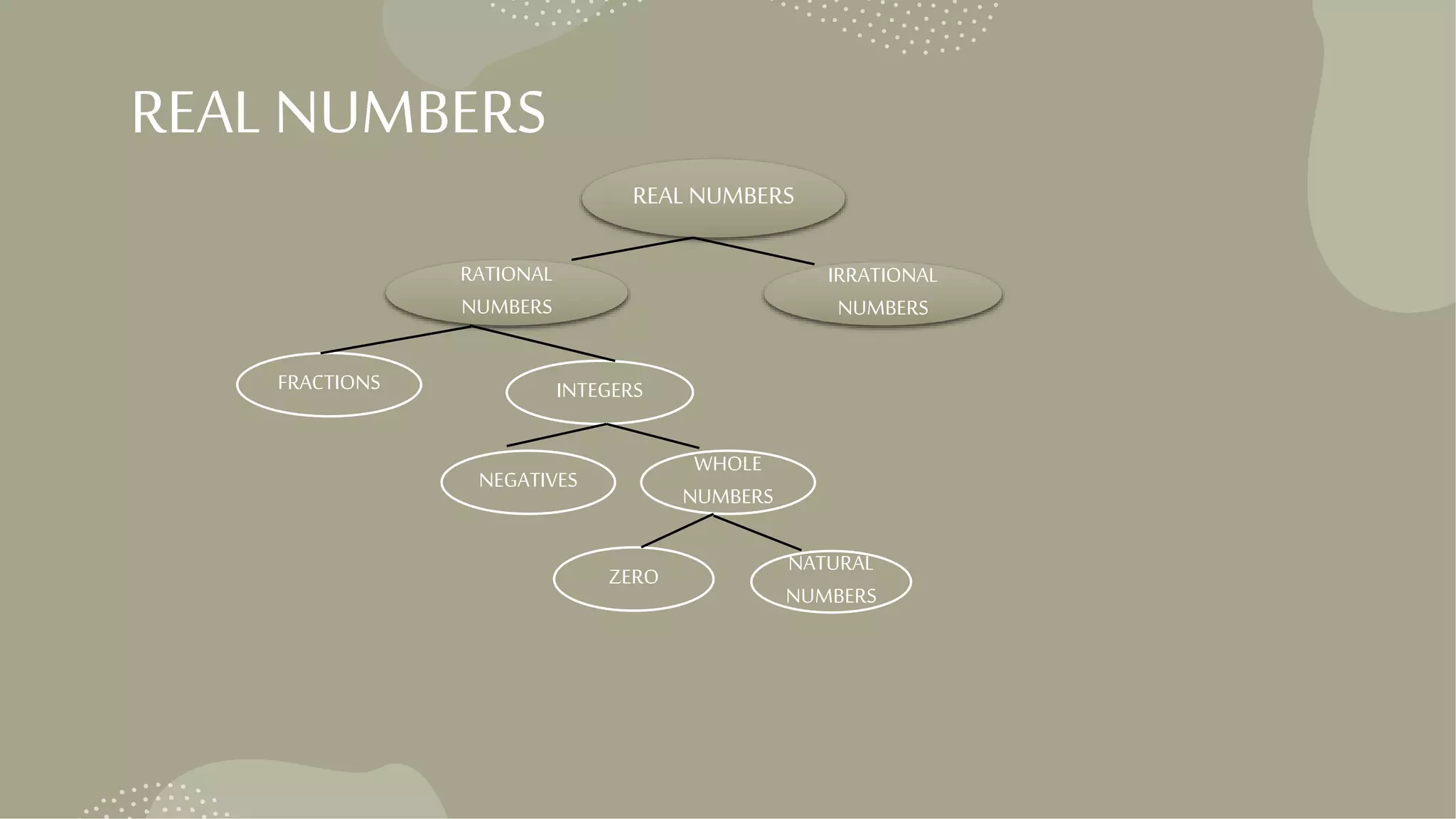
REAL NUMBERS
RATIONAL
NUMBERS
IRRATIONAL
NUMBERS
FRACTIONS INTEGERS
NEGATIVES
WHOLE
NUMBERS
ZERO
NATURAL
NUMBERS
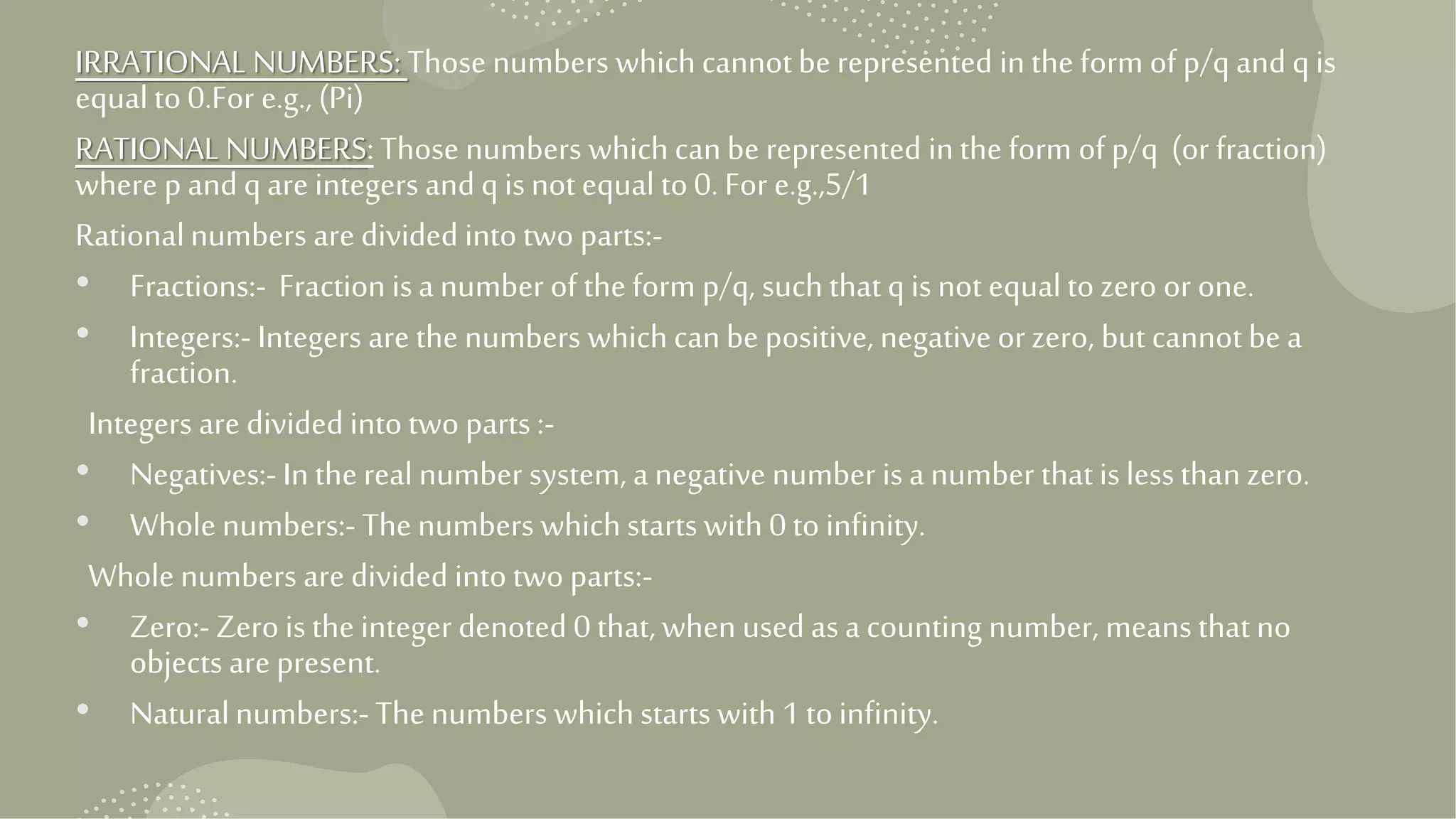
IRRATIONAL NUMBERS: Those numbers which cannot be represented in the form of p/q and q is
equal to 0.For e.g., (Pi)
RATIONAL NUMBERS: Those numbers which canbe represented inthe form of p/q (or fraction)
where p and q are integers and qis not equal to 0. For e.g.,5/1
Rationalnumbers are divided into two parts:-
• Fractions:- Fraction isa number of the form p/q, such that q is not equal to zero or one.
• Integers:- Integers are the numbers which canbe positive, negative or zero, but cannot be a
fraction.
Integers are divided into two parts :-
• Negatives:- In the real number system, a negative number is a number that is less than zero.
• Whole numbers:- The numbers which starts with 0 to infinity.
Whole numbers are divided into two parts:-
• Zero:- Zero is the integer denoted 0 that, when used asa counting number, means that no
objects are present.
• Naturalnumbers:- The numbers which starts with 1 to infinity.
DECIMALEXPANSION
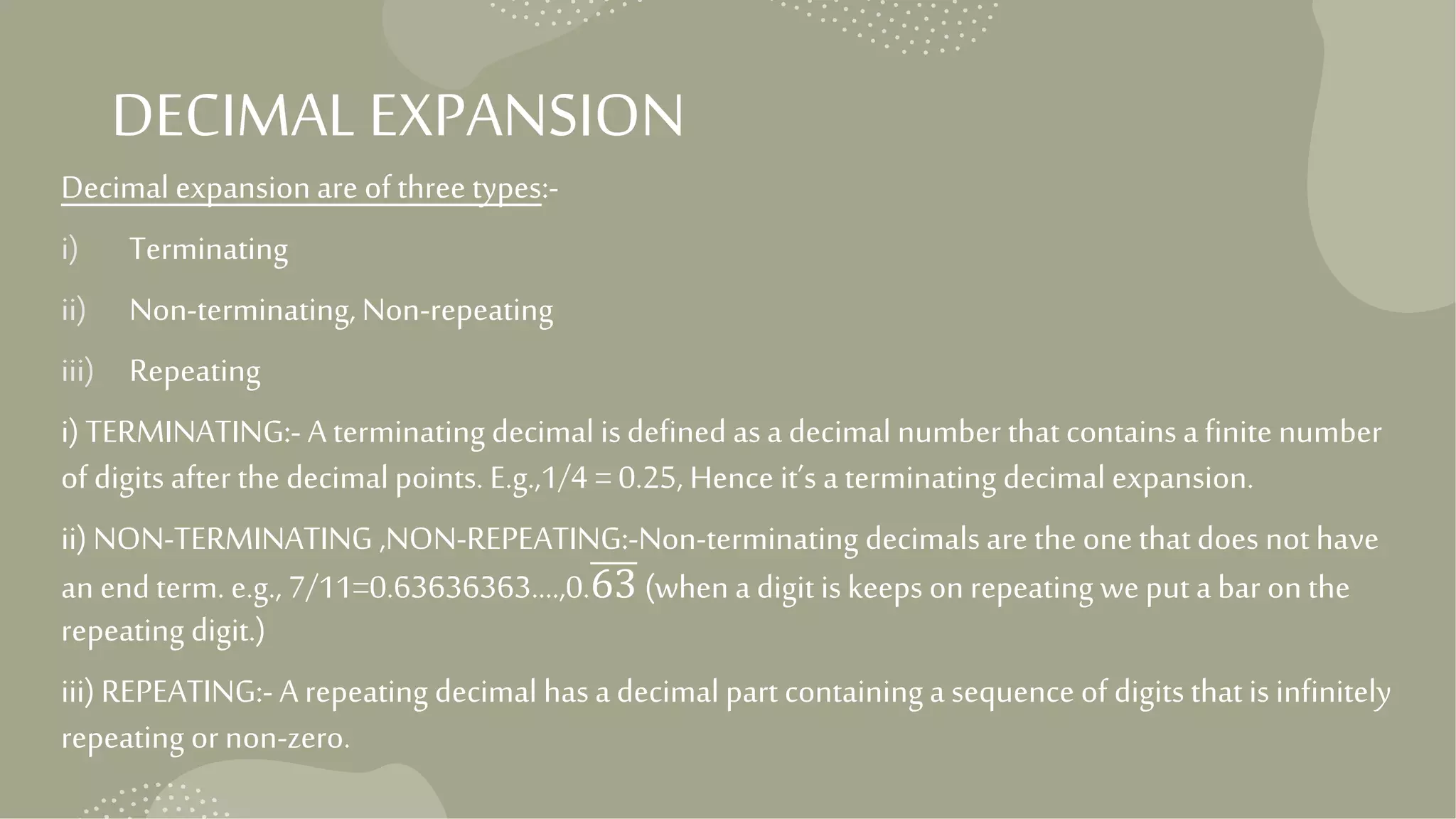
Decimal expansion are of three types:-
i) Terminating
ii) Non-terminating, Non-repeating
iii) Repeating
i) TERMINATING:- A terminating decimal isdefined asa decimal number that contains a finite number
of digits after the decimal points. E.g.,1/4 = 0.25, Hence it’s a terminating decimal expansion.
ii)NON-TERMINATING ,NON-REPEATING:-Non-terminating decimals are the one that does not have
an end term. e.g., 7/11=0.63636363….,0.63 (when a digit is keeps on repeating we put a bar on the
repeating digit.)
iii) REPEATING:- A repeating decimal hasa decimal part containing a sequence of digits that is infinitely
repeating or non-zero.
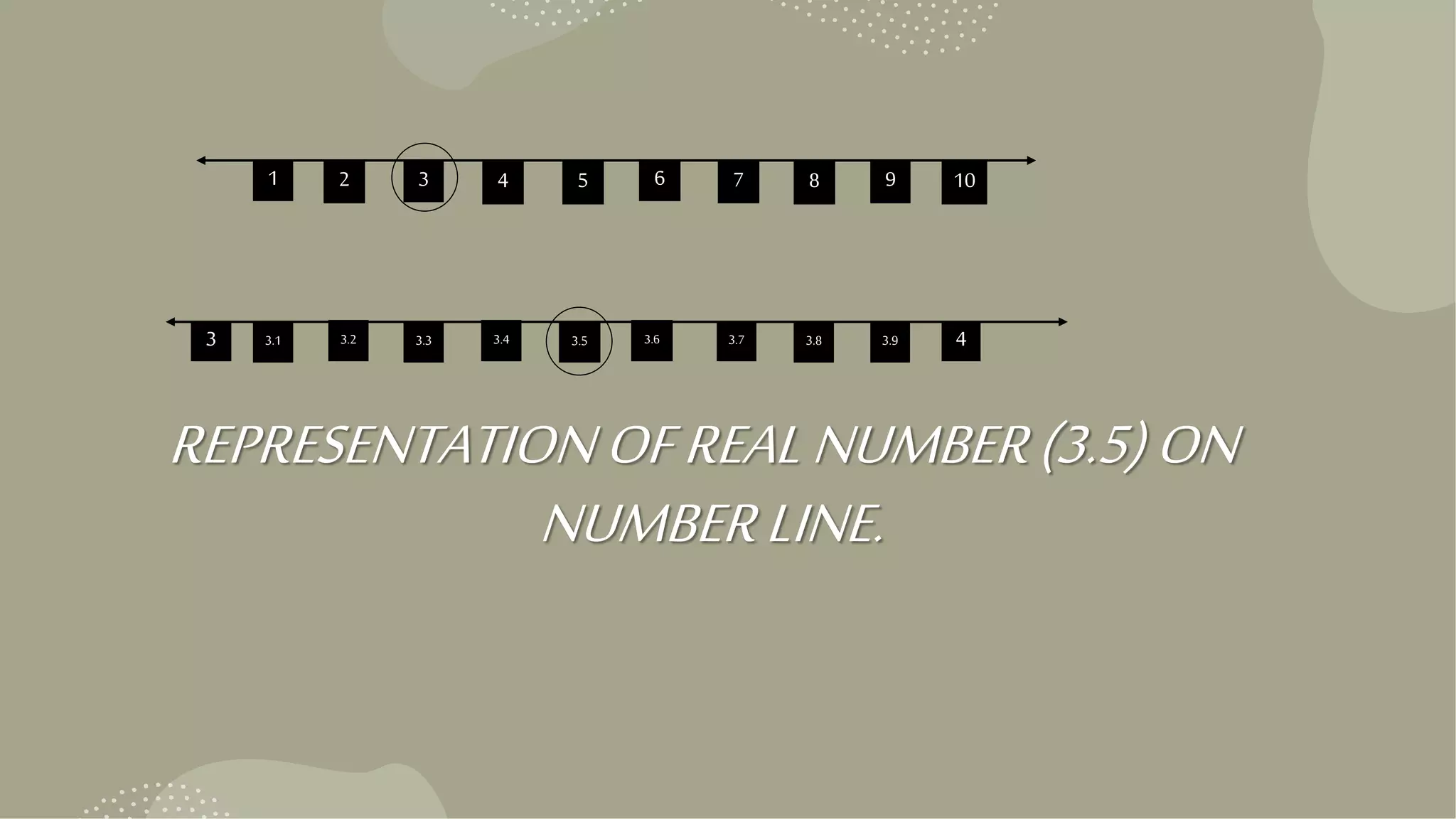
REPRESENTATIONOFREALNUMBER(3.5)ON
NUMBERLINE.
1 2 3 4 5 6 7 8 9 10
3.1 3.2 3.3 3.4 3.5 3.6 3.7 3.8 3.9 4
3
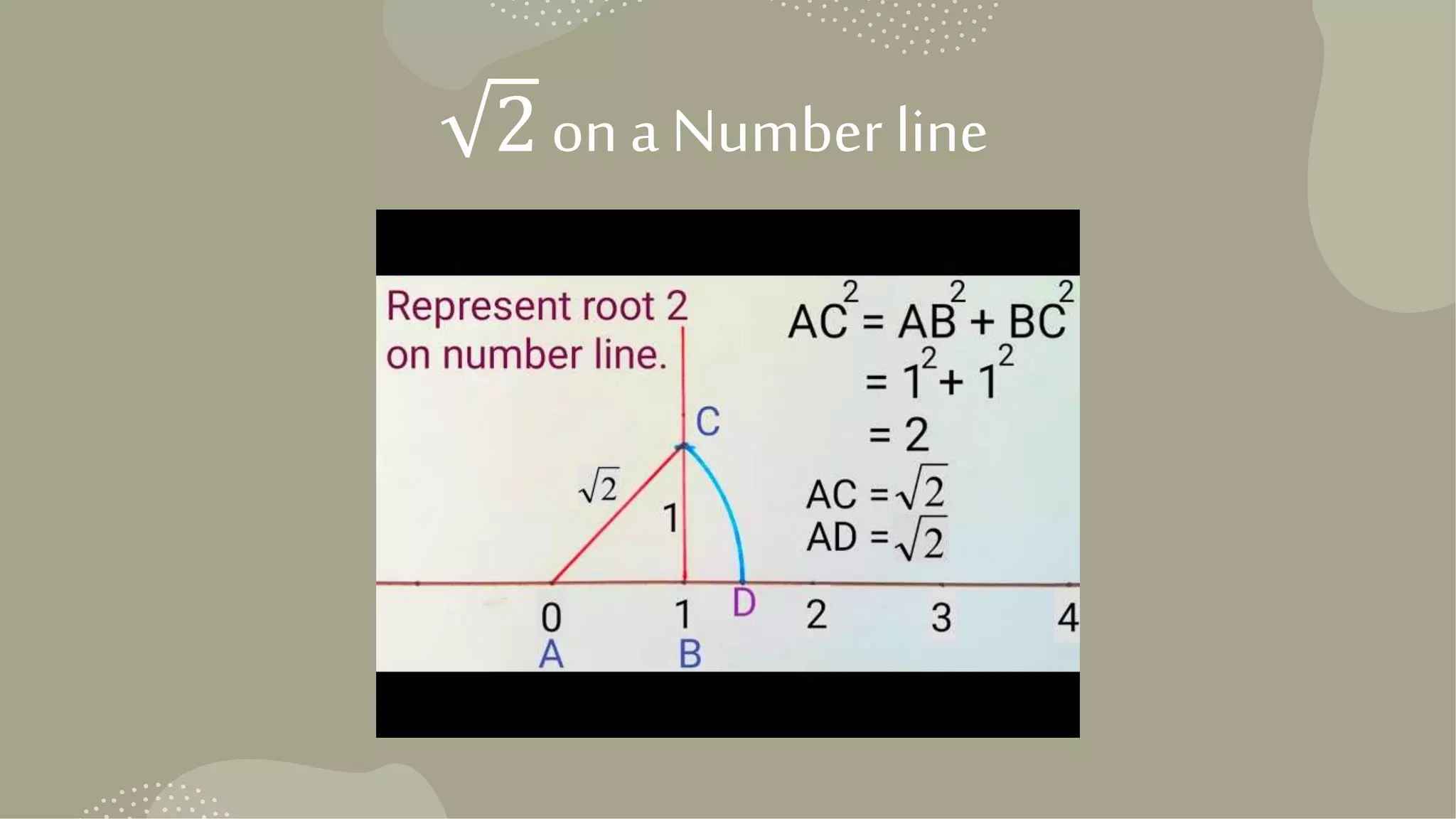
2 ona Number line
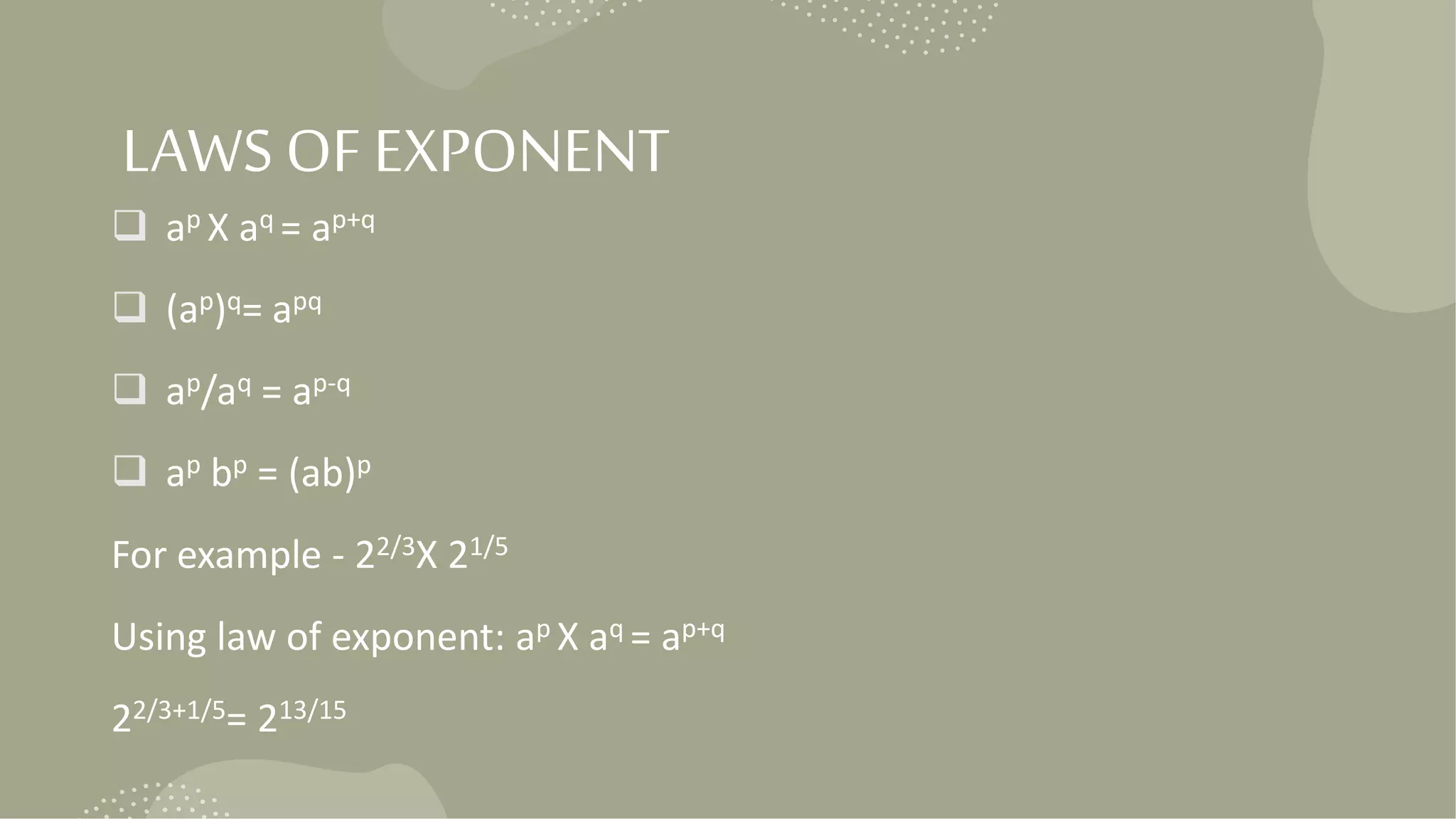
LAWS OF EXPONENT
 ap X aq = ap+q
 (ap)q= apq
 ap/aq = ap-q
 ap bp = (ab)p
For example - 22/3X 21/5
Using law of exponent: ap X aq = ap+q
22/3+1/5= 213/15
RATIONALIZATION
Rationalization is process by denominator isconjugated and then multiply and divide by the
denominator and numerator.
Some examples of rationalization are :-
(i) 1/(√5+√2)
Solution:
Multiply and divide 1/(√5+√2) by (√5-√2)
[1/(√5+√2)]×(√5-√2)/(√5-√2) = (√5-√2)/(√5+√2)(√5-√2)
= (√5-√2)/(√52-√22) [denominator is obtained by the property, (a+b)(a-b) = a2-b2]
= (√5-√2)/(5-2)
= (√5-√2)/3
PREPARED BY :-KANIKA
CLASS-9TH ‘B’
ROLL NO. 18

Maths PPT on NUMBER SYSTEM

  • 1.
    MATHS PROJECT NUMBERSYSTEM Thenumber systemis the system of naming or representing numbers. Forexample: number:1,2,3,4,5… and infinity, roman numerals: I,II,V,IX…and infinity. Number system was discovered by ARYABHATTA.
  • 2.
    TOPICS COVERED • REALNUMBERS • DECIMALEXPANSION • REAL NUMBERS ON NUMBER LINE • LAWSOF EXPONENTS • RATIONALISATION
  • 3.
  • 4.
    IRRATIONAL NUMBERS: Thosenumbers which cannot be represented in the form of p/q and q is equal to 0.For e.g., (Pi) RATIONAL NUMBERS: Those numbers which canbe represented inthe form of p/q (or fraction) where p and q are integers and qis not equal to 0. For e.g.,5/1 Rationalnumbers are divided into two parts:- • Fractions:- Fraction isa number of the form p/q, such that q is not equal to zero or one. • Integers:- Integers are the numbers which canbe positive, negative or zero, but cannot be a fraction. Integers are divided into two parts :- • Negatives:- In the real number system, a negative number is a number that is less than zero. • Whole numbers:- The numbers which starts with 0 to infinity. Whole numbers are divided into two parts:- • Zero:- Zero is the integer denoted 0 that, when used asa counting number, means that no objects are present. • Naturalnumbers:- The numbers which starts with 1 to infinity.
  • 5.
    DECIMALEXPANSION Decimal expansion areof three types:- i) Terminating ii) Non-terminating, Non-repeating iii) Repeating i) TERMINATING:- A terminating decimal isdefined asa decimal number that contains a finite number of digits after the decimal points. E.g.,1/4 = 0.25, Hence it’s a terminating decimal expansion. ii)NON-TERMINATING ,NON-REPEATING:-Non-terminating decimals are the one that does not have an end term. e.g., 7/11=0.63636363….,0.63 (when a digit is keeps on repeating we put a bar on the repeating digit.) iii) REPEATING:- A repeating decimal hasa decimal part containing a sequence of digits that is infinitely repeating or non-zero.
  • 6.
    REPRESENTATIONOFREALNUMBER(3.5)ON NUMBERLINE. 1 2 34 5 6 7 8 9 10 3.1 3.2 3.3 3.4 3.5 3.6 3.7 3.8 3.9 4 3
  • 7.
  • 8.
    LAWS OF EXPONENT ap X aq = ap+q  (ap)q= apq  ap/aq = ap-q  ap bp = (ab)p For example - 22/3X 21/5 Using law of exponent: ap X aq = ap+q 22/3+1/5= 213/15
  • 9.
    RATIONALIZATION Rationalization is processby denominator isconjugated and then multiply and divide by the denominator and numerator. Some examples of rationalization are :- (i) 1/(√5+√2) Solution: Multiply and divide 1/(√5+√2) by (√5-√2) [1/(√5+√2)]×(√5-√2)/(√5-√2) = (√5-√2)/(√5+√2)(√5-√2) = (√5-√2)/(√52-√22) [denominator is obtained by the property, (a+b)(a-b) = a2-b2] = (√5-√2)/(5-2) = (√5-√2)/3
  • 10.
    PREPARED BY :-KANIKA CLASS-9TH‘B’ ROLL NO. 18