SYMPTOMS
2
OBJECTIVE
Handling a clinical situation
Symptomatic and asymptomatic menopause
3
EXPECTED OUTCOME
a) Checklists of symptoms
b) Clinical assessment
4
CASE
41 yr old
Asymptomatic
Getting regular periods
Has heard she will have lot of problems at menopause
5
CONCERNS
How will you counsel her?
Natural phenomenon, many have no problems
Some women may develop symptoms
What are the symptoms ?
6
VASOMOTOR SYMPTOMS
Hot Flushes : 75% of women experience it
Varies in frequency, intensity and duration
Can last from 4-10 minutes, vary from 1-2/hr to 1-2/
wk. Usually involves face and neck.
Can manifest at night as night sweats and disturb sleep
significantly
May be associated with palpitations, anxiety,
irritability and panic
7
Prevalence and Timing of VMS
Experienced by> 50% of menopausal womena
Usually begin during the menopause transition
Mean duration bothersome VMS: 10.2 yb
VMS can persist 6 mo to 10+ y, with ↓ frequency and
intensity over time
Some experience VMS> 11 y
a. Nelson HD. Evid Rep TechnolAssess (Summ). 2005;1-6.
b. Freeman EW, et al. Obstet Gynecol. 2011;117:1095-1104.
7
When do VMS occur?
8
HOT FLUSH
Grading
Mild : Feeling of heat without
sweating
Moderate : Feeling of heat with sweating
Severe: Feeling of heat with sweating,
palpitation that disrupts usual
activity
9
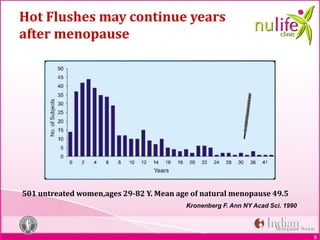
Hot Flushes may continue years
after menopause
501 untreated women,ages 29-82 Y. Mean age of natural menopause 49.5
Kronenberg F. Ann NY Acad Sci. 1990
10
PSYCHOLOGICAL SYMPTOMS
Irritability, Mood Swings
Poor Memory, Loss of Concentration
Low self esteem
Musculo-skeletal symptoms
Backache, Joint pains
11
SLEEP
Prevalence increases from 14% in general population
to 40% in permenopause and menopause
Can be associated with hot flushes and anxiety and
depression
Fibromyalgia
Obstructive sleep apnea
12
Sleep disorders
Sleep disorders can be primary sleep disorders which
get exaberated during perimenopause
Restless leg syndrome(RLS)
PLMD( Persistent limb movement disorder)
There can be social and behavioural or partner
problems which can lead to sleep disorders
Timely referral to sleep physician would help improve
quality of life
13
ASSOCIATED CONDITIONS WITH AGE
Obesity and sleep apnoea
Gastro esophageal reflux
Urinary incontinence and nocturia,
Thyroid dysfunction,
Chronic pain syndromes
fibromyalgia.
As women age, increased use of neuroactive
medications may also contribute to sleep difficulties
14
GENITO-URINARY SYMPTOMS
Urethral syndrome: frequency, urgency, dysuria,
recurrent UTI
Vaginal dryness, Dyspareunia
Loss of libido
15
The Vagina and Menopause
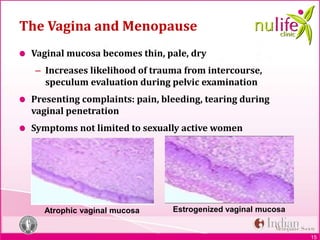
Vaginal mucosa becomes thin, pale, dry
– Increases likelihood of trauma from intercourse,
speculum evaluation during pelvic examination
Presenting complaints: pain, bleeding, tearing during
vaginal penetration
Symptoms not limited to sexually active women
15
Atrophic vaginal mucosa Estrogenized vaginal mucosa
16
Sexual problems
Dyspareunia leading to sexual dysfunction- corrected
by local estrogen therapy
Acquired sexual desire disorder in some women
responds to testosterone therapy
In the absence of availability of other androgen
preparations in India, tibolone is a good option to treat
vasomotor symptoms, psychological and libido
problems, and for prevention of osteoporosis
17
MENOPAUSE ---A WAKE –UP CALL
Time to think about healthy ageing
Prevent and early detection of CVD, osteoporosis,
cancers
Annual Health Check
18
CLINICAL EVALUATION
Evaluate women’s need
Evaluation of women’s individual risk factor
DETAILED HISTORY
Symptoms of Menopause
Elicit Risk Factors for various diseases
Dietary or Nutrition Assessment
Physical Activity
Sexual Practices
Drug abuse
Stress
Medical history - Diabetes, Hypertension, CVD
Family History - Malignancy, CVD,osteoporosis
19
ASSESSMENT
Assess general condition of patient
Physical examination:
Pulse
Blood pressure
– Optimal BP (<130/85) to be rechecked every 2
years
– Normal level (<140/90 mmHg) to be checked yearly
– Greater than 140/90 mmHg need second
measurement to confirm diagnosis of hypertension.
20
Auscultation of the heart and lungs
Height
Weight
Waist circumferences
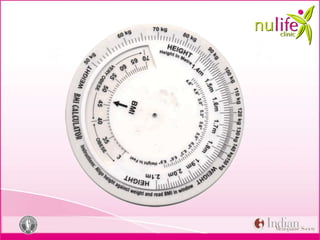
Calculate BMI
Breast examination
Pelvic examination.
21
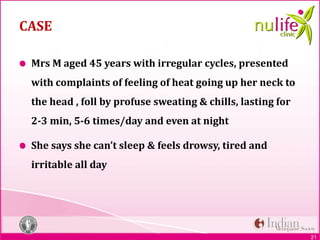
CASE
Mrs M aged 45 years with irregular cycles, presented
with complaints of feeling of heat going up her neck to
the head , foll by profuse sweating & chills, lasting for
2-3 min, 5-6 times/day and even at night
She says she can’t sleep & feels drowsy, tired and
irritable all day
22
When do we say a patient is in
menopause?
Periods stopped
Symptoms
FSH level
23
First a detailed history &
thorough clinical exam
Any investigations?
Routine screening
FSH?
– No need
24
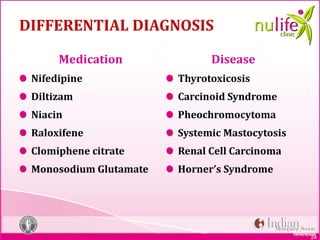
DIFFERENTIAL DIAGNOSIS
Medication
Nifedipine
Diltizam
Niacin
Raloxifene
Clomiphene citrate
Monosodium Glutamate
Disease
Thyrotoxicosis
Carcinoid Syndrome
Pheochromocytoma
Systemic Mastocytosis
Renal Cell Carcinoma
Horner’s Syndrome
Meeta
26
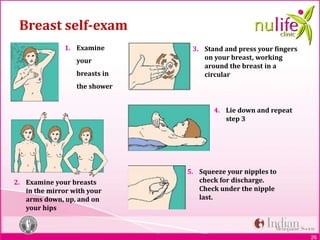
Breast self-exam
1. Examine
your
breasts in
the shower
2. Examine your breasts
in the mirror with your
arms down, up, and on
your hips
3. Stand and press your fingers
on your breast, working
around the breast in a
circular
4. Lie down and repeat
step 3
5. Squeeze your nipples to
check for discharge.
Check under the nipple
last.
27
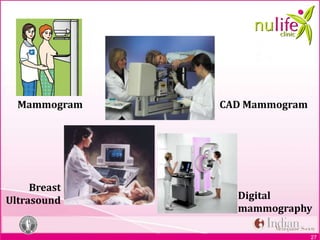
Mammogram CAD Mammogram
Digital
mammography
Breast
Ultrasound
28
USE MID LIFE OPD CARD FORMATS
29

Nulife module 3 symptoms edited

  • 1.
  • 2.
    2 OBJECTIVE Handling a clinicalsituation Symptomatic and asymptomatic menopause
  • 3.
    3 EXPECTED OUTCOME a) Checklistsof symptoms b) Clinical assessment
  • 4.
    4 CASE 41 yr old Asymptomatic Gettingregular periods Has heard she will have lot of problems at menopause
  • 5.
    5 CONCERNS How will youcounsel her? Natural phenomenon, many have no problems Some women may develop symptoms What are the symptoms ?
  • 6.
    6 VASOMOTOR SYMPTOMS Hot Flushes: 75% of women experience it Varies in frequency, intensity and duration Can last from 4-10 minutes, vary from 1-2/hr to 1-2/ wk. Usually involves face and neck. Can manifest at night as night sweats and disturb sleep significantly May be associated with palpitations, anxiety, irritability and panic
  • 7.
    7 Prevalence and Timingof VMS Experienced by> 50% of menopausal womena Usually begin during the menopause transition Mean duration bothersome VMS: 10.2 yb VMS can persist 6 mo to 10+ y, with ↓ frequency and intensity over time Some experience VMS> 11 y a. Nelson HD. Evid Rep TechnolAssess (Summ). 2005;1-6. b. Freeman EW, et al. Obstet Gynecol. 2011;117:1095-1104. 7 When do VMS occur?
  • 8.
    8 HOT FLUSH Grading Mild :Feeling of heat without sweating Moderate : Feeling of heat with sweating Severe: Feeling of heat with sweating, palpitation that disrupts usual activity
  • 9.
    9 Hot Flushes maycontinue years after menopause 501 untreated women,ages 29-82 Y. Mean age of natural menopause 49.5 Kronenberg F. Ann NY Acad Sci. 1990
  • 10.
    10 PSYCHOLOGICAL SYMPTOMS Irritability, MoodSwings Poor Memory, Loss of Concentration Low self esteem Musculo-skeletal symptoms Backache, Joint pains
  • 11.
    11 SLEEP Prevalence increases from14% in general population to 40% in permenopause and menopause Can be associated with hot flushes and anxiety and depression Fibromyalgia Obstructive sleep apnea
  • 12.
    12 Sleep disorders Sleep disorderscan be primary sleep disorders which get exaberated during perimenopause Restless leg syndrome(RLS) PLMD( Persistent limb movement disorder) There can be social and behavioural or partner problems which can lead to sleep disorders Timely referral to sleep physician would help improve quality of life
  • 13.
    13 ASSOCIATED CONDITIONS WITHAGE Obesity and sleep apnoea Gastro esophageal reflux Urinary incontinence and nocturia, Thyroid dysfunction, Chronic pain syndromes fibromyalgia. As women age, increased use of neuroactive medications may also contribute to sleep difficulties
  • 14.
    14 GENITO-URINARY SYMPTOMS Urethral syndrome:frequency, urgency, dysuria, recurrent UTI Vaginal dryness, Dyspareunia Loss of libido
  • 15.
    15 The Vagina andMenopause Vaginal mucosa becomes thin, pale, dry – Increases likelihood of trauma from intercourse, speculum evaluation during pelvic examination Presenting complaints: pain, bleeding, tearing during vaginal penetration Symptoms not limited to sexually active women 15 Atrophic vaginal mucosa Estrogenized vaginal mucosa
  • 16.
    16 Sexual problems Dyspareunia leadingto sexual dysfunction- corrected by local estrogen therapy Acquired sexual desire disorder in some women responds to testosterone therapy In the absence of availability of other androgen preparations in India, tibolone is a good option to treat vasomotor symptoms, psychological and libido problems, and for prevention of osteoporosis
  • 17.
    17 MENOPAUSE ---A WAKE–UP CALL Time to think about healthy ageing Prevent and early detection of CVD, osteoporosis, cancers Annual Health Check
  • 18.
    18 CLINICAL EVALUATION Evaluate women’sneed Evaluation of women’s individual risk factor DETAILED HISTORY Symptoms of Menopause Elicit Risk Factors for various diseases Dietary or Nutrition Assessment Physical Activity Sexual Practices Drug abuse Stress Medical history - Diabetes, Hypertension, CVD Family History - Malignancy, CVD,osteoporosis
  • 19.
    19 ASSESSMENT Assess general conditionof patient Physical examination: Pulse Blood pressure – Optimal BP (<130/85) to be rechecked every 2 years – Normal level (<140/90 mmHg) to be checked yearly – Greater than 140/90 mmHg need second measurement to confirm diagnosis of hypertension.
  • 20.
    20 Auscultation of theheart and lungs Height Weight Waist circumferences Calculate BMI Breast examination Pelvic examination.
  • 21.
    21 CASE Mrs M aged45 years with irregular cycles, presented with complaints of feeling of heat going up her neck to the head , foll by profuse sweating & chills, lasting for 2-3 min, 5-6 times/day and even at night She says she can’t sleep & feels drowsy, tired and irritable all day
  • 22.
    22 When do wesay a patient is in menopause? Periods stopped Symptoms FSH level
  • 23.
    23 First a detailedhistory & thorough clinical exam Any investigations? Routine screening FSH? – No need
  • 24.
    24 DIFFERENTIAL DIAGNOSIS Medication Nifedipine Diltizam Niacin Raloxifene Clomiphene citrate MonosodiumGlutamate Disease Thyrotoxicosis Carcinoid Syndrome Pheochromocytoma Systemic Mastocytosis Renal Cell Carcinoma Horner’s Syndrome Meeta
  • 26.
    26 Breast self-exam 1. Examine your breastsin the shower 2. Examine your breasts in the mirror with your arms down, up, and on your hips 3. Stand and press your fingers on your breast, working around the breast in a circular 4. Lie down and repeat step 3 5. Squeeze your nipples to check for discharge. Check under the nipple last.
  • 27.
  • 28.
    28 USE MID LIFEOPD CARD FORMATS
  • 29.