FUSION AND FISSION
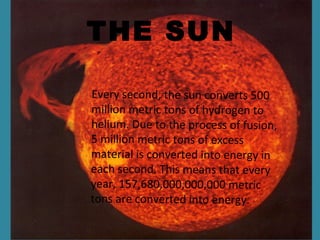
Every second, the sun converts 500
million metric tons of hydrogen to
helium. Due to the process of fusion,
5 million metric tons of excess
material is converted into energy in
each second. This means that every
year, 157,680,000,000,000 metric
tons are converted into energy.
THE SUN
Nuclear Fusion
• Nuclear fusion is the process by which
multiple nuclei join together to form a
heavier nucleus.
• It is accompanied by the release or
absorption of energy depending on the
masses of the nuclei involved.
Nuclear Fusion
• Iron and nickel nuclei have the largest binding
energies per nucleon of all nuclei and
therefore are the most stable.
Nuclear Fusion
• The fusion of two nuclei lighter than iron or
nickel generally releases energy.
• The fusion of nuclei heavier than them
absorbs energy.
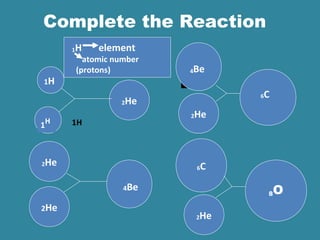
Complete the Reaction
1H
4Be
1H
8O
4Be
2He
2He
1H
2He
2He
2He
6C
1H element
atomic number
(protons)
6C
Learning Check
What process creates energy in the Sun?
Fusion of hydrogen into helium in the Sun’s core generates
the Sun’s energy.
How long ago did fusion generate the energy we
now receive as sunlight?
Fusion created the energy we receive today about a million
years ago. This is the time it takes for photons and then
convection to transport energy through the solar interior
to the photosphere. Once sunlight emerges from the
photosphere, it takes only about 8 minutes to reach Earth.
NUCLEAR FISSION
A reaction in which an atomic
nucleus of a radioactive element
splits by bombardment from an
external source, with
simultaneous release of large
amounts of energy, used for
electric power generation
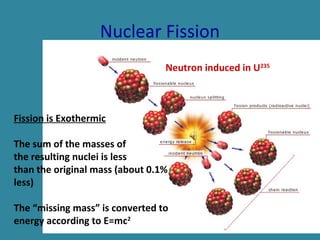
Nuclear Fission
Neutron induced in U235
Fission is Exothermic
The sum of the masses of
the resulting nuclei is less
than the original mass (about 0.1%
less)
The “missing mass” is converted to
energy according to E=mc2
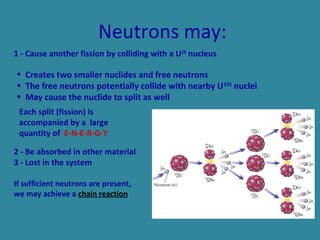
Neutrons may:
1 - Cause another fission by colliding with a U235
nucleus
2 - Be absorbed in other material
3 - Lost in the system
If sufficient neutrons are present,
we may achieve a chain reaction
Each split (fission) is
accompanied by a large
quantity of E-N-E-R-G-Y
• Creates two smaller nuclides and free neutrons
• The free neutrons potentially collide with nearby U235
nuclei
• May cause the nuclide to split as well
Fission can be controlled…
So energy is released more slowly.
Neutron moderation is a process that sows
down neutrons so the reactor fuel (uranium or
plutonium) captures them to continue the
chain reaction
Neutron absorption decreases the number of
slow moving neutrons
Fission can be controlled…
Why must neutrons in a reactor be slowed
down?
So the reactor fuel can capture them to
continue the chain reaction… thus more
energy is produced
So why is this so important to
us?
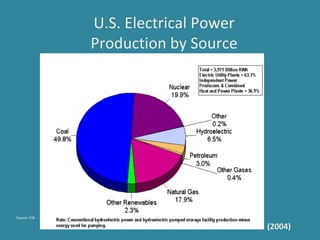
U.S. Electrical Power
Production by Source
Source: EIA
(2004)
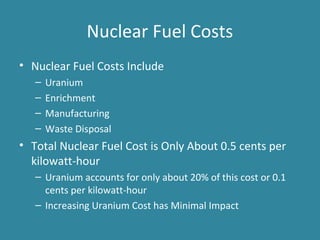
Nuclear Fuel Costs
• Nuclear Fuel Costs Include
– Uranium
– Enrichment
– Manufacturing
– Waste Disposal
• Total Nuclear Fuel Cost is Only About 0.5 cents per
kilowatt-hour
– Uranium accounts for only about 20% of this cost or 0.1
cents per kilowatt-hour
– Increasing Uranium Cost has Minimal Impact
Review
Nuclear fission:
A large nucleus splits into several
small nuclei when impacted by a
neutron, and energy is released in
this process
Nuclear fusion:
Several small nuclei fuse
together and release
energy.
One final thought…
What about
nuclear waste from
the process?
Fuel rods are a hugh source of
nuclear waste
• The rods are made from uranium-235 or
plutonium-239, which are both fissionable
isotopes
• Once the rods are “spent” they are still
considered high-level nuclear waste because
they continue to emit radiation
• They are placed in holding tanks or storage
pools
Make a list of growing concerns
the growing concerns…
• The rods spend years in the storage tanks
• Its cheaper to mine new sources of isotope
than it is to recycle the isotope remaining in
the rods
• The rods are moved to an off-site storage
facility and are taking up LOTS of room
• The DOE is responsible for cleaning up nuclear
sites and managing their waste

Ppt fusion and_fission_wk4

  • 1.
  • 2.
    Every second, thesun converts 500 million metric tons of hydrogen to helium. Due to the process of fusion, 5 million metric tons of excess material is converted into energy in each second. This means that every year, 157,680,000,000,000 metric tons are converted into energy. THE SUN
  • 3.
    Nuclear Fusion • Nuclearfusion is the process by which multiple nuclei join together to form a heavier nucleus. • It is accompanied by the release or absorption of energy depending on the masses of the nuclei involved.
  • 4.
    Nuclear Fusion • Ironand nickel nuclei have the largest binding energies per nucleon of all nuclei and therefore are the most stable.
  • 5.
    Nuclear Fusion • Thefusion of two nuclei lighter than iron or nickel generally releases energy. • The fusion of nuclei heavier than them absorbs energy.
  • 6.
  • 7.
    Learning Check What processcreates energy in the Sun? Fusion of hydrogen into helium in the Sun’s core generates the Sun’s energy. How long ago did fusion generate the energy we now receive as sunlight? Fusion created the energy we receive today about a million years ago. This is the time it takes for photons and then convection to transport energy through the solar interior to the photosphere. Once sunlight emerges from the photosphere, it takes only about 8 minutes to reach Earth.
  • 8.
    NUCLEAR FISSION A reactionin which an atomic nucleus of a radioactive element splits by bombardment from an external source, with simultaneous release of large amounts of energy, used for electric power generation
  • 9.
    Nuclear Fission Neutron inducedin U235 Fission is Exothermic The sum of the masses of the resulting nuclei is less than the original mass (about 0.1% less) The “missing mass” is converted to energy according to E=mc2
  • 10.
    Neutrons may: 1 -Cause another fission by colliding with a U235 nucleus 2 - Be absorbed in other material 3 - Lost in the system If sufficient neutrons are present, we may achieve a chain reaction Each split (fission) is accompanied by a large quantity of E-N-E-R-G-Y • Creates two smaller nuclides and free neutrons • The free neutrons potentially collide with nearby U235 nuclei • May cause the nuclide to split as well
  • 11.
    Fission can becontrolled… So energy is released more slowly. Neutron moderation is a process that sows down neutrons so the reactor fuel (uranium or plutonium) captures them to continue the chain reaction Neutron absorption decreases the number of slow moving neutrons
  • 12.
    Fission can becontrolled… Why must neutrons in a reactor be slowed down? So the reactor fuel can capture them to continue the chain reaction… thus more energy is produced
  • 13.
    So why isthis so important to us?
  • 14.
    U.S. Electrical Power Productionby Source Source: EIA (2004)
  • 15.
    Nuclear Fuel Costs •Nuclear Fuel Costs Include – Uranium – Enrichment – Manufacturing – Waste Disposal • Total Nuclear Fuel Cost is Only About 0.5 cents per kilowatt-hour – Uranium accounts for only about 20% of this cost or 0.1 cents per kilowatt-hour – Increasing Uranium Cost has Minimal Impact
  • 16.
    Review Nuclear fission: A largenucleus splits into several small nuclei when impacted by a neutron, and energy is released in this process Nuclear fusion: Several small nuclei fuse together and release energy.
  • 17.
    One final thought… Whatabout nuclear waste from the process?
  • 18.
    Fuel rods area hugh source of nuclear waste • The rods are made from uranium-235 or plutonium-239, which are both fissionable isotopes • Once the rods are “spent” they are still considered high-level nuclear waste because they continue to emit radiation • They are placed in holding tanks or storage pools
  • 19.
    Make a listof growing concerns
  • 20.
    the growing concerns… •The rods spend years in the storage tanks • Its cheaper to mine new sources of isotope than it is to recycle the isotope remaining in the rods • The rods are moved to an off-site storage facility and are taking up LOTS of room • The DOE is responsible for cleaning up nuclear sites and managing their waste

Editor's Notes

  • #15 The United States has 103 nuclear power reactors in 31 states. Nuclear energy provides electricity for one of every five homes and business … the second-largest source of electricity after coal. Some states are clearly are more dependent on nuclear energy than others. Vermont gets 76 percent of its electricity from nuclear reactors … New Hampshire, 58 percent … and South Carolina, 55 percent. In Virginia, nuclear power provides more than 40 percent of the electricity used.