“Nuclear power is a hell of a way to boil water.”
- Albert Einstein
 On May 7, 1945, 108
tons of TNT stacked
and threaded with
radioactive material
was detonated in the
White Sands desert in
New Mexico.
 This explosion was
meant to calibrate the
instruments that
would measure the
actual nuclear bombs
to be tested later.
3
One-Hundred Ton Test, 0.1 kilotons 4
 Nuclear technology takes advantage of the power
locked in structure of atoms, the basic particle of
matter.
 The nucleus of an atom
contains all of its
positively-charged protons
and non-charged neutrons.
 Negatively-charged electrons
orbit the nucleus.
 Atoms always contain equal numbers of protons and
electrons, , making them electrically neutral.
5
 Atoms can have different
numbers of neutrons in their
nuclei.
 Nuclei from the same element
with different numbers of
neutrons are called isotopes.
 Most isotopes are stable, but
some can spontaneously break
apart, emitting energy and
particles.
 This is radiation.
6
 Nuclear weapons harness a specific type of decay called
nuclear fission.
 This is the splitting of the nucleus into two smaller
fragments.
 The fuel used by the first
nuclear weapons was
Uranium-235, a naturally
occurring isotope.
 Uranium-235 has an
extremely large nucleus
that can be split when it
is hit with a high-speed
neutron.
7
 In a nuclear bomb, a large amount of uranium-235 is
clustered together, so that when fission is initiated in
one of the atoms, it splits and released more neutrons,
which then cause fission in other atoms.
 This creates a fission chain
reaction.
 Each time a nucleus splits,
a large amount of energy is
released.
 Multiplied across the entire
chain reaction…
8
Trinity, 21 kilotons 9
 The first nuclear test detonation used a device that was
an exact replica of “Fat Man”, which would later be
dropped on Nagasaki, Japan.
 The heat of the explosion fused the desert sands
together, forming a layer of radioactive green glass.
10
11
 Two atomic bombs were dropped during World War II –
Hiroshima and Nagasaki, Japan.
 Each had yields of 15-21 kilotons of TNT.
 These blasts ended World War II.
Hiroshima, March 1946.
 Following World War 2, additional nuclear weapons
testing was moved to part of the Marshall Islands, called
the Bikini Atoll (11°N, 165°E).
 This testing was codenamed “Operation Crossroads.”
12
 Two nuclear devices were detonated at sea as part of
Operation Crossroads.
 The purpose was to study the effects of a nuclear blast on
an armada of naval ships.
 The first blast, called Shot Able, was dropped from a
plane. The second, Shot Baker, was detonated
underwater, beneath the
ships.
 Different species of lab
animals were placed
on several ships, to test
for radiation poisoning
following the blast.
13
Shot Able and Shot Baker 14
 Glenn Seaborg,
chairman of the
Atomic Energy
Commission, called
Baker “the world’s
first nuclear disaster.”
 The target ships of Shot
Baker were all heavily
contaminated with
radioactive fallout.
 Some were so “hot” that they could not be safely
decontaminated and had to be sunk.
15
 In 1954, six large nuclear tests were conducted. The
largest was code named Castle Bravo.
 This tested a new design, called a hydrogen bomb.
16
Castle Bravo, 15 megatons (15000 kilotons) 17
18
 Castle Bravo was a much more
powerful blast than expected.
 Residents of nearby atolls were
exposed to toxic levels of
radioactive fallout.
 A Japanese tuna fishing boat
called the Lucky Dragon 5 was
also caught in the blast radius.
 Nuclear fallout is dust and ash propelled into the
atmosphere following a nuclear blast.
 Radiation exposure from fallout is measured in rems.
 100-200 rems causes mild symptoms, such as nausea and
vomiting.
 400-600 rems has about a 50% mortality rate.
 600-1000 rems will usually cause death.
 Over 1000 rems will cause death in a few hours or less.
 Interior exposure of fallout, from breathing or ingesting
the dust and ash, would have even more severe effects.
 An average person will be exposed to about 620
millirems of radiation per year from natural and man-
made sources.
19
 Radioactive coral dust fell on the Lucky Dragon 5.
 Fishermen touched the dust with their bare skin, inhaled
it, and in some cases, tasted it.
 One crewmember died from exposure.
20
 As the Bikini nuclear testing continued, President
Dwight Eisenhower gave a famous speech to the United
Nations:
“My country wants to be
constructive, not destructive.”
“…the United States pledges before you…
its determination to help solve the
fearful atomic dilemma--to devote its
entire heart and mind to find the way by
which the miraculous inventiveness of man
shall not be dedicated to his death, but
consecrated to his life."
21
 Equipment and technology were provided to schools,
hospitals, and research institutions to help develop
nuclear technology towards more peaceful goals.
 The primary goal: electricity generation.
 Optimism for the new technology was very high.
 Lewis Strauss, chairman of the Atomic Energy
Commission, predicted that,
“Our children will enjoy in
their homes electrical energy
too cheap to meter.”
22
 The process of
converting nuclear
energy into electricity
is similar to that of
using fossil fuels.
 Water is boiled, the
steam is passed
through a turbine,
which spins a
generator.
23
 As with nuclear bombs, the primary fuel is uranium-235.
 Uranium ore is enriched and formed into fuel pellets.
 The fuel pellets are stacked into long, cylindrical fuel rods.
 Control rods, made of a neutron-absorbing material, are
placed amongst the fuel rods.
 Can be removed and inserted to adjust the rate of the chain
reaction.
24
Withdraw
control
rods,
reaction
increases
Insert control
rods,
reaction
decreases
 One big advantage to nuclear power is that, under
normal conditions, it does not release any air pollution,
only steam.
25
Cooling
Tower in
Byron, Illinois
26
 Both reactor vessel and
steam generator are housed
in a special containment
building preventing
radiation from escaping,
and providing extra
security in case of
accidents.
 Under normal operating
conditions, a reactor
releases very little
radioactivity.
 Through the late
1970s, many new
reactors were
constructed all over
the United States.
 Since that initial
boom, few new
reactors have come
online.
28
29
 In 1979, a movie called “The China
Syndrome” was released.
 Fictional story about a California
nuclear plant that experienced a
near-meltdown of its nuclear core.
 The title of the movie is an
exaggeration of what happens
during a meltdown – the nuclear
core becomes so hot that it melts,
even melting through the floor of
the reactor vessel.
30
 Ten days following the movie’s release, the Three Mile
Island partial meltdown occurred.
 A relief water valve stuck open, allowing water to escape
from the core.
 A meltdown, when the fuel and control rods physically
begin to melt due to the heat surge within the reactor,
partially occurred.
 No major leak to the
environment occurred.
 In 1986, a full meltdown occurred at the Chernobyl
nuclear plant located in Ukraine (formerly Soviet
Union).
 A test was being conducted on the reactor to see how the
backup water pump generators would respond to a full
power outage.
 The control rods were fully removed.
 At some point, the fission chain reaction began occurring
uncontrollably.
 An explosion ripped apart the containment building,
spreading radioactive fallout throughout the area and into
the atmosphere.
31
 There were multiple design flaws at the Chernobyl plant:
 The containment building was inadequate.
 Graphite was used as a
moderator instead of
water. When the
meltdown occurred, it
ignited, releasing more
fallout.
 A water storage pool
was located under the
reactor. If the core had
melted down into this
pool, an even greater
explosion would have occurred.
32
 The burning core was eventually extinguished.
 The nearby employees’ town, Pripyat, was permanently
evacuated.
 A 30km radius around the plant, called the exclusion
zone, has been designated as uninhabitable to people.
33
 The most recent meltdown occurred following a massive
earthquake and tidal wave off the coast of Japan.
 The generators powering the water pumps of some of the
Fukushima Daiichi reactors were flooded.
 Without cooling water, the core overheated and
experienced a meltdown.
34
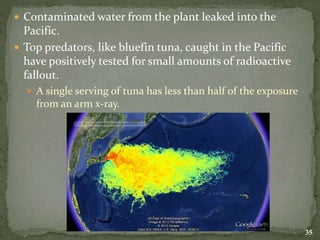
 Contaminated water from the plant leaked into the
Pacific.
 Top predators, like bluefin tuna, caught in the Pacific
have positively tested for small amounts of radioactive
fallout.
 A single serving of tuna has less than half of the exposure
from an arm x-ray.
35
36
 About 100,000 tons of low-level
waste (clothing) and about 15,000
tons of high-level waste (spent-
fuel) waste is stored in the U.S.
from reactor usage.
 Spent fuel rods are temporarily
placed in deep water pools while
they cool down and the fission
reaction slows.
 Waste is then moved to large casks
of metal and concrete near the
reactor.
37
 The U.S. Department of Energy
announced plans to build a high-
level waste repository near Yucca
Mountain, Nevada in 1987.
 The facility met three important
criteria for long-term waste
storage:
 Low moisture.
 Geologically stable.
 Far away from major population
centers.
 Plans to use Yucca have since
been halted, due to objections
from Nevada residents.
 No long-term storage plan has
been accepted by the U.S.
 Some alternative methods of nuclear waste
disposal have been researched.
 Transmutation uses the waste as fuel in a
different type of reactor, which converts it to a
less-dangerous waste.
 Geologic disposal involves
depositing the waste
deep below the Earth’s
crust in stable rock
formations.
38
 Nuclear energy makes up only a fraction of our
total energy generation.
 Its use may increase in the future, as fossil fuels
become more scarce or are considered too
environmentally damaging.
39

Nuclear Energy.pptx

  • 1.
    “Nuclear power isa hell of a way to boil water.” - Albert Einstein
  • 2.
     On May7, 1945, 108 tons of TNT stacked and threaded with radioactive material was detonated in the White Sands desert in New Mexico.  This explosion was meant to calibrate the instruments that would measure the actual nuclear bombs to be tested later. 3
  • 3.
    One-Hundred Ton Test,0.1 kilotons 4
  • 4.
     Nuclear technologytakes advantage of the power locked in structure of atoms, the basic particle of matter.  The nucleus of an atom contains all of its positively-charged protons and non-charged neutrons.  Negatively-charged electrons orbit the nucleus.  Atoms always contain equal numbers of protons and electrons, , making them electrically neutral. 5
  • 5.
     Atoms canhave different numbers of neutrons in their nuclei.  Nuclei from the same element with different numbers of neutrons are called isotopes.  Most isotopes are stable, but some can spontaneously break apart, emitting energy and particles.  This is radiation. 6
  • 6.
     Nuclear weaponsharness a specific type of decay called nuclear fission.  This is the splitting of the nucleus into two smaller fragments.  The fuel used by the first nuclear weapons was Uranium-235, a naturally occurring isotope.  Uranium-235 has an extremely large nucleus that can be split when it is hit with a high-speed neutron. 7
  • 7.
     In anuclear bomb, a large amount of uranium-235 is clustered together, so that when fission is initiated in one of the atoms, it splits and released more neutrons, which then cause fission in other atoms.  This creates a fission chain reaction.  Each time a nucleus splits, a large amount of energy is released.  Multiplied across the entire chain reaction… 8
  • 8.
  • 9.
     The firstnuclear test detonation used a device that was an exact replica of “Fat Man”, which would later be dropped on Nagasaki, Japan.  The heat of the explosion fused the desert sands together, forming a layer of radioactive green glass. 10
  • 10.
    11  Two atomicbombs were dropped during World War II – Hiroshima and Nagasaki, Japan.  Each had yields of 15-21 kilotons of TNT.  These blasts ended World War II. Hiroshima, March 1946.
  • 11.
     Following WorldWar 2, additional nuclear weapons testing was moved to part of the Marshall Islands, called the Bikini Atoll (11°N, 165°E).  This testing was codenamed “Operation Crossroads.” 12
  • 12.
     Two nucleardevices were detonated at sea as part of Operation Crossroads.  The purpose was to study the effects of a nuclear blast on an armada of naval ships.  The first blast, called Shot Able, was dropped from a plane. The second, Shot Baker, was detonated underwater, beneath the ships.  Different species of lab animals were placed on several ships, to test for radiation poisoning following the blast. 13
  • 13.
    Shot Able andShot Baker 14
  • 14.
     Glenn Seaborg, chairmanof the Atomic Energy Commission, called Baker “the world’s first nuclear disaster.”  The target ships of Shot Baker were all heavily contaminated with radioactive fallout.  Some were so “hot” that they could not be safely decontaminated and had to be sunk. 15
  • 15.
     In 1954,six large nuclear tests were conducted. The largest was code named Castle Bravo.  This tested a new design, called a hydrogen bomb. 16
  • 16.
    Castle Bravo, 15megatons (15000 kilotons) 17
  • 17.
    18  Castle Bravowas a much more powerful blast than expected.  Residents of nearby atolls were exposed to toxic levels of radioactive fallout.  A Japanese tuna fishing boat called the Lucky Dragon 5 was also caught in the blast radius.
  • 18.
     Nuclear falloutis dust and ash propelled into the atmosphere following a nuclear blast.  Radiation exposure from fallout is measured in rems.  100-200 rems causes mild symptoms, such as nausea and vomiting.  400-600 rems has about a 50% mortality rate.  600-1000 rems will usually cause death.  Over 1000 rems will cause death in a few hours or less.  Interior exposure of fallout, from breathing or ingesting the dust and ash, would have even more severe effects.  An average person will be exposed to about 620 millirems of radiation per year from natural and man- made sources. 19
  • 19.
     Radioactive coraldust fell on the Lucky Dragon 5.  Fishermen touched the dust with their bare skin, inhaled it, and in some cases, tasted it.  One crewmember died from exposure. 20
  • 20.
     As theBikini nuclear testing continued, President Dwight Eisenhower gave a famous speech to the United Nations: “My country wants to be constructive, not destructive.” “…the United States pledges before you… its determination to help solve the fearful atomic dilemma--to devote its entire heart and mind to find the way by which the miraculous inventiveness of man shall not be dedicated to his death, but consecrated to his life." 21
  • 21.
     Equipment andtechnology were provided to schools, hospitals, and research institutions to help develop nuclear technology towards more peaceful goals.  The primary goal: electricity generation.  Optimism for the new technology was very high.  Lewis Strauss, chairman of the Atomic Energy Commission, predicted that, “Our children will enjoy in their homes electrical energy too cheap to meter.” 22
  • 22.
     The processof converting nuclear energy into electricity is similar to that of using fossil fuels.  Water is boiled, the steam is passed through a turbine, which spins a generator. 23
  • 23.
     As withnuclear bombs, the primary fuel is uranium-235.  Uranium ore is enriched and formed into fuel pellets.  The fuel pellets are stacked into long, cylindrical fuel rods.  Control rods, made of a neutron-absorbing material, are placed amongst the fuel rods.  Can be removed and inserted to adjust the rate of the chain reaction. 24 Withdraw control rods, reaction increases Insert control rods, reaction decreases
  • 24.
     One bigadvantage to nuclear power is that, under normal conditions, it does not release any air pollution, only steam. 25 Cooling Tower in Byron, Illinois
  • 25.
    26  Both reactorvessel and steam generator are housed in a special containment building preventing radiation from escaping, and providing extra security in case of accidents.  Under normal operating conditions, a reactor releases very little radioactivity.
  • 27.
     Through thelate 1970s, many new reactors were constructed all over the United States.  Since that initial boom, few new reactors have come online. 28
  • 28.
    29  In 1979,a movie called “The China Syndrome” was released.  Fictional story about a California nuclear plant that experienced a near-meltdown of its nuclear core.  The title of the movie is an exaggeration of what happens during a meltdown – the nuclear core becomes so hot that it melts, even melting through the floor of the reactor vessel.
  • 29.
    30  Ten daysfollowing the movie’s release, the Three Mile Island partial meltdown occurred.  A relief water valve stuck open, allowing water to escape from the core.  A meltdown, when the fuel and control rods physically begin to melt due to the heat surge within the reactor, partially occurred.  No major leak to the environment occurred.
  • 30.
     In 1986,a full meltdown occurred at the Chernobyl nuclear plant located in Ukraine (formerly Soviet Union).  A test was being conducted on the reactor to see how the backup water pump generators would respond to a full power outage.  The control rods were fully removed.  At some point, the fission chain reaction began occurring uncontrollably.  An explosion ripped apart the containment building, spreading radioactive fallout throughout the area and into the atmosphere. 31
  • 31.
     There weremultiple design flaws at the Chernobyl plant:  The containment building was inadequate.  Graphite was used as a moderator instead of water. When the meltdown occurred, it ignited, releasing more fallout.  A water storage pool was located under the reactor. If the core had melted down into this pool, an even greater explosion would have occurred. 32
  • 32.
     The burningcore was eventually extinguished.  The nearby employees’ town, Pripyat, was permanently evacuated.  A 30km radius around the plant, called the exclusion zone, has been designated as uninhabitable to people. 33
  • 33.
     The mostrecent meltdown occurred following a massive earthquake and tidal wave off the coast of Japan.  The generators powering the water pumps of some of the Fukushima Daiichi reactors were flooded.  Without cooling water, the core overheated and experienced a meltdown. 34
  • 34.
     Contaminated waterfrom the plant leaked into the Pacific.  Top predators, like bluefin tuna, caught in the Pacific have positively tested for small amounts of radioactive fallout.  A single serving of tuna has less than half of the exposure from an arm x-ray. 35
  • 35.
    36  About 100,000tons of low-level waste (clothing) and about 15,000 tons of high-level waste (spent- fuel) waste is stored in the U.S. from reactor usage.  Spent fuel rods are temporarily placed in deep water pools while they cool down and the fission reaction slows.  Waste is then moved to large casks of metal and concrete near the reactor.
  • 36.
    37  The U.S.Department of Energy announced plans to build a high- level waste repository near Yucca Mountain, Nevada in 1987.  The facility met three important criteria for long-term waste storage:  Low moisture.  Geologically stable.  Far away from major population centers.  Plans to use Yucca have since been halted, due to objections from Nevada residents.  No long-term storage plan has been accepted by the U.S.
  • 37.
     Some alternativemethods of nuclear waste disposal have been researched.  Transmutation uses the waste as fuel in a different type of reactor, which converts it to a less-dangerous waste.  Geologic disposal involves depositing the waste deep below the Earth’s crust in stable rock formations. 38
  • 38.
     Nuclear energymakes up only a fraction of our total energy generation.  Its use may increase in the future, as fossil fuels become more scarce or are considered too environmentally damaging. 39