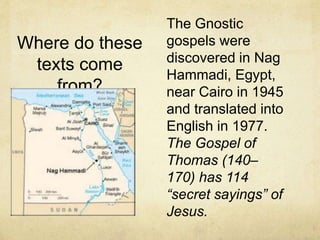
The document outlines the characteristics and beliefs of Gnosticism, emphasizing its focus on secret knowledge, dualism, and an unconventional understanding of Jesus and salvation, contrasting it with traditional Christianity. The Gnostic gospels, including the Gospel of Thomas, discovered in Nag Hammadi, Egypt, present Jesus in ways that diverge from the canonical gospels, depicting him as a figure who imparts esoteric revelations rather than as the savior known in orthodox Christianity. It argues that these writings reflect a heretical movement that arose in the second century, challenging the foundational teachings of the Christian faith, as articulated by apostles like John and Timothy.


![Apocalypse of Peter 81:4–
24
I saw him apparently being seized by them. And I
said, “What am I seeing, O Lord? Is it really you
whom they take? And are you holding on to me?
And are they hammering the feet and hands of
another? Who is this one above the cross, who is
glad and laughing?” The Savior said to me, “He
whom you saw being glad and laughing above the
cross is the Living Jesus. But he into whose hands
and feet they are driving the nails is his fleshly part,
which is the substitute. They put to shame that which
remained in his likeness. And look at him, and [look
at] me!](https://image.slidesharecdn.com/gnostics-140717194042-phpapp02/85/Gnostics-9-320.jpg)







![Thomas:70
Jesus said, “That which you have will
save you if you bring it forth from
yourselves. That which you do not have
within you [will] kill you if you do not
have it within you.”
This is wrong because: Salvation in
Thomas seems to focus on what is in a
person rather than our trust in a savior.](https://image.slidesharecdn.com/gnostics-140717194042-phpapp02/85/Gnostics-23-320.jpg)