The Chemical andBiological
Foundations of Life
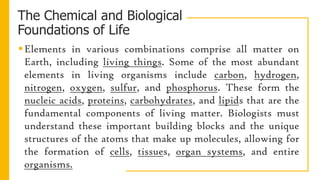
Elements in various combinations comprise all matter on
Earth, including living things. Some of the most abundant
elements in living organisms include carbon, hydrogen,
nitrogen, oxygen, sulfur, and phosphorus. These form the
nucleic acids, proteins, carbohydrates, and lipids that are the
fundamental components of living matter. Biologists must
understand these important building blocks and the unique
structures of the atoms that make up molecules, allowing for
the formation of cells, tissues, organ systems, and entire
organisms.
3.
At its mostfundamental level, life is made up of matter. Matter is any substance
that occupies space and has mass. Elements are unique forms of matter with specific
chemical and physical properties that cannot be broken down into smaller
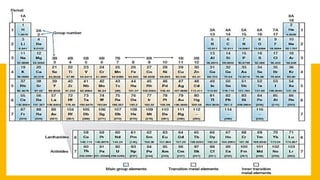
substances by ordinary chemical reactions. There are 118 elements, but only 92 occur
naturally. The remaining elements are synthesized in laboratories and are unstable.
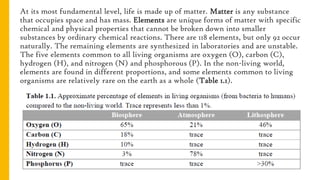
The five elements common to all living organisms are oxygen (O), carbon (C),
hydrogen (H), and nitrogen (N) and phosphorous (P). In the non-living world,
elements are found in different proportions, and some elements common to living
organisms are relatively rare on the earth as a whole (Table 1.1).
4.
The Structure of
theAtom
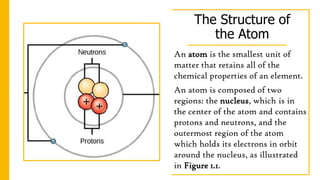
An atom is the smallest unit of
matter that retains all of the
chemical properties of an element.
An atom is composed of two
regions: the nucleus, which is in
the center of the atom and contains
protons and neutrons, and the
outermost region of the atom
which holds its electrons in orbit
around the nucleus, as illustrated
in Figure 1.1.
5.
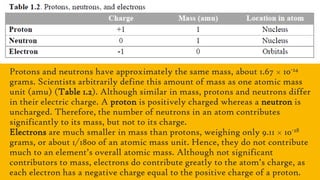
Protons and neutronshave approximately the same mass, about 1.67 × 10⁻²⁴
grams. Scientists arbitrarily define this amount of mass as one atomic mass
unit (amu) (Table 1.2). Although similar in mass, protons and neutrons differ
in their electric charge. A proton is positively charged whereas a neutron is
uncharged. Therefore, the number of neutrons in an atom contributes
significantly to its mass, but not to its charge.
Electrons are much smaller in mass than protons, weighing only 9.11 × 10⁻²⁸
grams, or about 1/1800 of an atomic mass unit. Hence, they do not contribute
much to an element’s overall atomic mass. Although not significant
contributors to mass, electrons do contribute greatly to the atom’s charge, as
each electron has a negative charge equal to the positive charge of a proton.
7.
MOLECULES
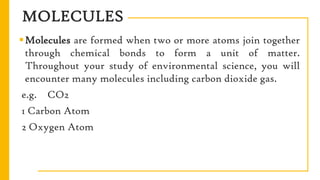
Molecules are formedwhen two or more atoms join together
through chemical bonds to form a unit of matter.
Throughout your study of environmental science, you will
encounter many molecules including carbon dioxide gas.
e.g. CO2
1 Carbon Atom
2 Oxygen Atom
8.
Isotopes
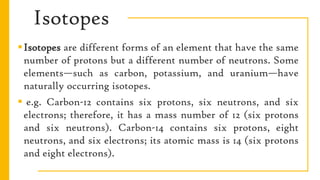
Isotopes are differentforms of an element that have the same
number of protons but a different number of neutrons. Some
elements—such as carbon, potassium, and uranium—have
naturally occurring isotopes.
e.g. Carbon-12 contains six protons, six neutrons, and six
electrons; therefore, it has a mass number of 12 (six protons
and six neutrons). Carbon-14 contains six protons, eight
neutrons, and six electrons; its atomic mass is 14 (six protons
and eight electrons).
9.
Carbon
The basic functionalunit of life is a cell and all organisms are
made up of one or more cells. Cells are made of many
complex molecules called macromolecules, such as proteins,
nucleic acids (RNA and DNA), carbohydrates, and lipids.
The macromolecules are a subset of organic molecules that
are especially important for life. The fundamental
component for all of these macromolecules is carbon. The
carbon atom has unique properties that allow it to form
covalent bonds with as many as four different atoms, making
this versatile element ideal to serve as the basic structural
component, or “backbone,” of the macromolecules.
10.
Hydrocarbons
Hydrocarbons are organicmolecules consisting entirely of
carbon and hydrogen, such as methane (CH4. We often use
hydrocarbons in our daily lives as fuels—like the propane in a
gas grill or the butane in a lighter. The many covalent bonds
between the atoms in hydrocarbons store a great amount of
energy, which is released when these molecules are burned
(oxidized).
11.
Biological molecules
Life onEarth is primarily made up of four
major classes of biological molecules, or
biomolecules. These include carbohydrates,
lipids, proteins, and nucleic acids.
12.
Carbohydrates
Most peopleare familiar with carbohydrates, one type of macromolecule,
especially when it comes to what we eat. Carbohydrates are, in fact, an essential
part of our diet; grains, fruits, and vegetables are all natural sources of
carbohydrates. Carbohydrates provide energy to the body, particularly through
glucose, a simple sugar that is a component of starch and an ingredient in many
staple foods. Carbohydrates also have other important functions in humans,
animals, and plants. Carbohydrates can be represented by the stoichiometric
formula (CH2O)n, where n is the number of carbons in the molecule. In other
words, the ratio of carbon to hydrogen to oxygen is
1:2:1 in carbohydrate molecules. This formula also explains the origin of the term
“carbohydrate”: the components are carbon (“carbo”) and the components of
water (hence, “hydrate”). The chemical formula for glucose is C6H12O6. In
humans, glucose is an important source of energy.
13.
Lipids
Lipids include adiverse group of compounds such as
fats, oils, waxes, phospholipids, and steroids that are
largely nonpolar in nature. Nonpolar molecules are
hydrophobic (“water fearing”), or insoluble in water.
These lipids have important roles in energy storage, as
well as in the building of cell membranes throughout
the body.
14.
Proteins
Proteins are oneof the most abundant organic molecules
in living systems and have the most diverse range of
functions of all macromolecules. Proteins may be
structural, regulatory, contractile, or protective; they may
serve in transport, storage, or membranes; or they may be
toxins or enzymes. Each cell in a living system may
contain thousands of proteins, each with a unique
function. Their structures, like their functions, vary
greatly.
15.
Nucleic acids
Nucleic acidsare the most important macromolecules for the
continuity of life. They carry the genetic blueprint of a cell
and carry instructions for the functioning of the cell. The
two main types of nucleic acids are deoxyribonucleic acid
(DNA) and ribonucleic acid (RNA). DNA is the genetic
material found in all living organisms, ranging from single-
celled bacteria to multicellular mammals. DNA controls all
of the cellular activities by turning the genes “on” or “off.”
The other type of nucleic acid, RNA, is mostly involved in
protein synthesis. DNA has a double-helix structure
16.
Biological organization
Allliving things are made of cells; the cell itself is the smallest fundamental
unit of structure and function in living organisms. In most organisms, these
cells contain organelles, which provide specific functions for the cell.
Organisms are individual living entities. For example, each tree in a forest
is an organism.
All the individuals of a species living within a specific area are collectively
called a population. Populations fluctuate based on a number of factors:
seasonal and yearly changes in the environment, natural disasters such as
forest fires and volcanic eruptions, and competition for resources between
and within species. A community is the sum of populations inhabiting a
particular area. For instance, all of the trees, insects, and other populations
in a forest form the forest’s community. The forest itself is an ecosystem.
17.
An ecosystem consistsof all the living things in a
particular area together with the abiotic, nonliving
parts of that environment such as nitrogen in the soil
or rain water. At the highest level of organization, the
biosphere is the collection of all ecosystems, and it
represents the zones of life on earth. It includes land,
water, and even the atmosphere to a certain extent.
18.
There arethree broad categories of ecosystems based on their general
environment: freshwater, ocean water (marine), and terrestrial.
Within these broad categories are individual ecosystem types based on
the organisms present and the type of environmental habitat. Ocean
ecosystems are the most common, comprising 75 percent of the Earth's
surface. The shallow ocean ecosystems include extremely biodiverse
coral reef ecosystems, and the deep ocean surface is known for its
large numbers of plankton and krill (small crustaceans) that support
it. These two environments are especially important to aerobic
respirators worldwide as the phytoplankton perform 40 percent of all
photosynthesis on Earth. Although not as diverse as the other two,
deep ocean ecosystems contain a wide variety of marine organisms.
Such ecosystems exist even at the bottom of the ocean where light is
unable to penetrate through the water.
19.
Freshwater ecosystems arethe rarest, occurring on
only 1.8 percent of the Earth's surface. Lakes, rivers,
streams, and springs comprise these systems; they are
quite diverse, and they support a variety of fish,
amphibians, reptiles, insects, phytoplankton, fungi,
and bacteria.
20.
Terrestrial ecosystems, alsoknown for their diversity, are
grouped into large categories called biomes, such as tropical
rainforests, savannas, deserts, coniferous forests, deciduous
forests, and tundra. Grouping these ecosystems into just a
few biome categories obscures the great diversity of the
individual ecosystems within them. For example, there is
great variation in desert vegetation: the saguaro cacti and
other plant life in the Sonoran Desert, in the United States,
are relatively abundant compared to the desolate rocky desert
of Boa Vista, an island off the coast of Western Africa.
21.
Environment and
environmental science
The word environment describes living and nonliving surroundings
relevant to organisms. It incorporates physical, chemical and
biological factors and processes that determine the growth and
survival of organisms, populations, and communities. All these
components fit within the ecosystem concept as a way to organize all
of the factors and processes that make up the environment. The
ecosystem includes organisms and their environment within a specific
area. Review the previous section for in-depth information regarding
the Earth’s ecosystems. Today, human activities influence all of the
Earth’s ecosystems.
22.
Environmental science studiesall aspects of the
environment in an interdisciplinary way. This means
that it requires the knowledge of various other subjects
including biology, chemistry, physics, statistics,
microbiology, biochemistry, geology, economics, law,
sociology, etc. It is a relatively new field of study that
has evolved from integrated use of many disciplines.
23.
Environmental engineering isone of the fastest growing and
most complex disciplines of engineering. Environmental
engineers solve problems and design systems using
knowledge of environmental concepts and ecology, thereby
providing solutions to various environmental problems.
Environmentalism, in contrast, is a social movement through
which citizens are involved in activism to further the
protection of environmental landmarks and natural
resources. This is not a field of science, but incorporates some
aspects of environmental knowledge to advance conservation
and sustainability efforts.
24.
The Process ofScience
Environmental science is a science, but what exactly is science?
Science (from the Latin scientia, meaning “knowledge”) can be defined
as all of the fields of study that attempt to comprehend the nature of
the universe and all its parts. The scientific method is a method of
research with defined steps that include experiments and careful
observation. One of the most important aspects of this method is the
testing of hypotheses by means of repeatable experiments. A
hypothesis is a suggested explanation for an event, which can be
tested. A theory is a tested and confirmed explanation for
observations or phenomena that is supported by many repeated
experiences and observations.
25.
The scientific method
Thescientific process typically starts with an observation
(often a problem to be solved) that leads to a question. The
scientific method consists of a series of well-defined steps. If
a hypothesis is not supported by experimental data, a new
hypothesis can be proposed. Let’s think about a simple
problem that starts with an observation and apply the
scientific method to solve the problem. One Monday
morning, a student arrives in class and quickly discovers that
the classroom is too warm. That is an observation that also
describes a problem: the classroom is too warm. The student
then asks a question: “Why is the classroom so warm?”
26.
The precautionary
principle
The precautionaryprinciple or the precautionary approach is
one perspective of environmental risk management. The
precautionary principle stakes that “When the health of
humans and the environment is at stake, it may not be
necessary to wait for scientific certainty to take protective
action”. In other words, better to be safe than sorry.
Proponents of the precautionary principle also believe that
the burden of proof should be on the individual, company or
government who is proposing the action, not on the people
who will be affected by it.
27.
What is theenvironment
worth to you?
The environment, and its benefits to individuals or
groups, can be viewed and justified from multiple
perspectives.
28.
Utilitarian justificationfor environmental conservation means that we should
protect the environment because doing so provides a direct economic benefit to
people.
An ecological justification for environmental conservation means that we
should protect the environmental because doing so will protect both species
that are beneficial to other as well as other species and an ecological
justification for conservation acknowledges the many ecosystem services that
we derive from healthy ecosystems.
An aesthetic justification for conservation acknowledges that many people
enjoy the outdoors and do not want to live in a world without wilderness. One
could also think of this as recreational, inspirational, or spiritual justification
for conservation.
a moral justification represents the belief that various aspects of the
environment have a right to exist and that it is our moral obligation to allow
them to continue or help them persist.




![Second Monthly Exam ,d';d;[;e];e];e]r;8.pptx](https://cdn.slidesharecdn.com/ss_thumbnails/secondmonthlyexam8-260128140644-f240f1d3-thumbnail.jpg?width=640&height=640&fit=bounds)


