Contents
2 AFLOAT
       Submarine PMS Performance– Declining trend in basic PMS accomplishment in
       the Submarine Force.

2 A S HO R E
      New Reporting Module for Diving and Parachuting Released
      – Makes reporting easier for commands.
      Nominations for CNO Shore Safety Awards – Don’t miss this
      valuable opportunity.
      Motorcycle Training—Closing the Gap– More than 7,000 sportbike riders still need
      training.

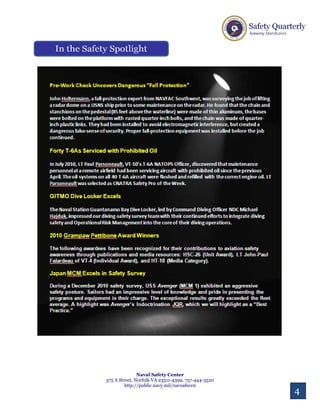
4   IN THE SAFETY SPOTLIGHT
      Pre-Work Check Uncovers Dangerous “Fall Protection” – NAVFAC Southwest
      fall-protection expert makes good catch before job.
      Forty T-6As Serviced with Prohibited Oil – Careful research pays off for VT-10’s T-
      6A NATOPS Officer.
      GITMO Dive Locker Excels – Exceptional integration of Operational Risk
      Management into diving operations.
      Grampaw Pettibone Award Winners – Unit, individual winners recognized for
      contributions to aviation-safety awareness.
      Japan MCM Excels in Safety Survey – USS Avenger (MCM 1).

5 MARINE CORPS
      Hearing Loss—We’ve Heard It Before – New hearing-
      conservation report helps track status of Marines.
      MRAP Safety Analysis – Lack of experience, confusion about “side
      slope” identified as factors.

6 MEDIA
      Two Focus areas for April 2011 – Distracted driving, sexual-assault
      prevention are targets of next campaigns.

6 OCCUPATIONAL SAFETY AND HEALTH
      Safety Success Stories – Winners of CNO and SECNAV Safety
      awards; activities that achieved OSHA VPP Star recognition.
      Contractor Safety – Growing area of importance to the Navy safety, legal, contracts,
      maritime, and facilities communities.
      OSHA Citations – Twelve in the first quarter, involving emergency response, hazmat
      storage, fire protection, welding, and electrical.


                                       Naval Safety Center
                        375 A Street, Norfolk VA 23511-4399, 757-444-3520
                                 http://public.navy.mil/navsafecen
Submarine PMS Performance

FY10 safety-survey results and communications            from surrounding units attend the school, receive
with INSURV and TYCOM personnel have                     training and provide feedback on the MRCs
identified a declining trend in basic PMS                provided to the fleet. Also, in conjunction with
accomplishment in the Submarine Force. The NSC           TYCOM N4 PMS personnel, we’re conducting
Submarine Division is making this a focus topic          verbatim compliance monitoring of basic PMS
for FY11, targeting deck-equipment readiness and         items that repeat as Top 10 significant
coordinating with TYCOM, SUBMEPP and                     discrepancies, including PMS spot-check
NAVSEA to support a 100% review of Deck MRCs.            conformance. Lastly, NSC is conducting a two-
A two-day deck-maintenance school to be                  hour, submarine-leadership seminar at all
conducted onboard a host unit using the host             submarine concentration areas to discuss PMS
unit’s gear has been developed. Deck petty officers      monitoring and spot-checks.


New Reporting Module for Diving and Parachuting Released

The new Dive Jump Reporting System (DJRS) Jump module, released on February 9th, makes things
easier for reporting commands. It captures jump activity via the creation and use of a manifest. Using this
data, the Naval Safety Center will be able to extract monthly activity reports for Navy and Marine Corps
commands, as well as a required DoD report. Once fully integrated, commands will no longer have to
submit these monthly activity reports.

DJRS offers units several added benefits, including multiple report-query options and maintenance of
jumper qualifications and currencies. Ultimately, DJRS is designed to streamline unit workload by
merging jump manifesting and jump activity reporting into one function.

                                   To date, approximately 20% of Navy and Marine Corps parachute
                                   program units have been incorporated into the DJRS system. This
                                   time-intensive process requires creating and/or verifying
                                   approximately 7,000 individual personnel profiles attached to
                                   approximately 55 commands. Since its release date, 111 parachute
                                   jumps have been recorded in the system.

                                    Users are encouraged to review the six DJRS training modules located
on the Naval Safety Center website at
http://www.public.navy.mil/navsafecen/Pages/ashore/Investigations_Home/Parachuting/DJRS.aspx. If
you have questions, call (757) 444-3520, Ext. 6044, and ask for DJRS jump support. Or submit the
feedback form at http://www.public.navy.mil/navsafecen/pages/ashore/investigations_home/
parachuting/parachuting.aspx, selecting “WESS” from the options bar at the top of the page.


                                             Naval Safety Center
                              375 A Street, Norfolk VA 23511-4399, 757-444-3520
                                       http://public.navy.mil/navsafecen
                                                                                                              2
CNO Shore Safety Awards for Individual Achievement in Safety

These important awards formally recognize                encouraged to recognize their personnel who are
outstanding civilian and military safety and             doing an exceptional job administering SOH
occupational health (SOH) personnel ashore who           programs. Nominations for the CNO Individual
have significantly contributed to either their           Award for safety can be submitted by anyone from
individual command safety program or to the              an ashore activity; however, the submission must
overall Navy SOH Program. The Award can be               be endorsed via the individual's chain of
presented to one military officer, one military          command to include the CO/XO, and must be
enlisted member, and one Navy civilian each fiscal       received at the Naval Safety Center by 31
year.                                                    December annually. For more information, refer
                                                         to Chapter 32 in OPNAVINST 5100.23G or
All shore-side commands falling under                    contact Stan Willingham at (757) 444-3520, Ext.
OPNAVINST 5100.23G (the Navy Safety and                  7125, or email Stanley.Willingham@navy.mil.
Occupational Health Program Manual) are


Motorcycle Training—Closing the Training Gap


Department of the Navy motorcycle fatalities have been reduced by 40 percent in the last two years. This
is a significant fatality reduction that riders and leaders should be proud of. However, resting on our
laurels is not yet in order. In FY10, 17 of 22 motorcycle fatalities occurred on sportbikes and 14 of those 17
riders (82%) had not received their required MSRC training.

As leaders and fellow riders, this summer’s goal is to reach that person who has high potential to be the
next “statistic.” Let’s identify our noncompliant sport-bike riders and get them into the next available
MSRC. We need to make sure every rider has the life-saving knowledge taught in the class. There are still
                                  7,688 sportbike riders who are not fully trained.

                               I challenge each of you to do your part to close this training gap. Work
                               through your local safety office to schedule MSRC training within the 60
                               days of BRC completion. Sooner is better than later. Today’s sport-bikes are
                               performance machines and deadly in untrained hands. Riders can register
                               for training through ESAMS at www.navymotorcyclerider.com or by calling
                               their local safety office.


                                             Naval Safety Center
                              375 A Street, Norfolk VA 23511-4399, 757-444-3520
                                       http://public.navy.mil/navsafecen
                                                                                                                 3
Naval Safety Center
375 A Street, Norfolk VA 23511-4399, 757-444-3520
         http://public.navy.mil/navsafecen
                                                    4
Hearing Loss—We’ve Heard It Before

Noise is not a new occupational health hazard. Since the military mechanized and introduced gun
powder, noise is a constant threat to Marines, Sailors and Soldiers. Short-term problems usually go away
within a few minutes or hours after leaving the noise. Repeated exposures, however, lead to permanent,
incurable hearing loss.

DoD and DoN policies require controlling hazardous noise in the workplace and during field training
whenever possible. Detailed programs are in place, but hearing protection devices remain the most
common defense against hazardous noise exposures. Starting with SECNAV’s memorandum, “Global War
on Noise” of 8 June 2007, and augmented by recent audits and a special interest item of the Naval
Inspector General, DoN has increased attention and awareness of this occupational health hazard.

A recent first step: Marine Corps commands are now able to track status of audiometric tests for their
unit. GENADMIN 011328Z Dec 09 [Marine Corps Safety Program, Medical Readiness Reporting System
(MRRS) and Hearing Readiness] has been updated with a hearing-conservation report for identifying
Marines who are exposed to hazardous noise. Commanders desiring MRRS access should contact their
command medical representative for guidance on how to do so.


MRAP Mishap Analysis Identifies Inexperience, Confusion About “Side Slope”

United States Marine Corps MRAP mishaps continue to rise, likely due to the increasing number of
vehicles available to units currently forward deployed. An analysis was conducted to identify common
trends that may assist deployed units (and units preparing to deploy) to develop risk-mitigation
strategies. Between 2008 and 2010 the USMC reported 78 Class A, B, and C mishaps in WESS, which
resulted in 8 deaths/permanent partial disabilities, 360 days lost, and $3.4M in damage to government
property. The 78 reported mishaps included 15 collisions, 13 crush incidents, 11 rollovers, 11 falls, 7 not
wearing seatbelts, 7 maintenance-related, and 7 shock/fire/negligent discharges.

                           Even though rollovers account for only 14 percent of USMC MRAP mishaps,
                           receive the most scrutiny because they account for all of the USMC MRAP
                           deaths and permanent disabilities. Some of these incidents could be due to
                           some confusion among MRAP operators and trainers regarding the side slope
                           that the MRAP is capable of transiting. All MRAP Technical Manuals state that
                           the vehicle can transit a 30% slope (17 degrees), but some operators have
                           mistakenly translated the 30% side-slope to be equivalent to 30 degrees
(57.5%), which is almost twice the side-slope that the MRAP is capable of operating on.

Most MRAP mishaps can be attributed to a lack of experience on the driver's part, lack of experience in
the operating area, lack of training or a combination of the three. The MRAP Joint Program Office (JPO)
conducted an independent analysis and found that 76% of all MRAP incidents occur with drivers who
have less than three months experience behind the wheel. The MRAP JPO noted that training or a lack
there of is noted in the narrative as a contributing factor 60% of the time for all Class A and B mishaps.

The MRAP JPO is currently working on several engineering initiatives to reduce the number of rollovers
DoD-wide. These initiatives include electronic stability control, hydraulic anti-roll bar, road-edge
detection systems, and a rollover alert device. However, supervision at the lowest level, effective training,
and enforcement of existing policies and procedures will remain key components in preventing MRAP
mishaps.

                                             Naval Safety Center
                              375 A Street, Norfolk VA 23511-4399, 757-444-3520
                                       http://public.navy.mil/navsafecen
                                                                                                                5
Two Focus Issues for April
 
April is National Distracted Driving Awareness Month, which makes it a perfect time to
identify and modify any behaviors that distract from the business of driving. Here’s an
example from a couple weeks ago, just down the street from the Naval Safety Center:
three Sailors were hit in a crosswalk by a driver who was talking on a cellphone, looking
left and turning right. All three had to be taken to the hospital, but none were seriously
injured.

Everyone should learn to recognize the three types of distraction—visual, manual and mental—and learn
intervention techniques. According to the National Highway Traffic Safety Administration, the two age
groups most prone to distracted driving are drivers under age 20 and those between the ages of 20 and
29. Please ensure all military personnel age 25 and under have complied with the requirement to
complete a four-hour driver-safety course. And take advantage of the distracted-driving awareness kit
available on our website, which offers Plan of the Day reminders, presentations, tips for General Military
Training, and more.

A second and equally important focus for the month of April is sexual assault, a corrosive challenge that
degrades mission readiness, has wide-ranging negative effects for all concerned, and interferes with our
ability to work as a team. This may not seem like a “safety” issue, but it is a mission degrader just like any
of our other mishaps. We are assembling and sharing resources to help teach personnel how to manage
the risk and recognize, avoid and prevent this crime. The Navy’s primary source of information is the
Sexual Assault Prevention and Response Office at http://www.sapr.mil.


Safety Success Stories

The Naval Safety Center coordinated the development of a record number of success stories over the past few
months. Six summarize the achievements of those who won the CNO or SECNAV Safety awards, two recognize
two activities who achieved OSHA VPP Star recognition, and one highlights the benefits of an ergonomics cart
caddy. Links are at
http://www.public.navy.mil/navsafecen/Pages/osh/Success_Stories/safety_success_stories_home.aspx.


Contractor Safety

Contractor safety is a growing area of importance to the Navy safety, legal, contracts, maritime, and facilities
communities. Ensuring that contractors on our Naval bases are operating safely is required by the OSHA VPP
program. Furthermore, the Navy pays indirectly for contractor mishaps, so there is an added financial interest
to improve the safety-related aspects of contracts. NSC led a contractor safety course at the DoD Safety
Professional Development conference in March 11. Slides from this session are at
http://www.public.navy.mil/navsafecen/Pages/osh/ShoreOSH/contractor_safety.aspx. Also, NAVFAC has
established excellent proactive construction safety contractor efforts.


                                              Naval Safety Center
                               375 A Street, Norfolk VA 23511-4399, 757-444-3520
                                        http://public.navy.mil/navsafecen
                                                                                                                   6
OSHA Citations

There were 12 OSHA citations for the first quarter of FY11 in the hazard areas of emergency response,
hazardous-material storage, fire protection, welding, and electrical. It is important for all industrial and
production activities to review and learn from these citations to ensure similar problems do not persist. Details
are available at http://www.public.navy.mil/navsafecen/Pages/osh/SOH_Metrics/OSHACitations.aspx.


                                                                                                          11
                                                                                                          11


As I wrap up another quarterly report, I fully realize that this might be my final one. Therefore, I’d like to
take this opportunity to thank each and every member of the collective Safety Team for your energy, drive,
innovative ideas and commitment to eliminate preventable mishaps. You have done an extraordinary job
building and sustaining safety programs throughout the Navy and Marine Corps to move us towards
world-class safety status. Everyone involved in the process should feel a true sense of accomplishment
when we compare today’s posture and mishap rates with those of several years ago.

Without question, there are Sailors and Marines who are alive today… safe and sound, thanks to programs
we have launched and overseen. Our personnel today are making better decisions and managing risk
more skillfully than ever before. The obvious results include increased readiness, preserved resources, and
a sharper focus on the mission at hand with fewer painful and costly distractions from preventable
mishaps.

Despite many laudable accomplishments—such as 2010 being the safest year in naval aviation history and
other positive mishap trends—our job is clearly not done. As we continue to operate in an increasingly
challenging geo-strategic world, we will face unanticipated risks and hazards. Enduring fiscal constraints
will further refine our focus on preserving our allocated resources. In short, this is “the perfect storm” for
a dynamic and vibrant safety program, fully permeating our naval enterprise and making a difference. As
always, new safety ideas from the fleet, active two-way communications and engaged leadership will be
key components to our Navy and Marine Corps team’s success going forward.

The Naval Safety Center team is firmly engaged, addressing the aforementioned challenges. We thank you
for your past support and look forward to your future contributions to keep us marching towards the
“world class safety” status that befits the world’s finest maritime power.

                                                                          RADM AJ “Blackjack” Johnson

                                                                     What hazard have you identified today?


                                                                                                           12


                                              Naval Safety Center
                               375 A Street, Norfolk VA 23511-4399, 757-444-3520
                                        http://public.navy.mil/navsafecen
                                                                                                                    7

Nsc quarterly report 2nd qtr fy2011

  • 1.
    Contents 2 AFLOAT Submarine PMS Performance– Declining trend in basic PMS accomplishment in the Submarine Force. 2 A S HO R E New Reporting Module for Diving and Parachuting Released – Makes reporting easier for commands. Nominations for CNO Shore Safety Awards – Don’t miss this valuable opportunity. Motorcycle Training—Closing the Gap– More than 7,000 sportbike riders still need training. 4 IN THE SAFETY SPOTLIGHT Pre-Work Check Uncovers Dangerous “Fall Protection” – NAVFAC Southwest fall-protection expert makes good catch before job. Forty T-6As Serviced with Prohibited Oil – Careful research pays off for VT-10’s T- 6A NATOPS Officer. GITMO Dive Locker Excels – Exceptional integration of Operational Risk Management into diving operations. Grampaw Pettibone Award Winners – Unit, individual winners recognized for contributions to aviation-safety awareness. Japan MCM Excels in Safety Survey – USS Avenger (MCM 1). 5 MARINE CORPS Hearing Loss—We’ve Heard It Before – New hearing- conservation report helps track status of Marines. MRAP Safety Analysis – Lack of experience, confusion about “side slope” identified as factors. 6 MEDIA Two Focus areas for April 2011 – Distracted driving, sexual-assault prevention are targets of next campaigns. 6 OCCUPATIONAL SAFETY AND HEALTH Safety Success Stories – Winners of CNO and SECNAV Safety awards; activities that achieved OSHA VPP Star recognition. Contractor Safety – Growing area of importance to the Navy safety, legal, contracts, maritime, and facilities communities. OSHA Citations – Twelve in the first quarter, involving emergency response, hazmat storage, fire protection, welding, and electrical. Naval Safety Center 375 A Street, Norfolk VA 23511-4399, 757-444-3520 http://public.navy.mil/navsafecen
  • 2.
    Submarine PMS Performance FY10safety-survey results and communications from surrounding units attend the school, receive with INSURV and TYCOM personnel have training and provide feedback on the MRCs identified a declining trend in basic PMS provided to the fleet. Also, in conjunction with accomplishment in the Submarine Force. The NSC TYCOM N4 PMS personnel, we’re conducting Submarine Division is making this a focus topic verbatim compliance monitoring of basic PMS for FY11, targeting deck-equipment readiness and items that repeat as Top 10 significant coordinating with TYCOM, SUBMEPP and discrepancies, including PMS spot-check NAVSEA to support a 100% review of Deck MRCs. conformance. Lastly, NSC is conducting a two- A two-day deck-maintenance school to be hour, submarine-leadership seminar at all conducted onboard a host unit using the host submarine concentration areas to discuss PMS unit’s gear has been developed. Deck petty officers monitoring and spot-checks. New Reporting Module for Diving and Parachuting Released The new Dive Jump Reporting System (DJRS) Jump module, released on February 9th, makes things easier for reporting commands. It captures jump activity via the creation and use of a manifest. Using this data, the Naval Safety Center will be able to extract monthly activity reports for Navy and Marine Corps commands, as well as a required DoD report. Once fully integrated, commands will no longer have to submit these monthly activity reports. DJRS offers units several added benefits, including multiple report-query options and maintenance of jumper qualifications and currencies. Ultimately, DJRS is designed to streamline unit workload by merging jump manifesting and jump activity reporting into one function. To date, approximately 20% of Navy and Marine Corps parachute program units have been incorporated into the DJRS system. This time-intensive process requires creating and/or verifying approximately 7,000 individual personnel profiles attached to approximately 55 commands. Since its release date, 111 parachute jumps have been recorded in the system. Users are encouraged to review the six DJRS training modules located on the Naval Safety Center website at http://www.public.navy.mil/navsafecen/Pages/ashore/Investigations_Home/Parachuting/DJRS.aspx. If you have questions, call (757) 444-3520, Ext. 6044, and ask for DJRS jump support. Or submit the feedback form at http://www.public.navy.mil/navsafecen/pages/ashore/investigations_home/ parachuting/parachuting.aspx, selecting “WESS” from the options bar at the top of the page. Naval Safety Center 375 A Street, Norfolk VA 23511-4399, 757-444-3520 http://public.navy.mil/navsafecen 2
  • 3.
    CNO Shore SafetyAwards for Individual Achievement in Safety These important awards formally recognize encouraged to recognize their personnel who are outstanding civilian and military safety and doing an exceptional job administering SOH occupational health (SOH) personnel ashore who programs. Nominations for the CNO Individual have significantly contributed to either their Award for safety can be submitted by anyone from individual command safety program or to the an ashore activity; however, the submission must overall Navy SOH Program. The Award can be be endorsed via the individual's chain of presented to one military officer, one military command to include the CO/XO, and must be enlisted member, and one Navy civilian each fiscal received at the Naval Safety Center by 31 year. December annually. For more information, refer to Chapter 32 in OPNAVINST 5100.23G or All shore-side commands falling under contact Stan Willingham at (757) 444-3520, Ext. OPNAVINST 5100.23G (the Navy Safety and 7125, or email Stanley.Willingham@navy.mil. Occupational Health Program Manual) are Motorcycle Training—Closing the Training Gap Department of the Navy motorcycle fatalities have been reduced by 40 percent in the last two years. This is a significant fatality reduction that riders and leaders should be proud of. However, resting on our laurels is not yet in order. In FY10, 17 of 22 motorcycle fatalities occurred on sportbikes and 14 of those 17 riders (82%) had not received their required MSRC training. As leaders and fellow riders, this summer’s goal is to reach that person who has high potential to be the next “statistic.” Let’s identify our noncompliant sport-bike riders and get them into the next available MSRC. We need to make sure every rider has the life-saving knowledge taught in the class. There are still 7,688 sportbike riders who are not fully trained. I challenge each of you to do your part to close this training gap. Work through your local safety office to schedule MSRC training within the 60 days of BRC completion. Sooner is better than later. Today’s sport-bikes are performance machines and deadly in untrained hands. Riders can register for training through ESAMS at www.navymotorcyclerider.com or by calling their local safety office. Naval Safety Center 375 A Street, Norfolk VA 23511-4399, 757-444-3520 http://public.navy.mil/navsafecen 3
  • 4.
    Naval Safety Center 375A Street, Norfolk VA 23511-4399, 757-444-3520 http://public.navy.mil/navsafecen 4
  • 5.
    Hearing Loss—We’ve HeardIt Before Noise is not a new occupational health hazard. Since the military mechanized and introduced gun powder, noise is a constant threat to Marines, Sailors and Soldiers. Short-term problems usually go away within a few minutes or hours after leaving the noise. Repeated exposures, however, lead to permanent, incurable hearing loss. DoD and DoN policies require controlling hazardous noise in the workplace and during field training whenever possible. Detailed programs are in place, but hearing protection devices remain the most common defense against hazardous noise exposures. Starting with SECNAV’s memorandum, “Global War on Noise” of 8 June 2007, and augmented by recent audits and a special interest item of the Naval Inspector General, DoN has increased attention and awareness of this occupational health hazard. A recent first step: Marine Corps commands are now able to track status of audiometric tests for their unit. GENADMIN 011328Z Dec 09 [Marine Corps Safety Program, Medical Readiness Reporting System (MRRS) and Hearing Readiness] has been updated with a hearing-conservation report for identifying Marines who are exposed to hazardous noise. Commanders desiring MRRS access should contact their command medical representative for guidance on how to do so. MRAP Mishap Analysis Identifies Inexperience, Confusion About “Side Slope” United States Marine Corps MRAP mishaps continue to rise, likely due to the increasing number of vehicles available to units currently forward deployed. An analysis was conducted to identify common trends that may assist deployed units (and units preparing to deploy) to develop risk-mitigation strategies. Between 2008 and 2010 the USMC reported 78 Class A, B, and C mishaps in WESS, which resulted in 8 deaths/permanent partial disabilities, 360 days lost, and $3.4M in damage to government property. The 78 reported mishaps included 15 collisions, 13 crush incidents, 11 rollovers, 11 falls, 7 not wearing seatbelts, 7 maintenance-related, and 7 shock/fire/negligent discharges. Even though rollovers account for only 14 percent of USMC MRAP mishaps, receive the most scrutiny because they account for all of the USMC MRAP deaths and permanent disabilities. Some of these incidents could be due to some confusion among MRAP operators and trainers regarding the side slope that the MRAP is capable of transiting. All MRAP Technical Manuals state that the vehicle can transit a 30% slope (17 degrees), but some operators have mistakenly translated the 30% side-slope to be equivalent to 30 degrees (57.5%), which is almost twice the side-slope that the MRAP is capable of operating on. Most MRAP mishaps can be attributed to a lack of experience on the driver's part, lack of experience in the operating area, lack of training or a combination of the three. The MRAP Joint Program Office (JPO) conducted an independent analysis and found that 76% of all MRAP incidents occur with drivers who have less than three months experience behind the wheel. The MRAP JPO noted that training or a lack there of is noted in the narrative as a contributing factor 60% of the time for all Class A and B mishaps. The MRAP JPO is currently working on several engineering initiatives to reduce the number of rollovers DoD-wide. These initiatives include electronic stability control, hydraulic anti-roll bar, road-edge detection systems, and a rollover alert device. However, supervision at the lowest level, effective training, and enforcement of existing policies and procedures will remain key components in preventing MRAP mishaps. Naval Safety Center 375 A Street, Norfolk VA 23511-4399, 757-444-3520 http://public.navy.mil/navsafecen 5
  • 6.
    Two Focus Issuesfor April   April is National Distracted Driving Awareness Month, which makes it a perfect time to identify and modify any behaviors that distract from the business of driving. Here’s an example from a couple weeks ago, just down the street from the Naval Safety Center: three Sailors were hit in a crosswalk by a driver who was talking on a cellphone, looking left and turning right. All three had to be taken to the hospital, but none were seriously injured. Everyone should learn to recognize the three types of distraction—visual, manual and mental—and learn intervention techniques. According to the National Highway Traffic Safety Administration, the two age groups most prone to distracted driving are drivers under age 20 and those between the ages of 20 and 29. Please ensure all military personnel age 25 and under have complied with the requirement to complete a four-hour driver-safety course. And take advantage of the distracted-driving awareness kit available on our website, which offers Plan of the Day reminders, presentations, tips for General Military Training, and more. A second and equally important focus for the month of April is sexual assault, a corrosive challenge that degrades mission readiness, has wide-ranging negative effects for all concerned, and interferes with our ability to work as a team. This may not seem like a “safety” issue, but it is a mission degrader just like any of our other mishaps. We are assembling and sharing resources to help teach personnel how to manage the risk and recognize, avoid and prevent this crime. The Navy’s primary source of information is the Sexual Assault Prevention and Response Office at http://www.sapr.mil. Safety Success Stories The Naval Safety Center coordinated the development of a record number of success stories over the past few months. Six summarize the achievements of those who won the CNO or SECNAV Safety awards, two recognize two activities who achieved OSHA VPP Star recognition, and one highlights the benefits of an ergonomics cart caddy. Links are at http://www.public.navy.mil/navsafecen/Pages/osh/Success_Stories/safety_success_stories_home.aspx. Contractor Safety Contractor safety is a growing area of importance to the Navy safety, legal, contracts, maritime, and facilities communities. Ensuring that contractors on our Naval bases are operating safely is required by the OSHA VPP program. Furthermore, the Navy pays indirectly for contractor mishaps, so there is an added financial interest to improve the safety-related aspects of contracts. NSC led a contractor safety course at the DoD Safety Professional Development conference in March 11. Slides from this session are at http://www.public.navy.mil/navsafecen/Pages/osh/ShoreOSH/contractor_safety.aspx. Also, NAVFAC has established excellent proactive construction safety contractor efforts. Naval Safety Center 375 A Street, Norfolk VA 23511-4399, 757-444-3520 http://public.navy.mil/navsafecen 6
  • 7.
    OSHA Citations There were12 OSHA citations for the first quarter of FY11 in the hazard areas of emergency response, hazardous-material storage, fire protection, welding, and electrical. It is important for all industrial and production activities to review and learn from these citations to ensure similar problems do not persist. Details are available at http://www.public.navy.mil/navsafecen/Pages/osh/SOH_Metrics/OSHACitations.aspx. 11 11 As I wrap up another quarterly report, I fully realize that this might be my final one. Therefore, I’d like to take this opportunity to thank each and every member of the collective Safety Team for your energy, drive, innovative ideas and commitment to eliminate preventable mishaps. You have done an extraordinary job building and sustaining safety programs throughout the Navy and Marine Corps to move us towards world-class safety status. Everyone involved in the process should feel a true sense of accomplishment when we compare today’s posture and mishap rates with those of several years ago. Without question, there are Sailors and Marines who are alive today… safe and sound, thanks to programs we have launched and overseen. Our personnel today are making better decisions and managing risk more skillfully than ever before. The obvious results include increased readiness, preserved resources, and a sharper focus on the mission at hand with fewer painful and costly distractions from preventable mishaps. Despite many laudable accomplishments—such as 2010 being the safest year in naval aviation history and other positive mishap trends—our job is clearly not done. As we continue to operate in an increasingly challenging geo-strategic world, we will face unanticipated risks and hazards. Enduring fiscal constraints will further refine our focus on preserving our allocated resources. In short, this is “the perfect storm” for a dynamic and vibrant safety program, fully permeating our naval enterprise and making a difference. As always, new safety ideas from the fleet, active two-way communications and engaged leadership will be key components to our Navy and Marine Corps team’s success going forward. The Naval Safety Center team is firmly engaged, addressing the aforementioned challenges. We thank you for your past support and look forward to your future contributions to keep us marching towards the “world class safety” status that befits the world’s finest maritime power. RADM AJ “Blackjack” Johnson What hazard have you identified today? 12 Naval Safety Center 375 A Street, Norfolk VA 23511-4399, 757-444-3520 http://public.navy.mil/navsafecen 7