©Iskratel.Allrightsreserved.OBR70121d
From broadband to 5G
…and beyond
Damjan Slapar, CTO
©Iskratel.Allrightsreserved.OBR70121d
Slide No. 1
Introduction/current state
– LTE deployed 8 years ago, wider adoption 5 years ago
– Current 3GPP/mobile technologies cover most of the current needs…
– …since they were primarily designed for
broadband (on top of simplified network
architecture – IP based)
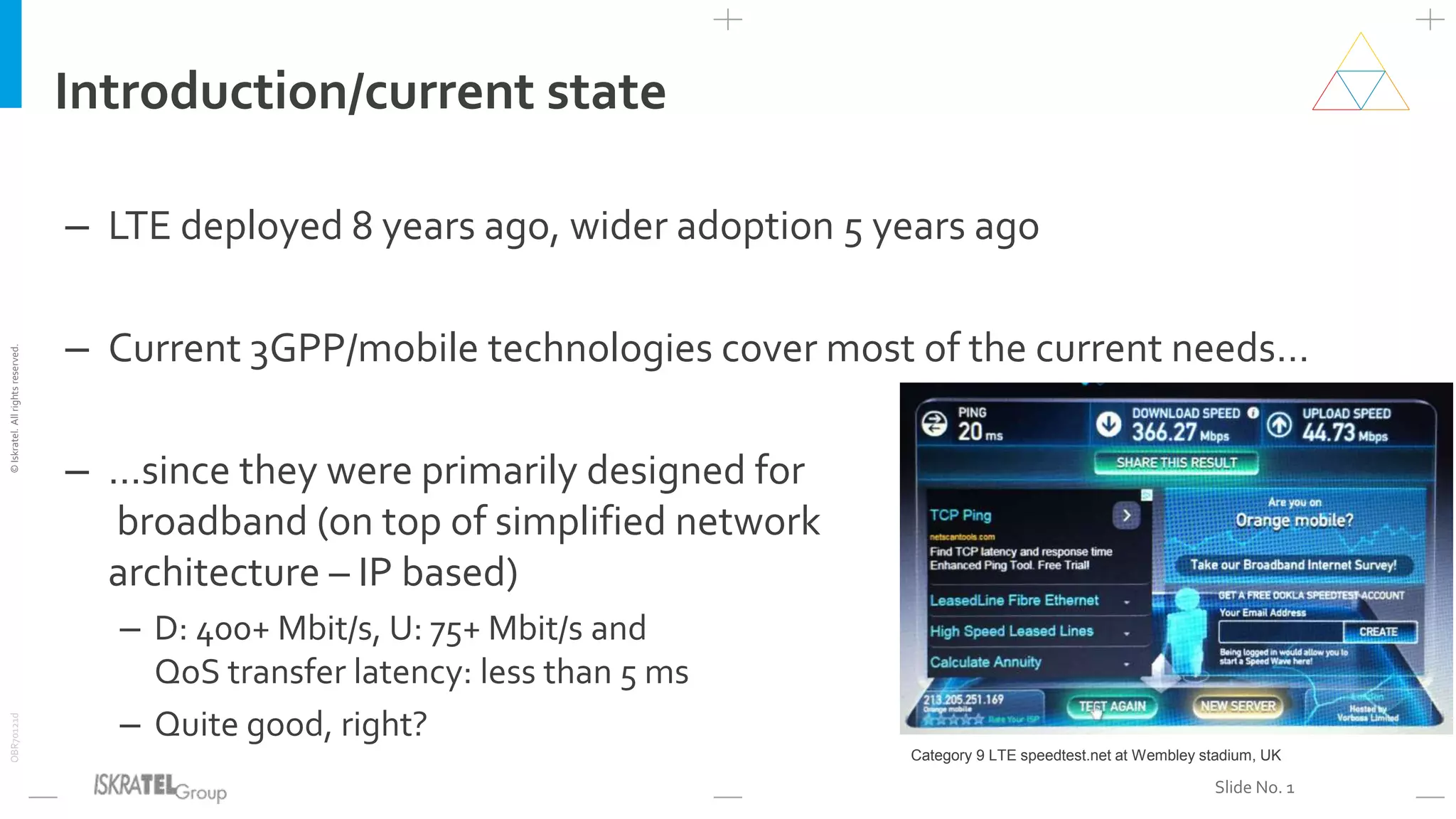
– D: 400+ Mbit/s, U: 75+ Mbit/s and
QoS transfer latency: less than 5 ms
– Quite good, right?
Category 9 LTE speedtest.net at Wembley stadium, UK
©Iskratel.Allrightsreserved.OBR70121d
Slide No. 2
Why 5G – economical/political needs
– European Commission (Digital Single Market) sets clear objectives for 5G:
• DigitalTransformation of Industry
• Maximizing economic growth
• Clearly defined broadband speed targets for the year 2020 of 100 % population coverage with at
least 30 Mb/s, and 50% with at least 100 Mb/s – this includes (especially) rural areas
– OECD (Committee on Digital Economic Policy) stated clear objectives for 5G:
• IncreasingGDP
• Creating employment
• Digitizing the economy
Goal is to have 5G covering/supporting the needs of all industry sectors
©Iskratel.Allrightsreserved.OBR70121d
Slide No. 3
Why 5G – technical needs
– Even more broadband needed
– Better quality (streaming) services like 3D video,Virtual andAugmented Reality… eg. More and more
broadband services consumed by (mobile) users
– New and unexpected services/technologies occur in various sectors, like automotive,
public safety, …
– Needs for critical and or/real-time, reliable and highly energy efficient solutions
– IoT will add billions of new devices in the next several years
– Currently 7 billion devices, 21 billion devices at the end of 2020 (by Gartner)
©Iskratel.Allrightsreserved.OBR70121d
Slide No. 4
5G – three main pillars
Enhanced Mobile Broadband
Massive Machine Type
Communications
Ultra-reliable and Low Latency
Communications
3D video, UHD screens
Smart City
Industry automation
Gigabytes in a second
Self Driving Car
Augmented reality
Smart Home/Building
Work and play in the cloud
Voice Mission critical application,
e.g. e-health
Future IMT
©Iskratel.Allrightsreserved.OBR70121d
Slide No. 5
5GVision – Connected world
– Well beyond just people (and broadband)
– Connecting devices instead of (just) people
– Various sectors covered:Transport, Healthcare, Utilities, Agriculture, Aviation,
Education, Entertainment, Factory automation, Automotive, …
©Iskratel.Allrightsreserved.OBR70121d
Slide No. 6
5G performance
– a new radio interface (NR) , an evolved LTE radio interface, a new core
network (NextGen), and evolved LTE core network (EPC)
– Polymorphic solution
– Enablers: virtualization of network functions, software defined networks, fog
computing, …
– Highest possible level of QoE
Source: ITU-R M.2083
©Iskratel.Allrightsreserved.OBR70121d
Slide No. 7
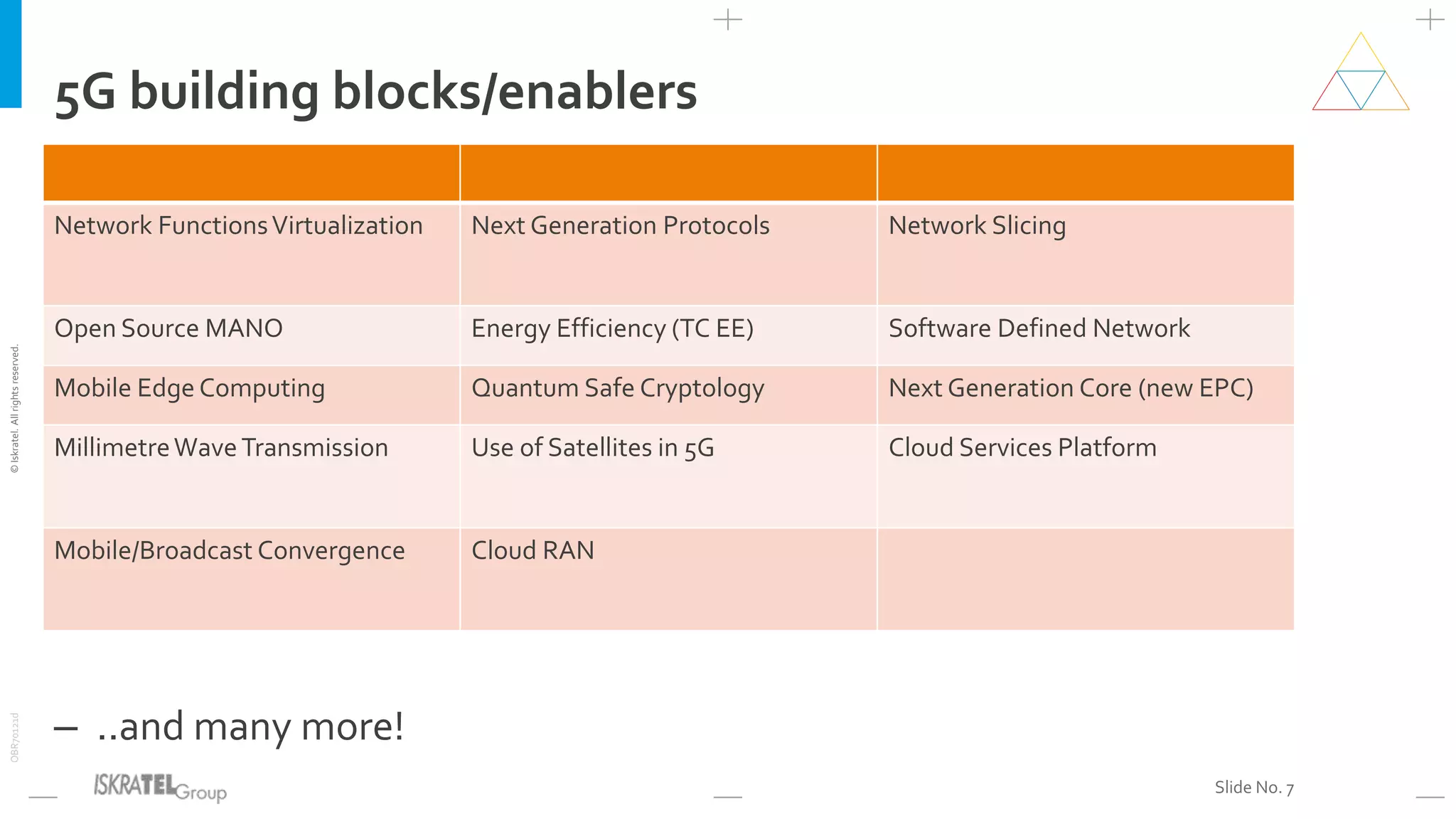
5G building blocks/enablers
– ..and many more!
Network FunctionsVirtualization Next Generation Protocols Network Slicing
Open Source MANO Energy Efficiency (TC EE) Software Defined Network
Mobile Edge Computing Quantum Safe Cryptology Next Generation Core (new EPC)
MillimetreWaveTransmission Use of Satellites in 5G Cloud Services Platform
Mobile/Broadcast Convergence Cloud RAN
©Iskratel.Allrightsreserved.OBR70121d
Slide No. 8
Roadmaps
2015 2016 2017 2018 2019 20202014
ITU-R
IMT-2020
3 GPP
ETSI
IEEE
ITU-T
Release 12
Release 13
Release 14 Release 15 (NR +
NG Network System) Release 16
NFV R1 NFV R2 NFV R3
Evaluation Criteria
Requirements
Evaluation
Initial Submission of Proposals IMT-2020 Spec
Tech.Trends
IMT above 6GHz
RAN: Scope & Requirements
Ongoing LTE-B & LTE-C/ NBIOT
RAN: Channel modelling, Evaluation of solutions, Specify Solutions
3GPP System work
NG-PON2
XGS-PON
Beyond NG-PON2
802.11ax - High Efficiency Wi-fi
802.3ca –PON beyond 10 Gbps
P1914.1 (Packet-based FrontHaulTN)
©Iskratel.Allrightsreserved.OBR70121d
Slide No. 9
5G network deployment
Source: http://www.gsa.com
©Iskratel.Allrightsreserved.OBR70121d
Slide No. 10
5G takeaway
– “Forget” broadband (it just evolves)!
– It is all about (currently unimaginable)
INDUSTRY USECASES
OWNERSHIP MODELS
BUSINESS MODELS
©Iskratel.Allrightsreserved.OBR70121d
Slide No. 11
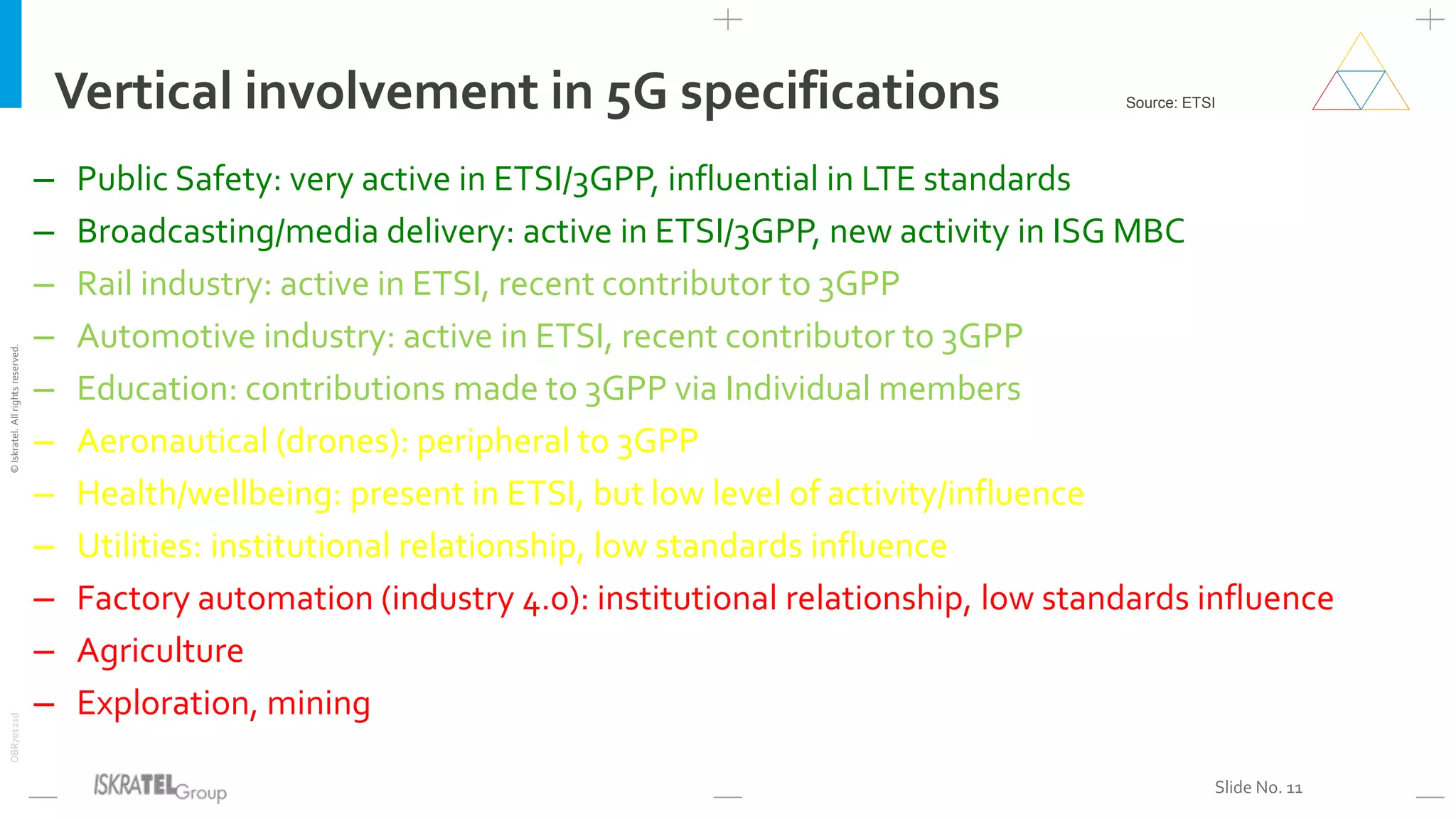
Vertical involvement in 5G specifications
– Public Safety: very active in ETSI/3GPP, influential in LTE standards
– Broadcasting/media delivery: active in ETSI/3GPP, new activity in ISG MBC
– Rail industry: active in ETSI, recent contributor to 3GPP
– Automotive industry: active in ETSI, recent contributor to 3GPP
– Education: contributions made to 3GPP via Individual members
– Aeronautical (drones): peripheral to 3GPP
– Health/wellbeing: present in ETSI, but low level of activity/influence
– Utilities: institutional relationship, low standards influence
– Factory automation (industry 4.0): institutional relationship, low standards influence
– Agriculture
– Exploration, mining
Source: ETSI
©Iskratel.Allrightsreserved.OBR70121d
Slide No. 12
5G – new use-cases
– Traffic & Logistics
– Self driving cars, boats, trains
– Bumper-to-bumper lorry driving on highways
– Energy
– Data from sensors in solar panels and windmills, controlled by 5G, combine up-to-date weather forecasts to
compile control information for the energy grid manager and ensure optimum energy flows within the networ
– Health care
– Smart wearables, supported by 5G, enabling older people being independent longer
– Agriculture
– Smart potato: Sensors placed between the potatoes provide information about factors such as humidity,
temperature and nutrients.This enables farmers to intervene where necessary (precision farming).
©Iskratel.Allrightsreserved.OBR70121d
Slide No. 13
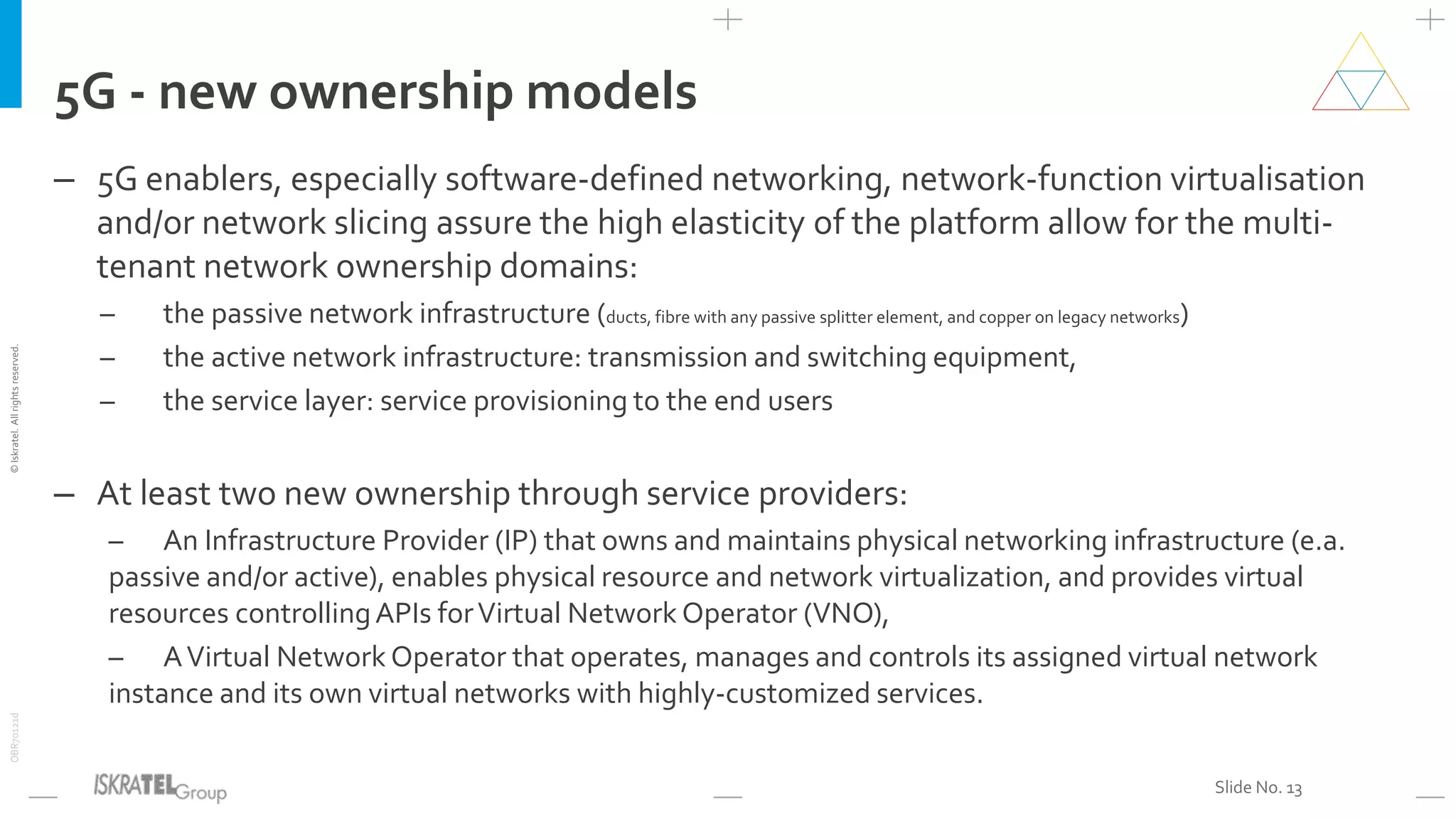
5G - new ownership models
– 5G enablers, especially software-defined networking, network-function virtualisation
and/or network slicing assure the high elasticity of the platform allow for the multi-
tenant network ownership domains:
– the passive network infrastructure (ducts, fibre with any passive splitter element, and copper on legacy networks)
– the active network infrastructure: transmission and switching equipment,
– the service layer: service provisioning to the end users
– At least two new ownership through service providers:
– An Infrastructure Provider (IP) that owns and maintains physical networking infrastructure (e.a.
passive and/or active), enables physical resource and network virtualization, and provides virtual
resources controllingAPIs forVirtual Network Operator (VNO),
– AVirtual Network Operator that operates, manages and controls its assigned virtual network
instance and its own virtual networks with highly-customized services.
©Iskratel.Allrightsreserved.OBR70121d
Slide No. 14
5G – new business models
– Monetizing from time and volume-based resources, technologies and
services to knowledge based services
– One-time Charges
– Pay-for-Results
– Freemium
– Subscription (over the top services)
– Pay-as-You-Go
– …
– 5G business models are much broader than just a solution for the
traditional consumer
©Iskratel.Allrightsreserved.OBR70121d
Slide No. 15
5G barriers
– Again, it is all about use-cases!
– For 5G to be successful, the telco industry must engage with other industry sectors
such as transport, healthcare, mining and exploration, utilities, agriculture, aviation
(drones), entertainment, factory automation, etc
– Also vendors, solution providers and integrators!!
– It is us who need to provide valuable use-cases to industries! (just throwing 5G at them
will not be successful)
– Governments: 5G must be coordinated across all ministries (e.g., transport, health,
industry etc) and not just within a communications or ICT ministry
©Iskratel.Allrightsreserved.OBR70121d
Slide No. 16
5G barriers (cont)
Source: http://www.gsa.com
©Iskratel.Allrightsreserved.OBR70121d
Slide No. 17
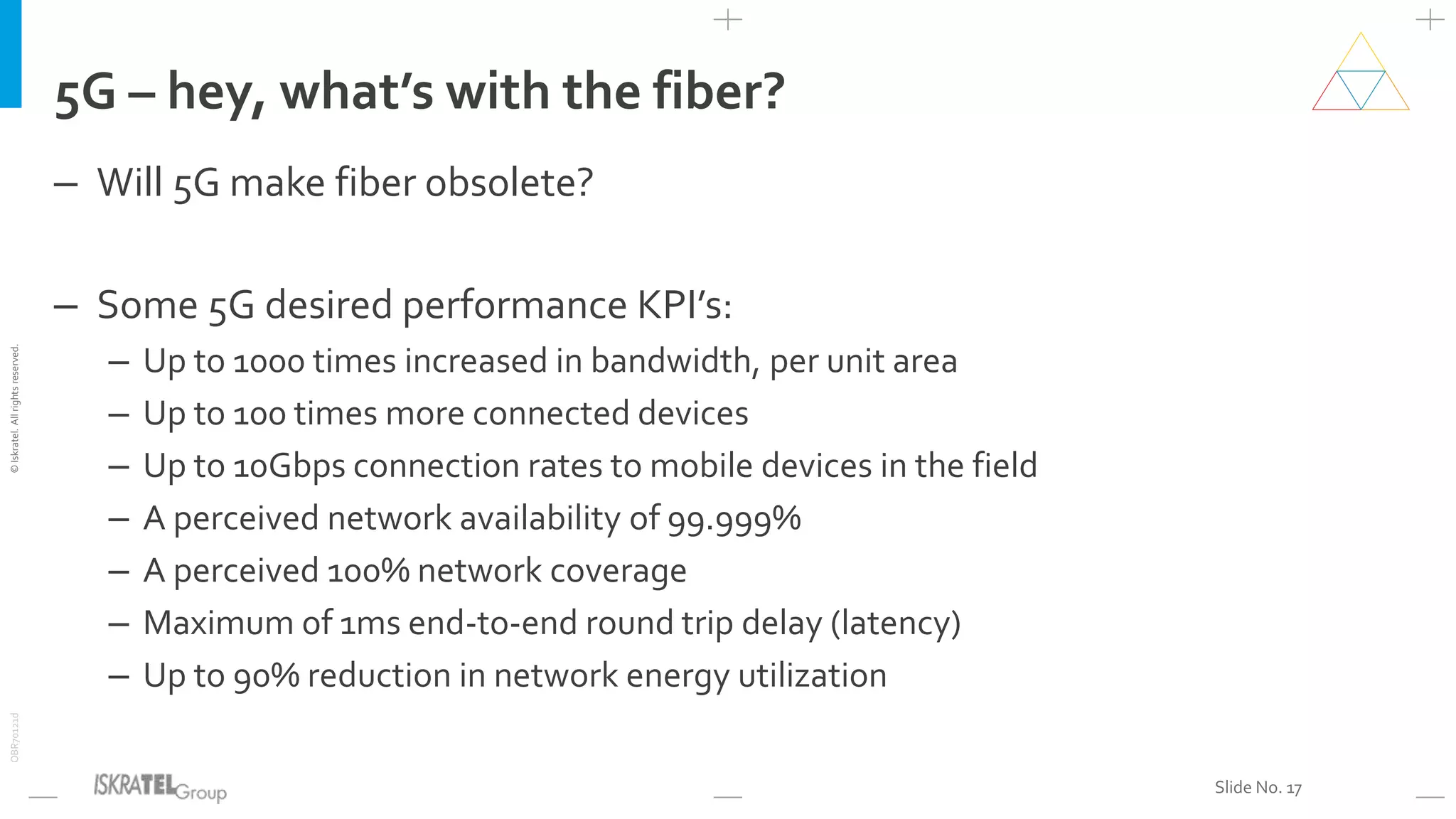
5G – hey, what’s with the fiber?
– Will 5G make fiber obsolete?
– Some 5G desired performance KPI’s:
– Up to 1000 times increased in bandwidth, per unit area
– Up to 100 times more connected devices
– Up to 10Gbps connection rates to mobile devices in the field
– A perceived network availability of 99.999%
– A perceived 100% network coverage
– Maximum of 1ms end-to-end round trip delay (latency)
– Up to 90% reduction in network energy utilization
©Iskratel.Allrightsreserved.OBR70121d
Slide No. 18
5G – hey, what’s with the fiber? (cont)
– Possibly less FTTH
– Absolutely huge need for fiber for Radio Access Network sites
– Theoretical speed of 5G is 10Gbs
– Even if the maximum theoretical download speed of 10Gbps were scaled down by 90% to 1Gbps, the
entire 1GbE MBH connection to a typical macrocell today, intended to serve all concurrent 4G users,
would be consumed by one bandwidth-hungry 5G user. Like me.
– Ironically, the projected performance goals of 5G wireless will depend on the
availability of wireline fiber
– The fact is: the only reason we don’t have fiber connected right to our smartphones is
because we’d be less mobile.
©Iskratel.Allrightsreserved.OBR70121d
Slide No. 19
5G conclusion
– 5G presents a huge opportunity for the digitization of the economy and
modernization of all industry sectors
– To achieve the full potential, all actors need to work together towards
common objectives
– The 5G timeline is very demanding
– Technology has always overcome challenges – no difference with 5G.
So, let’s talk use-cases, business and ownership models!
©Iskratel.Allrightsreserved.OBR70121d
Slide No. 20
Last, but not least
– Further reading on this topic inVitel 2017 magazine
– From Broadband to 5G (Damjan Slapar, Ana Robnik, Gašper Jezeršek)
– Koraki do uresničitve vizije 5G (Janez Öri, Ana Robnik, Simon Čimžar)
– http://www.iskratel.si
– Follow/contact me on
– Linkedin: https://www.linkedin.com/in/damjan-slapar-238a3744/
– slapar@iskratel.si

From broadband to 5G

  • 1.
  • 2.
    ©Iskratel.Allrightsreserved.OBR70121d Slide No. 1 Introduction/currentstate – LTE deployed 8 years ago, wider adoption 5 years ago – Current 3GPP/mobile technologies cover most of the current needs… – …since they were primarily designed for broadband (on top of simplified network architecture – IP based) – D: 400+ Mbit/s, U: 75+ Mbit/s and QoS transfer latency: less than 5 ms – Quite good, right? Category 9 LTE speedtest.net at Wembley stadium, UK
  • 3.
    ©Iskratel.Allrightsreserved.OBR70121d Slide No. 2 Why5G – economical/political needs – European Commission (Digital Single Market) sets clear objectives for 5G: • DigitalTransformation of Industry • Maximizing economic growth • Clearly defined broadband speed targets for the year 2020 of 100 % population coverage with at least 30 Mb/s, and 50% with at least 100 Mb/s – this includes (especially) rural areas – OECD (Committee on Digital Economic Policy) stated clear objectives for 5G: • IncreasingGDP • Creating employment • Digitizing the economy Goal is to have 5G covering/supporting the needs of all industry sectors
  • 4.
    ©Iskratel.Allrightsreserved.OBR70121d Slide No. 3 Why5G – technical needs – Even more broadband needed – Better quality (streaming) services like 3D video,Virtual andAugmented Reality… eg. More and more broadband services consumed by (mobile) users – New and unexpected services/technologies occur in various sectors, like automotive, public safety, … – Needs for critical and or/real-time, reliable and highly energy efficient solutions – IoT will add billions of new devices in the next several years – Currently 7 billion devices, 21 billion devices at the end of 2020 (by Gartner)
  • 5.
    ©Iskratel.Allrightsreserved.OBR70121d Slide No. 4 5G– three main pillars Enhanced Mobile Broadband Massive Machine Type Communications Ultra-reliable and Low Latency Communications 3D video, UHD screens Smart City Industry automation Gigabytes in a second Self Driving Car Augmented reality Smart Home/Building Work and play in the cloud Voice Mission critical application, e.g. e-health Future IMT
  • 6.
    ©Iskratel.Allrightsreserved.OBR70121d Slide No. 5 5GVision– Connected world – Well beyond just people (and broadband) – Connecting devices instead of (just) people – Various sectors covered:Transport, Healthcare, Utilities, Agriculture, Aviation, Education, Entertainment, Factory automation, Automotive, …
  • 7.
    ©Iskratel.Allrightsreserved.OBR70121d Slide No. 6 5Gperformance – a new radio interface (NR) , an evolved LTE radio interface, a new core network (NextGen), and evolved LTE core network (EPC) – Polymorphic solution – Enablers: virtualization of network functions, software defined networks, fog computing, … – Highest possible level of QoE Source: ITU-R M.2083
  • 8.
    ©Iskratel.Allrightsreserved.OBR70121d Slide No. 7 5Gbuilding blocks/enablers – ..and many more! Network FunctionsVirtualization Next Generation Protocols Network Slicing Open Source MANO Energy Efficiency (TC EE) Software Defined Network Mobile Edge Computing Quantum Safe Cryptology Next Generation Core (new EPC) MillimetreWaveTransmission Use of Satellites in 5G Cloud Services Platform Mobile/Broadcast Convergence Cloud RAN
  • 9.
    ©Iskratel.Allrightsreserved.OBR70121d Slide No. 8 Roadmaps 20152016 2017 2018 2019 20202014 ITU-R IMT-2020 3 GPP ETSI IEEE ITU-T Release 12 Release 13 Release 14 Release 15 (NR + NG Network System) Release 16 NFV R1 NFV R2 NFV R3 Evaluation Criteria Requirements Evaluation Initial Submission of Proposals IMT-2020 Spec Tech.Trends IMT above 6GHz RAN: Scope & Requirements Ongoing LTE-B & LTE-C/ NBIOT RAN: Channel modelling, Evaluation of solutions, Specify Solutions 3GPP System work NG-PON2 XGS-PON Beyond NG-PON2 802.11ax - High Efficiency Wi-fi 802.3ca –PON beyond 10 Gbps P1914.1 (Packet-based FrontHaulTN)
  • 10.
    ©Iskratel.Allrightsreserved.OBR70121d Slide No. 9 5Gnetwork deployment Source: http://www.gsa.com
  • 11.
    ©Iskratel.Allrightsreserved.OBR70121d Slide No. 10 5Gtakeaway – “Forget” broadband (it just evolves)! – It is all about (currently unimaginable) INDUSTRY USECASES OWNERSHIP MODELS BUSINESS MODELS
  • 12.
    ©Iskratel.Allrightsreserved.OBR70121d Slide No. 11 Verticalinvolvement in 5G specifications – Public Safety: very active in ETSI/3GPP, influential in LTE standards – Broadcasting/media delivery: active in ETSI/3GPP, new activity in ISG MBC – Rail industry: active in ETSI, recent contributor to 3GPP – Automotive industry: active in ETSI, recent contributor to 3GPP – Education: contributions made to 3GPP via Individual members – Aeronautical (drones): peripheral to 3GPP – Health/wellbeing: present in ETSI, but low level of activity/influence – Utilities: institutional relationship, low standards influence – Factory automation (industry 4.0): institutional relationship, low standards influence – Agriculture – Exploration, mining Source: ETSI
  • 13.
    ©Iskratel.Allrightsreserved.OBR70121d Slide No. 12 5G– new use-cases – Traffic & Logistics – Self driving cars, boats, trains – Bumper-to-bumper lorry driving on highways – Energy – Data from sensors in solar panels and windmills, controlled by 5G, combine up-to-date weather forecasts to compile control information for the energy grid manager and ensure optimum energy flows within the networ – Health care – Smart wearables, supported by 5G, enabling older people being independent longer – Agriculture – Smart potato: Sensors placed between the potatoes provide information about factors such as humidity, temperature and nutrients.This enables farmers to intervene where necessary (precision farming).
  • 14.
    ©Iskratel.Allrightsreserved.OBR70121d Slide No. 13 5G- new ownership models – 5G enablers, especially software-defined networking, network-function virtualisation and/or network slicing assure the high elasticity of the platform allow for the multi- tenant network ownership domains: – the passive network infrastructure (ducts, fibre with any passive splitter element, and copper on legacy networks) – the active network infrastructure: transmission and switching equipment, – the service layer: service provisioning to the end users – At least two new ownership through service providers: – An Infrastructure Provider (IP) that owns and maintains physical networking infrastructure (e.a. passive and/or active), enables physical resource and network virtualization, and provides virtual resources controllingAPIs forVirtual Network Operator (VNO), – AVirtual Network Operator that operates, manages and controls its assigned virtual network instance and its own virtual networks with highly-customized services.
  • 15.
    ©Iskratel.Allrightsreserved.OBR70121d Slide No. 14 5G– new business models – Monetizing from time and volume-based resources, technologies and services to knowledge based services – One-time Charges – Pay-for-Results – Freemium – Subscription (over the top services) – Pay-as-You-Go – … – 5G business models are much broader than just a solution for the traditional consumer
  • 16.
    ©Iskratel.Allrightsreserved.OBR70121d Slide No. 15 5Gbarriers – Again, it is all about use-cases! – For 5G to be successful, the telco industry must engage with other industry sectors such as transport, healthcare, mining and exploration, utilities, agriculture, aviation (drones), entertainment, factory automation, etc – Also vendors, solution providers and integrators!! – It is us who need to provide valuable use-cases to industries! (just throwing 5G at them will not be successful) – Governments: 5G must be coordinated across all ministries (e.g., transport, health, industry etc) and not just within a communications or ICT ministry
  • 17.
    ©Iskratel.Allrightsreserved.OBR70121d Slide No. 16 5Gbarriers (cont) Source: http://www.gsa.com
  • 18.
    ©Iskratel.Allrightsreserved.OBR70121d Slide No. 17 5G– hey, what’s with the fiber? – Will 5G make fiber obsolete? – Some 5G desired performance KPI’s: – Up to 1000 times increased in bandwidth, per unit area – Up to 100 times more connected devices – Up to 10Gbps connection rates to mobile devices in the field – A perceived network availability of 99.999% – A perceived 100% network coverage – Maximum of 1ms end-to-end round trip delay (latency) – Up to 90% reduction in network energy utilization
  • 19.
    ©Iskratel.Allrightsreserved.OBR70121d Slide No. 18 5G– hey, what’s with the fiber? (cont) – Possibly less FTTH – Absolutely huge need for fiber for Radio Access Network sites – Theoretical speed of 5G is 10Gbs – Even if the maximum theoretical download speed of 10Gbps were scaled down by 90% to 1Gbps, the entire 1GbE MBH connection to a typical macrocell today, intended to serve all concurrent 4G users, would be consumed by one bandwidth-hungry 5G user. Like me. – Ironically, the projected performance goals of 5G wireless will depend on the availability of wireline fiber – The fact is: the only reason we don’t have fiber connected right to our smartphones is because we’d be less mobile.
  • 20.
    ©Iskratel.Allrightsreserved.OBR70121d Slide No. 19 5Gconclusion – 5G presents a huge opportunity for the digitization of the economy and modernization of all industry sectors – To achieve the full potential, all actors need to work together towards common objectives – The 5G timeline is very demanding – Technology has always overcome challenges – no difference with 5G. So, let’s talk use-cases, business and ownership models!
  • 21.
    ©Iskratel.Allrightsreserved.OBR70121d Slide No. 20 Last,but not least – Further reading on this topic inVitel 2017 magazine – From Broadband to 5G (Damjan Slapar, Ana Robnik, Gašper Jezeršek) – Koraki do uresničitve vizije 5G (Janez Öri, Ana Robnik, Simon Čimžar) – http://www.iskratel.si – Follow/contact me on – Linkedin: https://www.linkedin.com/in/damjan-slapar-238a3744/ – slapar@iskratel.si