The 45 and Up Study
Update
Emily Banks
Scientific Director, 45 and Up Study
45 and Up Study Collaborators’ Meeting
September 2016
Today
• Brief background
• Study progress
• Highlights
• Priorities
#45andUp16
The 45 and Up Study
• The largest long term study of ageing in Australia
• A collaborative resource available for use by researchers and
policy makers
• Core funding from major partner Cancer Council NSW and
partners the National Heart Foundation of Australia (NSW
Division); NSW Ministry of Health; NSW Government Family
& Community Services – Carers, Ageing and Disability
Inclusion; Australian Red Cross Blood Service
#45andUp16
Study Recruitment
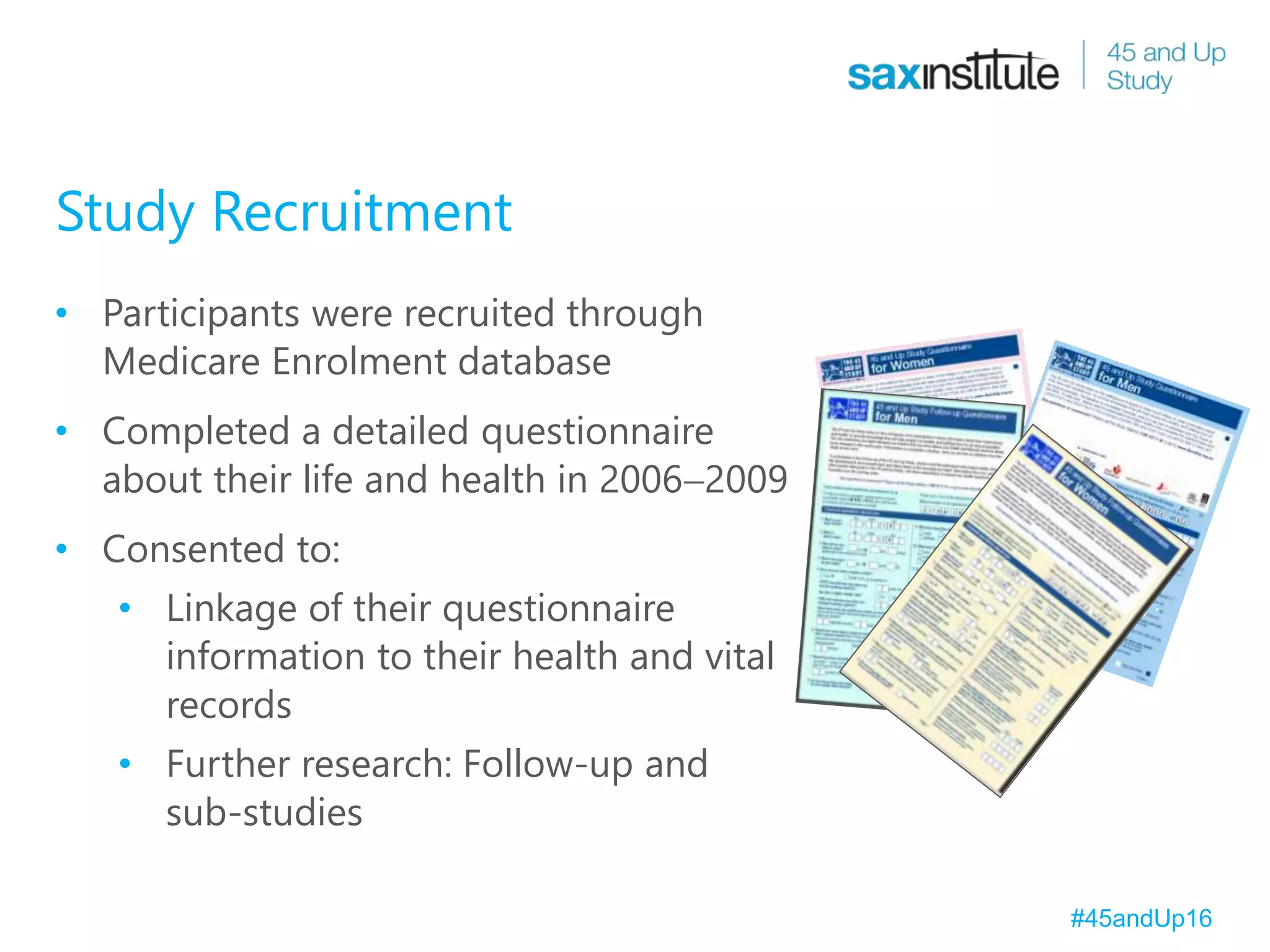
• Participants were recruited through
Medicare Enrolment database
• Completed a detailed questionnaire
about their life and health in 20062009
• Consented to:
• Linkage of their questionnaire
information to their health and vital
records
• Further research: Follow-up and
sub-studies
#45andUp16
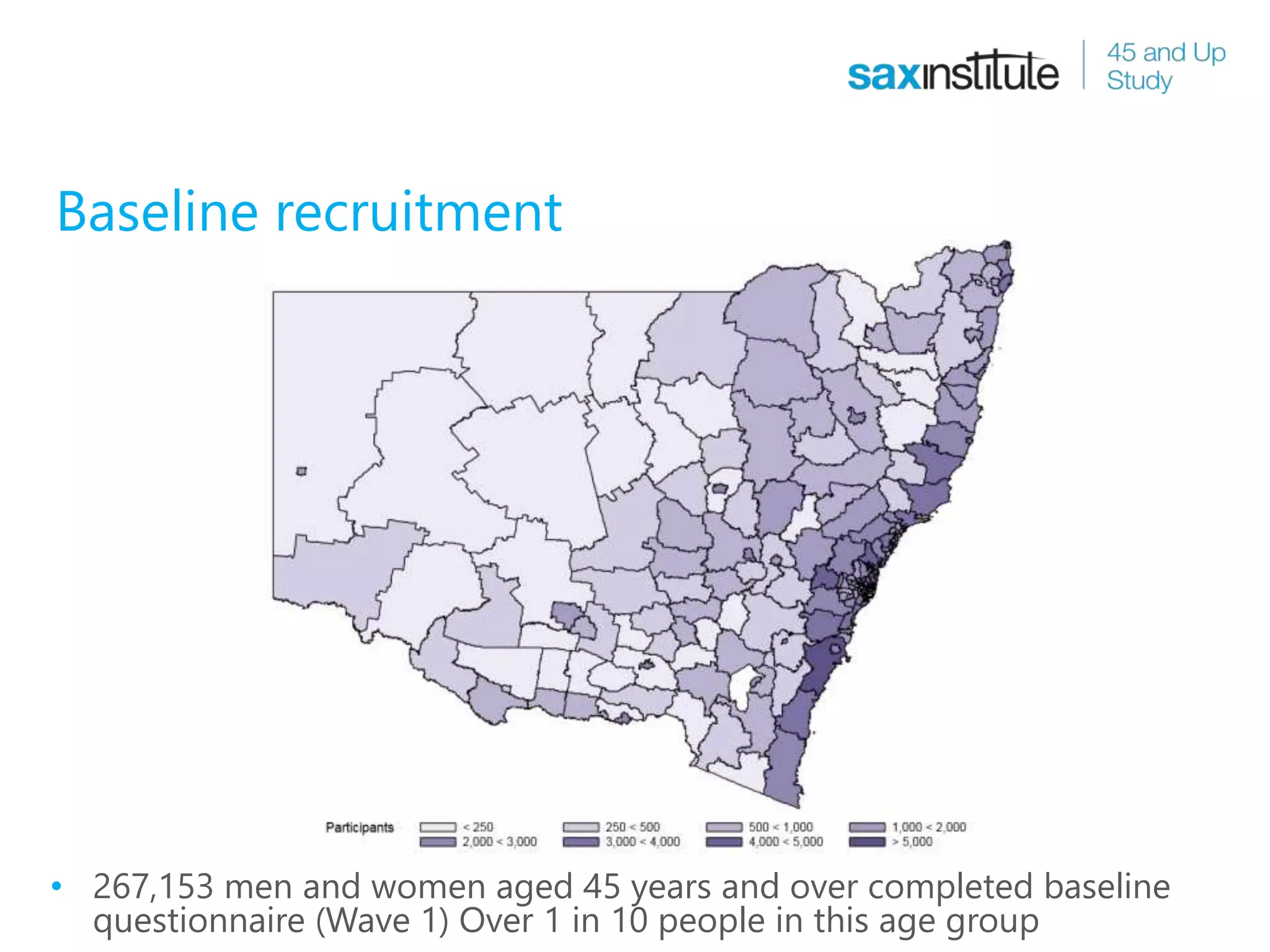
Baseline recruitment
• 267,153 men and women aged 45 years and over completed baseline
questionnaire (Wave 1) Over 1 in 10 people in this age group
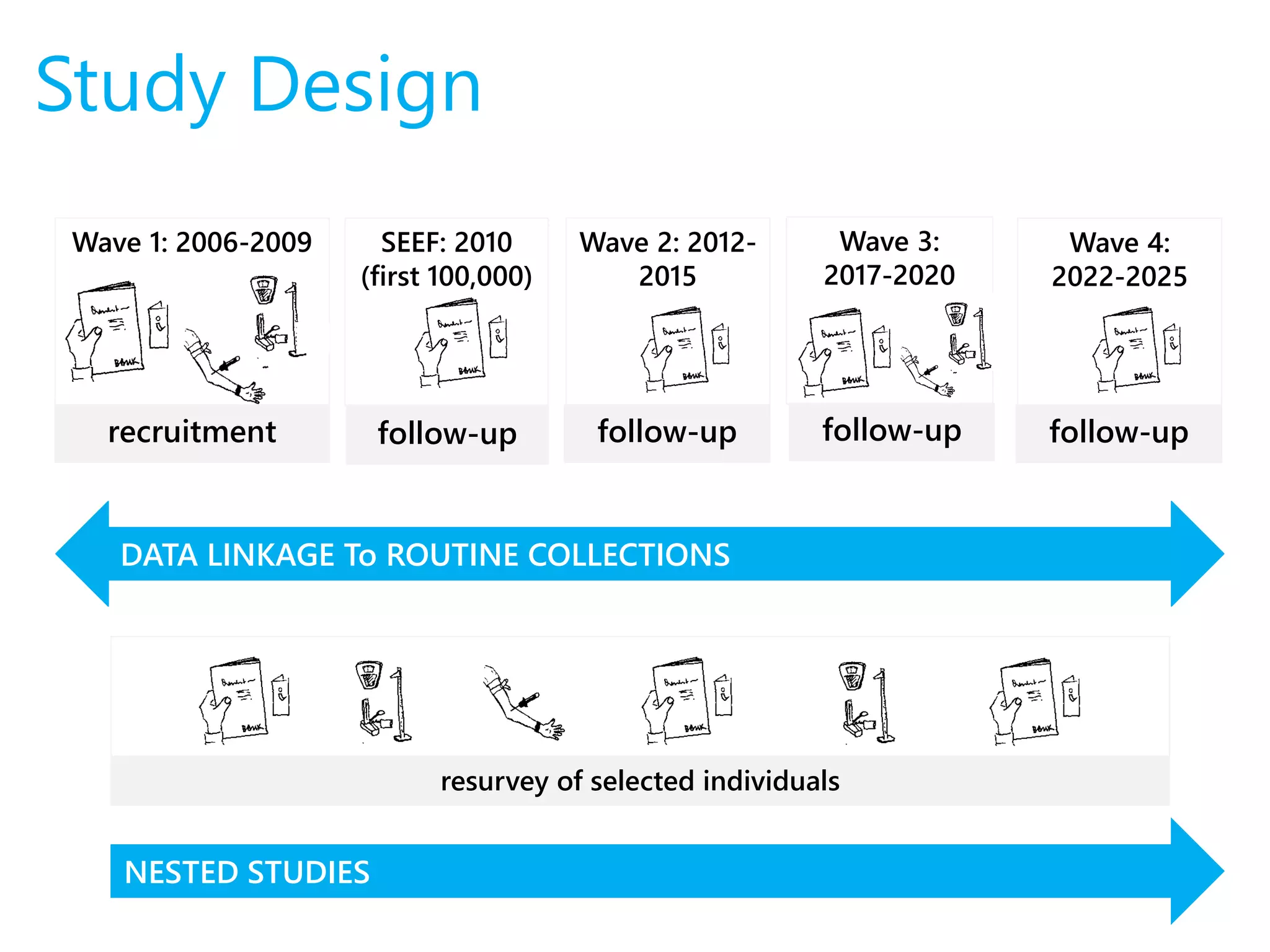
Wave 2: 2012-
2015
Wave 1: 2006-2009 Wave 3:
2017-2020
recruitment follow-up follow-up
DATA LINKAGE To ROUTINE COLLECTIONS
NESTED STUDIES
resurvey of selected individuals
SEEF: 2010
(first 100,000)
follow-up
Wave 4:
2022-2025
follow-up
Study Design
0
50000
100000
150000
200000
250000
300000
2006 2007 2008 2009 2010 2011 2012 2013 2014 2015
Initial cohort Current cohort Eligible for follow-up 7
Minus withdrawals
Minus withdrawals, no
follow-up and deaths
65,233 invited
(still in field, 33,708
responded to date)
52,664 invited (28,827
responded)
86,250 invited (50,023 responded)
41,440 invited (27,036 responded)
Study Cohort
S
E
E
F
Cohortnumber
#45andUp16
Mixed mode data
collection 2015 onwards
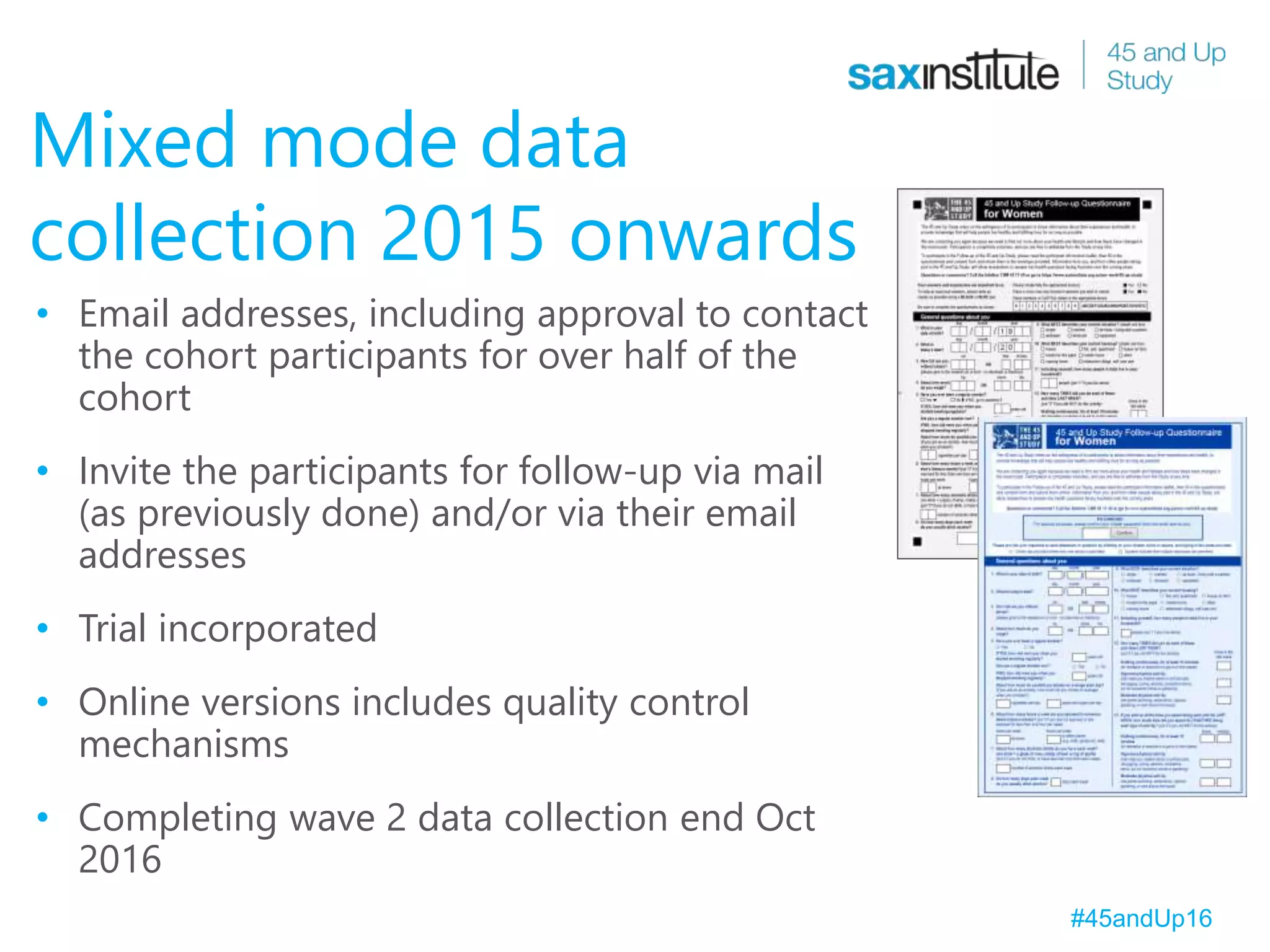
• Email addresses, including approval to contact
the cohort participants for over half of the
cohort
• Invite the participants for follow-up via mail
(as previously done) and/or via their email
addresses
• Trial incorporated
• Online versions includes quality control
mechanisms
• Completing wave 2 data collection end Oct
2016
#45andUp16
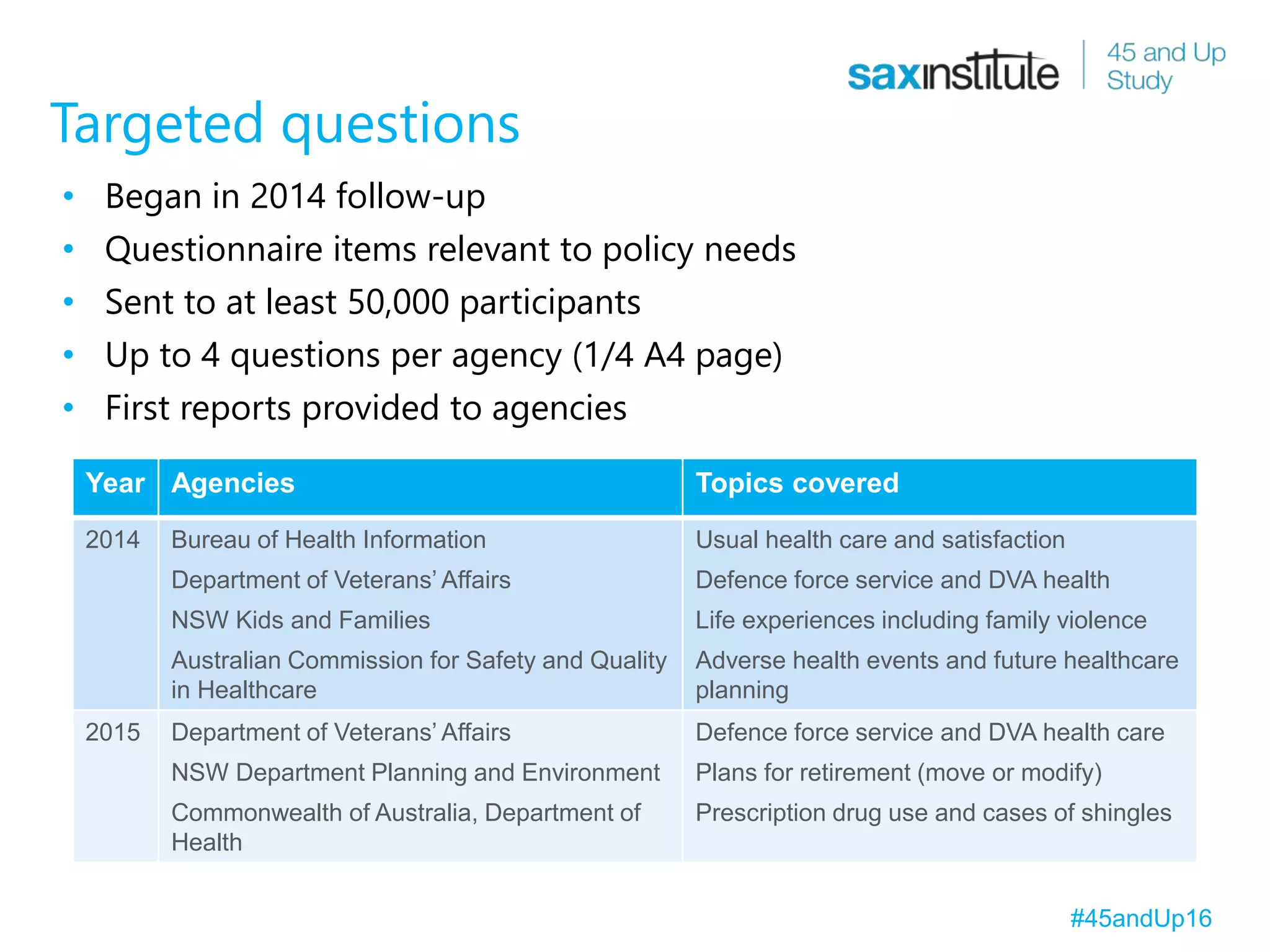
Targeted questions
Year Agencies Topics covered
2014 Bureau of Health Information
Department of Veterans’ Affairs
NSW Kids and Families
Australian Commission for Safety and Quality
in Healthcare
Usual health care and satisfaction
Defence force service and DVA health
Life experiences including family violence
Adverse health events and future healthcare
planning
2015 Department of Veterans’ Affairs
NSW Department Planning and Environment
Commonwealth of Australia, Department of
Health
Defence force service and DVA health care
Plans for retirement (move or modify)
Prescription drug use and cases of shingles
• Began in 2014 follow-up
• Questionnaire items relevant to policy needs
• Sent to at least 50,000 participants
• Up to 4 questions per agency (1/4 A4 page)
• First reports provided to agencies
#45andUp16
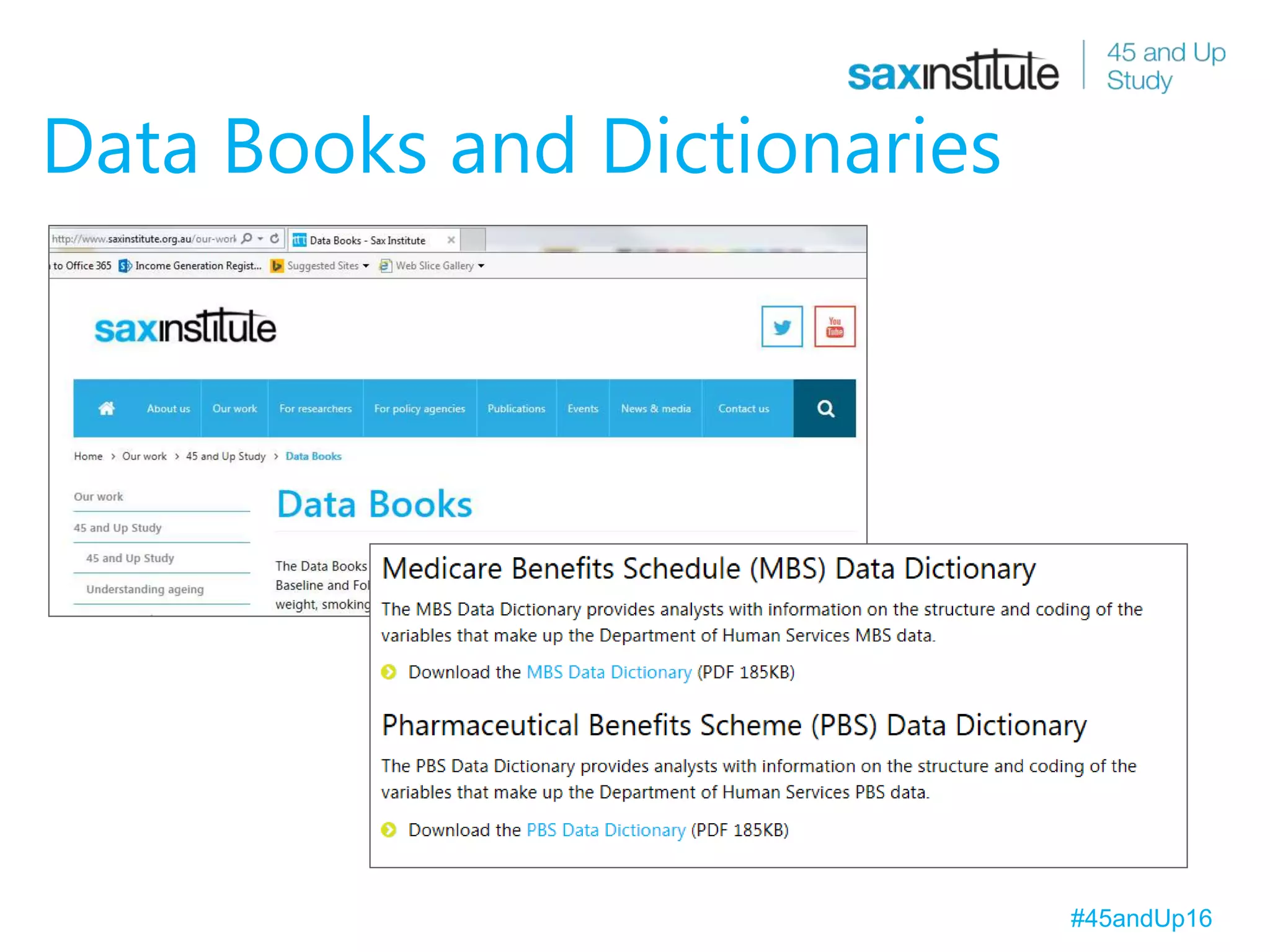
Data Books and Dictionaries
#45andUp16
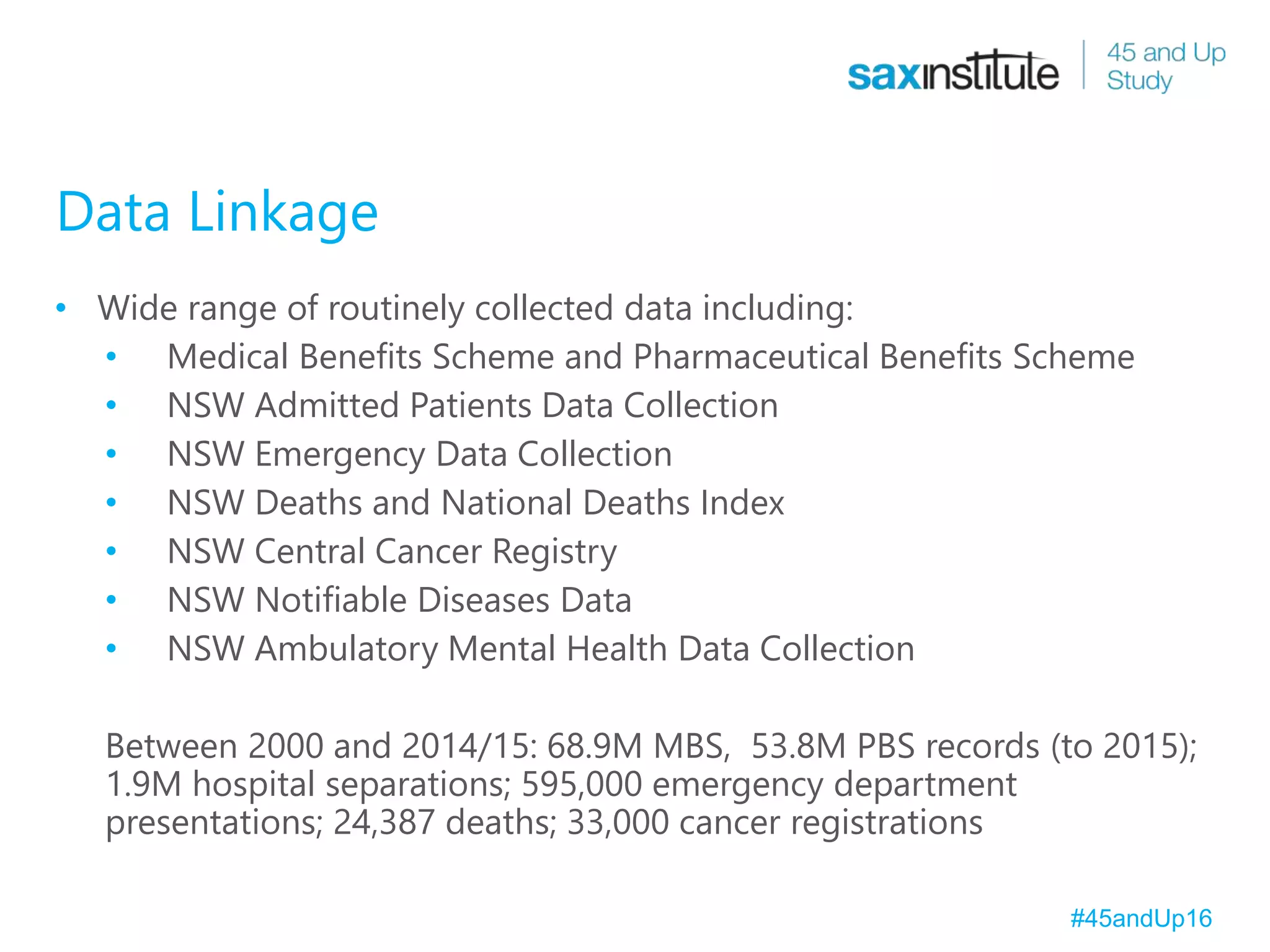
Data Linkage
• Wide range of routinely collected data including:
• Medical Benefits Scheme and Pharmaceutical Benefits Scheme
• NSW Admitted Patients Data Collection
• NSW Emergency Data Collection
• NSW Deaths and National Deaths Index
• NSW Central Cancer Registry
• NSW Notifiable Diseases Data
• NSW Ambulatory Mental Health Data Collection
Between 2000 and 2014/15: 68.9M MBS, 53.8M PBS records (to 2015);
1.9M hospital separations; 595,000 emergency department
presentations; 24,387 deaths; 33,000 cancer registrations
#45andUp16
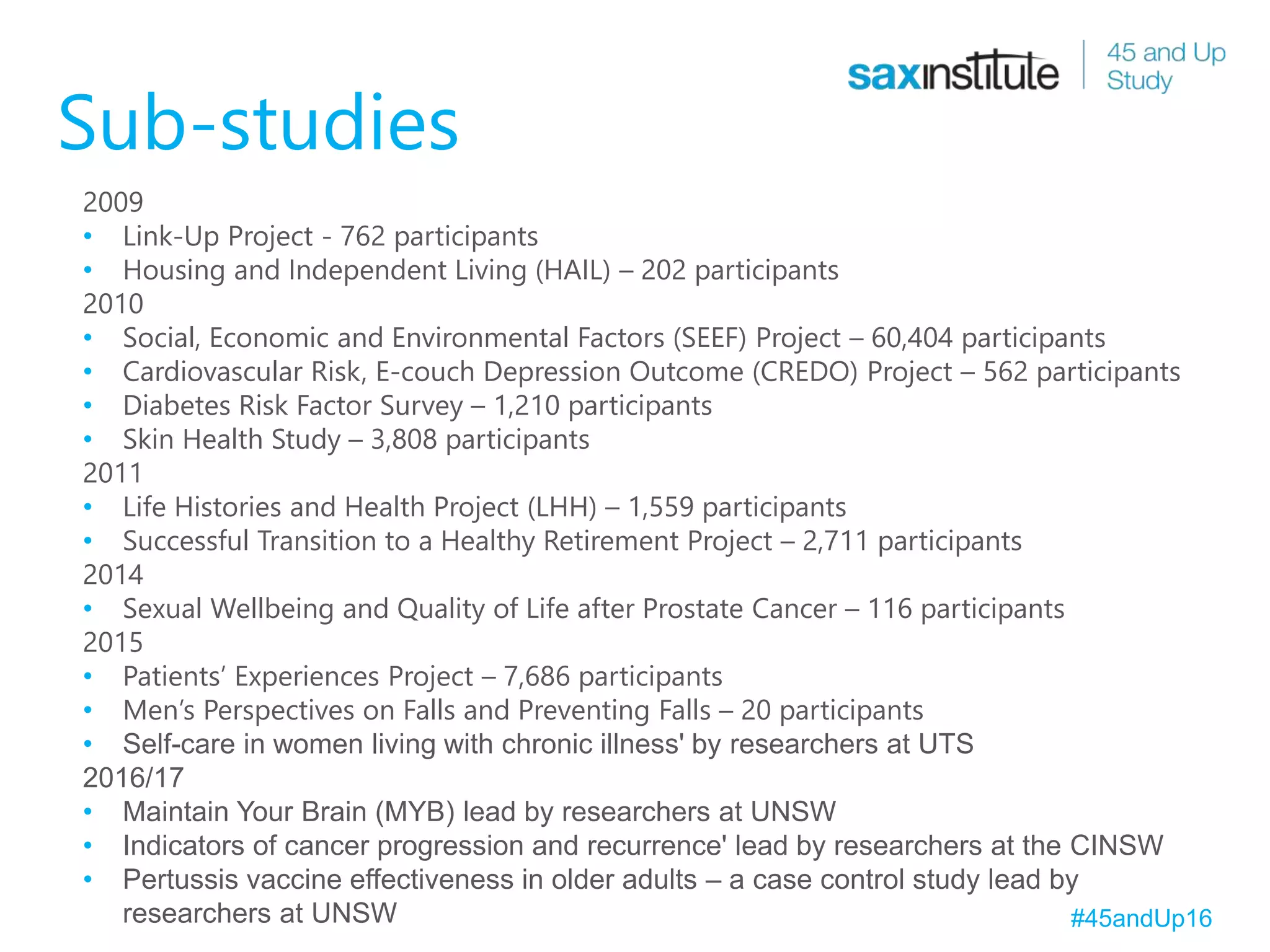
Sub-studies
2009
• Link-Up Project - 762 participants
• Housing and Independent Living (HAIL) – 202 participants
2010
• Social, Economic and Environmental Factors (SEEF) Project – 60,404 participants
• Cardiovascular Risk, E-couch Depression Outcome (CREDO) Project – 562 participants
• Diabetes Risk Factor Survey – 1,210 participants
• Skin Health Study – 3,808 participants
2011
• Life Histories and Health Project (LHH) – 1,559 participants
• Successful Transition to a Healthy Retirement Project – 2,711 participants
2014
• Sexual Wellbeing and Quality of Life after Prostate Cancer – 116 participants
2015
• Patients’ Experiences Project – 7,686 participants
• Men’s Perspectives on Falls and Preventing Falls – 20 participants
• Self-care in women living with chronic illness' by researchers at UTS
2016/17
• Maintain Your Brain (MYB) lead by researchers at UNSW
• Indicators of cancer progression and recurrence' lead by researchers at the CINSW
• Pertussis vaccine effectiveness in older adults – a case control study lead by
researchers at UNSW #45andUp16
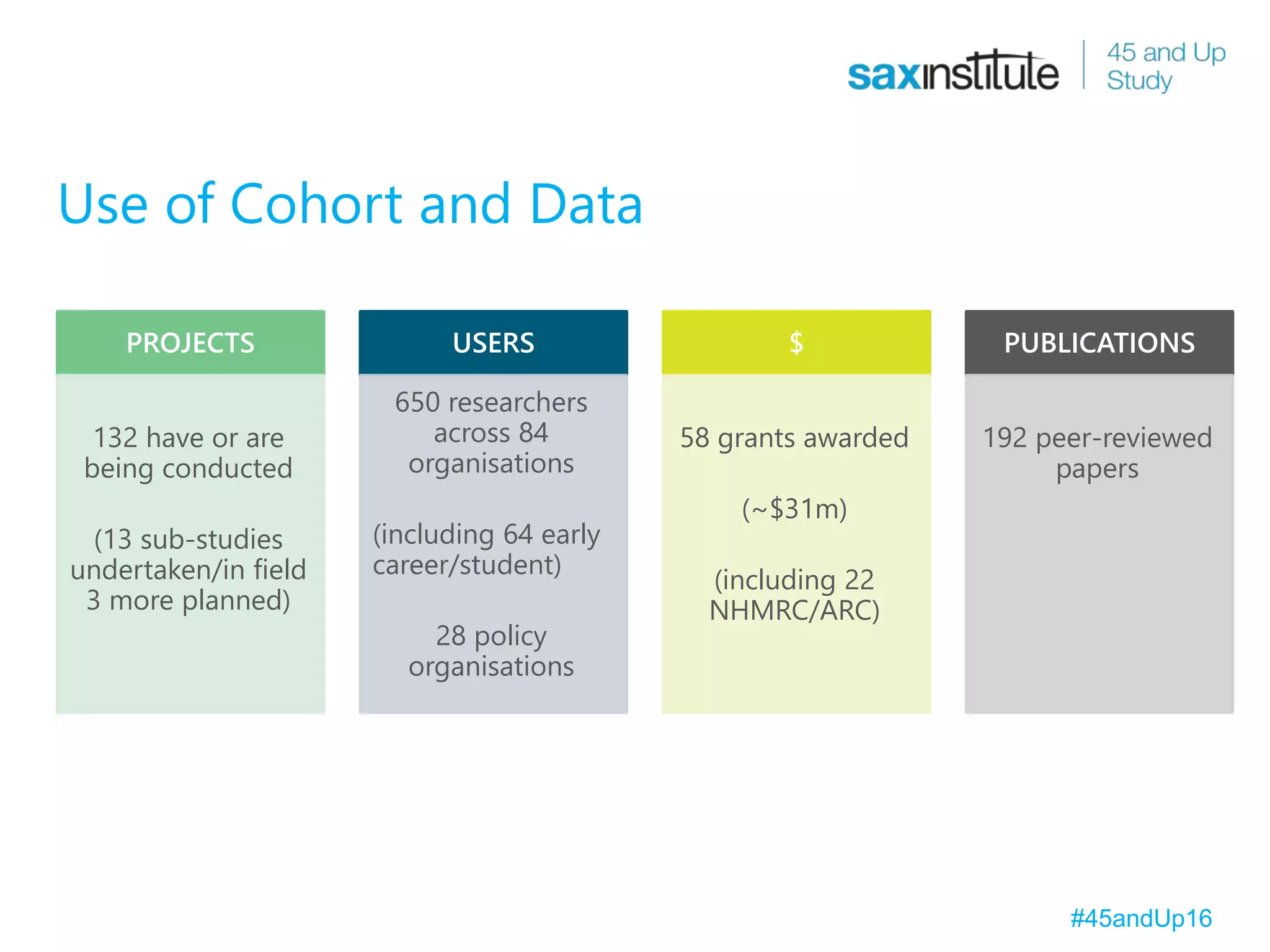
Use of Cohort and Data
PROJECTS
132 have or are
being conducted
(13 sub-studies
undertaken/in field
3 more planned)
USERS
650 researchers
across 84
organisations
(including 64 early
career/student)
28 policy
organisations
$
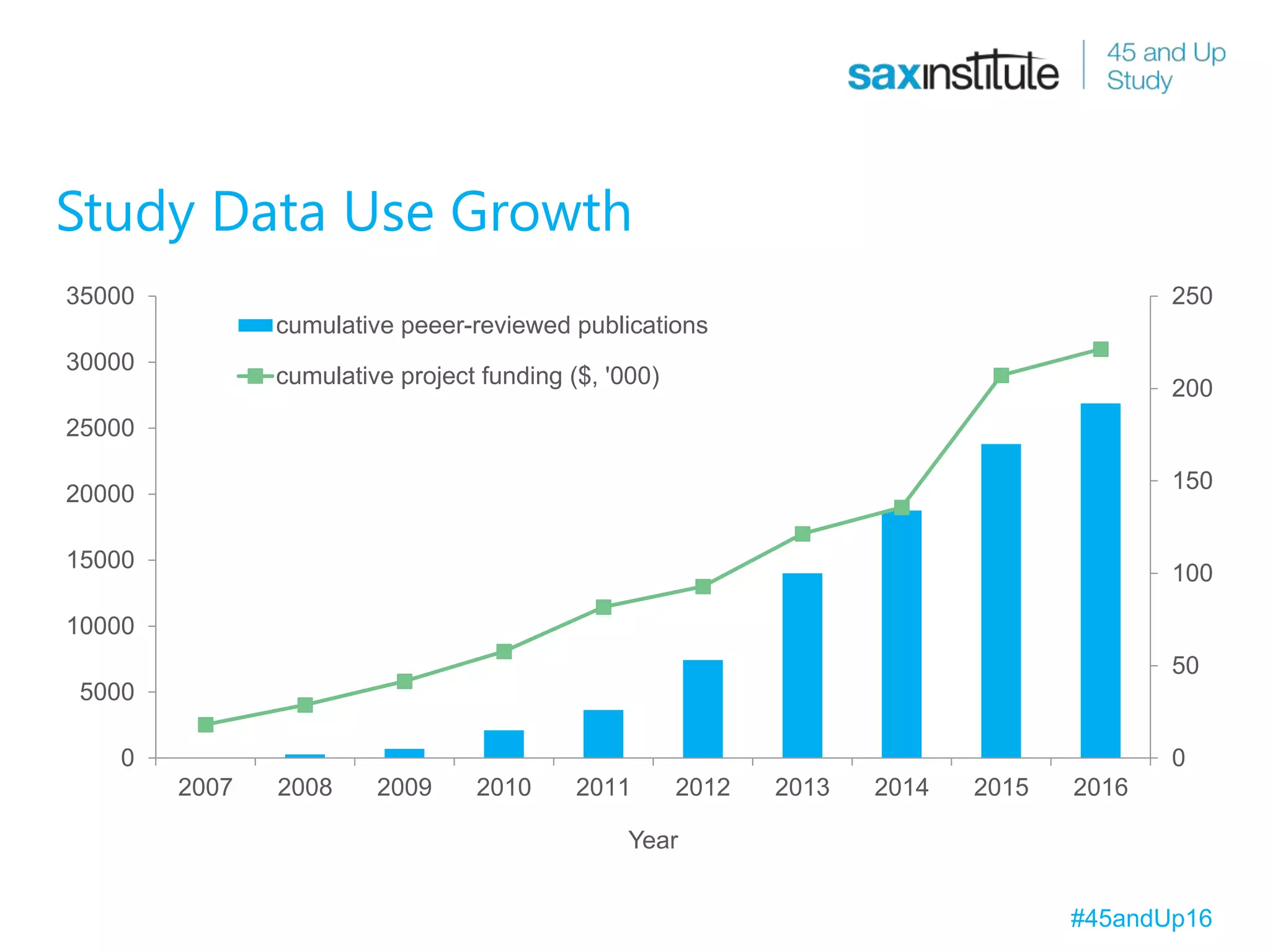
58 grants awarded
(~$31m)
(including 22
NHMRC/ARC)
PUBLICATIONS
192 peer-reviewed
papers
#45andUp16
Study Data Use Growth
0
50
100
150
200
250
0
5000
10000
15000
20000
25000
30000
35000
2007 2008 2009 2010 2011 2012 2013 2014 2015 2016
Year
cumulative peeer-reviewed publications
cumulative project funding ($, '000)
#45andUp16
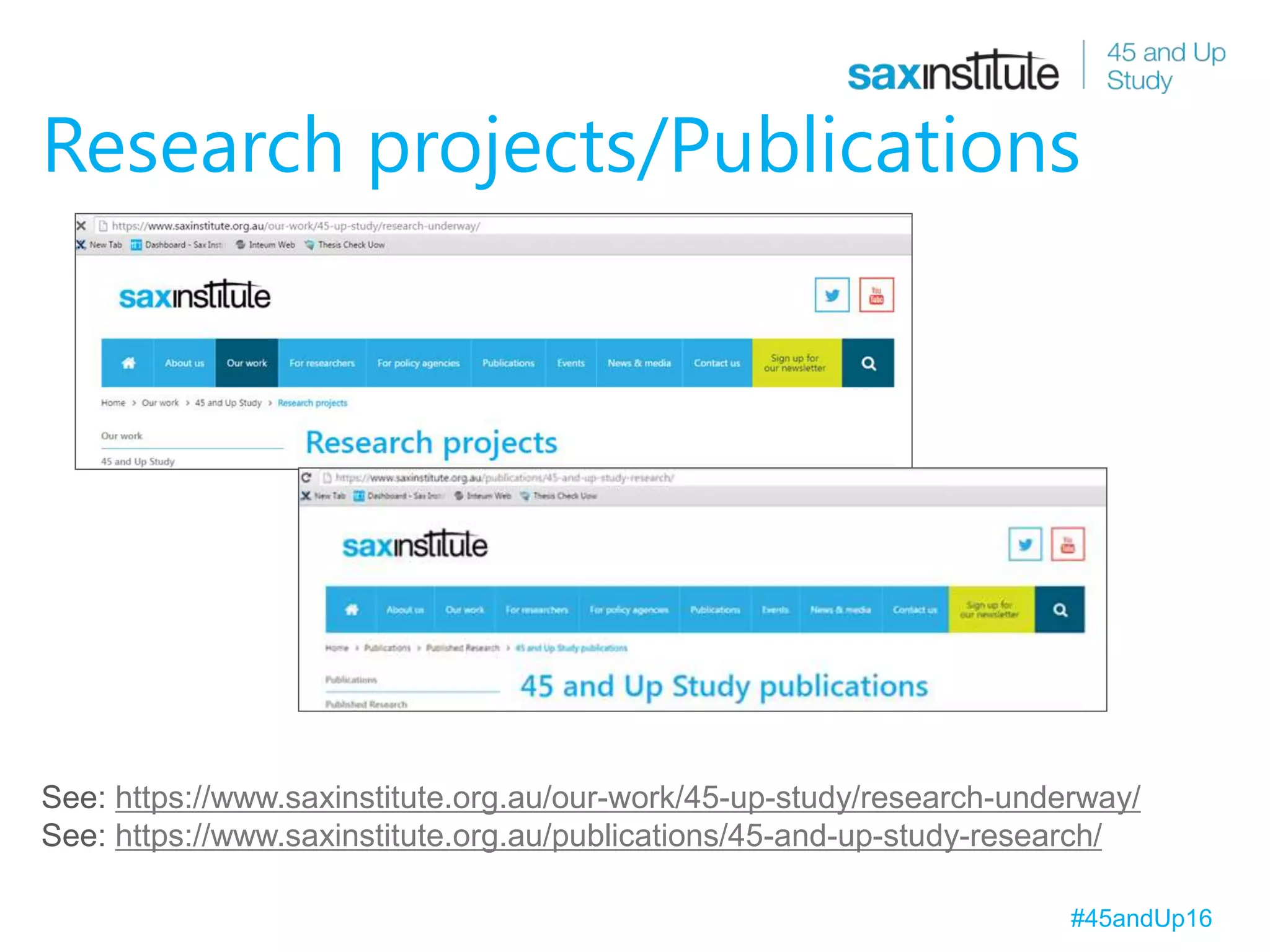
Research projects/Publications
See: https://www.saxinstitute.org.au/our-work/45-up-study/research-underway/
See: https://www.saxinstitute.org.au/publications/45-and-up-study-research/
#45andUp16
Additional general highlights since last
meeting
• Doubling of the number of researchers using the geocoded data in
SURE now that baseline and follow-up to date is completed
• Trialling the yesterday’s deaths linkage methodology developed by the
CHeReL for removal of deaths prior to contacting participants
• Provision of 1,123 buffy coats to the Gavan Institute for whole genome
sequencing
• Exploring options for cohort replenishment
#45andUp16
Research highlights since last meeting
• See publication list and presentations
• 26% of Aboriginal and 13% of non-Aboriginal participants had severe
physical functional limitations (aPR 2.8); factors related to disability were
similar in both groups (older age, illness, poverty and smoking)
• Insights into vaccine preventable diseases, including influenza, herpes
zoster and pertussis, including increased risk of herpes zoster with
immunosuppressive conditions, cancer and physical disability
• Geographic variation work increasing, including findings of significant
variation in primary care services for diabetes according to geographic
factors
• Broad uptake of smoking and mortality findings by policy and advocacy
organisations
#45andUp16
Priorities
• Facilitating new and innovative data linkages including
linkage to the Blood Service’s donor registry
• Consolidation of resource and use of genomic data
• Cohort replenishment
• “Beyond health”
• Review of Coordinating Centre and future management
requirements, and implementation
#45andUp16
In partnership with
THANK YOU

The 45 and Up Study Update

  • 1.
    The 45 andUp Study Update Emily Banks Scientific Director, 45 and Up Study 45 and Up Study Collaborators’ Meeting September 2016
  • 2.
    Today • Brief background •Study progress • Highlights • Priorities #45andUp16
  • 3.
    The 45 andUp Study • The largest long term study of ageing in Australia • A collaborative resource available for use by researchers and policy makers • Core funding from major partner Cancer Council NSW and partners the National Heart Foundation of Australia (NSW Division); NSW Ministry of Health; NSW Government Family & Community Services – Carers, Ageing and Disability Inclusion; Australian Red Cross Blood Service #45andUp16
  • 4.
    Study Recruitment • Participantswere recruited through Medicare Enrolment database • Completed a detailed questionnaire about their life and health in 20062009 • Consented to: • Linkage of their questionnaire information to their health and vital records • Further research: Follow-up and sub-studies #45andUp16
  • 5.
    Baseline recruitment • 267,153men and women aged 45 years and over completed baseline questionnaire (Wave 1) Over 1 in 10 people in this age group
  • 6.
    Wave 2: 2012- 2015 Wave1: 2006-2009 Wave 3: 2017-2020 recruitment follow-up follow-up DATA LINKAGE To ROUTINE COLLECTIONS NESTED STUDIES resurvey of selected individuals SEEF: 2010 (first 100,000) follow-up Wave 4: 2022-2025 follow-up Study Design
  • 7.
    0 50000 100000 150000 200000 250000 300000 2006 2007 20082009 2010 2011 2012 2013 2014 2015 Initial cohort Current cohort Eligible for follow-up 7 Minus withdrawals Minus withdrawals, no follow-up and deaths 65,233 invited (still in field, 33,708 responded to date) 52,664 invited (28,827 responded) 86,250 invited (50,023 responded) 41,440 invited (27,036 responded) Study Cohort S E E F Cohortnumber #45andUp16
  • 8.
    Mixed mode data collection2015 onwards • Email addresses, including approval to contact the cohort participants for over half of the cohort • Invite the participants for follow-up via mail (as previously done) and/or via their email addresses • Trial incorporated • Online versions includes quality control mechanisms • Completing wave 2 data collection end Oct 2016 #45andUp16
  • 9.
    Targeted questions Year AgenciesTopics covered 2014 Bureau of Health Information Department of Veterans’ Affairs NSW Kids and Families Australian Commission for Safety and Quality in Healthcare Usual health care and satisfaction Defence force service and DVA health Life experiences including family violence Adverse health events and future healthcare planning 2015 Department of Veterans’ Affairs NSW Department Planning and Environment Commonwealth of Australia, Department of Health Defence force service and DVA health care Plans for retirement (move or modify) Prescription drug use and cases of shingles • Began in 2014 follow-up • Questionnaire items relevant to policy needs • Sent to at least 50,000 participants • Up to 4 questions per agency (1/4 A4 page) • First reports provided to agencies #45andUp16
  • 10.
    Data Books andDictionaries #45andUp16
  • 11.
    Data Linkage • Widerange of routinely collected data including: • Medical Benefits Scheme and Pharmaceutical Benefits Scheme • NSW Admitted Patients Data Collection • NSW Emergency Data Collection • NSW Deaths and National Deaths Index • NSW Central Cancer Registry • NSW Notifiable Diseases Data • NSW Ambulatory Mental Health Data Collection Between 2000 and 2014/15: 68.9M MBS, 53.8M PBS records (to 2015); 1.9M hospital separations; 595,000 emergency department presentations; 24,387 deaths; 33,000 cancer registrations #45andUp16
  • 12.
    Sub-studies 2009 • Link-Up Project- 762 participants • Housing and Independent Living (HAIL) – 202 participants 2010 • Social, Economic and Environmental Factors (SEEF) Project – 60,404 participants • Cardiovascular Risk, E-couch Depression Outcome (CREDO) Project – 562 participants • Diabetes Risk Factor Survey – 1,210 participants • Skin Health Study – 3,808 participants 2011 • Life Histories and Health Project (LHH) – 1,559 participants • Successful Transition to a Healthy Retirement Project – 2,711 participants 2014 • Sexual Wellbeing and Quality of Life after Prostate Cancer – 116 participants 2015 • Patients’ Experiences Project – 7,686 participants • Men’s Perspectives on Falls and Preventing Falls – 20 participants • Self-care in women living with chronic illness' by researchers at UTS 2016/17 • Maintain Your Brain (MYB) lead by researchers at UNSW • Indicators of cancer progression and recurrence' lead by researchers at the CINSW • Pertussis vaccine effectiveness in older adults – a case control study lead by researchers at UNSW #45andUp16
  • 13.
    Use of Cohortand Data PROJECTS 132 have or are being conducted (13 sub-studies undertaken/in field 3 more planned) USERS 650 researchers across 84 organisations (including 64 early career/student) 28 policy organisations $ 58 grants awarded (~$31m) (including 22 NHMRC/ARC) PUBLICATIONS 192 peer-reviewed papers #45andUp16
  • 14.
    Study Data UseGrowth 0 50 100 150 200 250 0 5000 10000 15000 20000 25000 30000 35000 2007 2008 2009 2010 2011 2012 2013 2014 2015 2016 Year cumulative peeer-reviewed publications cumulative project funding ($, '000) #45andUp16
  • 15.
    Research projects/Publications See: https://www.saxinstitute.org.au/our-work/45-up-study/research-underway/ See:https://www.saxinstitute.org.au/publications/45-and-up-study-research/ #45andUp16
  • 16.
    Additional general highlightssince last meeting • Doubling of the number of researchers using the geocoded data in SURE now that baseline and follow-up to date is completed • Trialling the yesterday’s deaths linkage methodology developed by the CHeReL for removal of deaths prior to contacting participants • Provision of 1,123 buffy coats to the Gavan Institute for whole genome sequencing • Exploring options for cohort replenishment #45andUp16
  • 17.
    Research highlights sincelast meeting • See publication list and presentations • 26% of Aboriginal and 13% of non-Aboriginal participants had severe physical functional limitations (aPR 2.8); factors related to disability were similar in both groups (older age, illness, poverty and smoking) • Insights into vaccine preventable diseases, including influenza, herpes zoster and pertussis, including increased risk of herpes zoster with immunosuppressive conditions, cancer and physical disability • Geographic variation work increasing, including findings of significant variation in primary care services for diabetes according to geographic factors • Broad uptake of smoking and mortality findings by policy and advocacy organisations #45andUp16
  • 18.
    Priorities • Facilitating newand innovative data linkages including linkage to the Blood Service’s donor registry • Consolidation of resource and use of genomic data • Cohort replenishment • “Beyond health” • Review of Coordinating Centre and future management requirements, and implementation #45andUp16
  • 19.

Editor's Notes

  • #7 SEEF (first 100,000 participants) in 2010 (60,004 responded) 5 year follow-up (Wave 2) from 2012-2015 (103,300 responded to date; 62,000 yet to be followed up) 10 year follow-up (Wave 3) from 2016-2019.
  • #8 SEEF (first 100,000 participants) in 2010 (60,004 responded) 5 year follow-up (Wave 2) from 2012-2015 (103,300 responded to date; 62,000 yet to be followed up) 10 year follow-up (Wave 3) from 2016-2019.
  • #9 Completion of Wave 2 data collection by end October 2016 with final phase using both online and hard copy (which appears to have increased the response rate) Need details of trial and response rate
  • #10 Provision of the first reports from the targeted questionnaire items to Kids and Families, DVA, BHI and Australian Commission on Safety and Quality in Health Care