Is a word which names a person, place, thing, animal or idea
NOUN
TYPES OF NOUNS
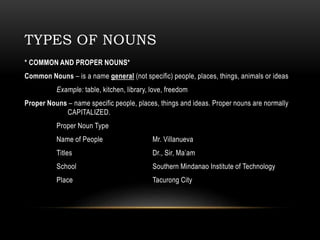
* COMMON AND PROPER NOUNS*
Common Nouns – is a name general (not specific) people, places, things, animals or ideas
Example: table, kitchen, library, love, freedom
Proper Nouns – name specific people, places, things and ideas. Proper nouns are normally
CAPITALIZED.
Proper Noun Type
Name of People Mr. Villanueva
Titles Dr., Sir, Ma’am
School Southern Mindanao Institute of Technology
Place Tacurong City
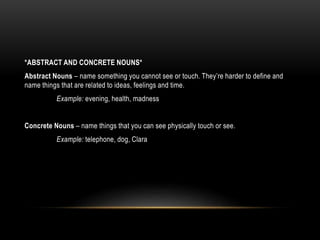
*ABSTRACT AND CONCRETE NOUNS*
Abstract Nouns – name something you cannot see or touch. They’re harder to define and
name things that are related to ideas, feelings and time.
Example: evening, health, madness
Concrete Nouns – name things that you can see physically touch or see.
Example: telephone, dog, Clara
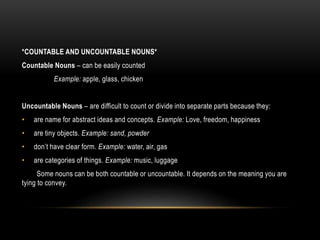
*COUNTABLE AND UNCOUNTABLE NOUNS*
Countable Nouns – can be easily counted
Example: apple, glass, chicken
Uncountable Nouns – are difficult to count or divide into separate parts because they:
• are name for abstract ideas and concepts. Example: Love, freedom, happiness
• are tiny objects. Example: sand, powder
• don’t have clear form. Example: water, air, gas
• are categories of things. Example: music, luggage
Some nouns can be both countable or uncountable. It depends on the meaning you are
tying to convey.
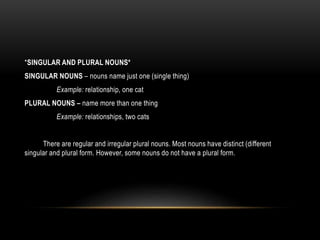
*SINGULAR AND PLURAL NOUNS*
SINGULAR NOUNS – nouns name just one (single thing)
Example: relationship, one cat
PLURAL NOUNS – name more than one thing
Example: relationships, two cats
There are regular and irregular plural nouns. Most nouns have distinct (different
singular and plural form. However, some nouns do not have a plural form.
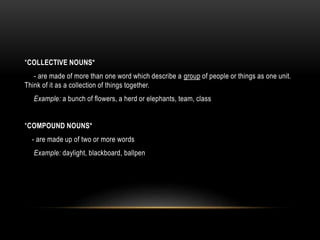
*COLLECTIVE NOUNS*
- are made of more than one word which describe a group of people or things as one unit.
Think of it as a collection of things together.
Example: a bunch of flowers, a herd or elephants, team, class
*COMPOUND NOUNS*
- are made up of two or more words
Example: daylight, blackboard, ballpen
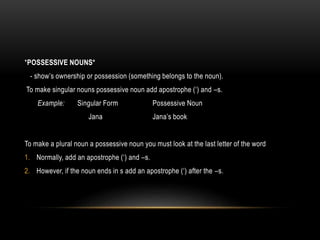
*POSSESSIVE NOUNS*
- show’s ownership or possession (something belongs to the noun).
To make singular nouns possessive noun add apostrophe (‘) and –s.
Example: Singular Form Possessive Noun
Jana Jana’s book
To make a plural noun a possessive noun you must look at the last letter of the word
1. Normally, add an apostrophe (‘) and –s.
2. However, if the noun ends in s add an apostrophe (‘) after the –s.
Presented By:
JAY ROLAND SUANICO
BeEd 41

Noun

  • 1.
    Is a wordwhich names a person, place, thing, animal or idea NOUN
  • 2.
    TYPES OF NOUNS *COMMON AND PROPER NOUNS* Common Nouns – is a name general (not specific) people, places, things, animals or ideas Example: table, kitchen, library, love, freedom Proper Nouns – name specific people, places, things and ideas. Proper nouns are normally CAPITALIZED. Proper Noun Type Name of People Mr. Villanueva Titles Dr., Sir, Ma’am School Southern Mindanao Institute of Technology Place Tacurong City
  • 3.
    *ABSTRACT AND CONCRETENOUNS* Abstract Nouns – name something you cannot see or touch. They’re harder to define and name things that are related to ideas, feelings and time. Example: evening, health, madness Concrete Nouns – name things that you can see physically touch or see. Example: telephone, dog, Clara
  • 4.
    *COUNTABLE AND UNCOUNTABLENOUNS* Countable Nouns – can be easily counted Example: apple, glass, chicken Uncountable Nouns – are difficult to count or divide into separate parts because they: • are name for abstract ideas and concepts. Example: Love, freedom, happiness • are tiny objects. Example: sand, powder • don’t have clear form. Example: water, air, gas • are categories of things. Example: music, luggage Some nouns can be both countable or uncountable. It depends on the meaning you are tying to convey.
  • 5.
    *SINGULAR AND PLURALNOUNS* SINGULAR NOUNS – nouns name just one (single thing) Example: relationship, one cat PLURAL NOUNS – name more than one thing Example: relationships, two cats There are regular and irregular plural nouns. Most nouns have distinct (different singular and plural form. However, some nouns do not have a plural form.
  • 6.
    *COLLECTIVE NOUNS* - aremade of more than one word which describe a group of people or things as one unit. Think of it as a collection of things together. Example: a bunch of flowers, a herd or elephants, team, class *COMPOUND NOUNS* - are made up of two or more words Example: daylight, blackboard, ballpen
  • 7.
    *POSSESSIVE NOUNS* - show’sownership or possession (something belongs to the noun). To make singular nouns possessive noun add apostrophe (‘) and –s. Example: Singular Form Possessive Noun Jana Jana’s book To make a plural noun a possessive noun you must look at the last letter of the word 1. Normally, add an apostrophe (‘) and –s. 2. However, if the noun ends in s add an apostrophe (‘) after the –s.
  • 8.
    Presented By: JAY ROLANDSUANICO BeEd 41