Note Making ASSIGNMENTS
Session Aims
Develop a process for planning and
writing assignments
Evaluate the role of note making within
within this process
Review different techniques for
note making
Apply these techniques to a note
making task
Why are you
making notes?
Consider the purpose: We take notes for different
purposes but in general it helps with our
understanding.
When it comes to assignments, we are generally
taking notes for two broad purposes:
(1) to help us with a general understanding of a
topic
(2) to record specific information to support an
argument.
Either way it helps to think of some questions you
want to answer before you start reading
Question
Analysis
Look at the extract on your worksheet
from a student's assignment and the
assignment question.
Discuss the feedback the lecturer may
have given the student about their
work.
Examine the use of Facebook in learning and
teaching for tertiary level students and teachers.
Discuss the impact of Facebook on tertiary
education by outlining both positive and negative
effects. State your overall position. (Write 1200
words)
Social media has a number of applications in
education. Students can follow important people on
Twitter to get their views. They can follow You Tubers
who vlog about education and similar on
Instagram. According to Fox (2018) social media is
one of the most underexploited tools by
educators. Additionally, Gornall (2016) argues
that there are a huge amount of positives to using
Facebook in the classroom.
Social media has a number of applications in education. Students
can follow important people on Twitter to get their views. They can
follow You Tubers who vlog about education and similar on
Instagram. According to Fox (2018) social media is one of the most
underexploited tools by educators. Additionally, Gornall (2016)
argues that there are a huge amount of positives to using Facebook
in the classroom.
I can see that you have done some research
for this assignment. However, you have not
really answered the specific question set. Instead you
have written a general review of social media in
education, rather than Facebook's application
in university. You have only addressed positive uses of
social media rather than reviewing negatives and have
not established a clear position on the topic.
Understanding Assignment Questions
This is a key stage in your planning
process.
Making certain that you
understand what you have been
asked to do.
This helps you undertake useful,
focused research, and then will
impact upon organising that
research into notes, an outline
plan and your final written piece.
Process
Discuss
Evaluate
Critically review
Describe
Explain
Dates
Locations
Aspect of a
topic
Formulate a
research plan
Areas to read
about and
analyze
Evaluate the
question
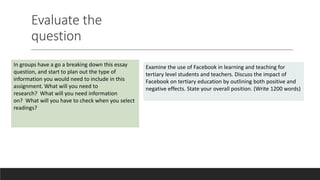
Examine the use of Facebook in learning and teaching for
tertiary level students and teachers. Discuss the impact of
Facebook on tertiary education by outlining both positive and
negative effects. State your overall position. (Write 1200 words)
In groups have a go a breaking down this essay
question, and start to plan out the type of
information you would need to include in this
assignment. What will you need to
research? What will you need information
on? What will you have to check when you select
readings?
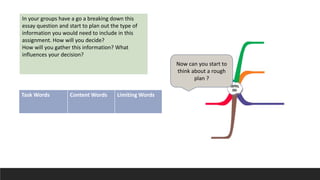
In your groups have a go a breaking down this
essay question and start to plan out the type of
information you would need to include in this
assignment. How will you decide?
How will you gather this information? What
influences your decision?
Task Words Content Words Limiting Words
Now can you start to
think about a rough
plan ?
How is Facebook used in universities?
• Examples and evaluation
• Formal and informal
• In claseses as part of the communication
system between staff and students
• Student to student communication
• Institution communication – SU, Socities etc. Impact
Positives
Negatives
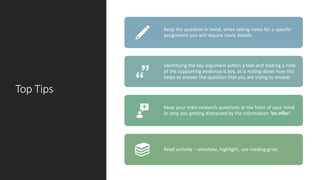
Top Tips
Keep the question in mind, when taking notes for a specific
assignment you will require more details.
Identifying the key argument within a text and making a note
of the supporting evidence is key, as is noting down how this
helps to answer the question that you are trying to answer.
Keep your main research questions at the front of your mind
to stop you getting distracted by the information ‘on offer’.
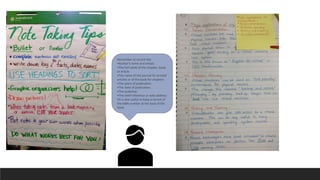
Read actively – annotate, highlight, use reading grids.
Highlights and
annotations-
making
meaningful
interactions with
the content.
Remember to record the:
•Author's name and initials.
•The full name of the chapter, book
or article.
•The name of the journal for printed
articles or of the book for chapters.
•The place of publication.
•The date of publication.
•The publisher.
•The shelf reference or web address.
•It is also useful to keep a record of
the ISBN number at the back of the
book.
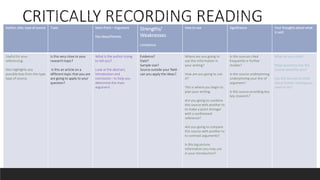
Author, title, type of source Topic Main Point – Argument
Key ideas/themes
Strengths/
Weaknesses
Limitations
How to use Significance Your thoughts about what
is said
Useful for your
referencing.
Also highlights any
possible bias from the type
type of source.
Is this very close to your
research topic?
Is this an article on a
different topic that you are
are going to apply to your
question?
What is the author trying
to tell you?
Look at the abstract,
introduction and
conclusion - to help you
determine the main
argument.
Evidence?
Date?
Sample size?
Source outside your field-
can you apply the ideas?
Where are you going to
use this information in
your writing?
How are you going to use
it?
This is where you begin to
plan your writing.
Are you going to combine
this source with another to
to make a point stronger
with a synthesised
reference?
Are you going to compare
this source with another to
to contrast arguments?
Is this big picture
information you may use
in your introduction?
Is this sources cited
frequently in further
studies?
Is this source underpinning
underpinning your line of
argument?
Is this source providing key
key research?
What do you think?
What questions has this
source raised for you?
Has this led you to think
about further reading you
need to do?
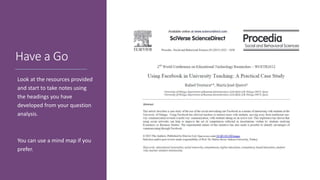
Have a Go
Look at the resources provided
and start to take notes using
the headings you have
developed from your question
analysis.
You can use a mind map if you
prefer.
Next Steps

Note making for assignments

  • 1.
  • 2.
    Session Aims Develop aprocess for planning and writing assignments Evaluate the role of note making within within this process Review different techniques for note making Apply these techniques to a note making task
  • 3.
    Why are you makingnotes? Consider the purpose: We take notes for different purposes but in general it helps with our understanding. When it comes to assignments, we are generally taking notes for two broad purposes: (1) to help us with a general understanding of a topic (2) to record specific information to support an argument. Either way it helps to think of some questions you want to answer before you start reading
  • 4.
    Question Analysis Look at theextract on your worksheet from a student's assignment and the assignment question. Discuss the feedback the lecturer may have given the student about their work.
  • 5.
    Examine the useof Facebook in learning and teaching for tertiary level students and teachers. Discuss the impact of Facebook on tertiary education by outlining both positive and negative effects. State your overall position. (Write 1200 words) Social media has a number of applications in education. Students can follow important people on Twitter to get their views. They can follow You Tubers who vlog about education and similar on Instagram. According to Fox (2018) social media is one of the most underexploited tools by educators. Additionally, Gornall (2016) argues that there are a huge amount of positives to using Facebook in the classroom.
  • 6.
    Social media hasa number of applications in education. Students can follow important people on Twitter to get their views. They can follow You Tubers who vlog about education and similar on Instagram. According to Fox (2018) social media is one of the most underexploited tools by educators. Additionally, Gornall (2016) argues that there are a huge amount of positives to using Facebook in the classroom. I can see that you have done some research for this assignment. However, you have not really answered the specific question set. Instead you have written a general review of social media in education, rather than Facebook's application in university. You have only addressed positive uses of social media rather than reviewing negatives and have not established a clear position on the topic.
  • 7.
    Understanding Assignment Questions Thisis a key stage in your planning process. Making certain that you understand what you have been asked to do. This helps you undertake useful, focused research, and then will impact upon organising that research into notes, an outline plan and your final written piece. Process Discuss Evaluate Critically review Describe Explain Dates Locations Aspect of a topic Formulate a research plan Areas to read about and analyze
  • 8.
    Evaluate the question Examine theuse of Facebook in learning and teaching for tertiary level students and teachers. Discuss the impact of Facebook on tertiary education by outlining both positive and negative effects. State your overall position. (Write 1200 words) In groups have a go a breaking down this essay question, and start to plan out the type of information you would need to include in this assignment. What will you need to research? What will you need information on? What will you have to check when you select readings?
  • 9.
    In your groupshave a go a breaking down this essay question and start to plan out the type of information you would need to include in this assignment. How will you decide? How will you gather this information? What influences your decision? Task Words Content Words Limiting Words Now can you start to think about a rough plan ?
  • 10.
    How is Facebookused in universities? • Examples and evaluation • Formal and informal • In claseses as part of the communication system between staff and students • Student to student communication • Institution communication – SU, Socities etc. Impact Positives Negatives
  • 11.
    Top Tips Keep thequestion in mind, when taking notes for a specific assignment you will require more details. Identifying the key argument within a text and making a note of the supporting evidence is key, as is noting down how this helps to answer the question that you are trying to answer. Keep your main research questions at the front of your mind to stop you getting distracted by the information ‘on offer’. Read actively – annotate, highlight, use reading grids.
  • 12.
  • 13.
    Remember to recordthe: •Author's name and initials. •The full name of the chapter, book or article. •The name of the journal for printed articles or of the book for chapters. •The place of publication. •The date of publication. •The publisher. •The shelf reference or web address. •It is also useful to keep a record of the ISBN number at the back of the book.
  • 14.
    Author, title, typeof source Topic Main Point – Argument Key ideas/themes Strengths/ Weaknesses Limitations How to use Significance Your thoughts about what is said Useful for your referencing. Also highlights any possible bias from the type type of source. Is this very close to your research topic? Is this an article on a different topic that you are are going to apply to your question? What is the author trying to tell you? Look at the abstract, introduction and conclusion - to help you determine the main argument. Evidence? Date? Sample size? Source outside your field- can you apply the ideas? Where are you going to use this information in your writing? How are you going to use it? This is where you begin to plan your writing. Are you going to combine this source with another to to make a point stronger with a synthesised reference? Are you going to compare this source with another to to contrast arguments? Is this big picture information you may use in your introduction? Is this sources cited frequently in further studies? Is this source underpinning underpinning your line of argument? Is this source providing key key research? What do you think? What questions has this source raised for you? Has this led you to think about further reading you need to do?
  • 15.
    Have a Go Lookat the resources provided and start to take notes using the headings you have developed from your question analysis. You can use a mind map if you prefer.
  • 17.