MODULE-VI
METAZOAN PARASITIE
Management of diseases comprises a significant
part of operating costs in fish mariculture , and
metazoan parasites are among the most
problematic. Metazoan parasites have become a
significant animal welfare concern in
mariculture while the chemical control methods
employed for parasites are coming under
increased environmental scrutiny and
government regulation.
• More holistic management methods are needed
for the future sustainability of fish mari culture.
Marine fish are a nutritious and high-value food
commodity, but many wild-capture fisheries are
in decline. Thus, marine fish culture is expected
to expand greatly in coming years. Management
of disease is a major problem in this industry, and
metazoan parasites are among the most
significant disease agents in terms of economic
loss and animal welfare.
• Current methods for controlling metazoan
parasites are mostly reactionary and rely on
chemical treatment. Such methods are
ultimately unsustainable.
:
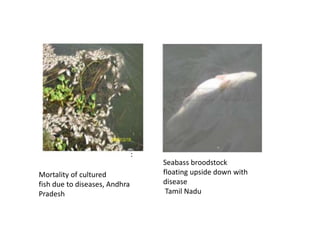
Mortality of cultured
fish due to diseases, Andhra
Pradesh
Seabass broodstock
floating upside down with
disease
Tamil Nadu
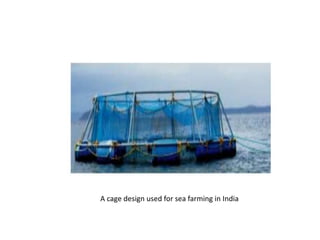
A cage design used for sea farming in India
Acanthocephalans
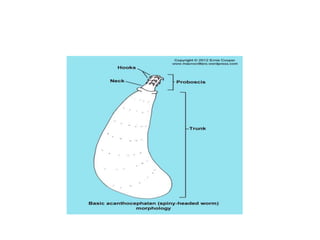
• It Comprises worms with an anterior proboscis
covered with many hooks and hence referred
as are ‘thorny’ or ‘spiny headed’ worm with
aquatic life cycles.
• Causative agents :Medium to large sized
parasite, most common species are
Acanthocephalus, Neoacanthorhynchus,
Tenuiproboscis.
Nematodes or round worms
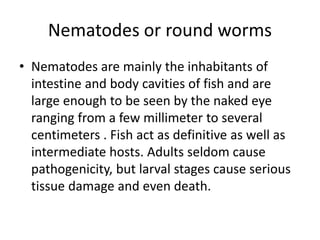
• Nematodes are mainly the inhabitants of
intestine and body cavities of fish and are
large enough to be seen by the naked eye
ranging from a few millimeter to several
centimeters . Fish act as definitive as well as
intermediate hosts. Adults seldom cause
pathogenicity, but larval stages cause serious
tissue damage and even death.
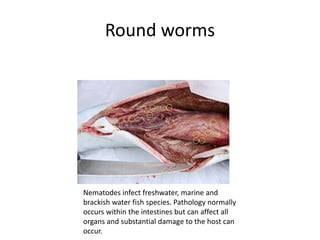
Round worms
Nematodes infect freshwater, marine and
brackish water fish species. Pathology normally
occurs within the intestines but can affect all
organs and substantial damage to the host can
occur.
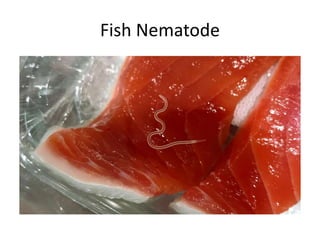
Fish Nematode
Causative Agents
• Causative agents: Cucullanus, Camellanus,
Spirocamellanus, Anisakis,Philometra,
Philometroides.
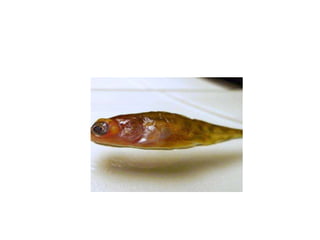
Trematodes or flat worms
• Trematodes are relatively large external or
internal parasites with adhesive structures for
attachment to the host. Monogeneans are
external parasites with specialized posterior
attachment organs characteristic to each
species and require a single host, while the
digeneans are internal parasites occurring
mostly in the intestinal tract and need more
than one host species for completion of their
life cycle.
• Monogeneans comprise ‘skin’ and ‘gill’ flukes
infecting skin, gill and fins of fishes .
Monogeneans are capable of multiplying in
large numbers in short time due to their
simple life cycle involving a single host. They
are often found threatening to young fish with
massive mortality.
Causative agents
• Causative agents : The most common
monogenean parasites in fishes are
Dactylogyrus, Gyrodactylus, Diplectanum,
Benedenia, etc. Among predominantly among
marine and brackishwater fishes and
Diplozoon, Bifurcohaptor among many fresh
water edible fishes.
• Species affected : Catfish, carp, tilapia,
seabass, grouper, mullet,pearl spot, etc.
Crustacean Parasite
• The Subphylum Crustacea (Phylum
Arthropoda) represents a diverse group of
animals with members within several classes
and orders, including the Amphipoda,
Branchiura, Cirripedia, Copepoda, Isopoda,
and Tantulocarida,there are two classes with
parasites: the Maxillopoda and Malacostraca.
• The majority of crustaceans are aquatic, living
in either marine environments or fresh water,
but a few groups have adapted to a terrestrial
existence, such as some species of crabs and
woodlice.
• Most crustaceans move about independently
and live a free existence, although some are
parasitic (about 30,000 named species) and
live attached as ectoparasites to their hosts,
including fish, sea, and whale lice, as well as
Cymothoa exigua, the tongue-eating louse, a
parasitic isopod. Among them, the parasitic
copepods are dominant.
• Crustaceans, jointly with the monogeneans,
are the most speciose group of metazoan
ectoparasites of marine fishes; in addition,
they infect a wide range of marine
invertebrates and freshwater vertebrates. It
has been estimated that three percent of all
crustacean species are parasites of other
Crustacea, and almost one-third of all
copepods are parasitic.
Maxillopoda
• The class Maxillopoda includes species with
five cephalic, six thoracic, and usually four
abdominal somites plus a telson (Terminal
appendage) in the primitive condition; often
segmentation is lost secondarily, and there are
normally no appendages on the abdomen.
The eye, when present in the nauplius, has a
unique structure called the maxillipodan eye.
• The class includes five subclasses: Ostracoda,
Copepoda, Brachiura, Cirripedia, and
Tantulocarida; there are numerous orders and
many different taxa have parasitic members.
Malacostraca
• The class Malacostraca contains very few
parasitic species and includes the orders
Amphipoda, Isopoda, and Decapoda.
Segmentation is distinct, and antennules of some
species are biramous (Especially crustacean limbs
and antennae dividing to form two branches).
Eight somites are in the thorax, with six to seven
somites and a telson (The last segment in the
abdomen) in the abdomen, and the first one to
three thoracic appendages are modified into
maxillipedes. Several members of this class can
be found in North America.
Environmental Diseases
• This environmental diseases focuses on swim
bladder stress syndrome and gas bubble
disease, the two most common disorders due
to adverse environmental conditions.
SWIMBLADDER STRESS SYNDROME
(SBSS)
• Swimbladder stress syndrome (SBSS) is a
malfunction of the swimbladder and is associated
with a combination of abrupt changes in several
environmental parameters. This syndrome has
been a major limiting factor in fry production of
Epinephelus sp. in Taiwan. It has also been
• reported in E. bleekeri, E. coioides, E. lanceolatus,
E. malabaricus, E. tauvina and Cromileptes
• altivelis in Malaysia, Singapore and Thailand.
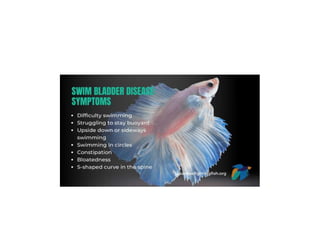
Symptoms
• Difficulty swimming
• Struggling to stay buoyant
• Swimming in circles
• Upside down or sideways swimming
Causative agent
• The causative agent is unknown, but the
syndrome is associated with abrupt changes in
water quality such as high ambient
temperature, high ambient illumination,
dense algal bloom that may cause oxygen
depletion at night and super saturation during
the day. In Malaysia, this syndrome usually
coincides with the monsoon season when
there is upwelling of bottom sediments under
the net cages.
Stages affected
• In the hatchery this syndrome occurs during
metamorphosis. It also affects
marketablesized fish and broodstock.
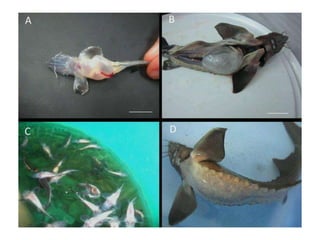
• Effects on host:Affected fish have bloated
swimbladder, which results in positive
buoyancy. This condition is not lethal to the
fish but they eventually die of starvation,
overexposure to direct sunlight or secondary
bacterial infection.
Transmission
This syndrome is non-infectious.
Diagnosis:
• The disease is diagnosed through gross
examination of the swimmbladder
GAS BUBBLE DISEASE (GBD)
• Gas bubble disease (GBD) is due to super
saturation of dissolved gases, usually nitrogen
and oxygen. All gases are more soluble in
water at low temperatures. Solubility is
diminished as temperature rises.
GAS BUBBLE DISEASE
GAS BUBBLE DISEASE
Causative agent
• GBD is caused by a super saturation of the
water with the gas, nitrogen. Super saturation
occurs whenever the pressure of a gas in the
water is higher than the pressure of the same
gas in the surrounding atmosphere. It is also
caused by the super saturation of oxygen in
water due to heavy algal blooms.
Symptoms
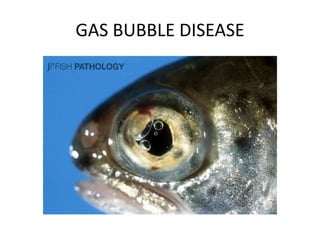
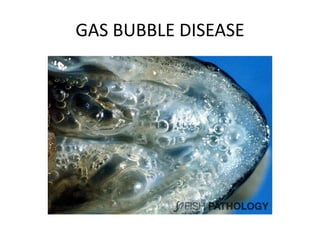
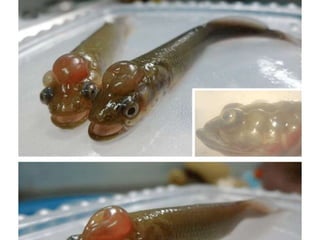
• Gas bubble disease (also known as GBD)
presents as bubbles inside the fish that
become trapped within the eyes, fins, or skin.
It does not include any swim bladder or
buoyancy disorders. This disease starts as a
collection of very small bubbles, known as
micro bubbles, that slowly form larger, more
visible bubbles.
Stages affected
This disease is common at the hatchery stage. It
also affects brood stock.
Affected fish show bubbles in the eyes (causing
exophthalmia or pop-eye body cavities, skin and
gills . The bubbles can form in the gill lamellae
and block blood flow resulting embolism of gill
vessels. Affected fish also show erratic
swimming patterns.
• Transmission:
• The disease is caused by an environmental
factor, thus is non-infectious.
• Effects on Host:
Affected fish die due to embolism in blood,
degeneration of the gill lamellae and bulging of
the cornea. There is also an occurrence of
abrupt mass mortalities.
Preventive and control methods
• To treat fish suffering from GDB, first weaken
water supply and supply strong aerationto
remove saturated nitrogen. Repair cracked
pipe, and position intake pipe above the water
surface to remove the nitrogen.
Nutrition Deficiency Diseases
• Introduction:Nutritional disease has been
defined as those which can be attributed to
deficiency, excess or improper balance of
components present in a fish diet. If food
contain all necessary components in proper
balance, a nutritional disease is possible

MODULE-VI-01.5.22.pptx

  • 1.
  • 2.
    METAZOAN PARASITIE Management ofdiseases comprises a significant part of operating costs in fish mariculture , and metazoan parasites are among the most problematic. Metazoan parasites have become a significant animal welfare concern in mariculture while the chemical control methods employed for parasites are coming under increased environmental scrutiny and government regulation.
  • 3.
    • More holisticmanagement methods are needed for the future sustainability of fish mari culture. Marine fish are a nutritious and high-value food commodity, but many wild-capture fisheries are in decline. Thus, marine fish culture is expected to expand greatly in coming years. Management of disease is a major problem in this industry, and metazoan parasites are among the most significant disease agents in terms of economic loss and animal welfare.
  • 4.
    • Current methodsfor controlling metazoan parasites are mostly reactionary and rely on chemical treatment. Such methods are ultimately unsustainable.
  • 5.
    : Mortality of cultured fishdue to diseases, Andhra Pradesh Seabass broodstock floating upside down with disease Tamil Nadu
  • 6.
    A cage designused for sea farming in India
  • 7.
    Acanthocephalans • It Comprisesworms with an anterior proboscis covered with many hooks and hence referred as are ‘thorny’ or ‘spiny headed’ worm with aquatic life cycles. • Causative agents :Medium to large sized parasite, most common species are Acanthocephalus, Neoacanthorhynchus, Tenuiproboscis.
  • 9.
    Nematodes or roundworms • Nematodes are mainly the inhabitants of intestine and body cavities of fish and are large enough to be seen by the naked eye ranging from a few millimeter to several centimeters . Fish act as definitive as well as intermediate hosts. Adults seldom cause pathogenicity, but larval stages cause serious tissue damage and even death.
  • 10.
    Round worms Nematodes infectfreshwater, marine and brackish water fish species. Pathology normally occurs within the intestines but can affect all organs and substantial damage to the host can occur.
  • 11.
  • 12.
    Causative Agents • Causativeagents: Cucullanus, Camellanus, Spirocamellanus, Anisakis,Philometra, Philometroides.
  • 13.
    Trematodes or flatworms • Trematodes are relatively large external or internal parasites with adhesive structures for attachment to the host. Monogeneans are external parasites with specialized posterior attachment organs characteristic to each species and require a single host, while the digeneans are internal parasites occurring mostly in the intestinal tract and need more than one host species for completion of their life cycle.
  • 15.
    • Monogeneans comprise‘skin’ and ‘gill’ flukes infecting skin, gill and fins of fishes . Monogeneans are capable of multiplying in large numbers in short time due to their simple life cycle involving a single host. They are often found threatening to young fish with massive mortality.
  • 16.
    Causative agents • Causativeagents : The most common monogenean parasites in fishes are Dactylogyrus, Gyrodactylus, Diplectanum, Benedenia, etc. Among predominantly among marine and brackishwater fishes and Diplozoon, Bifurcohaptor among many fresh water edible fishes. • Species affected : Catfish, carp, tilapia, seabass, grouper, mullet,pearl spot, etc.
  • 17.
    Crustacean Parasite • TheSubphylum Crustacea (Phylum Arthropoda) represents a diverse group of animals with members within several classes and orders, including the Amphipoda, Branchiura, Cirripedia, Copepoda, Isopoda, and Tantulocarida,there are two classes with parasites: the Maxillopoda and Malacostraca.
  • 18.
    • The majorityof crustaceans are aquatic, living in either marine environments or fresh water, but a few groups have adapted to a terrestrial existence, such as some species of crabs and woodlice.
  • 19.
    • Most crustaceansmove about independently and live a free existence, although some are parasitic (about 30,000 named species) and live attached as ectoparasites to their hosts, including fish, sea, and whale lice, as well as Cymothoa exigua, the tongue-eating louse, a parasitic isopod. Among them, the parasitic copepods are dominant.
  • 20.
    • Crustaceans, jointlywith the monogeneans, are the most speciose group of metazoan ectoparasites of marine fishes; in addition, they infect a wide range of marine invertebrates and freshwater vertebrates. It has been estimated that three percent of all crustacean species are parasites of other Crustacea, and almost one-third of all copepods are parasitic.
  • 21.
    Maxillopoda • The classMaxillopoda includes species with five cephalic, six thoracic, and usually four abdominal somites plus a telson (Terminal appendage) in the primitive condition; often segmentation is lost secondarily, and there are normally no appendages on the abdomen. The eye, when present in the nauplius, has a unique structure called the maxillipodan eye.
  • 22.
    • The classincludes five subclasses: Ostracoda, Copepoda, Brachiura, Cirripedia, and Tantulocarida; there are numerous orders and many different taxa have parasitic members.
  • 23.
    Malacostraca • The classMalacostraca contains very few parasitic species and includes the orders Amphipoda, Isopoda, and Decapoda. Segmentation is distinct, and antennules of some species are biramous (Especially crustacean limbs and antennae dividing to form two branches). Eight somites are in the thorax, with six to seven somites and a telson (The last segment in the abdomen) in the abdomen, and the first one to three thoracic appendages are modified into maxillipedes. Several members of this class can be found in North America.
  • 24.
    Environmental Diseases • Thisenvironmental diseases focuses on swim bladder stress syndrome and gas bubble disease, the two most common disorders due to adverse environmental conditions.
  • 25.
    SWIMBLADDER STRESS SYNDROME (SBSS) •Swimbladder stress syndrome (SBSS) is a malfunction of the swimbladder and is associated with a combination of abrupt changes in several environmental parameters. This syndrome has been a major limiting factor in fry production of Epinephelus sp. in Taiwan. It has also been • reported in E. bleekeri, E. coioides, E. lanceolatus, E. malabaricus, E. tauvina and Cromileptes • altivelis in Malaysia, Singapore and Thailand.
  • 26.
    Symptoms • Difficulty swimming •Struggling to stay buoyant • Swimming in circles • Upside down or sideways swimming
  • 29.
    Causative agent • Thecausative agent is unknown, but the syndrome is associated with abrupt changes in water quality such as high ambient temperature, high ambient illumination, dense algal bloom that may cause oxygen depletion at night and super saturation during the day. In Malaysia, this syndrome usually coincides with the monsoon season when there is upwelling of bottom sediments under the net cages.
  • 30.
    Stages affected • Inthe hatchery this syndrome occurs during metamorphosis. It also affects marketablesized fish and broodstock. • Effects on host:Affected fish have bloated swimbladder, which results in positive buoyancy. This condition is not lethal to the fish but they eventually die of starvation, overexposure to direct sunlight or secondary bacterial infection.
  • 31.
    Transmission This syndrome isnon-infectious. Diagnosis: • The disease is diagnosed through gross examination of the swimmbladder
  • 32.
    GAS BUBBLE DISEASE(GBD) • Gas bubble disease (GBD) is due to super saturation of dissolved gases, usually nitrogen and oxygen. All gases are more soluble in water at low temperatures. Solubility is diminished as temperature rises.
  • 33.
  • 34.
  • 36.
    Causative agent • GBDis caused by a super saturation of the water with the gas, nitrogen. Super saturation occurs whenever the pressure of a gas in the water is higher than the pressure of the same gas in the surrounding atmosphere. It is also caused by the super saturation of oxygen in water due to heavy algal blooms.
  • 37.
    Symptoms • Gas bubbledisease (also known as GBD) presents as bubbles inside the fish that become trapped within the eyes, fins, or skin. It does not include any swim bladder or buoyancy disorders. This disease starts as a collection of very small bubbles, known as micro bubbles, that slowly form larger, more visible bubbles.
  • 38.
    Stages affected This diseaseis common at the hatchery stage. It also affects brood stock. Affected fish show bubbles in the eyes (causing exophthalmia or pop-eye body cavities, skin and gills . The bubbles can form in the gill lamellae and block blood flow resulting embolism of gill vessels. Affected fish also show erratic swimming patterns.
  • 39.
    • Transmission: • Thedisease is caused by an environmental factor, thus is non-infectious. • Effects on Host: Affected fish die due to embolism in blood, degeneration of the gill lamellae and bulging of the cornea. There is also an occurrence of abrupt mass mortalities.
  • 40.
    Preventive and controlmethods • To treat fish suffering from GDB, first weaken water supply and supply strong aerationto remove saturated nitrogen. Repair cracked pipe, and position intake pipe above the water surface to remove the nitrogen.
  • 41.
    Nutrition Deficiency Diseases •Introduction:Nutritional disease has been defined as those which can be attributed to deficiency, excess or improper balance of components present in a fish diet. If food contain all necessary components in proper balance, a nutritional disease is possible