NoSQL no more
SQL on Druid with Apache Calcite
Gian Merlino
gian@imply.io
Who am I?
Gian Merlino
Committer & PMC member on
Committer on Apache Calcite
Cofounder at
2
Agenda
● What is Druid?
● What is NoSQL?
● What is Apache Calcite?
● From NoSQL to SQL
● Do try this at home!
3
4
open source, high-performance,
column-oriented, distributed data store
What is Druid?
● “high performance”: low query latency, high ingest rates
● “column-oriented”: best possible scan rates
● “distributed”: deployed in clusters, typically 10s–100s of nodes
● “data store”: the cluster stores a copy of your data
5
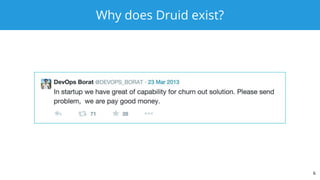
Why does Druid exist?
6
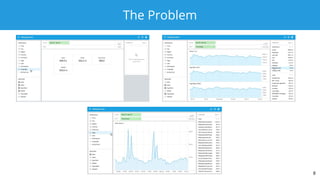
The Problem
● OLAP slice-and-dice for big data
● Interactive exploration
● Look under the hood of reports and dashboards
● And we want our data fresh, too
7
The Problem
8
Challenges
● Scale: big data is tough to process quickly
● Complexity: too much fine grain to precompute
● High dimensionality: 10s or 100s of dimensions
● Concurrency: many users and tenants
● Freshness: load from streams
9
Motivation
● Sub-second responses allow dialogue with data
● Rapid iteration on questions
● Remove barriers to understanding
10
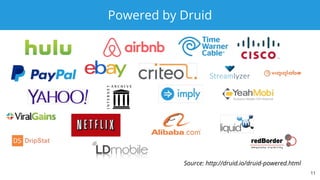
Powered by Druid
11
Source: http://druid.io/druid-powered.html
Powered by Druid
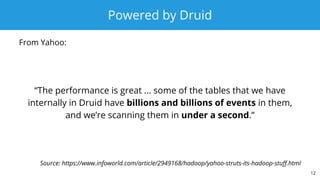
“The performance is great ... some of the tables that we have
internally in Druid have billions and billions of events in them,
and we’re scanning them in under a second.”
12
Source: https://www.infoworld.com/article/2949168/hadoop/yahoo-struts-its-hadoop-stuff.html
From Yahoo:
Druid Key Features
● Low latency ingestion from Kafka
● Bulk load from Hadoop
● Can pre-aggregate data during ingestion
● “Schema light”
● Ad-hoc queries
● Exact and approximate algorithms
● Can keep a lot of history (years are ok)
13
Druid
Druid makes interactive data exploration fast and
flexible, and powers analytic applications.
14
What is NoSQL?
15
What is NoSQL?
“There's no strong definition of the concept out there, no
trademarks, no standard group, not even a manifesto.”
16
Source: https://martinfowler.com/bliki/NosqlDefinition.html
What is NoSQL?
Early examples:
Voldemort, Cassandra, Dynomite,
HBase, Hypertable, CouchDB, MongoDB
17
Source: https://martinfowler.com/bliki/NosqlDefinition.html
What is NoSQL?
What are they?
● Document stores
● Key/value stores
● Graph databases
● Timeseries databases
18
What is NoSQL?
● Not using the relational model (nor the SQL language)
● Open source
● Designed to run on large clusters
● Based on the needs of 21st century web properties
● No schema, allowing fields to be added to any record without
controls
19
Source: https://martinfowler.com/bliki/NosqlDefinition.html
Categorizing Druid
● Not using the relational model (nor the SQL language)
● Open source
● Designed to run on large clusters
● Based on the needs of 21st century web properties
● No schema, allowing fields to be added to any record without
controls
20
Source: https://martinfowler.com/bliki/NosqlDefinition.html
Categorizing Druid
● Not using the relational model (nor the SQL language)
● Open source
● Designed to run on large clusters
● Based on the needs of 21st century web properties
● No schema, allowing fields to be added to any record without
controls
21
Source: https://martinfowler.com/bliki/NosqlDefinition.html
Categorizing Druid
● Not using the relational model (nor the SQL language)
● Open source
● Designed to run on large clusters
● Based on the needs of 21st century web properties
● No schema, allowing fields to be added to any record without
controls
22
Source: https://martinfowler.com/bliki/NosqlDefinition.html
Categorizing Druid
● Not using the relational model (nor the SQL language)
● Open source
● Designed to run on large clusters
● Based on the needs of 21st century web properties
● No schema, allowing fields to be added to any record without
controls
23
Source: https://martinfowler.com/bliki/NosqlDefinition.html
Categorizing Druid
● Not using the relational model (nor the SQL language)
● Open source
● Designed to run on large clusters
● Based on the needs of 21st century web properties
● No schema, allowing fields to be added to any record without
controls
24
Source: https://martinfowler.com/bliki/NosqlDefinition.html
Categorizing Druid
● Not using the relational model (nor the SQL language)
● Open source
● Designed to run on large clusters
● Based on the needs of 21st century web properties
● No schema, allowing fields to be added to any record without
controls
25
Source: https://martinfowler.com/bliki/NosqlDefinition.html
Categorizing Druid
Is avoiding the SQL language and
relational model really a good thing?
26
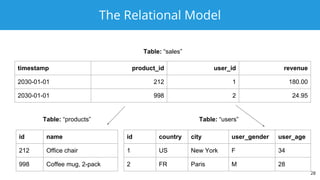
The Relational Model
● The relational model is based around relations
● SQL calls them tables and those tables have columns
● SQL queries describe relational operations
○ Scan
○ Project
○ Filter
○ Aggregate
○ Union
○ Join
27
The Relational Model
28
timestamp product_id user_id revenue
2030-01-01 212 1 180.00
2030-01-01 998 2 24.95
Table: “sales”
Table: “products”
id name
212 Office chair
998 Coffee mug, 2-pack
Table: “users”
id country city user_gender user_age
1 US New York F 34
2 FR Paris M 28
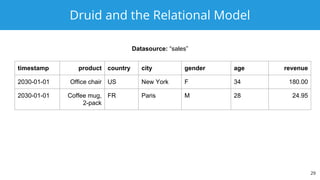
Druid and the Relational Model
29
timestamp product country city gender age revenue
2030-01-01 Office chair US New York F 34 180.00
2030-01-01 Coffee mug,
2-pack
FR Paris M 28 24.95
Datasource: “sales”
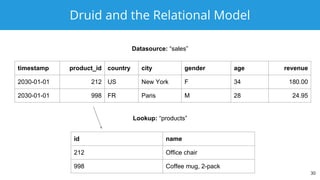
Druid and the Relational Model
30
Datasource: “sales”
Lookup: “products”
id name
212 Office chair
998 Coffee mug, 2-pack
timestamp product_id country city gender age revenue
2030-01-01 212 US New York F 34 180.00
2030-01-01 998 FR Paris M 28 24.95
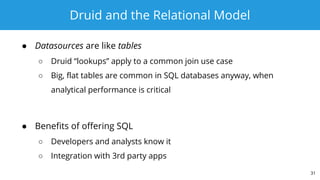
Druid and the Relational Model
● Datasources are like tables
○ Druid “lookups” apply to a common join use case
○ Big, flat tables are common in SQL databases anyway, when
analytical performance is critical
● Benefits of offering SQL
○ Developers and analysts know it
○ Integration with 3rd party apps
31
32
Enter…
Apache Calcite
● SQL parser
● Query optimizer
● Query interpreter
● JDBC server (Avatica)
33
Apache Calcite
● Widely used
○ Druid
○ Hive
○ Storm
○ Samza
○ Drill
○ Phoenix
○ Flink
34
Apache Calcite
35
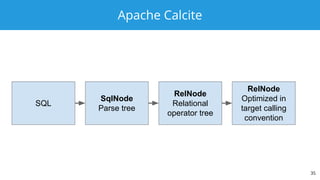
SQL
SqlNode
Parse tree
RelNode
Relational
operator tree
RelNode
Optimized in
target calling
convention
SQL query
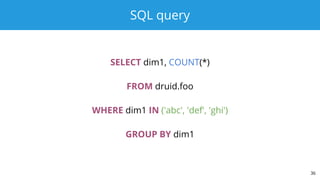
SELECT dim1, COUNT(*)
FROM druid.foo
WHERE dim1 IN ('abc', 'def', 'ghi')
GROUP BY dim1
36
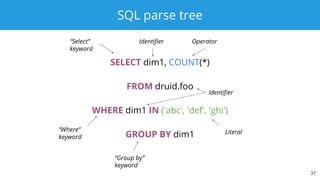
SQL parse tree
SELECT dim1, COUNT(*)
FROM druid.foo
WHERE dim1 IN ('abc', 'def', 'ghi')
GROUP BY dim1
37
Identifier“Select”
keyword
Operator
Identifier
Literal“Where”
keyword
“Group by”
keyword
Relational operators
SELECT dim1, COUNT(*)
FROM druid.foo
WHERE dim1 IN ('abc', 'def', 'ghi')
GROUP BY dim1
38
LogicalAggregate(group=[{0}], EXPR$1=[COUNT()])
LogicalProject(dim1=[$2])
LogicalFilter(condition=[OR(=($2, 'abc'), =($2, 'def'), =($2, 'ghi'))])
LogicalTableScan(table=[[druid, foo]])
Query planner
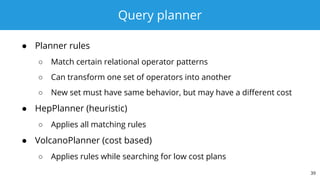
● Planner rules
○ Match certain relational operator patterns
○ Can transform one set of operators into another
○ New set must have same behavior, but may have a different cost
● HepPlanner (heuristic)
○ Applies all matching rules
● VolcanoPlanner (cost based)
○ Applies rules while searching for low cost plans
39
Using Calcite
Calcite can be embedded or it can
be used directly by end-users.
Druid SQL embeds Calcite.
40
From NoSQL to SQL
41
Native vs SQL
{
"queryType": "topN",
"dataSource": “wikipedia”,
"dimension": "countryName",
"metric": {
"type": "numeric",
"metric": "added"
},
"intervals": "2018-03-01/2018-03-06",
"filter": {
"type": "and",
"fields": [
{
"type": "selector",
"dimension": "channel",
"value": "#en.wikipedia",
"extractionFn": null
},
{
"type": "not",
"field": {
"type": "selector",
"dimension": "countryName",
"value": "",
"extractionFn": null
}
}
]
},
"granularity": "all",
"aggregations": [
{
"type": "longSum",
"name": "added",
"fieldName": "added"
}
],
"threshold": 5
}
SELECT
countryName,
SUM(added)
FROM wikipedia
WHERE
channel = '#en.wikipedia'
AND countryName IS NOT NULL
AND __time BETWEEN '2018-03-01' AND '2018-03-06'
GROUP BY countryName
ORDER BY SUM(added) DESC
LIMIT 5
42
Native vs SQL
{
"queryType": "topN",
"dataSource": “wikipedia”,
"dimension": "countryName",
"metric": {
"type": "numeric",
"metric": "added"
},
"intervals": "2018-03-01/2018-03-06",
"filter": {
"type": "and",
"fields": [
{
"type": "selector",
"dimension": "channel",
"value": "#en.wikipedia",
"extractionFn": null
},
{
"type": "not",
"field": {
"type": "selector",
"dimension": "countryName",
"value": "",
"extractionFn": null
}
}
]
},
"granularity": "all",
"aggregations": [
{
"type": "longSum",
"name": "added",
"fieldName": "added"
}
],
"threshold": 5
}
SELECT
countryName,
SUM(added)
FROM wikipedia
WHERE
channel = '#en.wikipedia'
AND countryName IS NOT NULL
AND __time BETWEEN '2018-03-01' AND '2018-03-06'
GROUP BY countryName
ORDER BY SUM(added) DESC
LIMIT 5
43
Native vs SQL
{
"queryType": "topN",
"dataSource": “wikipedia”,
"dimension": "countryName",
"metric": {
"type": "numeric",
"metric": "added"
},
"intervals": "2018-03-01/2018-03-06",
"filter": {
"type": "and",
"fields": [
{
"type": "selector",
"dimension": "channel",
"value": "#en.wikipedia",
"extractionFn": null
},
{
"type": "not",
"field": {
"type": "selector",
"dimension": "countryName",
"value": "",
"extractionFn": null
}
}
]
},
"granularity": "all",
"aggregations": [
{
"type": "longSum",
"name": "added",
"fieldName": "added"
}
],
"threshold": 5
}
SELECT
countryName,
SUM(added)
FROM wikipedia
WHERE
channel = '#en.wikipedia'
AND countryName IS NOT NULL
AND __time BETWEEN '2018-03-01' AND '2018-03-06'
GROUP BY countryName
ORDER BY SUM(added) DESC
LIMIT 5
44
Native vs SQL
{
"queryType": "topN",
"dataSource": “wikipedia”,
"dimension": "countryName",
"metric": {
"type": "numeric",
"metric": "added"
},
"intervals": "2018-03-01/2018-03-06",
"filter": {
"type": "and",
"fields": [
{
"type": "selector",
"dimension": "channel",
"value": "#en.wikipedia",
"extractionFn": null
},
{
"type": "not",
"field": {
"type": "selector",
"dimension": "countryName",
"value": "",
"extractionFn": null
}
}
]
},
"granularity": "all",
"aggregations": [
{
"type": "longSum",
"name": "added",
"fieldName": "added"
}
],
"threshold": 5
}
SELECT
countryName,
SUM(added)
FROM wikipedia
WHERE
channel = '#en.wikipedia'
AND countryName IS NOT NULL
AND __time BETWEEN '2018-03-01' AND '2018-03-06'
GROUP BY countryName
ORDER BY SUM(added) DESC
LIMIT 5
45
Native vs SQL
{
"queryType": "topN",
"dataSource": “wikipedia”,
"dimension": "countryName",
"metric": {
"type": "numeric",
"metric": "added"
},
"intervals": "2018-03-01/2018-03-06",
"filter": {
"type": "and",
"fields": [
{
"type": "selector",
"dimension": "channel",
"value": "#en.wikipedia",
"extractionFn": null
},
{
"type": "not",
"field": {
"type": "selector",
"dimension": "countryName",
"value": "",
"extractionFn": null
}
}
]
},
"granularity": "all",
"aggregations": [
{
"type": "longSum",
"name": "added",
"fieldName": "added"
}
],
"threshold": 5
}
SELECT
countryName,
SUM(added)
FROM wikipedia
WHERE
channel = '#en.wikipedia'
AND countryName IS NOT NULL
AND __time BETWEEN '2018-03-01' AND '2018-03-06'
GROUP BY countryName
ORDER BY SUM(added) DESC
LIMIT 5
46
Native vs SQL
{
"queryType": "topN",
"dataSource": “wikipedia”,
"dimension": "countryName",
"metric": {
"type": "numeric",
"metric": "added"
},
"intervals": "2018-03-01/2018-03-06",
"filter": {
"type": "and",
"fields": [
{
"type": "selector",
"dimension": "channel",
"value": "#en.wikipedia",
"extractionFn": null
},
{
"type": "not",
"field": {
"type": "selector",
"dimension": "countryName",
"value": "",
"extractionFn": null
}
}
]
},
"granularity": "all",
"aggregations": [
{
"type": "longSum",
"name": "added",
"fieldName": "added"
}
],
"threshold": 5
}
SELECT
countryName,
SUM(added)
FROM wikipedia
WHERE
channel = '#en.wikipedia'
AND countryName IS NOT NULL
AND __time BETWEEN '2018-03-01' AND '2018-03-06'
GROUP BY countryName
ORDER BY SUM(added) DESC
LIMIT 5
47
Native vs SQL
{
"queryType": "topN",
"dataSource": “wikipedia”,
"dimension": "countryName",
"metric": {
"type": "numeric",
"metric": "added"
},
"intervals": "2018-03-01/2018-03-06",
"filter": {
"type": "and",
"fields": [
{
"type": "selector",
"dimension": "channel",
"value": "#en.wikipedia",
"extractionFn": null
},
{
"type": "not",
"field": {
"type": "selector",
"dimension": "countryName",
"value": "",
"extractionFn": null
}
}
]
},
"granularity": "all",
"aggregations": [
{
"type": "longSum",
"name": "added",
"fieldName": "added"
}
],
"threshold": 5
}
SELECT
countryName,
SUM(added)
FROM wikipedia
WHERE
channel = '#en.wikipedia'
AND countryName IS NOT NULL
AND __time BETWEEN '2018-03-01' AND '2018-03-06'
GROUP BY countryName
ORDER BY SUM(added) DESC
LIMIT 5
48
SQL to Native translation
49
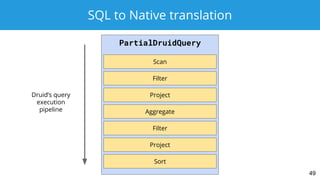
PartialDruidQuery
Scan
Filter
Project
Aggregate
Filter
Project
Sort
Druid’s query
execution
pipeline
SQL to Native translation
SELECT dim1, COUNT(*)
FROM druid.foo
WHERE dim1 IN ('abc', 'def', 'ghi')
GROUP BY dim1
50
LogicalAggregate(group=[{0}], EXPR$1=[COUNT()])
LogicalProject(dim1=[$2])
LogicalFilter(condition=[OR(=($2, 'abc'), =($2, 'def'), =($2, 'ghi'))])
LogicalTableScan(table=[[druid, foo]])
SQL to Native translation
51
PartialDruidQuery
Scan(table=[[druid, foo]])
Filter(condition=[OR(=($2,
'abc'), =($2, 'def'), =($2, 'ghi'))])
Project(dim1=[$2])
Aggregate(group=[{0}],EXPR$1=[COUNT()])
Filter
Project
Sort
LogicalTableScan(table=[[druid, foo]])
LogicalFilter(condition=[OR(=($2,
'abc'), =($2, 'def'), =($2, 'ghi'))])
LogicalProject(dim1=[$2])
LogicalAggregate(group=[{0}],EXPR$1=[COUNT()])
SQL to Native translation
52
PartialDruidQuery
Filter
Project
Sort
{
"queryType" : "groupBy",
"dataSource" : “foo”,
"filter" : {
"type" : "in",
"dimension" : "dim1",
"values" : [ "abc", "def", "ghi" ]
},
"dimensions" : [ “dim1” ],
"aggregations" : [ {
"type" : "count",
"name" : "a0"
} ],
}
Scan(table=[[druid, foo]])
Filter(condition=[OR(=($2,
'abc'), =($2, 'def'), =($2, 'ghi'))])
Project(dim1=[$2])
Aggregate(group=[{0}],EXPR$1=[COUNT()])
toDruidQuery()
SQL to Native translation
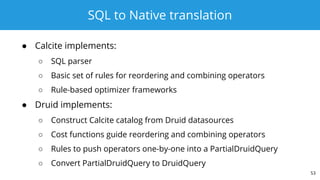
● Calcite implements:
○ SQL parser
○ Basic set of rules for reordering and combining operators
○ Rule-based optimizer frameworks
● Druid implements:
○ Construct Calcite catalog from Druid datasources
○ Cost functions guide reordering and combining operators
○ Rules to push operators one-by-one into a PartialDruidQuery
○ Convert PartialDruidQuery to DruidQuery
53
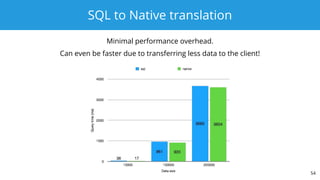
SQL to Native translation
Minimal performance overhead.
Can even be faster due to transferring less data to the client!
54
Challenges: Writing good queries
SQL makes it surprisingly easy to write inefficient queries.
Databases strive to optimize as best as they can.
But the “EXPLAIN” tool is still essential.
55
Challenges: Schema-lightness
● Druid is schema-light (columns and their types are flexible)
● SQL model has tables and columns with specific types
● Druid native queries use type coercions at query time (e.g. user
specifies: treat column XYZ as “string”)
● Druid SQL populates catalog with latest metadata
56
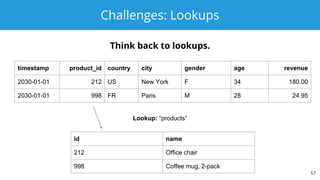
Challenges: Lookups
Think back to lookups.
57
Lookup: “products”
id name
212 Office chair
998 Coffee mug, 2-pack
timestamp product_id country city gender age revenue
2030-01-01 212 US New York F 34 180.00
2030-01-01 998 FR Paris M 28 24.95
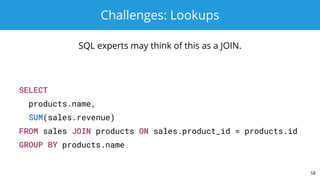
Challenges: Lookups
SQL experts may think of this as a JOIN.
SELECT
products.name,
SUM(sales.revenue)
FROM sales JOIN products ON sales.product_id = products.id
GROUP BY products.name
58
Challenges: Lookups
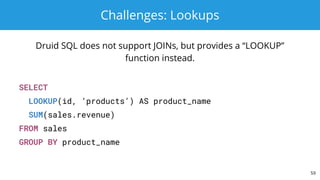
Druid SQL does not support JOINs, but provides a “LOOKUP”
function instead.
SELECT
LOOKUP(id, ‘products’) AS product_name
SUM(sales.revenue)
FROM sales
GROUP BY product_name
59
Future work
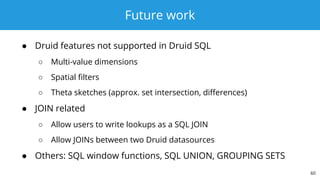
● Druid features not supported in Druid SQL
○ Multi-value dimensions
○ Spatial filters
○ Theta sketches (approx. set intersection, differences)
● JOIN related
○ Allow users to write lookups as a SQL JOIN
○ Allow JOINs between two Druid datasources
● Others: SQL window functions, SQL UNION, GROUPING SETS
60
Try this at home
61
Download
Druid community site: http://druid.io/
Imply distribution: https://imply.io/get-started
62
Contribute
63
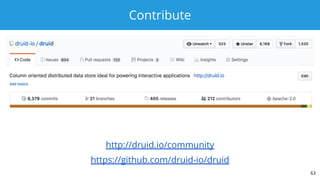
http://druid.io/community
https://github.com/druid-io/druid
Contribute
64
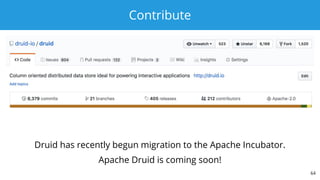
Druid has recently begun migration to the Apache Incubator.
Apache Druid is coming soon!

NoSQL no more: SQL on Druid with Apache Calcite

  • 1.
    NoSQL no more SQLon Druid with Apache Calcite Gian Merlino gian@imply.io
  • 2.
    Who am I? GianMerlino Committer & PMC member on Committer on Apache Calcite Cofounder at 2
  • 3.
    Agenda ● What isDruid? ● What is NoSQL? ● What is Apache Calcite? ● From NoSQL to SQL ● Do try this at home! 3
  • 4.
  • 5.
    What is Druid? ●“high performance”: low query latency, high ingest rates ● “column-oriented”: best possible scan rates ● “distributed”: deployed in clusters, typically 10s–100s of nodes ● “data store”: the cluster stores a copy of your data 5
  • 6.
  • 7.
    The Problem ● OLAPslice-and-dice for big data ● Interactive exploration ● Look under the hood of reports and dashboards ● And we want our data fresh, too 7
  • 8.
  • 9.
    Challenges ● Scale: bigdata is tough to process quickly ● Complexity: too much fine grain to precompute ● High dimensionality: 10s or 100s of dimensions ● Concurrency: many users and tenants ● Freshness: load from streams 9
  • 10.
    Motivation ● Sub-second responsesallow dialogue with data ● Rapid iteration on questions ● Remove barriers to understanding 10
  • 11.
    Powered by Druid 11 Source:http://druid.io/druid-powered.html
  • 12.
    Powered by Druid “Theperformance is great ... some of the tables that we have internally in Druid have billions and billions of events in them, and we’re scanning them in under a second.” 12 Source: https://www.infoworld.com/article/2949168/hadoop/yahoo-struts-its-hadoop-stuff.html From Yahoo:
  • 13.
    Druid Key Features ●Low latency ingestion from Kafka ● Bulk load from Hadoop ● Can pre-aggregate data during ingestion ● “Schema light” ● Ad-hoc queries ● Exact and approximate algorithms ● Can keep a lot of history (years are ok) 13
  • 14.
    Druid Druid makes interactivedata exploration fast and flexible, and powers analytic applications. 14
  • 15.
  • 16.
    What is NoSQL? “There'sno strong definition of the concept out there, no trademarks, no standard group, not even a manifesto.” 16 Source: https://martinfowler.com/bliki/NosqlDefinition.html
  • 17.
    What is NoSQL? Earlyexamples: Voldemort, Cassandra, Dynomite, HBase, Hypertable, CouchDB, MongoDB 17 Source: https://martinfowler.com/bliki/NosqlDefinition.html
  • 18.
    What is NoSQL? Whatare they? ● Document stores ● Key/value stores ● Graph databases ● Timeseries databases 18
  • 19.
    What is NoSQL? ●Not using the relational model (nor the SQL language) ● Open source ● Designed to run on large clusters ● Based on the needs of 21st century web properties ● No schema, allowing fields to be added to any record without controls 19 Source: https://martinfowler.com/bliki/NosqlDefinition.html
  • 20.
    Categorizing Druid ● Notusing the relational model (nor the SQL language) ● Open source ● Designed to run on large clusters ● Based on the needs of 21st century web properties ● No schema, allowing fields to be added to any record without controls 20 Source: https://martinfowler.com/bliki/NosqlDefinition.html
  • 21.
    Categorizing Druid ● Notusing the relational model (nor the SQL language) ● Open source ● Designed to run on large clusters ● Based on the needs of 21st century web properties ● No schema, allowing fields to be added to any record without controls 21 Source: https://martinfowler.com/bliki/NosqlDefinition.html
  • 22.
    Categorizing Druid ● Notusing the relational model (nor the SQL language) ● Open source ● Designed to run on large clusters ● Based on the needs of 21st century web properties ● No schema, allowing fields to be added to any record without controls 22 Source: https://martinfowler.com/bliki/NosqlDefinition.html
  • 23.
    Categorizing Druid ● Notusing the relational model (nor the SQL language) ● Open source ● Designed to run on large clusters ● Based on the needs of 21st century web properties ● No schema, allowing fields to be added to any record without controls 23 Source: https://martinfowler.com/bliki/NosqlDefinition.html
  • 24.
    Categorizing Druid ● Notusing the relational model (nor the SQL language) ● Open source ● Designed to run on large clusters ● Based on the needs of 21st century web properties ● No schema, allowing fields to be added to any record without controls 24 Source: https://martinfowler.com/bliki/NosqlDefinition.html
  • 25.
    Categorizing Druid ● Notusing the relational model (nor the SQL language) ● Open source ● Designed to run on large clusters ● Based on the needs of 21st century web properties ● No schema, allowing fields to be added to any record without controls 25 Source: https://martinfowler.com/bliki/NosqlDefinition.html
  • 26.
    Categorizing Druid Is avoidingthe SQL language and relational model really a good thing? 26
  • 27.
    The Relational Model ●The relational model is based around relations ● SQL calls them tables and those tables have columns ● SQL queries describe relational operations ○ Scan ○ Project ○ Filter ○ Aggregate ○ Union ○ Join 27
  • 28.
    The Relational Model 28 timestampproduct_id user_id revenue 2030-01-01 212 1 180.00 2030-01-01 998 2 24.95 Table: “sales” Table: “products” id name 212 Office chair 998 Coffee mug, 2-pack Table: “users” id country city user_gender user_age 1 US New York F 34 2 FR Paris M 28
  • 29.
    Druid and theRelational Model 29 timestamp product country city gender age revenue 2030-01-01 Office chair US New York F 34 180.00 2030-01-01 Coffee mug, 2-pack FR Paris M 28 24.95 Datasource: “sales”
  • 30.
    Druid and theRelational Model 30 Datasource: “sales” Lookup: “products” id name 212 Office chair 998 Coffee mug, 2-pack timestamp product_id country city gender age revenue 2030-01-01 212 US New York F 34 180.00 2030-01-01 998 FR Paris M 28 24.95
  • 31.
    Druid and theRelational Model ● Datasources are like tables ○ Druid “lookups” apply to a common join use case ○ Big, flat tables are common in SQL databases anyway, when analytical performance is critical ● Benefits of offering SQL ○ Developers and analysts know it ○ Integration with 3rd party apps 31
  • 32.
  • 33.
    Apache Calcite ● SQLparser ● Query optimizer ● Query interpreter ● JDBC server (Avatica) 33
  • 34.
    Apache Calcite ● Widelyused ○ Druid ○ Hive ○ Storm ○ Samza ○ Drill ○ Phoenix ○ Flink 34
  • 35.
    Apache Calcite 35 SQL SqlNode Parse tree RelNode Relational operatortree RelNode Optimized in target calling convention
  • 36.
    SQL query SELECT dim1,COUNT(*) FROM druid.foo WHERE dim1 IN ('abc', 'def', 'ghi') GROUP BY dim1 36
  • 37.
    SQL parse tree SELECTdim1, COUNT(*) FROM druid.foo WHERE dim1 IN ('abc', 'def', 'ghi') GROUP BY dim1 37 Identifier“Select” keyword Operator Identifier Literal“Where” keyword “Group by” keyword
  • 38.
    Relational operators SELECT dim1,COUNT(*) FROM druid.foo WHERE dim1 IN ('abc', 'def', 'ghi') GROUP BY dim1 38 LogicalAggregate(group=[{0}], EXPR$1=[COUNT()]) LogicalProject(dim1=[$2]) LogicalFilter(condition=[OR(=($2, 'abc'), =($2, 'def'), =($2, 'ghi'))]) LogicalTableScan(table=[[druid, foo]])
  • 39.
    Query planner ● Plannerrules ○ Match certain relational operator patterns ○ Can transform one set of operators into another ○ New set must have same behavior, but may have a different cost ● HepPlanner (heuristic) ○ Applies all matching rules ● VolcanoPlanner (cost based) ○ Applies rules while searching for low cost plans 39
  • 40.
    Using Calcite Calcite canbe embedded or it can be used directly by end-users. Druid SQL embeds Calcite. 40
  • 41.
  • 42.
    Native vs SQL { "queryType":"topN", "dataSource": “wikipedia”, "dimension": "countryName", "metric": { "type": "numeric", "metric": "added" }, "intervals": "2018-03-01/2018-03-06", "filter": { "type": "and", "fields": [ { "type": "selector", "dimension": "channel", "value": "#en.wikipedia", "extractionFn": null }, { "type": "not", "field": { "type": "selector", "dimension": "countryName", "value": "", "extractionFn": null } } ] }, "granularity": "all", "aggregations": [ { "type": "longSum", "name": "added", "fieldName": "added" } ], "threshold": 5 } SELECT countryName, SUM(added) FROM wikipedia WHERE channel = '#en.wikipedia' AND countryName IS NOT NULL AND __time BETWEEN '2018-03-01' AND '2018-03-06' GROUP BY countryName ORDER BY SUM(added) DESC LIMIT 5 42
  • 43.
    Native vs SQL { "queryType":"topN", "dataSource": “wikipedia”, "dimension": "countryName", "metric": { "type": "numeric", "metric": "added" }, "intervals": "2018-03-01/2018-03-06", "filter": { "type": "and", "fields": [ { "type": "selector", "dimension": "channel", "value": "#en.wikipedia", "extractionFn": null }, { "type": "not", "field": { "type": "selector", "dimension": "countryName", "value": "", "extractionFn": null } } ] }, "granularity": "all", "aggregations": [ { "type": "longSum", "name": "added", "fieldName": "added" } ], "threshold": 5 } SELECT countryName, SUM(added) FROM wikipedia WHERE channel = '#en.wikipedia' AND countryName IS NOT NULL AND __time BETWEEN '2018-03-01' AND '2018-03-06' GROUP BY countryName ORDER BY SUM(added) DESC LIMIT 5 43
  • 44.
    Native vs SQL { "queryType":"topN", "dataSource": “wikipedia”, "dimension": "countryName", "metric": { "type": "numeric", "metric": "added" }, "intervals": "2018-03-01/2018-03-06", "filter": { "type": "and", "fields": [ { "type": "selector", "dimension": "channel", "value": "#en.wikipedia", "extractionFn": null }, { "type": "not", "field": { "type": "selector", "dimension": "countryName", "value": "", "extractionFn": null } } ] }, "granularity": "all", "aggregations": [ { "type": "longSum", "name": "added", "fieldName": "added" } ], "threshold": 5 } SELECT countryName, SUM(added) FROM wikipedia WHERE channel = '#en.wikipedia' AND countryName IS NOT NULL AND __time BETWEEN '2018-03-01' AND '2018-03-06' GROUP BY countryName ORDER BY SUM(added) DESC LIMIT 5 44
  • 45.
    Native vs SQL { "queryType":"topN", "dataSource": “wikipedia”, "dimension": "countryName", "metric": { "type": "numeric", "metric": "added" }, "intervals": "2018-03-01/2018-03-06", "filter": { "type": "and", "fields": [ { "type": "selector", "dimension": "channel", "value": "#en.wikipedia", "extractionFn": null }, { "type": "not", "field": { "type": "selector", "dimension": "countryName", "value": "", "extractionFn": null } } ] }, "granularity": "all", "aggregations": [ { "type": "longSum", "name": "added", "fieldName": "added" } ], "threshold": 5 } SELECT countryName, SUM(added) FROM wikipedia WHERE channel = '#en.wikipedia' AND countryName IS NOT NULL AND __time BETWEEN '2018-03-01' AND '2018-03-06' GROUP BY countryName ORDER BY SUM(added) DESC LIMIT 5 45
  • 46.
    Native vs SQL { "queryType":"topN", "dataSource": “wikipedia”, "dimension": "countryName", "metric": { "type": "numeric", "metric": "added" }, "intervals": "2018-03-01/2018-03-06", "filter": { "type": "and", "fields": [ { "type": "selector", "dimension": "channel", "value": "#en.wikipedia", "extractionFn": null }, { "type": "not", "field": { "type": "selector", "dimension": "countryName", "value": "", "extractionFn": null } } ] }, "granularity": "all", "aggregations": [ { "type": "longSum", "name": "added", "fieldName": "added" } ], "threshold": 5 } SELECT countryName, SUM(added) FROM wikipedia WHERE channel = '#en.wikipedia' AND countryName IS NOT NULL AND __time BETWEEN '2018-03-01' AND '2018-03-06' GROUP BY countryName ORDER BY SUM(added) DESC LIMIT 5 46
  • 47.
    Native vs SQL { "queryType":"topN", "dataSource": “wikipedia”, "dimension": "countryName", "metric": { "type": "numeric", "metric": "added" }, "intervals": "2018-03-01/2018-03-06", "filter": { "type": "and", "fields": [ { "type": "selector", "dimension": "channel", "value": "#en.wikipedia", "extractionFn": null }, { "type": "not", "field": { "type": "selector", "dimension": "countryName", "value": "", "extractionFn": null } } ] }, "granularity": "all", "aggregations": [ { "type": "longSum", "name": "added", "fieldName": "added" } ], "threshold": 5 } SELECT countryName, SUM(added) FROM wikipedia WHERE channel = '#en.wikipedia' AND countryName IS NOT NULL AND __time BETWEEN '2018-03-01' AND '2018-03-06' GROUP BY countryName ORDER BY SUM(added) DESC LIMIT 5 47
  • 48.
    Native vs SQL { "queryType":"topN", "dataSource": “wikipedia”, "dimension": "countryName", "metric": { "type": "numeric", "metric": "added" }, "intervals": "2018-03-01/2018-03-06", "filter": { "type": "and", "fields": [ { "type": "selector", "dimension": "channel", "value": "#en.wikipedia", "extractionFn": null }, { "type": "not", "field": { "type": "selector", "dimension": "countryName", "value": "", "extractionFn": null } } ] }, "granularity": "all", "aggregations": [ { "type": "longSum", "name": "added", "fieldName": "added" } ], "threshold": 5 } SELECT countryName, SUM(added) FROM wikipedia WHERE channel = '#en.wikipedia' AND countryName IS NOT NULL AND __time BETWEEN '2018-03-01' AND '2018-03-06' GROUP BY countryName ORDER BY SUM(added) DESC LIMIT 5 48
  • 49.
    SQL to Nativetranslation 49 PartialDruidQuery Scan Filter Project Aggregate Filter Project Sort Druid’s query execution pipeline
  • 50.
    SQL to Nativetranslation SELECT dim1, COUNT(*) FROM druid.foo WHERE dim1 IN ('abc', 'def', 'ghi') GROUP BY dim1 50 LogicalAggregate(group=[{0}], EXPR$1=[COUNT()]) LogicalProject(dim1=[$2]) LogicalFilter(condition=[OR(=($2, 'abc'), =($2, 'def'), =($2, 'ghi'))]) LogicalTableScan(table=[[druid, foo]])
  • 51.
    SQL to Nativetranslation 51 PartialDruidQuery Scan(table=[[druid, foo]]) Filter(condition=[OR(=($2, 'abc'), =($2, 'def'), =($2, 'ghi'))]) Project(dim1=[$2]) Aggregate(group=[{0}],EXPR$1=[COUNT()]) Filter Project Sort LogicalTableScan(table=[[druid, foo]]) LogicalFilter(condition=[OR(=($2, 'abc'), =($2, 'def'), =($2, 'ghi'))]) LogicalProject(dim1=[$2]) LogicalAggregate(group=[{0}],EXPR$1=[COUNT()])
  • 52.
    SQL to Nativetranslation 52 PartialDruidQuery Filter Project Sort { "queryType" : "groupBy", "dataSource" : “foo”, "filter" : { "type" : "in", "dimension" : "dim1", "values" : [ "abc", "def", "ghi" ] }, "dimensions" : [ “dim1” ], "aggregations" : [ { "type" : "count", "name" : "a0" } ], } Scan(table=[[druid, foo]]) Filter(condition=[OR(=($2, 'abc'), =($2, 'def'), =($2, 'ghi'))]) Project(dim1=[$2]) Aggregate(group=[{0}],EXPR$1=[COUNT()]) toDruidQuery()
  • 53.
    SQL to Nativetranslation ● Calcite implements: ○ SQL parser ○ Basic set of rules for reordering and combining operators ○ Rule-based optimizer frameworks ● Druid implements: ○ Construct Calcite catalog from Druid datasources ○ Cost functions guide reordering and combining operators ○ Rules to push operators one-by-one into a PartialDruidQuery ○ Convert PartialDruidQuery to DruidQuery 53
  • 54.
    SQL to Nativetranslation Minimal performance overhead. Can even be faster due to transferring less data to the client! 54
  • 55.
    Challenges: Writing goodqueries SQL makes it surprisingly easy to write inefficient queries. Databases strive to optimize as best as they can. But the “EXPLAIN” tool is still essential. 55
  • 56.
    Challenges: Schema-lightness ● Druidis schema-light (columns and their types are flexible) ● SQL model has tables and columns with specific types ● Druid native queries use type coercions at query time (e.g. user specifies: treat column XYZ as “string”) ● Druid SQL populates catalog with latest metadata 56
  • 57.
    Challenges: Lookups Think backto lookups. 57 Lookup: “products” id name 212 Office chair 998 Coffee mug, 2-pack timestamp product_id country city gender age revenue 2030-01-01 212 US New York F 34 180.00 2030-01-01 998 FR Paris M 28 24.95
  • 58.
    Challenges: Lookups SQL expertsmay think of this as a JOIN. SELECT products.name, SUM(sales.revenue) FROM sales JOIN products ON sales.product_id = products.id GROUP BY products.name 58
  • 59.
    Challenges: Lookups Druid SQLdoes not support JOINs, but provides a “LOOKUP” function instead. SELECT LOOKUP(id, ‘products’) AS product_name SUM(sales.revenue) FROM sales GROUP BY product_name 59
  • 60.
    Future work ● Druidfeatures not supported in Druid SQL ○ Multi-value dimensions ○ Spatial filters ○ Theta sketches (approx. set intersection, differences) ● JOIN related ○ Allow users to write lookups as a SQL JOIN ○ Allow JOINs between two Druid datasources ● Others: SQL window functions, SQL UNION, GROUPING SETS 60
  • 61.
    Try this athome 61
  • 62.
    Download Druid community site:http://druid.io/ Imply distribution: https://imply.io/get-started 62
  • 63.
  • 64.
    Contribute 64 Druid has recentlybegun migration to the Apache Incubator. Apache Druid is coming soon!