As the largest cancer center in Northern
Europe, combining a hospital and a
research arm (the Institute for Cancer
Research), the Norwegian Radium
Hospital is leading the way with new
cancer treatments and ground-breaking
scientific advancements. With the
implementation of IMPAX Volume
Viewing, one of the latest clinical
applications available for IMPAX, the
hospital has applied that same approach
to the technology and processes that
support the work of its professional
teams.
As a cancer center, the hospital's
imaging requirements are complex.
Many diverse groups within the hospital
work with patient images; and there is
also a high volume of images to manage
– both those that come from outside,
from referring physicians across Norway,
and those from exams performed within
the hospital itself. "We have more exams
coming in from referring doctors than
those we do ourselves," says Dr. Cathrine
Saxhaug, Specialist in Oncologic
Radiology, whose primary focus is on
brain tumors and head and neck cancer.
Diagnostic imaging is used to diagnose
cancer, and also to assess responses to
treatment. In addition, many research
protocols are more image-intensive
than clinical imaging, and they can also
require more types of imaging.
Customer Case: NORWEGIAN RADIUM HOSPITAL, OSLO, NORWAY
Helping multi-disciplinary teams work
together more efficiently
‘Easier image interpretation’ and streamlined management of high image volumes
deliver more informed treatment plans at leading cancer center
Interviewee Dr. Cathrine Saxhaug, Specialist in Oncologic Radiology
Another difference as a cancer center
is the close cooperation between
the radiologists and the oncologists,
physicists and technicians who perform
radiation therapy. "We really work
together as a team," says Dr. Saxhaug.
Faster, easier image
interpretation and detection of
pathologies
The heaviest imaging demands come
from the large volumes generated
by MR. "We do a lot of 3D volume
imaging, so we need to have a system
that displays the volumes effectively,"
explains Dr. Saxhaug. The hospital uses
IMPAX Volume Viewing mainly for MR,
but also CT and PET CT. "In MR we
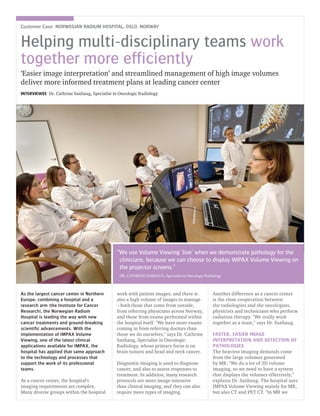
“We use Volume Viewing ‘live’ when we demonstrate pathology for the
clinicians, because we can choose to display IMPAX Volume Viewing on
the projector screens.”
Dr. Cathrine Saxhaug, Specialist in Oncologic Radiology
“The advanced functionality of
automatic registration and fusion
is extremely helpful and useful
for us.”
Dr. Cathrine Saxhaug,
Specialist in Oncologic Radiology
use it all the time," says Dr. Saxhaug.
"It gives us a better visualization of
the image volumes, and it is easier
to interpret the images and to find
pathologies. Another major use for
IMPAX Volume Viewing is to compare
two sets of images effectively by
using the registration tool: either a
comparison of two different sequences
from the same exam or a comparison of
the same sequence from two different
exams. This is an efficient way of
monitoring tumor development and
treatment response over time."
IMPAX Volume Viewing offers advanced
visualization tools including MIP/MPR,
volume rendering and segmentation,
and allows users to save reconstructed
series, static screenshots and video
captures. With IMPAX Volume Viewing
PLUS (an optional extension for IMPAX
Volume Viewing), users at the Norwegian
Radium Hospital can also view series in
fusion mode or subtraction mode, and
it offers automatic registration of both
volumes. "The advanced functionality
of automatic registration and fusion is
extremely helpful and useful for us," says
Dr. Saxhaug.
A tight integration with IMPAX PACS
makes IMPAX Volume Viewing highly
efficient. "It improves the workflow, and
you don't waste time loading all the
images," comments Dr. Saxhaug. "It is
seamless, easy to use, fast, offers a high
level of automation and it has a familiar
user interface."
Radiology-led MEETINGS benefit
with better view of patient
information
The radiologists at the hospital
hold daily and weekly meetings in
the radiology department, where
they demonstrate pathology for the
hospital's clinicians. "In Norway,
these meetings are a central way
for the radiologists to provide
information to clinicians," says Dr.
Saxhaug.
The daily meetings focus on cancer
patients who will be operated on, or
receive radiation treatment, that day.
Clinicians attend in groups, according
to their specialty area. For example
the oncologists who are working with
brain tumors come as a group, or the
surgeons who are working with breast
cancer. "We use Volume Viewing 'live'
when we demonstrate pathology for
the clinicians, because we can choose
to display IMPAX Volume Viewing on
the projector screens. It gives them
a better picture of the pathology. For
the surgeons, for example, it makes
it easier to visualize the tumors in
reference to neighboring structures."
The radiologists also host weekly
multi-disciplinary team meetings,
which are attended by surgeons,
oncologists, pathologists and nurses.
These meetings include discussions
on cancer treatment options and next
steps, and here also the participants
refer extensively to patient images.
“It gives us a better visualization
of the image volumes, and it is
easier to interpret the images
and to find pathologies.”
Dr. Cathrine Saxhaug,
Specialist in Oncologic Radiology
IMPAX Volume Viewing
» Provides radiologists with advanced
visualization tools to diagnose large CT and
MR volumes
» Covers MIP/MPR, volume rendering and
segmentation
» Allows users to save reconstructed series,
static screenshots and video captures
IMPAX Volume Viewing PLUS
» Optional extension, allows users to view two
series from the same or from different studies
simultaneously and view series in fusion
or subtraction mode, and offers automatic
registration of both volumes as well as
stereoscopic 3D view
IMPAX PACS
» World leader in enterprise-wide image and
information management
» Offers seamless integration with IMPAX
Clinical Applications
Solutions
» Builds solutions that integrate seamlessly,
across modalities and enterprise IT
» In-depth knowledge of image and information
management, founded on decades of
experience with PACS
» Can scale solutions and expertise according
to modality and connectivity requirements
Agfa HealthCare’s contribution
» The Institute for Cancer Research has
internationally strong research groups within
biochemistry, cell and tumor biology, genetics,
radiation biology, immunology and cancer
prevention.
» The Norwegian Radium Hospital is part of the
Oslo University Hospital, one of the largest
hospitals in Scandinavia, with more than 40
different locations, and more than 20,000
employees.
» Oslo University Hospital treats more than 1.2
million patients each year.
DID YOU KNOW…
In addition to providing a better view
of the images, the implementation of
IMPAX Volume Viewing has also helped
to streamline the daily and weekly
meeting process. "Because the Volume
Viewing is so tightly integrated with
IMPAX, we can start volume viewing
right when we are in a specific study,"
describes Dr. Saxhaug. "We use the
IMPAX PACS as the 'mother' system, and
we have two image screens plus a third
screen where we have Volume Viewing.
We are looking to add a fourth screen,
which will add an area for text as well."
New applications to help
manage images and aid in
diagnoses coming in future
A challenge for the Norwegian Radium
Hospital, and for hospitals around
the world, is how best to manage the
exponential increase and complexity in
images and data. Agfa HealthCare has
introduced IMPAX Volume Viewing and
a range of other clinical applications
in answer to this need, and is working
on others that will further address the
management of large image and data
volumes.
For Dr. Saxhaug, advances in
technology in this area will become
increasingly important. "We use a
combination of different imaging
types and different modalities in the
majority of patients, which means
a lot of information for radiologists
to sort. We need more help from
computers, in sorting different
types of signal intensities from all
the different types of sequences.
This is what I think technology will
do in the future. If you 'teach' it, a
computer can sort this huge amount
of information rapidly and present
it to us, much more easily than if we
look through every single image of
an exam that has 7,000 images. We
are moving more and more in this
direction," she concludes. •
© Agfa HealthCare 2013
IMPAX is a trademark of Agfa HealthCare NV, Belgium or its affiliates. www.agfahealthcare.com

Norway_Oslo_ClinApps

  • 1.
    As the largestcancer center in Northern Europe, combining a hospital and a research arm (the Institute for Cancer Research), the Norwegian Radium Hospital is leading the way with new cancer treatments and ground-breaking scientific advancements. With the implementation of IMPAX Volume Viewing, one of the latest clinical applications available for IMPAX, the hospital has applied that same approach to the technology and processes that support the work of its professional teams. As a cancer center, the hospital's imaging requirements are complex. Many diverse groups within the hospital work with patient images; and there is also a high volume of images to manage – both those that come from outside, from referring physicians across Norway, and those from exams performed within the hospital itself. "We have more exams coming in from referring doctors than those we do ourselves," says Dr. Cathrine Saxhaug, Specialist in Oncologic Radiology, whose primary focus is on brain tumors and head and neck cancer. Diagnostic imaging is used to diagnose cancer, and also to assess responses to treatment. In addition, many research protocols are more image-intensive than clinical imaging, and they can also require more types of imaging. Customer Case: NORWEGIAN RADIUM HOSPITAL, OSLO, NORWAY Helping multi-disciplinary teams work together more efficiently ‘Easier image interpretation’ and streamlined management of high image volumes deliver more informed treatment plans at leading cancer center Interviewee Dr. Cathrine Saxhaug, Specialist in Oncologic Radiology Another difference as a cancer center is the close cooperation between the radiologists and the oncologists, physicists and technicians who perform radiation therapy. "We really work together as a team," says Dr. Saxhaug. Faster, easier image interpretation and detection of pathologies The heaviest imaging demands come from the large volumes generated by MR. "We do a lot of 3D volume imaging, so we need to have a system that displays the volumes effectively," explains Dr. Saxhaug. The hospital uses IMPAX Volume Viewing mainly for MR, but also CT and PET CT. "In MR we “We use Volume Viewing ‘live’ when we demonstrate pathology for the clinicians, because we can choose to display IMPAX Volume Viewing on the projector screens.” Dr. Cathrine Saxhaug, Specialist in Oncologic Radiology
  • 2.
    “The advanced functionalityof automatic registration and fusion is extremely helpful and useful for us.” Dr. Cathrine Saxhaug, Specialist in Oncologic Radiology use it all the time," says Dr. Saxhaug. "It gives us a better visualization of the image volumes, and it is easier to interpret the images and to find pathologies. Another major use for IMPAX Volume Viewing is to compare two sets of images effectively by using the registration tool: either a comparison of two different sequences from the same exam or a comparison of the same sequence from two different exams. This is an efficient way of monitoring tumor development and treatment response over time." IMPAX Volume Viewing offers advanced visualization tools including MIP/MPR, volume rendering and segmentation, and allows users to save reconstructed series, static screenshots and video captures. With IMPAX Volume Viewing PLUS (an optional extension for IMPAX Volume Viewing), users at the Norwegian Radium Hospital can also view series in fusion mode or subtraction mode, and it offers automatic registration of both volumes. "The advanced functionality of automatic registration and fusion is extremely helpful and useful for us," says Dr. Saxhaug. A tight integration with IMPAX PACS makes IMPAX Volume Viewing highly efficient. "It improves the workflow, and you don't waste time loading all the images," comments Dr. Saxhaug. "It is seamless, easy to use, fast, offers a high level of automation and it has a familiar user interface." Radiology-led MEETINGS benefit with better view of patient information The radiologists at the hospital hold daily and weekly meetings in the radiology department, where they demonstrate pathology for the hospital's clinicians. "In Norway, these meetings are a central way for the radiologists to provide information to clinicians," says Dr. Saxhaug. The daily meetings focus on cancer patients who will be operated on, or receive radiation treatment, that day. Clinicians attend in groups, according to their specialty area. For example the oncologists who are working with brain tumors come as a group, or the surgeons who are working with breast cancer. "We use Volume Viewing 'live' when we demonstrate pathology for the clinicians, because we can choose to display IMPAX Volume Viewing on the projector screens. It gives them a better picture of the pathology. For the surgeons, for example, it makes it easier to visualize the tumors in reference to neighboring structures." The radiologists also host weekly multi-disciplinary team meetings, which are attended by surgeons, oncologists, pathologists and nurses. These meetings include discussions on cancer treatment options and next steps, and here also the participants refer extensively to patient images.
  • 3.
    “It gives usa better visualization of the image volumes, and it is easier to interpret the images and to find pathologies.” Dr. Cathrine Saxhaug, Specialist in Oncologic Radiology IMPAX Volume Viewing » Provides radiologists with advanced visualization tools to diagnose large CT and MR volumes » Covers MIP/MPR, volume rendering and segmentation » Allows users to save reconstructed series, static screenshots and video captures IMPAX Volume Viewing PLUS » Optional extension, allows users to view two series from the same or from different studies simultaneously and view series in fusion or subtraction mode, and offers automatic registration of both volumes as well as stereoscopic 3D view IMPAX PACS » World leader in enterprise-wide image and information management » Offers seamless integration with IMPAX Clinical Applications Solutions » Builds solutions that integrate seamlessly, across modalities and enterprise IT » In-depth knowledge of image and information management, founded on decades of experience with PACS » Can scale solutions and expertise according to modality and connectivity requirements Agfa HealthCare’s contribution » The Institute for Cancer Research has internationally strong research groups within biochemistry, cell and tumor biology, genetics, radiation biology, immunology and cancer prevention. » The Norwegian Radium Hospital is part of the Oslo University Hospital, one of the largest hospitals in Scandinavia, with more than 40 different locations, and more than 20,000 employees. » Oslo University Hospital treats more than 1.2 million patients each year. DID YOU KNOW… In addition to providing a better view of the images, the implementation of IMPAX Volume Viewing has also helped to streamline the daily and weekly meeting process. "Because the Volume Viewing is so tightly integrated with IMPAX, we can start volume viewing right when we are in a specific study," describes Dr. Saxhaug. "We use the IMPAX PACS as the 'mother' system, and we have two image screens plus a third screen where we have Volume Viewing. We are looking to add a fourth screen, which will add an area for text as well." New applications to help manage images and aid in diagnoses coming in future A challenge for the Norwegian Radium Hospital, and for hospitals around the world, is how best to manage the exponential increase and complexity in images and data. Agfa HealthCare has introduced IMPAX Volume Viewing and a range of other clinical applications in answer to this need, and is working on others that will further address the management of large image and data volumes. For Dr. Saxhaug, advances in technology in this area will become increasingly important. "We use a combination of different imaging types and different modalities in the majority of patients, which means a lot of information for radiologists to sort. We need more help from computers, in sorting different types of signal intensities from all the different types of sequences. This is what I think technology will do in the future. If you 'teach' it, a computer can sort this huge amount of information rapidly and present it to us, much more easily than if we look through every single image of an exam that has 7,000 images. We are moving more and more in this direction," she concludes. • © Agfa HealthCare 2013 IMPAX is a trademark of Agfa HealthCare NV, Belgium or its affiliates. www.agfahealthcare.com