How are We Doing?
A Look into Northside ISD’s Technology in Schools
Over 250,000 students, teachers and parents
(across more than 3,000 schools nationwide)
were surveyed regarding technology in schools.
Here is what they said…
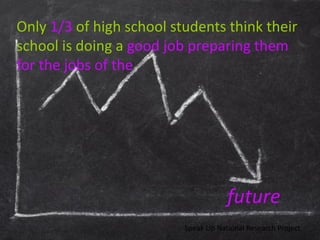
Only 1/3 of high school students think their
school is doing a good job preparing them
for the jobs of the


                                      future
                          Speak Up National Research Project
Students want access to
Digital resources
Games/virtual simulations
Video conferencing
              Speak Up National Research Project
Students say:
“let me use my own
devices and tools in
the school day”


                       Speak Up National Research Project
Students want
  24/7 access to information
Laptops for every student that can be taken
home (35%)
  Fast, wireless Internet access throughout
  the school (16%)
Computer labs that stay open after school and
on weekends (10%)


                          Speak Up National Research Project
1 out of 2 elementary school students
play educational computer games online


                     Speak Up National Research Project
1 out of 2 middle school
students create slide shows
and videos to demonstrate
their content knowledge
proficiency


                     Speak Up National Research Project
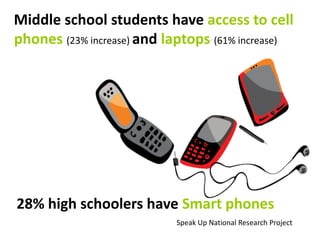
Middle school students have access to cell
phones (23% increase) and laptops (61% increase)


28% high schoolers have Smart phones
                           Speak Up National Research Project
They use technology to communicate,
organize their life, collaborate and create
content and context for their own learning


                        Speak Up National Research Project
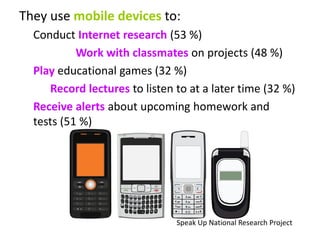
They use mobile devices to:
  Conduct Internet research (53 %)
           Work with classmates on projects (48 %)
  Play educational games (32 %)
     Record lectures to listen to at a later time (32 %)
  Receive alerts about upcoming homework and
  tests (51 %)


                               Speak Up National Research Project
Half of the 6-12 grade students use
 e-mail, IM and text messaging.


                    Speak Up National Research Project
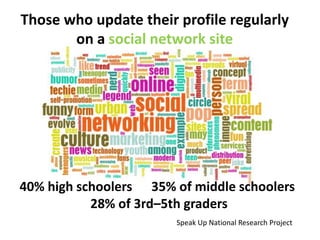
Those who update their profile regularly
       on a social network site


40% high schoolers 35% of middle schoolers
           28% of 3rd–5th graders
                       Speak Up National Research Project
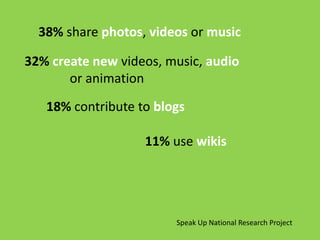
38% share photos, videos or music

32% create new videos, music, audio
       or animation
   18% contribute to blogs

                   11% use wikis


                        Speak Up National Research Project
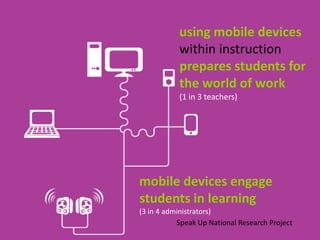
using mobile devices
           within instruction
           prepares students for
           the world of work
           (1 in 3 teachers)


mobile devices engage
students in learning
(3 in 4 administrators)
           Speak Up National Research Project
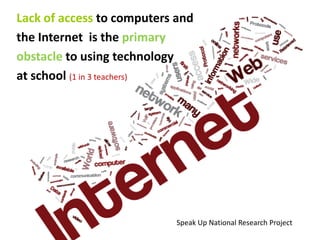
Lack of access to computers and
the Internet is the primary
obstacle to using technology
at school (1 in 3 teachers)


                            Speak Up National Research Project
What do parents want?
Better access to computers in schools
Training for teachers on technology integration
Training for students on how to use technology
                           for school work


                           Speak Up National Research Project
1 in 3 parents recommend
including games, video clips or
power point presentations to
help their child learn

1 in 5 parents would
include online classes in
their child’s school


         Speak Up National Research Project
How is Northside ISD doing with
        Technology Integration?
100% of campuses
               completely wireless
Texas teachers identified that fast, wireless Internet access was critical along with
professional development time for learning new technologies. Long Range Plan for
Technology, 2006-2020
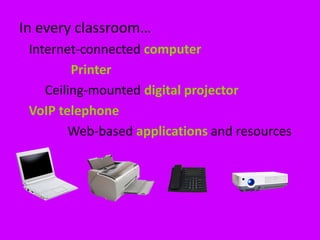
In every classroom…
 Internet-connected computer
         Printer
    Ceiling-mounted digital projector
 VoIP telephone
        Web-based applications and resources
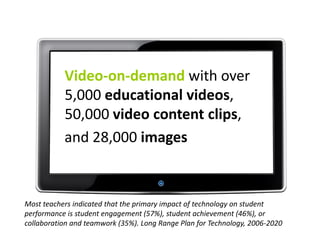
Video-on-demand with over
           5,000 educational videos,
           50,000 video content clips,
           and 28,000 images


Most teachers indicated that the primary impact of technology on student
performance is student engagement (57%), student achievement (46%), or
collaboration and teamwork (35%). Long Range Plan for Technology, 2006-2020
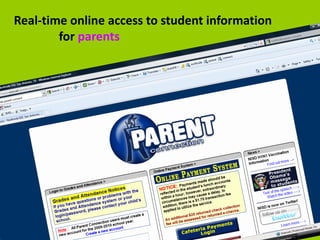
Real-time online access to student information
        for parents
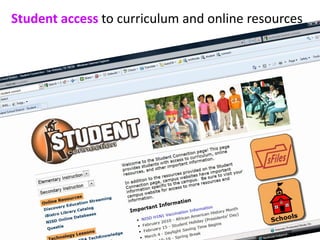
Student access to curriculum and online resources
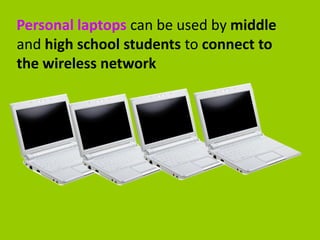
Personal laptops can be used by middle
and high school students to connect to
the wireless network
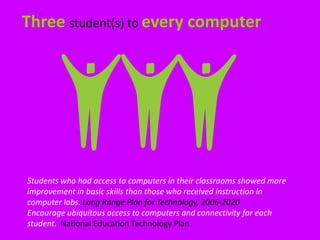
Three student(s) to every computer


Students who had access to computers in their classrooms showed more
improvement in basic skills than those who received instruction in
computer labs. Long Range Plan for Technology, 2006-2020
Encourage ubiquitous access to computers and connectivity for each
student. National Education Technology Plan
Smart phones, iPhones, iTouch, iPods
not allowed during the school day

YouTube, Myspace,
Facebook, gaming and
entertainment sites
are blocked from students
As more young people carry mobiles, some innovative
schools are beginning to consider how to use mobiles
as tools for K-12 education. The implications for K-12
education are dramatic: the potential for mobile
gaming and simulation, research aids, field work,
and tools for learning of all kinds is there, awaiting
development. The Horizon Report: 2009 K-12 Edition
Only five campuses have
                   video conferencing
                        capabilities


Videoconferencing affords enrichment activities with classroom students interacting,
at a distance, with selected peers, experts, and celebrities. Terry Anderson
One-to-one computing only in
               business magnet school
Only educators in new schools
            receive a laptop


Social networks can be accessed at school
by teachers only
The common features that unite collaborative environments are that multiple
people can work within them at once; that users can leave evidence of their
thoughts and reflections on the thoughts of others; and that they can support
users in any location at any time. The Horizon Report: 2009 K-12 Edition


              Only three mobile carts with 40 iPods
              each to rotate among 104 classrooms
Sirsi Library Management system for
student research

Computer-based instructional initiatives –
online & virtual courses, RiverDeep Destination
Math for elementary/middle school students
Provide every student access to e-learning 24/7. National Education Technology Plan
Bi-monthly technology training for teachers

Online courses, webinars for professional
development
Ongoing training for technology staff

100% completion of STaR Chart
Professional development must ensure that all educators understand the importance
of learning about educational technology and the many possibilities of its use. Long
Range Plan for Technology, 2006-2020

Teachers need access to research, examples, and innovations as well as staff
development to learn best practices. Enable every teacher to participate in e-learning
training. National Education Technology Plan
Although Northside ISD has made significant
strides in integrating technology and making it
accessible to students, there is still more that
the district can expand on. Expanding online
classes for students and teachers; permitting
the use of mobile devices in the classroom;
installing videoconferencing capabilities at each
school; allowing students to use social networks
for online collaborations; and providing 1 to 1
computing in classrooms are key tools for the
success of the 21st Century classroom.
Sources
A National Education Technology Plan: The Future is Now. 2006. Downloaded on February 12,
  2010 from http://www2.ed.gov/about/offices/list/os/technology/
  plan/2004/site/edlite-default.html
Long-Range Plan for Technology, 2006-2020, A Report to the 80th Texas Legislature from the
  Texas Education Agency. Downloaded on February 10, 2010 from
  http://ritter.tea.state.tx.us/technology/lrpt/LRPTCompleteDec06.pdf
Northside Notes- February 1, 2006. Downloaded on February 12, 2010 from
  http://www.nisd.net/technology/video_conf.pdf
Personal student laptops allowed in school. NISD Communications Department
  July 24, 2009. Downloaded on February 12, 2010 from
  http://www.nisd.net/news/articles/664
Speak Up 2007 for Students, Teachers, Parents & School Leaders. 2008. Downloaded on
  February 10, 2010 from http://www.tomorrow.org/speakup/index.html
Speak Up 2008 for Students, Teachers, Parents and Administrators. 2009. Downloaded on
  February 10, 2010 from
  http://www.tomorrow.org/docs/SU08_selected%20national_findings_complete.pdf
Reich, Steve. Music for 18 Musicians. Section 9. Steve Reich and Musicians.

Northside ISD Technology in Schools

  • 1.
    How are WeDoing? A Look into Northside ISD’s Technology in Schools
  • 2.
    Over 250,000 students,teachers and parents (across more than 3,000 schools nationwide) were surveyed regarding technology in schools. Here is what they said…
  • 3.
    Only 1/3 ofhigh school students think their school is doing a good job preparing them for the jobs of the future Speak Up National Research Project
  • 4.
    Students want accessto Digital resources Games/virtual simulations Video conferencing Speak Up National Research Project
  • 5.
    Students say: “let meuse my own devices and tools in the school day” Speak Up National Research Project
  • 6.
    Students want 24/7 access to information Laptops for every student that can be taken home (35%) Fast, wireless Internet access throughout the school (16%) Computer labs that stay open after school and on weekends (10%) Speak Up National Research Project
  • 7.
    1 out of2 elementary school students play educational computer games online Speak Up National Research Project
  • 8.
    1 out of2 middle school students create slide shows and videos to demonstrate their content knowledge proficiency Speak Up National Research Project
  • 9.
    Middle school studentshave access to cell phones (23% increase) and laptops (61% increase) 28% high schoolers have Smart phones Speak Up National Research Project
  • 10.
    They use technologyto communicate, organize their life, collaborate and create content and context for their own learning Speak Up National Research Project
  • 11.
    They use mobiledevices to: Conduct Internet research (53 %) Work with classmates on projects (48 %) Play educational games (32 %) Record lectures to listen to at a later time (32 %) Receive alerts about upcoming homework and tests (51 %) Speak Up National Research Project
  • 12.
    Half of the6-12 grade students use e-mail, IM and text messaging. Speak Up National Research Project
  • 13.
    Those who updatetheir profile regularly on a social network site 40% high schoolers 35% of middle schoolers 28% of 3rd–5th graders Speak Up National Research Project
  • 14.
    38% share photos,videos or music 32% create new videos, music, audio or animation 18% contribute to blogs 11% use wikis Speak Up National Research Project
  • 15.
    using mobile devices within instruction prepares students for the world of work (1 in 3 teachers) mobile devices engage students in learning (3 in 4 administrators) Speak Up National Research Project
  • 16.
    Lack of accessto computers and the Internet is the primary obstacle to using technology at school (1 in 3 teachers) Speak Up National Research Project
  • 17.
    What do parentswant? Better access to computers in schools Training for teachers on technology integration Training for students on how to use technology for school work Speak Up National Research Project
  • 18.
    1 in 3parents recommend including games, video clips or power point presentations to help their child learn 1 in 5 parents would include online classes in their child’s school Speak Up National Research Project
  • 19.
    How is NorthsideISD doing with Technology Integration?
  • 20.
    100% of campuses completely wireless Texas teachers identified that fast, wireless Internet access was critical along with professional development time for learning new technologies. Long Range Plan for Technology, 2006-2020
  • 21.
    In every classroom… Internet-connected computer Printer Ceiling-mounted digital projector VoIP telephone Web-based applications and resources
  • 22.
    Video-on-demand with over 5,000 educational videos, 50,000 video content clips, and 28,000 images Most teachers indicated that the primary impact of technology on student performance is student engagement (57%), student achievement (46%), or collaboration and teamwork (35%). Long Range Plan for Technology, 2006-2020
  • 23.
    Real-time online accessto student information for parents
  • 24.
    Student access tocurriculum and online resources
  • 25.
    Personal laptops canbe used by middle and high school students to connect to the wireless network
  • 26.
    Three student(s) toevery computer Students who had access to computers in their classrooms showed more improvement in basic skills than those who received instruction in computer labs. Long Range Plan for Technology, 2006-2020 Encourage ubiquitous access to computers and connectivity for each student. National Education Technology Plan
  • 27.
    Smart phones, iPhones,iTouch, iPods not allowed during the school day YouTube, Myspace, Facebook, gaming and entertainment sites are blocked from students As more young people carry mobiles, some innovative schools are beginning to consider how to use mobiles as tools for K-12 education. The implications for K-12 education are dramatic: the potential for mobile gaming and simulation, research aids, field work, and tools for learning of all kinds is there, awaiting development. The Horizon Report: 2009 K-12 Edition
  • 28.
    Only five campuseshave video conferencing capabilities Videoconferencing affords enrichment activities with classroom students interacting, at a distance, with selected peers, experts, and celebrities. Terry Anderson
  • 29.
    One-to-one computing onlyin business magnet school
  • 30.
    Only educators innew schools receive a laptop Social networks can be accessed at school by teachers only The common features that unite collaborative environments are that multiple people can work within them at once; that users can leave evidence of their thoughts and reflections on the thoughts of others; and that they can support users in any location at any time. The Horizon Report: 2009 K-12 Edition Only three mobile carts with 40 iPods each to rotate among 104 classrooms
  • 31.
    Sirsi Library Managementsystem for student research Computer-based instructional initiatives – online & virtual courses, RiverDeep Destination Math for elementary/middle school students Provide every student access to e-learning 24/7. National Education Technology Plan
  • 32.
    Bi-monthly technology trainingfor teachers Online courses, webinars for professional development Ongoing training for technology staff 100% completion of STaR Chart Professional development must ensure that all educators understand the importance of learning about educational technology and the many possibilities of its use. Long Range Plan for Technology, 2006-2020 Teachers need access to research, examples, and innovations as well as staff development to learn best practices. Enable every teacher to participate in e-learning training. National Education Technology Plan
  • 33.
    Although Northside ISDhas made significant strides in integrating technology and making it accessible to students, there is still more that the district can expand on. Expanding online classes for students and teachers; permitting the use of mobile devices in the classroom; installing videoconferencing capabilities at each school; allowing students to use social networks for online collaborations; and providing 1 to 1 computing in classrooms are key tools for the success of the 21st Century classroom.
  • 34.
    Sources A National EducationTechnology Plan: The Future is Now. 2006. Downloaded on February 12, 2010 from http://www2.ed.gov/about/offices/list/os/technology/ plan/2004/site/edlite-default.html Long-Range Plan for Technology, 2006-2020, A Report to the 80th Texas Legislature from the Texas Education Agency. Downloaded on February 10, 2010 from http://ritter.tea.state.tx.us/technology/lrpt/LRPTCompleteDec06.pdf Northside Notes- February 1, 2006. Downloaded on February 12, 2010 from http://www.nisd.net/technology/video_conf.pdf Personal student laptops allowed in school. NISD Communications Department July 24, 2009. Downloaded on February 12, 2010 from http://www.nisd.net/news/articles/664 Speak Up 2007 for Students, Teachers, Parents & School Leaders. 2008. Downloaded on February 10, 2010 from http://www.tomorrow.org/speakup/index.html Speak Up 2008 for Students, Teachers, Parents and Administrators. 2009. Downloaded on February 10, 2010 from http://www.tomorrow.org/docs/SU08_selected%20national_findings_complete.pdf Reich, Steve. Music for 18 Musicians. Section 9. Steve Reich and Musicians.