SMART: Social/Mobile Approach to Reduce WeighT – Evaluation ChallengesGreg NormanDepartment of Family & Preventive MedicineCenter for Wireless and Population Health Systems, Calit2Mobile Health 2011
Study Team| Slide 2Kevin Patrick, MD, MSGreg Norman, PhDSimon Marshall, PhDCheryl Rock, PhD RDJeannie Huang, MD MSJames Fowler, PhDBill Griswold, PhDTom Robinson, MD, MPHBJ Fogg, PhDFred RaabAnjali G. Kansagara, MS, MBAAaron ColemanMelanie Epstein-Corbin, MPHEvan CookJeff ChangErnesto Ramirez, MSLaura PinaKendra Markle
Objectives for TodayDescribe the SMART study.Describe ‘active ingredients’ of program.Describe the challenges of evaluating the intervention.
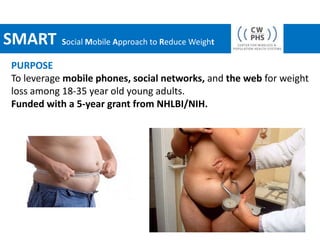
SMARTSocial Mobile Approach to Reduce WeightPURPOSETo leverage mobile phones, social networks,and the web for weight loss among 18-35 year old young adults. Funded with a 5-year grant from NHLBI/NIH.
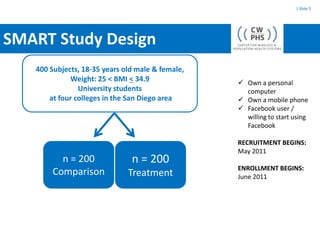
SMART Study Design| Slide 5400 Subjects, 18-35 years old male & female, Weight: 25 < BMI < 34.9University students at four colleges in the San Diego areaOwn a personal computer
Own a mobile phone
Facebook user / willing to start using FacebookRECRUITMENT BEGINS:May 2011ENROLLMENT BEGINS:  June 2011n = 200Comparisonn = 200Treatment
Study Population: College Students| Slide 6Partner with Student Health Services at each University.
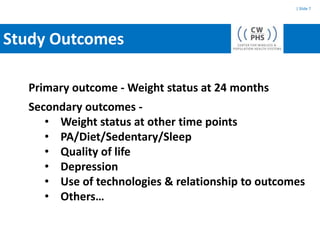
Study Outcomes| Slide 7Primary outcome - Weight status at 24 monthsSecondary outcomes -Weight status at other time points
PA/Diet/Sedentary/Sleep
Quality of life
Depression
Use of technologies & relationship to outcomes
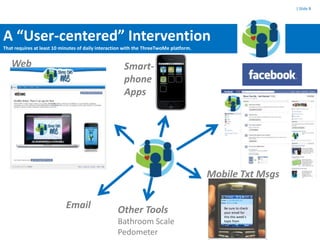
Others…A “User-centered” InterventionThat requires at least 10 minutes of daily interaction with the ThreeTwoMe platform.| Slide 8WebSmart-phoneAppsBe sure to check your email for this this week’s topic from ThreeTwoMeMobile Txt MsgsEmailOther ToolsBathroom ScalePedometer
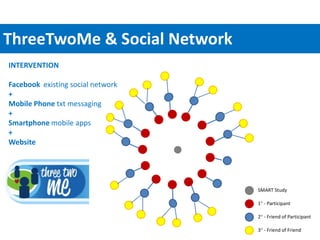
1 - Participant2 - Friend of ParticipantThreeTwoMe & Social Network3 - Friend of FriendSMART StudyINTERVENTION Facebook  existing social network+Mobile Phone txt messaging+Smartphone mobile apps+Website
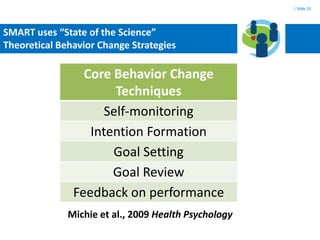
SMART uses “State of the Science” Theoretical Behavior Change Strategies| Slide 10Michie et al., 2009 Health Psychology
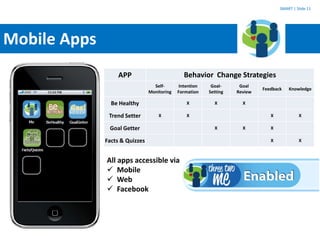
Mobile AppsSMART| Slide 11All apps accessible via Mobile
Web
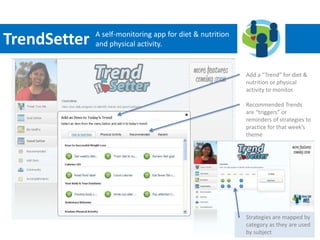
FacebookTrendSetterA self-monitoring app for diet & nutrition and physical activity.Add a “Trend” for diet & nutrition or physical activity to monitor.
Recommended Trends are “triggers” or reminders of strategies to practice for that week’s theme
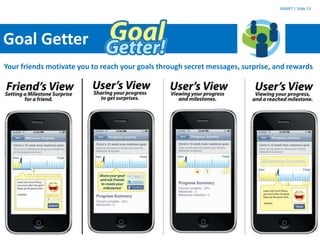
Strategies are mapped by category as they are used by subjectGoal GetterSMART| Slide 13Your friends motivate you to reach your goals through secret messages, surprise, and rewards

Norman mobile health presentation

  • 1.
    SMART: Social/Mobile Approachto Reduce WeighT – Evaluation ChallengesGreg NormanDepartment of Family & Preventive MedicineCenter for Wireless and Population Health Systems, Calit2Mobile Health 2011
  • 2.
    Study Team| Slide2Kevin Patrick, MD, MSGreg Norman, PhDSimon Marshall, PhDCheryl Rock, PhD RDJeannie Huang, MD MSJames Fowler, PhDBill Griswold, PhDTom Robinson, MD, MPHBJ Fogg, PhDFred RaabAnjali G. Kansagara, MS, MBAAaron ColemanMelanie Epstein-Corbin, MPHEvan CookJeff ChangErnesto Ramirez, MSLaura PinaKendra Markle
  • 3.
    Objectives for TodayDescribethe SMART study.Describe ‘active ingredients’ of program.Describe the challenges of evaluating the intervention.
  • 4.
    SMARTSocial Mobile Approachto Reduce WeightPURPOSETo leverage mobile phones, social networks,and the web for weight loss among 18-35 year old young adults. Funded with a 5-year grant from NHLBI/NIH.
  • 5.
    SMART Study Design|Slide 5400 Subjects, 18-35 years old male & female, Weight: 25 < BMI < 34.9University students at four colleges in the San Diego areaOwn a personal computer
  • 6.
  • 7.
    Facebook user /willing to start using FacebookRECRUITMENT BEGINS:May 2011ENROLLMENT BEGINS: June 2011n = 200Comparisonn = 200Treatment
  • 8.
    Study Population: CollegeStudents| Slide 6Partner with Student Health Services at each University.
  • 9.
    Study Outcomes| Slide7Primary outcome - Weight status at 24 monthsSecondary outcomes -Weight status at other time points
  • 10.
  • 11.
  • 12.
  • 13.
    Use of technologies& relationship to outcomes
  • 14.
    Others…A “User-centered” InterventionThatrequires at least 10 minutes of daily interaction with the ThreeTwoMe platform.| Slide 8WebSmart-phoneAppsBe sure to check your email for this this week’s topic from ThreeTwoMeMobile Txt MsgsEmailOther ToolsBathroom ScalePedometer
  • 15.
    1 - Participant2- Friend of ParticipantThreeTwoMe & Social Network3 - Friend of FriendSMART StudyINTERVENTION Facebook existing social network+Mobile Phone txt messaging+Smartphone mobile apps+Website
  • 16.
    SMART uses “Stateof the Science” Theoretical Behavior Change Strategies| Slide 10Michie et al., 2009 Health Psychology
  • 17.
    Mobile AppsSMART| Slide11All apps accessible via Mobile
  • 18.
  • 19.
    FacebookTrendSetterA self-monitoring appfor diet & nutrition and physical activity.Add a “Trend” for diet & nutrition or physical activity to monitor.
  • 20.
    Recommended Trends are“triggers” or reminders of strategies to practice for that week’s theme
  • 21.
    Strategies are mappedby category as they are used by subjectGoal GetterSMART| Slide 13Your friends motivate you to reach your goals through secret messages, surprise, and rewards

Editor's Notes

  • #3 Multi disciplinary team – public health, exercise science, nutrition, medicine, computer science, political science
  • #4 2. Active ingredients are the ‘what works’ or the evidence-based strategies for behavior change. 3. Specifically, challenges to conducting a randomized controlled trial with this type of intervention. And I’ll explain that as we go.Hopefully will show that in some ways the study is like a typical RCT and in other ways it is not.
  • #5 NHLBI had call for proposals specifically focusing on young adult weight loss – since this is considered an under researched population segment and one in need of intervention programs for weight loss and weight maintenance. One of the stipulations was the intervention program had to last 2 years.
  • #6 In some ways the study is a standard two group RCT…
  • #7 CampusExpect roughly 40 40 10 10% Total400Females not to exceed 70%Males at least 30%Hispanics not to exceed 30% at SDSUAsians not to exceed 30% at UCSDAge as evenly distributed as possible across 18-35 year oldsBMI 25-34.9
  • #8 In person measurements every 6 months – again pretty standard for a community-based RCT
  • #9 Three-two me concept I’ll explain in just a second.The program contains16-week (modules)of contentThe 16-week program repeated five times in the course of 2-year Participants don’t need to have a Smart phone and can still get all the content and tools. -this decision was a trade-off between real world generalizability OR limiting the sample to those with smart phones for a more controlled study
  • #10 ThreeTwoMe – has multiple meanings:-Three degrees of influence-Small steps to a better me-Stepped approach to health-Personal. Social. Global. – influences and interactionsWe are not intending to create a social net among the study participants. We want users to engage their own social network to get support for changing behavior and weight loss.
  • #11 These are our ‘active ingredients’ – the behavior change strategies that we know are important for physical activity and diet.Self-monitoring found to be most importantSelf-monitoring plus one other technique even betterIntention formation – making a commitment - from attitudes, beliefs, previous experience – aka Readiness to change, ‘stages of change’ Underlying TheoriesSocial Cognitive TheoryControl Theory - Operant LearningEcological Models
  • #12 Each app adds the social network connectionsto the behavior change strategies. -social norms and accountability, praise, social statusJquiry to build apps
  • #15 Based on the ‘Do Good’ app.
  • #18 -Design randomized two group (treatment &amp; control) – assessments every 6 months.First challenge is 2 year intervention that will change over time – not ‘locking down’ program and standardizing for course of the intervention.
  • #19 Second challenge is controls gain access to intervention, ‘contamination’.Do we try to control contamination?
  • #20 Third challenge is whether or not participants will become friends on FB because of program. Can measure friendship ties and determine extent of clustering, We don’t anticipate significant clustering, previous studies have shown that people don’t tend to become friends through FB.
  • #21 So I will end here, and welcome discussion on these issues.