


Consumer-Centric Health
 Models for Change ‘11
Mobile & Social Technologies
 Applications in Health Behavior Change
                  Karen J. Calfas, Ph.D.
    Assistant Vice Chancellor, Health, Recreation & Well-being
                    University of CA, San Diego
Faculty Joint Doctoral Program in Clinical Psychology (SDSU/UCSD)
          Faculty Graduate School of Public Health, SDSU
                     Co-Founder, Santech, Inc.

                       Seattle, Washington
                        October 13, 2011
| Slide 3


Overview


 Describe our approach

 Describe studies using a social / mobile approach to
 weight loss
    • mDIET
    • SMART
    • Facebook Connect

 Describe areas of focus to refine and further health
 behavior change
Research Background
• Primary research partners
  – Kevin Patrick, MD, MS
  – James Sallis, PhD
• Program of research (beginning 1990)
  – Print-based interventions in clinical settings
  – Web interventions (clinical and community)
  – Texting interventions (community)
  – Social / mobile interventions

                                                     4
| Slide 5


Conflicts of Interest

                   Co-Founder of Santech, Inc.
                      San Diego, California
                       Santechhealth.com

                         Other Co-Founders:
              James Sallis, PhD & Kevin Patrick, MD, MS

     Santech markets mobile and web products that promote improved
          health behaviors and health outcomes with a focus on
                     lifestyle behaviors and obesity.

                    Santech licenses technologies from
   San Diego State University and the University of California, San Diego
 developed by the founders and conducts its own Research & Development.
California Institute for
 Telecommunications
  and Information
   Technology


                6
| Slide 7


Collaborating Investigators & Partners

UCSD School of Medicine
Kevin Patrick, MD, MS, Greg Norman, PhD, Fred Raab,
Jacqueline Kerr, PhD, Jeannie Huang, MD, MPH, Cheryl Rock, PhD

UCSD Jacobs School of Engineering
Bill Griswold, PhD, Ingolf Krueger, PhD, Tajana Simunic Rosing, PhD

San Diego Supercomputer Center
Chaitan Baru, PhD

UCSD School of Medicine, Division of Genetics & Department of Political Science
James Fowler, PhD

SDSU Departments of Psychology, Exercise/Nutrition Science
 & School of Public Health
James Sallis, PhD, Simon Marshall, PhD, Elva Arredondo, PhD

PhD students and Post-doctoral Fellows (current)
Jordan Carlson, Barry Demchak, Laura Pina, Ernesto Ramirez, Celal Zifti

Santech, Inc.
Jennifer Shapiro, PhD, Ram Seshan, MS, MBA
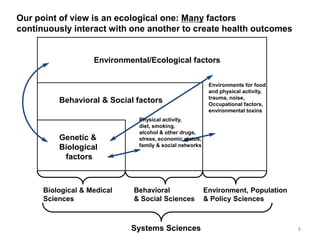
Our point of view is an ecological one: Many factors
continuously interact with one another to create health outcomes


                    Environmental/Ecological factors


                                                           Environments for food
                                                           and physical activity,
                                                           trauma, noise,
          Behavioral & Social factors                      Occupational factors,
                                                           environmental toxins
                               Physical activity,
                               diet, smoking,
                               alcohol & other drugs,
          Genetic &            stress, economic status,
          Biological           family & social networks

           factors


      Biological & Medical    Behavioral                  Environment, Population
      Sciences                & Social Sciences           & Policy Sciences


                             Systems Sciences                                       8
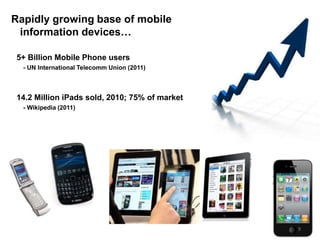
Rapidly growing base of mobile
 information devices…

5+ Billion Mobile Phone users
  - UN International Telecomm Union (2011)


14.2 Million iPads sold, 2010; 75% of market
  - Wikipedia (2011)


                                               9
| Slide 10


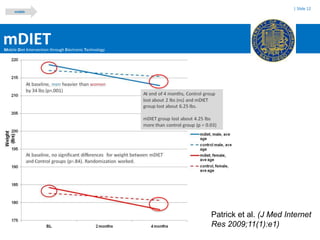
mDIET
Mobile Diet Intervention through Electronic Technology


   PURPOSE
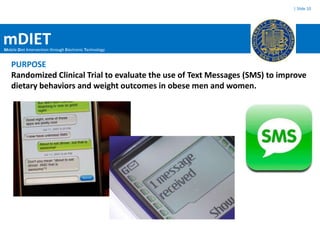
   Randomized Clinical Trial to evaluate the use of Text Messages (SMS) to improve
   dietary behaviors and weight outcomes in obese men and women.
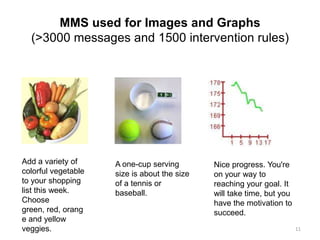
MMS used for Images and Graphs
  (>3000 messages and 1500 intervention rules)


Add a variety of     A one-cup serving        Nice progress. You're
colorful vegetable   size is about the size   on your way to
to your shopping     of a tennis or           reaching your goal. It
list this week.      baseball.                will take time, but you
Choose                                        have the motivation to
green, red, orang                             succeed.
e and yellow
veggies.                                                                11
| Slide 12
     mobile


mDIET
Mobile Diet Intervention through Electronic Technology


                                                         Patrick et al. (J Med Internet
                                                         Res 2009;11(1):e1)
| Slide 13


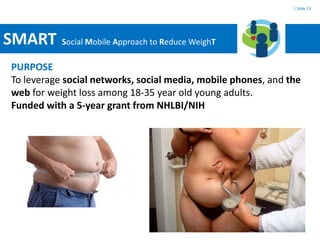
SMART      Social Mobile Approach to Reduce WeighT

PURPOSE
To leverage social networks, social media, mobile phones, and the
web for weight loss among 18-35 year old young adults.
Funded with a 5-year grant from NHLBI/NIH
| Slide 14


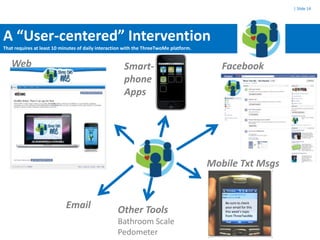
A “User-centered” Intervention
That requires at least 10 minutes of daily interaction with the ThreeTwoMe platform.


   Web                                                Smart-                              Facebook
                                                      phone
                                                      Apps


                                                                                       Mobile Txt Msgs


                            Email                  Other Tools
                                                                                          Be sure to check
                                                                                          your email for this
                                                                                          this week’s topic
                                                                                          from ThreeTwoMe
                                                   Bathroom Scale
                                                   Pedometer
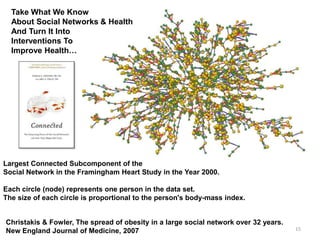
Take What We Know
  About Social Networks & Health
  And Turn It Into
  Interventions To
  Improve Health…


Largest Connected Subcomponent of the
Social Network in the Framingham Heart Study in the Year 2000.

Each circle (node) represents one person in the data set.
The size of each circle is proportional to the person's body-mass index.


Christakis & Fowler, The spread of obesity in a large social network over 32 years.
New England Journal of Medicine, 2007                                                 15
| Slide 16


SMART
Social Mobile Approaches to Reduce Weight


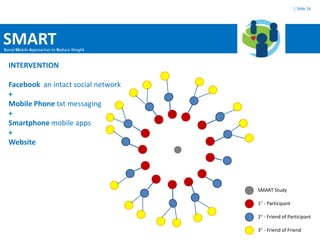
  INTERVENTION

  Facebook an intact social network
  +
  Mobile Phone txt messaging
  +
  Smartphone mobile apps
  +
  Website


                                            SMART Study

                                            1 - Participant

                                            2 - Friend of Participant

                                            3 - Friend of Friend
| Slide 17


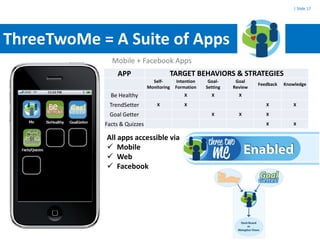
ThreeTwoMe = A Suite of Apps
              Mobile + Facebook Apps
                APP                    TARGET BEHAVIORS & STRATEGIES
                                Self-       Intention    Goal-     Goal
                                                                           Feedback   Knowledge
                              Monitoring   Formation    Setting   Review
              Be Healthy                       X          X         X

             TrendSetter          X            X                              X          X

             Goal Getter                                  X         X         X

            Facts & Quizzes                                                   X          X

            All apps accessible via
             Mobile
             Web
             Facebook
| Slide 18


Facebook Connect

          Unfunded Study at Univ. of CA, San Diego

          Investigators: Karen Calfas, James Fowler,
              Lucila Ohno-Machado, Myong Lah


    Purpose:

       • Identify how student networks form and evolve on facebook
       • Gather and analyze data from posts and activity
       • Analyze content of language
| Slide 19


Facebook Connect

    How can we better understand student needs via their
    social networks?

    How can we affect important outcomes using social
    network intervention?
       •   Depression and suicidality
       •   Academic success
       •   Racial tension
       •   Meaningful friendships and sense of belonging
| Slide 20


Focus Areas in Health Behavior Change
Maintenance of Behavior Change
• Ubiquitous technology
• Must be relevant to the patient and/or the
  theoretical approach
• High degree of tailoring
• Continuous intervention
• Connect to personal values
• Focus on personal flourishing (+ psych)
• Environmental influences
                                               | Slide 21
Special Considerations
• The annoyance factor
• Consider negative effects of intervention
  – Assess and test for them
• Not a substitute for human interaction


                                              22
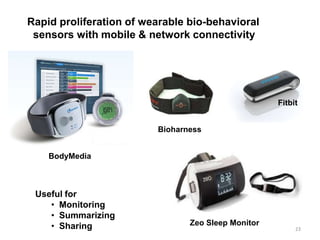
Rapid proliferation of wearable bio-behavioral
 sensors with mobile & network connectivity


                                                    Fitbit


                         Bioharness


    BodyMedia


 Useful for
    • Monitoring
    • Summarizing
    • Sharing                   Zeo Sleep Monitor
                                                         23
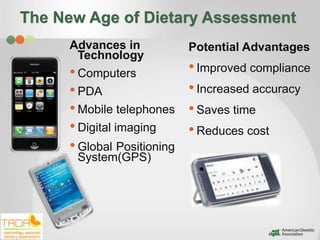
The New Age of Dietary Assessment
     Advances in            Potential Advantages
      Technology
     • Computers            • Improved compliance
     • PDA                  • Increased accuracy
     • Mobile telephones    • Saves time
     • Digital imaging      • Reduces cost
     • Global Positioning
      System(GPS)
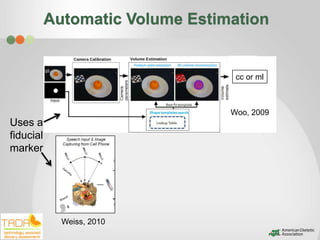
Automatic Volume Estimation


                                  cc or ml


                                 Woo, 2009
Uses a
fiducial
marker


             Weiss, 2010
Social Component
• Long term evidence of importance of social
  support
• Emerging evidence about social networks
• Existing social network vs. created network
  – Where are their eyeballs?
• Promise of “positive contagion” effect


                                                26
Thank You!


     kcalfas@ucsd.edu
     Santechhealth.com
                     27

Karen Calfas at Consumer Centric Health, Models for Change '11

  • 1.
  • 2.
    Mobile & SocialTechnologies Applications in Health Behavior Change Karen J. Calfas, Ph.D. Assistant Vice Chancellor, Health, Recreation & Well-being University of CA, San Diego Faculty Joint Doctoral Program in Clinical Psychology (SDSU/UCSD) Faculty Graduate School of Public Health, SDSU Co-Founder, Santech, Inc. Seattle, Washington October 13, 2011
  • 3.
    | Slide 3 Overview Describe our approach Describe studies using a social / mobile approach to weight loss • mDIET • SMART • Facebook Connect Describe areas of focus to refine and further health behavior change
  • 4.
    Research Background • Primaryresearch partners – Kevin Patrick, MD, MS – James Sallis, PhD • Program of research (beginning 1990) – Print-based interventions in clinical settings – Web interventions (clinical and community) – Texting interventions (community) – Social / mobile interventions 4
  • 5.
    | Slide 5 Conflictsof Interest Co-Founder of Santech, Inc. San Diego, California Santechhealth.com Other Co-Founders: James Sallis, PhD & Kevin Patrick, MD, MS Santech markets mobile and web products that promote improved health behaviors and health outcomes with a focus on lifestyle behaviors and obesity. Santech licenses technologies from San Diego State University and the University of California, San Diego developed by the founders and conducts its own Research & Development.
  • 6.
    California Institute for Telecommunications and Information Technology 6
  • 7.
    | Slide 7 CollaboratingInvestigators & Partners UCSD School of Medicine Kevin Patrick, MD, MS, Greg Norman, PhD, Fred Raab, Jacqueline Kerr, PhD, Jeannie Huang, MD, MPH, Cheryl Rock, PhD UCSD Jacobs School of Engineering Bill Griswold, PhD, Ingolf Krueger, PhD, Tajana Simunic Rosing, PhD San Diego Supercomputer Center Chaitan Baru, PhD UCSD School of Medicine, Division of Genetics & Department of Political Science James Fowler, PhD SDSU Departments of Psychology, Exercise/Nutrition Science & School of Public Health James Sallis, PhD, Simon Marshall, PhD, Elva Arredondo, PhD PhD students and Post-doctoral Fellows (current) Jordan Carlson, Barry Demchak, Laura Pina, Ernesto Ramirez, Celal Zifti Santech, Inc. Jennifer Shapiro, PhD, Ram Seshan, MS, MBA
  • 8.
    Our point ofview is an ecological one: Many factors continuously interact with one another to create health outcomes Environmental/Ecological factors Environments for food and physical activity, trauma, noise, Behavioral & Social factors Occupational factors, environmental toxins Physical activity, diet, smoking, alcohol & other drugs, Genetic & stress, economic status, Biological family & social networks factors Biological & Medical Behavioral Environment, Population Sciences & Social Sciences & Policy Sciences Systems Sciences 8
  • 9.
    Rapidly growing baseof mobile information devices… 5+ Billion Mobile Phone users - UN International Telecomm Union (2011) 14.2 Million iPads sold, 2010; 75% of market - Wikipedia (2011) 9
  • 10.
    | Slide 10 mDIET MobileDiet Intervention through Electronic Technology PURPOSE Randomized Clinical Trial to evaluate the use of Text Messages (SMS) to improve dietary behaviors and weight outcomes in obese men and women.
  • 11.
    MMS used forImages and Graphs (>3000 messages and 1500 intervention rules) Add a variety of A one-cup serving Nice progress. You're colorful vegetable size is about the size on your way to to your shopping of a tennis or reaching your goal. It list this week. baseball. will take time, but you Choose have the motivation to green, red, orang succeed. e and yellow veggies. 11
  • 12.
    | Slide 12 mobile mDIET Mobile Diet Intervention through Electronic Technology Patrick et al. (J Med Internet Res 2009;11(1):e1)
  • 13.
    | Slide 13 SMART Social Mobile Approach to Reduce WeighT PURPOSE To leverage social networks, social media, mobile phones, and the web for weight loss among 18-35 year old young adults. Funded with a 5-year grant from NHLBI/NIH
  • 14.
    | Slide 14 A“User-centered” Intervention That requires at least 10 minutes of daily interaction with the ThreeTwoMe platform. Web Smart- Facebook phone Apps Mobile Txt Msgs Email Other Tools Be sure to check your email for this this week’s topic from ThreeTwoMe Bathroom Scale Pedometer
  • 15.
    Take What WeKnow About Social Networks & Health And Turn It Into Interventions To Improve Health… Largest Connected Subcomponent of the Social Network in the Framingham Heart Study in the Year 2000. Each circle (node) represents one person in the data set. The size of each circle is proportional to the person's body-mass index. Christakis & Fowler, The spread of obesity in a large social network over 32 years. New England Journal of Medicine, 2007 15
  • 16.
    | Slide 16 SMART SocialMobile Approaches to Reduce Weight INTERVENTION Facebook an intact social network + Mobile Phone txt messaging + Smartphone mobile apps + Website SMART Study 1 - Participant 2 - Friend of Participant 3 - Friend of Friend
  • 17.
    | Slide 17 ThreeTwoMe= A Suite of Apps Mobile + Facebook Apps APP TARGET BEHAVIORS & STRATEGIES Self- Intention Goal- Goal Feedback Knowledge Monitoring Formation Setting Review Be Healthy X X X TrendSetter X X X X Goal Getter X X X Facts & Quizzes X X All apps accessible via  Mobile  Web  Facebook
  • 18.
    | Slide 18 FacebookConnect Unfunded Study at Univ. of CA, San Diego Investigators: Karen Calfas, James Fowler, Lucila Ohno-Machado, Myong Lah Purpose: • Identify how student networks form and evolve on facebook • Gather and analyze data from posts and activity • Analyze content of language
  • 19.
    | Slide 19 FacebookConnect How can we better understand student needs via their social networks? How can we affect important outcomes using social network intervention? • Depression and suicidality • Academic success • Racial tension • Meaningful friendships and sense of belonging
  • 20.
    | Slide 20 FocusAreas in Health Behavior Change
  • 21.
    Maintenance of BehaviorChange • Ubiquitous technology • Must be relevant to the patient and/or the theoretical approach • High degree of tailoring • Continuous intervention • Connect to personal values • Focus on personal flourishing (+ psych) • Environmental influences | Slide 21
  • 22.
    Special Considerations • Theannoyance factor • Consider negative effects of intervention – Assess and test for them • Not a substitute for human interaction 22
  • 23.
    Rapid proliferation ofwearable bio-behavioral sensors with mobile & network connectivity Fitbit Bioharness BodyMedia Useful for • Monitoring • Summarizing • Sharing Zeo Sleep Monitor 23
  • 24.
    The New Ageof Dietary Assessment Advances in Potential Advantages Technology • Computers • Improved compliance • PDA • Increased accuracy • Mobile telephones • Saves time • Digital imaging • Reduces cost • Global Positioning System(GPS)
  • 25.
    Automatic Volume Estimation cc or ml Woo, 2009 Uses a fiducial marker Weiss, 2010
  • 26.
    Social Component • Longterm evidence of importance of social support • Emerging evidence about social networks • Existing social network vs. created network – Where are their eyeballs? • Promise of “positive contagion” effect 26
  • 27.
    Thank You! kcalfas@ucsd.edu Santechhealth.com 27

Editor's Notes

  • #3 Health Psychologist, Physical activity and diet intervention researcher,
  • #25 The application of new innovative technologies into dietary assessment offers several advantages. These technologies hold promise for improving data quality, reducing costs (no need for trained interviewer), time saving (b/c the data are stored immediately), and reduces the burden on the respondent. Doesn’t require them to estimate portion size or remember their foods. Be sure to make mention that digital photography is a bogus phrase.