Perspectives on mHealth
 business development
         Arto Leppisaari
 Tampere University of Technology
        Data‐Driven Medicine
             28.3.2012
Project Felix
Research‐based business development project
    Department of Biomedical Engineering
      Tampere University of Technology

  Part of the new research group focusing into
          Personal Health Technologies
for chronic disease management and prevention
Content
mHealth promise on chronic disease challenge

Personal health monitoring

Behavior change

Mass market adoption barriers
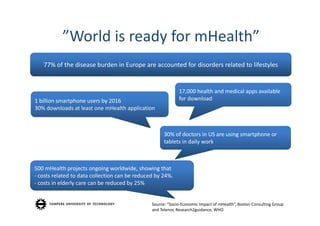
”World is ready for mHealth”
   77% of the disease burden in Europe are accounted for disorders related to lifestyles


                                                             17,000 health and medical apps available 
1 billion smartphone users by 2016                           for download
30% downloads at least one mHealth application


                                                      30% of doctors in US are using smartphone or 
                                                      tablets in daily work 


500 mHealth projects ongoing worldwide, showing that
‐ costs related to data collection can be reduced by 24%.
‐ costs in elderly care can be reduced by 25%


                                                Source: “Socio‐Economic Impact of mHealth”, Boston Consulting Group 
                                                and Telenor, Research2guidance, WHO
5


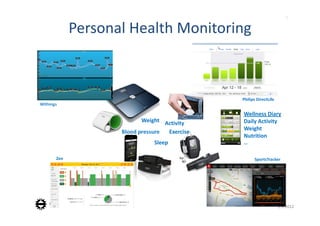
             Personal Health Monitoring


                                              Philips DirectLife
Withings

                                              Wellness Diary
                           Weight Activity    Daily Activity
                                              Weight
                    Blood pressure Exercise
                                              Nutrition
                               Sleep          …

       Zeo                                          SportsTracker


                                                                   2.4.2012
Ease‐to‐use connected sensors
               everywhere
169.5 million wearable wireless health and fitness sensors sold in 2017, 
up from 21 million in 2011.
~90% supporting mobile phone connectivity, compared to 5% currently
[ABI Research]


 NFC and Low Energy Bluetooth 4.0 technologies deployed
 in the majority of smartphones by the end of 2012
  Tapping – new, intuitive way to interact
  Wearable wireless sensors with long operating times


                      Nike+ Fuelband                       VTT HearMeFeelMe
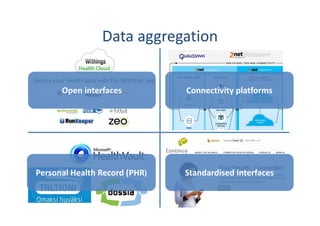
Data aggregation


      Open interfaces          Connectivity platforms


                                Standard interfaces


Personal Health Record (PHR)   Standardised interfaces
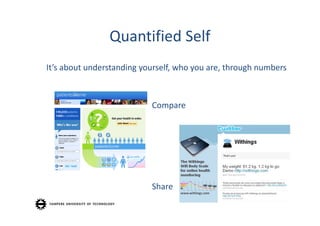
Quantified Self
It’s about understanding yourself, who you are, through numbers


                           Compare


                           Share
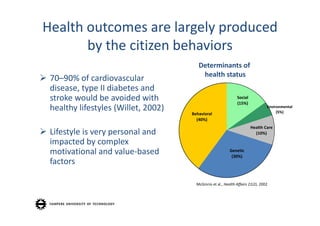
Health outcomes are largely produced
       by the citizen behaviors
                                         Determinants of 
                                          health status
 70–90% of cardiovascular 
  disease, type II diabetes and 
  stroke would be avoided with                                  Social
                                                                (15%)
  healthy lifestyles (Willet, 2002)                                               Environmental
                                                                                       (5%)
                                      Behavioral
                                        (40%)
                                                                         Health Care
 Lifestyle is very personal and                                           (10%)

  impacted by complex 
  motivational and value‐based                              Genetic
                                                             (30%)
  factors

                                        McGinnis et al., Health Affairs 21(2), 2002
Knowledge‐behavior gap
 Most citizen have sufficient
  information about healthy lifestyles
  but this information does not
  transform into behaviors

 It is unlikely that more information
  alone would significantly improve
  the situation

 Human being is not a rational actor
 Most of our daily behaviors are
  automatic decisions
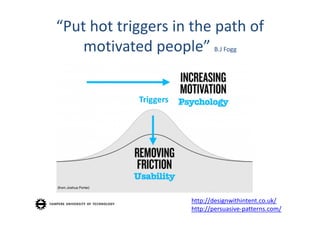
“Put hot triggers in the path of 
    motivated people” B.J Fogg


            Triggers


                       http://designwithintent.co.uk/
                       http://persuasive‐patterns.com/
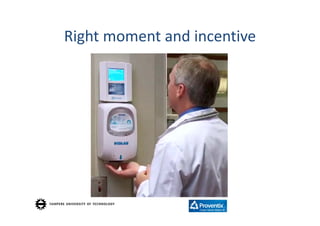
Right moment and incentive
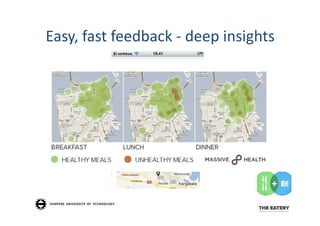
Easy, fast feedback ‐ deep insights
mHealth adoption curve?

                                                                            Get through the day 11%

                                                                         Not right now 24%

                                                             I need a plan 20%

                                                Value Independence 19%

                                       In it for Fun 17%

                  Leading the Way 10%


Health & Wellness segmentation in US
[The Future Company]                                                                   Diffusion of innovations
                                                                                       [Rogers]
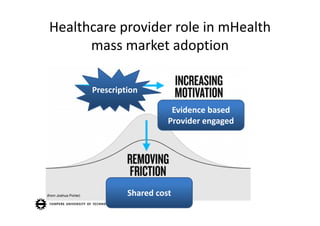
Healthcare provider role in mHealth
      mass market adoption

      Prescription

                          Evidence based
                         Provider engaged


               Shared cost
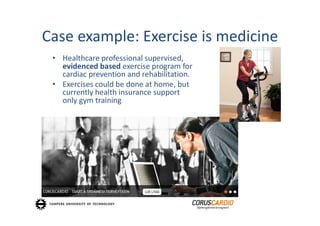
Case example: Exercise is medicine
 • Healthcare professional supervised, 
   evidenced based exercise program for 
   cardiac prevention and rehabilitation.
 • Exercises could be done at home, but
   currently health insurance support
   only gym training
Take away messages
 Technology infrastucture ready for mHealth

 To efficiently prevent and manage lifestyle diseases, a 
  behavioral change is needed. Citizen need to take 
  responsibility on own health

 We need solutions that make the healthy choice the easy
  choice. Persuasive technology as a great tool.

 Mobile Health need to be incorporated into healthcare 
  practices in order to create mass market adoption
    Making the healthy choice the default choice
Tampere University of Technology

          Personal Health Technologies
for chronic disease management and prevention

                 Contact us!

Data driven medicine - Perspectives on mHealth

  • 1.
    Perspectives on mHealth business development Arto Leppisaari Tampere University of Technology Data‐Driven Medicine 28.3.2012
  • 2.
    Project Felix Research‐based business development project Department of Biomedical Engineering Tampere University of Technology Part of the new research group focusing into Personal Health Technologies for chronic disease management and prevention
  • 3.
    Content mHealth promise on chronicdisease challenge Personal health monitoring Behavior change Mass market adoption barriers
  • 4.
    ”World is ready for mHealth” 77% of the disease burden in Europe are accounted for disorders related to lifestyles 17,000 health and medical apps available  1 billion smartphone users by 2016 for download 30% downloads at least one mHealth application 30% of doctors in US are using smartphone or  tablets in daily work  500 mHealth projects ongoing worldwide, showing that ‐ costs related to data collection can be reduced by 24%. ‐ costs in elderly care can be reduced by 25% Source: “Socio‐Economic Impact of mHealth”, Boston Consulting Group  and Telenor, Research2guidance, WHO
  • 5.
    5 Personal Health Monitoring Philips DirectLife Withings Wellness Diary Weight Activity Daily Activity Weight Blood pressure Exercise Nutrition Sleep … Zeo SportsTracker 2.4.2012
  • 6.
    Ease‐to‐use connected sensors everywhere 169.5 million wearable wireless health and fitness sensors sold in 2017,  up from 21 million in 2011. ~90% supporting mobile phone connectivity, compared to 5% currently [ABI Research] NFC and Low Energy Bluetooth 4.0 technologies deployed in the majority of smartphones by the end of 2012  Tapping – new, intuitive way to interact  Wearable wireless sensors with long operating times Nike+ Fuelband VTT HearMeFeelMe
  • 7.
    Data aggregation Open interfaces Connectivity platforms Standard interfaces Personal Health Record (PHR) Standardised interfaces
  • 8.
  • 9.
    Health outcomes are largelyproduced by the citizen behaviors Determinants of  health status  70–90% of cardiovascular  disease, type II diabetes and  stroke would be avoided with  Social (15%) healthy lifestyles (Willet, 2002) Environmental (5%) Behavioral (40%) Health Care  Lifestyle is very personal and  (10%) impacted by complex  motivational and value‐based Genetic (30%) factors McGinnis et al., Health Affairs 21(2), 2002
  • 10.
    Knowledge‐behavior gap  Mostcitizen have sufficient information about healthy lifestyles but this information does not transform into behaviors  It is unlikely that more information alone would significantly improve the situation  Human being is not a rational actor  Most of our daily behaviors are automatic decisions
  • 11.
    “Put hot triggers in the path of  motivated people” B.J Fogg Triggers http://designwithintent.co.uk/ http://persuasive‐patterns.com/
  • 12.
  • 13.
  • 14.
    mHealth adoption curve? Get through the day 11% Not right now 24% I need a plan 20% Value Independence 19% In it for Fun 17% Leading the Way 10% Health & Wellness segmentation in US [The Future Company] Diffusion of innovations [Rogers]
  • 15.
    Healthcare provider role in mHealth mass market adoption Prescription Evidence based Provider engaged Shared cost
  • 16.
    Case example: Exercise is medicine •Healthcare professional supervised,  evidenced based exercise program for  cardiac prevention and rehabilitation. • Exercises could be done at home, but currently health insurance support only gym training
  • 17.
    Take away messages Technology infrastucture ready for mHealth  To efficiently prevent and manage lifestyle diseases, a  behavioral change is needed. Citizen need to take  responsibility on own health  We need solutions that make the healthy choice the easy choice. Persuasive technology as a great tool.  Mobile Health need to be incorporated into healthcare  practices in order to create mass market adoption  Making the healthy choice the default choice
  • 18.
    Tampere University of Technology Personal Health Technologies for chronic disease management and prevention Contact us!