

TM


                                              Thoughts on
                                              Gamification &
                                              Quantified Self


                                              May 2012


Mayfield© 2008 Proprietary and Confidential
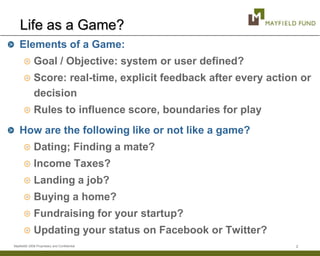
Life as a Game?
    Elements of a Game:
              Goal / Objective: system or user defined?
              Score: real-time, explicit feedback after every action or
              decision
              Rules to influence score, boundaries for play
    How are the following like or not like a game?
              Dating; Finding a mate?
              Income Taxes?
              Landing a job?
              Buying a home?
              Fundraising for your startup?
              Updating your status on Facebook or Twitter?
Mayfield© 2008 Proprietary and Confidential                        2
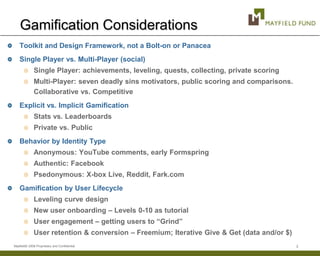
Gamification Considerations
    Toolkit and Design Framework, not a Bolt-on or Panacea
    Single Player vs. Multi-Player (social)
              Single Player: achievements, leveling, quests, collecting, private scoring
              Multi-Player: seven deadly sins motivators, public scoring and comparisons.
              Collaborative vs. Competitive
    Explicit vs. Implicit Gamification
              Stats vs. Leaderboards
              Private vs. Public
    Behavior by Identity Type
              Anonymous: YouTube comments, early Formspring
              Authentic: Facebook
              Psedonymous: X-box Live, Reddit, Fark.com
    Gamification by User Lifecycle
              Leveling curve design
              New user onboarding – Levels 0-10 as tutorial
              User engagement – getting users to “Grind”
              User retention & conversion – Freemium; Iterative Give & Get (data and/or $)
Mayfield© 2008 Proprietary and Confidential                                                  3
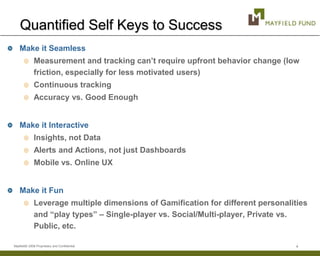
Quantified Self Keys to Success
    Make it Seamless
              Measurement and tracking can’t require upfront behavior change (low
              friction, especially for less motivated users)
              Continuous tracking
              Accuracy vs. Good Enough


    Make it Interactive
              Insights, not Data
              Alerts and Actions, not just Dashboards
              Mobile vs. Online UX


    Make it Fun
              Leverage multiple dimensions of Gamification for different personalities
              and “play types” – Single-player vs. Social/Multi-player, Private vs.
              Public, etc.

Mayfield© 2008 Proprietary and Confidential                                        4

Mobile health 2012

  • 1.
    TM Thoughts on Gamification & Quantified Self May 2012 Mayfield© 2008 Proprietary and Confidential
  • 2.
    Life as aGame? Elements of a Game: Goal / Objective: system or user defined? Score: real-time, explicit feedback after every action or decision Rules to influence score, boundaries for play How are the following like or not like a game? Dating; Finding a mate? Income Taxes? Landing a job? Buying a home? Fundraising for your startup? Updating your status on Facebook or Twitter? Mayfield© 2008 Proprietary and Confidential 2
  • 3.
    Gamification Considerations Toolkit and Design Framework, not a Bolt-on or Panacea Single Player vs. Multi-Player (social) Single Player: achievements, leveling, quests, collecting, private scoring Multi-Player: seven deadly sins motivators, public scoring and comparisons. Collaborative vs. Competitive Explicit vs. Implicit Gamification Stats vs. Leaderboards Private vs. Public Behavior by Identity Type Anonymous: YouTube comments, early Formspring Authentic: Facebook Psedonymous: X-box Live, Reddit, Fark.com Gamification by User Lifecycle Leveling curve design New user onboarding – Levels 0-10 as tutorial User engagement – getting users to “Grind” User retention & conversion – Freemium; Iterative Give & Get (data and/or $) Mayfield© 2008 Proprietary and Confidential 3
  • 4.
    Quantified Self Keysto Success Make it Seamless Measurement and tracking can’t require upfront behavior change (low friction, especially for less motivated users) Continuous tracking Accuracy vs. Good Enough Make it Interactive Insights, not Data Alerts and Actions, not just Dashboards Mobile vs. Online UX Make it Fun Leverage multiple dimensions of Gamification for different personalities and “play types” – Single-player vs. Social/Multi-player, Private vs. Public, etc. Mayfield© 2008 Proprietary and Confidential 4

Editor's Notes

  • #3 Business Models and Utility and Value Driven
  • #4 Business Models and Utility and Value Driven
  • #5 Business Models and Utility and Value Driven