Prepared by:
Paul John Rey A. Tanghal
NORMAL
APPROXIMATION TO
BINOMIAL DISTRIBUTION
The normal approximation to the
binomial is when you use a continuous
distribution (the normal distribution) to
approximate a discrete distribution (the
binomial distribution). According to the
Central Limit Theorem, the sampling
distribution of the sample means
becomes approximately normal if the
sample size is large enough.
WHAT IS NORMAL APPROXIMATION TO
THE BINOMIAL DISTRIBUTION?
The first step into using the normal approximation to
the binomial is making sure you have a “large
enough sample”. How large is “large enough”? You
figure this out with two calculations: n * p and n * q .
The Uses of n*p and n*q
Where:
n is your sample size,
p is your given probability.
q is just 1 – p. For example, let’s say your probability p is .6.
You would find q by subtracting this probability from 1: q = 1
– .6 = .4. Percentages (instead of decimals) can make this a
little more understandable; if you have a 60% chance of it
raining (p) then there’s a 40% probability it won’t rain (q).
When n * p and n * q are greater than 5, you can use the
normal approximation to the binomial to solve a problem.
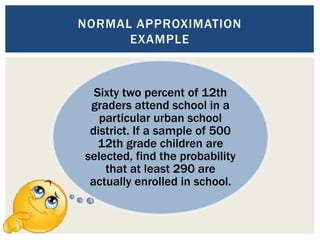
Sixty two percent of 12th
graders attend school in a
particular urban school
district. If a sample of 500
12th grade children are
selected, find the probability
that at least 290 are
actually enrolled in school.
NORMAL APPROXIMATION
EXAMPLE
Find p, q, and
n:
The
probability p
is given in the
question as
62%, or 0.62
To find q,
subtract p
from 1: 1 –
0.62 = 0.38
The sample
size n is given
in the
question as
500
MAKING CALCULATIONS
STEP 1
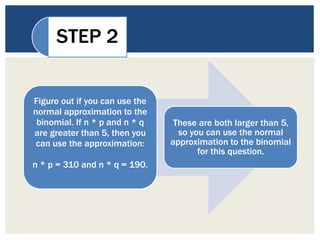
Figure out if you can use the
normal approximation to the
binomial. If n * p and n * q
are greater than 5, then you
can use the approximation:
n * p = 310 and n * q = 190.
These are both larger than 5,
so you can use the normal
approximation to the binomial
for this question.
STEP 2
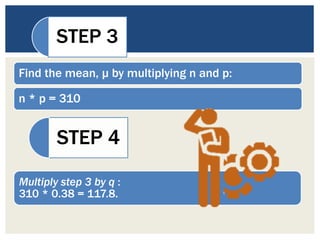
Find the mean, μ by multiplying n and p:
n * p = 310
STEP 3
STEP 4
Multiply step 3 by q :
310 * 0.38 = 117.8.
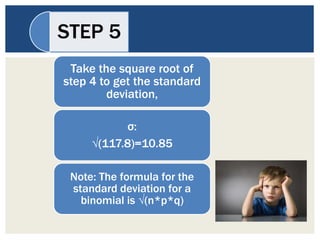
Take the square root of
step 4 to get the standard
deviation,
σ:
√(117.8)=10.85
Note: The formula for the
standard deviation for a
binomial is √(n*p*q)
STEP 5
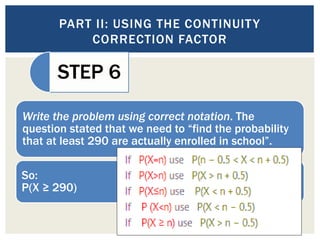
Write the problem using correct notation. The
question stated that we need to “find the probability
that at least 290 are actually enrolled in school”.
So:
P(X ≥ 290)
PART II: USING THE CONTINUITY
CORRECTION FACTOR
STEP 6
Rewrite the problem using the continuity correction factor:
P (X ≥ 290-0.5) = P (X ≥ 289.5)
STEP 7
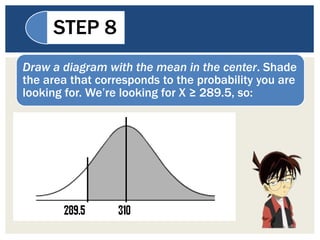
Draw a diagram with the mean in the center. Shade
the area that corresponds to the probability you are
looking for. We’re looking for X ≥ 289.5, so:
STEP 8
Find the z-score.
You can find this by subtracting the mean (μ) from the
probability you found in step 7, then dividing by the standard
deviation (σ):
(289.5 – 310) / 10.85 = -1.89
STEP 9
STEP 10
Look up the z-value in the z-table:
The area for -1.89 is 0.4706.
Add .5 to your
answer in step 10
to find the total
area pictured:
0.4706 + 0.5 =
0.9706.
That’s it! The
probability is
.9706, or 97.06%.
STEP 11
References:
Stephanie Glen. "Normal Approximation to the Binomial" From
StatisticsHowTo.com: Elementary Statistics for the rest of us!
https://www.statisticshowto.com/probability-and-
statistics/binomial-theorem/normal-approximation-to-the-binomial/
END
E N D

Normal Approximation to Binomial Distribution.pptx

  • 1.
    Prepared by: Paul JohnRey A. Tanghal NORMAL APPROXIMATION TO BINOMIAL DISTRIBUTION
  • 2.
    The normal approximationto the binomial is when you use a continuous distribution (the normal distribution) to approximate a discrete distribution (the binomial distribution). According to the Central Limit Theorem, the sampling distribution of the sample means becomes approximately normal if the sample size is large enough. WHAT IS NORMAL APPROXIMATION TO THE BINOMIAL DISTRIBUTION?
  • 3.
    The first stepinto using the normal approximation to the binomial is making sure you have a “large enough sample”. How large is “large enough”? You figure this out with two calculations: n * p and n * q . The Uses of n*p and n*q
  • 4.
    Where: n is yoursample size, p is your given probability. q is just 1 – p. For example, let’s say your probability p is .6. You would find q by subtracting this probability from 1: q = 1 – .6 = .4. Percentages (instead of decimals) can make this a little more understandable; if you have a 60% chance of it raining (p) then there’s a 40% probability it won’t rain (q). When n * p and n * q are greater than 5, you can use the normal approximation to the binomial to solve a problem.
  • 5.
    Sixty two percentof 12th graders attend school in a particular urban school district. If a sample of 500 12th grade children are selected, find the probability that at least 290 are actually enrolled in school. NORMAL APPROXIMATION EXAMPLE
  • 6.
    Find p, q,and n: The probability p is given in the question as 62%, or 0.62 To find q, subtract p from 1: 1 – 0.62 = 0.38 The sample size n is given in the question as 500 MAKING CALCULATIONS STEP 1
  • 7.
    Figure out ifyou can use the normal approximation to the binomial. If n * p and n * q are greater than 5, then you can use the approximation: n * p = 310 and n * q = 190. These are both larger than 5, so you can use the normal approximation to the binomial for this question. STEP 2
  • 8.
    Find the mean,μ by multiplying n and p: n * p = 310 STEP 3 STEP 4 Multiply step 3 by q : 310 * 0.38 = 117.8.
  • 9.
    Take the squareroot of step 4 to get the standard deviation, σ: √(117.8)=10.85 Note: The formula for the standard deviation for a binomial is √(n*p*q) STEP 5
  • 10.
    Write the problemusing correct notation. The question stated that we need to “find the probability that at least 290 are actually enrolled in school”. So: P(X ≥ 290) PART II: USING THE CONTINUITY CORRECTION FACTOR STEP 6
  • 11.
    Rewrite the problemusing the continuity correction factor: P (X ≥ 290-0.5) = P (X ≥ 289.5) STEP 7
  • 12.
    Draw a diagramwith the mean in the center. Shade the area that corresponds to the probability you are looking for. We’re looking for X ≥ 289.5, so: STEP 8
  • 13.
    Find the z-score. Youcan find this by subtracting the mean (μ) from the probability you found in step 7, then dividing by the standard deviation (σ): (289.5 – 310) / 10.85 = -1.89 STEP 9 STEP 10 Look up the z-value in the z-table: The area for -1.89 is 0.4706.
  • 14.
    Add .5 toyour answer in step 10 to find the total area pictured: 0.4706 + 0.5 = 0.9706. That’s it! The probability is .9706, or 97.06%. STEP 11
  • 15.
    References: Stephanie Glen. "NormalApproximation to the Binomial" From StatisticsHowTo.com: Elementary Statistics for the rest of us! https://www.statisticshowto.com/probability-and- statistics/binomial-theorem/normal-approximation-to-the-binomial/
  • 16.