


PRESENT BY:
LOH YU WEI 136256C
WANG DONG 130529C
CHENG YUN SHENG 136265M
JOEL NG 131079Y
LEONG JING YUEN
TERRENCE
134192H
In this presentation we are going
to let you know about :
The material that used to produce a Non-
stick frying pan.
The properties of the materials.
The reason of using those material.
The environmental issue that the
material bring to us.
Stainless Steel 304
Phenolic Resin
Polytetrafluoroethylene(PTFE)
or Teflon
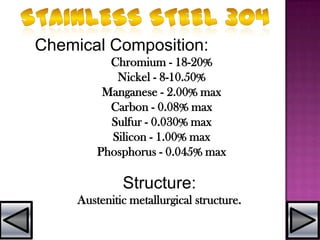
Chemical Composition:
Chromium - 18-20%
Nickel - 8-10.50%
Manganese - 2.00% max
Carbon - 0.08% max
Sulfur - 0.030% max
Silicon - 1.00% max
Phosphorus - 0.045% max
Structure:
Austenitic metallurgical structure.
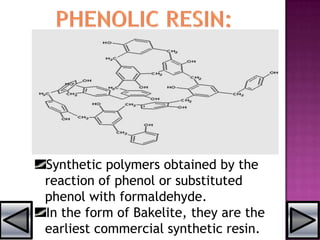
Synthetic polymers obtained by the
reaction of phenol or substituted
phenol with formaldehyde.
In the form of Bakelite, they are the
earliest commercial synthetic resin.
Formed by a step-growth
polymerization reaction that can
be either acid- or base- catalysed.
Found in myriad industrial
products.
First plastic made from synthetic
components.
Widely used for its heat-resistant
properties in kitchenware.
PHYSICAL PROPERTIES
MECHANICAL PROPERTIES
TECHNOLOGICAL PROPERTIES
CHEMICAL PROPERTIES
ECONOMIC PROPERTIES
AESTHETIC PROPERTIES
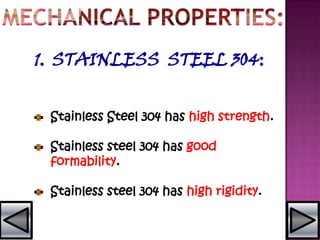
1. STAINLESS STEEL 304:
Stainless Steel 304 has high strength.
Stainless steel 304 has good
formability.
Stainless steel 304 has high rigidity.
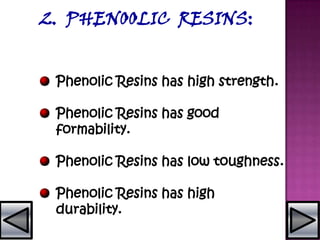
2. PHENOOLIC RESINS:
Phenolic Resins has high strength.
Phenolic Resins has good
formability.
Phenolic Resins has low toughness.
Phenolic Resins has high
durability.
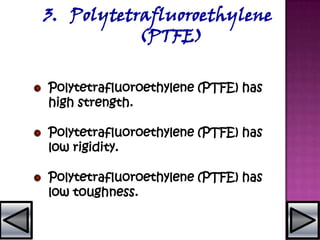
3. Polytetrafluoroethylene
(PTFE)
Polytetrafluoroethylene (PTFE) has
high strength.
Polytetrafluoroethylene (PTFE) has
low rigidity.
Polytetrafluoroethylene (PTFE) has
low toughness.
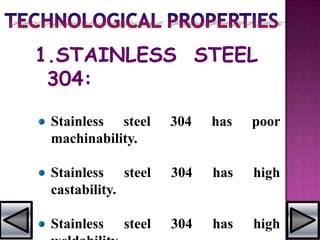
1.STAINLESS STEEL
304:
Stainless steel 304 has poor
machinability.
Stainless steel 304 has high
castability.
Stainless steel 304 has high
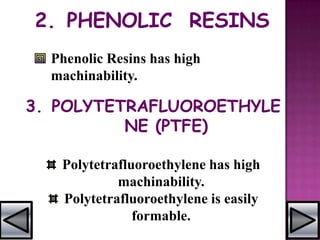
2. PHENOLIC RESINS
Phenolic Resins has high
machinability.
3. POLYTETRAFLUOROETHYLE
NE (PTFE)
Polytetrafluoroethylene has high
machinability.
Polytetrafluoroethylene is easily
formable.
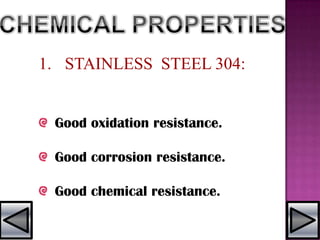
1. STAINLESS STEEL 304:
Good oxidation resistance.
Good corrosion resistance.
Good chemical resistance.
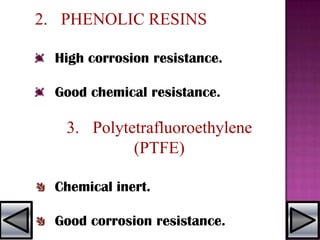
2. PHENOLIC RESINS
High corrosion resistance.
Good chemical resistance.
3. Polytetrafluoroethylene
(PTFE)
Chemical inert.
Good corrosion resistance.
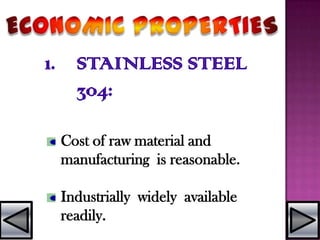
1. STAINLESS STEEL
304:
Cost of raw material and
manufacturing is reasonable.
Industrially widely available
readily.
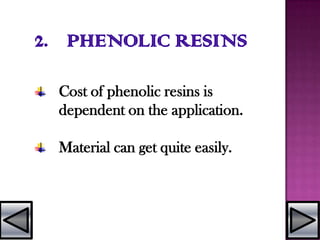
2. PHENOLIC RESINS
Cost of phenolic resins is
dependent on the application.
Material can get quite easily.
3. POLYTETRAFLUOROETHYLENE
(PTFE)
Have a relatively low cost for its raw
material and manufacturing cost.
Can get it quite easily.
1. STAINLESS STEEL 304:
Has a beautiful appearance.
Good texture for cook.
Has an attractive appeal.
2. PHENOLIC RESINS:
Nice appearance.
Good texture.
Attractive look.
3. Polytetrafluoroethylene
(PTFE):
Suitable texture for cook.
1) STAINLESS STEEL 304:
Able to withstand cooking
temperatures.
Able to fry food quickly.
Hygienic.
Durable.
Able to attract consumer’s attention.
does not bend and break under
normal use.
Reasonable manufacturing cost.
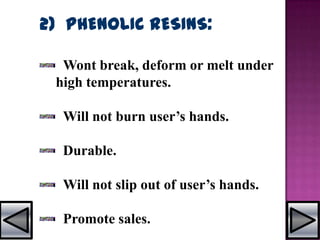
2) PHENOLIC RESINS:
Wont break, deform or melt under
high temperatures.
Will not burn user’s hands.
Durable.
Will not slip out of user’s hands.
Promote sales.
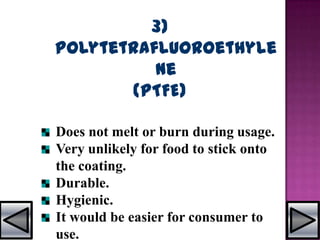
3)
Polytetrafluoroethyle
ne
(PTFE)
Does not melt or burn during usage.
Very unlikely for food to stick onto
the coating.
Durable.
Hygienic.
It would be easier for consumer to
use.
A.Effect of using materials.
B.Ways to solve the problem.
C.Better material that can replace.
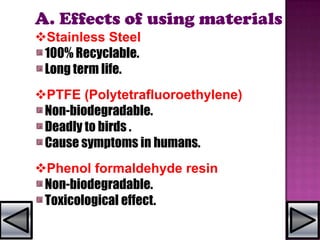
A. Effects of using materials
Stainless Steel
100% Recyclable.
Long term life.
PTFE (Polytetrafluoroethylene)
Non-biodegradable.
Deadly to birds .
Cause symptoms in humans.
Phenol formaldehyde resin
Non-biodegradable.
Toxicological effect.
B.Ways to solve the problem
Stainless Steel:
----
PTFE & Phenol formaldehyde resin
Combustion into renewable energy
Landfills.
C.Better Material That
Can Replace
Stainless Steel: Cast Iron
Extremely Long Lasting
Gives off Iron Particles
Completing the Recycling Process
PTFE Coating: Thermolon
PTFE-free
Use no PFOA in manufacturing
Phenol formaldehyde resin: wood
Bio-degradable
Recyclable
REFERENCE:
• http://www.engineeringtoolbox.com/melting-temperature-metals-
d_860.html
• http://en.wikipedia.org/wiki/Stainless_steel
• http://www.emachineshop.com/machine-shop/Stainless-
Steel/page54.html
• http://www.engineeringtoolbox.com/thermal-conductivity-
d_429.html
• http://en.wikipedia.org/wiki/Non-stick_pan
• http://en.wikipedia.org/wiki/Frying_pan
• http://www.dynalabcorp.com/technical_info_ptfe.asp
• http://en.wikipedia.org/wiki/Bakelite
• http://www.acs.org/content/acs/en/education/whatischemistry/landm
arks/bakelite.html
• http://uk.answers.yahoo.com/question/index?qid=20101205070521A
AHxa4G
• http://www.answers.com/topic/bakelite
• http://www.infoplease.com/encyclopedia/science/bakelite.html
THEEND

Non stick frying pan presentation

  • 1.
    PRESENT BY: LOH YUWEI 136256C WANG DONG 130529C CHENG YUN SHENG 136265M JOEL NG 131079Y LEONG JING YUEN TERRENCE 134192H
  • 3.
    In this presentationwe are going to let you know about : The material that used to produce a Non- stick frying pan. The properties of the materials. The reason of using those material. The environmental issue that the material bring to us.
  • 4.
    Stainless Steel 304 PhenolicResin Polytetrafluoroethylene(PTFE) or Teflon
  • 5.
    Chemical Composition: Chromium -18-20% Nickel - 8-10.50% Manganese - 2.00% max Carbon - 0.08% max Sulfur - 0.030% max Silicon - 1.00% max Phosphorus - 0.045% max Structure: Austenitic metallurgical structure.
  • 6.
    Synthetic polymers obtainedby the reaction of phenol or substituted phenol with formaldehyde. In the form of Bakelite, they are the earliest commercial synthetic resin.
  • 7.
    Formed by astep-growth polymerization reaction that can be either acid- or base- catalysed. Found in myriad industrial products. First plastic made from synthetic components. Widely used for its heat-resistant properties in kitchenware.
  • 9.
    PHYSICAL PROPERTIES MECHANICAL PROPERTIES TECHNOLOGICALPROPERTIES CHEMICAL PROPERTIES ECONOMIC PROPERTIES AESTHETIC PROPERTIES
  • 13.
    1. STAINLESS STEEL304: Stainless Steel 304 has high strength. Stainless steel 304 has good formability. Stainless steel 304 has high rigidity.
  • 14.
    2. PHENOOLIC RESINS: PhenolicResins has high strength. Phenolic Resins has good formability. Phenolic Resins has low toughness. Phenolic Resins has high durability.
  • 15.
    3. Polytetrafluoroethylene (PTFE) Polytetrafluoroethylene (PTFE)has high strength. Polytetrafluoroethylene (PTFE) has low rigidity. Polytetrafluoroethylene (PTFE) has low toughness.
  • 16.
    1.STAINLESS STEEL 304: Stainless steel304 has poor machinability. Stainless steel 304 has high castability. Stainless steel 304 has high
  • 17.
    2. PHENOLIC RESINS PhenolicResins has high machinability. 3. POLYTETRAFLUOROETHYLE NE (PTFE) Polytetrafluoroethylene has high machinability. Polytetrafluoroethylene is easily formable.
  • 18.
    1. STAINLESS STEEL304: Good oxidation resistance. Good corrosion resistance. Good chemical resistance.
  • 19.
    2. PHENOLIC RESINS Highcorrosion resistance. Good chemical resistance. 3. Polytetrafluoroethylene (PTFE) Chemical inert. Good corrosion resistance.
  • 20.
    1. STAINLESS STEEL 304: Costof raw material and manufacturing is reasonable. Industrially widely available readily.
  • 21.
    2. PHENOLIC RESINS Costof phenolic resins is dependent on the application. Material can get quite easily.
  • 22.
    3. POLYTETRAFLUOROETHYLENE (PTFE) Have arelatively low cost for its raw material and manufacturing cost. Can get it quite easily.
  • 23.
    1. STAINLESS STEEL304: Has a beautiful appearance. Good texture for cook. Has an attractive appeal.
  • 24.
    2. PHENOLIC RESINS: Niceappearance. Good texture. Attractive look. 3. Polytetrafluoroethylene (PTFE): Suitable texture for cook.
  • 26.
    1) STAINLESS STEEL304: Able to withstand cooking temperatures. Able to fry food quickly. Hygienic. Durable. Able to attract consumer’s attention. does not bend and break under normal use. Reasonable manufacturing cost.
  • 27.
    2) PHENOLIC RESINS: Wontbreak, deform or melt under high temperatures. Will not burn user’s hands. Durable. Will not slip out of user’s hands. Promote sales.
  • 28.
    3) Polytetrafluoroethyle ne (PTFE) Does not meltor burn during usage. Very unlikely for food to stick onto the coating. Durable. Hygienic. It would be easier for consumer to use.
  • 29.
    A.Effect of usingmaterials. B.Ways to solve the problem. C.Better material that can replace.
  • 30.
    A. Effects ofusing materials Stainless Steel 100% Recyclable. Long term life. PTFE (Polytetrafluoroethylene) Non-biodegradable. Deadly to birds . Cause symptoms in humans. Phenol formaldehyde resin Non-biodegradable. Toxicological effect.
  • 31.
    B.Ways to solvethe problem Stainless Steel: ---- PTFE & Phenol formaldehyde resin Combustion into renewable energy Landfills.
  • 32.
    C.Better Material That CanReplace Stainless Steel: Cast Iron Extremely Long Lasting Gives off Iron Particles Completing the Recycling Process PTFE Coating: Thermolon PTFE-free Use no PFOA in manufacturing Phenol formaldehyde resin: wood Bio-degradable Recyclable
  • 33.
    REFERENCE: • http://www.engineeringtoolbox.com/melting-temperature-metals- d_860.html • http://en.wikipedia.org/wiki/Stainless_steel •http://www.emachineshop.com/machine-shop/Stainless- Steel/page54.html • http://www.engineeringtoolbox.com/thermal-conductivity- d_429.html • http://en.wikipedia.org/wiki/Non-stick_pan • http://en.wikipedia.org/wiki/Frying_pan • http://www.dynalabcorp.com/technical_info_ptfe.asp • http://en.wikipedia.org/wiki/Bakelite • http://www.acs.org/content/acs/en/education/whatischemistry/landm arks/bakelite.html • http://uk.answers.yahoo.com/question/index?qid=20101205070521A AHxa4G • http://www.answers.com/topic/bakelite • http://www.infoplease.com/encyclopedia/science/bakelite.html
  • 35.