NON-PARAMETRIC STATISTICS
PRESENTED BY:
Muhammad Munsif Siyal
Dr./E-2024-F-10
munsifsail@gmail.com
PRESENTED TO:
PROF. DR. MUHAMMAD. SHAHID FAROOQ
DASE, IER, UNIVERSITY OF THE PUNJAB
TABLE OF CONTENT
• Introduction
• Assumptions
• Types
• Summary
• Strengths
• Limitations
• Practice Links
• References
INTRODUCTION
A variable is something that can change or vary. In the context of education, variables
are factors or characteristics that researchers, teachers, or students observe, measure,
or manipulate to understand or improve learning outcomes.
Types of variables
• Independent Variable
• Dependent Variable
• Control Variable
• Extraneous Variable
• Confounding Variable
• Categorical Variable
• Numerical Variable etc.
DATA: MEASUREMENTS OR OBSERVATION OF A
VARIABLE
• Nominal: Categories without order (e.g., subjects: Math, Science, English, History; types
of schools: public, private, charter; classroom colors: red, blue, green, yellow; teaching
methods: lecture, discussion, activity-based).
• Ordinal: Ordered categories (e.g., student ranks: 1st, 2nd, 3rd, 4th; grades: A, B, C, D;
teacher ratings: excellent, good, average, poor; difficulty levels: beginner, intermediate,
advanced, expert).
• Interval: Equal intervals, no true zero (e.g., test scores: 50, 60, 70, 80; IQ scores: 90, 100,
110, 120; temperature in classrooms: 20°C, 25°C, 30°C, 35°C; scale ratings: 1-5 for
satisfaction).
• Ratio: Equal intervals with a true zero (e.g., study hours: 0, 2, 4, 6; number of books
read: 0, 5, 10, 15; attendance percentage: 0%, 50%, 100%; time taken to complete a test:
0 minutes, 30 minutes, 60 minutes).
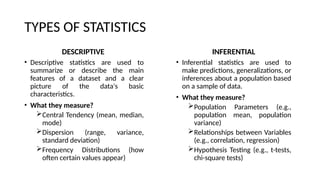
TYPES OF STATISTICS
DESCRIPTIVE
• Descriptive statistics are used to
summarize or describe the main
features of a dataset and a clear
picture of the data's basic
characteristics.
• What they measure?
Central Tendency (mean, median,
mode)
Dispersion (range, variance,
standard deviation)
Frequency Distributions (how
often certain values appear)
INFERENTIAL
• Inferential statistics are used to
make predictions, generalizations, or
inferences about a population based
on a sample of data.
• What they measure?
Population Parameters (e.g.,
population mean, population
variance)
Relationships between Variables
(e.g., correlation, regression)
Hypothesis Testing (e.g., t-tests,
chi-square tests)
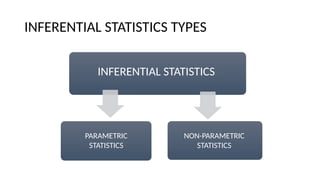
INFERENTIAL STATISTICS TYPES
INFERENTIAL STATISTICS
PARAMETRIC
STATISTICS
NON-PARAMETRIC
STATISTICS
NON-PARAMETRIC STATISTICS
Non-Parametric Statistics refers to statistical methods that do not assume a
specific distribution for the data being analyzed. They are also known as
distribution-free tests. These methods are distribution-free and are often used
when the assumptions of parametric tests (e.g., normality or equal variances) are
not met.
ASSUMPTIONS
• At least one assumption of a parametric test has been violated.
• Data is not normally distributed.
• Data is nominal or ordinal.
• There are outliers in the data set.
NON-PARAMETRIC TESTS
1.Chi-Square Test
2.Wilcoxon-Signed Rank Test
3.Mann-Whitney U Test
4.Kruskal-Wallis Test
CHI-SQUARE TEST
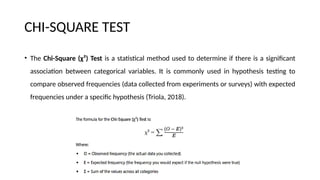
• The Chi-Square (χ²) Test is a statistical method used to determine if there is a significant
association between categorical variables. It is commonly used in hypothesis testing to
compare observed frequencies (data collected from experiments or surveys) with expected
frequencies under a specific hypothesis (Triola, 2018).
ASSUMPTIONS
Independent Observations: Each observation should be independent (e.g., each person in a
survey answers their own question, no overlap).
Categorical Data: The data should be in categories (e.g., gender, favorite color, yes/no answers).
Adequate Sample Size: Each expected frequency should be 5 or more. For example, if you're
testing favorite colors in a group of 30 people, each color category (red, blue, green, etc.) should
have at least 5 people. If any category has fewer than 5 people, the Chi-Square test may not give
accurate results.
Mutually Exclusive Categories: Each observation can only fit into one category (e.g., a student
can't belong to both "A" and "B" grade groups at the same time or a student cannot be both a
"Math lover" and a "Art lover" in the same survey).
STEPS
• State the Hypotheses
• Set the Significance Level (α)
• Collect and Organize the Data
• Calculate the Expected Frequencies (E)
• Compute the Chi-Square Statistic (χ²)
• Determine the Degrees of Freedom (df)
• Find the Critical Value
• Compare the Chi-Square Statistic with the Critical Value
• Draw a Conclusion
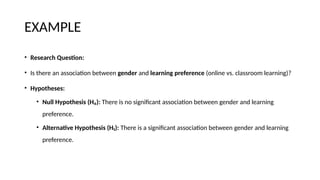
EXAMPLE
• Research Question:
• Is there an association between gender and learning preference (online vs. classroom learning)?
• Hypotheses:
• Null Hypothesis (H₀): There is no significant association between gender and learning
preference.
• Alternative Hypothesis (H₁): There is a significant association between gender and learning
preference.
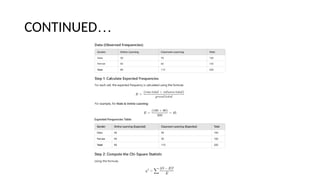
CONTINUED…
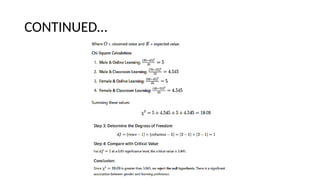
CONTINUED…
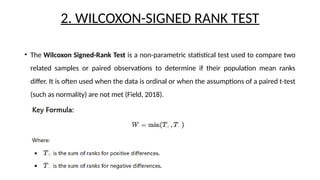
2. WILCOXON-SIGNED RANK TEST
• The Wilcoxon Signed-Rank Test is a non-parametric statistical test used to compare two
related samples or paired observations to determine if their population mean ranks
differ. It is often used when the data is ordinal or when the assumptions of a paired t-test
(such as normality) are not met (Field, 2018).
ASSUMPTIONS
• Paired Observations: The data consists of paired samples (e.g., pre-test and post-test
scores of students in a class).
• Symmetry of Differences: The differences between paired values are symmetrically
distributed (e.g., changes in student scores before and after training).
• Ordinal or Continuous Data: The data should be at least ordinal or continuous (e.g., test
scores, ranking of students).
• No Extreme Outliers: There should be no extreme outliers affecting the differences (e.g.,
one student’s performance drastically different from others).
STEPS
• Calculate Differences between paired values.
• Rank the Absolute Differences from smallest to largest.
• Assign Signs (positive or negative) to the ranks based on the direction of the differences.
• Sum the Positive and Negative Ranks.
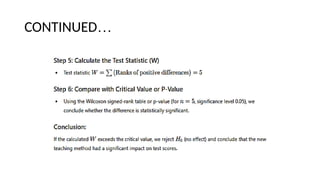
• Calculate the Test Statistic (W).
• Compare with Critical Value or use the p-value.
• Make a Conclusion based on the comparison.
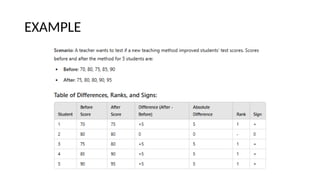
EXAMPLE
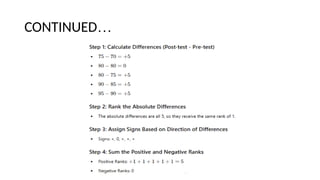
CONTINUED…
CONTINUED…
3. MANN-WHITNEY U TEST
• The Mann-Whitney U Test is a non-parametric test used to compare two
independent groups to determine if there is a significant difference between their
distributions. It is often used when the data does not meet the assumptions of a
parametric test (like the t-test), such as normality or equal variances (Hollander.,
& Chicken 2013).
ASSUMPTIONS
• Independence: Two groups (e.g., students taught with Method A vs. Method B) are
independent.
• Ordinal/Continuous Data: Test scores or rankings are ordinal or continuous.
• Similar Distribution Shape: The spread of scores should look somewhat alike, even if
their medians are different.
STEPS
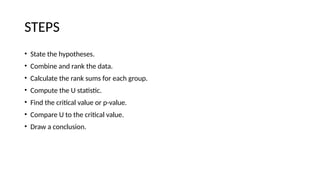
• State the hypotheses.
• Combine and rank the data.
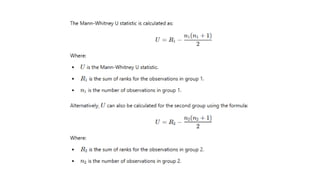
• Calculate the rank sums for each group.
• Compute the U statistic.
• Find the critical value or p-value.
• Compare U to the critical value.
• Draw a conclusion.
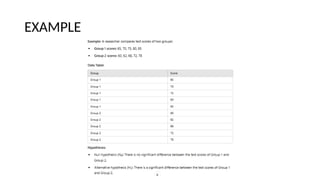
EXAMPLE
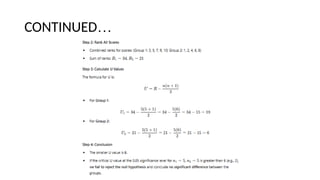
CONTINUED…
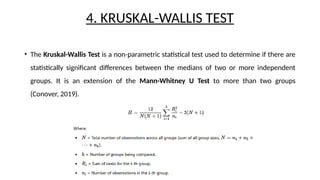
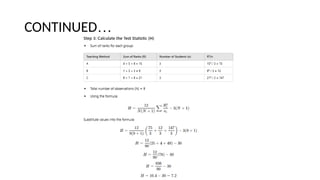
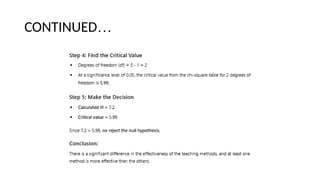
4. KRUSKAL-WALLIS TEST
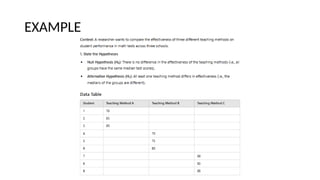
• The Kruskal-Wallis Test is a non-parametric statistical test used to determine if there are
statistically significant differences between the medians of two or more independent
groups. It is an extension of the Mann-Whitney U Test to more than two groups
(Conover, 2019).
ASSUMPTIONS
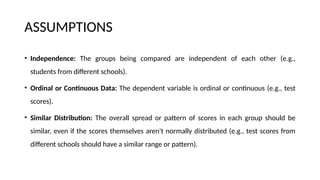
• Independence: The groups being compared are independent of each other (e.g.,
students from different schools).
• Ordinal or Continuous Data: The dependent variable is ordinal or continuous (e.g., test
scores).
• Similar Distribution: The overall spread or pattern of scores in each group should be
similar, even if the scores themselves aren't normally distributed (e.g., test scores from
different schools should have a similar range or pattern).
STEPS
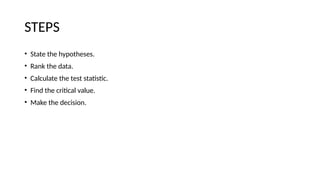
• State the hypotheses.
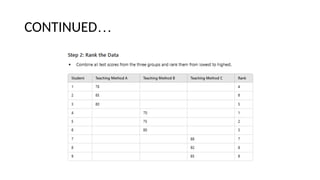
• Rank the data.
• Calculate the test statistic.
• Find the critical value.
• Make the decision.
EXAMPLE
CONTINUED…
CONTINUED…
CONTINUED…
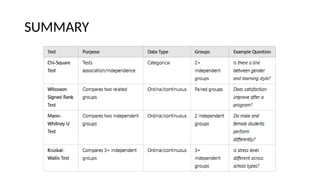
SUMMARY
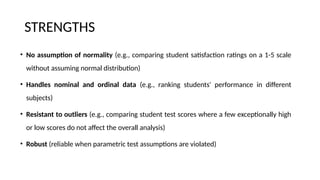
STRENGTHS
• No assumption of normality (e.g., comparing student satisfaction ratings on a 1-5 scale
without assuming normal distribution)
• Handles nominal and ordinal data (e.g., ranking students' performance in different
subjects)
• Resistant to outliers (e.g., comparing student test scores where a few exceptionally high
or low scores do not affect the overall analysis)
• Robust (reliable when parametric test assumptions are violated)
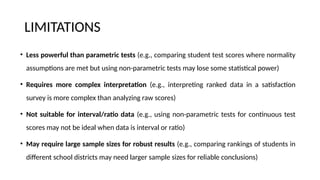
LIMITATIONS
• Less powerful than parametric tests (e.g., comparing student test scores where normality
assumptions are met but using non-parametric tests may lose some statistical power)
• Requires more complex interpretation (e.g., interpreting ranked data in a satisfaction
survey is more complex than analyzing raw scores)
• Not suitable for interval/ratio data (e.g., using non-parametric tests for continuous test
scores may not be ideal when data is interval or ratio)
• May require large sample sizes for robust results (e.g., comparing rankings of students in
different school districts may need larger sample sizes for reliable conclusions)
PRACTICE LINKS
• https://youtu.be/KrZ3GSnJV0U?si=tCc50_4bkmRVTx9_ (Chi-Square Test)
• https://youtu.be/LE3AIyY_cn8?si=Zzipao6uSX-ohDKq (Chi-Square Test)
• https://youtu.be/aaGW9B6vLlI?si=R92vIYsKPfo1iEBf (Chi-Square Test using SPSS)
• https://youtu.be/UrdTEIyWvOM?si=GdT9GNL_g25lxeOy (Wilcoxon Signed Rank Test)
• https://youtu.be/gHvH0UWEnts?si=CcFnlMsDLC0LQt6Y (Wilcoxon-Signed Rank Test using SPSS)
• https://youtu.be/i4_86DrAfzI?si=jw2hIb1-gyfXFMaE (Mann-Whitney U Test)
• https://youtu.be/bYwxvcs3HJs?si=C5_7rhtgPF3tHuqP (Kruskal Wallis Test)
• https://youtu.be/_DS9oisG6xw?si=CZ9UCtS7MlNOjH7j (Kruskal Wallis Test)
REFERENCES
• Conover, W. J. (2019). Practical Nonparametric Statistics (3rd ed.). Wiley.
• Field, A. (2018). Discovering Statistics Using IBM SPSS Statistics (5th ed.). Sage.
• Hollander, M., Wolfe, D. A., & Chicken, E. (2013). Nonparametric Statistical Methods. John
Wiley & Sons.
• Kumar, R. (2018). Research Methodology: A Step-by-step Guide For Beginners. Sage.
• Singh, Y. K. (2006). Fundamental of Research Methodology and Statistics. New Age
International.
• Triola, M. F. (2018). Elementary Statistics (13th ed.). Pearson.
• Wasserman, L. (2006). All of Nonparametric Statistics. Springer.
THANK YOU

Non-Parametric Statistics | DATA: MEASUREMENTS OR OBSERVATION OF A VARIABLE

  • 1.
    NON-PARAMETRIC STATISTICS PRESENTED BY: MuhammadMunsif Siyal Dr./E-2024-F-10 munsifsail@gmail.com PRESENTED TO: PROF. DR. MUHAMMAD. SHAHID FAROOQ DASE, IER, UNIVERSITY OF THE PUNJAB
  • 2.
    TABLE OF CONTENT •Introduction • Assumptions • Types • Summary • Strengths • Limitations • Practice Links • References
  • 3.
    INTRODUCTION A variable issomething that can change or vary. In the context of education, variables are factors or characteristics that researchers, teachers, or students observe, measure, or manipulate to understand or improve learning outcomes. Types of variables • Independent Variable • Dependent Variable • Control Variable • Extraneous Variable • Confounding Variable • Categorical Variable • Numerical Variable etc.
  • 4.
    DATA: MEASUREMENTS OROBSERVATION OF A VARIABLE • Nominal: Categories without order (e.g., subjects: Math, Science, English, History; types of schools: public, private, charter; classroom colors: red, blue, green, yellow; teaching methods: lecture, discussion, activity-based). • Ordinal: Ordered categories (e.g., student ranks: 1st, 2nd, 3rd, 4th; grades: A, B, C, D; teacher ratings: excellent, good, average, poor; difficulty levels: beginner, intermediate, advanced, expert). • Interval: Equal intervals, no true zero (e.g., test scores: 50, 60, 70, 80; IQ scores: 90, 100, 110, 120; temperature in classrooms: 20°C, 25°C, 30°C, 35°C; scale ratings: 1-5 for satisfaction). • Ratio: Equal intervals with a true zero (e.g., study hours: 0, 2, 4, 6; number of books read: 0, 5, 10, 15; attendance percentage: 0%, 50%, 100%; time taken to complete a test: 0 minutes, 30 minutes, 60 minutes).
  • 5.
    TYPES OF STATISTICS DESCRIPTIVE •Descriptive statistics are used to summarize or describe the main features of a dataset and a clear picture of the data's basic characteristics. • What they measure? Central Tendency (mean, median, mode) Dispersion (range, variance, standard deviation) Frequency Distributions (how often certain values appear) INFERENTIAL • Inferential statistics are used to make predictions, generalizations, or inferences about a population based on a sample of data. • What they measure? Population Parameters (e.g., population mean, population variance) Relationships between Variables (e.g., correlation, regression) Hypothesis Testing (e.g., t-tests, chi-square tests)
  • 6.
    INFERENTIAL STATISTICS TYPES INFERENTIALSTATISTICS PARAMETRIC STATISTICS NON-PARAMETRIC STATISTICS
  • 7.
    NON-PARAMETRIC STATISTICS Non-Parametric Statisticsrefers to statistical methods that do not assume a specific distribution for the data being analyzed. They are also known as distribution-free tests. These methods are distribution-free and are often used when the assumptions of parametric tests (e.g., normality or equal variances) are not met.
  • 8.
    ASSUMPTIONS • At leastone assumption of a parametric test has been violated. • Data is not normally distributed. • Data is nominal or ordinal. • There are outliers in the data set.
  • 9.
    NON-PARAMETRIC TESTS 1.Chi-Square Test 2.Wilcoxon-SignedRank Test 3.Mann-Whitney U Test 4.Kruskal-Wallis Test
  • 10.
    CHI-SQUARE TEST • TheChi-Square (χ²) Test is a statistical method used to determine if there is a significant association between categorical variables. It is commonly used in hypothesis testing to compare observed frequencies (data collected from experiments or surveys) with expected frequencies under a specific hypothesis (Triola, 2018).
  • 11.
    ASSUMPTIONS Independent Observations: Eachobservation should be independent (e.g., each person in a survey answers their own question, no overlap). Categorical Data: The data should be in categories (e.g., gender, favorite color, yes/no answers). Adequate Sample Size: Each expected frequency should be 5 or more. For example, if you're testing favorite colors in a group of 30 people, each color category (red, blue, green, etc.) should have at least 5 people. If any category has fewer than 5 people, the Chi-Square test may not give accurate results. Mutually Exclusive Categories: Each observation can only fit into one category (e.g., a student can't belong to both "A" and "B" grade groups at the same time or a student cannot be both a "Math lover" and a "Art lover" in the same survey).
  • 12.
    STEPS • State theHypotheses • Set the Significance Level (α) • Collect and Organize the Data • Calculate the Expected Frequencies (E) • Compute the Chi-Square Statistic (χ²) • Determine the Degrees of Freedom (df) • Find the Critical Value • Compare the Chi-Square Statistic with the Critical Value • Draw a Conclusion
  • 13.
    EXAMPLE • Research Question: •Is there an association between gender and learning preference (online vs. classroom learning)? • Hypotheses: • Null Hypothesis (H₀): There is no significant association between gender and learning preference. • Alternative Hypothesis (H₁): There is a significant association between gender and learning preference.
  • 14.
  • 15.
  • 16.
    2. WILCOXON-SIGNED RANKTEST • The Wilcoxon Signed-Rank Test is a non-parametric statistical test used to compare two related samples or paired observations to determine if their population mean ranks differ. It is often used when the data is ordinal or when the assumptions of a paired t-test (such as normality) are not met (Field, 2018).
  • 17.
    ASSUMPTIONS • Paired Observations:The data consists of paired samples (e.g., pre-test and post-test scores of students in a class). • Symmetry of Differences: The differences between paired values are symmetrically distributed (e.g., changes in student scores before and after training). • Ordinal or Continuous Data: The data should be at least ordinal or continuous (e.g., test scores, ranking of students). • No Extreme Outliers: There should be no extreme outliers affecting the differences (e.g., one student’s performance drastically different from others).
  • 18.
    STEPS • Calculate Differencesbetween paired values. • Rank the Absolute Differences from smallest to largest. • Assign Signs (positive or negative) to the ranks based on the direction of the differences. • Sum the Positive and Negative Ranks. • Calculate the Test Statistic (W). • Compare with Critical Value or use the p-value. • Make a Conclusion based on the comparison.
  • 19.
  • 20.
  • 21.
  • 22.
    3. MANN-WHITNEY UTEST • The Mann-Whitney U Test is a non-parametric test used to compare two independent groups to determine if there is a significant difference between their distributions. It is often used when the data does not meet the assumptions of a parametric test (like the t-test), such as normality or equal variances (Hollander., & Chicken 2013).
  • 24.
    ASSUMPTIONS • Independence: Twogroups (e.g., students taught with Method A vs. Method B) are independent. • Ordinal/Continuous Data: Test scores or rankings are ordinal or continuous. • Similar Distribution Shape: The spread of scores should look somewhat alike, even if their medians are different.
  • 25.
    STEPS • State thehypotheses. • Combine and rank the data. • Calculate the rank sums for each group. • Compute the U statistic. • Find the critical value or p-value. • Compare U to the critical value. • Draw a conclusion.
  • 26.
  • 27.
  • 28.
    4. KRUSKAL-WALLIS TEST •The Kruskal-Wallis Test is a non-parametric statistical test used to determine if there are statistically significant differences between the medians of two or more independent groups. It is an extension of the Mann-Whitney U Test to more than two groups (Conover, 2019).
  • 29.
    ASSUMPTIONS • Independence: Thegroups being compared are independent of each other (e.g., students from different schools). • Ordinal or Continuous Data: The dependent variable is ordinal or continuous (e.g., test scores). • Similar Distribution: The overall spread or pattern of scores in each group should be similar, even if the scores themselves aren't normally distributed (e.g., test scores from different schools should have a similar range or pattern).
  • 30.
    STEPS • State thehypotheses. • Rank the data. • Calculate the test statistic. • Find the critical value. • Make the decision.
  • 31.
  • 32.
  • 33.
  • 34.
  • 35.
  • 36.
    STRENGTHS • No assumptionof normality (e.g., comparing student satisfaction ratings on a 1-5 scale without assuming normal distribution) • Handles nominal and ordinal data (e.g., ranking students' performance in different subjects) • Resistant to outliers (e.g., comparing student test scores where a few exceptionally high or low scores do not affect the overall analysis) • Robust (reliable when parametric test assumptions are violated)
  • 37.
    LIMITATIONS • Less powerfulthan parametric tests (e.g., comparing student test scores where normality assumptions are met but using non-parametric tests may lose some statistical power) • Requires more complex interpretation (e.g., interpreting ranked data in a satisfaction survey is more complex than analyzing raw scores) • Not suitable for interval/ratio data (e.g., using non-parametric tests for continuous test scores may not be ideal when data is interval or ratio) • May require large sample sizes for robust results (e.g., comparing rankings of students in different school districts may need larger sample sizes for reliable conclusions)
  • 38.
    PRACTICE LINKS • https://youtu.be/KrZ3GSnJV0U?si=tCc50_4bkmRVTx9_(Chi-Square Test) • https://youtu.be/LE3AIyY_cn8?si=Zzipao6uSX-ohDKq (Chi-Square Test) • https://youtu.be/aaGW9B6vLlI?si=R92vIYsKPfo1iEBf (Chi-Square Test using SPSS) • https://youtu.be/UrdTEIyWvOM?si=GdT9GNL_g25lxeOy (Wilcoxon Signed Rank Test) • https://youtu.be/gHvH0UWEnts?si=CcFnlMsDLC0LQt6Y (Wilcoxon-Signed Rank Test using SPSS) • https://youtu.be/i4_86DrAfzI?si=jw2hIb1-gyfXFMaE (Mann-Whitney U Test) • https://youtu.be/bYwxvcs3HJs?si=C5_7rhtgPF3tHuqP (Kruskal Wallis Test) • https://youtu.be/_DS9oisG6xw?si=CZ9UCtS7MlNOjH7j (Kruskal Wallis Test)
  • 39.
    REFERENCES • Conover, W.J. (2019). Practical Nonparametric Statistics (3rd ed.). Wiley. • Field, A. (2018). Discovering Statistics Using IBM SPSS Statistics (5th ed.). Sage. • Hollander, M., Wolfe, D. A., & Chicken, E. (2013). Nonparametric Statistical Methods. John Wiley & Sons. • Kumar, R. (2018). Research Methodology: A Step-by-step Guide For Beginners. Sage. • Singh, Y. K. (2006). Fundamental of Research Methodology and Statistics. New Age International. • Triola, M. F. (2018). Elementary Statistics (13th ed.). Pearson. • Wasserman, L. (2006). All of Nonparametric Statistics. Springer.
  • 40.