Non-orthogonal Multiple Access with SIC
Short Discourse
Jiljo K Moncy
jkmoncy@caltech.edu
http://www.linkedin.com/in/jiljokmoncy
California Institute of Technology
Pasadena, CA
March 9, 2018
Jiljo K Moncy March 9, 2018 NOMA with SIC 1 / 23
Agenda
• Introduction
• Concept of NOMA
• System Model
• Downlink
• Uplink
• Component Technologies
• Power allocation
• Scheduling
• Receiver
• Multiple antennas
• Performance Evaluation
• Receiver test-bed
Jiljo K Moncy March 9, 2018 NOMA with SIC 2 / 23
Introduction
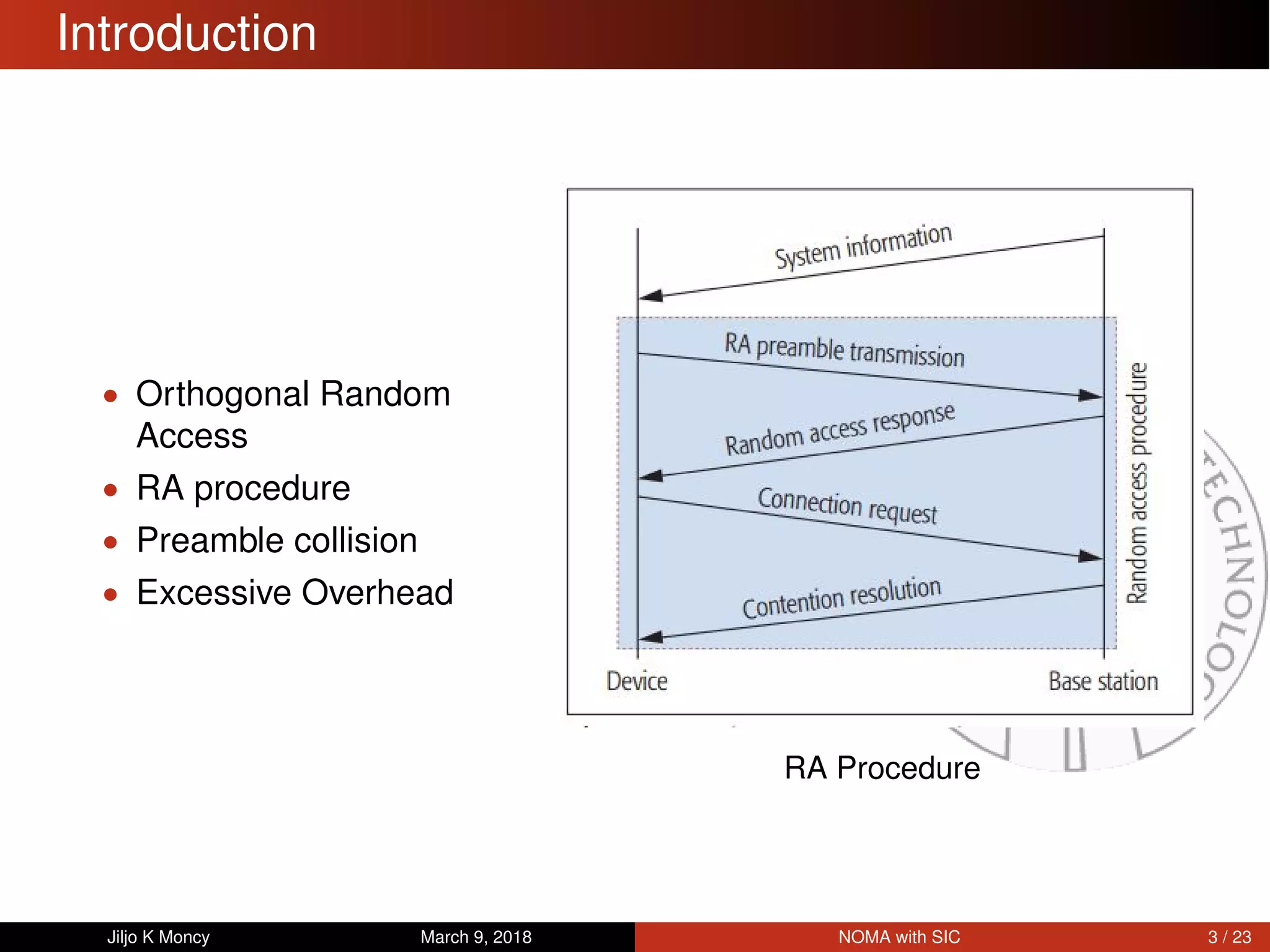
• Orthogonal Random
Access
• RA procedure
• Preamble collision
• Excessive Overhead
RA Procedure
Jiljo K Moncy March 9, 2018 NOMA with SIC 3 / 23
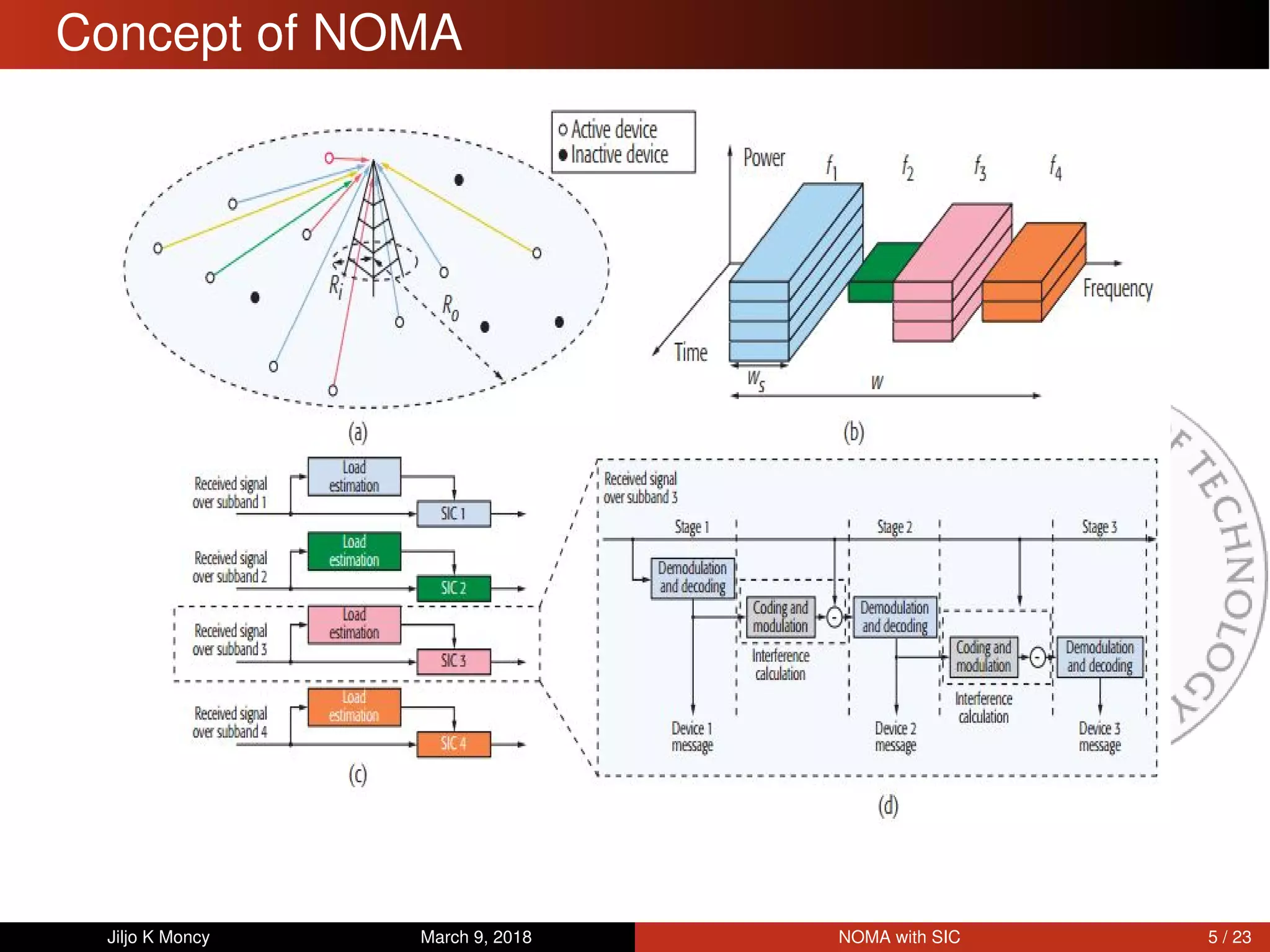
Concept of NOMA
Concept of NOMA [3]
• Signals superimposed in power domain
• Superimposed signal considered as interference
• SIC employed at user with higher SINR
Jiljo K Moncy March 9, 2018 NOMA with SIC 4 / 23
Concept of NOMA
Jiljo K Moncy March 9, 2018 NOMA with SIC 5 / 23
NOMA Vs OMA
• OMA splits available BW
• NOMA uses different power for transmissions
Spectrum Usage [2]
Jiljo K Moncy March 9, 2018 NOMA with SIC 6 / 23
System Model
Downlink
Transmission
• Each sub-band caters multiple users
• Scheduling to determine multiplicity
• Transmission power assigned to users
• Cell centered users have smaller power allocation than cell edge
users
x =
m
k=1
Pk sk (1)
Pk = βk
PBS
NSB
(2)
Downlink: Resource allocation [3]
Jiljo K Moncy March 9, 2018 NOMA with SIC 7 / 23
System Model
Downlink
Reception
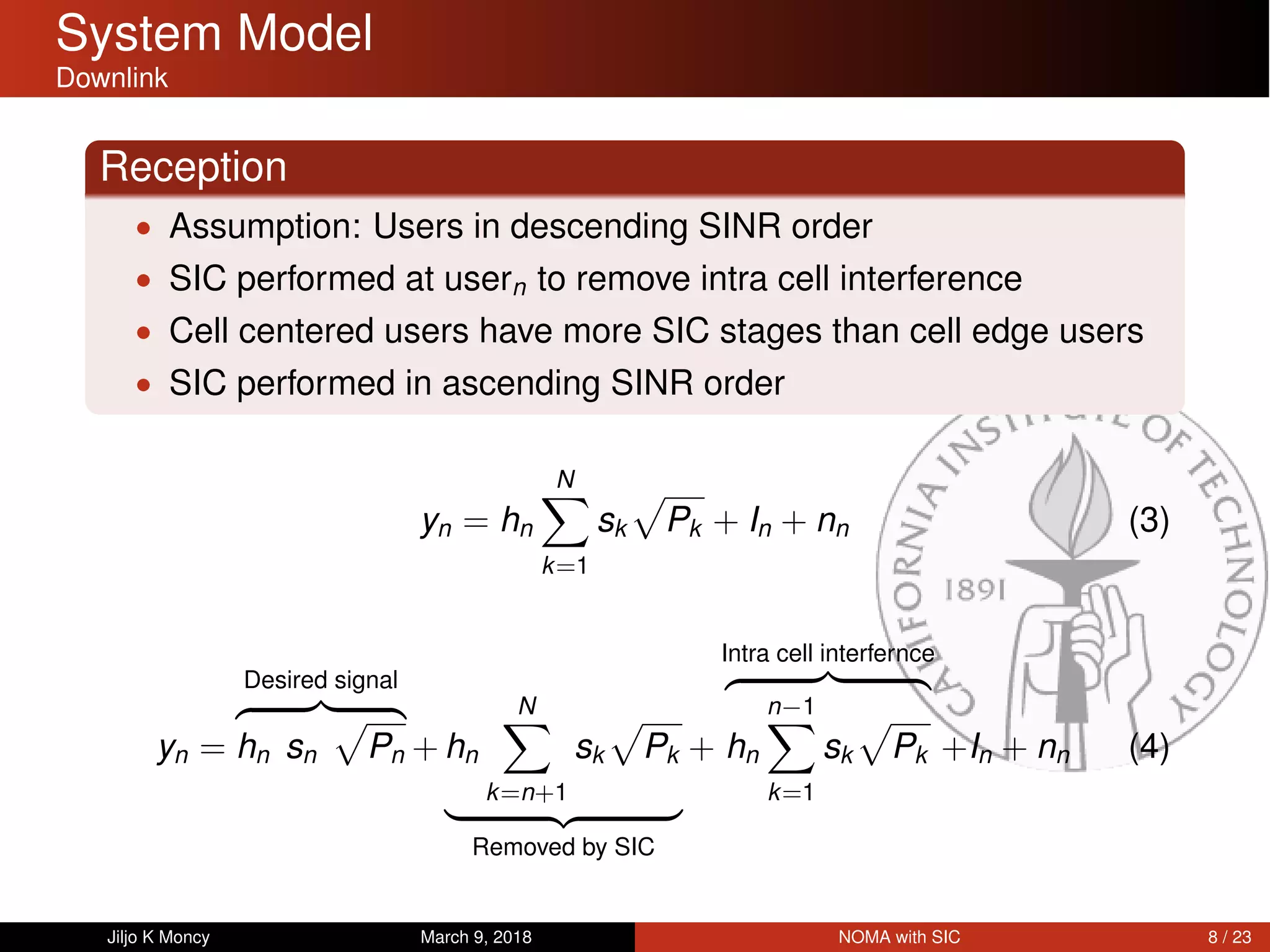
• Assumption: Users in descending SINR order
• SIC performed at usern to remove intra cell interference
• Cell centered users have more SIC stages than cell edge users
• SIC performed in ascending SINR order
yn = hn
N
k=1
sk Pk + In + nn (3)
yn =
Desired signal
hn sn Pn + hn
N
k=n+1
sk Pk
Removed by SIC
+
Intra cell interfernce
hn
n−1
k=1
sk Pk +In + nn (4)
Jiljo K Moncy March 9, 2018 NOMA with SIC 8 / 23
System Model
Uplink
Signals from cell centered users are decoded prior to other users
Uplink SIC [2]
Jiljo K Moncy March 9, 2018 NOMA with SIC 9 / 23
Component Technologies
• Multi-user transmission power allocation
• Scheduling algorithm
• Receiver design
• Combination with multiple antennas
Jiljo K Moncy March 9, 2018 NOMA with SIC 10 / 23
Multi-user transmission power
Post-processing SINR of usern after SIC,
SINRPost
n =
βn
n−1
k=1 βk + 1
SINRn
(5)
SINRn = |hn|2 PBS
NSBPI+N
(6)
• Power assignment ratios control the user throughput
• [3] proposes allocation by maximizing geometric mean user
throughput
Jiljo K Moncy March 9, 2018 NOMA with SIC 11 / 23
Power allocation
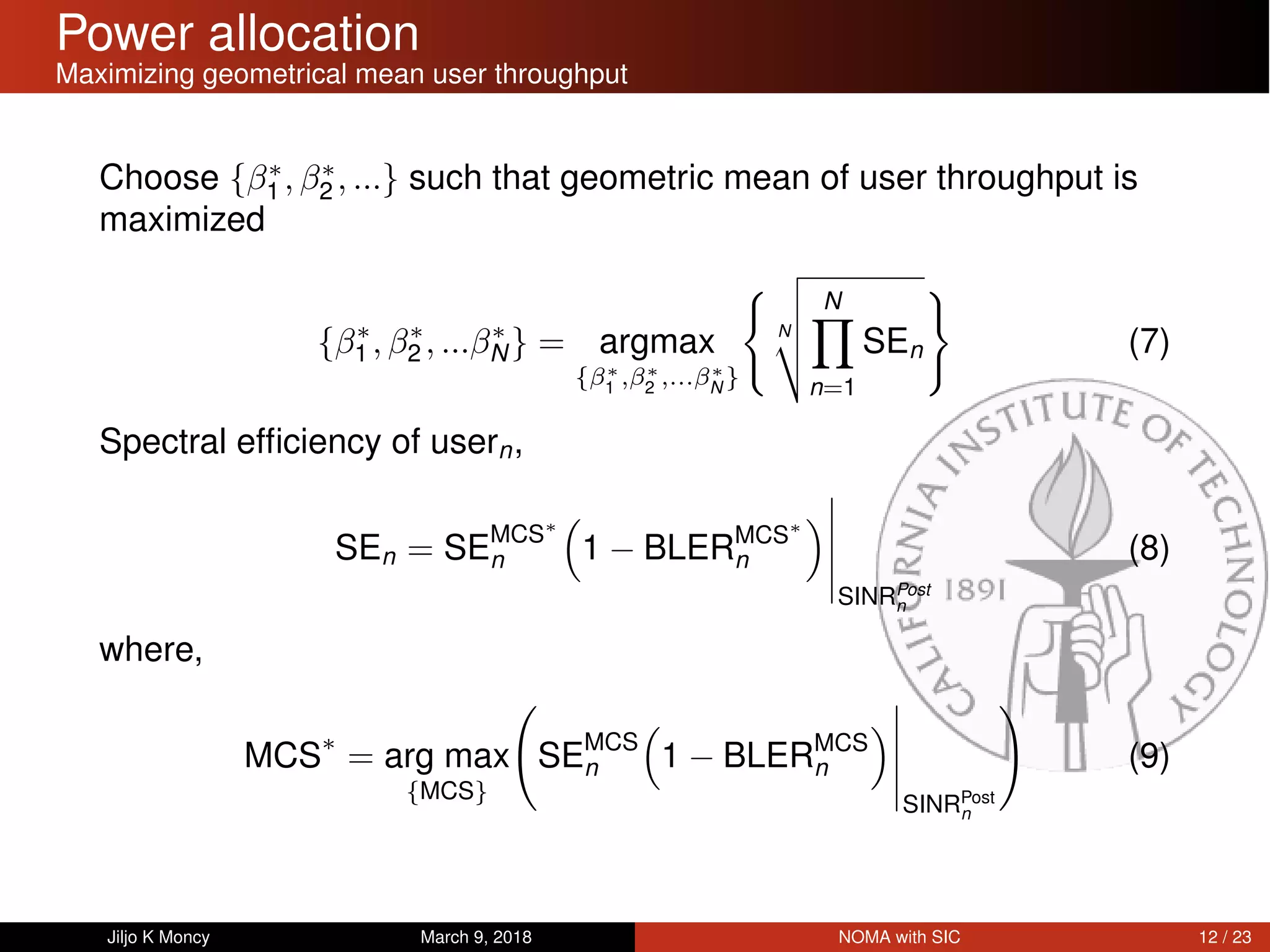
Maximizing geometrical mean user throughput
Choose {β∗
1 , β∗
2 , ...} such that geometric mean of user throughput is
maximized
{β∗
1 , β∗
2 , ...β∗
N} = argmax
{β∗
1
,β∗
2
,...β∗
N
}
N
N
n=1
SEn (7)
Spectral efficiency of usern,
SEn = SEMCS∗
n 1 − BLERMCS∗
n
SINRPost
n
(8)
where,
MCS∗
= arg max
{MCS}
SEMCS
n 1 − BLERMCS
n
SINRPost
n
(9)
Jiljo K Moncy March 9, 2018 NOMA with SIC 12 / 23
Power allocation
Algorithms
Computational complexity increases exponentially with users
Other algorithms proposed:
• Allocation proportional to pathloss
• Allocation with limited power assignment ratio sets
• Tree-search based low complexity algorithm
Jiljo K Moncy March 9, 2018 NOMA with SIC 13 / 23
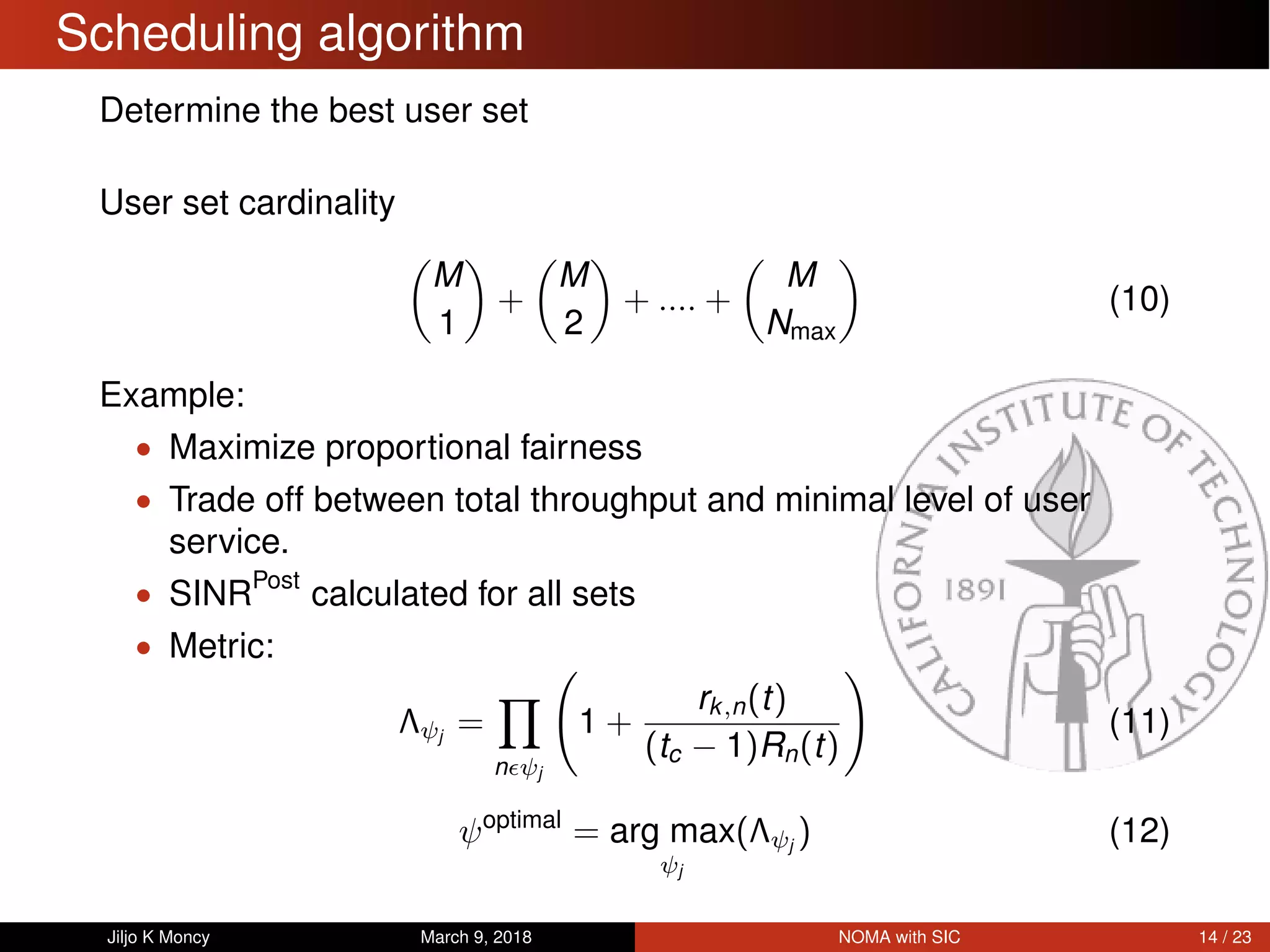
Scheduling algorithm
Determine the best user set
User set cardinality
M
1
+
M
2
+ .... +
M
Nmax
(10)
Example:
• Maximize proportional fairness
• Trade off between total throughput and minimal level of user
service.
• SINRPost
calculated for all sets
• Metric:
Λψj
=
n ψj
1 +
rk,n(t)
(tc − 1)Rn(t)
(11)
ψoptimal
= arg max
ψj
(Λψj
) (12)
Jiljo K Moncy March 9, 2018 NOMA with SIC 14 / 23
Receiver design
Two kinds of receiver
1 Symbol-level SIC receiver
2 Codeword-level SIC
Receiver Design [3]
Jiljo K Moncy March 9, 2018 NOMA with SIC 15 / 23
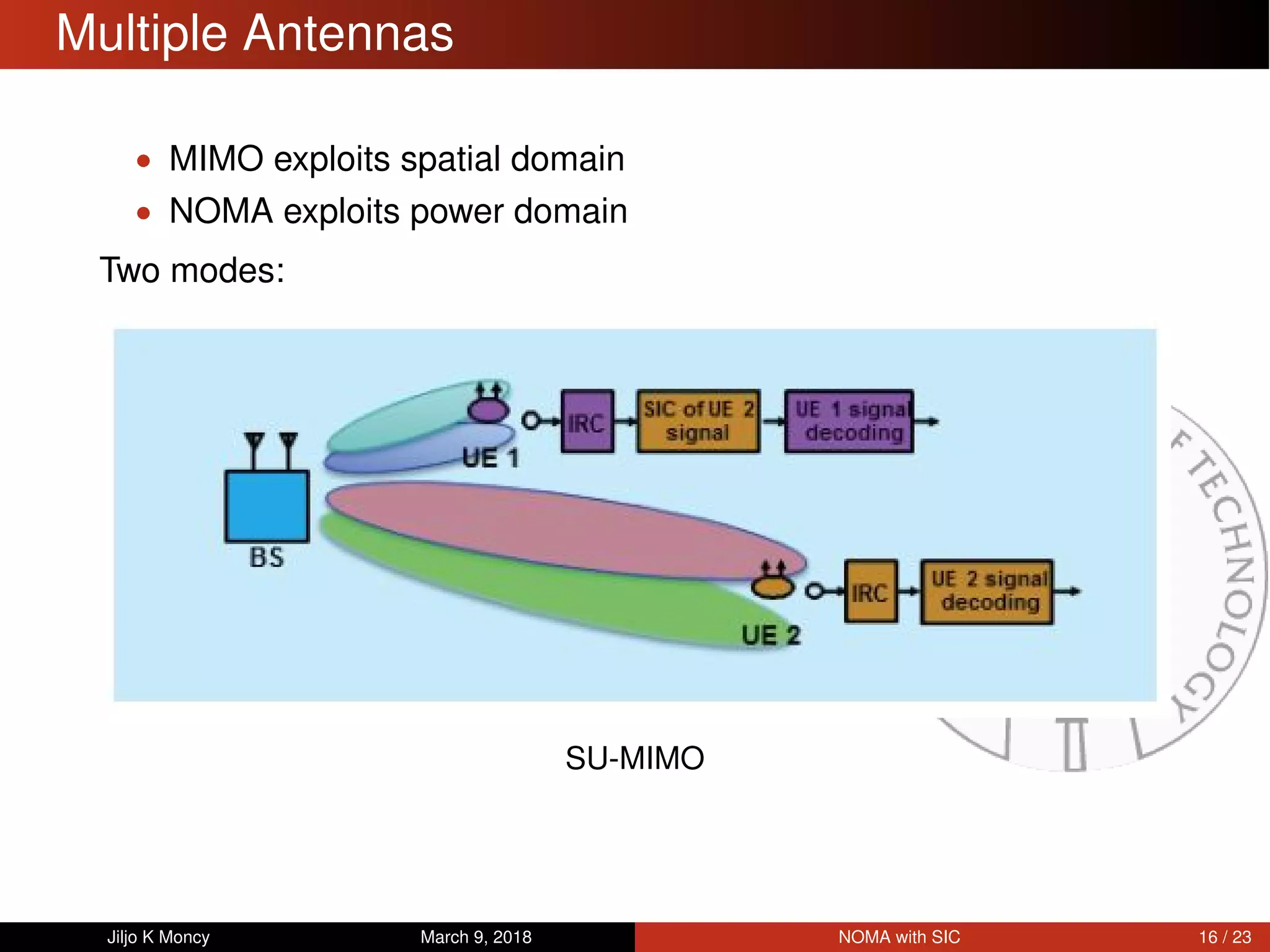
Multiple Antennas
• MIMO exploits spatial domain
• NOMA exploits power domain
Two modes:
SU-MIMO
Jiljo K Moncy March 9, 2018 NOMA with SIC 16 / 23
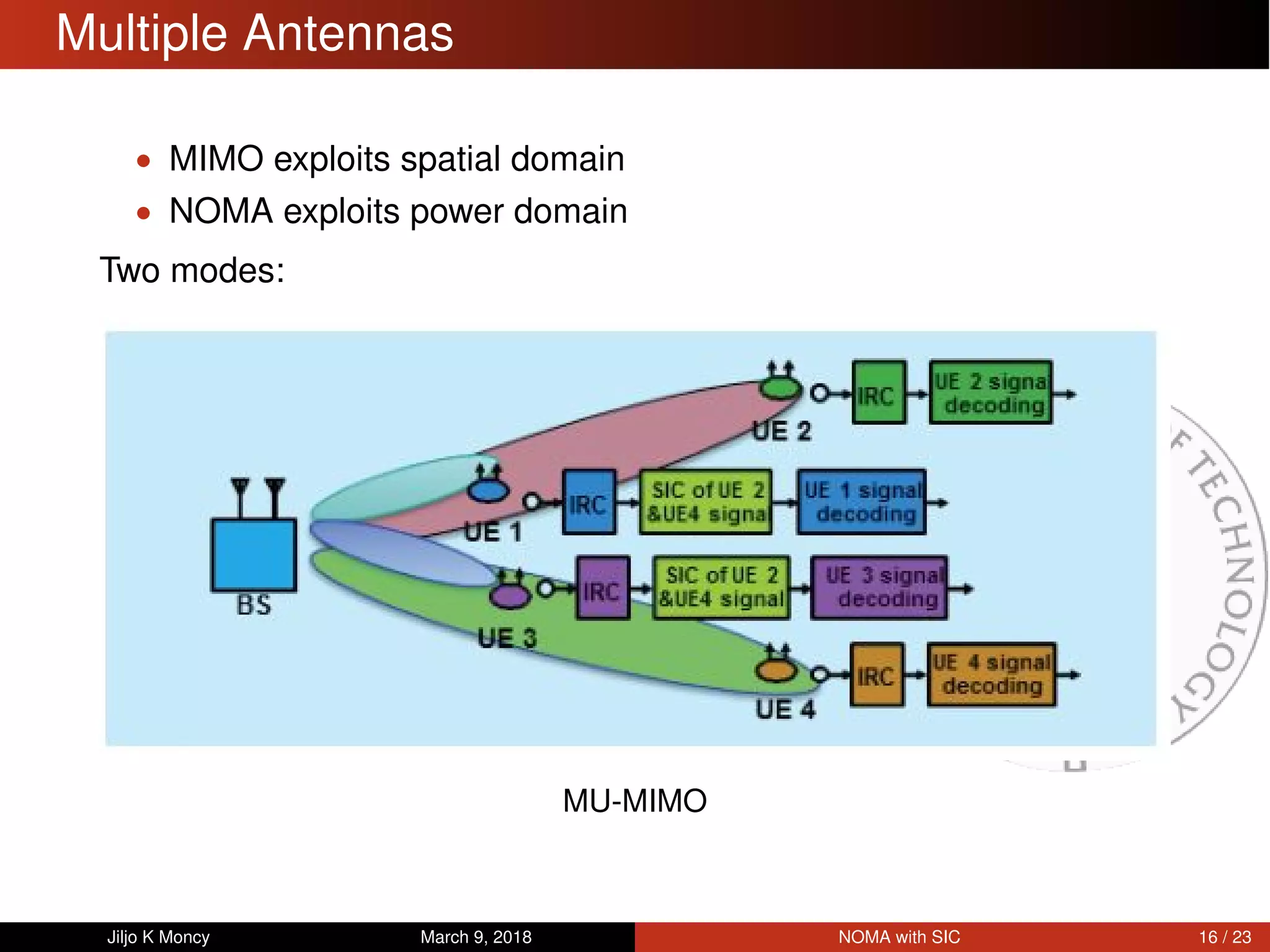
Multiple Antennas
• MIMO exploits spatial domain
• NOMA exploits power domain
Two modes:
MU-MIMO
Jiljo K Moncy March 9, 2018 NOMA with SIC 16 / 23
Performance Evaluation
Link-level
Performance comparison of different receivers [3]
Jiljo K Moncy March 9, 2018 NOMA with SIC 17 / 23
Performance Evaluation
System-level
Cummulative throughput of downlink
user throughput [2] Downlink total user throughput [2]
Jiljo K Moncy March 9, 2018 NOMA with SIC 18 / 23
Performance Evaluation
System-level
Performance comparison: NOMA Vs OFDMA [3]
Jiljo K Moncy March 9, 2018 NOMA with SIC 19 / 23
Experimental Trial
NOMA test bed [1]
Jiljo K Moncy March 9, 2018 NOMA with SIC 20 / 23
Conclusion
Jiljo K Moncy March 9, 2018 NOMA with SIC 21 / 23
Conclusion
1 Efficient spectrum usage & higher throughput
Jiljo K Moncy March 9, 2018 NOMA with SIC 21 / 23
Conclusion
1 Efficient spectrum usage & higher throughput
2 Robust performance gain in high-mobility scenarios
Jiljo K Moncy March 9, 2018 NOMA with SIC 21 / 23
Conclusion
1 Efficient spectrum usage & higher throughput
2 Robust performance gain in high-mobility scenarios
3 Compatible with OFDMA (thus LTE)
Jiljo K Moncy March 9, 2018 NOMA with SIC 21 / 23
Conclusion
1 Efficient spectrum usage & higher throughput
2 Robust performance gain in high-mobility scenarios
3 Compatible with OFDMA (thus LTE)
4 Compatible with beamforming and multi-antenna
Jiljo K Moncy March 9, 2018 NOMA with SIC 21 / 23
Conclusion
1 Efficient spectrum usage & higher throughput
2 Robust performance gain in high-mobility scenarios
3 Compatible with OFDMA (thus LTE)
4 Compatible with beamforming and multi-antenna
5 Avoids collision and overload
Jiljo K Moncy March 9, 2018 NOMA with SIC 21 / 23
Conclusion
1 Efficient spectrum usage & higher throughput
2 Robust performance gain in high-mobility scenarios
3 Compatible with OFDMA (thus LTE)
4 Compatible with beamforming and multi-antenna
5 Avoids collision and overload
6 Random access procedures eliminated
Jiljo K Moncy March 9, 2018 NOMA with SIC 21 / 23
References
A. Benjebbour, K. Saito, A. Li, Y. Kishiyama, and T. Nakamura, “Non-orthogonal multiple
access (noma): Concept, performance evaluation and experimental trials,” in Wireless
Networks and Mobile Communications (WINCOM), 2015 International Conference on,
pp. 1–6, IEEE, 2015.
K. Higuchi and A. Benjebbour, “Non-orthogonal multiple access (noma) with successive
interference cancellation for future radio access,” IEICE Transactions on Communications,
vol. 98, no. 3, pp. 403–414, 2015.
L. Anxin, L. Yang, C. Xiaohang, and J. Huiling, “Non-orthogonal multiple access (noma) for
future downlink radio access of 5g,” China Communications, vol. 12, no. Supplement,
pp. 28–37, 2015.
M. Shirvanimoghaddam, M. Dohler, and S. J. Johnson, “Massive non-orthogonal multiple
access for cellular iot: Potentials and limitations,” IEEE Communications Magazine, vol. 55,
no. 9, pp. 55–61, 2017.
Jiljo K Moncy March 9, 2018 NOMA with SIC 22 / 23
Jiljo K Moncy March 9, 2018 NOMA with SIC 23 / 23

Non Orthogonal Multiple Acess with SIC

  • 1.
    Non-orthogonal Multiple Accesswith SIC Short Discourse Jiljo K Moncy jkmoncy@caltech.edu http://www.linkedin.com/in/jiljokmoncy California Institute of Technology Pasadena, CA March 9, 2018 Jiljo K Moncy March 9, 2018 NOMA with SIC 1 / 23
  • 2.
    Agenda • Introduction • Conceptof NOMA • System Model • Downlink • Uplink • Component Technologies • Power allocation • Scheduling • Receiver • Multiple antennas • Performance Evaluation • Receiver test-bed Jiljo K Moncy March 9, 2018 NOMA with SIC 2 / 23
  • 3.
    Introduction • Orthogonal Random Access •RA procedure • Preamble collision • Excessive Overhead RA Procedure Jiljo K Moncy March 9, 2018 NOMA with SIC 3 / 23
  • 4.
    Concept of NOMA Conceptof NOMA [3] • Signals superimposed in power domain • Superimposed signal considered as interference • SIC employed at user with higher SINR Jiljo K Moncy March 9, 2018 NOMA with SIC 4 / 23
  • 5.
    Concept of NOMA JiljoK Moncy March 9, 2018 NOMA with SIC 5 / 23
  • 6.
    NOMA Vs OMA •OMA splits available BW • NOMA uses different power for transmissions Spectrum Usage [2] Jiljo K Moncy March 9, 2018 NOMA with SIC 6 / 23
  • 7.
    System Model Downlink Transmission • Eachsub-band caters multiple users • Scheduling to determine multiplicity • Transmission power assigned to users • Cell centered users have smaller power allocation than cell edge users x = m k=1 Pk sk (1) Pk = βk PBS NSB (2) Downlink: Resource allocation [3] Jiljo K Moncy March 9, 2018 NOMA with SIC 7 / 23
  • 8.
    System Model Downlink Reception • Assumption:Users in descending SINR order • SIC performed at usern to remove intra cell interference • Cell centered users have more SIC stages than cell edge users • SIC performed in ascending SINR order yn = hn N k=1 sk Pk + In + nn (3) yn = Desired signal hn sn Pn + hn N k=n+1 sk Pk Removed by SIC + Intra cell interfernce hn n−1 k=1 sk Pk +In + nn (4) Jiljo K Moncy March 9, 2018 NOMA with SIC 8 / 23
  • 9.
    System Model Uplink Signals fromcell centered users are decoded prior to other users Uplink SIC [2] Jiljo K Moncy March 9, 2018 NOMA with SIC 9 / 23
  • 10.
    Component Technologies • Multi-usertransmission power allocation • Scheduling algorithm • Receiver design • Combination with multiple antennas Jiljo K Moncy March 9, 2018 NOMA with SIC 10 / 23
  • 11.
    Multi-user transmission power Post-processingSINR of usern after SIC, SINRPost n = βn n−1 k=1 βk + 1 SINRn (5) SINRn = |hn|2 PBS NSBPI+N (6) • Power assignment ratios control the user throughput • [3] proposes allocation by maximizing geometric mean user throughput Jiljo K Moncy March 9, 2018 NOMA with SIC 11 / 23
  • 12.
    Power allocation Maximizing geometricalmean user throughput Choose {β∗ 1 , β∗ 2 , ...} such that geometric mean of user throughput is maximized {β∗ 1 , β∗ 2 , ...β∗ N} = argmax {β∗ 1 ,β∗ 2 ,...β∗ N } N N n=1 SEn (7) Spectral efficiency of usern, SEn = SEMCS∗ n 1 − BLERMCS∗ n SINRPost n (8) where, MCS∗ = arg max {MCS} SEMCS n 1 − BLERMCS n SINRPost n (9) Jiljo K Moncy March 9, 2018 NOMA with SIC 12 / 23
  • 13.
    Power allocation Algorithms Computational complexityincreases exponentially with users Other algorithms proposed: • Allocation proportional to pathloss • Allocation with limited power assignment ratio sets • Tree-search based low complexity algorithm Jiljo K Moncy March 9, 2018 NOMA with SIC 13 / 23
  • 14.
    Scheduling algorithm Determine thebest user set User set cardinality M 1 + M 2 + .... + M Nmax (10) Example: • Maximize proportional fairness • Trade off between total throughput and minimal level of user service. • SINRPost calculated for all sets • Metric: Λψj = n ψj 1 + rk,n(t) (tc − 1)Rn(t) (11) ψoptimal = arg max ψj (Λψj ) (12) Jiljo K Moncy March 9, 2018 NOMA with SIC 14 / 23
  • 15.
    Receiver design Two kindsof receiver 1 Symbol-level SIC receiver 2 Codeword-level SIC Receiver Design [3] Jiljo K Moncy March 9, 2018 NOMA with SIC 15 / 23
  • 16.
    Multiple Antennas • MIMOexploits spatial domain • NOMA exploits power domain Two modes: SU-MIMO Jiljo K Moncy March 9, 2018 NOMA with SIC 16 / 23
  • 17.
    Multiple Antennas • MIMOexploits spatial domain • NOMA exploits power domain Two modes: MU-MIMO Jiljo K Moncy March 9, 2018 NOMA with SIC 16 / 23
  • 18.
    Performance Evaluation Link-level Performance comparisonof different receivers [3] Jiljo K Moncy March 9, 2018 NOMA with SIC 17 / 23
  • 19.
    Performance Evaluation System-level Cummulative throughputof downlink user throughput [2] Downlink total user throughput [2] Jiljo K Moncy March 9, 2018 NOMA with SIC 18 / 23
  • 20.
    Performance Evaluation System-level Performance comparison:NOMA Vs OFDMA [3] Jiljo K Moncy March 9, 2018 NOMA with SIC 19 / 23
  • 21.
    Experimental Trial NOMA testbed [1] Jiljo K Moncy March 9, 2018 NOMA with SIC 20 / 23
  • 22.
    Conclusion Jiljo K MoncyMarch 9, 2018 NOMA with SIC 21 / 23
  • 23.
    Conclusion 1 Efficient spectrumusage & higher throughput Jiljo K Moncy March 9, 2018 NOMA with SIC 21 / 23
  • 24.
    Conclusion 1 Efficient spectrumusage & higher throughput 2 Robust performance gain in high-mobility scenarios Jiljo K Moncy March 9, 2018 NOMA with SIC 21 / 23
  • 25.
    Conclusion 1 Efficient spectrumusage & higher throughput 2 Robust performance gain in high-mobility scenarios 3 Compatible with OFDMA (thus LTE) Jiljo K Moncy March 9, 2018 NOMA with SIC 21 / 23
  • 26.
    Conclusion 1 Efficient spectrumusage & higher throughput 2 Robust performance gain in high-mobility scenarios 3 Compatible with OFDMA (thus LTE) 4 Compatible with beamforming and multi-antenna Jiljo K Moncy March 9, 2018 NOMA with SIC 21 / 23
  • 27.
    Conclusion 1 Efficient spectrumusage & higher throughput 2 Robust performance gain in high-mobility scenarios 3 Compatible with OFDMA (thus LTE) 4 Compatible with beamforming and multi-antenna 5 Avoids collision and overload Jiljo K Moncy March 9, 2018 NOMA with SIC 21 / 23
  • 28.
    Conclusion 1 Efficient spectrumusage & higher throughput 2 Robust performance gain in high-mobility scenarios 3 Compatible with OFDMA (thus LTE) 4 Compatible with beamforming and multi-antenna 5 Avoids collision and overload 6 Random access procedures eliminated Jiljo K Moncy March 9, 2018 NOMA with SIC 21 / 23
  • 29.
    References A. Benjebbour, K.Saito, A. Li, Y. Kishiyama, and T. Nakamura, “Non-orthogonal multiple access (noma): Concept, performance evaluation and experimental trials,” in Wireless Networks and Mobile Communications (WINCOM), 2015 International Conference on, pp. 1–6, IEEE, 2015. K. Higuchi and A. Benjebbour, “Non-orthogonal multiple access (noma) with successive interference cancellation for future radio access,” IEICE Transactions on Communications, vol. 98, no. 3, pp. 403–414, 2015. L. Anxin, L. Yang, C. Xiaohang, and J. Huiling, “Non-orthogonal multiple access (noma) for future downlink radio access of 5g,” China Communications, vol. 12, no. Supplement, pp. 28–37, 2015. M. Shirvanimoghaddam, M. Dohler, and S. J. Johnson, “Massive non-orthogonal multiple access for cellular iot: Potentials and limitations,” IEEE Communications Magazine, vol. 55, no. 9, pp. 55–61, 2017. Jiljo K Moncy March 9, 2018 NOMA with SIC 22 / 23
  • 30.
    Jiljo K MoncyMarch 9, 2018 NOMA with SIC 23 / 23