Download to read offline
![2
facing a new challenge, giving birth to a hyper-connected society through the emergence of
fifth-generation (5G) services. With enormous potential for both consumers and industry, 5G is
expected to roll out by 2020. From the next-generation radio access technology viewpoint, a step
change in data speed and a significant reduction in end-to-end latency is a major concern for 5G,
since the rapid development of the mobile Internet and the Internet of Things (IoT) exponentially
accelerates the demand for high data–rate applications. In particular, many of the industry
initiatives that have progressed with work on 5G declare that the network-level data rate in 5G
should be 10-20 Gbps (that is, 10-20 times the peak data rate in 4G), and the user-experienced data
rate should be 1 Gbps (100 times the user-experienced data rate in 4G). They also set the latency
(end-to-end round-trip delay) at 1 millisecond (one-fifth of the latency in 4G).
The underlying physical connection in a cellular network is called radio access technology,
which is implemented by a radio access network (RAN). A RAN basically utilizes a channel
access technique to provide the mobile terminals with a connection to the core network. The
design of a suitable multiple access technique is one of the most important aspects in improving
the system capacity. Multiple access techniques can broadly be categorized into two different
approaches [1], namely, orthogonal multiple access (OMA) and non-orthogonal multiple access
(NOMA). An orthogonal scheme allows a perfect receiver to entirely separate unwanted signals
from the desired signal using different basis functions. In other words, signals from different users
are orthogonal to each other in orthogonal schemes. Time division multiple access (TDMA), and
orthogonal frequency-division multiple access (OFDMA) are a couple of examples of OMA
schemes. In TDMA, several users share the same frequency channel on a time-sharing basis. The
users communicate in rapid succession, one after the other, each using their assigned time slots.
OFDMA allows multi-user communications through an orthogonal frequency-division
multiplexing (OFDM) technique in which subcarrier frequencies are chosen so that the subcarriers
are orthogonal to each other. In contrast to OMA, NOMA allows allocating one frequency channel
to multiple users at the same time within the same cell and offers a number of advantages,
including improved spectral efficiency (SE), higher cell-edge throughput, relaxed channel
feedback (only the received signal strength, not exact channel state information (CSI), is required),
and low transmission latency (no scheduling request from users to base station is required). The
available NOMA techniques can broadly be divided into two categories, namely, power-domain
and code-domain NOMA. This paper focuses on the power-domain NOMA that superposes
multiple users in power domain and exploits the channel gain difference between multiplexed
users. At the transmitter side, signals from various users are superposed and the resulting signal is
then transmitted over the same channels (i.e., the same time-frequency resources). At the receiver
sides, multiuser detection (MUD) algorithms, such as successive interference cancellation (SIC)
are utilized to detect the desired signals. Although this paper primarily surveys the power-domain
superposition coding (SC)-based NOMA, a brief discussion of other classes of NOMA is given in
the next section.](https://image.slidesharecdn.com/noma-220613064550-1e06d3d2/85/NOMA-pdf-2-320.jpg)
![3
OMA is a realistic choice for achieving good performance in terms of system-level throughput.
However, due to the aforementioned upcoming wave, 5G networks require further enhancement in
system efficacy. In this regard, researchers all over the globe have started investigating NOMA as
a promising multiple access scheme for future radio access. NOMA achieves superior spectral
efficiencies by SC at the transmitter with SIC at the receiver [2, 3]. On the top of that, the evolution
of wireless networks to 5G poses new challenges for energy efficiency (EE), since the entire
network will be ultra-dense. With an extreme increase in the number of infrastructure nodes, total
energy consumption may simply surpass an acceptable level. Although substantial energy is
basically consumed by the hardware, NOMA has an inherent ability to adapt the transmission
strategy according to the traffic and users’ CSIs. Thus, it can achieve a good operating point, where
both spectrum efficiency and EE become optimum.
Over the past few years, NOMA has attracted a great deal of attention from researchers trying to
meet 5G requirements. As a consequence, many research efforts in this field already exist.
Research trends in NOMA include diverse topics, for example, various performance analysis
methods, fairness analysis, EE, and user pairing. Many researchers are attempting to further
enhance the performance of other existing wireless technologies, such as cooperative
communications, multiple-input multiple-output (MIMO), light communications, and relay networks
Fig. 1. The organization and structure of this paper.](https://image.slidesharecdn.com/noma-220613064550-1e06d3d2/85/NOMA-pdf-3-320.jpg)
![4
by using NOMA. However, NOMA in 5G is still in its infancy. At this stage, comprehensive
knowledge on the up-to-date research status of NOMA in 5G systems is extremely useful to
researchers who want to do more in this area. In this regard, this paper examines the trends in
NOMA-based research and the various issues that need to be addressed to transform radio access
techniques through NOMA innovation. The rest of this paper is organized as follows. In Section II,
the basic concepts of NOMA are presented, whereas Section III discusses state-of-the-art NOMA
research into solutions. Section IV evaluates the performance of various NOMA solutions. In
Section V, several challenges to NOMA implementations are presented, and Section VI discusses
other implementation issues. The final section concludes this survey. Fig. 1 presents an overview
of the organization and structure of this paper.
II. BASIC CONCEPTS OF NOMA
There exist different NOMA solutions, which can primarily be classified into two major
approaches. Fig. 2 presents a simple classification of the existing NOMA techniques. Unlike
power-domain NOMA, which attains multiplexing in power domain, code-domain NOMA
achieves multiplexing in code domain. Like the basic code division multiple access (CDMA)
systems, code-domain NOMA shares the entire available resources (time/frequency). In contrast,
code-domain NOMA utilizes user-specific spreading sequences that are either sparse sequences or
non-orthogonal cross-correlation sequences of low correlation coefficient. This can be further
divided into a few different classes, such as low-density spreading CDMA (LDS-CDMA) [4, 5],
low-density spreading-based OFDM (LDS-OFDM) [6, 7], and sparse code multiple access
(SCMA) [8, 9]. The use of low-density spreading sequences helps LDS-CDMA to limit the impact
of interference on each chip of basic CDMA systems. LDS-OFDM can be thought of as an
amalgamation of LDS-CDMA and OFDM, where the information symbols are first spread across
low-density spreading sequences and the resultant chips are then transmitted on a set of
subcarriers. SCMA is a recent code-domain NOMA technique based on LDS-CDMA. In contrast
to LDS-CDMA, the information bits can be directly mapped to different sparse codewords,
because both bit mapping and bit spreading are combined. When compared to LDS-CDMA,
Fig. 2. A simple classification of NOMA techniques.](https://image.slidesharecdn.com/noma-220613064550-1e06d3d2/85/NOMA-pdf-4-320.jpg)
![5
SCMA provides a low complexity reception technique and offers improved performances.
There exist some other multiple access techniques, which are also closely-related to NOMA,
including pattern division multiple access (PDMA) [10] and spatial division multiple access
(SDMA) [11, 12, 13, 14]. PDMA can be realized in various domains. At the transmitter side,
PDMA first maximizes the diversity and minimizes the overlaps among multiple users in order to
design non-orthogonal patterns. The multiplexing is then performed either in the code domain,
spatial domain, or a combination of them. For SDMA, the working principle is inspired by basic
CDMA systems. Instead of using user-specific spreading sequences, SDMA distinguishes
different users by using user-specific channel impulse responses (CIRs). This technique is
particularly useful for the cases where the number of uplink users is considerably higher than the
number of corresponding receiving antennas in BS. However, accurate CIR estimation becomes
challenging for a large number of users. The concept of software defined radio for multiple access
(SDR-MA) allows various forms of NOMA schemes to coexist [15]. This technique provides a
flexible configuration of participating multiple access schemes in order to support heterogeneous
services and applications in 5G. It is worth noting that while the aforementioned list provides some
insights into different forms of NOMA, it is not exhaustive, and the primary focus of this paper is
on power-domain NOMA.
In the following, a brief note about SC and SIC is presented, since these two basic techniques
play important roles in understanding the class of NOMA on which this paper focuses on.
Henceforth, this paper refers to power-domain NOMA simply by NOMA.
A. Superposition Coding (SC)
The SC that was first proposed in [16] is a technique of simultaneously communicating
information to several receivers by a single source. In other words, it allows the transmitter to
transmit multiple users’ information at the same time. Examples of communications in a
superposed fashion include broadcasting a television signal to multiple receivers and giving a
speech to a group of people with different backgrounds and aptitudes, such as a lecture in a
Fig. 3. An example of SC encoding (a) signal constellation of user 1 (b) signal constellation of user 2 (c)
constellation of superposed signal.](https://image.slidesharecdn.com/noma-220613064550-1e06d3d2/85/NOMA-pdf-5-320.jpg)
![6
classroom. Suppose a professor is giving students information through a lecture in the classroom.
Since there are differences among the qualities and backgrounds of the students, some of them
receive most of the information, and others receive only a little. The lecture may be organized that
it proceeds at the pace of the student with the weakest background. However, in the ideal situation,
the lecture can be designed in such a way that the students with the most suitable background
obtain more information and the poor students get at least the minimum amount of information.
This situation is an example of a broadcast channel where a superposed lecture is being delivered
by the speaker. To make SC practical, the transmitter must encode information relevant to each
user. For example, for a two-user scenario, the transmitter will have to contain two point-to-point
encoders that map their respective inputs to complex-valued sequences of the two-user signal. In
order to show how SC is performed, a schematic diagram is given in Fig. 3, where the quadrature
phase-shift keying (QPSK) constellation of user 1 with higher transmitting power is superposed on
that of user 2 with lower transmitting power. It can be mentioned that SC is a recognized
non-orthogonal scheme that attains the capacity on a scalar Gaussian broadcast channel. Vanka et
al. introduced good strategies for SC [17], and proposed a design technique for SC by using
off-the-shelf single-user coding and decoding blocks. In the superposition encoding phase, two
point-to-point encoders, * +⌊ ⌋
and * +⌊ ⌋
first map the respective
input bits to two output bit sequences ( ) and ( ), respectively, each of block length . Here
and denote the transmission rates of user 1 and user 2, respectively, and ⌊ ⌋ represents the
floor operator. is nothing but a code library. Then, a summation device provides an output
sequence as
( ) √ ( ) √ ( ) ( )
where represents a fraction of the total power assigned to user , subject to the constraint on
.
B. Successive Interference Cancellation (SIC)
To decode the superposed information at each receiver, Cover first proposed the SIC technique
[16]. SIC is conceivable by exploiting specifications on the differences in signal strength among
Fig. 4. An example of SC decoding (a) decoding the signal of user 2 (b) decoding the signal of user 1.](https://image.slidesharecdn.com/noma-220613064550-1e06d3d2/85/NOMA-pdf-6-320.jpg)
![7
the signals of interest. The basic idea of SIC is that user signals are successively decoded. After
one user’s signal is decoded, it is subtracted from the combined signal before the next user’s signal
is decoded. When SIC is applied, one of the user signals is decoded, treating the other user signal
as an interferer, but the latter is then decoded with the benefit of the signal of the former having
already been removed. However, prior to SIC, users are ordered according to their signal strengths,
so that the receiver can decode the stronger signal first, subtract it from the combined signal, and
isolate the weaker one from the residue. Note that each user is decoded treating the other
interfering users as noise in signal reception. Fig. 4 presents the technique for decoding the
superposed signal (Fig. 3) at the receiving side. Here, the constellation point of user 1 is decoded
first from the received signal. Then, the decoding of the constellation point of user 2 is performed
with respect to decoded constellation point of user 1. To gain a deeper understanding of how SIC
performs in wireless communications in general, and in OFDM (and MIMO systems) in particular,
interested readers are referred to [18]. In brief, the particular process involved in decoding the
superposed messages can be mathematically expressed as follows [17]:
1) At user 1, a single-user decoder * + decodes the message ( ) by treating
( ) as noise.
2) User 2 performs the following steps to successively recover its message from its received signal
( ):
a) Decode user 1’s message ( ) by using the single-user decoder * + .
b) Subtract √ ( ) from the received signal ( )
( ) ( ) √ ( ) ( )
where is the complex channel gain at user 2.
c) Decode user 2’s messages ( ) by applying another single-user decoder
* + on ( ).
C. A Typical NOMA Scheme
This scheme considers a single-cell downlink scenario where there is a single base station (BS),
and users , with * +, and all terminals are equipped with a single antenna.
Note that a similar uplink scenario can also be described, and a NOMA scheme can equally be
utilized there. The BS always sends data to all users simultaneously, subject to the constraint of
total power . It is assumed that the wireless links experience independent and identically
distributed (i.i.d.) block Rayleigh fading and additive white Gaussian noise (AWGN). The
channels are sorted as | | | | | | | | , which indicates that user
always holds the weakest instantaneous channel. The NOMA scheme allows simultaneous
serving of all users by using the entire system bandwidth (BW) to transmit data with the help of SC
at the BS and SIC decoding techniques at the users. Here, user multiplexing is executed in the
power domain. The BS transmits a linear superposition of users’ data by allocating a fraction
of the total power to each , i.e., the power allocated for the user is . On the receiving
end, each user decodes the signals of the weaker users, i.e., can decode the signals for each](https://image.slidesharecdn.com/noma-220613064550-1e06d3d2/85/NOMA-pdf-7-320.jpg)
![9
( | | ) ( )
( ) 4
| |
5 ( )
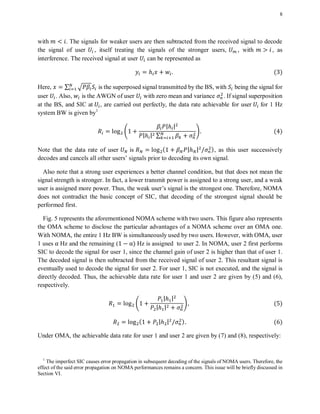
It is clear from (5) and (6) that the NOMA scheme controls the throughput of each user by
adjusting the power allocation ratio, . Thus, the overall throughput and user fairness are
closely related to the power allocation scheme. If an asymmetric channel, where signal-to-noise
ratios (SNRs) of the two users are different, is considered, it can be numerically shown that the
values of and , calculated from (5) and (6), respectively, are considerably much higher than
those of and calculated from (7) and (8). This numerical comparison is basically a special
case of the multi-user channel capacity analysis [3]. Fig. 6 gives us the idea of a generalized
capacity comparison of NOMA and OMA for two users. It shows that the boundary of achievable
rate pairs with NOMA is outside the OMA capacity region, in general. Therefore, NOMA is highly
effective in terms of system-level throughput when the channels are different for two users. On
that, NOMA is considered a promising multiple-access technique for future radio access.
NOMA can equally be applied in an uplink scenario. In the uplink, SIC is performed at the BS
(see Fig. 7). For a two-user NOMA, the received signal at the BS is represented as
√ √ ( )
Here, user transmits the signal , with √ being the transmission power. Also, is the
AWGN with zero mean and variance . With the help of SIC, the BS decodes the signals of
and in two stages. In the first stage, the signal of is decoded, treating the signal of as
noise. In the next stage, the receiver subtracts the decoded signal from the received signal and
Fig. 5. Multiple access schemes for a two-user scenario (a) NOMA (b) OMA.](https://image.slidesharecdn.com/noma-220613064550-1e06d3d2/85/NOMA-pdf-9-320.jpg)
![10
then decodes the signal of .
III. POTENTIAL NOMA SOLUTIONS
This section presents an overview of the present and emerging NOMA research, in a categorized
fashion, considered as potential solutions to problems or issues associated with the integration of
NOMA in 5G. Detailed explanations and mathematical derivations of the techniques will be
avoided, since our major focus is to cover the core ideas of the state-of-the-art NOMA research in
5G systems. Interested readers are referred to the original articles for greater depth.
A. Impact of Path Loss
A substantial number of researchers have investigated the performance of NOMA schemes to
study the feasibility of adopting this technique as a multiple access scheme for 5G systems. A
survey by Higuchi and Benjebbour and the references therein demonstrate that NOMA can be a
promising power-domain user multiplexing scheme for future radio access [19]. In a cellular
Fig. 6. Capacity regions of NOMA and OMA for downlink.
Fig. 7. NOMA in an uplink scenario.](https://image.slidesharecdn.com/noma-220613064550-1e06d3d2/85/NOMA-pdf-10-320.jpg)
![11
network with randomly deployed users, the path loss performance of NOMA can be evaluated
under two situations. In the first scenario, each user has a targeted data rate determined by the
assigned quality of service (QoS). Here, the outage probability is an ideal performance metric,
since it measures the capability of NOMA to meet the users’ QoS requirements. In the other
scenario, users’ rates are opportunistically allocated according to the channel conditions. In this
situation, the achievable ergodic sum rate can be investigated to evaluate NOMA performance.
According to Ding et al. [20], if users’ data rates and assigned power are chosen properly, NOMA
can offer better outage performance than other OMA techniques. This study also showed that
NOMA can achieve a superior ergodic sum rate. If the SNR is high, the outage probability of the
user in a typical disk-shaped cell with radius can be given by:
( ) ( )
where ( ) ( )
, and ∑ with √ . / . .
/ /, and . /. Symbols , , and represent the complexity-accuracy trade-off
parameter2
, the path-loss factor, and the maximum SNR corresponding to the data rate of the ith
user, respectively. Also, with a sufficient number of users, , and adequate transmit SNR, ,
NOMA can achieve the following ergodic sum rate:
( * +) ( )
According to the feedback framework of LTE, each user measures the downlink channel by
employing reference signals and feeds back CSI in the form of predesigned transmission formats.
This CSI feedback contains a rank indicator (RI), a precoding matrix indicator (PMI), and a
channel quality indicator (CQI) [21]. Moreover, the rank is reported by each user at a certain time
interval (i.e., semi-static). The BS can then use this feedback information for various purposes,
including power control. During the channel measurement, full transmission power of BS and no
interference from intra-cell users are considered by each user. On that, the reported RI is suitable
for OMA. In case of NOMA, however, the transmission power is split between strong and weak
users. Additionally, inter-user interference occurs in NOMA. Thus, both signal and interference
powers experienced by NOMA users change, which may result in a different rank from that of
reported RI assuming full transmission power. Therefore, the rank feedback in NOMA will
inherently place a limitation on the achievable gain. A couple of rank optimization methods [21]
could be deployed in order to overcome this limitation, thereby enhancing both the outage
probability and ergodic capacity performance.
2
Complexity-accuracy trade-off parameter: as the name suggests, the accuracy increases at the expense of
increased computational complexity (in outage calculation). Therefore, a trade-off between complexity and accuracy
is required in order to calculate the outage probability. The calculations of outage probabilities for NOMA users might
be frequently needed for precise resource allocation.](https://image.slidesharecdn.com/noma-220613064550-1e06d3d2/85/NOMA-pdf-11-320.jpg)
![12
B. Cooperative NOMA (C-NOMA)
In wireless networks, cooperative communications has gained a great deal of attention due to the
ability to offer spatial diversity to mitigate fading, while resolving the difficulties of mounting
multiple antennas on small communications terminals [22]. In cooperative communications,
several relay nodes are assigned to assist a source in forwarding information to the respective
destinations. Therefore, the integration of cooperative communications with NOMA can further
improve system efficiency in terms of capacity and reliability. The cooperative NOMA
(C-NOMA) scheme [23] exploits prior information available in NOMA systems. In this scheme,
users with better channel conditions decode the messages for the others, and therefore, these users
act as relays to improve reception reliability for users with poor connections to the base station.
Cooperative communications for users with better channel conditions than others can be
implemented by using short-range communications techniques, such as ultra-wideband (UWB)
and Bluetooth (BT). In particular, C-NOMA consists of two phases, namely, transmission phase
and cooperative phase. During the transmission phase, the BS sends superposed messages (
users’ signal) to NOMA users. At the end of this phase, successive detection will be carried out by
the users. The cooperative phase consists of ( ) time slots. At the th time slot, (
), the ( )th user broadcasts the combination of the ( ) messages. One can note that
the power allocation coefficients at each time slot are different based on local channel conditions.
This demonstrates that C-NOMA can achieve the maximum diversity gain for all users. The
cooperative NOMA scheme ensures that the ith best user experiences a diversity of the order of
conditioned on a specific power allocation ratio. However, C-NOMA is expensive in terms of
additional time slots, since its cooperative phase requires message retransmissions from each user
acting as a relay in a serial manner. To reduce system complexity, C-NOMA performs user pairing
based on distinctive channel gains. The performance of C-NOMA can be further enhanced by
adopting optimal power allocation schemes [24, 25]. Direct derivation of the theoretical
achievable data rate in NOMA is quite difficult. However, if the rate of conventional TDMA is
compared with that of non-cooperative NOMA, the performance difference is seen not as a
function of power allocation coefficients but rather as depending on how disparate two users’
channels are. And a similar observation can be noted for C-NOMA.
NOMA for a multiple-antenna relay network has been studied in [26, 27]. These studies
analyzed the outage behavior of the mobile users and derived closed-form expressions for the
exact outage probability. If NOMA is combined with a multiple-antenna amplify-and-forward
(AF) relay network, where the base station and mobile users are equipped with multiple antennas,
the relay locations have a substantial impact on the outage performance. When the relay location is
close to the BS, NOMA outperforms conventional OMA. However, conventional OMA attains
better outage performance when the relay location is close to the users. In either case, NOMA
offers better performance in terms of SE and user fairness. Unlike C-NOMA systems, a
cooperative relaying system (CRS) using NOMA [28] for spatially multiplexed transmissions
enhances SE. In this system, the source transmits a superposed signal to the relay and the](https://image.slidesharecdn.com/noma-220613064550-1e06d3d2/85/NOMA-pdf-12-320.jpg)
![13
destination during the first time slot. During the second time slot, only the relay transmits the
decoded symbol to the destination. Note that the destination receives a single data symbol during
two time slots in conventional CRS (cooperative relaying without NOMA). With and
being the average powers for the channels of source-to-relay and relay-to-destination,
respectively, the average sum rate of CRS using NOMA can be obtained by:
( ) ( )
where is the Euler constant. CRS using NOMA achieves more SE than conventional CRS when
the SNR is high and the average channel power of the source-to-relay link is superior to the
source-to-destination and relay-to-destination links. The concept of relaying can also be adopted to
extend the cell coverage or overcome shadowing in case of NOMA transmission [29] where a BS
can directly communicate with a nearby user while communicating with a distant user only
through a relay. In this system, the BS transmits a superposed signal to the relay and the nearby
user during the first time slot. During the second time slot, while the relay transmits the decoded
symbol for the distant user, the BS transmits the information for only the nearby user. Note that the
nearby user can remove the interference signal that originated from the relay by using the side
information (the signal of the distant user) obtained during the first time slot. The utilization of
NOMA in this sort of coordinated direct and relay transmission provides considerable
performance gain compared with NOMA in uncoordinated direct and relay transmission.
C. Fairness in NOMA
NOMA users experience unequal data rates, since this access method is based on SIC decoding
order [2, 3]. Although the decoding order is formulated based on users’ CSI, the NOMA service
could be critical for some situations where strict fairness might be an issue. The power allocation
problem from a fairness viewpoint can be investigated under two assumptions: i) the BS has
perfect CSI, and hence, users’ data rates adapt to the channel conditions; and ii) users have fixed
targeted data rates under an average CSI. With these assumptions, it is possible to come up with
low-complexity algorithms that yield globally optimal solutions. NOMA with a fairness constraint
also outperforms OMA approaches by significantly improving the performance of the users with
the worst channel conditions [30]. If instantaneous CSI is available at the BS, fairness among users
can be ensured by maximizing the minimum achievable data rate, i.e.,
( ) ( )
∑ ( )
( )](https://image.slidesharecdn.com/noma-220613064550-1e06d3d2/85/NOMA-pdf-13-320.jpg)
![14
Since problem (13) is not convex, it needs to first be converted into a sequence of linear
programming. Eventually, the optimal solution to (13) can be given by:
| |
( | | ∑ ) ( )
where represents the minimum data rate. If instantaneous CSI is not available, the outage
probability should be optimized with average CSI. In this case, fairness among users can be
ensured by minimizing the maximum outage probability as ( ) conditioned on
(13a) and (13b). The fairness of a NOMA system can also be determined by controlling the rate
allocated to concurrent transmissions, which in turn can be achieved by using different scheduling
approaches [31].
D. NOMA with MIMO and Beamforming
Beamforming (BF) is a signal processing technique used in various wireless systems for
directional communications. Multi-user BF in MIMO systems is known as a capacity-enhancing
technology. In a multi-user BF system, each user is supported by a single BF vector, orthogonal to
the other users’ channels in order to eliminate interference from other users and thus maximize the
achievable sum capacity. The integration of NOMA with multi-user BF (NOMA-BF) thus has the
potential to capture the benefits of both NOMA and BF [25]. The NOMA-BF technique allows
two users to share a single beamforming vector. To reduce the inter-beam interference (from users
of other beams) and intra-beam interference (from users sharing the same beamforming vector),
NOMA-BF comes with a clustering and power allocation algorithm based on correlation among
users and channel gain difference, respectively. The NOMA-BF system improves the sum
capacity, compared to the conventional multi-user beamforming system. NOMA-BF also
guarantees weak users’ capacity to ensure user fairness. Suppose there is a two-user NOMA-BF
consists of clusters, where each of them contains two users. In this scenario, a power allocation
scheme for the cluster maximizes the sum capacity while keeping the weak user’s capacity at
least equal to that of the conventional multi-user beamforming system. It can be formulated as
follows, conditioned on (13a) and (13b):
( ) ( )
( )
where and are the capacities of the strong and weak users, respectively, whereas
is the capacity of the weak user if the weak user is supported by conventional beamforming.
Symbols and are the power fractions of the strong and weak users, respectively,
in the cluster. The optimal solution to (15) can be obtained by using the Karush-Kuhn-Tucker
(KKT) condition below:](https://image.slidesharecdn.com/noma-220613064550-1e06d3d2/85/NOMA-pdf-14-320.jpg)
![15
√. | | /
{√. | | / } 2∑ | | 3
| | √. | | /
( )
The above clustering algorithm, based on channel correlation and a zero forcing (ZF) precoding
matrix, helps two users in the same cluster to achieve similar benefits from the ZF precoding
matrix. However, the performance of the system becomes considerably degraded due to the
increased multi-user interference (MUI) when there is a shortage of user sets with high channel
correlation. In this regard, researchers investigated the design of the precoding matrix for
MU-MIMO NOMA to achieve a higher sum-rate in the presence of said interference [32].
As discussed above, random opportunistic beamforming [25] for the MIMO NOMA system
works under the assumption of perfect CSI at the transmitter. It becomes evident that with a
relatively large number of users, the combination of NOMA and MIMO can achieve sufficient
throughput gain [33]. If perfect CSI at the transmitter is unavailable due to limited feedback,
statistical CSI can be utilized for long-term power allocation to maximize the ergodic capacity of
MIMO NOMA systems. The systematic implementation of MIMO NOMA has been reported in
[21, 24, 34] and demonstrates that the use of MIMO NOMA can outperform conventional MIMO
OMA. Both optimal and low-complexity suboptimal power allocation schemes [35] can maximize
ergodic capacity with a total transmit power constraint. Ding et al. proposed a new design for
precoding and detection matrices in a general NOMA downlink scenario with a fixed power
allocation scheme for all the participating users [36]. The analytical and numerical results
confirmed that MIMO NOMA can achieve better outage performance than conventional MIMO
OMA, even for users who experience strong co-channel interference. Suppose a BS equipped with
antennas communicates with several users equipped with antennas each. Also, the users are
randomly grouped into clusters with users in each cluster. Then, the outage probability, at a
high SNR, for the th ordered user in the th cluster can be given by
[
( )
( ) ]
( ) ( )( )
( )
where represents the maximum required SINR to meet the QoS of users in the th cluster. As
can be seen from (17), MIMO NOMA can experience a diversity gain of ( )(
). It is also intuitive that the extension of NOMA in massive MIMO systems can further
enhance the SE. Unlike the single-antenna system, where the strong user is responsible for
successful SIC decoding, precoders in MIMO systems usually affect the
signal-to-interference-plus-noise ratio (SINR) of both users. Thus, the weak user data rate will be
limited by not only the decoding performance of the weak user but also by the decoding capability
of the strong user. In this respect, the same precoder for both users in each cluster may not be
sufficient. The above work on MIMO NOMA deals with the same precoder in each cluster.](https://image.slidesharecdn.com/noma-220613064550-1e06d3d2/85/NOMA-pdf-15-320.jpg)
![16
However, it is possible to further enhance the sum rate if the two users in a cluster can use different
precoders [37].
E. NOMA in a Coordinated System
In cellular systems, a cell-edge user usually experiences a lower data rate compared to that
experienced by a user near the BS. Coordinated multipoint (CoMP) transmission (and reception)
techniques, where multiple BSs support cell-edge users together, are usually employed to increase
transmission rates to cell-edge users. The associated BSs for CoMP need to allocate the same
channel to a cell-edge user. As a result, the SE of the system worsens as the number of cell-edge
users increases. In order to avoid this problem, a coordinated SC (CSC)-based NOMA scheme
[38] was formulated by considering SC for downlink transmissions to a group of cell-edge users
and users near the BS simultaneously with a common access channel [17]. In other words, BSs
transmit Alamouti (space-time) [39] coded signals to user c (a cell-edge user), while each BS also
transmits signals to a user near the BS. The CSC-NOMA scheme with Alamouti code provides a
cell-edge user with a reasonable transmission rate without diminishing the rates to nearby users,
and increases SE. If , , and are the rates to a user ( ) near BS 1, a user ( ) near BS 2,
and a coordinated user ( ), respectively, the sum rate becomes with
* (
| |
0| | 1
)+ ( )
* (
| |
0| | 1
)+ ( )
{ } ( )
where , ( )-, , ( )-, and , ( )- .
Let be the SINR for user in decoding the signal of user . Note that denotes the
channel coefficient from the BS j to user . Because of the use of Alamouti code for CoMP
communications, the exchange of instantaneous CSI is not required. This is a significant advantage
over coherent transmission schemes that require instantaneous CSI exchange, which results in an
excessive backhaul overhead for high mobility cell-edge users.
F. Network NOMA
Suppose there is a simple two-cell scenario of a cellular system (see Fig. 8), where and
are served by BS 1, while and are served by BS 2. Also, assume that a two-user NOMA
scheme is adopted, so that is paired with , and is paired with . As a cell-edge user in
NOMA does not perform SIC before decoding its signal, and are inherently unable to avoid
the interference from and , respectively. In order to reduce the impact of this interference,](https://image.slidesharecdn.com/noma-220613064550-1e06d3d2/85/NOMA-pdf-16-320.jpg)
![17
BS 1 and BS 2 allocate more power to and , respectively. As such, inter-cell interference
occurs in downlink transmissions and mutual interference between and occurs in uplink
transmissions [40]. To deal with this problem, associated with the employment of NOMA in a
multi-cell scenario, the straightforward application of single-cell NOMA solutions will not be
appropriate; single-cell NOMA needs to be extended to network NOMA. Like various inter-cell
interference mitigation techniques employed in OMA, some solutions are also required in NOMA
to reduce the impact of interferences in the context of a multi-cell scenario. One possible solution
to mitigate the aforementioned interferences in network NOMA is to utilize joint precoding of
users’ signals across the neighboring cells. However, the design of an optimal precoder is difficult,
since each BS should know all users’ data and CSI. The correlation-based precoder design needs
dynamic user selection for each NOMA pair [25]. Moreover, the multi-user precoding applicable
to single-cell NOMA may not be realistic in network NOMA, since a beam generated via
geographically separated BSs does not support more than one spatially separated user for
intra-beam NOMA. A low-complexity precoding scheme for network NOMA was introduced [40]
based on the fact that large-scale fading would be very disparate between the links to different
cells. Here, the joint precoder is applied only to cell-edge users (e.g., and in Fig. 8) and the
resulting SINR of each user of power is found as:
[*( ( ) ) + ]
| | | |
( )
| |
| | . | | | | /
( )
| |
| | . | | | | /
( )
[*( ( ) ) + ]
| | | |
( )
where , - with the channel vector of the ith user, , -, and (
* + * +) being the channel response between the jth BS and ith user. The
zero-forcing precoder, , is the normalized pseudo-inverse of , i.e.,
Fig. 8. NOMA in a two-cell scenario (network NOMA).](https://image.slidesharecdn.com/noma-220613064550-1e06d3d2/85/NOMA-pdf-17-320.jpg)
![18
( ) ( ( ) ) , is the system bandwidth, and is noise spectral density.
G. NOMA User Pairing
Since NOMA is an interference-limited system, it is practically unwise to ask all users in the
system to perform NOMA jointly. In this regard, users can be divided into multiple groups, where
NOMA is implemented within each group, and different groups are allocated with OMA. Clearly,
the performance of this hybrid MA scheme depends on which users are grouped together. The
impact of user pairing/grouping was investigated mathematically in [41]. This work demonstrates
that the performance gain of NOMA with fixed power allocation over conventional OMA can be
further increased by selecting users whose channel conditions are more distinctive. A two-step
method for user pairing based on proportional fairness (PF) was introduced [42]. In the first step,
the power allocation for each candidate user set is optimized to find the highest scheduling metric.
In a subsequent step, the optimal user pair, or single user with the maximum metric, is scheduled.
Since this user-pair power allocation (UPPA) technique avoids unnecessary comparison of
candidate user pairs by formulating the prerequisites for user pairing, this method comes with
considerably lower computation complexity compared to tree-search–based transmission power
allocation (TTPA). Suppose, the upper and lower bounds of the allocated power coefficient of
are and , respectively. Now, if any of the following conditions, termed the prerequisites, are
not satisfied by a candidate user pair, the computation and comparison of their PF scheduling
factor can be omitted. So the compared number of user pairs can be substantially reduced.
( )
( )
( )
where is the channel quality indicator (CQI) of user , and is the minimum required SINR
threshold, while the modulation and coding scheme (MCS) with the lowest coding rate is selected
for an expected block error rate. Eventually, the solution to the optimal power ratio provided by the
two-user proportional fairness-based NOMA can be given by:
̂ , ( )
where is the solution to the modified scheduling factor [43]. As (28) indicates, the available
scheduling factor of every valid pair of users can be computed, and the largest one can be selected.
A similar user set–selection algorithm is formulated based on the mathematical characteristics of
the PF metric [44]. This method can also reduce the computational complexity by judging whether
a user set is worth multiplexing based on a simple condition between the weakest two users within
the set. Also, the impact of user pairing on the performance gain of NOMA with a MIMO system](https://image.slidesharecdn.com/noma-220613064550-1e06d3d2/85/NOMA-pdf-18-320.jpg)
![19
was investigated [36], demonstrating that the performance gain of MIMO NOMA over MIMO
OMA increases as the number of users in each group increases.
H. Energy-Efficient NOMA
NOMA employs some controllable interference via non-orthogonal resource allocation and
realizes overloading at the cost of slightly increased receiver complexity. Consequently, higher SE
can be achieved by NOMA for 5G. Although SE shows how efficiently a limited spectrum
resource is utilized, it fails to provide any insight on how efficiently energy is utilized. With the
rise in desire for green communications in recent years, reducing energy consumption has become
of prime importance for researchers, and 5G has also targeted EE as one of the major parameters to
be achieved. Nonetheless, Shannon’s information capacity theorem illustrates that the two
objectives of minimizing consumed energy and maximizing SE are not achievable simultaneously,
and calls for a trade-off. It can be noted that with circuit power under consideration, there always
exists an optimal point in the EE versus SE (EE-SE) curve. An energy-efficient two-user
single-cell NOMA was studied in [40]. Under fixed total power consumption, the EE-SE
relationship was found to be linear with a positive slope. Appropriate power allocation between
two users allows achieving any point in the EE-SE curve. For a given SE for each user, maximum
EE performance can be achieved. The degree of efficiency can be adjusted by varying total power
using power-control schemes. If the sum rate capacity of the cell is with total power
consumption , EE can be written as ⁄ ⁄ , where is the spectrum
efficiency. The EE optimization can be achieved in both single input single output and MIMO
systems [45].
I. NOMA in Visible Light Communications
One of the major downsides to visible light communications (VLC) systems is the narrow
modulation BW of the light sources, which results in a barrier to attaining competent data rates.
Like wireless communications, optical wireless communications also considers various
signal-processing techniques, and multicarrier and multi-antenna systems for achieving higher
data rates in VLC systems. Since NOMA is now a potential candidate for next-generation wireless
communications, the feasibility of NOMA in VLC is also be a subject of interest. It is viable to
apply a NOMA scheme to enhance the achievable throughput in high-rate VLC. In fact, studies
reveal that NOMA is a promising MA scheme for downlink in VLC networks [46, 47]. However,
these works simply reflect a scenario with multiple light emitting diodes (LEDs) in an indoor
environment; real high-speed OFDM-based communications has not been considered. Other
research investigated optical OFDM transmission and compared the achievable capacities of
NOMA and OFDMA [48]. It also analyzed the impact of cancellation error in SIC receivers for
VLC systems. The achievable data rates for in two-user NOMA with DC-biased optical
OFDM (DCO-OFDM), assuming a frequency-flat fading channel, can be written as](https://image.slidesharecdn.com/noma-220613064550-1e06d3d2/85/NOMA-pdf-19-320.jpg)
![20
4
( )
5 ( )
4 5 ( )
where the optical parameters ( ) are receiver responsivity, number of LED chips, and the
signal cancellation error, symbols are channel gain for , respectively, and the
symbol denotes the power coefficient for the th subcarrier for .
J. NOMA with Link Adaptation
Hybrid automatic repeat request (HARQ) protocol, an indispensable part of link adaptation, is
designed for reliable communications by using retransmission diversity and channel coding gain.
Suppose, when multiple NOMA packets are transmitted, there is a collision, and a retransmission
request is sent to the users in collision. Each packet can convey at least a certain amount of
information, even though the packets collided. All the retransmitted signals can be combined by
using HARQ in order to improve the SE of NOMA [49]. Li et al. provided a thorough investigation
of HARQ design for NOMA with single user-MIMO (SU-MIMO) [50]. They found that the
HARQ technique for a NOMA system is more challenging than for an OFDMA system. A good
HARQ algorithm should deal with two central problems in NOMA retransmission: when the
HARQ combination should be directed, and how to conduct power assignment for retransmission.
Based on channel responses to initial transmission and retransmission, it was found that the
optimum time for conducting an opportunistic HARQ combination by the distant user is when the
SINR of the initial transmission is reasonably larger than the retransmission SINR. And one
approach for conducting retransmission power assignment would be assigning the power in such
way so that it maximizes the geometric mean user throughput of all the users in retransmission. In
sum, an advanced HARQ design can bring NOMA gain improvement both in cell throughput and
cell-edge throughput.
K. Other NOMA Solutions
NOMA with Raptor Codes
For a given integer, , and a real number , Raptor codes, first proposed by Shokrollahi [51],
encode a message of symbols into a potentially limitless sequence of encoding symbols such
that any subset of ( ) encoding symbols allows the message to be recovered with high
probability. Raptor codes were recently found effective in several cooperative communications
scenarios. The integration of Raptor codes with NOMA has been studied in [52], where an
interfering channel with Raptor code was added to an existing main non-orthogonal wireless
channel. It was demonstrated that the coded interference does not affect the performance of the
main channel, while the interfering signal itself can successfully be decoded with high probability.](https://image.slidesharecdn.com/noma-220613064550-1e06d3d2/85/NOMA-pdf-20-320.jpg)
![21
NOMA with Network Coding
Random linear network coding (RLNC) is a good encoding scheme that allows data
retransmission. In RLNC, the source does not need to be aware of the packets lost by the intended
receiver. To date, various RLNC techniques have been proposed to improve transmission
efficiency in both multicast and broadcast services. The performance of multicast services in
downlink networks can be further enhanced by integrating RLNC with NOMA. NOMA with
RLNC was studied by Hagh and Soleymani in [53]. In conventional NOMA, the power domain
multiplexing of multiple receivers is considered for unicast services, whereas NOMA-RLNC
utilizes power-domain multiplexing for multiple reception groups of receivers for multicast
services. It was found that NOMA-RLNC improves the packet success probability of providing
multicast services where a source superposes multiple coded packets before transmitting.
Coexistence of NOMA and OMA
In terms of capacity enhancement, which is a major goal of 5G, NOMA is a potential candidate
for future radio access. That said, it does not mean OMA schemes will be entirely replaced by
NOMA. For example, OMA might be preferred over NOMA for small cells if the number of users
is small and the near–far effect is not important. It can be concluded that both OMA and NOMA
will coexist to fulfill varied requirements of different services and applications in future 5G. As a
matter of fact, the long-term coexistence of different radio access technologies is, in general, an
important feature of 5G networks. Dai et al. discussed NOMA schemes for 5G and analyzed their
basic principles, key features, and receiver complexity [15]. They conclude that the concept of
software-defined multiple access can offer various services and applications with different
requirements.
SIC Receiver Variations
An ideal SIC receiver perfectly cancels the interference from the cell-edge user at the receiver of
a cell-center user. Until now, the seminal works on NOMA adopt a SIC receiver at cell-center
users, while cell-edge users do not take SIC detection into account. However, it is possible to
further improve the performance of NOMA by considering an advanced receiver at cell-edge users
[54]. By advanced receiver, this paper means a receiver that can perform ideal SIC processing,
since the improvement in NOMA performance gain with non-ideal SIC is not satisfactory. SIC
where the cell-edge user’s signal is demodulated and a hard decision is made without channel
decoding is called symbol-level SIC (SLSIC). In codeword-level SIC (CWSIC), the signal of a
cell-edge user is demodulated and decoded. The probability of successful cell-edge user signal
recovery increases, compared with SLSIC, since channel decoding is involved in signal detection.
Consequently, the impact of error propagation can be reduced in CWSIC [55, 56]. However, it
increases computational complexity. If the Gray mapping of superposed signals be achieved by
jointly modulating multi-users’ signals at the transmitter, the desired signal can be decoded with
the application of a log-likelihood method at the receiver. Since the decoding can be performed](https://image.slidesharecdn.com/noma-220613064550-1e06d3d2/85/NOMA-pdf-21-320.jpg)
![22
without SIC processing, the complexity of CWSIC can be reduced [55]. Appropriate power
control mechanism for NOMA employing minimum mean squared error-based linear filtering
followed by SIC (MMSE-SIC) can mitigate inter-cell interference and the fairness can be ensured
by employing a PF-based multiuser scheduling [57].
NOMA with SWIPT
In addition to enhancing SE, another major goal of 5G networks is to maximize EE. Many
researchers demonstrated that simultaneous wireless information and power transfer (SWIPT) is
expected to provide a viable solution to overcome EE issues. It is possible to establish a
cooperative communications protocol by combining SWIPT and NOMA, where cell-center users
act as energy-harvesting relays to help cell-edge users. The use of SWIPT does not affect the
diversity orders of both nearby and distant users, compared to conventional NOMA [58].
IV. PERFORMANCE EVALUATIONS
To illustrate the performance gains, this section provides numerical results for various NOMA
setups. Two primary performance metrics, namely, outage probability and achievable rate are
considered for this purpose. Also, the section provides some insights into SE and EE performances
of NOMA.
A. Outage Probability
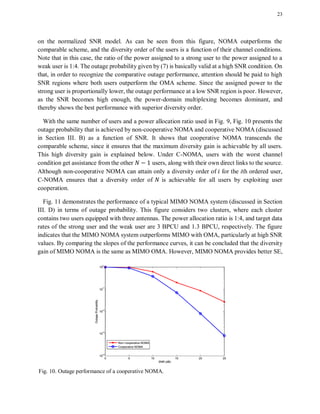
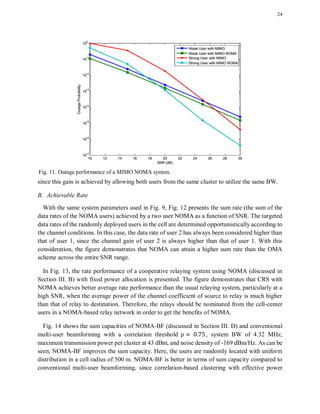
Based on (10), Fig. 9 compares the outage performance of a NOMA scheme with that of an
OMA scheme for a cellular network comprising randomly deployed users with
m. The users are uniformly located. The targeted data rates of 0.1 bits per
channel use (BPCU) and 0.5 BPCU, respectively, for a weak user and a strong user (user 2) were
used. Since the conventional orthogonal scheme is considered for benchmarking, its targeted rate
is 0.6 BPCU (the addition of two users’ data rates). Also, note that the numerical results are based
Fig. 9. Outage performance of NOMA in 5G with random users in a cell.](https://image.slidesharecdn.com/noma-220613064550-1e06d3d2/85/NOMA-pdf-22-320.jpg)
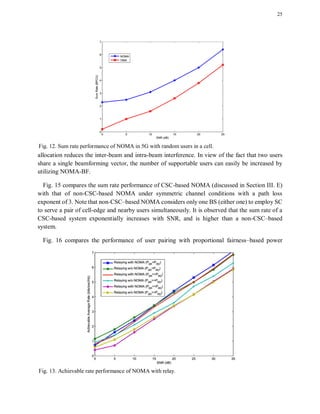
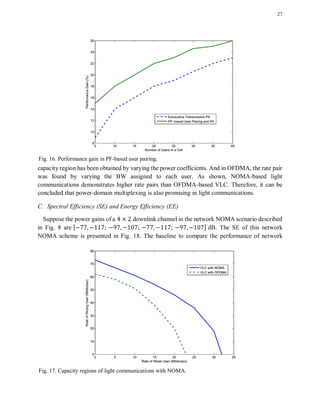
![26
allocation (discussed in Section III. G) to that of the TTPA scheme [59] in terms of percentage gain
with respect to OFDMA. A better performance gain is obtained across the entire range of numbers
of users per cell when user pairing is formed through PF-based scheduling. This is because
PF-based user pairing effectively preserves user diversity by its power allocation metric. Also,
removing invalid user pairs during prerequisite checking perhaps partly contributes to this
performance enhancement, since it ensures distinct channel variations among candidate users, to
some extent.
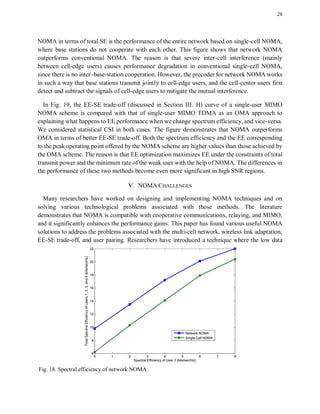
Fig. 17 shows the achievable capacity regions of NOMA and OFDMA-based VLC systems
(discussed in Section III. I) with the following numerical parameters: number of LED chips
with responsivity A/W, and system BW MHz. In NOMA, the
Fig. 14. Sum capacity of NOMA beamforming.
Fig. 15. Sum capacity of CSC-based NOMA.](https://image.slidesharecdn.com/noma-220613064550-1e06d3d2/85/NOMA-pdf-26-320.jpg)
![29
rate and bad quality of services experienced by cell-edge users can easily be improved by adopting
NOMA-based coordination. In addition to research concerns in the literature, there are several
other challenges and open issues that need to be carefully addressed. This section will try to
provide some research directions for researchers interested in investigating NOMA on a larger
scale.
A. Dynamic User Pairing
As mentioned earlier in this paper, co-channel interference is strong in NOMA systems, since
multiple users share the same time, frequency, and spreading code. As a result, it is difficult to ask
all the users in the system to perform NOMA jointly. Alternatively, the users in the system are
divided into several groups, where NOMA is applied within each group, and different groups are
allocated with orthogonal BW resources. The static case is usually considered, where the th user
and the th user, (| | is constant and considerably high) are paired to implement NOMA.
Although it is difficult in practice, the design of dynamic user pairing/grouping schemes is
necessary to achieve the maximum benefits offered by NOMA. In this regard, the analytical
insights obtained by Ding et al. [41] for the case with two selected users can be considered as
criteria for the design of distributed methods. It is known that the UPPA scheme [42] improves
performance gains. However, only two users are permitted to be scheduled by NOMA. An
encouraging extension of the UPPA scheme would be a power allocation scheme in the multi-user
NOMA system where the scheduler allows more than two users. Also, it requires more research in
order to apply UPPA schemes and variations [44] to a practical system with a suitable modulation
and coding scheme.
Fig. 19. A trade-off between energy efficiency and spectral efficiency.](https://image.slidesharecdn.com/noma-220613064550-1e06d3d2/85/NOMA-pdf-29-320.jpg)
![30
B. Impact of Transmission Distortion
The transmission of source information, such as voice and video over communications channels
is generally considered lossy. The transmitted data always experience distortion while they
propagate to the receiver. To deal with this lossy transmission, considerable theoretical attention in
assessing source fidelity over fading channels has been paid to date. Different source coding and
channel coding have been framed to minimize the end-to-end distortion. However, source coding
diversity and channel coding diversity provide conflicting situations among the preferred amounts
of distortion, cost, and complexity. Choudhury and Gibson compared the source distortion for two
definitions of channel capacity, namely, ergodic capacity and outage capacity [60]. Both
information capacity and distortion depend on outage probability. It is evident that outage
probability that maximizes outage rate may not provide the minimum expected distortion. An
investigation can be carried out to optimize the outage probability for which a NOMA scheme can
provide the maximum outage rate with acceptable distortion.
C. Impact of Interference
Although interference analysis is a generic term in wireless communications, here this survey
focuses on cooperative NOMA [23], which utilizes Bluetooth-like short-range communications in
the cooperative phase. However, the uses of BT radio in cellular communications faces an extreme
interference scenario from existing wireless personal area network (WPAN) operations. BT
interference decreases the coverage and throughput, causes intermittent or complete loss of
connectivity, and results in difficult pairing during the user’s discovery phase. In fact, interference
in the deployed environment, payload size, and distance between cooperative users all affect the
deployment of channel allocation. Also, a self-organizing scatternet to manage BT nodes needs to
be reformulated to make it functional with NOMA, since the users in NOMA are paired according
to CSI. In addition, a robust scatternet should offer valid routes between nodes with high
probability, even though users’ mobility causes complete loss of some of the wireless links.
Furthermore, due to the mobility of users, interference becomes dynamic. Therefore, performance
analysis of a cooperative NOMA scheme in this dynamic interfering environment will be an
interesting study.
D. Resource Allocation
In order to accommodate a diverse set of traffic requirements, 5G systems should be capable of
supporting high data rates at very low latency and in reliable ways. However, this is a very difficult
task, since resources are limited. So, resource management has to assist with effective utilization.
Wireless resource management is a series of processes required to determine the timing and
amount of related resources to be allocated to each user [61]. It also depends on the type of
resources. According to the Shannon’s information capacity theorem, BW is one of these wireless
resources. As a part of the effective management of the system BW in a communications system,
the total BW is first divided into several chunks. Each chunk is then assigned to a particular user or
a group of users, as in the case of NOMA. Also, the number of packets for each user varies over](https://image.slidesharecdn.com/noma-220613064550-1e06d3d2/85/NOMA-pdf-30-320.jpg)
![31
time. Therefore, user-pairing and optimum power allocation among users in NOMA requires a
sophisticated algorithm to provide the best performance with the usages of minimum resources.
Resource allocation in NOMA can also be explored from a mathematical optimization theory point
of view. For example, Lei et al. considered joint power and channel allocation for NOMA in 5G
networks in [62]. They take user power control and SIC implementation into account to solve the
power and channel allocation problem. Power allocation in NOMA-based cognitive radio
networks [63] is also an unexplored area of research.
E. NOMA with Multiple Antenna
The larger the rank of the MIMO channel matrix, the larger the number of de-correlated
channels obtained, and thus, better system performance occurs. Therefore, the channel matrix rank
plays a key role in evaluating MIMO NOMA. However, existing works in MIMO NOMA
consider full-rank channel matrices in order to investigate system performance. Under this
constraint, for example, the analytical results developed by Ding et al. [36] provide the upper
bounds of outage probability and capacity. It is therefore now essential to study the design of
MIMO NOMA with consideration of rank-deficient channel matrices. Rank adjustment for
NOMA can be adopted in order to improve MIMO NOMA performance [21]. A joint optimization
of rank and transmission power assignment can be investigated to further enhance performance. It
is also interesting to focus on existing MIMO NOMA techniques combined with other promising
wireless techniques, for example, orthogonal frequency and code division multiplexing
(OFCDM). Most of the MIMO NOMA algorithms (for example, the beamforming algorithm
proposed by Kim et al. [32]) visited in this paper have very high computational complexity.
Therefore, there is an urgent need for research activities into complexity reduction.
F. Heterogeneous Networks
A heterogeneous network (HetNet) is a wireless network consisting of nodes with diverse
transmission powers and coverage sizes. The HetNet has potential enough for next-generation
wireless networks in terms of capacity and coverage with reduced energy consumption. The
infrastructure featuring a high-density deployment of low-power nodes can also significantly
increase EE, compared to low-density deployment of fewer high-power nodes. There are several
research works on HetNets, for example, node cooperation, optimal load balancing, and enhanced
inter-cell interference coordination [64]. A system framework of a cooperative HetNet for 5G was
recently studied in [65] with the aims of both spectrum efficiency and EE. Since the objective of
NOMA coincides with that of a HetNet, the specific utilization of NOMA in a particular HetNet
can offer extended benefits. Also, the non-uniform spatial distribution of mobile users will affect
the performance of NOMA. Therefore, investigation of outage performance, ergodic capacity, and
user fairness in NOMA schemes with spatial user distribution can be worthy work.](https://image.slidesharecdn.com/noma-220613064550-1e06d3d2/85/NOMA-pdf-31-320.jpg)
![32
G. Outage Probability Analysis
Outage analysis is fundamental to understanding the performance of any wireless system. As a
matter of fact, the achievable capacity depends upon the outage behavior of users. Various
researchers have investigated the outage probability of the basic NOMA scheme, in general. For
example, compared to OMA, less outage occurs in NOMA for users randomly deployed in a cell
[19]. That analysis considered the impact of path loss. Also, it was observed that a NOMA-BF
system improves the sum capacity, compared to the conventional multi-user BF system [25].
However, when NOMA comes with beamforming, the outage probability of users will be changed.
On that, outage performance analysis of NOMA-BF can be investigated. Similarly, network
NOMA [40] primarily focuses on inter-cell interference mitigation by designing a precoder. But it
needs explicit analysis to understand the outage behaviors of cell-edge users. Other NOMA works,
for example, NOMA with VLC [48] and NOMA with coding [52, 53], can be further investigated
to analyze outage performance.
H. Practical Channel Model
To support the ever-growing amount of consumer data, next-generation wireless networks
require not only an efficient radio access technique but also spectrum availability. For the time
being, it is obvious that 5G will use spectrum allocations in the unused millimeter wave (mmW)
frequency bands. Also, the backbone networks for 5G are expected to move from copper and fiber
to mmW wireless connections, allowing rapid deployment and mesh-like connectivity. The mmW
frequencies between 30 and 300 GHz are a new frontier for cellular networks that offers a huge
amount of BW. Understanding the challenges of mmW cellular communications, in general, and
channel behavior in particular, is therefore extremely important, and is a fundamental requirement
to developing 5G mobile systems, as well as backhaul techniques [66]. The existing studies on
NOMA assume the wireless links between transmitter and receiver exhibit a Rayleigh fading
channel with AWGN. A more realistic analysis would be revealed if the measured path loss and
delay spread values [67] could be considered to reflect the radio channel in mmW band.
I. Uniform Fairness
In mmW cellular, at a distance greater than 175 m, most locations experience a signal outage
[66]. Since outage is highly dependent on the environment, actual outage may be more significant
if there are more local obstacles. Deriving a NOMA scheme that provides users (especially located
at a distance greater than 150 m up to the cell boundary, in the case of mmW cellular) uniform
outage experiences would be excellent work.
J. NOMA with Antenna Selection
The simultaneous use of multiple antennas on the transmitter side requires a corresponding
number of parallel radio frequency (RF) chains at the front end. As such, it increases system
complexity, power consumption, and cost with an increase in the number of antennas. To
overcome such issues, transmit antenna selection (TAS) is often preferred to make the transmitter](https://image.slidesharecdn.com/noma-220613064550-1e06d3d2/85/NOMA-pdf-32-320.jpg)
![33
structure simple. An effective TAS technique opportunistically selects the best antenna out of
multiple antennas and uses a single RF chain for transmission. This eventually reduces system
complexity, power consumption, and cost, as well as size, at the expense of acceptable
performance loss. In this respect, research should be conducted into finding a novel TAS-NOMA
scheme for downlink communications from a base station equipped with multiple antennas to
multiple users, each equipped with a single antenna. The aim of the scheme should ultimately
improve the sum rate, considering the targeted user rate is allocated opportunistically based on
channel conditions.
K. Carrier Aggregation
In order to increase the BW and, thereby increase the data rate of its users, LTE-Advanced
utilizes the concept of carrier aggregation (CA) [68]. The CA concept is that users are allocated
aggregated resources consisting of two or more component carriers (CCs). A CC is nothing but
each aggregated carrier. The arrangement of aggregation would be either contiguous allocation,
where CCs are set adjacent to each other, or non-contiguous allocation, where there is a gap in
between. It is possible to integrate CA with NOMA in order to take the advantages offered by both.
To do so, however, the user pairing will be different from that of basic NOMA. It is well known
that a NOMA user is paired with another NOMA user in a basic two-user NOMA scheme; each
carrier is usually assigned to two users based on channel conditions. The user paring in
CA-enabled NOMA can be explained as follows. A CC (say, ) assigned to a NOMA user
( ) will also be a CC of another NOMA user ( ). The situation is that the user is
paired with with respect to the CC . At the same time, it is also possible that the user
is paired with with respect to the CC . On that, a NOMA user might be pared with
multiple different users at the same time based on the number of CCs if CA is integrated with basic
NOMA. To the best of authors’ knowledge, answering the question of what CA type is appropriate
for NOMA solutions represents an open issue, and thus, investigation of different types of CA in
NOMA is an interesting research direction.
L. Other Challenges
There are also some other challenges that need to be addressed before NOMA becomes a part of
5G in the future. In a downlink scenario, for example, the transmitter allocates the power to the
users based on their respective CSI. Therefore, a proper mechanism for CSI feedback, a suitable
channel estimation scheme with proper reference signal design, is important for achieving robust
performance. In addition, the benefit of NOMA is proven only under the ideal condition of perfect
acquisition of CSI data at the transmitter side. One possible solution might be the use of a limited
feedback channel to acquire CSI [69]. However, it requires additional BW to convey various
channel quality indicators. From this perspective, proper user selection and power allocation
schemes are necessary when the transmitter has to work under imperfect CSI and/or with limited
feedback. In multicarrier communications, the peak-to-average-power ratio (PAPR) can cause the
transmitter’s power amplifier (PA) to run within a non-linear operating region. This causes](https://image.slidesharecdn.com/noma-220613064550-1e06d3d2/85/NOMA-pdf-33-320.jpg)
![34
significant signal distortion in PA output. The effect of PAPR is thus critical to determining what
techniques to use to achieve the best NOMA performance. The concept of relaying [29] to extend
cell coverage can be applied in non-orthogonal coordinated transmissions between multiple small
cells and a macro cell in order to achieve more capacity gain. A hybrid scheme proposed by
Kalokidou et al. [70] combines the principles of topological interference management and NOMA
schemes to achieve better performance in terms of sum rate. Further work on the MIMO form of
this hybrid method can be investigated. However, the challenge, especially for a dense network, is
how to determine a fair power allocation method. To adopt NOMA in 5G, NOMA should also be
made robust in terms of system scalability, since 5G must support heterogeneous traffic and
diverse radio environments. To date, most of the work has been dedicated to verifying the
performance of NOMA in theory, but not in practice. Although Xiong et al. introduced a
software-defined radio (SDR) NOMA as a prototype [71], more over-the-air experiments are
required for the purpose of demonstrating NOMA’s potential in 5G mobile networks.
VI. IMPLEMENTATION ISSUES
NOMA implementation includes designing and operating the system. A lot of what will be
attempted at this stage will rely upon a particular application and environment. In this section, this
survey tries to give some generic points, including some on computational complexity and error
propagation that can be critical to assessing NOMA performance.
A. Decoding Complexity
Signal decoding by using SIC requires additional implementation complexity compared to
orthogonal schemes, since the receiver has to decode other users’ information prior to decoding its
own information [3]. Also, this complexity increases as the number of users in the cell of interest
increases. However, users can be clustered into a number of groups, where each cluster contains a
small number of users with bad channels. SC/SIC can then be executed within each group. This
group-wise SC and SIC operation basically provides a tradeoff between performance gain and
implementation complexity.
B. Error Propagation
It is intuitive that once an error occurs in SIC, all other user information will likely be decoded
erroneously. However, the effect of error propagation can be compensated by using a stronger
code (e.g., increasing the block length) when the number of users is reasonably small [3]. In case
of degradation in the performance for some users, nonlinear detection techniques can also be
considered to suppress the error propagation. Based on computer simulations, authors in [2]
showed that the error propagation can have a marginal impact on the NOMA performance. The
reason is that a user with bad channel gain is assigned to another user with good channel gain
during NOMA scheduling. This finding has been reported under the conditions of a worst-case
model which assumes that the decoding of the strong user at the second stage is always
unsuccessful whenever the decoding of the weak user is unsuccessful at the first stage of the strong](https://image.slidesharecdn.com/noma-220613064550-1e06d3d2/85/NOMA-pdf-34-320.jpg)
![35
user receiver. Although there exist works that analytically study the SIC error propagation in basic
MIMO systems [72, 73], there is no prominent research that provides a mathematical
understanding of the effect of imperfect SIC on NOMA schemes. Therefore, a mathematical
analysis of the impact of imperfect SIC on NOMA performances represents an interesting research
direction.
C. Quantization Error
When the received signal strengths of users are disparate, the analog-to-digital (A/D) converter
needs to support a very large full-scale input voltage range, and requires high resolution to
accurately quantize a weak signal, since the more levels the ADC uses for quantization, the lower
its quantization noise power. However, there is a limitation placed on arbitrarily high–resolution
ADC due to its cost, conversation time, and hardware complexity. This constraint eventually leads
to a trade-off between the quantization error and SIC gain.
D. Power Allocation Complexity
The achievable throughput of a user is affected by the transmit power allocation to that user.
This particular power allocation also affects the achievable capacity of other users, since the basis
of NOMA is power-domain user multiplexing. To achieve the best throughput performance in
NOMA, a brute-force search over the possible user pairs with dynamic power allocation is
required. However, this kind of exhaustive search is computationally expensive.
E. Residual Timing Offset
Synchronous transmission has been considered in NOMA research, and this consideration is
reasonable for the downlink scenario, because the BS controls transmission for all users. However,
perfect synchronization among NOMA users is impractical on uplink, since users are spatially
distributed, and the mobile communications channel is usually dynamic in nature. In asynchronous
communications, OFDM symbols from the superposition-coded users are time-misaligned. Thus,
NOMA users’ performance substantially depends on the relative time offset between interfering
users [74]. On that, it is important to further investigate NOMA in asynchronous communications.
In practice, the asynchronous scheme requires information on multiple symbols for detection and
interference cancellation. Otherwise, performance degrades when complete information on
interfering signals is unknown.
F. NOMA or IDMA
Both NOMA and interleave division multiple access (IDMA) are prospective multiple access
schemes for equal rate transmission without link adaptation. The question may arise as to which
scheme should be adopted in practical system implementation. Chen et al. concluded that IDMA is
able to deal with the user power–balanced scenario and still offer robust performance with higher
computational complexity [75]. And NOMA is effective in the power-imbalanced scenario,
smartly performing the trade-off between performance and complexity.](https://image.slidesharecdn.com/noma-220613064550-1e06d3d2/85/NOMA-pdf-35-320.jpg)
![36
G. Signaling and Processing Overhead
There are several sources of additional signaling and processing overhead in NOMA compared
to its orthogonal counterparts. For example, to collect the CSI from different receivers and to
inform the receivers of the SIC order, some time slots need to lapse. This causes data rate
degradation in NOMA. Also, with dynamic power allocation, and encoding and decoding for SC
and SIC, NOMA signal processing requires additional energy overhead.
H. Limited Number of User Pairs
NOMA exploits power-domain multiplexing to offer its benefits. More specifically, about an 8
difference in propagation loss is required to pair a cell-edge user with a cell-center user [76].
Therefore, the possible number of pairs of users in a typical NOMA scheme is limited, which
eventually reduces the capacity gain of NOMA. Finding the appropriate signal detection and
decoding strategy that increases the number of pairs of users is an important issue.
I. NOMA Deploying Environment
Since the power domain is exploited, and channel gains are naturally adequately large in
macrocells, researchers commonly consider macrocell deployment. In addition to macrocells,
small cells are also becoming important and are being studied for future 5G networks. Fortunately,
the NOMA gain is still achievable, even in a small cell where NOMA offers a higher performance
gain compared to OMA [77]. It is also important to note that NOMA gain in terms of cell
throughput in small cells is even larger than in macrocells. Therefore, NOMA can be equally
deployed in both macrocell and small-cell environments.
J. Standardization Status
There exist some standardization efforts on NOMA technologies. Below is the summary of the
current status of ongoing standardization of NOMA. The 3rd Generation Partnership Project
(3GPP) LTE Release 13 approved the study item (SI) of downlink multiuser superposition
transmission (MUST) [78]. The primary objective of MUST was to identify promising
enhancements of downlink multiuser transmission schemes within one cell. To achieve this
objective, the SI focused on the evaluation of system level gain and complexity-performance
trade-off under practical deployment scenarios and traffic models [79, 80, 81, 82, 83, 84]. The
study concludes that NOMA can increase system capacity and improve user experiences. A new
work item (WI) of downlink multiuser superposition transmission for LTE has recently been
approved by 3GPP LTE Release 14 [85]. The core objective of this WI is to identify necessary
techniques to enable LTE to support downlink intra-cell multiuser superposition transmission for
the physical downlink shared channel.
VII. CONCLUDING REMARKS
This paper provides a comprehensive overview of the present and emerging power-domain](https://image.slidesharecdn.com/noma-220613064550-1e06d3d2/85/NOMA-pdf-36-320.jpg)
![37
SC-based NOMA research into 5G, and discusses NOMA performance with numerical results. It
is clear that NOMA is a candidate multiple access technology for next-generation radio access. Its
diversity gain originates from the power domain of the signals to be transmitted in a superposed
fashion. Many research results have been found in favor of NOMA in terms of outage probability,
achievable capacity, weak users’ rate guarantees, and cell-edge user experiences. In addition to
perfect SC at the transmitter and error-free SIC at the receiver, optimum power allocation,
QoS-oriented user fairness, appropriate user pairing, and good link adaptation are also required to
obtain the maximum benefits offered by NOMA. In addition, this paper discusses how NOMA
works with various standard wireless technologies, including cooperative communications and
MIMO. For a deeper understanding of NOMA, this paper provides a discussion on how inter-cell
interference in a network can be mitigated, and explains how a trade-off between energy efficiency
and bandwidth efficiency can be achieved. The discussions of several important issues, such as
dynamic user pairing, distortion analysis, interference analysis, resource allocation, heterogeneous
networks, carrier aggregation, and transmit antenna selection, are expected to facilitate, and
provide a basis for, further research on NOMA in 5G. This paper offers a general view of some
implementation issues, including computational complexity, error propagation, deployment
environments, and standardization status. In sum, the results of this survey are expected to be
useful to researchers working in the area of wireless communications and NOMA.
ACKNOWLEDGEMENT
The authors would like to thank the anonymous reviewers for their valuable comments and
suggestions to improve the quality of the paper.
REFERENCES
[1] P. Wang, J. Xiao, and L. P “Comparison of orthogonal and non-orthogonal approaches to future
wireless cellular systems,” IEEE Veh. Technol. Mag., vol. 1, no. 3, pp. 4-11, Sep. 2006.
[2] A. Benjebbour, Y. Saito, Y. Kishiyama, A. Li, A. Harada, and T. Nakamura, “Concept and practical
considerations of non-orthogonal multiple access (NOMA) for future radio access,” in Proc. Int. Symp.
Intelligent Signal Process. Commun. Syst. (ISPACS), Nov. 2013. pp. 770-774.
[3] D. Tse and P. Viswanath, Fundamentals of Wireless Communication. Cambridge, The UK: Cambridge
University Press, 2005.
[4] R. Hoshyar, F. P. Wathan, and R. Tafazolli, “Novel low-density signaturefor synchronous CDMA
systems over AWGN channel,” IEEE Trans. Signal Process., vol. 56, no. 4, pp. 1616–1626, Apr. 2008.
[5] R. Razavi, R. Hoshyar, M. A. Imran, and Y. Wang, “Information theoretic analysis of LDS scheme,”
IEEE Commun. Lett., vol. 15, no. 8,pp. 798–800, Jun. 2011.
[6] M. Al-Imari, P. Xiao, M. A. Imran, and R. Tafazolli, “Uplink nonorthogonalmultiple access for 5G
wireless networks,” in Proc. Int. Symposium on Wireless Commun. Syst. (ISWCS), Aug. 2014, pp. 781–
785.
[7] M. Al-Imari, M. A. Imran, and R. Tafazolli, “Low density spreading for next generation multicarrier
cellular systems,” in Proc. IEEE Int. Conf. Future Commun. Networks (ICFCN), Apr. 2012, pp. 52–57.
[8] H. Nikopour and H. Baligh, “Sparse code multiple access,” in Proc. IEEE Int. Symposium on Personal
Indoor and Mobile Radio Commun. (PIMRC), Sep. 2013, pp. 332–336.](https://image.slidesharecdn.com/noma-220613064550-1e06d3d2/85/NOMA-pdf-37-320.jpg)
![38
[9] H. Nikopour, E. Yi, A. Bayesteh, K. Au, M. Hawryluck, H. Baligh, and J. Ma, “SCMA for downlink
multiple access of 5G wireless networks,” in Proc. IEEE Global Telecommun. Conf. (GLOBECOM),
Dec. 2014, pp. 1–5.
[10] S. Kang, X. Dai, and B. Ren, “Pattern division multiple access for 5G,” Telecommunications Network
Technology, vol. 5, no. 5, pp. 43–47, May 2015.
[11] L. Hanzo , M. Munster , B. J. Choi, and T. Keller, OFDM and MC-CDMA for Broadband Multi-User
Communications, WLANs and Broadcasting, The US: IEEE Press, 2003.
[12] T. Abe and T. Matsumoto, “Space-time turbo equalization in frequency-selective MIMO channels,”
IEEE Trans. Veh. Technol., vol. 52, no. 3, pp. 469-475, May 2003.
[13] M. Y. Alias, S. Chen, and L. Hanzo, “Multiple-antenna-aided OFDM employing
genetic-algorithm-assisted minimum bit error rate multiuser detection,” IEEE Trans. Veh. Technol.,
vol. 54, no. 5, pp. 1713–1721, Sep. 2005.
[14] L. Hanzo, S. Chen, J. Zhang, and X. Mu, “Evolutionary algorithm assisted joint channel estimation and
turbo multi-user detection/decoding for OFDM/SDMA,” IEEE Trans. Veh. Technol., vol. 63, no. 3, pp.
1204–1222, Mar. 2014.
[15] L. Dai, B. Wang, Y. Yuan, S. Han, C. l. I and Z. Wang, “Non-orthogonal multiple access for 5G:
solutions, challenges, opportunities, and future research trends,” IEEE Commun. Mag., vol. 53, no. 9,
pp. 74-81, Sep. 2015.
[16] T. Cover, “Broadcast channels,” IEEE Trans. Inf. Theory, vol. 18, no. 1, pp. 2-14, Jan 1972.
[17] S. Vanka, S. Srinivasa, Z. Gong, P. Vizi, K. Stamatiou, and M. Haenggi, “Superposition coding
strategies: Design and experimental evaluation,” IEEE Trans. Wireless Commun., vol. 11, no. 7, pp.
2628–2639, 2012.
[18] N. I. Miridakis and D. D. Vergados, “A survey on the successive interference cancellation performance
for single-antenna and multiple-antenna OFDM systems,” IEEE Commun. Surveys Tutorials, vol. 15,
no. 1, pp. 312-335, Feb. 2013.
[19] K. Higuchi and A. Benjebbour, “Non-orthogonal multiple access (NOMA) with successive
interference cancellation,” IEICE Trans. Commun., vol. E98-B, no. 3, pp. 403-414, Mar. 2015.
[20] Z. Ding, Z. Yang, P. Fan, and H.V. Poor, “On the performance of non-orthogonal multiple access in 5G
systems with randomly deployed users,” IEEE Signal Process. Lett., vol. 21, no. 12, pp. 1501-1505,
Dec. 2014.
[21] X. Chen, A. Benjebbour, Y. Lan, A. Li, and H. Jiang, “Impact of rank optimization on downlink
non-orthogonal multiple access (NOMA) with SU-MIMO,” in Proc. IEEE Int. Conf. Commun. Syst.
(ICCS), Nov. 2014, pp. 233-237.
[22] A. S. Ibrahim, A. K. Sadek, W. Su, and K. J. R. Liu, “Cooperative communications with
relay-selection: When to cooperate and whom to cooperate with,” IEEE Trans. Wireless Commun., vol.
7, no. 7, Jul. 2008.
[23] Z. Ding, M. Peng, and H. V. Poor, “Cooperative non-orthogonal multiple access in 5G systems,” IEEE
Commun. Lett., vol. 19, no. 8, pp. 1462-1465, Aug. 2015.
[24] Y. Hayashi, Y. Kishiyama, and K. Higuchi, “Investigations on power allocation among beams in
non-orthogonal access with random beamforming and intra-beam SIC for cellular MIMO downlink,”
in Proc. IEEE Veh. Technol. Conf., Las Vegas, NV, USA, Sep. 2013.
[25] B. Kim, S. Lim, H. Kim, S. Suh, J. Kwun, S. Choi, C. Lee, S. Lee, and D. Hong, “Non-orthogonal
multiple access in a downlink multiuser beamforming system,” in Proc. IEEE Military Commun. Conf.,
San Diego, CA, USA, Nov. 2013.
[26] J. Men and J. Ge, “Non-orthogonal multiple access for multiple-antenna relaying networks” IEEE
Commun. Lett., Vol. 19, No. 10, pp. 1686-1689, Oct. 2015.
[27] J. Men and J. Ge, “Performance analysis of non-orthogonal multiple access in downlink cooperative
network,” IET Commun., vol. 9, no. 18, pp. 2267-2273, Dec. 2015.](https://image.slidesharecdn.com/noma-220613064550-1e06d3d2/85/NOMA-pdf-38-320.jpg)
![39
[28] J. B. Kim and I. H. Lee, “Capacity analysis of cooperative relaying systems using non-Orthogonal
Multiple Access,” IEEE Commun. Lett., vol. 19, no. 11, pp. 1949-1952, Nov. 2015.
[29] J. B. Kim and I. H. Lee, “Non-orthogonal multiple access in coordinated direct and relay
transmission,” IEEE Commun. Lett., vol. 19, no. 11, pp. 2037-2040, Nov. 2015.
[30] S. Timotheou and I. Krikidis, “Fairness for non-orthogonal multiple access in 5G systems,” IEEE
Signal Process. Lett., vol. 22, no. 10, pp. 1647-1651, Oct. 2015.
[31] M. Mollanoori and M. Ghaderi, “Uplink scheduling in wireless networks with successive interference
cancellation,” IEEE Trans. Mobile Computing, vol. 13, no. 5, pp. 1132-1144, May 2014.
[32] J. Kim, J. Koh, J. Kang, K. Lee, and J. Kang, “Design of user clustering and precoding for downlink
non-orthogonal multiple access (NOMA),” in Proc. IEEE Military Commun. Conf. (MILCOM), Oct.
2015, pp. 1170-1175.
[33] K. Higuchi and Y. Kishiyama, “Non-orthogonal access with random beamforming and intra-beam SIC
for cellular MIMO downlink,” in Proc. IEEE Veh. Technol. Conf., Sep. 2013, pp. 1–5.
[34] Y. Lan, A. Benjebboiu, X. Chen, A. Li, and H. Jiang, “Considerations on downlink non-orthogonal
multiple access (NOMA) combined with closed-loop SU-MIMO,” in Proc. IEEE Int. Conf. Signal
Process. Commun. Syst., Gold Coast, QLD, Australia, Dec. 2014, pp. 1–5.
[35] Q. Sun, S. Han, I. C. Lin, and Z. Pan, “On the ergodic capacity of MIMO NOMA systems,” IEEE
Wireless Commun. Lett., vol.4, no.4, pp. 405-408, Aug. 2015.
[36] Z. Ding, F. Adachi, H. V. Poor, “The application of MIMO to non-orthogonal multiple access,” IEEE
Trans. Wireless Commun., vol. 15, no. 1, pp. 537-552, Jan. 2016.
[37] Q. Sun et al., “Sum rate optimization for MIMO non-orthogonal multiple access systems,” in Proc.
Wireless Commun. Networking Conf. (WCNC), Mar. 2015, pp. 747-752.
[38] J. Choi, “Non-orthogonal multiple access in downlink coordinated two-point systems,” IEEE Commun.
Lett., vol. 18, no. 2, pp. 313-316, Feb. 2014.
[39] S. Alamouti, “A simple transmit diversity technique for wireless communications,” IEEE J. Sel. Areas
Commun., vol. 16, no. 8, pp. 1451–1458, 1998.
[40] S. Han, C. L. I, Z. Xu, and Q. Sun, “Energy efficiency and spectrum efficiency co-design: From
NOMA to network NOMA,” IEEE Commun. Society MMTC E-Lett., vol. 9, no. 5, pp. 21-24, Sep.
2014.
[41] Z. Ding, P. Fan, and H. V. Poor, “Impact of user pairing on 5G non-orthogonal multiple access
downlink transmissions,” IEEE Trans. on Veh. Technol., In Press, Sep. 2015.
[42] F. Liu, P. Mähönen, and M. Petrova, “Proportional fairness-based user pairing and power allocation for
non-orthogonal multiple access,” in Proc. IEEE 26th Annu. Int. Symp. Personal, Indoor, and Mobile
Radio Commun. (PIMRC), Sep. 2015, pp.1127-1131.
[43] N. Otao et al., “Performance of non-orthogonal access with SIC in cellular downlink using
proportional fair-based resource allocation,” in Proc. Int. Symp. Wireless Commun. Sys., 2012, pp.
476–480.
[44] T. Seyama, T. Dateki, H. Seki, “Efficient selection of user sets for downlink non-orthogonal multiple
access,” in Proc. IEEE 26th Annu. Int. Symp. Personal, Indoor, and Mobile Radio Commun. (PIMRC),
Sep. 2015, pp. 1062-1066.
[45] Q. Sun, S. Han, I. C. Lin, and Z. Pan, “Energy efficiency optimization for fading MIMO
non-orthogonal multiple access systems,” in Proc. IEEE Int. Conf. Commun. (ICC), London, Jun. 2015,
pp. 2668-2673.
[46] H. Marshoud, V. M. Kapinas, G. K. Karagiannidis, and S. Muhaidat, “Non-orthogonal multiple access
for visible light communications,” IEEE Photonics Technol. Lett., Submitted, Jul. 2015.
[47] Y. Lang, W. Xiping, and H. Haas, “On the performance of non-orthogonal multiple access in visible
light communication,” in Proc. IEEE 26th Annu. Int. Symp. Personal, Indoor, and Mobile Radio
Commun. (PIMRC), Sep. 2015, pp. 1354-1359.](https://image.slidesharecdn.com/noma-220613064550-1e06d3d2/85/NOMA-pdf-39-320.jpg)
![40
[48] R. C. Kizilirmak, C. R. Rowell, and M. Uysal, “Non-orthogonal multiple access (NOMA) for indoor
visible light communications,” in Proc. 4th Int. Workshop Optical Wireless Commun. (IWOW), Sep.
2015, pp. 98-101.
[49] J. Choi, “H-ARQ based non-orthogonal multiple access with successive interference cancellation,’ in
Proc. IEEE Global Telecommun. Conf., Dc. 2008, pp.1-5.
[50] A. Li, A. Benjebbour, X. Chen, H. Jiang, and H. Kayama, “Investigation on hybrid automatic repeat
request (HARQ) design for NOMA with SU-MIMO,” in Proc. IEEE 26th Annu. Int. Symp. Personal,
Indoor, and Mobile Radio Commun. (PIMRC), Sep. 2015, pp. 590-594.
[51] A. Shokrollahi, “Raptor codes,” IEEE Trans. Inf. Theory, vol. 52, no. 6, pp. 2551-2567, Jun. 2006.
[52] M. J. Hagh and M. R. Soleymani, “Raptor coding for non-orthogonal multiple access channels,” in
Proc. IEEE Int. Conf. Commun. (ICC), Jun. 2011, pp. 1-6.
[53] S. Park and D. Cho, “Random linear network coding based on non-orthogonal multiple access in
wireless networks,” IEEE Commun. Lett., vol. 19, no.7, pp. 1273-1276, Jul. 2015.
[54] X. Chen, A. Beiijebbour, A. Li, H. Jiang, and H. Kayama, “Consideration on successive interference
canceller (SIC) receiver at cell-edge users for non-orthogonal multiple access (NOMA) with
SU-MIMO,” in Proc. IEEE 26th Annu. Int. Symp. Personal, Indoor, and Mobile Radio Commun.
(PIMRC), Sep. 2015, pp. 522-526.
[55] C. Yan et al., “Receiver design for downlink non-orthogonal multiple access (NOMA),” in Proc. IEEE
81th Veh. Technol. Conf. (VTC), Glasgow, May 2015, pp. 1-6.
[56] K. Saito, A. Benjebbour, Y. Kishiyama, Y. Okumura and T. Nakamura, “Performance and design of
SIC receiver for downlink NOMA with open-loop SU-MIMO,” in Proc. IEEE Int. Conf. Commun.
Workshop (ICCW), London, Jun. 2015, pp. 1161-1165.
[57] Y. Endo, Y. Kishiyama, and K. Higuchi, “Uplink non-orthogonal access with MMSE-SIC in the
presence of inter-cell interference,” in Proc. Int. Symp. Wireless Commun. Syst. (ISWCS), Aug. 2012,
pp. 261-265.
[58] Y. Liu, Z. Ding, M. Eikashlan, and H.V. Poor, “Cooperative non-orthogonal multiple access in 5G
systems with SWIPT,” in Proc. 23th European Signal Process. Conf. (EUSIPCO), Nice, Sep. 2015, pp.
1999-2003.
[59] A. Li, A. Harada, and H. Kayama, “A novel low computational complexity power allocation method
for non-orthogonal multiple access systems,” IEICE Trans. Fundamentals, vol. E97-A, no. 1, pp.
57-67, Jan. 2014.
[60] S. Choudhury, and J.D. Gibson, “Information transmission over fading channels,” in Proc. IEEE
Global Telecommun. Conf. (GLOBECOM), Nov. 2007, pp. 3316-3321.
[61] B. Lee, D. Park, and H. Seo, Wireless Communications Resource Management. Wiley, 2009.
[62] L. Lei, D. Yuan, C. K. Ho, and S. Sun, “Joint optimization of power and channel allocation with
non-orthogonal multiple access for 5G cellular systems,” in Proc. IEEE Global Telecommun. Conf.
(GLOBECOM), Dec. 2015, pp. 1–6.
[63] M. Zeng, G. I. Tsiropoulos, O. A. Dobre, and M. H. Ahmed, “Power allocation for cognitive radio
networks employing non-orthogonal multiple access,” in Proc. IEEE Global Telecommun. Conf.
(GLOBECOM), Dec. 2016, In Press.
[64] R. Q. Hu and Y. Qian, Heterogeneous Cellular Networks. Wiley, 2013
[65] R. Q. Hu and Y. Qian, “An energy efficient and spectrum efficient wireless heterogeneous network
framework for 5G systems,” IEEE Commun. Mag., vol. 52, no. 5, pp. 94-101, May. 2014.
[66] S. Rangan, T. S. Rappaport, and E. Erkip, “Millimeter-wave cellular wireless networks: potentials and
challenges,” Proc. IEEE, vol. 102, no. 3, pp. 366-385, Mar. 2014.
[67] T. S. Rappaport, S. Shu, R. Mayzus, Z. Hang, Y. Azar, K. Wang, G.N. Wong, J.K. Schulz, M. Samimi,
and F. Gutierrez, “Millimeter wave mobile communications for 5G cellular: It will work!,” IEEE
Access, vol. 1, pp. 335-349, 2013.](https://image.slidesharecdn.com/noma-220613064550-1e06d3d2/85/NOMA-pdf-40-320.jpg)
![41
[68] G. Yuan, X. Zhang, W. Wang, and Y. Yang, “Carrier aggregation for LTE-advanced mobile
communication systems,” IEEE Commun. Mag., vol. 48, no. 2, pp. 88-93, Feb. 2010.
[69] S. Liu and C. Zhang, “Downlink non-orthogonal multiple access system with limited feedback
channel,” in Proc. IEEE 7th Int. Conf. Wireless Commun. Signal Process. (WCSP), Nanjing, Oct. 2015,
pp. 1-5.
[70] V. Kalokidou, O. Johnson, and R. Piechocki, “A hybrid TIM-NOMA scheme for the SISO Broadcast
Channel,” in Proc. IEEE Int. Conf. Commun. Workshop (ICCW), London, Jun. 2015, pp. 387-392.
[71] X. Xiong, W. Xiang, K. Zheng, H. Shen and X. Wei, “An open source SDR-based NOMA system for
5G networks,” IEEE Wireless Commun., vol. 22, no. 6, pp. 24-32, Dec. 2015.
[72] P. Li, R. C. de Lamare and R. Fa, “Multiple feedback successive interference cancellation detection for
multiuser MIMO systems,” IEEE Trans. Wireless Commun., vol. 10, no. 8, pp. 2434-2439, Aug. 2011.
[73] J. Kim, D. Kim, S. K. Yun, “Mitigating error propagation in successive interference cancellation,”
IEICE Trans. Commun., vol. E89-B, no. 10, pp. 2956-2960, Oct. 2006.
[74] H. Haci and H. Zhu, “Performance of non-orthogonal multiple access with a novel interference
cancellation method,” in Proc. IEEE Int. Conf. Commun. (ICC), London, Jun. 2015, pp. 2912-2917.
[75] Y. Chen, J. Schaepperle, and T. Wild, “Comparing IDMA and NOMA with superimposed pilots based
channel estimation in uplink,” in Proc. IEEE 26th Annu. Int. Symp. Personal, Indoor, and Mobile
Radio Commun. (PIMRC), Sep. 2015, pp. 89-94.
[76] T. Yazaki and Y. Sanada, “Effect of joint detection and decoding in non-orthogonal multiple access,”
Int. Symp. Intelligent Signal Process. Commun. Syst. (ISPACS), Kuching, Dec. 2014, pp. 245-250.
[77] Y. Saito, A. Benjebbour, Y. Kishiyama, and T. Nakamura, “System-level performance of downlink
non-orthogonal multiple access (NOMA) under various environments,” in Proc. IEEE 81th Veh.
Technol. Conf. (VTC), Glasgow, May 2015, pp. 1-5.
[78] 3GPP, RP-151100, “Study on downlink multiuser superposition transmission for LTE,” Jan. 2016.
[79] A. Benjebbour, A. Li, K. Saito, Y. Saito, Y. Kishiyama, and T. Nakamura, “NOMA: From concept to
standardization,” in Proc. IEEE Conf. Standards for Commun. Networking (CSCN), Tokyo, May 2015,
pp. 18-23.
[80] 3GPP, R1-152062, “Deployment scenarios for downlink multiuser superposition transmissions,” Apr.
2015.
[81] 3GPP, R1-153332, “Evaluation methodologies for downlink multiuser superposition transmissions,”
May 2015.
[82] 3GPP, R1-153335, “Candidate non-orthogonal multiple access,” May 2015.
[83] 3GPP, R1-154536, “System-level evaluation results for downlink multiuser superposition
transmissions,” Aug. 2015.
[84] 3GPP, R1-154537, “Link-level evaluation results for downlink multiuser superposition
transmissions,” Aug. 2015.
[85] 3GPP, RP-160680, “Downlink multiuser superposition transmissions for LTE,” Mar. 2016.](https://image.slidesharecdn.com/noma-220613064550-1e06d3d2/85/NOMA-pdf-41-320.jpg)

This document provides an overview of non-orthogonal multiple access (NOMA) as a promising technique for 5G networks. It discusses how NOMA uses superposition coding at the transmitter and successive interference cancellation at the receiver to multiplex users in the power domain. This allows multiple users to be served on the same time-frequency resources, improving spectral efficiency compared to orthogonal multiple access techniques. The document reviews recent research on NOMA capacity analysis, power allocation strategies, fairness issues, and other integration with wireless technologies. It also discusses challenges and open issues regarding practical NOMA implementation and deployment.


