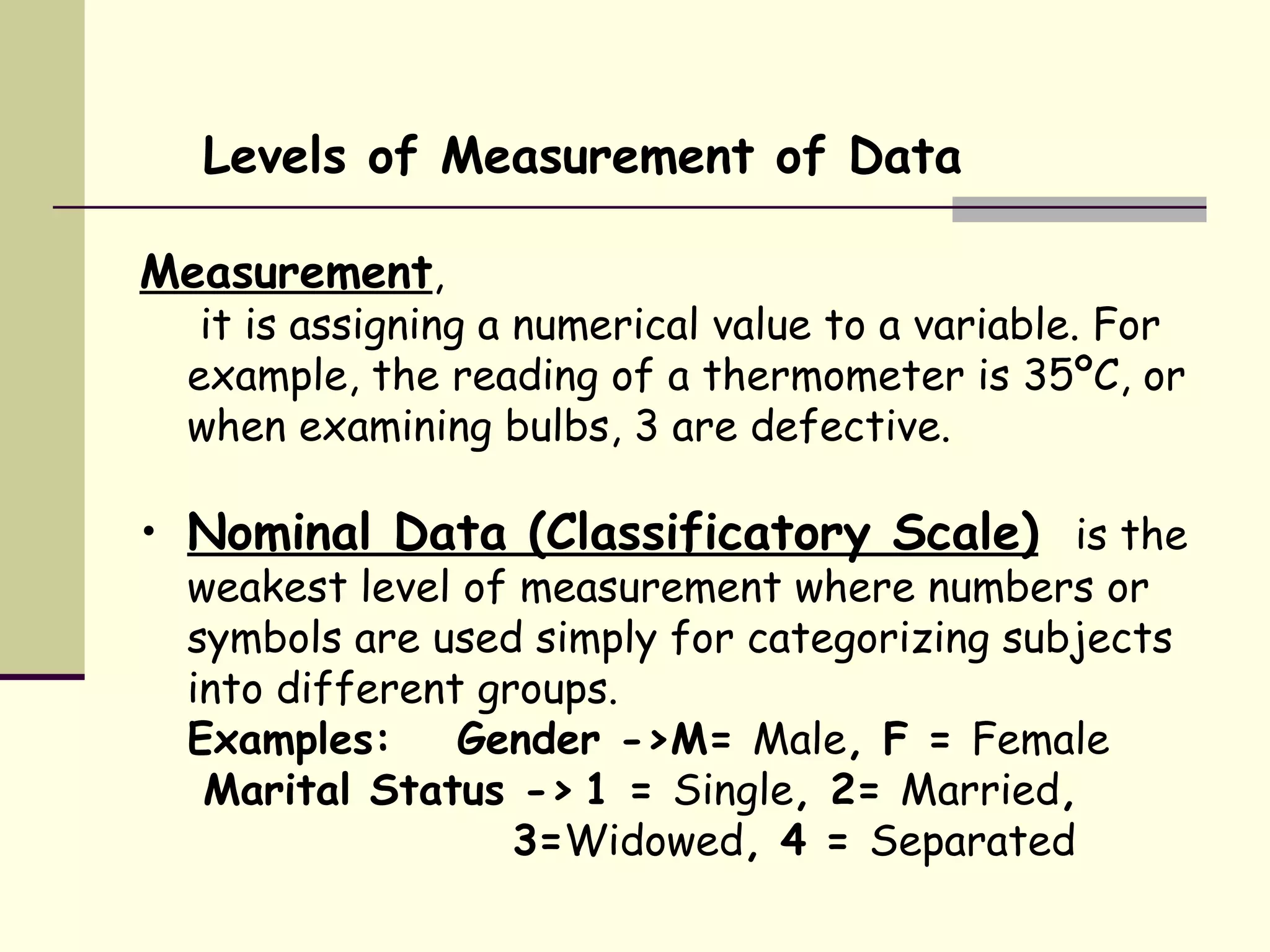
Levels of Measurement of Data Measurement ,   it is assigning a numerical value to a variable. For example, the reading of a thermometer is 35ºC, or when examining bulbs, 3 are defective. Nominal Data (Classificatory Scale)   is the weakest level of measurement where numbers or  symbols are used simply for categorizing subjects into different groups. Examples:  Gender ->M=  Male , F =  Female Marital Status -> 1 =  Single , 2=  Married ,    3= Widowed , 4 =  Separated
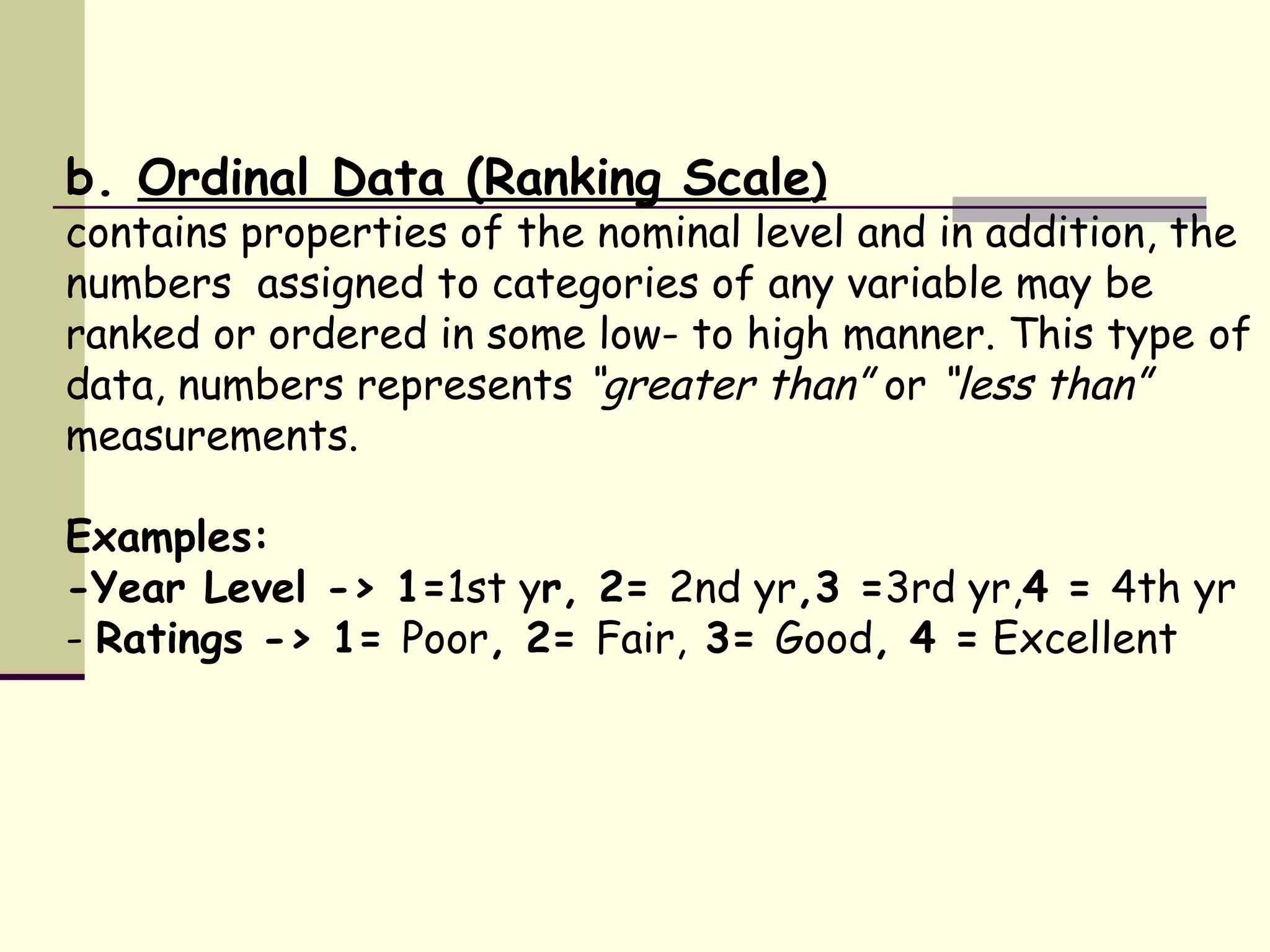
b.  Ordinal Data (Ranking Scale )   contains properties of the nominal level and in addition, the numbers  assigned to categories of any variable may be ranked or ordered in some low- to high manner. This type  of data, numbers represents  “greater than”  or  “less than”  measurements. Examples:  -Year Level -> 1= 1st y r, 2=  2nd yr ,3 = 3rd yr, 4 =  4th yr -  Ratings -> 1=  Poor , 2=  Fair,  3=  Good , 4 =  Excellent
Interval Data   has the properties of the ordinal and in addition, the distances between any two numbers on the scale are known sizes, interval scale must have a common and constant unit of measurement ( unit of measurement is arbitrary and there is NO ZERO point). Examples:  -IQ Level -Temperature d.  Ratio   contains all the properties of the interval level and in addition, has a TRUE ZERO point Examples:  -Scores in a certain test -Age ( in years ) -Election vote -Weight, height, length, area, volume,  density, velocity, money, etc.

Nominal

  • 1.
    Levels of Measurementof Data Measurement , it is assigning a numerical value to a variable. For example, the reading of a thermometer is 35ºC, or when examining bulbs, 3 are defective. Nominal Data (Classificatory Scale) is the weakest level of measurement where numbers or symbols are used simply for categorizing subjects into different groups. Examples: Gender ->M= Male , F = Female Marital Status -> 1 = Single , 2= Married , 3= Widowed , 4 = Separated
  • 2.
    b. OrdinalData (Ranking Scale ) contains properties of the nominal level and in addition, the numbers assigned to categories of any variable may be ranked or ordered in some low- to high manner. This type of data, numbers represents “greater than” or “less than” measurements. Examples: -Year Level -> 1= 1st y r, 2= 2nd yr ,3 = 3rd yr, 4 = 4th yr - Ratings -> 1= Poor , 2= Fair, 3= Good , 4 = Excellent
  • 3.
    Interval Data has the properties of the ordinal and in addition, the distances between any two numbers on the scale are known sizes, interval scale must have a common and constant unit of measurement ( unit of measurement is arbitrary and there is NO ZERO point). Examples: -IQ Level -Temperature d. Ratio contains all the properties of the interval level and in addition, has a TRUE ZERO point Examples: -Scores in a certain test -Age ( in years ) -Election vote -Weight, height, length, area, volume, density, velocity, money, etc.