j
HISTORY OF NOKIA
 Nokia is finland based company incorporated in 1967.
 Nokia started of as Pulp,Rubber and cable manufacturing
company to a major manufacturer of mobile devices.
 It’s the leading manufacture of mobile device.
 Nokia offers a wide range of mobile device with the
experience in music,video,imaging,gaming and a lot more.
 It also provides the services for network operators.
 Company recorded revenues of 41,121 million in 2007 about
20.3% increase from 2006.
NOKIA STRATEGY
 Expend mobile voice.
 Drive consumer multimedia.
 Bring extended mobility to enterprise.
WHY NOKIA WAS ON TOP
 Bold strategic in intent.
 Innovation through value chain.
 Flat organization.
 Global R&D Network.
 Customer focus.
NOKIA IN INDIA
 Nokia started its operation in INDIA in 1995.
 Nokia merged with siemens including handset and
network infrastructure.
 In 2004,it was chosen for ‘The most respected
consumer durables company’ by Business world.
 In 2005,Nokia was recognized as the ‘Brand of the
year’ by CII for being most preferred by the customers.
STRATEGY
WINNING RULER MARKET
 Started rural van project,2 year back.
 Showcase solution , use of mobile technology.
 Nine regional language support.
 Nokia life tool-Agriculture , Education.
COMPETITORS OF NOKIA
 SONY ERICSSON
 Great quality music.
 Superb picture quality.
 Product lacks.
 Innovation.
SAMSUNG
 Superior display quality.
 Costly.
 Less durable.
MOTOROLA
 Most trusted brand in cellular phone communication.
 High end internal feature.
NOKIA X
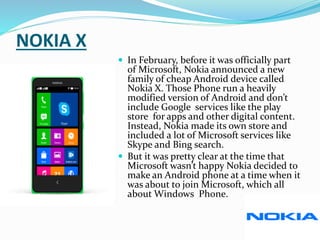
 In February, before it was officially part
of Microsoft, Nokia announced a new
family of cheap Android device called
Nokia X. Those Phone run a heavily
modified version of Android and don’t
include Google services like the play
store for apps and other digital content.
Instead, Nokia made its own store and
included a lot of Microsoft services like
Skype and Bing search.
 But it was pretty clear at the time that
Microsoft wasn’t happy Nokia decided to
make an Android phone at a time when it
was about to join Microsoft, which all
about Windows Phone.
MICROSOFT PURCHASED NOKIA
 Nokia was the biggest seller of windows
phone and pretty much the only company
that took the platform seriously. Other
manufacturers like samsung and HTC
tried to make windows phone, but they
were mostly duds.
 Nokia was once the biggest smartphone
maker in the world, but was slow to adapt
new generation of devices that came
along after the original iPhone launched
in 2007. Android phone eventually
dominated the global market, but Nokia
made decision to use the Windows Phone
for its top-tire devices.
 Microsoft announced it was buying
Nokia for $ 7.2 billion in September of
last Year.Microsoft CEO Sataya Nadella
with Nokia’s Stephen Elop.
CONCLUSION
 It provided huge variety of services to all class of
people.
 Nokia was the most preferred brand among all the
companies because of:
Wide Range of mobile handsets.
Price that suits to all category of people.
Customer satisfaction.
Market Position.
After sale service.
Features.
Nokia ppt

Nokia ppt

  • 1.
  • 2.
    HISTORY OF NOKIA Nokia is finland based company incorporated in 1967.  Nokia started of as Pulp,Rubber and cable manufacturing company to a major manufacturer of mobile devices.  It’s the leading manufacture of mobile device.  Nokia offers a wide range of mobile device with the experience in music,video,imaging,gaming and a lot more.  It also provides the services for network operators.  Company recorded revenues of 41,121 million in 2007 about 20.3% increase from 2006.
  • 3.
    NOKIA STRATEGY  Expendmobile voice.  Drive consumer multimedia.  Bring extended mobility to enterprise.
  • 4.
    WHY NOKIA WASON TOP  Bold strategic in intent.  Innovation through value chain.  Flat organization.  Global R&D Network.  Customer focus.
  • 5.
    NOKIA IN INDIA Nokia started its operation in INDIA in 1995.  Nokia merged with siemens including handset and network infrastructure.  In 2004,it was chosen for ‘The most respected consumer durables company’ by Business world.  In 2005,Nokia was recognized as the ‘Brand of the year’ by CII for being most preferred by the customers.
  • 6.
    STRATEGY WINNING RULER MARKET Started rural van project,2 year back.  Showcase solution , use of mobile technology.  Nine regional language support.  Nokia life tool-Agriculture , Education.
  • 7.
    COMPETITORS OF NOKIA SONY ERICSSON  Great quality music.  Superb picture quality.  Product lacks.  Innovation.
  • 8.
    SAMSUNG  Superior displayquality.  Costly.  Less durable.
  • 9.
    MOTOROLA  Most trustedbrand in cellular phone communication.  High end internal feature.
  • 10.
    NOKIA X  InFebruary, before it was officially part of Microsoft, Nokia announced a new family of cheap Android device called Nokia X. Those Phone run a heavily modified version of Android and don’t include Google services like the play store for apps and other digital content. Instead, Nokia made its own store and included a lot of Microsoft services like Skype and Bing search.  But it was pretty clear at the time that Microsoft wasn’t happy Nokia decided to make an Android phone at a time when it was about to join Microsoft, which all about Windows Phone.
  • 11.
    MICROSOFT PURCHASED NOKIA Nokia was the biggest seller of windows phone and pretty much the only company that took the platform seriously. Other manufacturers like samsung and HTC tried to make windows phone, but they were mostly duds.  Nokia was once the biggest smartphone maker in the world, but was slow to adapt new generation of devices that came along after the original iPhone launched in 2007. Android phone eventually dominated the global market, but Nokia made decision to use the Windows Phone for its top-tire devices.  Microsoft announced it was buying Nokia for $ 7.2 billion in September of last Year.Microsoft CEO Sataya Nadella with Nokia’s Stephen Elop.
  • 12.
    CONCLUSION  It providedhuge variety of services to all class of people.  Nokia was the most preferred brand among all the companies because of: Wide Range of mobile handsets. Price that suits to all category of people. Customer satisfaction. Market Position. After sale service. Features.