“Evaluating the potential of end user based
services based on the 3G/WCDMA
platform in India and what kind of Revenue
Models can be tried with these Services”
“Evaluating the potential of end user based services
based on the 3G/WCDMA platform in India and
What kind of Revenue Models can be tried with these
Services”
Submitted by: Submitted to:
Rajat Sapra Mr. Kapil Sharma
Management Student Sales Director
Amity Business School Nokia India Pvt. Ltd.
Amity University, U.P
Nokia India Pvt. Ltd. (Nokia Networks)
2
Submitted on 10th
July 2006
Letter of Authorization
This is to certify that this Marketing Research report, title “Evaluating the potential of end user
based services based on the 3G/WCDMA platform in India and what kind of Revenue Models
can be tried with these Services”
is the bonafide work of Mr. Rajat Sapra
The report will only be used for Nokia India Pvt. Ltd. internal use and will not be used as
a commercial data.
Authorized by:
Mr. Kapil Sharma
Sales Director, Networks
Nokia India Pvt. Ltd.
(Industry Guide)
3
ACKNOWLEDGEMENT
“Words express everything
Mouth Co-ordinates,
When it comes to gratitude,
Heart comes to play.”
It gives me immense pleasure for an opportunity to have undergone my Summer internship in
Nokia India Pvt. Ltd. There is always a sense of gratitude which one expresses to other people
for their helpful and needy service they render during phases of life. I too would like to do the
same as I really wish to express my gratitude to those who have been helpful to me in getting
this project completed.
In representing this report I would like to express my gratitude to Mr. Kapil Sharma, Sales
Director , Nokia India Pvt. Ltd. for giving me this opportunity to work with Nokia, and
providing me with his able guidance and inspiration for the completion of project.
I also would like to express my gratitude to Mr. Prashant Bhrgava and Mr. Rajbir Singh for their
co-operation and guidance without which this project would never have been a success.
I am also indebted to all the internal employees of Nokia for providing consistent
encouragement and congenial atmosphere to complete the project.
Last but not the least I will express my sincere thanks to Mr. Abhijeet Agashe and Amity
Business School for providing me with support and necessary guidance and valuable
instructions for the completion of this project.
4
RAJAT SAPRA
TABLE OF CONTENTS
Part 1: Introduction
1. Executive Summary…………………………………………………………….....8
2. Research Proposal..….………………………………………………………….....10
3. Nokia: Company Profile…………………………………………………………...12
4. Significance of Study…..………………………………………………………….10
5. Hypothesis………...……………………………………………………………….11
6. Objective of the project...………………………………………………………….12
7. Research Design………..………………………………………………………….13
8. Sample Questionnaire…..…...………………………………………………….....16
9. Sample Selection…….………………………………………………………….....17
10. Data Collection……...…………………………………………………………......18
11. Statistical Analysis..…………………………………………………………….....19
12. Project Cost and Schedule...…………………………………………………….....20
Part 2: Literature
1. Introduction…….... ……………………………………………………………...22
2. Present Development. …………………………………………………………...23
3. Passenger Airlines-The main Players….………………………………………...24
4. Customer Relationship Management- The concept ……………………..……....26
5. Customer Relationship Management in the Airline Industry.…………………...28
6. Jet Airways CRM Programs. ….………………………………………………...30
7. Indian Airlines CRM Programs…..……………………………………………...32
8. Kingfisher Airlines CRM Programs..…………………………………………....33
9. AirDeccan CRM Programs. ……….…..………………………………………...34
10. Balance Score Card and Branding. ……………………………………………...35
11. E-CRM for the Airline……………………………………………………….......41
12. Limitations……………………………………………………………………….47
Part 3: Analysis and Result………………………………………………………………48
Part 4: Recommendation…………………………………………………………………78
Part 5: Conclusion. & learning…………………………………………………………..84
Part 6: Appendix. ………………………………………………………………………..85
5
LIST OF ILLUSTRATIONS:
1. Region wise break up of the sample…………………………..35
2. Brand Awareness……………………………………………...36
3. Flight Class……………………………………………………37
4. Occasion of Use……………………………….........................37
5. Frequency of usage………………………………....................38
6. Circuits flown………………………………............................38
7. Scheme Preference……………………………….....................39
8. Consumer choice parameters……………………………….....39
9. Consumer perception……………………………….................40
10. Frequency of flying………………………………....................49
11. Airline ranking………………………………...........................50
12. In flight Services………………………………........................51
13. service factor………………………………..............................53
14. Crew members………………………………...........................55
15. Ground Staff………………………………..............................56
16. Plane ambience………………………………..........................57
17. Fooding preference………………………………....................58
18. Ground services……………………………….........................59
19. Customer relation employees………………………………....62
20. Programs/benefits awareness……………………………….....63
21. Value added service………………………………...................64
22. Technology Advancement……………………………….........65
23. Crosstabs (Airline Ranking * Technology advancement)…….66
24. Crosstabs (Frequency of flying- Male * Female)……………..68
25. Crosstabs (Airline Ranking- Male* Female)………………….69
26. Histogram for Airline Ranking……………………………….71
27. Histogram for Frequency of flying……………………………74
28. Airline customer value segmentation (By Revenue)………….79
29. Identifying customer needs……………………………………80
30. BCG Model……………………………………………………80
31. Customer focused Airline Operation………………………….82
6
Executive Summary
7
1.1 EXECUTIVE SUMMARY
An Introduction to Mobile communication Industry
The mobile communications industry continues to undergo significant changes as more users in
growth markets gain access to mobile communications, enterprise becomes increasingly mobile,
the importance of end-to-end solutions increases, and technology continues to evolve. Another
trend is an increased emphasis on the role of customization in mobile devices. These changes
have demanded agility and flexibility from industry players to adapt to new market conditions.
Today, Mobility is expanding into new areas such as imaging, games, entertainment, media and
enterprises. There are new mobile services already taking telecommunication industry forward
and creating new opportunities. At the same time, major opportunities still exist in bringing
mobile voice to completely new users.
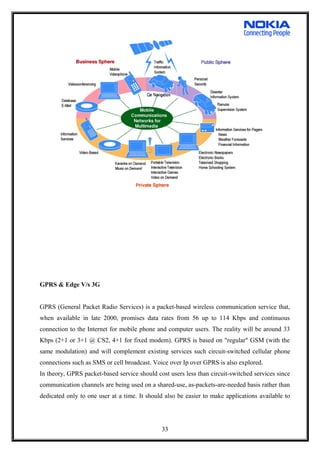
The Telecommunication industry has reached the crossroads. The ever changing technology and
decreasing revenues of the operators has made it important for the Mobile operators to change
with time. Mobile operations of telcos are progressively overtaking fixed line operations. This is
largely due to fixed-line operators not having introduced significant new products, services or
cost-saving technologies in the same way that mobile operators have. However, despite retaining
their role as cash cows for incumbent operators, fixed and mobile voice services are
progressively being overtaken by broadband. Increasingly, operators will need to take a holistic
view of the market, necessitating a total review of their business models.
Executive Summary
Faced with uncertainty over the demand for new 3G services and a growing multitude of
technology evolution paths, mobile operators in India must now commit to 3G network roll-outs
and service launches. Rather than being driven by 3G licence requirements, competitor actions
or short-term cost savings, operators must take control of their own destinies.
Mobile operators need to make critical decisions about what all 3G services will be successful in
India and whether Indian end user is ready for a dive into the 3G Multimedia wave. Mobile
8
operators need to access the choice of technology and the speed, depth and breadth of roll-out of
these services. By evaluating the diverse approaches being pursued worldwide, and wide variety
of these services and applications being used around the world, this report on the basis of Market
research identifies the most appropriate Service choices for Indian End user based on diversity
of Indian culture.
Therefore through this market research project on “Evaluating the potential of end user based
services based on the 3G/WCDMA platform in India and what kind of Revenue Models can
be tried with these Services” , I will try to get a more realistic picture of the set of applications
and services that will be accepted by the Indian end user. I will also identify the main set of
revenue models that can be tried with these services thus presenting a clear picture on which
tariff plans are preferred by the Consumers. This Market Research also helps in identifying the
consumer psych which can help the Mobile operators to target these services accurately in the
minds of the consumer.
9
Research Proposal
10
1.2 Research Proposal
Management Dilemma
Nokia faces apprehensions from its customer’s i.e the operators for launching the 3G/ WCDMA
technology in India. Therefore the sales department in Nokia Networks are putting in Extra
efforts in convincing the operators about the benefits of launching 3G/WCDMA technology and
its compatibility with the existing GSM networks of the operators. Nokia also wants to tell its
customers which set of the 3G services will be accepted by the Indian user.
Management Question
Which all 3G service have the Potential in Indian Market and are the Indian user willing to go
for these services?
Research Objective
“Evaluating the potential of end user based services based on the 3G/WCDMA platform in
India and what kind of Revenue Models can be tried with these Services”
Research Questions
• What are the Services the Indian Consumer is looking for and is he willing to go for
these services? To What extent is the consumer willing to pay for these services?
• For what purpose will the consumer be using these services so as to understand the
consumer Psyche and target these services accurately?
Hypothesis
Null Hypothesis: The Indian End user is not willing to accept 3G Services.
Alternate Hypothesis: The Indian end user is willing to accept 3G Services.
Research Design
This is a multidimensional research and will be conducted in following consumer Segments
1. Corporates/Service Class: In depth interviews and Questionnaires
2. Businessman (Small and Medium enterprises): In depth interviews and Questionnaires
3. Public opinion survey (Teenagers/Students/housewife’s): In depth interviews and
Questionnaires.
In addition it will also include secondary data analysis by study and learning from the
experience of operators around the world
11
Scope of Study
The research aims in identifying consumer preference towards 3G services.
1.3 Company Profile
Nokia: Connecting People
As we move further into the mobile world, Nokia remains committed to strong growth,
profitability, and responsible market leadership.
Nokia’s Vision: Life Goes Mobile!
Today, Nokia sees mobility surpassing voice communications and expanding into new areas
such as imaging, games, entertainment, media and enterprises.
Ten years ago, Nokia had a vision that seemed revolutionary for the times: Voice Goes Mobile!
As history shows, this vision became reality in an incredibly short amount of time. With more
than 1.6 billion mobile phone subscriptions globally – and more mobile phones than fixed-line
phones in use – we see that mobility has transformed the way people live their lives.
Today, Nokia sees mobility expanding into new areas such as imaging, games, entertainment,
media and enterprises. There are new mobile services already taking our industry forward and
creating new opportunities. At the same time, major opportunities still exist in bringing mobile
voice to completely new users.
Strategy
At Nokia, strategy focuses on activities designed to expand mobile communications in terms of
volume and value.
The Nokia Strategy continues to focus on three activities to expand mobile communications in
terms of volume and value:
• Expand mobile voice
• Drive consumer multimedia
• Bring extended mobility to enterprises
12
Expand mobile voice: Nokia believes it can further develop the mobile voice market -- both in
markets where mobile telephony is just taking off as well as in more mature markets. Nokia
estimates the number of mobile subscriptions to surpass three billion in 2008. Nokia’s position
in mobile voice is strong thanks to our key assets and excellent logistics capabilities.
Nokia believes that many opportunities for growth exist in the mobile voice market, and intends
to continue to focus on this area. In doing so, Nokia aims to capitalize on its demonstrated
efficiency and skill in execution and demand-supply chain management, and their history of
innovation. The markets on which Nokia intends to focus include markets with low mobile
subscription rates relative to the size of the population, geographic areas where it is more cost-
effective to build wireless infrastructure than fixed-line networks, and heavily populated areas,
where factors such as poor housing infrastructure or theft of materials tilt the scales in favor of
wireless solutions. Nokia also intends to focus on markets where the need for network capacity
is growing as a result of mobile network operators promoting the replacement of fixed networks
with wireless.
Drive consumer multimedia: Nokia is playing a key role in shaping this emerging complex
market by focusing on the fastest growth areas: imaging, music, and games, to name a few.
Nokia intends to enter new product and service niches, which are expected to emerge as
technologies from diverse industries start to converge, especially in the area of consumer
multimedia. Nokia strategy is to explore, identify and extract revenue from the most profitable
and fastest growing segments of the consumer multimedia business and its value chain by
anticipating consumer needs in this area, and developing innovative products and services. In the
near term, Nokia intends to focus on imaging and games, where Nokia have already introduced a
number of products.
Bring extended mobility to enterprises: Nokia will provide a range of competitive,
specifically targeted handsets, platforms, and connectivity solutions so enterprises can boost
productivity through the power of mobility.
Nokia intends to capture profitable segments of the corporate market by offering products and
services that will benefit companies and individual business people alike, including a diverse
handset range as well as security and mobile connectivity solutions specifically tailored for
enterprise needs. Nokia also intends to capitalize on companies' needs for mobility and seamless
mobile connectivity in their operations, and also expect to collaborate with leading technology
and systems integration partners.
13
Nokia is structured into four business groups – Mobile Phones, Multimedia, Enterprise
Solutions, and Networks -- to better focus and capitalize on the opportunities in each of these
areas. Throughout all these, the Networks business group provides the infrastructure backbone
and enables end-to-end communications.
Nokia’s Mission - Connecting People
By connecting people, Nokia helps fulfill a fundamental human need for social connections and
contact. Nokia builds bridges between people – both when they are far apart and face-to-face –
and also bridges the gap between people and the information they need.
Business Environment
Industry Development and Trends
The mobile communications industry continues to undergo significant changes as more users in
growth markets gain access to mobile communications, enterprise becomes increasingly mobile,
the importance of end-to-end solutions increases, and technology continues to evolve. Another
trend is an increased emphasis on the role of customization in mobile devices. These changes
have demanded agility and flexibility from industry players to adapt to new market conditions.
Converging Industries
The mobile communications, information technology, media, and consumer electronics
industries are converging in some areas into one broader industry.
Some of the first examples of this convergence include camera phones, as well as the use of
mobile devices for email, web browsing and applications, and music downloading. Multi-radio
solutions and devices, which automatically transfer connectivity among cellular networks and
complementary access technologies such as Wireless LAN and Bluetooth, are another example.
Although this convergence presents new challenges, Nokia believe that these trends also expand
the potential for future growth in the mobile communications industry.
End-to-End Solutions
Nokia sees the ability to offer tailored end-to-end solutions as being important to meet the needs
of operators, enterprises, and consumers. A solution is considered end-to-end when it provides
the hardware and software elements, including infrastructure, applications or service platforms
and mobile devices.
Today, Nokia's Push to talk over Cellular offering, which enables walkie-talkie communication
between individuals or among a group, is an example of such a solution.
Intellectual Ownership
14
The creation and ownership of relevant intellectual property rights, or IPR, are essential to
maintaining competitiveness and to creating profitable products. Nokia believes that achieving
technology leadership will depend on the ability to build a solid IPR portfolio through strong
research and development capabilities.
The Mobile Device Market
The mobile device market continued its strong volume growth during 2004, reaching a record of
643 million units compared with 490 million units in 2003, according to Nokia estimates.
Growth was driven by the ongoing boom in new subscribers in Latin America, Russia, India,
and China, as mobile communications continued to become more affordable and widely
available. Nokia expects growth in these markets to be a main driver for global mobile
subscriptions, reaching approximately 2 billion users by the end of 2005 and approximately 3
billion users by 2010.
Mobile device market growth during 2004 was also driven by attractively priced color-screen
and camera phones in Western Europe and North America. In Nokia's five geographical sales
areas, mobile device market volume growth was 100% in Latin America, 33% in Europe, the
Middle-East, and Africa, 32% in China, 22% in North America, and 15% in the Asia-Pacific
region, compared with 2003.
Beyond Voice
The mobile device market is expanding from voice-based communications towards new, data-
driven areas and applications in consumer multimedia and enterprise mobility solutions.
According to estimates, the global camera phone market reached approximately 215 million
units in 2004 compared with approximately 90 million units sold in 2003, and is estimated to
reach approximately 340 million units in 2005.
Nokia has introduced 48 camera phones since the launch of its first one, the Nokia 7650, in
2002. The global megapixel camera phone market, the high end of the camera phone market, is
expected to grow from around 40 million units in 2004 to around 100 million units in 2005.
A smartphone is a new category of mobile device that can run computer-like applications such
as email, web browsing and enterprise software, and can also have built-in music players, video
recorders, and other multimedia features. The global smartphone market is expected to grow
from around 22 million units in 2004 to more than 50 million units in 2005 and represent
approximately 25% of the total global mobile device market volume in 2008. Some of these
markets overlap with each other.
In the longer term, Nokia believes that applications such as music, mobile games and mobile TV
15
will be taken widely into use.
The Benefits of Mobility
Mobility is increasingly important to the business market as enterprises assess the potential
productivity gains, cost savings, and competitive advantages that can result from employees
being able to work outside of the office.
The enterprise mobility market is still fragmented, however. We expect that as the technologies
become more reliable, affordable, and easier to use, mobility will be more widely used by
employees.
External studies currently show a very low percentage of mobile email among workers who
spend much of their time on the move and who connect to their offices via a mobile device. This
is expected to become the lead application as businesses mobilize.
In the coming years, we believe that devices with multi-radio access and the addition of mobile
elements to corporate applications will be key drivers for establishing and extending mobility in
enterprises. Nokia is well positioned to take advantage of these trends given its expertise in these
areas.
The Mobile Infrastructure Market
During 2004, the mobile infrastructure market showed year-on-year growth of approximately
14% in euro terms, following three years of decline. Growth was largely the result of operator
investments in the current technologies of GSM, EDGE, and GPRS and their related services,
and in new-generation technologies, such as WCDMA 3G.
The pace of WCDMA 3G rollouts also picked up during 2004, and by the end of the year 63
operators had launched commercial WCDMA 3G services. Nokia supplied WCDMA 3G
technology to 28 of these operators. The number of WCDMA 3G subscribers increased
significantly during the year, reaching around 16 million by year-end. Nokia believe this
subscriber growth was largely the result of attractive pricing of services and an expanded
WCDMA 3G handsets range and the further maturity of WCDMA 3G technology. Nokia
expects the number of WCDMA 3G subscribers to reach approximately 70 million by the end of
2005. Competition in both the 2G and the 3G network infrastructure market remains intense. In
2G, competition is driven by price, solutions that are able to offer low total cost of ownership,
and the vendor's ability to roll-out mobile networks in new growth markets. In 3G technology,
vendors compete on the grounds of price, track record of network implementations, and which
future technologies they plan to offer and when, such as HSDPA, or High Speed Downlink
16
Packet Access, which provides high speed data delivery to 3G terminals to support multimedia
services.
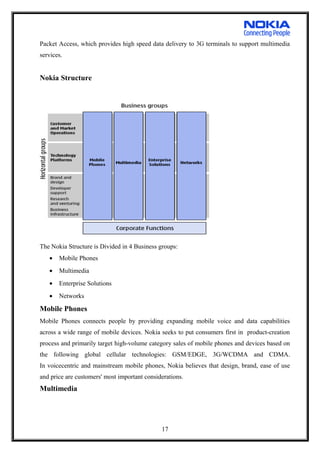
Nokia Structure
The Nokia Structure is Divided in 4 Business groups:
• Mobile Phones
• Multimedia
• Enterprise Solutions
• Networks
Mobile Phones
Mobile Phones connects people by providing expanding mobile voice and data capabilities
across a wide range of mobile devices. Nokia seeks to put consumers first in product-creation
process and primarily target high-volume category sales of mobile phones and devices based on
the following global cellular technologies: GSM/EDGE, 3G/WCDMA and CDMA.
In voicecentric and mainstream mobile phones, Nokia believes that design, brand, ease of use
and price are customers' most important considerations.
Multimedia
17
Multimedia brings mobile multimedia experiences to consumers in the form of advanced mobile
devices and applications with connectivity over GSM, 3G/WCDMA, WLAN, Bluetooth and
other standards. Nokia’s products give people the ability to create, access and consume
multimedia, as well as share their experiences with others.
Enterprise Solutions
Enterprise Solutions offers businesses and institutions a broad range of products and solutions,
including enterprise-grade mobile devices, underlying security infrastructure, software and
services. Nokia also collaborates with a range of companies to provide fixed IP network
security, mobilize corporate e-mail and extend corporate telephone systems to Nokia’s mobile
devices.
Networks
Networks provide network infrastructure, communications and networks service platforms, as
well as professional services to operators and service providers. Networks focuses on the GSM
family of radio technologies and aims at leadership in three areas: GSM, EDGE and
3G/WCDMA networks; core networks with increasing IP and multi-access capabilities; and
services. At the end of 2005, Networks had more than 150 mobile network customers in more
than 60 countries, with its systems serving in excess of 400 million subscribers.
Customer and Market Operations
Customer and Market Operations is responsible for marketing, sales, sourcing, manufacturing
and logistics for mobile devices from Mobile Phones, Multimedia and Enterprise Solutions.
The Networks business group has its own dedicated sales and marketing, logistics and sourcing
functions.
Technology Platforms
Technology Platforms is responsible for the competitiveness of Nokia’s technology assets. It
supports Nokia’s overall technology management and development by delivering leading
technologies and well-defined platforms to Nokia’s business groups as well as to external
customers.
18
1.4 INTRODUCTION
Faced with uncertainty over the demand for new 3G services and a growing multitude of
technology evolution paths, mobile operators in India must now commit to 3G network roll-outs
and service launches. Rather than being driven by 3G license requirements, competitor actions
or short-term cost savings, operators must take control of their own destinies.
Drawing on case studies of launched and planned 3G services from across the globe,
critical decisions on services can be taken on how an optimum set of 3G services can be defined
and assess the merits of alternative service strategies. It can also show how to decide on the
timing and pricing of new services, highlighting the need to take positive action without forcing
services to market too soon, and considering the best mix of voice telephony, small-screen
services (including video-on-demand) and high-speed Internet/intranet services.
Mobile operators in India need to make critical decisions about what will be required to support
3G services, including the choice of technology and the speed, depth and breadth of roll-out. By
evaluating the diverse approaches being pursued worldwide, this report identifies the most
appropriate service roll out choices for different 3G service mixes.
This report identifies the most appropriate service roll out Choices and answers following
critical questions.
- What decisions and actions are 3G operators already taking on services around the world and
how India can Learn from them? What are the potential pitfalls?
- How do operators make the right decisions on set of 3G services suiting to the Indian end user?
- What is the optimum mix of voice, small-screen data and high-speed Internet/intranet services?
19
- Where next for small-screen services? Does video-on-demand lead to a pot of gold? Can this
be the killer application telecom’s were looking for in India?
- What is the role for 3G wireless Internet access – just faster mobile Internet for business users
– or can it substitute for fixed DSL?
Current thinking is that 3G users are looking for email access, online gaming, video
conferencing and location based services. But is this really what consumers want? Is it what they
will pay for? Or is it simply only what can be provided just now?
Several technical, regulatory and market issues are delaying the mass deployment of 3G
networks and services in India. However, the demand for 3G services and applications is strong
within the consumer population in India. Through this Market Research will examine the
potential of these Third Generation mobile services, with special emphasis on the three most
important segments i.e. Corporates, Businessman, and teenagers which form the bulk of users in
India.
20
1.5 SIGNIFICANCE OF STUDY
The project is titled “Evaluating the potential of end user based services based on the
3G/WCDMA platform in India and what kind of Revenue Models can be tried with these
Services”. The significance of this study is enumerated as follows:
• It gives an in depth knowledge about 3G technology and how 3G technology is the next
Big thing for the Indian Mobile communication industry.
• This Research tells us about which all services is the Indian end user looking for from
the pool of 3G services.
• The study helps us to know about the customer psyche, preferences, attitudes, behaviors
etc toward the new 3G/WCDMA services.
• This research project will tell us as to which are the main services that the Indian
operators should start with and whether to start these services for introductory free tariffs
as in European countries or to come up with any other revenue model.
• This research tells us that what is the optimum mix of voice, small-screen data and high-
speed Internet/intranet services?
1.6 HYPOTHESIS
Assuming Null Hypothesis that the Indian end user is not willing to accept 3G
technology and is not ready for 3G services, whereas Alternate Hypothesis is assumed that
Indian end user is ready for the 3G/WCDMA technology and is willing to use 3G services.
21
1.7 OBJECTIVE OF THE PROJECT
The main objective of this project lies in “Evaluating the potential of end user based
services based on the 3G/WCDMA platform in India and what kind of Revenue Models can
be tried with these Services” however there are other objectives also, which are as follows:
• To study and learn from the experience of various 3G operators around the world.
• To identify the Major 3G Applications and Services that are being offered to the end user
around the world.
• To establish with the help of Questionnaires and interviews about whether Indian end
user is ready for 3G Services or not.
• To develop a Revenue Model for the 3G services with reference to Tariff plan in UK by
normalizing ARPU and Currency.
• Identify the Services which are best suited to Indian end user according to culture and
level of preference over other services.
• To present recommendations to the Mobile operators in India in order to make critical
decisions about what will be required to support 3G services, the speed, depth and
breadth of roll-out.
22
1.8 RESEARCH DESIGN
The survey research will be conducted by filling up of questionnaires to a total of 300
Mobile user respondents between the age group of 15 years to 75 years at various locations in
and around NCR region. The Total sample size will be divided into 3 consumer segments which
are:
1. Corporates/Service Class
2. Businessman (Small and Medium enterprises)
3. Public opinion survey (Teenagers/Students/housewife’s)
The survey was conducted in major market places and corporate houses in Delhi, Gurgaon and
Noida. Major market places such as Vasant Vihar market, Khan Market, Canuoght Place, Karol
Bagh, Chawri Bazaar, Darya Ganj and Malls in Gurgaon, Noida, and Delhi were targeted to get
the responses from Businessman and Teenage segment. Corporate houses in Gurgaon such as
DLF Infinity Towers, First India Place, JMD Regent Square, HCL Infotech, Augusta Point, DLF
Corporate Park and many similar places were targeted to get responses from Corporate Segment.
Apart from Primary data through Questionnaires, Secondary data was also collected from
websites of operators around the world and Major 3G services and Practices of Operators were
studied from the internet.
23
1.9 SAMPLE QUESTIONNAIRE
1. Are you aware of GSM/GPRS/EDGE technology and its use in mobile phones?
Yes No
2. Are You Aware of the 3G Technology in mobile phones?
Yes No
(3G WCDMA, is a global standard technology allowing video conferencing and high-speed,
high-capacity data access to users on their 3G Mobile phones.)
3. Are you aware that you can use internet services on your mobile and through your mobile on
computer?
Yes No
4. Would you like to access high speed wireless internet on your 3G Mobile phone/laptop? (With
Speeds 3 times faster than wired broadband)
Yes No Can’t Say
5. Would you like to use your mobile as a TV while you are stuck in traffic or during free time and
use following service?
• Watch your Favorite TV serial on phone, which you missed?
Yes No Can’t Say
• Watch highlights of cricket/football matches on your phone.
Yes No Can’t Say
• Watch live news (business/weather/sports) on your phone.
Yes No Can’t Say
• Download and Read e-books on your mobile phone.
Yes No Can’t Say
6. “Video Calling allows you to see the person you are talking to on your 3G phone “Will you like
to use Video Calling feature?
Yes No Can’t Say
7. For what Purpose will you be using video calling, Rate from 1 to 4 with 1 for Most Preferred
and 4 for least preferred?
Calling Relatives in India/Abroad
Business Reasons – Showing a new product to Boss, which you saw in trade fair.
Calling Friends and family
Others please Specify (eg. Locating some one at the airport)
____________________________________________
8. How would you like the tariff plan for this video calling service?
24
Fixed Monthly Rental + Usage Charges (Per Min)
Rs. 250 Monthly Rent + Usage Rs. 2.50 per min
Usage Charges (Per Min)
Usage Rs. 3.50 Per min
One time Subscription charges + Usage Charges
Subscription Rs. 2000 non refundable + Rs. 3 per min.
Bundle Pack Charges (Packs of 30/60/90minutes)
Pack 30 = Rs. 150 Valid 5 days
Pack 60 = Rs. 300 Valid 7 days
Pack 90 = Rs. 450 Valid 10 Days
I will only use it as long as it is for free
9. “Audio Streaming – Listening to Audio Tracks on phone – Radio on Demand”
“Audi Download – Download Audio Tracks on your phone”
Would you like to use Audio Streaming and Audio Download on your mobile phone?
Yes No Can’t Say
10. How would you like the tariff plan for this Audio Streaming/ Audio Download service?
Fixed Monthly Rental + Download/streaming Charges (Per track)
Download/ Streaming Charges (Per Track) only
Subscription charges per month for unlimited download/streaming
I will only use it as long as it is for free
11. “Video Streaming – Watching Video on phone”
“Video Download – Download Video on your phone”
Would you like to use Video Streaming and Video Download on your mobile phone?
Yes No Can’t Say
12. How would you like the tariff plan for this Video Streaming/ Video Download service?
Fixed Monthly Rental + Download/streaming Charges
Download/ Streaming Charges (Per Min) only
Subscription charges per month for unlimited download/streaming
I will only use it as long as it is for free
13. Would You like to use Instant Messaging Service (Yahoo Messenger, MSN, AOL) on your
Mobile Phone just like you use it on Computer?
Yes No Can’t Say
14. Would you like to play online games with no pause on your phone and download 3Dgames?
Yes No Can’t Say
15. If Your Mobile offers Navigational Service (Driving assistance and Location Search) would you
be willing to use these services?
Yes No Can’t Say
16. Would you be willing to go for a new 3G Mobile handset which can cater to all these services
and costs you 12000+ ?
Yes No Can’t Say
17. What Service you rate as most needful by you from the upcoming 3G services? Rate 1 as Most
needed, and 7 as Least needed
Video Calling Audio Streaming/ Video Streaming/ Mobile TV Games Instant Others
Audio Download Video Download Messaging Specify
25
18. How much do you value the end user experience?
Important Average Not important
19. Any other suggestions/inputs please specify?
______________________________________________________________________
Personal Information
Name: _______________________________Age:_______ Sex:________________
Occupation:___________________________ Annual Income:___________________
Email:________________________________ Ph:_____________________________
Monthly Mobile Bill:____________________ Model of Mobile you own:__________
1.10 SAMPLE SELECTION
The sample size of 300 is taken with equal amount of responses from all the three segments,
thus 100 Responses each from all the three segments.
The Total sample size will be divided into 3 consumer segments which are:
1. Corporates/Service Class
2. Businessman (Small and Medium enterprises)
3. Public opinion survey (Teenagers/Students/housewife’s)
1.11 DATA COLLECTION
The data for research is collected through the following ways:
Primary Data:-
• Survey questionnaires
• Interviews with Working Professionals
• Telephonic interviews
Secondary data:-
• Journals of 3GP Association
• News Articles on 3G
• Websites of the Operators offering 3G Services
26
• Business reports provided by the Mobile operators offering 3G
1.12 STATISTICAL ANALYSIS
Statistical analysis is the most important part of any market research, without appropriate
statistical analysis no accurate inference can be drawn on the research. Based on the response of
market research appropriate statistical techniques are used to get the desired results. There are
following statistical tools that I have used in this research:
• Co-relation Analysis, Regression Analysis
• Cross Tabs between Variables.
• Frequency Tables
• Bar graphs, Pie charts etc.
The analysis of this project will help focus on the following parameters:
• Which all services are most preferred by the end user?
• Preference of one service to the other?
• Consumer Psyche i.e. for what purpose will the consumer use that particular service?
• Preference according to Segment (e.g. teenagers have more inclination towards 3G
games and Audi streaming)
• The tariff model customers are willing to pay for these services.
27
1.13 PROJECT COST AND SCHEDULE
The total estimated cost of this project is Rs 9000 (Nine thousand only)
Traveling expenses: Rs 6000
Questionnaires: Rs 200
Internet Usage: Rs 1000
Report printout: Rs 1000
Miscellaneous expenses: Rs 500
The estimated time for project is 2 months
Setting up research plan : 1stweek Collection of primary data : 5th
– 7th
week
Secondary data collection : 2nd
– 4th
week Analysis of the data : 8th
week
Making of Questionnaire : 4th
week Making of the report : 8th
week
28
LITERATURE
29
2.1 INTRODUCTION – WHAT IS
3G/WCDMA?
3G Dive into the Multimedia Wave !
UMTS (Universal Mobile Telecommunications System) is a so-called "third-generation (3G),"
broadband, packet-based transmission of text, digitized voice, video, and multimedia at data
rates up to and possibly higher than 2 megabits per second (Mbps), offering a consistent set of
services to mobile computer and phone users no matter where they are located in the world.
Based on the GSM communication standard, UMTS, endorsed by major standards bodies and
manufacturers, is the planned standard for mobile users around the world since 2002. Once
UMTS is fully implemented, computer and phone users can be constantly attached to the
Internet as they travel and, as they roaming service, have the same set of capabilities no matter
where they travel to. Users will have access through a combination of terrestrial wireless and
satellite transmissions. Until UMTS is fully implemented, users can have multi-mode devices
that switch to the currently available technology (such as Gprs and Edge) where UMTS is not yet
available.
30
Today's cellular telephone systems are mainly circuit-switched, with connections always
dependent on circuit availability. Packet-switched connection, using the Internet Protocol
(Internet Protocol), means that a virtual connection is always available to any other end point in
the network. It will also make it possible to provide new services, such as alternative billing
methods (pay-per-bit, pay-per-session, flat rate, asymmetric bandwidth, and others). The higher
bandwidth of UMTS also promises new services, such as video conferencing. UMTS promises
to realize the Virtual Home Environment in which a roaming user can have the same services to
which the user is accustomed when at home or in the office, through a combination of
transparent terrestrial and satellite connections.
UMTS is a network consisting of two main elements connected over a standard interface, called
Iu. These two elements are:
• UTRAN (UMTS Terrestrial Radio Access Network
• The Core Network
ATM based architecture: this R'99 architecture may reuses in some cases the two-domain
architecture of GSM/GPRS, with:
1. Iu-PS (Packet Switched) interface instead of Gb on the packet domain.
2. Iu-CS (Circuit Switched) interface instead of A on the circuit domain
Transport Independent and multimedia architecture: this R'00 architecture is in line with
the Next Generation Networks architecture and introduces separation of control and user planes.
It also integrates multimedia capabilities.
31
• Frequency use
• Difference between regular CDMA and W-CDMA
• W-CDMA makes possible a world of mobile multimedia.
32
GPRS & Edge V/s 3G
GPRS (General Packet Radio Services) is a packet-based wireless communication service that,
when available in late 2000, promises data rates from 56 up to 114 Kbps and continuous
connection to the Internet for mobile phone and computer users. The reality will be around 33
Kbps (2+1 or 3+1 @ CS2, 4+1 for fixed modem). GPRS is based on "regular" GSM (with the
same modulation) and will complement existing services such circuit-switched cellular phone
connections such as SMS or cell broadcast. Voice over Ip over GPRS is also explored.
In theory, GPRS packet-based service should cost users less than circuit-switched services since
communication channels are being used on a shared-use, as-packets-are-needed basis rather than
dedicated only to one user at a time. It should also be easier to make applications available to
33
mobile users and Wap or i-mode should far more attractive for the user. In addition to the
Internet Protocol GPRS supports X.25, a packet-based protocol that is used mainly in Europe.
Operator should deploy GPRS very fast as most of the interoperability test between the network
and the Handset are now finished (September'00) and because GPRS is mainly a software
upgrade for the BTS, BSC and servers.
SPECTRUM EFFICIENCY
Packet switching means that GPRS radio resources are used only when users are actually
sending or receiving data. Rather than dedicating a radio channel to a mobile data user for a
fixed period of time, the available radio resource can be concurrently shared between several
users. This efficient use of scarce radio resources means that large numbers of GPRS users can
potentially share the same bandwidth and be served from a single cell. The actual number of
users supported depends on the application being used and how much data is being transferred.
Because of the spectrum efficiency of GPRS, there is less need to build in idle capacity that is
only used in peak hours. GPRS therefore lets network operators maximize the use of their
network resources in a dynamic and flexible way, along with user access to resources and
revenues.
GPRS should improve the peak time capacity of a GSM network since it simultaneously:
• allocates scarce radio resources more efficiently by supporting virtual connectivity
• immigrates traffic that was previously sent using Circuit Switched Data to GPRS instead,
and reduces SMS Center and signaling channel loading by migrating some traffic that
previously was sent using SMS to GPRS instead using the GPRS/ SMS interconnect that
is supported by the GPRS standards
Relatively high mobile data speeds may not be available to individual mobile users until
Enhanced Data rates for GSM Evolution (EDGE) or Universal Mobile Telephone System
(UMTS) are introduced
EDGE, Enhanced Data GSM Environment
Enhanced Data rates for Global Evolution (EDGE) is a radio based high-speed mobile data
standard. It allows data transmission speeds of 384 kbps to be achieved when all eight timeslots
are used. In fact, EDGE was formerly called GSM384. This means a maximum bit rate of 48
kbps per timeslot. Even higher speeds may be available in good radio conditions.
34
EDGE was initially developed for mobile network operators who fail to win Universal Mobile
Telephone System (UMTS) spectrum. EDGE gives incumbent GSM operators the opportunity
to offer data services at speeds that are near to those available on UMTS networks.
EDGE can also provide an evolutionary migration path from GPRS to UMTS by implementing
now the changes in modulation that will be necessary for implementing UMTS later. The idea
behind EDGE is to eke out even higher data rates on the current 200 kHz GSM radio carrier by
changing the type of modulation used, whilst still working with current circuit (and packet)
switches.
Implementation of EDGE by network operators has been designed to be simple. Only one
EDGE transceiver unit will need to be added to each cell. With most vendors, it is envisaged that
software upgrades to the BSCs and Base Stations can be carried out remotely. The new EDGE
capable transceiver can also handle standard GSM traffic and will automatically switch to
EDGE mode when needed.
EDGE capable terminals will also be needed- existing GSM terminals do not support the new
modulation techniques and will need to be upgraded to use EDGE network functionality. Some
EDGE capable terminals are expected to support high data rates in the downlink receiver only
(i.e. high dates rates can be received but not sent), whilst others will access EDGE in both uplink
and downlinks (i.e. high data rates can be received and sent). The later device types will
therefore need greater terminal modifications to both the receiver and the transmitter parts.
In addition, the TDMA industry association, the Universal Wireless Communications
Corporation, has introduced what it calls EDGE Compact. This a spectrum efficient version of
EDGE that will support the 384 kbits mandated packet data rates but will require only minimum
spectral clearing and therefore could work for network operators with limited spectrum
allocations. In fact, as a result of this, EDGE has been renamed Enhanced Data Rates for GSM
and TDMA Evolution. (See the TDMA section below for more details).
Source:mobileipworld.com
EDGE is planned to be commercially available end of year 2001 (FOA).
High Speed Circuit Switched Data (HSCSD)
GSM Circuit Switched Data supports one user per channel per time slot. High Speed Circuit
Switched Data (HSCSD) gives a single user simultaneous access to multiple channels (up to
four) at the same time. As such, there is a direct trade-off between greater speed and the
35
associated cost from using more radio resources- it is expensive for end users to pay for multiple
simultaneous calls.
Assuming a standard Circuit Switched Data transmission rate of 14.4 kilobits per second (kbps),
using four timeslots with High Speed Circuit Switched Data (HSCSD) allows theoretical speeds
of up to 57.6 kbps. This is broadly equivalent to providing the same transmission rate as that
available over one ISDN B-Channel. Some Mobile Switching Centres (MSCs) are limited to 64
kbps maximum throughput- this restriction is removed with GPRS.
In networks where HSCSD is deployed, GPRS may only be assigned third priority, after voice
as number one priority and HSCSD as number two. In theory, HSCSD can be preempted by
voice calls- such that HSCSD calls can be reduced to one channel if voice calls are seeking to
occupy these channels. HSCSD does not disrupt voice service availability, but it does affect
GPRS. Even given preemption, it is difficult to see how HSCSD can be deployed in busy
networks and still confer an agreeable user experience- i.e. continuously high data rate. HSCSD
is therefore more likely to be deployed in start up networks or those with plenty of spare
capacity- since it is relatively inexpensive to deploy and can turn some spare channels into
revenue streams. High Speed Circuit Switched Data (HSCSD) is however easier to implement in
mobile networks than General Packet Radio Service (GPRS) because some GSM vendor
solutions require only a software upgrade of base stations and no new hardware. This is not the
case with D-AMPS networks and some GSM vendor solutions.
There are a couple of reasons why HSCSD may be the preferred bearer for certain applications
when compared to GPRS. The fact that associated packets can be sent in different directions to
arrive at the same destination should in theory make the transmission more robust since there are
many different ways of achieving the end result. However, this nature of packet transmission
means that packets are subject to variable delay and some could be lost. Whilst packet
retransmission is incorporated into the GPRS standards, naturally this process does take time
and in the case of applications such as video transmission can cause poor quality images.
Another preferred application for HSCSD could be the fact that whilst GPRS is complementary
for communicating with other packet-based networks such as the Internet, HSCSD could be the
best way of communicating with other circuit switched communications media such as the
PSTN and ISDN. HSCSD is mainly supported by Nokia with little success
36
2.2 HOW 3G WORKS?
The main principle of Spread Spectrum communication is that the bandwidth occupancy is much
higher than usual. Because of this much larger bandwidth the power spectral density is lower, in
the channel the signal just looks like noise. The Spreading is done by combining the data signal
with a code (code division multiple access) which is independent of the transmitted data
message.
37
A number of advantages are:
• As the signal is spread over a large frequency-band, the Power Spectral Density is
getting very small, so other communications systems do not suffer from this kind of
communications. However the Gaussian Noise level is increasing.
• Random Access can be dealt with, as a large number of codes can be generated a large
number of users can be permitted.
• The maximal number of users is interference limited.
• Security: without knowing the spreading code, it is (nearly) impossible to recover the
transmitted data.
• Fading rejection: as a large bandwidth is used the system is less susceptible to
distortions.
There are a couple of Spread Spectrum Techniques which can be used. The most famous one is
Direct-Sequence (DS) also well-known is Frequency-Hopping (FH). A combination of these two
(DS/FH) offers a lot of advantages over the other two and will be the basis of the proposed
system.
38
Direct Sequence
Direct Sequence is the most famous Spread Spectrum Technique. The data signal is multiplied
by a Pseudo Random Noise Code (PN-code).
A PN-code is a sequence of chips valued -1 and 1 (polar) or 0 and 1 (non-polar). The number of
chips within one code is called the period of this code. A PN-code is a noise-like code with
certain properties.
Several classes of binary (2-phase) PN-codes exist: M-sequences (base), Gold-codes and
Kasami-codes. There exists also 4-phase codes , these aren't taken into account yet. A PN-code
can be created by means of one or more shift registers. When the length of such a shift register is
, in general the following can be said about the period
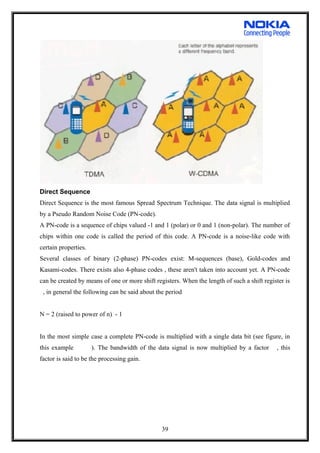
N = 2 (raised to power of n) - 1
In the most simple case a complete PN-code is multiplied with a single data bit (see figure, in
this example ). The bandwidth of the data signal is now multiplied by a factor , this
factor is said to be the processing gain.
39
Frequency Hopping
When using Frequency Hopping, the carrier frequency is 'hopping' according to a known
sequence (of length ). In this way the bandwidth is also increased. If the channels are non-
overlapping the factor of spreading is , this factor is equal to the Processing Gain. The
process of frequency hopping is shown below
40
There are two kinds of Frequency Hopping Techniques:
• Slow Frequency Hopping (SFH)
In this case one or more data bits are transmitted within one Frequency Hop. An
advantage is that coherent data detection is possible. A disadvantage is that if one
frequency hop channel is jammed, one or more data bits are lost. So we are forced to use
error correcting codes
Fast Frequency Hopping (FFH)
In this technique one data bit is divided over more Frequency Hops. Now error
correcting codes are not needed. An other advantage is that diversity can be applied.
Every frequency hop a decision is made whether a -1 or a 1 is transmitted, at the end of
each data bit a majority decision is made. A disadvantage is that coherent data detection
is not possible because of phase discontinuities
Hybrid System: DS/(F)FH
The DS/FFH Spread Spectrum technique is a combination of direct-sequence and frequency-
hopping. One data bit is divided over frequency-hop channels (carrier frequencies). In each
frequency-hop channel one complete PN-code of length is added to the data signal (see figure,
where is taken to be 5). Using the FFH scheme in stead of the SFH scheme causes the
bandwidth to increase, this increase however is neglectable with regard to the enormous
bandwidth already in use
41
As the FH-sequence and the PN-codes are coupled, an address is a combination of an FH-
sequence and PN-codes. To bound the hit-chance (the chance that two users share the same
frequency channel in the same time) the frequency-hop sequences are chosen in such a way that
two transmitters with different FH-sequences share at most two frequencies at the same time
(timeshift is random). From Jack P.F. Glas
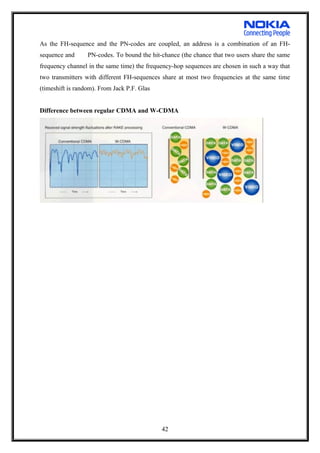
Difference between regular CDMA and W-CDMA
42
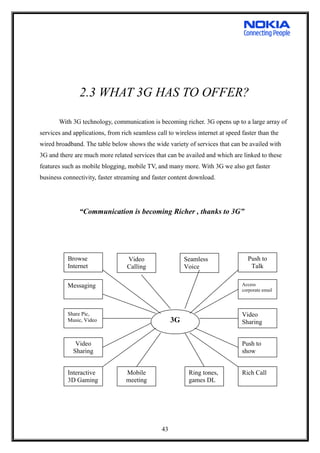
2.3 WHAT 3G HAS TO OFFER?
With 3G technology, communication is becoming richer. 3G opens up to a large array of
services and applications, from rich seamless call to wireless internet at speed faster than the
wired broadband. The table below shows the wide variety of services that can be availed with
3G and there are much more related services that can be availed and which are linked to these
features such as mobile blogging, mobile TV, and many more. With 3G we also get faster
business connectivity, faster streaming and faster content download.
“Communication is becoming Richer , thanks to 3G”
3G
Browse
Internet
Messaging
Share Pic,
Music, Video
Video
Sharing
Interactive
3D Gaming
Push to
Talk
Access
corporate email
Video
Sharing
Push to
show
Rich Call
Video
Calling
Seamless
Voice
Mobile
meeting
Ring tones,
games DL
43
“Graph showing bandwidth requirement for the service and value for the end
user”
The above graph shows the bandwidth requirement for the service and how much value does the
end user associate with that service. It is quite evident that the services which require more
band width are up on the value list for the end user.
New services demand higher speed
44
Voice,
SMS
GSM
10-40
Kbps
MMS,
WAP,
Download,
Audio
Streaming
SMS
GPRS
30-40
Kbps
Web Browsing,
Mobile intranet
access, Video
streaming,
Video sharing.
EDGE
80-160 Kbps
Video
telephony,
Video sharing.
Real time IP,
real time
games, mobile
internet
WCDMA
128-384 Kbps
Faster Business
connectivity,
faster
streaming,
content
download
HSPA
1-14 Mbps
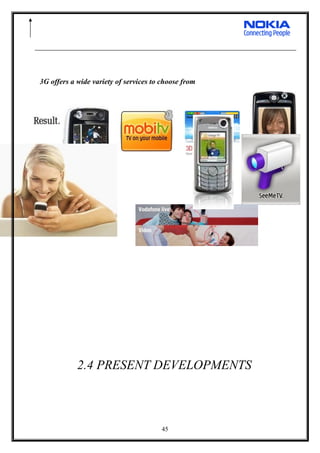
3G offers a wide variety of services to choose from
2.4 PRESENT DEVELOPMENTS
45
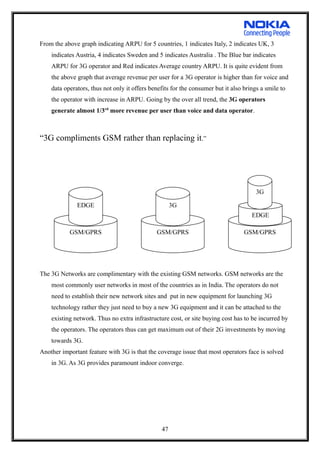
3G Operators generate higher ARPU
than Voice and data operators
36
50
56
42
52
30 30
34
19
27
0
10
20
30
40
50
60
1 2 3 4 5
Countries
ARPUPerUser(Euro)
Source: www.3gtoday.com/
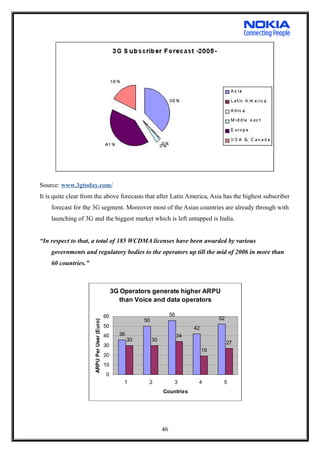
It is quite clear from the above forecasts that after Latin America, Asia has the highest subscriber
forecast for the 3G segment. Moreover most of the Asian countries are already through with
launching of 3G and the biggest market which is left untapped is India.
“In respect to that, a total of 185 WCDMA licenses have been awarded by various
governments and regulatory bodies to the operators up till the mid of 2006 in more than
60 countries.”
46
From the above graph indicating ARPU for 5 countries, 1 indicates Italy, 2 indicates UK, 3
indicates Austria, 4 indicates Sweden and 5 indicates Australia . The Blue bar indicates
ARPU for 3G operator and Red indicates Average country ARPU. It is quite evident from
the above graph that average revenue per user for a 3G operator is higher than for voice and
data operators, thus not only it offers benefits for the consumer but it also brings a smile to
the operator with increase in ARPU. Going by the over all trend, the 3G operators
generate almost 1/3rd
more revenue per user than voice and data operator.
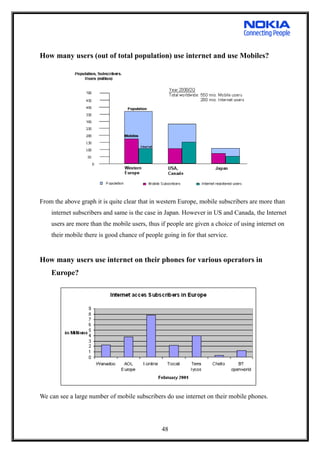
“3G compliments GSM rather than replacing it.”
The 3G Networks are complimentary with the existing GSM networks. GSM networks are the
most commonly user networks in most of the countries as in India. The operators do not
need to establish their new network sites and put in new equipment for launching 3G
technology rather they just need to buy a new 3G equipment and it can be attached to the
existing network. Thus no extra infrastructure cost, or site buying cost has to be incurred by
the operators. The operators thus can get maximum out of their 2G investments by moving
towards 3G.
Another important feature with 3G is that the coverage issue that most operators face is solved
in 3G. As 3G provides paramount indoor converge.
47
GSM/GPRS GSM/GPRS GSM/GPRS
EDGE 3G
EDGE
3G
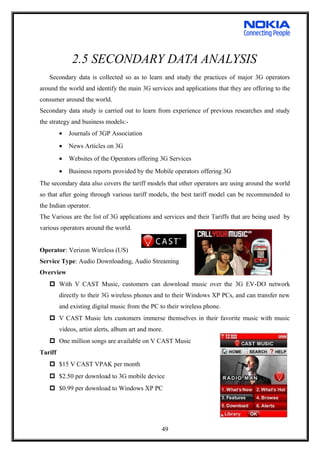
How many users (out of total population) use internet and use Mobiles?
From the above graph it is quite clear that in western Europe, mobile subscribers are more than
internet subscribers and same is the case in Japan. However in US and Canada, the Internet
users are more than the mobile users, thus if people are given a choice of using internet on
their mobile there is good chance of people going in for that service.
How many users use internet on their phones for various operators in
Europe?
We can see a large number of mobile subscribers do use internet on their mobile phones.
48
2.5 SECONDARY DATA ANALYSIS
Secondary data is collected so as to learn and study the practices of major 3G operators
around the world and identify the main 3G services and applications that they are offering to the
consumer around the world.
Secondary data study is carried out to learn from experience of previous researches and study
the strategy and business models:-
• Journals of 3GP Association
• News Articles on 3G
• Websites of the Operators offering 3G Services
• Business reports provided by the Mobile operators offering 3G
The secondary data also covers the tariff models that other operators are using around the world
so that after going through various tariff models, the best tariff model can be recommended to
the Indian operator.
The Various are the list of 3G applications and services and their Tariffs that are being used by
various operators around the world.
Operator: Verizon Wireless (US)
Service Type: Audio Downloading, Audio Streaming
Overview
 With V CAST Music, customers can download music over the 3G EV-DO network
directly to their 3G wireless phones and to their Windows XP PCs, and can transfer new
and existing digital music from the PC to their wireless phone.
 V CAST Music lets customers immerse themselves in their favorite music with music
videos, artist alerts, album art and more.
 One million songs are available on V CAST Music
Tariff
 $15 V CAST VPAK per month
 $2.50 per download to 3G mobile device
 $0.99 per download to Windows XP PC
49
Operator: Cingular USA
Service Type: Video Streaming
Overview
 Allow users to watch video clips from HBO shows on their phones.
 Users could also get tones, graphics, and games from their favorite
HBO shows!
Tariff
 HBO Mobile: $4:99/month
 HBO Family: $2:99/month
Operator: Cingular USA
Service Type: Wireless Internet
Overview
 Cingular broadband Connect allows users to have wireless access on their laptops
virtually anywhere.
 Supported by Cingular 3G PC cards, this service frees the users' laptops from the
limitations of wired connections and extend their reach far beyond the range of hotspots
Tariff
 $59:99 - 900 anytime minutes
 $79:99 - 1350 anytime minutes
50
Operator: Cingular USA
Service Type: Java Games Download
Overview
Users can download games with full-color animation and robust sound effects. Once
downloaded, users can play the games again and again, creating a little diversion during a busy
day.
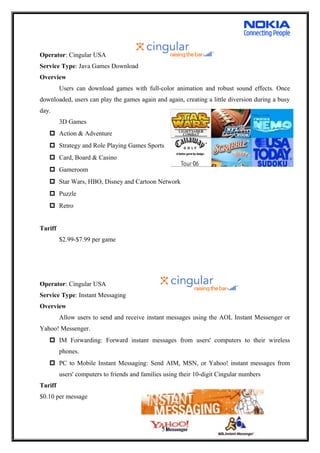
3D Games
 Action & Adventure
 Strategy and Role Playing Games Sports
 Card, Board & Casino
 Gameroom
 Star Wars, HBO, Disney and Cartoon Network
 Puzzle
 Retro
Tariff
$2.99-$7.99 per game
Operator: Cingular USA
Service Type: Instant Messaging
Overview
Allow users to send and receive instant messages using the AOL Instant Messenger or
Yahoo! Messenger.
 IM Forwarding: Forward instant messages from users' computers to their wireless
phones.
 PC to Mobile Instant Messaging: Send AIM, MSN, or Yahoo! instant messages from
users' computers to friends and families using their 10-digit Cingular numbers
Tariff
$0.10 per message
51
Operator: Cingular USA
Service Type: Mobile Portal
Overview
Allows users to personalize their homepage with topics of their interest, and instantly check out
sports scores, surf the web, get email, grab new ringtones and games, and more
Tariff
 MEdia Net 1MB: $4:99/month
 MEdia Net 5MB: $9:99/month
 MEdia Net 10MB: $14:99/month
 MEdia Net Unlimited: $19:99/month
 MEdia Net pay Pay-Per-Use: $0.01/KB
Operator: Cingular USA
Service Type: Email
Overview
 Cingular Mobile Email allows
users to have access to their personal emails such as AOL, Yahoo, and Hotmail.
 Cingular Mobile Email allows users to Instantly check personal e-mail quickly and easily
from a 3G Cingular phone
Tariff
No monthly fees. Standard data charges apply while downloading inbox and messages
Operator: Cingular USA
Service Type: Picture Message, Video Message
Overview
Allow users to send pictures, video, and voice messages to another phone or e-mail address even
with personalized text or a voice recording. Services include Picture messaging, Video
Messaging, Voice Messaging, Greeting Cards, Kodak Mobile, Multimedia Fun.
Tariff
52
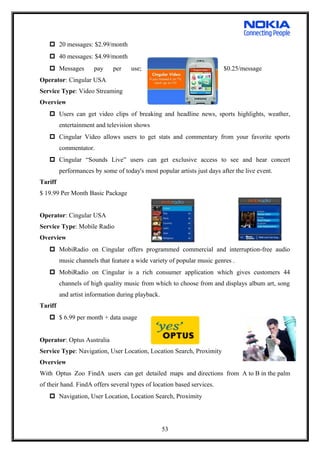
 20 messages: $2.99/month
 40 messages: $4.99/month
 Messages pay per use; $0.25/message
Operator: Cingular USA
Service Type: Video Streaming
Overview
 Users can get video clips of breaking and headline news, sports highlights, weather,
entertainment and television shows
 Cingular Video allows users to get stats and commentary from your favorite sports
commentator.
 Cingular “Sounds Live” users can get exclusive access to see and hear concert
performances by some of today's most popular artists just days after the live event.
Tariff
$ 19.99 Per Month Basic Package
Operator: Cingular USA
Service Type: Mobile Radio
Overview
 MobiRadio on Cingular offers programmed commercial and interruption-free audio
music channels that feature a wide variety of popular music genres .
 MobiRadio on Cingular is a rich consumer application which gives customers 44
channels of high quality music from which to choose from and displays album art, song
and artist information during playback.
Tariff
 $ 6.99 per month + data usage
Operator: Optus Australia
Service Type: Navigation, User Location, Location Search, Proximity
Overview
With Optus Zoo FindA users can get detailed maps and directions from A to B in the palm
of their hand. FindA offers several types of location based services.
 Navigation, User Location, Location Search, Proximity
53
Tariff
AU$4.95 (US$3.65) per month, or “Pay-as-you-Go” at rate of AU$0.55 (US$0.40) for 20
minutes
Operator: Vodafone UK
Service Type: Mobile TV
Overview
With the Vodafone Live! Mobile TV service users can watch a
wide variety of popular TV channels on their 3G Vodafone mobile
Tariff
 Sky Mobile TV pack: £5 (US$9.40) per month.
 Variety pack: £3 (US$5.60) per month.
Operator: 3 (Hutchison Telecom) UK
Service Type: Video Messaging , Video Download
Overview
 SeeMe TV is a new video service where the users produce and act in their own home-
made movies that are submitted to 3 to be viewed by the rest of the subscriber base. Each
time their video is viewed they receive a monetary credit in their account from 3.
 SeeMe TV subscribers can record mini-movies (15 seconds) on their 3G mobile phone
and send them to 3 to earn money
Tariff
 Each time a user downloads your Video from See Me TV, you earn money in your See
Me TV account, as follows:
 Video Price Credit Amount
 10p 1p
 20p 2p
 30p 3p
 50p 5p
Operator: Orange UK
Service Type: Games Download
54
Overview
 Orange offers a large selection of mobile games, including 3D, action, board, casino,
puzzle, racing strategy and film games.
Tariff
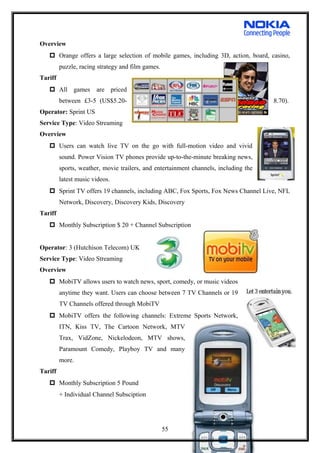
 All games are priced
between £3-5 (US$5.20- 8.70).
Operator: Sprint US
Service Type: Video Streaming
Overview
 Users can watch live TV on the go with full-motion video and vivid
sound. Power Vision TV phones provide up-to-the-minute breaking news,
sports, weather, movie trailers, and entertainment channels, including the
latest music videos.
 Sprint TV offers 19 channels, including ABC, Fox Sports, Fox News Channel Live, NFL
Network, Discovery, Discovery Kids, Discovery
Tariff
 Monthly Subscription $ 20 + Channel Subscription
Operator: 3 (Hutchison Telecom) UK
Service Type: Video Streaming
Overview
 MobiTV allows users to watch news, sport, comedy, or music videos
anytime they want. Users can choose between 7 TV Channels or 19
TV Channels offered through MobiTV
 MobiTV offers the following channels: Extreme Sports Network,
ITN, Kiss TV, The Cartoon Network, MTV
Trax, VidZone, Nickelodeon, MTV shows,
Paramount Comedy, Playboy TV and many
more.
Tariff
 Monthly Subscription 5 Pound
+ Individual Channel Subsciption
55
Operator: 3 (Hutchison Telecom) UK
Service Type: Video Telephony, Dating
Overview
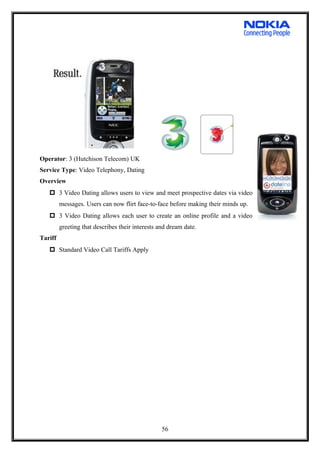
 3 Video Dating allows users to view and meet prospective dates via video
messages. Users can now flirt face-to-face before making their minds up.
 3 Video Dating allows each user to create an online profile and a video
greeting that describes their interests and dream date.
Tariff
 Standard Video Call Tariffs Apply
56
Jet Airways has been voted India's 'Best Domestic Airline' consecutively and
won several national and international awards, including the 'Market Development Award' for
2001 awarded by Air Transport World.
AIR DECCAN
Air Deccan is a unit of Deccan Aviation Private Limited, India's largest private heli-
charter company. Formed in 1995, Deccan Aviation Private Limited has carved a niche for itself
in the Indian aviation scene with its reputation for providing speedy and reliable heli-services for
company charters, tourism, medical evacuation, off-shore logistics and a host of other services.
The company has a modern fleet of ATR-42-320 aircraft, one of the finest and most efficient
Turbo-Prop aircraft flying. ATR is a European joint venture between Alenia Aeronautica and
EADS. The ATR 42 has become a reference aircraft amongst airlines around the world, by
offering a safe, easy to maintain and comfortable aircraft operating on the regional market with
the best economics on short haul sectors. To date, ATR has sold over 650 aircraft to more than
100 operators in 73 countries all around the world.
The company has adopted a 'lean-and-mean' approach to staffing and aims at maintaining a low
aircraft-to-employee ratio. A good work culture coupled with a skilled workforce is the
backbone of the company.
57
2.4 CUSTOMER RELATIONSHIP MANAGEMENT –THE
CONCEPT
The business environment has changed—becoming more intensely competitive as
globalization has brought new competitors into the marketplace... This trend is both a blessing
and a curse since companies can now connect with customers around the globe but will have to
compete with players around the globe as well.
Customers have become harder to satisfy as they have become inundated with rapidly changing
product and service offerings. In fact, product proliferation has resulted from a greater number
of competing companies trying to offer global consumers an array of choices in order to fulfill
their diverse needs and wants. In addition, technology advances resulting in improved
transportation and communication capabilities have enabled faster delivery times as well. As a
result of these trends, customers’ expectations have risen rapidly to the level of demanding what
they want, where, when and how they want it.
To understand what exactly Customer Relationship Management is, first we have to understand
the terms customer, customer perceived value, total customer satisfaction, customer equity,
value equity brand equity, and relationship equity.
Customer: Customer is defined as that person who buys any product or services from any
business house to satisfy his daily need wants and demands.
Customer Perceived Value: It is the difference between the prospective customer’s evaluation
of all the benefits and all the costs of the offerings and the perceived alternatives.
Total Customer Satisfaction: It is defined as a person’s feeling of pleasure or disappointment
resulting from comparing the products perceived performance in relation to his expectations. If
the performance matches his expectations the customer is a satisfied customer, if the
performance of the product or service exceeds his expectations then the customer is a delighted
customer. Today the rule is to make your customer delighted and not only satisfied.
58
Customer Equity: is the total of the discounted lifetime values of all the firm’s
customers.
Value Equity: It is defined as the customer’s objective assessment of the utility of an
offering based on perception of its benefits relative to its costs.
Brand Equity: In terms of CRM, it is defined as customer’s subjective and intangible
assessment of the brand, above and beyond, it’s objectively perceived value.
Relationship Equity: It is the customer’s tendency to stick with the brand, above and
beyond the objective and subjective assessment of its worth.
The above defined terms will now enable us to get a clear understanding of the term
Customer Relationship management.
Customer Relationship Management: Customer Relationship Management, is the
business strategy that aims to understand, anticipate, manage and personalize the needs of
an organization's current and potential customers" -- PWC Consulting. Therefore we can
say that CRM is a business strategy, one that puts the customer at the heart of the
business.
59
2.5 CUSTOMER RELATIONSHIP MANAGEMENT
IN THE AIRLINE INDUSTRY
Today the major carriers are moving in direction of Customer Relationship Management,
but none is fully there yet. Smaller airlines are behind, but chasing. The consultants at McKinsey
estimate that true CRM could boost the operating profits of a large Indian airline by up to $250
million a year. Even small carriers could increase their annual income by $15-50 million each
year. The gains come mostly in reducing customer churn, increasing an airline’s share of
existing customers’ spending and in gaining new customers.
In order to manage the customer more effectively across all lines of service, airlines have the
following approaches to CRM:
• Customer segmentation—Airlines need to recognize that mileage-based segmentation is
inadequate, whereas value-based and needs-based approaches can help guide investment
decisions and drive greater insight into the needs of high-value customers.
• CRM initiative development—In order to differentiate themselves from the competition,
airlines must abandon a “fast follower” approach to CRM initiative development, in favor of
investing in initiatives with a high return, which responds to the needs and desires of their own
customers.
• Organizational design and management—Airlines need to instill a service mentality in their
employees, empowering them with a complete view of the customer and clearly articulating the
employee’s role in the CRM strategy.
60
By taking steps to implement a truly consumer-centric approach to relationship management, an
airline is better positioned to acquire, develop and retain high-value customers. Through the
development and implementation of customer analytics and decision-support technologies,
airlines are beginning to use customer information not only to differentiate service levels based
on customer value, but also to drive crucial operational decisions. In the end, an airline’s CRM
program becomes a platform for achieving both near-term operational efficiency and long-term
relationship management and growth.
As the Indian airline industry grapple with how to deliver a consistent and distinctive customer
experience while maintaining low operating costs, they have turned to the promise of CRM.
Although operational and security issues became top-of-mind immediately after September 11th,
CRM has gradually come back into focus as airlines recognize the importance of effective
customer management in establishing long-term competitive advantage. CRM’s promise is
indeed compelling: strengthened loyalty driving increased revenue, with lower acquisition costs
and improved operational efficiency. For full-service airlines, CRM is an essential component of
their corporate strategy—the means of differentiating themselves from competitors in the eyes
of the customer. And although low-cost carriers may be less reliant on CRM as a means of
driving competitive differentiation, even they must invest in fundamental CRM technologies and
processes to manage the customer efficiently over the course of the travel experience.
Increasingly, airlines are recognizing that CRM is a long-term investment, with the true benefits
reaped through profitable lifelong customer relationships.
To date, the Indian airline industry have used CRM primarily as a competitive “catch-up” rather
than a means of differentiation. Rushing to imitate the customer-oriented initiatives introduced
by competitors, many airlines have done little to determine the value to the customer of those
initiatives, or to the business itself. Today, not only are frequent flyer programs a universal cost
of doing business, but even recent innovations such as kiosk check-in One of the primary goals
of CRM is to differentiate a company’s services to the customer through personalization.
61
2.6 JET AIRWAYS CRM PROGRAMS
On ground customer services:
• Check-In Options:
1. Web Check-in – India’s first and only online service where you can choose your
seat and print your boarding pass from home or office. Whether you’re flying
Club Premiere or Economy, whether you’re a frequent flyer or a first-time flyer
all you require is a valid Jet Airways e-ticket, access to the Internet and a printer.
2. City Check-in-If you have a confirmed ticket and will be traveling with only
hand baggage, bid adieu to long queues at the airport. Jet Airways now brings
Bangalore, Kolkata, Chennai, Delhi, Indore and Mumbai airports closer to you.
Passengers traveling with hand baggage and a confirmed ticket need not report at
the airport hours before their flight departure. All you need to do is to drop in at
our conveniently located city offices and check-in as early as 24 hours prior to
your flight departure
3. Tele Check-in-if you are a member of Club Première passenger or a holder of
the Jet Privilege Platinum/Gold/Silver/Blue Plus card? You just avoided the wait
at the airport. Use the extra time to shop, go sightseeing or simply catch up with
62
your work. When business takes you places, your every minute is precious.
Breeze through check-in with our Tele check-in facility.
• 24 hours Help Desk: Jet Airways provide a 24 hours help desk for their
customers to provide any sort of information regarding boarding, tickets, bookings ,flight
and seat availability, etc any time of the day and night.
In Flight Customer Services
• In-Flight Convenience: Jet Airways provide full convenience service in-flight to their
passengers ranging from Towels, Sleep Easy Pillows and blankets are available on
request on all our flights. Reading Material Every Jet Airways flight has a wide choice
of newspapers and magazines. Club Première passengers may request the cabin crew to
provide them with exclusive stationery.First Aid A first-aid kit is available with the
cabin crew on all our flights
Class of service: Jet Airways operates two classes of service - Club Premiere and Economy
class. Club Premiere is the exclusive Business Class and the preferred mode of travel for
businessmen and senior personnel in the corporate world.
Benefits and privileges programs for customers: Jet Airways, believe in providing
passengers with the best experiences possible. And now with the introduction of International
long-haul flights, they have enhanced the Jet Privilege programme to be more global in nature.
As a member of the Jet Privilege programme, passengers will enjoy a variety of enhanced
benefits that transcend beyond traditional forms of Frequent Flyer programmes.
5 Membership Levels In addition to the 3 existing tiers, the new Jet Privilege programme
introduces 2 new tier levels. JP Blue continues to be the entry level into the JP Programme. JP
Blue Plus is a new tier, introduced for our JP Blue members who are on the fast track to an
upgrade; they can start enjoying the facility of Tele Check-in as soon as they complete 10 Jet
Airways flights or 15,000 Status JPMiles in a six-month period.JP Silver & JP Gold continue to
remain the elite tier levels of the JP Programme. JP Platinum is an exclusive elite tier level,
specially created for our most frequent flyers
The Dynamic Tier Review (DTR) System - A world first! To make the tier upgrade and
retention easier for our JP Members, Jet Privilege has developed a multi-criteria based tier
assessment system. This innovative system, which is referred to as the DTR System, is totally
unique to Jet Airways and has no precedent anywhere in the world. With this system, we will be
63
able to provide members with quicker tier upgrades as well as more opportunities to retain their
tier status.
Check-in at Club Première & PREMIERE counters As JP Silver, JP Gold, JP Platinum or Jet
Airways Citibank Gold Credit Card member, you can now check-in at the Club Première &
PREMIERE desk, irrespective of your class of travel.
E-ticketing: An unique fast function where a customer can book his ticket online and then get a
simple print out of his ticket in order to walk in the departure area of the airport.
2.7 INDIAN AIRLINES CRM PROGRAMS
Premium Clubs for Customers:
The Maharajah Club: The Maharajah Club has been specially created for discerning travelers
like you. It is Air India's way of providing you superior service, convenience and comfort that
will make flying an extremely pleasurable experience for you. Anywhere. Every time
Golden Edge Club: Life is a journey full of surprising rewards if you are a frequent flyer with
Indian Airlines, and the awards seem to multiply with every passing nautical mile. Gradually,
you realize that you now belong to an exclusive club, where sky is not the limit.
Leading Edge Club: We like to make your experience with Air India pleasant both in the air
and on ground. In our Endeavour to satisfy your special needs and offer you the best in luxury
travel, we have linked up with organizations of high repute, in India and abroad.
Silver Edge Club: As a high profile executive, you are the centre of the limelight. The frequent
flights you take on Indian Airlines ads up to two things. Membership to the elite Silver Edge
Club, a world of rewards, offers and promotions.
Super Saver Utsav Plus: In order to facilitate and give 'value for money' to frequent travelers
like Indian has introduced a new scheme "Super Saver Utsav Plus", during the New Year /
Festive Season.
64
Desh Videsh: Indian has launched various Customer Schemes and Easy Fares/Unchecked fares
in the market, by offering very attractive discounts, to valued customers. In order to recognize
and reward all passengers, who are loyal and traveling on Indian Airlines, a new scheme "Desh -
Videsh 2006" is being launched with effect from 6th February 2006."Desh-Videsh 2006" is a
scheme to reward passengers, based on the total volume of travel, irrespective of the type of
discounted ticket they are traveling on
E-ticketing: Electronic tickets are permitted between the following online points in India:
Mumbai, Delhi, Hyderabad, Bangalore, Ahmedabad, Kolkata, Chennai, Kochi and
Thiruvanthapuram and online points in the USA Region viz. New York, Newark, Chicago and
Los Angeles. Passengers availing of stopovers at Paris and Frankfurt will not be able to avail of
electronic tickets.
These tickets can be booked/purchased at our Booking Offices and online on www.airindia.in
2.8 KINGFISHER AIRLINES CRM PROGRAMS
King Club: Kingfisher airlines have always believed in treating their passengers to the Good Times on-
board. As their loyal Guest, they believe that passengers deserve special care. And they are proud to crown
the passengers King of the skies. Each time passengers fly the Good Times, they get a treasury full
of rewards and privileges. Please and as always, they assure of unparalleled levels of service that
have become accustomed to with Kingfisher Airlines. Come have a royal time…
Online ticket Booking: This service enables the passengers to book their tickets online through
the internet from any corner of the world, saving their precious time in going to a travel agent
and standing in long standing lines.
In-flight entertainment: Personalized video screens and headphones broadcasting 5 video
channels of the trendy FUN TV and the exclusive Kingfisher Radio - 10 channels of
chartbusting music from across the globe.
King Club Miles and Tiers: The King Club membership comprises 3 Royal tiers - Red, Silver
and Gold. Tier status determines the benefits & privileges that the passengers are entitled to.
Needless to add, the higher the tier, the more the benefits. Passengers will, however, continue to
accrue and redeem Miles, regardless of their tier status. All Guests automatically enroll into the
King Red tier on completion of 3 valid flights on Kingfisher Airlines. If the passengers have
65
taken 30 or more flights during the course of the year, he would be automatically upgraded to
the King Silver tier. On completion of 60 or more flights a year, the tier status would be further
upgraded to King Gold. Tiers are reviewed annually. In order to retain tier status, our King Club
Guests would require flying a specified minimum number of times on Kingfisher Airlines during
the course of the membership year.
2.9 AIR DECCAN CRM PROGRAMS
Super Value Flier: this is one of the most important schemes for the customers that the airline
has adopted to build up a long relationship with its customer or rather its potential passengers.
These are special packages for frequent flyers and include the following:
Package Name: Price: INR No of Tickets: Valid For:
Value Flier Plus 48000.00 14 12 Months
Value Flier 24000.00 12 12 Months
Super Flier Plus 100000.00 32 12 Months
Super Flier 50000.00 26 12 Months
Citizen charter: Air Deccan’s Citizens' Charter is presented to give information on all the
interfaces between our valued customers and us at Air Deccan. Relevant information regarding
reservations, check-in procedures, baggage allowance, cancellation charges and security
regulations is briefly outlined in this Citizens' Charter.
66
2.10 BALANCED SCORE CARD IN BRANDING
To develop a balanced score card for the airline companies we first have to know as to
how these various Indian companies are positioning their airlines name as a brand in the market
as well as in the minds of their customers or rather passengers.
Air Deccan:” India’s low cost airline carrier”
Jet Airways:” The joy of flying”
India Airlines:” New horizons, enduring values”
Kingfisher:” Fly king class”
We studied the passengers and found out as to what their perceptions about the various airline
companies are and what the parameters that effect their perception are. The chart here gives us
passengers traveling to Delhi from the different regions of India mainly region-wise spilt up of
the sample is as follows:
67
The areas covered in measuring perceptions of the passengers are as follows:
1. Brand Awareness
2. Airlines usage –
a. Frequency
b. Brands
c. Purpose
d. Circuits
e. Class
3. Factors affecting consumer perception
4. Promotional Scheme Preferences
5. Brand parameter preferences
6. Circuits flown
Brand Awareness Study
Indian Airlines ranks number one in brand awareness. This could be attributed to its long stay in
the market and continued support from the government. Today, Indian Airlines has become
synonymous with reliability and efficiency. Jet Airways is offering stiff competition and ranks
second in the list. Sahara is providing value-add services and is following closely. The concept
of a low-cost, no-frills airline is being merged into having high quality, low-cost carriers. Air
Deccan, following the low-cost airlines model, being a relatively new entrant in the market,
comes in lowest currently on brand awareness.
68
Usage of Airlines
Indian Airlines, mostly used by government employees, recorded the highest usage followed by
Jet Airways. Although most consumers rated Jet Airways high on price, it still ranks second in
usage and this could be attributed to its excellent service and promotion schemes. Similar data
for the entire population reflects a higher usage of Jet Airways than IA, and a lower usage of
Sahara, which is a possible implication of the sample location being concentrated in almost
equal proportion in Lucknow (which has a higher price sensitive population) as other major
metros.
69
Frequency of Usage
As indicated in the graph below, a majority the population flies relatively infrequently
(as compared to the developed markets). Passengers traveling on business were found to be
70
more frequent users, while those flying on holidays and emergencies were those that tended to
make up the segment that flew less than once a year.
Flight Class and Occasion of use
Although the occasion of use indicates that maximum usage is for business, the flight
class graph indicates that the proportion travelled by business class is very small in comparison
to that travelled by economy class. This indicates that most business travellers are flying
Economy class as well. Further, the second important occasion of usage is for emergencies and
time-critical travels.
Circuits Flown: The most frequently flown circuit is that between major metros, followed by
other state capitals and Delhi-Mumbai. Delhi and Mumbai airports accounts for roughly half of
passengers flown, and metro airports account for 66% of the passengers flown (and 47% of
revenues, as per secondary data).
71
Scheme Preference: With the entry of new players in the market, airlines are competing for
passengers on non-price parameters. This increases the product differentiation in order to
decrease elasticity of demand in the market. Given the key differentiators that substitute for
price, consumers have rated Apex fares as their most preferred scheme. Indian Airlines, Jet and
Air Sahara offer apex fares. Next most preferred to Apex fares is the frequent flyer program, a
trend noticed predictably in the high frequency repeat users and those traveling on business.
Factors affecting consumer perception
We identified the following factors that make the demand function of consumers.
a) Price
b) Service
c) Promotional Schemes
d) Loyalty programmes
e) Flight Schedules
f) Comfort with the brand
g) Corporate tie-ups
72
Consumer Choice Parameters
Price appears to be most important factor for the consumer followed by service provided and
flight schedules.
Indian Airlines has been rated high on most parameters while Jet Airways, although rated low
on price, is rated highest in most other factors. Air Deccan, which has been ranked best on
prices, has succeeded in its mission to provide reliable low-cost air-travel to common man by
constantly driving down air-fares.
Kingfisher’s many services such as In-flight entertainment and Wings n' Wheels coach service,
exclusive business lounges being operated at departure halls at airports in a number of cities,
providing for business and refreshment services has made it second most popular under services.
It has taken the lead in introducing novel initiatives such as Steal-a-seat flexi fare options,
Sixer/Super Sixer and Square Drive/Super Four.
Corporate tie-ups were a trend significant by their absence on the brand preference parameters.
While the only major tie-ups were by Indian Airlines with government agencies, these were not
perceived as strictly ‘corporate’ tie-ups. This segment is hence a possible opportunity which can
be explored as a non-price differentiator, given the large frequency of use by business travelers
73
2.11 E-CRM FOR THE AIRLINES
What is e-CRM
Today, more and more airlines are using the Internet to implement e-business
applications and CRM strategy. These applications can be very resource intensive. e-CRM is
interest intensified in managing customer relationship through the Internet, and many airlines
approached this as a separate project to their e-business strategy.
What differentiates airlines in today's hyper-competitive and demand-driven markets is their
ability to address their customers' preferences and priorities. This means more than simply
knowing and understanding their customers better than their competitors do. It means
strategically implementing this customer knowledge in every area of the airline, from the highest
management level to all the employees who come into direct contact with customers.
E-CRM involves far more than automating processes in sales, marketing, and service and then
increasing the efficiency of these processes. It involves conducting interactions with customers
on a more informed basis and individually tailoring them to customers' needs.
Business Drivers--Why CRM
There are three primary reasons why CRM has taken hold as rapidly as it has:
1. Competition is fierce;
2. The economics of customer retention are unequivocal;
3. Technology allows airlines to do this more effectively and profitably today.
The benefit of application CRM to the airline industry
There are only three ways to increase the profitability of a customer base; acquire more
customers, optimize the value of existing customers, or retain the right customers longer. All of
these benefits must be achieved with lower costs.
74
Of the three choices above, acquiring new customers is the most expensive. Research shows that
acquiring a new customer cost 5 to 10 times more than retaining an existing one. Studies also
show that loyal customers will buy more over their lifetime and are willing to pay a premium for
doing business with someone they like and trust.
An investigation of the India airlines industry has clearly indicated that significant revenue
improvements of n 0.9 and 2.4% are achievable
Benefits of a CRM Strategy
This revenue increase comes from three areas:
• Re-attracting defected customers, which accounts for between 0.1 and 0.3% of revenues;
• Increasing the share of a customer's travel wallet, which accounts for 0.3 and 1.2% of
revenues;
• Acquiring new customers, which accounts for approximately 0.05% of revenues?
Naturally, associated with these revenues are costs, but these only amounts to between 0.3 and
0.6% of the existing cost base:
• The marginal additional flights needed as incentives estimated to be between 0.2 and
0.4% of costs;
• Additional CRM initiatives amounting to between 0.2 and 0.5% of costs.
Savings in costs due to more efficient and targeted running of the existing CRM program,
providing a reduction of 0.1 to 0.3% of costs;
As stated above, the bottom line impact of CRM is significant, but varies according to the airline
implementing the initiatives. The range estimates are:
• For a large airline: $100-$250 million per year;
• For a midsize airline: $25-$60 million per year;
• For a smaller airline: $15-$50 million per year.
75
There are many benefits to be gained for airlines and airline passengers, firstly, passengers could
book and check in through internet 24 hours, 7 days a week, at any time, any where. Secondly,
airlines could reduce sales cost.
Specific benefits to implementing a CRM strategy with Interaction Management And to
the customers:
• Planning and implementing business processes across airlines and CRM applications
ensures customers are handled in the most efficient and effective fashion
• Implementing CRM applications may simultaneously lower the cost of design,
implementation, etc. It also reduces the risk of re-engineering systems at a later date.
CRM - ensuring streamlined processes are in place before the customer makes contact
• Influence and enhance intelligent call routing by leveraging the data gathered from the
switch (ANI, DNIS, and Caller ID), caller, and CRM applications.
• The E-mail was responded to immediately, with personalized, valuable information.
• Web self-service allowed customer to take immediate action to resolve issue.
• Personalization enabled promotion tailored to customer profile - enhancing one-to-one
marketing.
• The "callback" option was easy to use, enabling the customer to quickly request live
support.
• The intelligent interaction routing engine immediately connected the customer to the
right CSR.
For the airlines implementing CRM, it becomes possible to single out customers who are
profitable, gaining an understanding of their preferences to improve retention and increase the
volumes sold. These valuable customers can become advocates for the airline and its products.
Finally, CRM helps an airline to build loyalty. With e-CRM, airlines can increase sales and
customer loyalty. This strategy can improve sales effectiveness, bring higher value to all of
airline's key business relationships, help airline to understand what each client relationship is
truly worth, develop and reinforce a consistent experience for customers, improve management
effectiveness, improve tactical and strategic planning, respond faster to competitive challenges,
use critical resources more efficiently, and reduce administrative burdens and overall cost.
76
How to e-CRM
Four Steps to e-CRM success
e-CRM is a business strategy that should guide airlines to increased profitability by
creating customer loyalty. In order to implement a true e-CRM strategy, airlines must have a
vision and look at CRM as one holistic project - whether implemented all at once, or through a
phased approach.
First, an airline must commit to focus on the customer and create a complete vision that fosters a
true customer-centric organization. Once a clear vision is in place, developing a strategy and
establishing goals are the next steps toward effectively deploying e-CRM. The entire plan must
align the airline's strategy, goals, and technology in order to achieve the objectives of the e-CRM
project.
Airlines that make strategic e-CRM investments and align processes, strategies, and technology
around customers are in a better position to deliver a seamless, high-quality customer experience
across all channels.
1. Airlines have a clear overall strategy to achieve enterprise-wide acceptance of a
customer-focused culture. Without clear direction, resources are likely to be misdirected
and return on investment sacrificed. Underpinning this must be senior management
sponsorship of the complete culture, process and business change needed to successfully
re-focus a business on its customers rather than its products.
2. Airlines have maximized value from their investment in technology to achieve the
sought after 'single view' of each customer. Being customer-centric is not just about
technology, however any airline considering using on-line channels to reach its
customers knows it needs a clear vision of what it wants the technology to do. It is
essential to have a coherent strategy for unifying multiple customer contact channels but
ultimately, success lies in ensuring that the online customer experience is relevant,
personalized, and supported with excellent customer service, support and fulfillment.
Done badly, e-business provides an open door for mass customer defection.
77
3. Airlines have united people and technology for outstanding performance. It is essential to
have staff able to proactively connect with the data and create and sustain an appropriate
relationship with the customer. Achieving this empathy requires defining new customer-
focused, technology-enabled behaviors and delivering these through teamwork and
aligning reward recognition with customer delivery. Without proper staff training and
motivation, companies will fall at the last hurdle.
4. Airlines use an accepted method of measuring success to justify initial and ongoing
investment in customer-focused initiatives. They need to develop appraisal systems for
enterprise customer management, which identify all likely costs (including people,
technology and process change) and benefits before any investment is made. The
creation of robust measurement methods will be key to achieving board-level support.
Airline e-CRM system model
Airline's success depends heavily on its ability to intelligently manage sales, marketing, and
service processes and to draw mutual advantages from understanding of airline's customers. To
help airline maximize the strategic value of customer centric initiatives, Airline e-CRM model
provides a comprehensive analytical solution, it can contribute toward improving the way that
measure and optimize airline's relationships with customers. Figure 3 best illustrates Airline e-
CRM model using system engineering methodology.
Airline e-CRM model can be conceptualized as a system that is made up of components,
linkages amongst the components, and dynamics-that takes advantage of the properties of the
Internet to make money. It takes advantage of the properties of the Internet in the way it builds
each of the components-value, scope, revenue sources, pricing, connected activities,
implementation, capabilities and sustainability-and crafts the linkages among these components.
It is what, preferably, enables an airline to have a sustainable competitive advantage. It includes
three components (subsystem): Web Based Airline-Passenger Interaction subsystem; Airline
Data Warehouse subsystem; and Airline e-CRM operation subsystem.
Airline e-CRM model is an asset-based solution that includes best-of-breed components to build
an e-CRM infrastructure and enable any-channel, any-time communication with customers. At
the heart of this offering is the CRM Foundation, which includes the CRM data model, starter
set of CRM queries, reports and analysis, sample data, a demonstration prototype, data utilities
78
and scripts, and comprehensive documentation that covers implementation guidelines, business
perspective and analysis guidelines, system components, data model descriptions, and use and
customization guidelines.
Since managing customer interactions is a vital piece of the e-CRM puzzle, planning and
implementing a Multi-Channel Interaction Management solution with the other subsystems and
enterprise solutions is crucial. Without Interaction Management, the puzzle remains incomplete.
Interaction Management is the foundation for evolving customer service into customer
satisfaction by tying together all customer data - no matter where it is located within the
enterprise. Making this information easily and quickly accessible to the customer management
process, and ensuring each customer is handled in the most efficient and effective way possible
is the ultimate result of a well-defined and deployed strategy and solution.
Airline e-CRM model also:
• Provides an understanding of customer behavior and enables airlines to measure results
of marketing and merchandising changes.
• Supports more effective promotions through integration of data between marketing and
merchandising users.
• Provides a single view of customers across the enterprise and across contact points.
• Gives airlines the ability to respond more dynamically and quickly to market demands.
Significance derived from airline-CRM implementation will allow for new e-business model,
based on the wide availability of information and its direct distribution to end-customers.
• Directly connect airlines and passengers.
• Support fully digital information exchange between airlines and customers, reduced cost
of a customer contact.
• Suppress time and place limits.
• Support interactivity and therefore can dynamically adapt to customer behavior.
• To be able to satisfy customers' need, build customer confidence and retention.
• Can be updated in real-time, therefore always up-to-date.
• Enhance airlines competitive advantages over its rivals.
• Profitable and sustainable revenue growth.
79
2.12 LIMITATIONS
As every thing has its advantage and disadvantage, similarly our project on market research has
its limitations too: the following were the limitations for our project:
• There may be some ambiguity in the response given by the passengers
• The response given by the passengers may not be totally true.
• The data provided by the airline offices are not totally sufficient for our research
purpose.
• We got limited permission to fill up our research questionnaire at the airport.
• We have to take only one location into consideration that is the Delhi sector only, and
not the whole of India, which has limited the scope of our learning.
• Since we can get data from only four airlines, we cannot prepare the comparative study
of the airline industry as a whole.
• Expenditure was another limitation therefore we have to conduct our research on a small
scale basis only.
80
ANALYSIS
81
• How frequent do you fly by air?
The following table and graph depicts the classification of sample in our entire sample
population of 370 on the basis of Frequency of flying.
Frequ
ency Percent Valid Percent
Cumulative
Percent
Valid Weekly 26 7.0 7.0 7.0
Quarterly 89 24.1 24.1 31.1
Monthly 100 27.0 27.0 58.1
Yearly 145 39.2 39.2 97.3
Others 10 2.7 2.7 100.0
Total 370 100.0 100.0
N Valid 370
Missing 0
Mean 3.06
Median 3.00
Std. Deviation 1.010
Variance 1.020
Minimum 1
Maximum 5
82
Weekly Quarterly Monthly yearly Others
Frequency of Flying
0
30
60
90
120
150
Frequency
Frequency of Flying
Inference:
Out of the total Sample size of 370, 7% fly weekly, 24.1% fly monthly, 27% fly
quarterly, 39.2% fly yearly and 2.7% has no proper flying pattern.
• Please rank the following airline according to your preference.
Airline Ranking
N Valid 370
Missing 0
Mean 2.22
Median 1.00
Std. Deviation 1.534
Variance 2.353
Range 5
Minimum 1
Maximum 6
83
Airline Ranking
Jet airways Indian
Airlines
Air Deccan Spice Jet King fisher others
Airline Ranking
0
50
100
150
200
Frequency
Airline Ranking
Airline Ranking
Jet airways
Indian Airlines
Air Deccan
Spice Jet
King fisher
others
Interference:
The above table and graphs depicts the classification of airline as preferred by the
samples (Passengers) in our entire sample population of 370.
As per our analysis, out of total sample size of 370, 51.6% prefer Jet Airways, 12.2%
prefer Indian Airlines, 15.4% prefer Air Deccan, 5.9 % prefer Spice Jet, 12.7% Prefer King
Fisher and Other airline 2.2%.
Scale used is ORDINAL
• Rate the following in-flight services on the scale of 1 to 5 according to your satisfaction.
(1 being the most important and 5 being the least)
Luggage
Space Fooding Boarding Cargo
N Valid 370 370 370 370
Missing 0 0 0 0
Mean 2.47 2.37 2.41 2.87
Median 2.50 2.00 2.00 3.00
Frequency Percent
Valid
Percent
Cumulative
Percent
Valid Jet airways 191 51.6 51.6 51.6
Indian Airlines 45 12.2 12.2 63.8
Air Deccan 57 15.4 15.4 79.2
Spice Jet 22 5.9 5.9 85.1
King fisher 47 12.7 12.7 97.8
others 8 2.2 2.2 100.0
Total 370 100.0 100.0
84
Std. Deviation 1.107 1.082 1.081 1.146
Variance 1.225 1.171 1.169 1.313
Range 4 4 4 4
Minimum 1 1 1 1
Maximum 5 5 5 5
1 2 3 4 5
Luggage Space
0
25
50
75
100
125
Frequency
Luggage Space
1 2 3 4 5
Cargo
0
30
60
90
120
150
Frequency
Cargo
1 2 3 4 5
Fooding
0
20
40
60
80
100
120
Frequency
Fooding
1 2 3 4 5
Boarding
0
25
50
75
100
125
Frequency
Boarding
Inference:
On the scale of 1 to 5, with 1 being the most Important and 5 being the least, maximum
number of passengers’ i.e., 33% rate Luggage Space as 3, which means it is moderately
important.
85
28.8% Passengers rate Food Service as 1 and 28.6% Passengers rate is as 2. This means
that customers consider food service as a very important factor for selection of their interest of
airline.
32.2% Passengers rate Boarding as 2, which indicates that boarding also influence the
choice of airline.
38.4% Passengers rate Cargo as 4, which means that it hardly influence the behavior of
customer to choice their airline.
• Please rate the following factors on the scale of 1 to 5 ( 1 for the best and 5 for the worst)
according to your preference
86
1 2 3 4 5
Service Factors
0
20
40
60
80
100
120
Frequency
Service Factors
1 2 3 4 5
Quality
0
20
40
60
80
100
120
Frequency
Quality
1 2 3 4 5
Cheaper Fares
0
20
40
60
80
100
120
Frequency
Cheaper Fares
1 2 3 4 5
Customer Relationship Program
0
20
40
60
80
100
120
Frequency
Customer Relationship Program
Inference:
On the scale of 1 to 5, with 1 being the most Important and 5 being the least, maximum
number of passengers’ i.e., 27.6% rate Service provided by the airline as 1 and 23.0% as 2.
Service
Factors Quality
Cheaper
Fares
Customer
Relationship
Program
N Valid 370 370 370 370
Missing 0 0 0 0
Mean 2.56 2.53 2.70 2.70
Median 2.00 3.00 3.00 3.00
Std. Deviation 1.257 1.122 1.149 1.121
Minimum 1 1 1 1
Maximum 5 5 5 5
87
The service provided by the airline influence the behavior of customer to a large extent, as they
consider this factor as an important one.
30.3% Passengers rate Quality as 3. This means that quality moderately influence the
customer behavior.
31.1% Passengers rate Cheaper fares as 4, which indicates that cost hardly influence the
behavior of customer to choice their airline.
30.0% Passengers rate Customer Relationship Programs as 3, which means that it
moderately influence the behavior of customer to choice their airline.
• Rate the performance of the CREW MEMBERS according to your satisfaction
88
Very Good Good Barely
Acceptable
Poor Very Poor
Crew Member Perfomance
0
10
20
30
40
50
60
70
Percent
Crew Member Perfomance
Crew Member Performance
Frequency Percent Valid Percent
Cumulative
Percent
Valid Very Good 85 23.0 23.0 23.0
Good 232 62.7 62.7 85.7
Barely
Acceptable
35 9.5 9.5 95.1
Poor 14 3.8 3.8 98.9
Very Poor 4 1.1 1.1 100.0
Total 370 100.0 100.0
Inference:
Out of the sample size of 370, 232 i.e., 62.7% passengers consider the
performance of the crew members of their choice of airline are good.
• Rate the performance of the GROUND STAFF according to your satisfaction.
N Valid 370
Missing 0
Mean 1.97
Median 2.00
Minimum 1
Maximum 5
89
Very Good Good Barely
Acceptable
Poor Very Poor
Ground Staff
0
10
20
30
40
50
60
Percent
Ground Staff
Ground Staff
Frequency Percent Valid Percent
Cumulative
Percent
Valid Very Good 71 19.2 19.2 19.2
Good 215 58.1 58.1 77.3
Barely
Acceptable
46 12.4 12.4 89.7
Poor 24 6.5 6.5 96.2
Very Poor 14 3.8 3.8 100.0
Total 370 100.0 100.0
Inference:
215 passengers i.e., 58.1% passengers are satisfied with Ground Staff of their airline.
They rank the service of ground staff as GOOD.
N Valid 370
Missing 0
Mean 2.18
Median 2.00
Minimum 1
Maximum 5
90
• Rate the ambience of the Plane according to your satisfaction.
Very Good Good Barely
Acceptable
Poor Very Poor
Ambience
0
50
100
150
200
250
Frequency
Ambience
Ambience
Frequency Percent Valid Percent
Cumulative
Percent
Valid Very Good 73 19.7 19.7 19.7
Good 216 58.4 58.4 78.1
Barely
Acceptable
46 12.4 12.4 90.5
Poor 20 5.4 5.4 95.9
Very Poor 15 4.1 4.1 100.0
Total 370 100.0 100.0
Inference:
216 passengers i.e., 58.4% passengers are satisfied with ambience of their airline. They
rank the ambiance of the plane as GOOD.
N Valid 370
Missing 0
Mean 2.16
Median 2.00
Minimum 1
Maximum 5
91
• Rate the Food service on the scale of 1 to 5 (1 for the best and 5 for the worst)
according to your preference
Quality Of
Food
Variety Of
Food
Serving
Speed Services
N Valid 370 370 370 370
Missing 0 0 0 0
Mean 2.35 2.55 2.83 2.58
Median 2.00 3.00 3.00 2.00
Std. Deviation 1.291 1.061 1.054 1.095
Variance 1.666 1.126 1.112 1.199
Minimum 1 1 1 1
Maximum 5 5 5 5
1 2 3 4 5
Quality Of Food
0
20
40
60
80
100
120
140
Frequency
Quality Of Food
1 2 3 4 5
Variety Of Food
0
20
40
60
80
100
120
140
Frequency
Variety Of Food
1 2 3 4 5
Serving Speed
0
20
40
60
80
100
120
Frequency
Serving Speed
1 2 3 4 5
Services
0
20
40
60
80
100
120
140
Frequency
Services
92
Inference:
On the scale of 1 to 5, with 1 being the most Important and 5 being the least, maximum
number of passengers’ i.e., 37.8% rate Quality as 1. The quality of food provided by the airline
is an important factor for customers.
35.9% Passengers rate Variety as 3. This means that the customers are moderately
satisfied with the variety of food offered by their airlines.
30.0% Passengers rate Serving Speed as 4, which indicates that serving speed is not
important for the customers and hardly influence the behavior of customer to change opinion of
their airlines.
36.5% Passengers rate Services as 2, which means that it is an important factor that
influence the behavior of customer to choice their airline.
93
• Rate the following ground services on the scale of 1 to 5 (1 for the best and 5 for the
worst) according to your satisfaction
Baggage and
Handling Ticketing
Customer
Care
Security
Check Up
N Valid 370 370 370 370
Missing 0 0 0 0
Mean 2.49 2.54 2.54 2.65
Median 2.00 3.00 2.00 3.00
Minimum 1 1 1 1
Maximum 5 5 5 5
1
2
3
4
5
Baggage and Handling
1
2
3
4
5
Security Check Up
1
2
3
4
5
Customer Care
1
2
3
4
5
Ticketing
94
Inference:
On the scale of 1 to 5, with 1 being the most Important and 5 being the least, maximum
number of passengers’ i.e., 27.0% rate Baggage and Handling as 1. This is an important factor
from customer’s point of view and they prefer those airlines which provide them with very good
baggage and handling facility.
31.6% Passengers rate Ticketing as 3. This means that the customers are moderately
keep ticketing facility in their mind when going for the selection of airline.
27.6% Passengers rate Customer Care as 2, which indicates that this is an important
factor for the customers and influence the behavior of customer to change opinion of their
airlines.
27.6% Passengers rate Security check up as 4, which mean that it is not an important
factor that influence the behavior of customer to choice their airline.
95
• Are you satisfied with the Customer Relation Employees of the airline you fly?
Yes
No
Satisfied With Customer Relation
Employees
Satisfied With Customer Relation Employees
Frequency Percent Valid Percent
Cumulative
Percent
Valid Yes 301 81.4 81.4 81.4
No 69 18.6 18.6 100.0
Total 370 100.0 100.0
Inference:
81.4% i.e., 301 passengers are satisfied with the Customer relation employees
N Valid 370
Missing 0
Mean 1.19
Median 1.00
Std. Deviation .390
Variance .152
96
• Are you aware of the various Programs/ Benefits/ Privileges offered by the airlines?
Yes
No
Satisfied With Benefits Offered
Frequency Percent Valid Percent
Cumulative
Percent
Valid Yes 266 71.9 71.9 71.9
No 104 28.1 28.1 100.0
Total 370 100.0 100.0
Inference:
71.9% i.e., 266 passengers out of 370 are aware and satisfied by the various
programs like frequent flying benefits etc. launched by their airlines.
N Valid 370
Missing 0
Mean 1.28
Median 1.00
Std. Deviation .450
Variance .203
97
• Do you like the value added services being offered by your airlines?
Yes
No
Satisfied With Value Added
Service Offered
Satisfied With Value Added Service Offered
Frequency Percent Valid Percent
Cumulative
Percent
Valid Yes 316 85.4 85.4 85.4
No 54 14.6 14.6 100.0
Total 370 100.0 100.0
Inference:
85.4% passengers are satisfied with the Value Added Services offered by the
airlines.
N Valid 370
Missing 0
Mean 1.15
Median 1.00
Std. Deviation .354
Variance .125
98
• TECHNOLOGICALLY ADVANCEMENT
Strongly
Agree
Agree
Neither
Agree/
Disagree
Disagree
Strongly
Disagree
Technologically Advancement
Strongly Agree
Agree
Neither Agree/ Disagree
Disagree
Strongly Disagree
Technologically Advancement
0
10
20
30
40
50
Percent
Technologically Advancement
Inference:
48.9% passengers agree that the airlines with which they fly are technically advance.
However, 7.3% Passengers are disagreeing with this and 0.5% passengers are strongly disagree
that their airline is Technologically advance.
The technology affects the customer behavior while selection. Technologically in
advancement may affect the airline at the cost of their employees.
N Valid 370
Missing 0
Mean 2.29
Median 2.00
Std. Deviation .830
Variance .690
99
CROSS TABS
Case Processing Summary
Cases
Valid Missing Total
N Percent N Percent N Percent
Airline Ranking *
Technologically
Advancement
370 100.0% 0 .0% 370 100.0%
Airline Ranking * Technologically Advancement Cross tabulation
Count
Technologically Advancement
Total
Strongly
Agree Agree
Neither Agree/
Disagree Disagree
Strongly
Disagree
Airline
Ranking
Jet airways 22 97 62 10 0 191
Indian
Airlines
7 18 16 4 0 45
Air Deccan 9 36 5 5 2 57
Spice Jet 11 7 0 4 0 22
King fisher 3 19 21 4 0 47
Others 4 4 0 0 0 8
Total 56 181 104 27 2 370
Jet
airways
Indian
Airlines
Air
Deccan
Spice Jet King fisher others
Airline Ranking
0
20
40
60
80
100
Count
Technologically
Advancement
Strongly Agree
Agree
Neither Agree/
Disagree
Disagree
Strongly Disagree
Bar Chart
100
Inference:
Here we can see the comparison between the type of airline and the opinion of
passengers flying with that airline on the basis of technology advancement
22 passengers are strongly agree and 97 of the passengers flying with Jet Airways are
satisfied and agree that the airline is technologically advance. While only 10 are disagree with
this.
36 passengers are agree that Air Deccan is technologically advance. And 5 disagree with
this.
7 passengers are strongly agree and 18 passengers are agree that Indian Airline is
technologically advance. However, 4 are disagree with this.
3 Passengers of King Fisher are strongly agree and 19 are agree that King fisher is
technologically advance. However, 4 customers of Kingfisher found this airline as
technologically not advance.
101
Case Processing Summary
Cases
Valid Missing Total
N Percent N Percent N Percent
Frequency of Flying *
Male / Female 370 100.0% 0 .0% 370 100.0%
Airline Ranking * Male
/ Female 370 100.0% 0 .0% 370 100.0%
Frequency of Flying * Male / Female Cross tabulation
Count
Male / Female
TotalMale Female
Frequency
of Flying
Weekly 16 10 26
Quarterly 55 34 89
Monthly 66 34 100
yearly 71 74 145
Others 6 4 10
Total 214 156 370
Weekly Quarterly Monthly yearly Others
Frequency of Flying
0
20
40
60
80
Count
Male / Female
Male
Female
Bar Chart
102
Airline Ranking * Male / Female Cross tabulation
Count
Male / Female
TotalMale Female
Airline
Ranking
Jet airways 118 73 191
Indian
Airlines
16 29 45
Air Deccan 38 19 57
Spice Jet 10 12 22
King fisher 30 17 47
others 2 6 8
Total 214 156 370
Jet
airways
Indian
Airlines
Air
Deccan
Spice Jet King fisher others
Airline Ranking
0
20
40
60
80
100
120
Count
Male / Female
Male
Female
Bar Chart
103
Testing Of Hypothesis
Hypothesis is usually considered as a principle instrument in research. Its main function is to
suggest new experiments and observations. Hypothesis testing enables us to make probability
statements about population parameters. Hypothesis helps us determine the validity of the
assumption with a view to choose between two conflicting hypothesis about the value of the
population parameter. It helps us ascertain weather the hypothesis about the population is true
or false.
Does Sex (Male/Female) play any Role in Choice of Airlines ?
Null Hypothesis : Sex Plays a Role in Selection of Airlines.
Alternate Hypothesis : Sex does not have any Role in Selection of Airlines.
Dependent Variable : Airline Ranking
Predictors : Sex (Male/Female)
Model Summary(b)
Model R
R
Square
Adjusted R
Square
Std. Error of
the Estimate Change Statistics
R Square
Change F Change df1 df2
Sig. F
Change
1 .036(a) .001 -.001 1.535 .001 .471 1 368 .493
a Predictors: (Constant), Male / Female
b Dependent Variable: Airline Ranking
Coefficients(a)
Model
Unstandardized
Coefficients
Standardized
Coefficients
t Sig.
95% Confidence
Interval for B
Collinearity
Statistics
B
Std.
Error Beta
Lower
Bound
Upper
Bound
Toler
ance VIF
1 (Constan
t) 2.067 .243
8.49
7
.000 1.588 2.545
Male /
Female .111 .162 .036 .686 .493 -.207 .429 1.000
1.00
0
Dependent Variable: Airline Ranking
The Above Analysis has been carried out with a Confidence interval of 95% and
Significance Level of 5, Thus the Results indicate a Value of .493, Which
indicates that process is correct and our Null Hypothesis is wrong.
Result : Null Hypothesis is Wrong, Sex does not effect choice of Airlines.
104
Collinearity Diagnostics(a)
Model
Dimensio
n Eigenvalue
Condition
Index
Variance Proportions
(Constant) Male / Female
1 1 1.945 1.000 .03 .03
2 .055 5.926 .97 .97
Dependent Variable: Airline Ranking
Residuals Statistics(a)
Minimum Maximum Mean Std. Deviation N
Predicted Value 2.18 2.29 2.22 .055 370
Residual -1.288 3.822 .000 1.533 370
Std. Predicted Value -.853 1.170 .000 1.000 370
Std. Residual -.839 2.490 .000 .999 370
-1 0 1 2 3
Regression Standardized Residual
0
50
100
150
200
Frequency
Mean = -7.33E-17
Std. Dev. = 0.999
N = 370
Dependent Variable: Airline Ranking
Histogram
The Above Histogram between Frequency and Regression Standardized Residual for
Airline Ranking – Sex depicts a Normal Distribution Curve with a mean Value of -7.33
and Standard Deviation of .99 for the sample size of 370.
105
Correlation Between Airline Ranking and Satisfaction With Customer Relation
Employees.
Descriptive Statistics
Mean Std. Deviation N
Airline Ranking 2.22 1.534 370
Satisfied With Customer
Relation Employees 1.19 .390 370
Correlations
Airline
Ranking
Satisfied With
Customer
Relation
Employees
Airline Ranking Pearson Correlation 1 .116(*)
Sig. (2-tailed) . .026
N 370 370
Satisfied With Customer
Relation Employees
Pearson Correlation .116(*) 1
Sig. (2-tailed) .026 .
N 370 370
* Correlation is significant at the 0.05 level (2-tailed).
The Above Table shows the Pearson Correlation (2 Tailed) between Airline ranking and
satisfaction level with Customer Relation employees.
The Value of Correlation is significant at the .05 level which shows that both
parameters are highly correlated.
Correlations
Airline
Ranking
Satisfied With
Customer
Relation
Employees
Spearman's rho Airline Ranking Correlation Coefficient 1.000 .122(*)
Sig. (2-tailed) . .019
N 370 370
Satisfied With
Customer Relation
Employees
Correlation Coefficient .122(*) 1.000
Sig. (2-tailed) .019 .
N 370 370
* Correlation is significant at the 0.05 level (2-tailed).
The Above Table Shows Spearman’s Non Parametric correlation for same parameters.
106
Regression Analysis
The Regression Analysis between cheaper fares and Frequency of Flying with
Frequency of Flying being Dependent Variable and Fares as independent Variable is
shown in the table below.
Model Summary(b)
Model R R Square
Adjusted
R Square
Std. Error of
the Estimate
Change Statistics
R Square
Change F Change df1 df2
Sig. F
Change
1 .066(a) .004 .002 1.009 .004 1.595 1 368 .207
a Predictors: (Constant), Cheaper Fares
b Dependent Variable: Frequency of Flying
The value of Regression ‘R’ comes to be 0.66, for R Square as 0.004, the value of
Adjusted R Square is 0.002.
The Standard Error of Estimation is 0.009 Which is Acceptable.
Residuals Statistics(a)
Minimum Maximum Mean Std. Deviation N
Predicted Value 2.97 3.20 3.06 .066 370
Residual -2.198 2.033 .000 1.008 370
Std. Predicted Value -1.482 1.999 .000 1.000 370
Std. Residual -2.177 2.015 .000 .999 370
a Dependent Variable: Frequency of Flying
The Mean Calculated in the above data indicates a value of Close to 3 which suggests
maximum no. of people fly on Monthly basis from the sample collected.
107
-4 -2 0 2 4
Regression Standardized Residual
0
20
40
60
80
100
120
Frequency
Mean = 7.55E-17
Std. Dev. = 0.999
N = 370
Dependent Variable: Frequency of Flying
Histogram
The Above Histogram between Frequency and Standard residual of Regression depicts
a Normal Curve and Standard Deviation of 0.99 for the sample size 370.
108
Correlation Between Airline Ranking and Customer Relationship Programs.
Descriptive Statistics
Mean Std. Deviation N
Customer Relationship
Program 2.70 1.121 370
Airline Ranking 2.22 1.534 370
Correlations
Customer
Relationship
Program
Airline
Ranking
Customer Relationship
Program
Pearson Correlation 1 .113(*)
Sig. (2-tailed) . .030
N 370 370
Airline Ranking Pearson Correlation .113(*) 1
Sig. (2-tailed) .030 .
N 370 370
* Correlation is significant at the 0.05 level (2-tailed).
The Correlation between program and airline ranking is correlated with value of
0.113
109
Chi Square Test
The Chi-Square Test procedure tabulates a variable into categories and computes a chi-square
statistic. This goodness-of-fit test compares the observed and expected frequencies in each
category to test either that all categories contain the same proportion of values or that each
category contains a user-specified proportion of values.
Variable List Tested Under Chi Square Test
• Frequency of Flying
• Airline Rankings
• Customer Relationship Programs
• Satisfied with Customer Relationship Employees
• Technology Advancement
Airline Ranking
Observed N Expected N Residual
Jet airways 191 61.7 129.3
Indian Airlines 45 61.7 -16.7
Air Deccan 57 61.7 -4.7
Spice Jet 22 61.7 -39.7
King fisher 47 61.7 -14.7
Others 8 61.7 -53.7
Total 370
Illustration : The above Table shows that in Airline Ranking Jet Airways is clearly the
front runner up with observed N leading the Expected N by a value of 129.3 closely
followed by Air Deccan where observed N lagging the expected N i.e Residual -4.7
Frequency of Flying
Observed N Expected N Residual
Weekly 26 74.0 -48.0
Quarterly 89 74.0 15.0
Monthly 100 74.0 26.0
Yearly 145 74.0 71.0
Others 10 74.0 -64.0
Total 370
Illustration : The above Table shows that in Frequency of Flying, Maximum No. of
people from the sample selected travel yearly with observed N leading the Expected N
110
by a value by 71 closely followed by people flying Monthly with observed N Leading
the expected N i.e Residual 2
CustomerCare
Observed N Expected N Residual
1 89 74.0 15.0
2 102 74.0 28.0
3 86 74.0 12.0
4 78 74.0 4.0
5 15 74.0 -59.0
Total 370
Illustration : The above Table shows that in Customer Care, Maximum No. of people
from the sample selected gave the rating 2 with observed N leading the Expected N
by a value by 28.
Satisfied With Customer Relation Employees
Observed N Expected N Residual
Yes 301 185.0 116.0
No 69 185.0 -116.0
Total 370
Illustration : The above Table shows that in Satisfaction with Customer relationship
employees, Maximum No. of people from the sample selected said YES with observed
N leading the Expected N by a value by 116..
111
RECOMMENDATIONS
112
PREREQUISITES RECOMMENDATIONS OF CRM IN THE
INDIAN AIRLINE INDUSTRY
• Some customers deserve greater attention than others & segmentation
In order to differentiate their CRM programs more effectively, airlines will need to
understand the customer in terms of both value and needs. Effective customer segmentation is
vital to the success of any CRM strategy. Although customers can be grouped in many different
ways, value-based segmentation enables a business to understand the profitability of each
customer. By assessing customers’ value to the company, and their key needs, the business can
determine which customers it should retain and how it can migrate lower-value customers to
higher-value segments. This knowledge, in turn, can help guide investment decisions on and
better enable calculation of ROI, from customer-oriented initiatives. Air travel spending is
driven primarily by the customer’s profession, in the case of business travel, or by the location
of a customer’s family or vacation destination preference, in the case of leisure travel. Using
frequent flyer status, based on miles flown, to segment customers is a somewhat better indicator
of profitability.
Airline customer value segmentation (by revenue)
• Differentiate services based on customer and business value
Gaining a deeper understanding of the profitability and the key satisfaction drivers of
each segment will help airlines better assess the business value of potential customer-facing
programs. Using a wide variety of direct and indirect customer input airlines can map feedback
they receive against individual customer segments. Then, in combination with advanced
113
customer analytics, they can develop unique insights into the habits and needs of each customer
segment. Thus, customer value segmentation becomes a valuable tool in CRM program
definition and execution.
Methods to identify customer needs.
• Cost of CRM initiatives
114
The total cost of any CRM initiatives should be well calculated and seen that the company is not
exceeding its budget. CRM initiative should not only be concentrated on the larger areas like
flyer programs or web check in but also in small and relatively less important areas like gate
information display, baggage handling etc. The total cost and financial expenses of all the CRM
activities should be well planned. The various Indian airline companies should also calculate the
various CRM initiatives cost while implementing nay new CRM strategies or programs. The
areas of CRM should well be identified in order to gain financial reduction in operating cost and
also to get competitive advantage.
• Drive better operating decisions
Customer value analysis is also central to improved operating efficiency—a key goal in the
current economic climate. By using value-based segmentation to understand the habits of
different customer groups, airlines can begin to make operating decisions that help increase the
profitability of specific routes. There are two primary areas where this approach should
influence airline operations.
• Route and schedule planning— Airlines already closely analyze route and schedule
profitability. In the future, airlines should use customer analytics to help make more
informed and effective decisions on route and schedule planning. There are four key
opportunities in this area. Routes that are loss-making in their own right may be an
115
important customer acquisition vehicle for high-value customers, with costs recovered
through ongoing business from these customers.
.
• To retain high-value passengers— An airline must be able to consistently provide
customers with a seat in their desired fare class on each route they fly. Airlines must use
customer analytics and predictive modeling to help evaluate route and schedule
profitability for potential expansions.
Yield management and pricing—Airlines can also use customer analytics to improve yield
management and pricing; determine which customer segments view price as a low priority when
choosing an airline; and calculate the highest price that each individual customer segment is
willing to pay for a given route. Advanced analytics can help drive pricing strategies,
simplifying fare classes and improving yields. By using value-based customer segmentation to
help make decisions regarding these basic operational issues, airlines can find opportunities to
reduce costs associated with specific routes, while increasing customer revenues. The key is
that the customer is central to improving key operations. In turn, all operational improvements
must support strengthened customer relationships for airlines to achieve long-term viability
• Operational improvements
116
Operational improvements must support strengthened customer
relationships for airlines.
Operational improvements is directly proportional to CRM, that is because of the fact that if the
operations such as the ground or in-flight are not satisfactory enough the passengers are not
satisfied and tend to move on to the other next best alternative. Thus the airline company is
unable to build up a profitable relationship with the customer.
• Focus on customer value—understand the profitability of each customer. Segment all
customers, regardless of frequent flyer status or membership, based on value. Use
customer value to differentiate service levels, identifying opportunities to build the
loyalty of your most valuable customers and to recruit new customers with similar
profiles. Value-based segmentation is the key to an effective CRM program, allowing an
airline to focus directly on creating the greatest lifetime customer value.
• Address customer needs throughout the lifecycle—become an essential partner to the
customers. Analyze information gained through customer interactions to learn more
about them continuously, refining business actions to target the customers’ needs better
and creating an even more customized and consistent experience over time.
• Call Center Initiatives: The airline should try and set up call centers across the county
so that it is easier for the passengers or the customers to enquire any thing regarding
flight information, tickets availability, etc. the call centers can also enable the customers
or rather the passengers to lodge complaints if any they faced during their flights.
117
CONCLUSIONS
Full-service airlines must adopt an integrated CRM strategy if they are to pursue
competitive differentiation and profitability effectively in the future. Low-cost carriers also need
to invest in fundamental CRM capabilities to optimize the efficiency of customer-facing
operations. Airline executives who develop their CRM program in a deliberate, holistic way will
substantially increase the likelihood that their efforts will succeed. By creating a truly customer-
centric organization, based on a firm understanding of customer value and needs, and
empowering employees with the tools and knowledge to respond to the customer, airlines
establish a virtuous cycle that can lead to renewed economic success.
Thus from this research we see that today only reducing costs and tariff of the air fare and
launching promotional and benefit schemes are not enough for the airlines Customer
Relationship Management. Today the airline companies need a more integrated approach
towards the Customer Relationship Management for maximum customer retention, customer
loyalty, long term relationship with customers and more important of all gaining cost leadership,
market share and profit maximization.
118
This project has enabled us to get a clearer and practical picture of the Customer relationship
Management, the pros and cons of the CRM in the airline industry, how these companies handle
such large and growing customer base what are the problems they are facing and how they are
going about in solving their problems.
APPENDIX
Reference
• M r. Shudir Ghosh Marketing Head Jet Airways
• Miss Madhu Jaiswal, CRM officer, Air Deccan,
• Miss Sharmishta Majzumdar, Ticketing Officer, Kingfisher Airlines,
• Mr. Manoj Bearea Senior Airport Manager, New Delhi
• Mr. Shashank Mehra Faculty Guide(Program Leader M.B.A.(G))
Bibliography
• Businessline, Sept. 15, 2005
• The Sky’s The Limit, Indian Express
• Aviation Week & Space Technology
• Low-fare Airlines, (2005, July 8). Economist.com.
119
• Marketing Research By Naresh Melhotra
• Research Methodology By C.R. Kothari
• Customer relationship management
• Jetwings Flight Magazine Jet Airways
• Swagat Indian Airlines Flight Magazine
• www.jetairways.com
• www.flykingfisher.com
• www.spicejet.com
• www.indianairlines.ac.in
120

nokia report

  • 1.
    “Evaluating the potentialof end user based services based on the 3G/WCDMA platform in India and what kind of Revenue Models can be tried with these Services”
  • 2.
    “Evaluating the potentialof end user based services based on the 3G/WCDMA platform in India and What kind of Revenue Models can be tried with these Services” Submitted by: Submitted to: Rajat Sapra Mr. Kapil Sharma Management Student Sales Director Amity Business School Nokia India Pvt. Ltd. Amity University, U.P Nokia India Pvt. Ltd. (Nokia Networks) 2
  • 3.
    Submitted on 10th July2006 Letter of Authorization This is to certify that this Marketing Research report, title “Evaluating the potential of end user based services based on the 3G/WCDMA platform in India and what kind of Revenue Models can be tried with these Services” is the bonafide work of Mr. Rajat Sapra The report will only be used for Nokia India Pvt. Ltd. internal use and will not be used as a commercial data. Authorized by: Mr. Kapil Sharma Sales Director, Networks Nokia India Pvt. Ltd. (Industry Guide) 3
  • 4.
    ACKNOWLEDGEMENT “Words express everything MouthCo-ordinates, When it comes to gratitude, Heart comes to play.” It gives me immense pleasure for an opportunity to have undergone my Summer internship in Nokia India Pvt. Ltd. There is always a sense of gratitude which one expresses to other people for their helpful and needy service they render during phases of life. I too would like to do the same as I really wish to express my gratitude to those who have been helpful to me in getting this project completed. In representing this report I would like to express my gratitude to Mr. Kapil Sharma, Sales Director , Nokia India Pvt. Ltd. for giving me this opportunity to work with Nokia, and providing me with his able guidance and inspiration for the completion of project. I also would like to express my gratitude to Mr. Prashant Bhrgava and Mr. Rajbir Singh for their co-operation and guidance without which this project would never have been a success. I am also indebted to all the internal employees of Nokia for providing consistent encouragement and congenial atmosphere to complete the project. Last but not the least I will express my sincere thanks to Mr. Abhijeet Agashe and Amity Business School for providing me with support and necessary guidance and valuable instructions for the completion of this project. 4
  • 5.
    RAJAT SAPRA TABLE OFCONTENTS Part 1: Introduction 1. Executive Summary…………………………………………………………….....8 2. Research Proposal..….………………………………………………………….....10 3. Nokia: Company Profile…………………………………………………………...12 4. Significance of Study…..………………………………………………………….10 5. Hypothesis………...……………………………………………………………….11 6. Objective of the project...………………………………………………………….12 7. Research Design………..………………………………………………………….13 8. Sample Questionnaire…..…...………………………………………………….....16 9. Sample Selection…….………………………………………………………….....17 10. Data Collection……...…………………………………………………………......18 11. Statistical Analysis..…………………………………………………………….....19 12. Project Cost and Schedule...…………………………………………………….....20 Part 2: Literature 1. Introduction…….... ……………………………………………………………...22 2. Present Development. …………………………………………………………...23 3. Passenger Airlines-The main Players….………………………………………...24 4. Customer Relationship Management- The concept ……………………..……....26 5. Customer Relationship Management in the Airline Industry.…………………...28 6. Jet Airways CRM Programs. ….………………………………………………...30 7. Indian Airlines CRM Programs…..……………………………………………...32 8. Kingfisher Airlines CRM Programs..…………………………………………....33 9. AirDeccan CRM Programs. ……….…..………………………………………...34 10. Balance Score Card and Branding. ……………………………………………...35 11. E-CRM for the Airline……………………………………………………….......41 12. Limitations……………………………………………………………………….47 Part 3: Analysis and Result………………………………………………………………48 Part 4: Recommendation…………………………………………………………………78 Part 5: Conclusion. & learning…………………………………………………………..84 Part 6: Appendix. ………………………………………………………………………..85 5
  • 6.
    LIST OF ILLUSTRATIONS: 1.Region wise break up of the sample…………………………..35 2. Brand Awareness……………………………………………...36 3. Flight Class……………………………………………………37 4. Occasion of Use……………………………….........................37 5. Frequency of usage………………………………....................38 6. Circuits flown………………………………............................38 7. Scheme Preference……………………………….....................39 8. Consumer choice parameters……………………………….....39 9. Consumer perception……………………………….................40 10. Frequency of flying………………………………....................49 11. Airline ranking………………………………...........................50 12. In flight Services………………………………........................51 13. service factor………………………………..............................53 14. Crew members………………………………...........................55 15. Ground Staff………………………………..............................56 16. Plane ambience………………………………..........................57 17. Fooding preference………………………………....................58 18. Ground services……………………………….........................59 19. Customer relation employees………………………………....62 20. Programs/benefits awareness……………………………….....63 21. Value added service………………………………...................64 22. Technology Advancement……………………………….........65 23. Crosstabs (Airline Ranking * Technology advancement)…….66 24. Crosstabs (Frequency of flying- Male * Female)……………..68 25. Crosstabs (Airline Ranking- Male* Female)………………….69 26. Histogram for Airline Ranking……………………………….71 27. Histogram for Frequency of flying……………………………74 28. Airline customer value segmentation (By Revenue)………….79 29. Identifying customer needs……………………………………80 30. BCG Model……………………………………………………80 31. Customer focused Airline Operation………………………….82 6
  • 7.
  • 8.
    1.1 EXECUTIVE SUMMARY AnIntroduction to Mobile communication Industry The mobile communications industry continues to undergo significant changes as more users in growth markets gain access to mobile communications, enterprise becomes increasingly mobile, the importance of end-to-end solutions increases, and technology continues to evolve. Another trend is an increased emphasis on the role of customization in mobile devices. These changes have demanded agility and flexibility from industry players to adapt to new market conditions. Today, Mobility is expanding into new areas such as imaging, games, entertainment, media and enterprises. There are new mobile services already taking telecommunication industry forward and creating new opportunities. At the same time, major opportunities still exist in bringing mobile voice to completely new users. The Telecommunication industry has reached the crossroads. The ever changing technology and decreasing revenues of the operators has made it important for the Mobile operators to change with time. Mobile operations of telcos are progressively overtaking fixed line operations. This is largely due to fixed-line operators not having introduced significant new products, services or cost-saving technologies in the same way that mobile operators have. However, despite retaining their role as cash cows for incumbent operators, fixed and mobile voice services are progressively being overtaken by broadband. Increasingly, operators will need to take a holistic view of the market, necessitating a total review of their business models. Executive Summary Faced with uncertainty over the demand for new 3G services and a growing multitude of technology evolution paths, mobile operators in India must now commit to 3G network roll-outs and service launches. Rather than being driven by 3G licence requirements, competitor actions or short-term cost savings, operators must take control of their own destinies. Mobile operators need to make critical decisions about what all 3G services will be successful in India and whether Indian end user is ready for a dive into the 3G Multimedia wave. Mobile 8
  • 9.
    operators need toaccess the choice of technology and the speed, depth and breadth of roll-out of these services. By evaluating the diverse approaches being pursued worldwide, and wide variety of these services and applications being used around the world, this report on the basis of Market research identifies the most appropriate Service choices for Indian End user based on diversity of Indian culture. Therefore through this market research project on “Evaluating the potential of end user based services based on the 3G/WCDMA platform in India and what kind of Revenue Models can be tried with these Services” , I will try to get a more realistic picture of the set of applications and services that will be accepted by the Indian end user. I will also identify the main set of revenue models that can be tried with these services thus presenting a clear picture on which tariff plans are preferred by the Consumers. This Market Research also helps in identifying the consumer psych which can help the Mobile operators to target these services accurately in the minds of the consumer. 9
  • 10.
  • 11.
    1.2 Research Proposal ManagementDilemma Nokia faces apprehensions from its customer’s i.e the operators for launching the 3G/ WCDMA technology in India. Therefore the sales department in Nokia Networks are putting in Extra efforts in convincing the operators about the benefits of launching 3G/WCDMA technology and its compatibility with the existing GSM networks of the operators. Nokia also wants to tell its customers which set of the 3G services will be accepted by the Indian user. Management Question Which all 3G service have the Potential in Indian Market and are the Indian user willing to go for these services? Research Objective “Evaluating the potential of end user based services based on the 3G/WCDMA platform in India and what kind of Revenue Models can be tried with these Services” Research Questions • What are the Services the Indian Consumer is looking for and is he willing to go for these services? To What extent is the consumer willing to pay for these services? • For what purpose will the consumer be using these services so as to understand the consumer Psyche and target these services accurately? Hypothesis Null Hypothesis: The Indian End user is not willing to accept 3G Services. Alternate Hypothesis: The Indian end user is willing to accept 3G Services. Research Design This is a multidimensional research and will be conducted in following consumer Segments 1. Corporates/Service Class: In depth interviews and Questionnaires 2. Businessman (Small and Medium enterprises): In depth interviews and Questionnaires 3. Public opinion survey (Teenagers/Students/housewife’s): In depth interviews and Questionnaires. In addition it will also include secondary data analysis by study and learning from the experience of operators around the world 11
  • 12.
    Scope of Study Theresearch aims in identifying consumer preference towards 3G services. 1.3 Company Profile Nokia: Connecting People As we move further into the mobile world, Nokia remains committed to strong growth, profitability, and responsible market leadership. Nokia’s Vision: Life Goes Mobile! Today, Nokia sees mobility surpassing voice communications and expanding into new areas such as imaging, games, entertainment, media and enterprises. Ten years ago, Nokia had a vision that seemed revolutionary for the times: Voice Goes Mobile! As history shows, this vision became reality in an incredibly short amount of time. With more than 1.6 billion mobile phone subscriptions globally – and more mobile phones than fixed-line phones in use – we see that mobility has transformed the way people live their lives. Today, Nokia sees mobility expanding into new areas such as imaging, games, entertainment, media and enterprises. There are new mobile services already taking our industry forward and creating new opportunities. At the same time, major opportunities still exist in bringing mobile voice to completely new users. Strategy At Nokia, strategy focuses on activities designed to expand mobile communications in terms of volume and value. The Nokia Strategy continues to focus on three activities to expand mobile communications in terms of volume and value: • Expand mobile voice • Drive consumer multimedia • Bring extended mobility to enterprises 12
  • 13.
    Expand mobile voice:Nokia believes it can further develop the mobile voice market -- both in markets where mobile telephony is just taking off as well as in more mature markets. Nokia estimates the number of mobile subscriptions to surpass three billion in 2008. Nokia’s position in mobile voice is strong thanks to our key assets and excellent logistics capabilities. Nokia believes that many opportunities for growth exist in the mobile voice market, and intends to continue to focus on this area. In doing so, Nokia aims to capitalize on its demonstrated efficiency and skill in execution and demand-supply chain management, and their history of innovation. The markets on which Nokia intends to focus include markets with low mobile subscription rates relative to the size of the population, geographic areas where it is more cost- effective to build wireless infrastructure than fixed-line networks, and heavily populated areas, where factors such as poor housing infrastructure or theft of materials tilt the scales in favor of wireless solutions. Nokia also intends to focus on markets where the need for network capacity is growing as a result of mobile network operators promoting the replacement of fixed networks with wireless. Drive consumer multimedia: Nokia is playing a key role in shaping this emerging complex market by focusing on the fastest growth areas: imaging, music, and games, to name a few. Nokia intends to enter new product and service niches, which are expected to emerge as technologies from diverse industries start to converge, especially in the area of consumer multimedia. Nokia strategy is to explore, identify and extract revenue from the most profitable and fastest growing segments of the consumer multimedia business and its value chain by anticipating consumer needs in this area, and developing innovative products and services. In the near term, Nokia intends to focus on imaging and games, where Nokia have already introduced a number of products. Bring extended mobility to enterprises: Nokia will provide a range of competitive, specifically targeted handsets, platforms, and connectivity solutions so enterprises can boost productivity through the power of mobility. Nokia intends to capture profitable segments of the corporate market by offering products and services that will benefit companies and individual business people alike, including a diverse handset range as well as security and mobile connectivity solutions specifically tailored for enterprise needs. Nokia also intends to capitalize on companies' needs for mobility and seamless mobile connectivity in their operations, and also expect to collaborate with leading technology and systems integration partners. 13
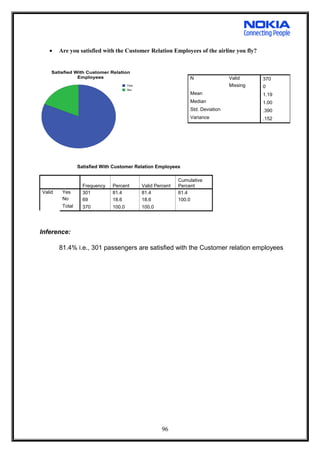
  • 14.
    Nokia is structuredinto four business groups – Mobile Phones, Multimedia, Enterprise Solutions, and Networks -- to better focus and capitalize on the opportunities in each of these areas. Throughout all these, the Networks business group provides the infrastructure backbone and enables end-to-end communications. Nokia’s Mission - Connecting People By connecting people, Nokia helps fulfill a fundamental human need for social connections and contact. Nokia builds bridges between people – both when they are far apart and face-to-face – and also bridges the gap between people and the information they need. Business Environment Industry Development and Trends The mobile communications industry continues to undergo significant changes as more users in growth markets gain access to mobile communications, enterprise becomes increasingly mobile, the importance of end-to-end solutions increases, and technology continues to evolve. Another trend is an increased emphasis on the role of customization in mobile devices. These changes have demanded agility and flexibility from industry players to adapt to new market conditions. Converging Industries The mobile communications, information technology, media, and consumer electronics industries are converging in some areas into one broader industry. Some of the first examples of this convergence include camera phones, as well as the use of mobile devices for email, web browsing and applications, and music downloading. Multi-radio solutions and devices, which automatically transfer connectivity among cellular networks and complementary access technologies such as Wireless LAN and Bluetooth, are another example. Although this convergence presents new challenges, Nokia believe that these trends also expand the potential for future growth in the mobile communications industry. End-to-End Solutions Nokia sees the ability to offer tailored end-to-end solutions as being important to meet the needs of operators, enterprises, and consumers. A solution is considered end-to-end when it provides the hardware and software elements, including infrastructure, applications or service platforms and mobile devices. Today, Nokia's Push to talk over Cellular offering, which enables walkie-talkie communication between individuals or among a group, is an example of such a solution. Intellectual Ownership 14
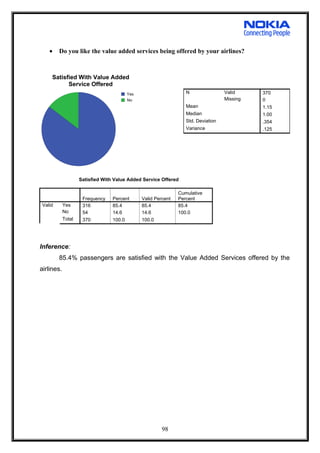
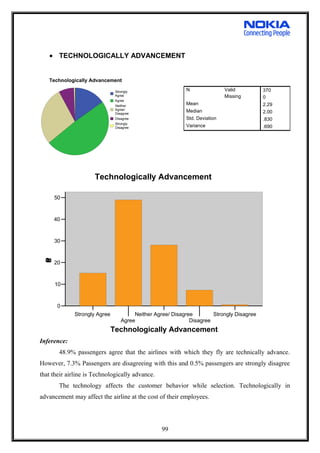
  • 15.
    The creation andownership of relevant intellectual property rights, or IPR, are essential to maintaining competitiveness and to creating profitable products. Nokia believes that achieving technology leadership will depend on the ability to build a solid IPR portfolio through strong research and development capabilities. The Mobile Device Market The mobile device market continued its strong volume growth during 2004, reaching a record of 643 million units compared with 490 million units in 2003, according to Nokia estimates. Growth was driven by the ongoing boom in new subscribers in Latin America, Russia, India, and China, as mobile communications continued to become more affordable and widely available. Nokia expects growth in these markets to be a main driver for global mobile subscriptions, reaching approximately 2 billion users by the end of 2005 and approximately 3 billion users by 2010. Mobile device market growth during 2004 was also driven by attractively priced color-screen and camera phones in Western Europe and North America. In Nokia's five geographical sales areas, mobile device market volume growth was 100% in Latin America, 33% in Europe, the Middle-East, and Africa, 32% in China, 22% in North America, and 15% in the Asia-Pacific region, compared with 2003. Beyond Voice The mobile device market is expanding from voice-based communications towards new, data- driven areas and applications in consumer multimedia and enterprise mobility solutions. According to estimates, the global camera phone market reached approximately 215 million units in 2004 compared with approximately 90 million units sold in 2003, and is estimated to reach approximately 340 million units in 2005. Nokia has introduced 48 camera phones since the launch of its first one, the Nokia 7650, in 2002. The global megapixel camera phone market, the high end of the camera phone market, is expected to grow from around 40 million units in 2004 to around 100 million units in 2005. A smartphone is a new category of mobile device that can run computer-like applications such as email, web browsing and enterprise software, and can also have built-in music players, video recorders, and other multimedia features. The global smartphone market is expected to grow from around 22 million units in 2004 to more than 50 million units in 2005 and represent approximately 25% of the total global mobile device market volume in 2008. Some of these markets overlap with each other. In the longer term, Nokia believes that applications such as music, mobile games and mobile TV 15
  • 16.
    will be takenwidely into use. The Benefits of Mobility Mobility is increasingly important to the business market as enterprises assess the potential productivity gains, cost savings, and competitive advantages that can result from employees being able to work outside of the office. The enterprise mobility market is still fragmented, however. We expect that as the technologies become more reliable, affordable, and easier to use, mobility will be more widely used by employees. External studies currently show a very low percentage of mobile email among workers who spend much of their time on the move and who connect to their offices via a mobile device. This is expected to become the lead application as businesses mobilize. In the coming years, we believe that devices with multi-radio access and the addition of mobile elements to corporate applications will be key drivers for establishing and extending mobility in enterprises. Nokia is well positioned to take advantage of these trends given its expertise in these areas. The Mobile Infrastructure Market During 2004, the mobile infrastructure market showed year-on-year growth of approximately 14% in euro terms, following three years of decline. Growth was largely the result of operator investments in the current technologies of GSM, EDGE, and GPRS and their related services, and in new-generation technologies, such as WCDMA 3G. The pace of WCDMA 3G rollouts also picked up during 2004, and by the end of the year 63 operators had launched commercial WCDMA 3G services. Nokia supplied WCDMA 3G technology to 28 of these operators. The number of WCDMA 3G subscribers increased significantly during the year, reaching around 16 million by year-end. Nokia believe this subscriber growth was largely the result of attractive pricing of services and an expanded WCDMA 3G handsets range and the further maturity of WCDMA 3G technology. Nokia expects the number of WCDMA 3G subscribers to reach approximately 70 million by the end of 2005. Competition in both the 2G and the 3G network infrastructure market remains intense. In 2G, competition is driven by price, solutions that are able to offer low total cost of ownership, and the vendor's ability to roll-out mobile networks in new growth markets. In 3G technology, vendors compete on the grounds of price, track record of network implementations, and which future technologies they plan to offer and when, such as HSDPA, or High Speed Downlink 16
  • 17.
    Packet Access, whichprovides high speed data delivery to 3G terminals to support multimedia services. Nokia Structure The Nokia Structure is Divided in 4 Business groups: • Mobile Phones • Multimedia • Enterprise Solutions • Networks Mobile Phones Mobile Phones connects people by providing expanding mobile voice and data capabilities across a wide range of mobile devices. Nokia seeks to put consumers first in product-creation process and primarily target high-volume category sales of mobile phones and devices based on the following global cellular technologies: GSM/EDGE, 3G/WCDMA and CDMA. In voicecentric and mainstream mobile phones, Nokia believes that design, brand, ease of use and price are customers' most important considerations. Multimedia 17
  • 18.
    Multimedia brings mobilemultimedia experiences to consumers in the form of advanced mobile devices and applications with connectivity over GSM, 3G/WCDMA, WLAN, Bluetooth and other standards. Nokia’s products give people the ability to create, access and consume multimedia, as well as share their experiences with others. Enterprise Solutions Enterprise Solutions offers businesses and institutions a broad range of products and solutions, including enterprise-grade mobile devices, underlying security infrastructure, software and services. Nokia also collaborates with a range of companies to provide fixed IP network security, mobilize corporate e-mail and extend corporate telephone systems to Nokia’s mobile devices. Networks Networks provide network infrastructure, communications and networks service platforms, as well as professional services to operators and service providers. Networks focuses on the GSM family of radio technologies and aims at leadership in three areas: GSM, EDGE and 3G/WCDMA networks; core networks with increasing IP and multi-access capabilities; and services. At the end of 2005, Networks had more than 150 mobile network customers in more than 60 countries, with its systems serving in excess of 400 million subscribers. Customer and Market Operations Customer and Market Operations is responsible for marketing, sales, sourcing, manufacturing and logistics for mobile devices from Mobile Phones, Multimedia and Enterprise Solutions. The Networks business group has its own dedicated sales and marketing, logistics and sourcing functions. Technology Platforms Technology Platforms is responsible for the competitiveness of Nokia’s technology assets. It supports Nokia’s overall technology management and development by delivering leading technologies and well-defined platforms to Nokia’s business groups as well as to external customers. 18
  • 19.
    1.4 INTRODUCTION Faced withuncertainty over the demand for new 3G services and a growing multitude of technology evolution paths, mobile operators in India must now commit to 3G network roll-outs and service launches. Rather than being driven by 3G license requirements, competitor actions or short-term cost savings, operators must take control of their own destinies. Drawing on case studies of launched and planned 3G services from across the globe, critical decisions on services can be taken on how an optimum set of 3G services can be defined and assess the merits of alternative service strategies. It can also show how to decide on the timing and pricing of new services, highlighting the need to take positive action without forcing services to market too soon, and considering the best mix of voice telephony, small-screen services (including video-on-demand) and high-speed Internet/intranet services. Mobile operators in India need to make critical decisions about what will be required to support 3G services, including the choice of technology and the speed, depth and breadth of roll-out. By evaluating the diverse approaches being pursued worldwide, this report identifies the most appropriate service roll out choices for different 3G service mixes. This report identifies the most appropriate service roll out Choices and answers following critical questions. - What decisions and actions are 3G operators already taking on services around the world and how India can Learn from them? What are the potential pitfalls? - How do operators make the right decisions on set of 3G services suiting to the Indian end user? - What is the optimum mix of voice, small-screen data and high-speed Internet/intranet services? 19
  • 20.
    - Where nextfor small-screen services? Does video-on-demand lead to a pot of gold? Can this be the killer application telecom’s were looking for in India? - What is the role for 3G wireless Internet access – just faster mobile Internet for business users – or can it substitute for fixed DSL? Current thinking is that 3G users are looking for email access, online gaming, video conferencing and location based services. But is this really what consumers want? Is it what they will pay for? Or is it simply only what can be provided just now? Several technical, regulatory and market issues are delaying the mass deployment of 3G networks and services in India. However, the demand for 3G services and applications is strong within the consumer population in India. Through this Market Research will examine the potential of these Third Generation mobile services, with special emphasis on the three most important segments i.e. Corporates, Businessman, and teenagers which form the bulk of users in India. 20
  • 21.
    1.5 SIGNIFICANCE OFSTUDY The project is titled “Evaluating the potential of end user based services based on the 3G/WCDMA platform in India and what kind of Revenue Models can be tried with these Services”. The significance of this study is enumerated as follows: • It gives an in depth knowledge about 3G technology and how 3G technology is the next Big thing for the Indian Mobile communication industry. • This Research tells us about which all services is the Indian end user looking for from the pool of 3G services. • The study helps us to know about the customer psyche, preferences, attitudes, behaviors etc toward the new 3G/WCDMA services. • This research project will tell us as to which are the main services that the Indian operators should start with and whether to start these services for introductory free tariffs as in European countries or to come up with any other revenue model. • This research tells us that what is the optimum mix of voice, small-screen data and high- speed Internet/intranet services? 1.6 HYPOTHESIS Assuming Null Hypothesis that the Indian end user is not willing to accept 3G technology and is not ready for 3G services, whereas Alternate Hypothesis is assumed that Indian end user is ready for the 3G/WCDMA technology and is willing to use 3G services. 21
  • 22.
    1.7 OBJECTIVE OFTHE PROJECT The main objective of this project lies in “Evaluating the potential of end user based services based on the 3G/WCDMA platform in India and what kind of Revenue Models can be tried with these Services” however there are other objectives also, which are as follows: • To study and learn from the experience of various 3G operators around the world. • To identify the Major 3G Applications and Services that are being offered to the end user around the world. • To establish with the help of Questionnaires and interviews about whether Indian end user is ready for 3G Services or not. • To develop a Revenue Model for the 3G services with reference to Tariff plan in UK by normalizing ARPU and Currency. • Identify the Services which are best suited to Indian end user according to culture and level of preference over other services. • To present recommendations to the Mobile operators in India in order to make critical decisions about what will be required to support 3G services, the speed, depth and breadth of roll-out. 22
  • 23.
    1.8 RESEARCH DESIGN Thesurvey research will be conducted by filling up of questionnaires to a total of 300 Mobile user respondents between the age group of 15 years to 75 years at various locations in and around NCR region. The Total sample size will be divided into 3 consumer segments which are: 1. Corporates/Service Class 2. Businessman (Small and Medium enterprises) 3. Public opinion survey (Teenagers/Students/housewife’s) The survey was conducted in major market places and corporate houses in Delhi, Gurgaon and Noida. Major market places such as Vasant Vihar market, Khan Market, Canuoght Place, Karol Bagh, Chawri Bazaar, Darya Ganj and Malls in Gurgaon, Noida, and Delhi were targeted to get the responses from Businessman and Teenage segment. Corporate houses in Gurgaon such as DLF Infinity Towers, First India Place, JMD Regent Square, HCL Infotech, Augusta Point, DLF Corporate Park and many similar places were targeted to get responses from Corporate Segment. Apart from Primary data through Questionnaires, Secondary data was also collected from websites of operators around the world and Major 3G services and Practices of Operators were studied from the internet. 23
  • 24.
    1.9 SAMPLE QUESTIONNAIRE 1.Are you aware of GSM/GPRS/EDGE technology and its use in mobile phones? Yes No 2. Are You Aware of the 3G Technology in mobile phones? Yes No (3G WCDMA, is a global standard technology allowing video conferencing and high-speed, high-capacity data access to users on their 3G Mobile phones.) 3. Are you aware that you can use internet services on your mobile and through your mobile on computer? Yes No 4. Would you like to access high speed wireless internet on your 3G Mobile phone/laptop? (With Speeds 3 times faster than wired broadband) Yes No Can’t Say 5. Would you like to use your mobile as a TV while you are stuck in traffic or during free time and use following service? • Watch your Favorite TV serial on phone, which you missed? Yes No Can’t Say • Watch highlights of cricket/football matches on your phone. Yes No Can’t Say • Watch live news (business/weather/sports) on your phone. Yes No Can’t Say • Download and Read e-books on your mobile phone. Yes No Can’t Say 6. “Video Calling allows you to see the person you are talking to on your 3G phone “Will you like to use Video Calling feature? Yes No Can’t Say 7. For what Purpose will you be using video calling, Rate from 1 to 4 with 1 for Most Preferred and 4 for least preferred? Calling Relatives in India/Abroad Business Reasons – Showing a new product to Boss, which you saw in trade fair. Calling Friends and family Others please Specify (eg. Locating some one at the airport) ____________________________________________ 8. How would you like the tariff plan for this video calling service? 24
  • 25.
    Fixed Monthly Rental+ Usage Charges (Per Min) Rs. 250 Monthly Rent + Usage Rs. 2.50 per min Usage Charges (Per Min) Usage Rs. 3.50 Per min One time Subscription charges + Usage Charges Subscription Rs. 2000 non refundable + Rs. 3 per min. Bundle Pack Charges (Packs of 30/60/90minutes) Pack 30 = Rs. 150 Valid 5 days Pack 60 = Rs. 300 Valid 7 days Pack 90 = Rs. 450 Valid 10 Days I will only use it as long as it is for free 9. “Audio Streaming – Listening to Audio Tracks on phone – Radio on Demand” “Audi Download – Download Audio Tracks on your phone” Would you like to use Audio Streaming and Audio Download on your mobile phone? Yes No Can’t Say 10. How would you like the tariff plan for this Audio Streaming/ Audio Download service? Fixed Monthly Rental + Download/streaming Charges (Per track) Download/ Streaming Charges (Per Track) only Subscription charges per month for unlimited download/streaming I will only use it as long as it is for free 11. “Video Streaming – Watching Video on phone” “Video Download – Download Video on your phone” Would you like to use Video Streaming and Video Download on your mobile phone? Yes No Can’t Say 12. How would you like the tariff plan for this Video Streaming/ Video Download service? Fixed Monthly Rental + Download/streaming Charges Download/ Streaming Charges (Per Min) only Subscription charges per month for unlimited download/streaming I will only use it as long as it is for free 13. Would You like to use Instant Messaging Service (Yahoo Messenger, MSN, AOL) on your Mobile Phone just like you use it on Computer? Yes No Can’t Say 14. Would you like to play online games with no pause on your phone and download 3Dgames? Yes No Can’t Say 15. If Your Mobile offers Navigational Service (Driving assistance and Location Search) would you be willing to use these services? Yes No Can’t Say 16. Would you be willing to go for a new 3G Mobile handset which can cater to all these services and costs you 12000+ ? Yes No Can’t Say 17. What Service you rate as most needful by you from the upcoming 3G services? Rate 1 as Most needed, and 7 as Least needed Video Calling Audio Streaming/ Video Streaming/ Mobile TV Games Instant Others Audio Download Video Download Messaging Specify 25
  • 26.
    18. How muchdo you value the end user experience? Important Average Not important 19. Any other suggestions/inputs please specify? ______________________________________________________________________ Personal Information Name: _______________________________Age:_______ Sex:________________ Occupation:___________________________ Annual Income:___________________ Email:________________________________ Ph:_____________________________ Monthly Mobile Bill:____________________ Model of Mobile you own:__________ 1.10 SAMPLE SELECTION The sample size of 300 is taken with equal amount of responses from all the three segments, thus 100 Responses each from all the three segments. The Total sample size will be divided into 3 consumer segments which are: 1. Corporates/Service Class 2. Businessman (Small and Medium enterprises) 3. Public opinion survey (Teenagers/Students/housewife’s) 1.11 DATA COLLECTION The data for research is collected through the following ways: Primary Data:- • Survey questionnaires • Interviews with Working Professionals • Telephonic interviews Secondary data:- • Journals of 3GP Association • News Articles on 3G • Websites of the Operators offering 3G Services 26
  • 27.
    • Business reportsprovided by the Mobile operators offering 3G 1.12 STATISTICAL ANALYSIS Statistical analysis is the most important part of any market research, without appropriate statistical analysis no accurate inference can be drawn on the research. Based on the response of market research appropriate statistical techniques are used to get the desired results. There are following statistical tools that I have used in this research: • Co-relation Analysis, Regression Analysis • Cross Tabs between Variables. • Frequency Tables • Bar graphs, Pie charts etc. The analysis of this project will help focus on the following parameters: • Which all services are most preferred by the end user? • Preference of one service to the other? • Consumer Psyche i.e. for what purpose will the consumer use that particular service? • Preference according to Segment (e.g. teenagers have more inclination towards 3G games and Audi streaming) • The tariff model customers are willing to pay for these services. 27
  • 28.
    1.13 PROJECT COSTAND SCHEDULE The total estimated cost of this project is Rs 9000 (Nine thousand only) Traveling expenses: Rs 6000 Questionnaires: Rs 200 Internet Usage: Rs 1000 Report printout: Rs 1000 Miscellaneous expenses: Rs 500 The estimated time for project is 2 months Setting up research plan : 1stweek Collection of primary data : 5th – 7th week Secondary data collection : 2nd – 4th week Analysis of the data : 8th week Making of Questionnaire : 4th week Making of the report : 8th week 28
  • 29.
  • 30.
    2.1 INTRODUCTION –WHAT IS 3G/WCDMA? 3G Dive into the Multimedia Wave ! UMTS (Universal Mobile Telecommunications System) is a so-called "third-generation (3G)," broadband, packet-based transmission of text, digitized voice, video, and multimedia at data rates up to and possibly higher than 2 megabits per second (Mbps), offering a consistent set of services to mobile computer and phone users no matter where they are located in the world. Based on the GSM communication standard, UMTS, endorsed by major standards bodies and manufacturers, is the planned standard for mobile users around the world since 2002. Once UMTS is fully implemented, computer and phone users can be constantly attached to the Internet as they travel and, as they roaming service, have the same set of capabilities no matter where they travel to. Users will have access through a combination of terrestrial wireless and satellite transmissions. Until UMTS is fully implemented, users can have multi-mode devices that switch to the currently available technology (such as Gprs and Edge) where UMTS is not yet available. 30
  • 31.
    Today's cellular telephonesystems are mainly circuit-switched, with connections always dependent on circuit availability. Packet-switched connection, using the Internet Protocol (Internet Protocol), means that a virtual connection is always available to any other end point in the network. It will also make it possible to provide new services, such as alternative billing methods (pay-per-bit, pay-per-session, flat rate, asymmetric bandwidth, and others). The higher bandwidth of UMTS also promises new services, such as video conferencing. UMTS promises to realize the Virtual Home Environment in which a roaming user can have the same services to which the user is accustomed when at home or in the office, through a combination of transparent terrestrial and satellite connections. UMTS is a network consisting of two main elements connected over a standard interface, called Iu. These two elements are: • UTRAN (UMTS Terrestrial Radio Access Network • The Core Network ATM based architecture: this R'99 architecture may reuses in some cases the two-domain architecture of GSM/GPRS, with: 1. Iu-PS (Packet Switched) interface instead of Gb on the packet domain. 2. Iu-CS (Circuit Switched) interface instead of A on the circuit domain Transport Independent and multimedia architecture: this R'00 architecture is in line with the Next Generation Networks architecture and introduces separation of control and user planes. It also integrates multimedia capabilities. 31
  • 32.
    • Frequency use •Difference between regular CDMA and W-CDMA • W-CDMA makes possible a world of mobile multimedia. 32
  • 33.
    GPRS & EdgeV/s 3G GPRS (General Packet Radio Services) is a packet-based wireless communication service that, when available in late 2000, promises data rates from 56 up to 114 Kbps and continuous connection to the Internet for mobile phone and computer users. The reality will be around 33 Kbps (2+1 or 3+1 @ CS2, 4+1 for fixed modem). GPRS is based on "regular" GSM (with the same modulation) and will complement existing services such circuit-switched cellular phone connections such as SMS or cell broadcast. Voice over Ip over GPRS is also explored. In theory, GPRS packet-based service should cost users less than circuit-switched services since communication channels are being used on a shared-use, as-packets-are-needed basis rather than dedicated only to one user at a time. It should also be easier to make applications available to 33
  • 34.
    mobile users andWap or i-mode should far more attractive for the user. In addition to the Internet Protocol GPRS supports X.25, a packet-based protocol that is used mainly in Europe. Operator should deploy GPRS very fast as most of the interoperability test between the network and the Handset are now finished (September'00) and because GPRS is mainly a software upgrade for the BTS, BSC and servers. SPECTRUM EFFICIENCY Packet switching means that GPRS radio resources are used only when users are actually sending or receiving data. Rather than dedicating a radio channel to a mobile data user for a fixed period of time, the available radio resource can be concurrently shared between several users. This efficient use of scarce radio resources means that large numbers of GPRS users can potentially share the same bandwidth and be served from a single cell. The actual number of users supported depends on the application being used and how much data is being transferred. Because of the spectrum efficiency of GPRS, there is less need to build in idle capacity that is only used in peak hours. GPRS therefore lets network operators maximize the use of their network resources in a dynamic and flexible way, along with user access to resources and revenues. GPRS should improve the peak time capacity of a GSM network since it simultaneously: • allocates scarce radio resources more efficiently by supporting virtual connectivity • immigrates traffic that was previously sent using Circuit Switched Data to GPRS instead, and reduces SMS Center and signaling channel loading by migrating some traffic that previously was sent using SMS to GPRS instead using the GPRS/ SMS interconnect that is supported by the GPRS standards Relatively high mobile data speeds may not be available to individual mobile users until Enhanced Data rates for GSM Evolution (EDGE) or Universal Mobile Telephone System (UMTS) are introduced EDGE, Enhanced Data GSM Environment Enhanced Data rates for Global Evolution (EDGE) is a radio based high-speed mobile data standard. It allows data transmission speeds of 384 kbps to be achieved when all eight timeslots are used. In fact, EDGE was formerly called GSM384. This means a maximum bit rate of 48 kbps per timeslot. Even higher speeds may be available in good radio conditions. 34
  • 35.
    EDGE was initiallydeveloped for mobile network operators who fail to win Universal Mobile Telephone System (UMTS) spectrum. EDGE gives incumbent GSM operators the opportunity to offer data services at speeds that are near to those available on UMTS networks. EDGE can also provide an evolutionary migration path from GPRS to UMTS by implementing now the changes in modulation that will be necessary for implementing UMTS later. The idea behind EDGE is to eke out even higher data rates on the current 200 kHz GSM radio carrier by changing the type of modulation used, whilst still working with current circuit (and packet) switches. Implementation of EDGE by network operators has been designed to be simple. Only one EDGE transceiver unit will need to be added to each cell. With most vendors, it is envisaged that software upgrades to the BSCs and Base Stations can be carried out remotely. The new EDGE capable transceiver can also handle standard GSM traffic and will automatically switch to EDGE mode when needed. EDGE capable terminals will also be needed- existing GSM terminals do not support the new modulation techniques and will need to be upgraded to use EDGE network functionality. Some EDGE capable terminals are expected to support high data rates in the downlink receiver only (i.e. high dates rates can be received but not sent), whilst others will access EDGE in both uplink and downlinks (i.e. high data rates can be received and sent). The later device types will therefore need greater terminal modifications to both the receiver and the transmitter parts. In addition, the TDMA industry association, the Universal Wireless Communications Corporation, has introduced what it calls EDGE Compact. This a spectrum efficient version of EDGE that will support the 384 kbits mandated packet data rates but will require only minimum spectral clearing and therefore could work for network operators with limited spectrum allocations. In fact, as a result of this, EDGE has been renamed Enhanced Data Rates for GSM and TDMA Evolution. (See the TDMA section below for more details). Source:mobileipworld.com EDGE is planned to be commercially available end of year 2001 (FOA). High Speed Circuit Switched Data (HSCSD) GSM Circuit Switched Data supports one user per channel per time slot. High Speed Circuit Switched Data (HSCSD) gives a single user simultaneous access to multiple channels (up to four) at the same time. As such, there is a direct trade-off between greater speed and the 35
  • 36.
    associated cost fromusing more radio resources- it is expensive for end users to pay for multiple simultaneous calls. Assuming a standard Circuit Switched Data transmission rate of 14.4 kilobits per second (kbps), using four timeslots with High Speed Circuit Switched Data (HSCSD) allows theoretical speeds of up to 57.6 kbps. This is broadly equivalent to providing the same transmission rate as that available over one ISDN B-Channel. Some Mobile Switching Centres (MSCs) are limited to 64 kbps maximum throughput- this restriction is removed with GPRS. In networks where HSCSD is deployed, GPRS may only be assigned third priority, after voice as number one priority and HSCSD as number two. In theory, HSCSD can be preempted by voice calls- such that HSCSD calls can be reduced to one channel if voice calls are seeking to occupy these channels. HSCSD does not disrupt voice service availability, but it does affect GPRS. Even given preemption, it is difficult to see how HSCSD can be deployed in busy networks and still confer an agreeable user experience- i.e. continuously high data rate. HSCSD is therefore more likely to be deployed in start up networks or those with plenty of spare capacity- since it is relatively inexpensive to deploy and can turn some spare channels into revenue streams. High Speed Circuit Switched Data (HSCSD) is however easier to implement in mobile networks than General Packet Radio Service (GPRS) because some GSM vendor solutions require only a software upgrade of base stations and no new hardware. This is not the case with D-AMPS networks and some GSM vendor solutions. There are a couple of reasons why HSCSD may be the preferred bearer for certain applications when compared to GPRS. The fact that associated packets can be sent in different directions to arrive at the same destination should in theory make the transmission more robust since there are many different ways of achieving the end result. However, this nature of packet transmission means that packets are subject to variable delay and some could be lost. Whilst packet retransmission is incorporated into the GPRS standards, naturally this process does take time and in the case of applications such as video transmission can cause poor quality images. Another preferred application for HSCSD could be the fact that whilst GPRS is complementary for communicating with other packet-based networks such as the Internet, HSCSD could be the best way of communicating with other circuit switched communications media such as the PSTN and ISDN. HSCSD is mainly supported by Nokia with little success 36
  • 37.
    2.2 HOW 3GWORKS? The main principle of Spread Spectrum communication is that the bandwidth occupancy is much higher than usual. Because of this much larger bandwidth the power spectral density is lower, in the channel the signal just looks like noise. The Spreading is done by combining the data signal with a code (code division multiple access) which is independent of the transmitted data message. 37
  • 38.
    A number ofadvantages are: • As the signal is spread over a large frequency-band, the Power Spectral Density is getting very small, so other communications systems do not suffer from this kind of communications. However the Gaussian Noise level is increasing. • Random Access can be dealt with, as a large number of codes can be generated a large number of users can be permitted. • The maximal number of users is interference limited. • Security: without knowing the spreading code, it is (nearly) impossible to recover the transmitted data. • Fading rejection: as a large bandwidth is used the system is less susceptible to distortions. There are a couple of Spread Spectrum Techniques which can be used. The most famous one is Direct-Sequence (DS) also well-known is Frequency-Hopping (FH). A combination of these two (DS/FH) offers a lot of advantages over the other two and will be the basis of the proposed system. 38
  • 39.
    Direct Sequence Direct Sequenceis the most famous Spread Spectrum Technique. The data signal is multiplied by a Pseudo Random Noise Code (PN-code). A PN-code is a sequence of chips valued -1 and 1 (polar) or 0 and 1 (non-polar). The number of chips within one code is called the period of this code. A PN-code is a noise-like code with certain properties. Several classes of binary (2-phase) PN-codes exist: M-sequences (base), Gold-codes and Kasami-codes. There exists also 4-phase codes , these aren't taken into account yet. A PN-code can be created by means of one or more shift registers. When the length of such a shift register is , in general the following can be said about the period N = 2 (raised to power of n) - 1 In the most simple case a complete PN-code is multiplied with a single data bit (see figure, in this example ). The bandwidth of the data signal is now multiplied by a factor , this factor is said to be the processing gain. 39
  • 40.
    Frequency Hopping When usingFrequency Hopping, the carrier frequency is 'hopping' according to a known sequence (of length ). In this way the bandwidth is also increased. If the channels are non- overlapping the factor of spreading is , this factor is equal to the Processing Gain. The process of frequency hopping is shown below 40
  • 41.
    There are twokinds of Frequency Hopping Techniques: • Slow Frequency Hopping (SFH) In this case one or more data bits are transmitted within one Frequency Hop. An advantage is that coherent data detection is possible. A disadvantage is that if one frequency hop channel is jammed, one or more data bits are lost. So we are forced to use error correcting codes Fast Frequency Hopping (FFH) In this technique one data bit is divided over more Frequency Hops. Now error correcting codes are not needed. An other advantage is that diversity can be applied. Every frequency hop a decision is made whether a -1 or a 1 is transmitted, at the end of each data bit a majority decision is made. A disadvantage is that coherent data detection is not possible because of phase discontinuities Hybrid System: DS/(F)FH The DS/FFH Spread Spectrum technique is a combination of direct-sequence and frequency- hopping. One data bit is divided over frequency-hop channels (carrier frequencies). In each frequency-hop channel one complete PN-code of length is added to the data signal (see figure, where is taken to be 5). Using the FFH scheme in stead of the SFH scheme causes the bandwidth to increase, this increase however is neglectable with regard to the enormous bandwidth already in use 41
  • 42.
    As the FH-sequenceand the PN-codes are coupled, an address is a combination of an FH- sequence and PN-codes. To bound the hit-chance (the chance that two users share the same frequency channel in the same time) the frequency-hop sequences are chosen in such a way that two transmitters with different FH-sequences share at most two frequencies at the same time (timeshift is random). From Jack P.F. Glas Difference between regular CDMA and W-CDMA 42
  • 43.
    2.3 WHAT 3GHAS TO OFFER? With 3G technology, communication is becoming richer. 3G opens up to a large array of services and applications, from rich seamless call to wireless internet at speed faster than the wired broadband. The table below shows the wide variety of services that can be availed with 3G and there are much more related services that can be availed and which are linked to these features such as mobile blogging, mobile TV, and many more. With 3G we also get faster business connectivity, faster streaming and faster content download. “Communication is becoming Richer , thanks to 3G” 3G Browse Internet Messaging Share Pic, Music, Video Video Sharing Interactive 3D Gaming Push to Talk Access corporate email Video Sharing Push to show Rich Call Video Calling Seamless Voice Mobile meeting Ring tones, games DL 43
  • 44.
    “Graph showing bandwidthrequirement for the service and value for the end user” The above graph shows the bandwidth requirement for the service and how much value does the end user associate with that service. It is quite evident that the services which require more band width are up on the value list for the end user. New services demand higher speed 44 Voice, SMS GSM 10-40 Kbps MMS, WAP, Download, Audio Streaming SMS GPRS 30-40 Kbps Web Browsing, Mobile intranet access, Video streaming, Video sharing. EDGE 80-160 Kbps Video telephony, Video sharing. Real time IP, real time games, mobile internet WCDMA 128-384 Kbps Faster Business connectivity, faster streaming, content download HSPA 1-14 Mbps
  • 45.
    3G offers awide variety of services to choose from 2.4 PRESENT DEVELOPMENTS 45
  • 46.
    3G Operators generatehigher ARPU than Voice and data operators 36 50 56 42 52 30 30 34 19 27 0 10 20 30 40 50 60 1 2 3 4 5 Countries ARPUPerUser(Euro) Source: www.3gtoday.com/ It is quite clear from the above forecasts that after Latin America, Asia has the highest subscriber forecast for the 3G segment. Moreover most of the Asian countries are already through with launching of 3G and the biggest market which is left untapped is India. “In respect to that, a total of 185 WCDMA licenses have been awarded by various governments and regulatory bodies to the operators up till the mid of 2006 in more than 60 countries.” 46
  • 47.
    From the abovegraph indicating ARPU for 5 countries, 1 indicates Italy, 2 indicates UK, 3 indicates Austria, 4 indicates Sweden and 5 indicates Australia . The Blue bar indicates ARPU for 3G operator and Red indicates Average country ARPU. It is quite evident from the above graph that average revenue per user for a 3G operator is higher than for voice and data operators, thus not only it offers benefits for the consumer but it also brings a smile to the operator with increase in ARPU. Going by the over all trend, the 3G operators generate almost 1/3rd more revenue per user than voice and data operator. “3G compliments GSM rather than replacing it.” The 3G Networks are complimentary with the existing GSM networks. GSM networks are the most commonly user networks in most of the countries as in India. The operators do not need to establish their new network sites and put in new equipment for launching 3G technology rather they just need to buy a new 3G equipment and it can be attached to the existing network. Thus no extra infrastructure cost, or site buying cost has to be incurred by the operators. The operators thus can get maximum out of their 2G investments by moving towards 3G. Another important feature with 3G is that the coverage issue that most operators face is solved in 3G. As 3G provides paramount indoor converge. 47 GSM/GPRS GSM/GPRS GSM/GPRS EDGE 3G EDGE 3G
  • 48.
    How many users(out of total population) use internet and use Mobiles? From the above graph it is quite clear that in western Europe, mobile subscribers are more than internet subscribers and same is the case in Japan. However in US and Canada, the Internet users are more than the mobile users, thus if people are given a choice of using internet on their mobile there is good chance of people going in for that service. How many users use internet on their phones for various operators in Europe? We can see a large number of mobile subscribers do use internet on their mobile phones. 48
  • 49.
    2.5 SECONDARY DATAANALYSIS Secondary data is collected so as to learn and study the practices of major 3G operators around the world and identify the main 3G services and applications that they are offering to the consumer around the world. Secondary data study is carried out to learn from experience of previous researches and study the strategy and business models:- • Journals of 3GP Association • News Articles on 3G • Websites of the Operators offering 3G Services • Business reports provided by the Mobile operators offering 3G The secondary data also covers the tariff models that other operators are using around the world so that after going through various tariff models, the best tariff model can be recommended to the Indian operator. The Various are the list of 3G applications and services and their Tariffs that are being used by various operators around the world. Operator: Verizon Wireless (US) Service Type: Audio Downloading, Audio Streaming Overview  With V CAST Music, customers can download music over the 3G EV-DO network directly to their 3G wireless phones and to their Windows XP PCs, and can transfer new and existing digital music from the PC to their wireless phone.  V CAST Music lets customers immerse themselves in their favorite music with music videos, artist alerts, album art and more.  One million songs are available on V CAST Music Tariff  $15 V CAST VPAK per month  $2.50 per download to 3G mobile device  $0.99 per download to Windows XP PC 49
  • 50.
    Operator: Cingular USA ServiceType: Video Streaming Overview  Allow users to watch video clips from HBO shows on their phones.  Users could also get tones, graphics, and games from their favorite HBO shows! Tariff  HBO Mobile: $4:99/month  HBO Family: $2:99/month Operator: Cingular USA Service Type: Wireless Internet Overview  Cingular broadband Connect allows users to have wireless access on their laptops virtually anywhere.  Supported by Cingular 3G PC cards, this service frees the users' laptops from the limitations of wired connections and extend their reach far beyond the range of hotspots Tariff  $59:99 - 900 anytime minutes  $79:99 - 1350 anytime minutes 50
  • 51.
    Operator: Cingular USA ServiceType: Java Games Download Overview Users can download games with full-color animation and robust sound effects. Once downloaded, users can play the games again and again, creating a little diversion during a busy day. 3D Games  Action & Adventure  Strategy and Role Playing Games Sports  Card, Board & Casino  Gameroom  Star Wars, HBO, Disney and Cartoon Network  Puzzle  Retro Tariff $2.99-$7.99 per game Operator: Cingular USA Service Type: Instant Messaging Overview Allow users to send and receive instant messages using the AOL Instant Messenger or Yahoo! Messenger.  IM Forwarding: Forward instant messages from users' computers to their wireless phones.  PC to Mobile Instant Messaging: Send AIM, MSN, or Yahoo! instant messages from users' computers to friends and families using their 10-digit Cingular numbers Tariff $0.10 per message 51
  • 52.
    Operator: Cingular USA ServiceType: Mobile Portal Overview Allows users to personalize their homepage with topics of their interest, and instantly check out sports scores, surf the web, get email, grab new ringtones and games, and more Tariff  MEdia Net 1MB: $4:99/month  MEdia Net 5MB: $9:99/month  MEdia Net 10MB: $14:99/month  MEdia Net Unlimited: $19:99/month  MEdia Net pay Pay-Per-Use: $0.01/KB Operator: Cingular USA Service Type: Email Overview  Cingular Mobile Email allows users to have access to their personal emails such as AOL, Yahoo, and Hotmail.  Cingular Mobile Email allows users to Instantly check personal e-mail quickly and easily from a 3G Cingular phone Tariff No monthly fees. Standard data charges apply while downloading inbox and messages Operator: Cingular USA Service Type: Picture Message, Video Message Overview Allow users to send pictures, video, and voice messages to another phone or e-mail address even with personalized text or a voice recording. Services include Picture messaging, Video Messaging, Voice Messaging, Greeting Cards, Kodak Mobile, Multimedia Fun. Tariff 52
  • 53.
     20 messages:$2.99/month  40 messages: $4.99/month  Messages pay per use; $0.25/message Operator: Cingular USA Service Type: Video Streaming Overview  Users can get video clips of breaking and headline news, sports highlights, weather, entertainment and television shows  Cingular Video allows users to get stats and commentary from your favorite sports commentator.  Cingular “Sounds Live” users can get exclusive access to see and hear concert performances by some of today's most popular artists just days after the live event. Tariff $ 19.99 Per Month Basic Package Operator: Cingular USA Service Type: Mobile Radio Overview  MobiRadio on Cingular offers programmed commercial and interruption-free audio music channels that feature a wide variety of popular music genres .  MobiRadio on Cingular is a rich consumer application which gives customers 44 channels of high quality music from which to choose from and displays album art, song and artist information during playback. Tariff  $ 6.99 per month + data usage Operator: Optus Australia Service Type: Navigation, User Location, Location Search, Proximity Overview With Optus Zoo FindA users can get detailed maps and directions from A to B in the palm of their hand. FindA offers several types of location based services.  Navigation, User Location, Location Search, Proximity 53
  • 54.
    Tariff AU$4.95 (US$3.65) permonth, or “Pay-as-you-Go” at rate of AU$0.55 (US$0.40) for 20 minutes Operator: Vodafone UK Service Type: Mobile TV Overview With the Vodafone Live! Mobile TV service users can watch a wide variety of popular TV channels on their 3G Vodafone mobile Tariff  Sky Mobile TV pack: £5 (US$9.40) per month.  Variety pack: £3 (US$5.60) per month. Operator: 3 (Hutchison Telecom) UK Service Type: Video Messaging , Video Download Overview  SeeMe TV is a new video service where the users produce and act in their own home- made movies that are submitted to 3 to be viewed by the rest of the subscriber base. Each time their video is viewed they receive a monetary credit in their account from 3.  SeeMe TV subscribers can record mini-movies (15 seconds) on their 3G mobile phone and send them to 3 to earn money Tariff  Each time a user downloads your Video from See Me TV, you earn money in your See Me TV account, as follows:  Video Price Credit Amount  10p 1p  20p 2p  30p 3p  50p 5p Operator: Orange UK Service Type: Games Download 54
  • 55.
    Overview  Orange offersa large selection of mobile games, including 3D, action, board, casino, puzzle, racing strategy and film games. Tariff  All games are priced between £3-5 (US$5.20- 8.70). Operator: Sprint US Service Type: Video Streaming Overview  Users can watch live TV on the go with full-motion video and vivid sound. Power Vision TV phones provide up-to-the-minute breaking news, sports, weather, movie trailers, and entertainment channels, including the latest music videos.  Sprint TV offers 19 channels, including ABC, Fox Sports, Fox News Channel Live, NFL Network, Discovery, Discovery Kids, Discovery Tariff  Monthly Subscription $ 20 + Channel Subscription Operator: 3 (Hutchison Telecom) UK Service Type: Video Streaming Overview  MobiTV allows users to watch news, sport, comedy, or music videos anytime they want. Users can choose between 7 TV Channels or 19 TV Channels offered through MobiTV  MobiTV offers the following channels: Extreme Sports Network, ITN, Kiss TV, The Cartoon Network, MTV Trax, VidZone, Nickelodeon, MTV shows, Paramount Comedy, Playboy TV and many more. Tariff  Monthly Subscription 5 Pound + Individual Channel Subsciption 55
  • 56.
    Operator: 3 (HutchisonTelecom) UK Service Type: Video Telephony, Dating Overview  3 Video Dating allows users to view and meet prospective dates via video messages. Users can now flirt face-to-face before making their minds up.  3 Video Dating allows each user to create an online profile and a video greeting that describes their interests and dream date. Tariff  Standard Video Call Tariffs Apply 56
  • 57.
    Jet Airways hasbeen voted India's 'Best Domestic Airline' consecutively and won several national and international awards, including the 'Market Development Award' for 2001 awarded by Air Transport World. AIR DECCAN Air Deccan is a unit of Deccan Aviation Private Limited, India's largest private heli- charter company. Formed in 1995, Deccan Aviation Private Limited has carved a niche for itself in the Indian aviation scene with its reputation for providing speedy and reliable heli-services for company charters, tourism, medical evacuation, off-shore logistics and a host of other services. The company has a modern fleet of ATR-42-320 aircraft, one of the finest and most efficient Turbo-Prop aircraft flying. ATR is a European joint venture between Alenia Aeronautica and EADS. The ATR 42 has become a reference aircraft amongst airlines around the world, by offering a safe, easy to maintain and comfortable aircraft operating on the regional market with the best economics on short haul sectors. To date, ATR has sold over 650 aircraft to more than 100 operators in 73 countries all around the world. The company has adopted a 'lean-and-mean' approach to staffing and aims at maintaining a low aircraft-to-employee ratio. A good work culture coupled with a skilled workforce is the backbone of the company. 57
  • 58.
    2.4 CUSTOMER RELATIONSHIPMANAGEMENT –THE CONCEPT The business environment has changed—becoming more intensely competitive as globalization has brought new competitors into the marketplace... This trend is both a blessing and a curse since companies can now connect with customers around the globe but will have to compete with players around the globe as well. Customers have become harder to satisfy as they have become inundated with rapidly changing product and service offerings. In fact, product proliferation has resulted from a greater number of competing companies trying to offer global consumers an array of choices in order to fulfill their diverse needs and wants. In addition, technology advances resulting in improved transportation and communication capabilities have enabled faster delivery times as well. As a result of these trends, customers’ expectations have risen rapidly to the level of demanding what they want, where, when and how they want it. To understand what exactly Customer Relationship Management is, first we have to understand the terms customer, customer perceived value, total customer satisfaction, customer equity, value equity brand equity, and relationship equity. Customer: Customer is defined as that person who buys any product or services from any business house to satisfy his daily need wants and demands. Customer Perceived Value: It is the difference between the prospective customer’s evaluation of all the benefits and all the costs of the offerings and the perceived alternatives. Total Customer Satisfaction: It is defined as a person’s feeling of pleasure or disappointment resulting from comparing the products perceived performance in relation to his expectations. If the performance matches his expectations the customer is a satisfied customer, if the performance of the product or service exceeds his expectations then the customer is a delighted customer. Today the rule is to make your customer delighted and not only satisfied. 58
  • 59.
    Customer Equity: isthe total of the discounted lifetime values of all the firm’s customers. Value Equity: It is defined as the customer’s objective assessment of the utility of an offering based on perception of its benefits relative to its costs. Brand Equity: In terms of CRM, it is defined as customer’s subjective and intangible assessment of the brand, above and beyond, it’s objectively perceived value. Relationship Equity: It is the customer’s tendency to stick with the brand, above and beyond the objective and subjective assessment of its worth. The above defined terms will now enable us to get a clear understanding of the term Customer Relationship management. Customer Relationship Management: Customer Relationship Management, is the business strategy that aims to understand, anticipate, manage and personalize the needs of an organization's current and potential customers" -- PWC Consulting. Therefore we can say that CRM is a business strategy, one that puts the customer at the heart of the business. 59
  • 60.
    2.5 CUSTOMER RELATIONSHIPMANAGEMENT IN THE AIRLINE INDUSTRY Today the major carriers are moving in direction of Customer Relationship Management, but none is fully there yet. Smaller airlines are behind, but chasing. The consultants at McKinsey estimate that true CRM could boost the operating profits of a large Indian airline by up to $250 million a year. Even small carriers could increase their annual income by $15-50 million each year. The gains come mostly in reducing customer churn, increasing an airline’s share of existing customers’ spending and in gaining new customers. In order to manage the customer more effectively across all lines of service, airlines have the following approaches to CRM: • Customer segmentation—Airlines need to recognize that mileage-based segmentation is inadequate, whereas value-based and needs-based approaches can help guide investment decisions and drive greater insight into the needs of high-value customers. • CRM initiative development—In order to differentiate themselves from the competition, airlines must abandon a “fast follower” approach to CRM initiative development, in favor of investing in initiatives with a high return, which responds to the needs and desires of their own customers. • Organizational design and management—Airlines need to instill a service mentality in their employees, empowering them with a complete view of the customer and clearly articulating the employee’s role in the CRM strategy. 60
  • 61.
    By taking stepsto implement a truly consumer-centric approach to relationship management, an airline is better positioned to acquire, develop and retain high-value customers. Through the development and implementation of customer analytics and decision-support technologies, airlines are beginning to use customer information not only to differentiate service levels based on customer value, but also to drive crucial operational decisions. In the end, an airline’s CRM program becomes a platform for achieving both near-term operational efficiency and long-term relationship management and growth. As the Indian airline industry grapple with how to deliver a consistent and distinctive customer experience while maintaining low operating costs, they have turned to the promise of CRM. Although operational and security issues became top-of-mind immediately after September 11th, CRM has gradually come back into focus as airlines recognize the importance of effective customer management in establishing long-term competitive advantage. CRM’s promise is indeed compelling: strengthened loyalty driving increased revenue, with lower acquisition costs and improved operational efficiency. For full-service airlines, CRM is an essential component of their corporate strategy—the means of differentiating themselves from competitors in the eyes of the customer. And although low-cost carriers may be less reliant on CRM as a means of driving competitive differentiation, even they must invest in fundamental CRM technologies and processes to manage the customer efficiently over the course of the travel experience. Increasingly, airlines are recognizing that CRM is a long-term investment, with the true benefits reaped through profitable lifelong customer relationships. To date, the Indian airline industry have used CRM primarily as a competitive “catch-up” rather than a means of differentiation. Rushing to imitate the customer-oriented initiatives introduced by competitors, many airlines have done little to determine the value to the customer of those initiatives, or to the business itself. Today, not only are frequent flyer programs a universal cost of doing business, but even recent innovations such as kiosk check-in One of the primary goals of CRM is to differentiate a company’s services to the customer through personalization. 61
  • 62.
    2.6 JET AIRWAYSCRM PROGRAMS On ground customer services: • Check-In Options: 1. Web Check-in – India’s first and only online service where you can choose your seat and print your boarding pass from home or office. Whether you’re flying Club Premiere or Economy, whether you’re a frequent flyer or a first-time flyer all you require is a valid Jet Airways e-ticket, access to the Internet and a printer. 2. City Check-in-If you have a confirmed ticket and will be traveling with only hand baggage, bid adieu to long queues at the airport. Jet Airways now brings Bangalore, Kolkata, Chennai, Delhi, Indore and Mumbai airports closer to you. Passengers traveling with hand baggage and a confirmed ticket need not report at the airport hours before their flight departure. All you need to do is to drop in at our conveniently located city offices and check-in as early as 24 hours prior to your flight departure 3. Tele Check-in-if you are a member of Club Première passenger or a holder of the Jet Privilege Platinum/Gold/Silver/Blue Plus card? You just avoided the wait at the airport. Use the extra time to shop, go sightseeing or simply catch up with 62
  • 63.
    your work. Whenbusiness takes you places, your every minute is precious. Breeze through check-in with our Tele check-in facility. • 24 hours Help Desk: Jet Airways provide a 24 hours help desk for their customers to provide any sort of information regarding boarding, tickets, bookings ,flight and seat availability, etc any time of the day and night. In Flight Customer Services • In-Flight Convenience: Jet Airways provide full convenience service in-flight to their passengers ranging from Towels, Sleep Easy Pillows and blankets are available on request on all our flights. Reading Material Every Jet Airways flight has a wide choice of newspapers and magazines. Club Première passengers may request the cabin crew to provide them with exclusive stationery.First Aid A first-aid kit is available with the cabin crew on all our flights Class of service: Jet Airways operates two classes of service - Club Premiere and Economy class. Club Premiere is the exclusive Business Class and the preferred mode of travel for businessmen and senior personnel in the corporate world. Benefits and privileges programs for customers: Jet Airways, believe in providing passengers with the best experiences possible. And now with the introduction of International long-haul flights, they have enhanced the Jet Privilege programme to be more global in nature. As a member of the Jet Privilege programme, passengers will enjoy a variety of enhanced benefits that transcend beyond traditional forms of Frequent Flyer programmes. 5 Membership Levels In addition to the 3 existing tiers, the new Jet Privilege programme introduces 2 new tier levels. JP Blue continues to be the entry level into the JP Programme. JP Blue Plus is a new tier, introduced for our JP Blue members who are on the fast track to an upgrade; they can start enjoying the facility of Tele Check-in as soon as they complete 10 Jet Airways flights or 15,000 Status JPMiles in a six-month period.JP Silver & JP Gold continue to remain the elite tier levels of the JP Programme. JP Platinum is an exclusive elite tier level, specially created for our most frequent flyers The Dynamic Tier Review (DTR) System - A world first! To make the tier upgrade and retention easier for our JP Members, Jet Privilege has developed a multi-criteria based tier assessment system. This innovative system, which is referred to as the DTR System, is totally unique to Jet Airways and has no precedent anywhere in the world. With this system, we will be 63
  • 64.
    able to providemembers with quicker tier upgrades as well as more opportunities to retain their tier status. Check-in at Club Première & PREMIERE counters As JP Silver, JP Gold, JP Platinum or Jet Airways Citibank Gold Credit Card member, you can now check-in at the Club Première & PREMIERE desk, irrespective of your class of travel. E-ticketing: An unique fast function where a customer can book his ticket online and then get a simple print out of his ticket in order to walk in the departure area of the airport. 2.7 INDIAN AIRLINES CRM PROGRAMS Premium Clubs for Customers: The Maharajah Club: The Maharajah Club has been specially created for discerning travelers like you. It is Air India's way of providing you superior service, convenience and comfort that will make flying an extremely pleasurable experience for you. Anywhere. Every time Golden Edge Club: Life is a journey full of surprising rewards if you are a frequent flyer with Indian Airlines, and the awards seem to multiply with every passing nautical mile. Gradually, you realize that you now belong to an exclusive club, where sky is not the limit. Leading Edge Club: We like to make your experience with Air India pleasant both in the air and on ground. In our Endeavour to satisfy your special needs and offer you the best in luxury travel, we have linked up with organizations of high repute, in India and abroad. Silver Edge Club: As a high profile executive, you are the centre of the limelight. The frequent flights you take on Indian Airlines ads up to two things. Membership to the elite Silver Edge Club, a world of rewards, offers and promotions. Super Saver Utsav Plus: In order to facilitate and give 'value for money' to frequent travelers like Indian has introduced a new scheme "Super Saver Utsav Plus", during the New Year / Festive Season. 64
  • 65.
    Desh Videsh: Indianhas launched various Customer Schemes and Easy Fares/Unchecked fares in the market, by offering very attractive discounts, to valued customers. In order to recognize and reward all passengers, who are loyal and traveling on Indian Airlines, a new scheme "Desh - Videsh 2006" is being launched with effect from 6th February 2006."Desh-Videsh 2006" is a scheme to reward passengers, based on the total volume of travel, irrespective of the type of discounted ticket they are traveling on E-ticketing: Electronic tickets are permitted between the following online points in India: Mumbai, Delhi, Hyderabad, Bangalore, Ahmedabad, Kolkata, Chennai, Kochi and Thiruvanthapuram and online points in the USA Region viz. New York, Newark, Chicago and Los Angeles. Passengers availing of stopovers at Paris and Frankfurt will not be able to avail of electronic tickets. These tickets can be booked/purchased at our Booking Offices and online on www.airindia.in 2.8 KINGFISHER AIRLINES CRM PROGRAMS King Club: Kingfisher airlines have always believed in treating their passengers to the Good Times on- board. As their loyal Guest, they believe that passengers deserve special care. And they are proud to crown the passengers King of the skies. Each time passengers fly the Good Times, they get a treasury full of rewards and privileges. Please and as always, they assure of unparalleled levels of service that have become accustomed to with Kingfisher Airlines. Come have a royal time… Online ticket Booking: This service enables the passengers to book their tickets online through the internet from any corner of the world, saving their precious time in going to a travel agent and standing in long standing lines. In-flight entertainment: Personalized video screens and headphones broadcasting 5 video channels of the trendy FUN TV and the exclusive Kingfisher Radio - 10 channels of chartbusting music from across the globe. King Club Miles and Tiers: The King Club membership comprises 3 Royal tiers - Red, Silver and Gold. Tier status determines the benefits & privileges that the passengers are entitled to. Needless to add, the higher the tier, the more the benefits. Passengers will, however, continue to accrue and redeem Miles, regardless of their tier status. All Guests automatically enroll into the King Red tier on completion of 3 valid flights on Kingfisher Airlines. If the passengers have 65
  • 66.
    taken 30 ormore flights during the course of the year, he would be automatically upgraded to the King Silver tier. On completion of 60 or more flights a year, the tier status would be further upgraded to King Gold. Tiers are reviewed annually. In order to retain tier status, our King Club Guests would require flying a specified minimum number of times on Kingfisher Airlines during the course of the membership year. 2.9 AIR DECCAN CRM PROGRAMS Super Value Flier: this is one of the most important schemes for the customers that the airline has adopted to build up a long relationship with its customer or rather its potential passengers. These are special packages for frequent flyers and include the following: Package Name: Price: INR No of Tickets: Valid For: Value Flier Plus 48000.00 14 12 Months Value Flier 24000.00 12 12 Months Super Flier Plus 100000.00 32 12 Months Super Flier 50000.00 26 12 Months Citizen charter: Air Deccan’s Citizens' Charter is presented to give information on all the interfaces between our valued customers and us at Air Deccan. Relevant information regarding reservations, check-in procedures, baggage allowance, cancellation charges and security regulations is briefly outlined in this Citizens' Charter. 66
  • 67.
    2.10 BALANCED SCORECARD IN BRANDING To develop a balanced score card for the airline companies we first have to know as to how these various Indian companies are positioning their airlines name as a brand in the market as well as in the minds of their customers or rather passengers. Air Deccan:” India’s low cost airline carrier” Jet Airways:” The joy of flying” India Airlines:” New horizons, enduring values” Kingfisher:” Fly king class” We studied the passengers and found out as to what their perceptions about the various airline companies are and what the parameters that effect their perception are. The chart here gives us passengers traveling to Delhi from the different regions of India mainly region-wise spilt up of the sample is as follows: 67
  • 68.
    The areas coveredin measuring perceptions of the passengers are as follows: 1. Brand Awareness 2. Airlines usage – a. Frequency b. Brands c. Purpose d. Circuits e. Class 3. Factors affecting consumer perception 4. Promotional Scheme Preferences 5. Brand parameter preferences 6. Circuits flown Brand Awareness Study Indian Airlines ranks number one in brand awareness. This could be attributed to its long stay in the market and continued support from the government. Today, Indian Airlines has become synonymous with reliability and efficiency. Jet Airways is offering stiff competition and ranks second in the list. Sahara is providing value-add services and is following closely. The concept of a low-cost, no-frills airline is being merged into having high quality, low-cost carriers. Air Deccan, following the low-cost airlines model, being a relatively new entrant in the market, comes in lowest currently on brand awareness. 68
  • 69.
    Usage of Airlines IndianAirlines, mostly used by government employees, recorded the highest usage followed by Jet Airways. Although most consumers rated Jet Airways high on price, it still ranks second in usage and this could be attributed to its excellent service and promotion schemes. Similar data for the entire population reflects a higher usage of Jet Airways than IA, and a lower usage of Sahara, which is a possible implication of the sample location being concentrated in almost equal proportion in Lucknow (which has a higher price sensitive population) as other major metros. 69
  • 70.
    Frequency of Usage Asindicated in the graph below, a majority the population flies relatively infrequently (as compared to the developed markets). Passengers traveling on business were found to be 70
  • 71.
    more frequent users,while those flying on holidays and emergencies were those that tended to make up the segment that flew less than once a year. Flight Class and Occasion of use Although the occasion of use indicates that maximum usage is for business, the flight class graph indicates that the proportion travelled by business class is very small in comparison to that travelled by economy class. This indicates that most business travellers are flying Economy class as well. Further, the second important occasion of usage is for emergencies and time-critical travels. Circuits Flown: The most frequently flown circuit is that between major metros, followed by other state capitals and Delhi-Mumbai. Delhi and Mumbai airports accounts for roughly half of passengers flown, and metro airports account for 66% of the passengers flown (and 47% of revenues, as per secondary data). 71
  • 72.
    Scheme Preference: Withthe entry of new players in the market, airlines are competing for passengers on non-price parameters. This increases the product differentiation in order to decrease elasticity of demand in the market. Given the key differentiators that substitute for price, consumers have rated Apex fares as their most preferred scheme. Indian Airlines, Jet and Air Sahara offer apex fares. Next most preferred to Apex fares is the frequent flyer program, a trend noticed predictably in the high frequency repeat users and those traveling on business. Factors affecting consumer perception We identified the following factors that make the demand function of consumers. a) Price b) Service c) Promotional Schemes d) Loyalty programmes e) Flight Schedules f) Comfort with the brand g) Corporate tie-ups 72
  • 73.
    Consumer Choice Parameters Priceappears to be most important factor for the consumer followed by service provided and flight schedules. Indian Airlines has been rated high on most parameters while Jet Airways, although rated low on price, is rated highest in most other factors. Air Deccan, which has been ranked best on prices, has succeeded in its mission to provide reliable low-cost air-travel to common man by constantly driving down air-fares. Kingfisher’s many services such as In-flight entertainment and Wings n' Wheels coach service, exclusive business lounges being operated at departure halls at airports in a number of cities, providing for business and refreshment services has made it second most popular under services. It has taken the lead in introducing novel initiatives such as Steal-a-seat flexi fare options, Sixer/Super Sixer and Square Drive/Super Four. Corporate tie-ups were a trend significant by their absence on the brand preference parameters. While the only major tie-ups were by Indian Airlines with government agencies, these were not perceived as strictly ‘corporate’ tie-ups. This segment is hence a possible opportunity which can be explored as a non-price differentiator, given the large frequency of use by business travelers 73
  • 74.
    2.11 E-CRM FORTHE AIRLINES What is e-CRM Today, more and more airlines are using the Internet to implement e-business applications and CRM strategy. These applications can be very resource intensive. e-CRM is interest intensified in managing customer relationship through the Internet, and many airlines approached this as a separate project to their e-business strategy. What differentiates airlines in today's hyper-competitive and demand-driven markets is their ability to address their customers' preferences and priorities. This means more than simply knowing and understanding their customers better than their competitors do. It means strategically implementing this customer knowledge in every area of the airline, from the highest management level to all the employees who come into direct contact with customers. E-CRM involves far more than automating processes in sales, marketing, and service and then increasing the efficiency of these processes. It involves conducting interactions with customers on a more informed basis and individually tailoring them to customers' needs. Business Drivers--Why CRM There are three primary reasons why CRM has taken hold as rapidly as it has: 1. Competition is fierce; 2. The economics of customer retention are unequivocal; 3. Technology allows airlines to do this more effectively and profitably today. The benefit of application CRM to the airline industry There are only three ways to increase the profitability of a customer base; acquire more customers, optimize the value of existing customers, or retain the right customers longer. All of these benefits must be achieved with lower costs. 74
  • 75.
    Of the threechoices above, acquiring new customers is the most expensive. Research shows that acquiring a new customer cost 5 to 10 times more than retaining an existing one. Studies also show that loyal customers will buy more over their lifetime and are willing to pay a premium for doing business with someone they like and trust. An investigation of the India airlines industry has clearly indicated that significant revenue improvements of n 0.9 and 2.4% are achievable Benefits of a CRM Strategy This revenue increase comes from three areas: • Re-attracting defected customers, which accounts for between 0.1 and 0.3% of revenues; • Increasing the share of a customer's travel wallet, which accounts for 0.3 and 1.2% of revenues; • Acquiring new customers, which accounts for approximately 0.05% of revenues? Naturally, associated with these revenues are costs, but these only amounts to between 0.3 and 0.6% of the existing cost base: • The marginal additional flights needed as incentives estimated to be between 0.2 and 0.4% of costs; • Additional CRM initiatives amounting to between 0.2 and 0.5% of costs. Savings in costs due to more efficient and targeted running of the existing CRM program, providing a reduction of 0.1 to 0.3% of costs; As stated above, the bottom line impact of CRM is significant, but varies according to the airline implementing the initiatives. The range estimates are: • For a large airline: $100-$250 million per year; • For a midsize airline: $25-$60 million per year; • For a smaller airline: $15-$50 million per year. 75
  • 76.
    There are manybenefits to be gained for airlines and airline passengers, firstly, passengers could book and check in through internet 24 hours, 7 days a week, at any time, any where. Secondly, airlines could reduce sales cost. Specific benefits to implementing a CRM strategy with Interaction Management And to the customers: • Planning and implementing business processes across airlines and CRM applications ensures customers are handled in the most efficient and effective fashion • Implementing CRM applications may simultaneously lower the cost of design, implementation, etc. It also reduces the risk of re-engineering systems at a later date. CRM - ensuring streamlined processes are in place before the customer makes contact • Influence and enhance intelligent call routing by leveraging the data gathered from the switch (ANI, DNIS, and Caller ID), caller, and CRM applications. • The E-mail was responded to immediately, with personalized, valuable information. • Web self-service allowed customer to take immediate action to resolve issue. • Personalization enabled promotion tailored to customer profile - enhancing one-to-one marketing. • The "callback" option was easy to use, enabling the customer to quickly request live support. • The intelligent interaction routing engine immediately connected the customer to the right CSR. For the airlines implementing CRM, it becomes possible to single out customers who are profitable, gaining an understanding of their preferences to improve retention and increase the volumes sold. These valuable customers can become advocates for the airline and its products. Finally, CRM helps an airline to build loyalty. With e-CRM, airlines can increase sales and customer loyalty. This strategy can improve sales effectiveness, bring higher value to all of airline's key business relationships, help airline to understand what each client relationship is truly worth, develop and reinforce a consistent experience for customers, improve management effectiveness, improve tactical and strategic planning, respond faster to competitive challenges, use critical resources more efficiently, and reduce administrative burdens and overall cost. 76
  • 77.
    How to e-CRM FourSteps to e-CRM success e-CRM is a business strategy that should guide airlines to increased profitability by creating customer loyalty. In order to implement a true e-CRM strategy, airlines must have a vision and look at CRM as one holistic project - whether implemented all at once, or through a phased approach. First, an airline must commit to focus on the customer and create a complete vision that fosters a true customer-centric organization. Once a clear vision is in place, developing a strategy and establishing goals are the next steps toward effectively deploying e-CRM. The entire plan must align the airline's strategy, goals, and technology in order to achieve the objectives of the e-CRM project. Airlines that make strategic e-CRM investments and align processes, strategies, and technology around customers are in a better position to deliver a seamless, high-quality customer experience across all channels. 1. Airlines have a clear overall strategy to achieve enterprise-wide acceptance of a customer-focused culture. Without clear direction, resources are likely to be misdirected and return on investment sacrificed. Underpinning this must be senior management sponsorship of the complete culture, process and business change needed to successfully re-focus a business on its customers rather than its products. 2. Airlines have maximized value from their investment in technology to achieve the sought after 'single view' of each customer. Being customer-centric is not just about technology, however any airline considering using on-line channels to reach its customers knows it needs a clear vision of what it wants the technology to do. It is essential to have a coherent strategy for unifying multiple customer contact channels but ultimately, success lies in ensuring that the online customer experience is relevant, personalized, and supported with excellent customer service, support and fulfillment. Done badly, e-business provides an open door for mass customer defection. 77
  • 78.
    3. Airlines haveunited people and technology for outstanding performance. It is essential to have staff able to proactively connect with the data and create and sustain an appropriate relationship with the customer. Achieving this empathy requires defining new customer- focused, technology-enabled behaviors and delivering these through teamwork and aligning reward recognition with customer delivery. Without proper staff training and motivation, companies will fall at the last hurdle. 4. Airlines use an accepted method of measuring success to justify initial and ongoing investment in customer-focused initiatives. They need to develop appraisal systems for enterprise customer management, which identify all likely costs (including people, technology and process change) and benefits before any investment is made. The creation of robust measurement methods will be key to achieving board-level support. Airline e-CRM system model Airline's success depends heavily on its ability to intelligently manage sales, marketing, and service processes and to draw mutual advantages from understanding of airline's customers. To help airline maximize the strategic value of customer centric initiatives, Airline e-CRM model provides a comprehensive analytical solution, it can contribute toward improving the way that measure and optimize airline's relationships with customers. Figure 3 best illustrates Airline e- CRM model using system engineering methodology. Airline e-CRM model can be conceptualized as a system that is made up of components, linkages amongst the components, and dynamics-that takes advantage of the properties of the Internet to make money. It takes advantage of the properties of the Internet in the way it builds each of the components-value, scope, revenue sources, pricing, connected activities, implementation, capabilities and sustainability-and crafts the linkages among these components. It is what, preferably, enables an airline to have a sustainable competitive advantage. It includes three components (subsystem): Web Based Airline-Passenger Interaction subsystem; Airline Data Warehouse subsystem; and Airline e-CRM operation subsystem. Airline e-CRM model is an asset-based solution that includes best-of-breed components to build an e-CRM infrastructure and enable any-channel, any-time communication with customers. At the heart of this offering is the CRM Foundation, which includes the CRM data model, starter set of CRM queries, reports and analysis, sample data, a demonstration prototype, data utilities 78
  • 79.
    and scripts, andcomprehensive documentation that covers implementation guidelines, business perspective and analysis guidelines, system components, data model descriptions, and use and customization guidelines. Since managing customer interactions is a vital piece of the e-CRM puzzle, planning and implementing a Multi-Channel Interaction Management solution with the other subsystems and enterprise solutions is crucial. Without Interaction Management, the puzzle remains incomplete. Interaction Management is the foundation for evolving customer service into customer satisfaction by tying together all customer data - no matter where it is located within the enterprise. Making this information easily and quickly accessible to the customer management process, and ensuring each customer is handled in the most efficient and effective way possible is the ultimate result of a well-defined and deployed strategy and solution. Airline e-CRM model also: • Provides an understanding of customer behavior and enables airlines to measure results of marketing and merchandising changes. • Supports more effective promotions through integration of data between marketing and merchandising users. • Provides a single view of customers across the enterprise and across contact points. • Gives airlines the ability to respond more dynamically and quickly to market demands. Significance derived from airline-CRM implementation will allow for new e-business model, based on the wide availability of information and its direct distribution to end-customers. • Directly connect airlines and passengers. • Support fully digital information exchange between airlines and customers, reduced cost of a customer contact. • Suppress time and place limits. • Support interactivity and therefore can dynamically adapt to customer behavior. • To be able to satisfy customers' need, build customer confidence and retention. • Can be updated in real-time, therefore always up-to-date. • Enhance airlines competitive advantages over its rivals. • Profitable and sustainable revenue growth. 79
  • 80.
    2.12 LIMITATIONS As everything has its advantage and disadvantage, similarly our project on market research has its limitations too: the following were the limitations for our project: • There may be some ambiguity in the response given by the passengers • The response given by the passengers may not be totally true. • The data provided by the airline offices are not totally sufficient for our research purpose. • We got limited permission to fill up our research questionnaire at the airport. • We have to take only one location into consideration that is the Delhi sector only, and not the whole of India, which has limited the scope of our learning. • Since we can get data from only four airlines, we cannot prepare the comparative study of the airline industry as a whole. • Expenditure was another limitation therefore we have to conduct our research on a small scale basis only. 80
  • 81.
  • 82.
    • How frequentdo you fly by air? The following table and graph depicts the classification of sample in our entire sample population of 370 on the basis of Frequency of flying. Frequ ency Percent Valid Percent Cumulative Percent Valid Weekly 26 7.0 7.0 7.0 Quarterly 89 24.1 24.1 31.1 Monthly 100 27.0 27.0 58.1 Yearly 145 39.2 39.2 97.3 Others 10 2.7 2.7 100.0 Total 370 100.0 100.0 N Valid 370 Missing 0 Mean 3.06 Median 3.00 Std. Deviation 1.010 Variance 1.020 Minimum 1 Maximum 5 82
  • 83.
    Weekly Quarterly Monthlyyearly Others Frequency of Flying 0 30 60 90 120 150 Frequency Frequency of Flying Inference: Out of the total Sample size of 370, 7% fly weekly, 24.1% fly monthly, 27% fly quarterly, 39.2% fly yearly and 2.7% has no proper flying pattern. • Please rank the following airline according to your preference. Airline Ranking N Valid 370 Missing 0 Mean 2.22 Median 1.00 Std. Deviation 1.534 Variance 2.353 Range 5 Minimum 1 Maximum 6 83
  • 84.
    Airline Ranking Jet airwaysIndian Airlines Air Deccan Spice Jet King fisher others Airline Ranking 0 50 100 150 200 Frequency Airline Ranking Airline Ranking Jet airways Indian Airlines Air Deccan Spice Jet King fisher others Interference: The above table and graphs depicts the classification of airline as preferred by the samples (Passengers) in our entire sample population of 370. As per our analysis, out of total sample size of 370, 51.6% prefer Jet Airways, 12.2% prefer Indian Airlines, 15.4% prefer Air Deccan, 5.9 % prefer Spice Jet, 12.7% Prefer King Fisher and Other airline 2.2%. Scale used is ORDINAL • Rate the following in-flight services on the scale of 1 to 5 according to your satisfaction. (1 being the most important and 5 being the least) Luggage Space Fooding Boarding Cargo N Valid 370 370 370 370 Missing 0 0 0 0 Mean 2.47 2.37 2.41 2.87 Median 2.50 2.00 2.00 3.00 Frequency Percent Valid Percent Cumulative Percent Valid Jet airways 191 51.6 51.6 51.6 Indian Airlines 45 12.2 12.2 63.8 Air Deccan 57 15.4 15.4 79.2 Spice Jet 22 5.9 5.9 85.1 King fisher 47 12.7 12.7 97.8 others 8 2.2 2.2 100.0 Total 370 100.0 100.0 84
  • 85.
    Std. Deviation 1.1071.082 1.081 1.146 Variance 1.225 1.171 1.169 1.313 Range 4 4 4 4 Minimum 1 1 1 1 Maximum 5 5 5 5 1 2 3 4 5 Luggage Space 0 25 50 75 100 125 Frequency Luggage Space 1 2 3 4 5 Cargo 0 30 60 90 120 150 Frequency Cargo 1 2 3 4 5 Fooding 0 20 40 60 80 100 120 Frequency Fooding 1 2 3 4 5 Boarding 0 25 50 75 100 125 Frequency Boarding Inference: On the scale of 1 to 5, with 1 being the most Important and 5 being the least, maximum number of passengers’ i.e., 33% rate Luggage Space as 3, which means it is moderately important. 85
  • 86.
    28.8% Passengers rateFood Service as 1 and 28.6% Passengers rate is as 2. This means that customers consider food service as a very important factor for selection of their interest of airline. 32.2% Passengers rate Boarding as 2, which indicates that boarding also influence the choice of airline. 38.4% Passengers rate Cargo as 4, which means that it hardly influence the behavior of customer to choice their airline. • Please rate the following factors on the scale of 1 to 5 ( 1 for the best and 5 for the worst) according to your preference 86
  • 87.
    1 2 34 5 Service Factors 0 20 40 60 80 100 120 Frequency Service Factors 1 2 3 4 5 Quality 0 20 40 60 80 100 120 Frequency Quality 1 2 3 4 5 Cheaper Fares 0 20 40 60 80 100 120 Frequency Cheaper Fares 1 2 3 4 5 Customer Relationship Program 0 20 40 60 80 100 120 Frequency Customer Relationship Program Inference: On the scale of 1 to 5, with 1 being the most Important and 5 being the least, maximum number of passengers’ i.e., 27.6% rate Service provided by the airline as 1 and 23.0% as 2. Service Factors Quality Cheaper Fares Customer Relationship Program N Valid 370 370 370 370 Missing 0 0 0 0 Mean 2.56 2.53 2.70 2.70 Median 2.00 3.00 3.00 3.00 Std. Deviation 1.257 1.122 1.149 1.121 Minimum 1 1 1 1 Maximum 5 5 5 5 87
  • 88.
    The service providedby the airline influence the behavior of customer to a large extent, as they consider this factor as an important one. 30.3% Passengers rate Quality as 3. This means that quality moderately influence the customer behavior. 31.1% Passengers rate Cheaper fares as 4, which indicates that cost hardly influence the behavior of customer to choice their airline. 30.0% Passengers rate Customer Relationship Programs as 3, which means that it moderately influence the behavior of customer to choice their airline. • Rate the performance of the CREW MEMBERS according to your satisfaction 88
  • 89.
    Very Good GoodBarely Acceptable Poor Very Poor Crew Member Perfomance 0 10 20 30 40 50 60 70 Percent Crew Member Perfomance Crew Member Performance Frequency Percent Valid Percent Cumulative Percent Valid Very Good 85 23.0 23.0 23.0 Good 232 62.7 62.7 85.7 Barely Acceptable 35 9.5 9.5 95.1 Poor 14 3.8 3.8 98.9 Very Poor 4 1.1 1.1 100.0 Total 370 100.0 100.0 Inference: Out of the sample size of 370, 232 i.e., 62.7% passengers consider the performance of the crew members of their choice of airline are good. • Rate the performance of the GROUND STAFF according to your satisfaction. N Valid 370 Missing 0 Mean 1.97 Median 2.00 Minimum 1 Maximum 5 89
  • 90.
    Very Good GoodBarely Acceptable Poor Very Poor Ground Staff 0 10 20 30 40 50 60 Percent Ground Staff Ground Staff Frequency Percent Valid Percent Cumulative Percent Valid Very Good 71 19.2 19.2 19.2 Good 215 58.1 58.1 77.3 Barely Acceptable 46 12.4 12.4 89.7 Poor 24 6.5 6.5 96.2 Very Poor 14 3.8 3.8 100.0 Total 370 100.0 100.0 Inference: 215 passengers i.e., 58.1% passengers are satisfied with Ground Staff of their airline. They rank the service of ground staff as GOOD. N Valid 370 Missing 0 Mean 2.18 Median 2.00 Minimum 1 Maximum 5 90
  • 91.
    • Rate theambience of the Plane according to your satisfaction. Very Good Good Barely Acceptable Poor Very Poor Ambience 0 50 100 150 200 250 Frequency Ambience Ambience Frequency Percent Valid Percent Cumulative Percent Valid Very Good 73 19.7 19.7 19.7 Good 216 58.4 58.4 78.1 Barely Acceptable 46 12.4 12.4 90.5 Poor 20 5.4 5.4 95.9 Very Poor 15 4.1 4.1 100.0 Total 370 100.0 100.0 Inference: 216 passengers i.e., 58.4% passengers are satisfied with ambience of their airline. They rank the ambiance of the plane as GOOD. N Valid 370 Missing 0 Mean 2.16 Median 2.00 Minimum 1 Maximum 5 91
  • 92.
    • Rate theFood service on the scale of 1 to 5 (1 for the best and 5 for the worst) according to your preference Quality Of Food Variety Of Food Serving Speed Services N Valid 370 370 370 370 Missing 0 0 0 0 Mean 2.35 2.55 2.83 2.58 Median 2.00 3.00 3.00 2.00 Std. Deviation 1.291 1.061 1.054 1.095 Variance 1.666 1.126 1.112 1.199 Minimum 1 1 1 1 Maximum 5 5 5 5 1 2 3 4 5 Quality Of Food 0 20 40 60 80 100 120 140 Frequency Quality Of Food 1 2 3 4 5 Variety Of Food 0 20 40 60 80 100 120 140 Frequency Variety Of Food 1 2 3 4 5 Serving Speed 0 20 40 60 80 100 120 Frequency Serving Speed 1 2 3 4 5 Services 0 20 40 60 80 100 120 140 Frequency Services 92
  • 93.
    Inference: On the scaleof 1 to 5, with 1 being the most Important and 5 being the least, maximum number of passengers’ i.e., 37.8% rate Quality as 1. The quality of food provided by the airline is an important factor for customers. 35.9% Passengers rate Variety as 3. This means that the customers are moderately satisfied with the variety of food offered by their airlines. 30.0% Passengers rate Serving Speed as 4, which indicates that serving speed is not important for the customers and hardly influence the behavior of customer to change opinion of their airlines. 36.5% Passengers rate Services as 2, which means that it is an important factor that influence the behavior of customer to choice their airline. 93
  • 94.
    • Rate thefollowing ground services on the scale of 1 to 5 (1 for the best and 5 for the worst) according to your satisfaction Baggage and Handling Ticketing Customer Care Security Check Up N Valid 370 370 370 370 Missing 0 0 0 0 Mean 2.49 2.54 2.54 2.65 Median 2.00 3.00 2.00 3.00 Minimum 1 1 1 1 Maximum 5 5 5 5 1 2 3 4 5 Baggage and Handling 1 2 3 4 5 Security Check Up 1 2 3 4 5 Customer Care 1 2 3 4 5 Ticketing 94
  • 95.
    Inference: On the scaleof 1 to 5, with 1 being the most Important and 5 being the least, maximum number of passengers’ i.e., 27.0% rate Baggage and Handling as 1. This is an important factor from customer’s point of view and they prefer those airlines which provide them with very good baggage and handling facility. 31.6% Passengers rate Ticketing as 3. This means that the customers are moderately keep ticketing facility in their mind when going for the selection of airline. 27.6% Passengers rate Customer Care as 2, which indicates that this is an important factor for the customers and influence the behavior of customer to change opinion of their airlines. 27.6% Passengers rate Security check up as 4, which mean that it is not an important factor that influence the behavior of customer to choice their airline. 95
  • 96.
    • Are yousatisfied with the Customer Relation Employees of the airline you fly? Yes No Satisfied With Customer Relation Employees Satisfied With Customer Relation Employees Frequency Percent Valid Percent Cumulative Percent Valid Yes 301 81.4 81.4 81.4 No 69 18.6 18.6 100.0 Total 370 100.0 100.0 Inference: 81.4% i.e., 301 passengers are satisfied with the Customer relation employees N Valid 370 Missing 0 Mean 1.19 Median 1.00 Std. Deviation .390 Variance .152 96
  • 97.
    • Are youaware of the various Programs/ Benefits/ Privileges offered by the airlines? Yes No Satisfied With Benefits Offered Satisfied With Benefits Offered Frequency Percent Valid Percent Cumulative Percent Valid Yes 266 71.9 71.9 71.9 No 104 28.1 28.1 100.0 Total 370 100.0 100.0 Inference: 71.9% i.e., 266 passengers out of 370 are aware and satisfied by the various programs like frequent flying benefits etc. launched by their airlines. N Valid 370 Missing 0 Mean 1.28 Median 1.00 Std. Deviation .450 Variance .203 97
  • 98.
    • Do youlike the value added services being offered by your airlines? Yes No Satisfied With Value Added Service Offered Satisfied With Value Added Service Offered Frequency Percent Valid Percent Cumulative Percent Valid Yes 316 85.4 85.4 85.4 No 54 14.6 14.6 100.0 Total 370 100.0 100.0 Inference: 85.4% passengers are satisfied with the Value Added Services offered by the airlines. N Valid 370 Missing 0 Mean 1.15 Median 1.00 Std. Deviation .354 Variance .125 98
  • 99.
    • TECHNOLOGICALLY ADVANCEMENT Strongly Agree Agree Neither Agree/ Disagree Disagree Strongly Disagree TechnologicallyAdvancement Strongly Agree Agree Neither Agree/ Disagree Disagree Strongly Disagree Technologically Advancement 0 10 20 30 40 50 Percent Technologically Advancement Inference: 48.9% passengers agree that the airlines with which they fly are technically advance. However, 7.3% Passengers are disagreeing with this and 0.5% passengers are strongly disagree that their airline is Technologically advance. The technology affects the customer behavior while selection. Technologically in advancement may affect the airline at the cost of their employees. N Valid 370 Missing 0 Mean 2.29 Median 2.00 Std. Deviation .830 Variance .690 99
  • 100.
    CROSS TABS Case ProcessingSummary Cases Valid Missing Total N Percent N Percent N Percent Airline Ranking * Technologically Advancement 370 100.0% 0 .0% 370 100.0% Airline Ranking * Technologically Advancement Cross tabulation Count Technologically Advancement Total Strongly Agree Agree Neither Agree/ Disagree Disagree Strongly Disagree Airline Ranking Jet airways 22 97 62 10 0 191 Indian Airlines 7 18 16 4 0 45 Air Deccan 9 36 5 5 2 57 Spice Jet 11 7 0 4 0 22 King fisher 3 19 21 4 0 47 Others 4 4 0 0 0 8 Total 56 181 104 27 2 370 Jet airways Indian Airlines Air Deccan Spice Jet King fisher others Airline Ranking 0 20 40 60 80 100 Count Technologically Advancement Strongly Agree Agree Neither Agree/ Disagree Disagree Strongly Disagree Bar Chart 100
  • 101.
    Inference: Here we cansee the comparison between the type of airline and the opinion of passengers flying with that airline on the basis of technology advancement 22 passengers are strongly agree and 97 of the passengers flying with Jet Airways are satisfied and agree that the airline is technologically advance. While only 10 are disagree with this. 36 passengers are agree that Air Deccan is technologically advance. And 5 disagree with this. 7 passengers are strongly agree and 18 passengers are agree that Indian Airline is technologically advance. However, 4 are disagree with this. 3 Passengers of King Fisher are strongly agree and 19 are agree that King fisher is technologically advance. However, 4 customers of Kingfisher found this airline as technologically not advance. 101
  • 102.
    Case Processing Summary Cases ValidMissing Total N Percent N Percent N Percent Frequency of Flying * Male / Female 370 100.0% 0 .0% 370 100.0% Airline Ranking * Male / Female 370 100.0% 0 .0% 370 100.0% Frequency of Flying * Male / Female Cross tabulation Count Male / Female TotalMale Female Frequency of Flying Weekly 16 10 26 Quarterly 55 34 89 Monthly 66 34 100 yearly 71 74 145 Others 6 4 10 Total 214 156 370 Weekly Quarterly Monthly yearly Others Frequency of Flying 0 20 40 60 80 Count Male / Female Male Female Bar Chart 102
  • 103.
    Airline Ranking *Male / Female Cross tabulation Count Male / Female TotalMale Female Airline Ranking Jet airways 118 73 191 Indian Airlines 16 29 45 Air Deccan 38 19 57 Spice Jet 10 12 22 King fisher 30 17 47 others 2 6 8 Total 214 156 370 Jet airways Indian Airlines Air Deccan Spice Jet King fisher others Airline Ranking 0 20 40 60 80 100 120 Count Male / Female Male Female Bar Chart 103
  • 104.
    Testing Of Hypothesis Hypothesisis usually considered as a principle instrument in research. Its main function is to suggest new experiments and observations. Hypothesis testing enables us to make probability statements about population parameters. Hypothesis helps us determine the validity of the assumption with a view to choose between two conflicting hypothesis about the value of the population parameter. It helps us ascertain weather the hypothesis about the population is true or false. Does Sex (Male/Female) play any Role in Choice of Airlines ? Null Hypothesis : Sex Plays a Role in Selection of Airlines. Alternate Hypothesis : Sex does not have any Role in Selection of Airlines. Dependent Variable : Airline Ranking Predictors : Sex (Male/Female) Model Summary(b) Model R R Square Adjusted R Square Std. Error of the Estimate Change Statistics R Square Change F Change df1 df2 Sig. F Change 1 .036(a) .001 -.001 1.535 .001 .471 1 368 .493 a Predictors: (Constant), Male / Female b Dependent Variable: Airline Ranking Coefficients(a) Model Unstandardized Coefficients Standardized Coefficients t Sig. 95% Confidence Interval for B Collinearity Statistics B Std. Error Beta Lower Bound Upper Bound Toler ance VIF 1 (Constan t) 2.067 .243 8.49 7 .000 1.588 2.545 Male / Female .111 .162 .036 .686 .493 -.207 .429 1.000 1.00 0 Dependent Variable: Airline Ranking The Above Analysis has been carried out with a Confidence interval of 95% and Significance Level of 5, Thus the Results indicate a Value of .493, Which indicates that process is correct and our Null Hypothesis is wrong. Result : Null Hypothesis is Wrong, Sex does not effect choice of Airlines. 104
  • 105.
    Collinearity Diagnostics(a) Model Dimensio n Eigenvalue Condition Index VarianceProportions (Constant) Male / Female 1 1 1.945 1.000 .03 .03 2 .055 5.926 .97 .97 Dependent Variable: Airline Ranking Residuals Statistics(a) Minimum Maximum Mean Std. Deviation N Predicted Value 2.18 2.29 2.22 .055 370 Residual -1.288 3.822 .000 1.533 370 Std. Predicted Value -.853 1.170 .000 1.000 370 Std. Residual -.839 2.490 .000 .999 370 -1 0 1 2 3 Regression Standardized Residual 0 50 100 150 200 Frequency Mean = -7.33E-17 Std. Dev. = 0.999 N = 370 Dependent Variable: Airline Ranking Histogram The Above Histogram between Frequency and Regression Standardized Residual for Airline Ranking – Sex depicts a Normal Distribution Curve with a mean Value of -7.33 and Standard Deviation of .99 for the sample size of 370. 105
  • 106.
    Correlation Between AirlineRanking and Satisfaction With Customer Relation Employees. Descriptive Statistics Mean Std. Deviation N Airline Ranking 2.22 1.534 370 Satisfied With Customer Relation Employees 1.19 .390 370 Correlations Airline Ranking Satisfied With Customer Relation Employees Airline Ranking Pearson Correlation 1 .116(*) Sig. (2-tailed) . .026 N 370 370 Satisfied With Customer Relation Employees Pearson Correlation .116(*) 1 Sig. (2-tailed) .026 . N 370 370 * Correlation is significant at the 0.05 level (2-tailed). The Above Table shows the Pearson Correlation (2 Tailed) between Airline ranking and satisfaction level with Customer Relation employees. The Value of Correlation is significant at the .05 level which shows that both parameters are highly correlated. Correlations Airline Ranking Satisfied With Customer Relation Employees Spearman's rho Airline Ranking Correlation Coefficient 1.000 .122(*) Sig. (2-tailed) . .019 N 370 370 Satisfied With Customer Relation Employees Correlation Coefficient .122(*) 1.000 Sig. (2-tailed) .019 . N 370 370 * Correlation is significant at the 0.05 level (2-tailed). The Above Table Shows Spearman’s Non Parametric correlation for same parameters. 106
  • 107.
    Regression Analysis The RegressionAnalysis between cheaper fares and Frequency of Flying with Frequency of Flying being Dependent Variable and Fares as independent Variable is shown in the table below. Model Summary(b) Model R R Square Adjusted R Square Std. Error of the Estimate Change Statistics R Square Change F Change df1 df2 Sig. F Change 1 .066(a) .004 .002 1.009 .004 1.595 1 368 .207 a Predictors: (Constant), Cheaper Fares b Dependent Variable: Frequency of Flying The value of Regression ‘R’ comes to be 0.66, for R Square as 0.004, the value of Adjusted R Square is 0.002. The Standard Error of Estimation is 0.009 Which is Acceptable. Residuals Statistics(a) Minimum Maximum Mean Std. Deviation N Predicted Value 2.97 3.20 3.06 .066 370 Residual -2.198 2.033 .000 1.008 370 Std. Predicted Value -1.482 1.999 .000 1.000 370 Std. Residual -2.177 2.015 .000 .999 370 a Dependent Variable: Frequency of Flying The Mean Calculated in the above data indicates a value of Close to 3 which suggests maximum no. of people fly on Monthly basis from the sample collected. 107
  • 108.
    -4 -2 02 4 Regression Standardized Residual 0 20 40 60 80 100 120 Frequency Mean = 7.55E-17 Std. Dev. = 0.999 N = 370 Dependent Variable: Frequency of Flying Histogram The Above Histogram between Frequency and Standard residual of Regression depicts a Normal Curve and Standard Deviation of 0.99 for the sample size 370. 108
  • 109.
    Correlation Between AirlineRanking and Customer Relationship Programs. Descriptive Statistics Mean Std. Deviation N Customer Relationship Program 2.70 1.121 370 Airline Ranking 2.22 1.534 370 Correlations Customer Relationship Program Airline Ranking Customer Relationship Program Pearson Correlation 1 .113(*) Sig. (2-tailed) . .030 N 370 370 Airline Ranking Pearson Correlation .113(*) 1 Sig. (2-tailed) .030 . N 370 370 * Correlation is significant at the 0.05 level (2-tailed). The Correlation between program and airline ranking is correlated with value of 0.113 109
  • 110.
    Chi Square Test TheChi-Square Test procedure tabulates a variable into categories and computes a chi-square statistic. This goodness-of-fit test compares the observed and expected frequencies in each category to test either that all categories contain the same proportion of values or that each category contains a user-specified proportion of values. Variable List Tested Under Chi Square Test • Frequency of Flying • Airline Rankings • Customer Relationship Programs • Satisfied with Customer Relationship Employees • Technology Advancement Airline Ranking Observed N Expected N Residual Jet airways 191 61.7 129.3 Indian Airlines 45 61.7 -16.7 Air Deccan 57 61.7 -4.7 Spice Jet 22 61.7 -39.7 King fisher 47 61.7 -14.7 Others 8 61.7 -53.7 Total 370 Illustration : The above Table shows that in Airline Ranking Jet Airways is clearly the front runner up with observed N leading the Expected N by a value of 129.3 closely followed by Air Deccan where observed N lagging the expected N i.e Residual -4.7 Frequency of Flying Observed N Expected N Residual Weekly 26 74.0 -48.0 Quarterly 89 74.0 15.0 Monthly 100 74.0 26.0 Yearly 145 74.0 71.0 Others 10 74.0 -64.0 Total 370 Illustration : The above Table shows that in Frequency of Flying, Maximum No. of people from the sample selected travel yearly with observed N leading the Expected N 110
  • 111.
    by a valueby 71 closely followed by people flying Monthly with observed N Leading the expected N i.e Residual 2 CustomerCare Observed N Expected N Residual 1 89 74.0 15.0 2 102 74.0 28.0 3 86 74.0 12.0 4 78 74.0 4.0 5 15 74.0 -59.0 Total 370 Illustration : The above Table shows that in Customer Care, Maximum No. of people from the sample selected gave the rating 2 with observed N leading the Expected N by a value by 28. Satisfied With Customer Relation Employees Observed N Expected N Residual Yes 301 185.0 116.0 No 69 185.0 -116.0 Total 370 Illustration : The above Table shows that in Satisfaction with Customer relationship employees, Maximum No. of people from the sample selected said YES with observed N leading the Expected N by a value by 116.. 111
  • 112.
  • 113.
    PREREQUISITES RECOMMENDATIONS OFCRM IN THE INDIAN AIRLINE INDUSTRY • Some customers deserve greater attention than others & segmentation In order to differentiate their CRM programs more effectively, airlines will need to understand the customer in terms of both value and needs. Effective customer segmentation is vital to the success of any CRM strategy. Although customers can be grouped in many different ways, value-based segmentation enables a business to understand the profitability of each customer. By assessing customers’ value to the company, and their key needs, the business can determine which customers it should retain and how it can migrate lower-value customers to higher-value segments. This knowledge, in turn, can help guide investment decisions on and better enable calculation of ROI, from customer-oriented initiatives. Air travel spending is driven primarily by the customer’s profession, in the case of business travel, or by the location of a customer’s family or vacation destination preference, in the case of leisure travel. Using frequent flyer status, based on miles flown, to segment customers is a somewhat better indicator of profitability. Airline customer value segmentation (by revenue) • Differentiate services based on customer and business value Gaining a deeper understanding of the profitability and the key satisfaction drivers of each segment will help airlines better assess the business value of potential customer-facing programs. Using a wide variety of direct and indirect customer input airlines can map feedback they receive against individual customer segments. Then, in combination with advanced 113
  • 114.
    customer analytics, theycan develop unique insights into the habits and needs of each customer segment. Thus, customer value segmentation becomes a valuable tool in CRM program definition and execution. Methods to identify customer needs. • Cost of CRM initiatives 114
  • 115.
    The total costof any CRM initiatives should be well calculated and seen that the company is not exceeding its budget. CRM initiative should not only be concentrated on the larger areas like flyer programs or web check in but also in small and relatively less important areas like gate information display, baggage handling etc. The total cost and financial expenses of all the CRM activities should be well planned. The various Indian airline companies should also calculate the various CRM initiatives cost while implementing nay new CRM strategies or programs. The areas of CRM should well be identified in order to gain financial reduction in operating cost and also to get competitive advantage. • Drive better operating decisions Customer value analysis is also central to improved operating efficiency—a key goal in the current economic climate. By using value-based segmentation to understand the habits of different customer groups, airlines can begin to make operating decisions that help increase the profitability of specific routes. There are two primary areas where this approach should influence airline operations. • Route and schedule planning— Airlines already closely analyze route and schedule profitability. In the future, airlines should use customer analytics to help make more informed and effective decisions on route and schedule planning. There are four key opportunities in this area. Routes that are loss-making in their own right may be an 115
  • 116.
    important customer acquisitionvehicle for high-value customers, with costs recovered through ongoing business from these customers. . • To retain high-value passengers— An airline must be able to consistently provide customers with a seat in their desired fare class on each route they fly. Airlines must use customer analytics and predictive modeling to help evaluate route and schedule profitability for potential expansions. Yield management and pricing—Airlines can also use customer analytics to improve yield management and pricing; determine which customer segments view price as a low priority when choosing an airline; and calculate the highest price that each individual customer segment is willing to pay for a given route. Advanced analytics can help drive pricing strategies, simplifying fare classes and improving yields. By using value-based customer segmentation to help make decisions regarding these basic operational issues, airlines can find opportunities to reduce costs associated with specific routes, while increasing customer revenues. The key is that the customer is central to improving key operations. In turn, all operational improvements must support strengthened customer relationships for airlines to achieve long-term viability • Operational improvements 116
  • 117.
    Operational improvements mustsupport strengthened customer relationships for airlines. Operational improvements is directly proportional to CRM, that is because of the fact that if the operations such as the ground or in-flight are not satisfactory enough the passengers are not satisfied and tend to move on to the other next best alternative. Thus the airline company is unable to build up a profitable relationship with the customer. • Focus on customer value—understand the profitability of each customer. Segment all customers, regardless of frequent flyer status or membership, based on value. Use customer value to differentiate service levels, identifying opportunities to build the loyalty of your most valuable customers and to recruit new customers with similar profiles. Value-based segmentation is the key to an effective CRM program, allowing an airline to focus directly on creating the greatest lifetime customer value. • Address customer needs throughout the lifecycle—become an essential partner to the customers. Analyze information gained through customer interactions to learn more about them continuously, refining business actions to target the customers’ needs better and creating an even more customized and consistent experience over time. • Call Center Initiatives: The airline should try and set up call centers across the county so that it is easier for the passengers or the customers to enquire any thing regarding flight information, tickets availability, etc. the call centers can also enable the customers or rather the passengers to lodge complaints if any they faced during their flights. 117
  • 118.
    CONCLUSIONS Full-service airlines mustadopt an integrated CRM strategy if they are to pursue competitive differentiation and profitability effectively in the future. Low-cost carriers also need to invest in fundamental CRM capabilities to optimize the efficiency of customer-facing operations. Airline executives who develop their CRM program in a deliberate, holistic way will substantially increase the likelihood that their efforts will succeed. By creating a truly customer- centric organization, based on a firm understanding of customer value and needs, and empowering employees with the tools and knowledge to respond to the customer, airlines establish a virtuous cycle that can lead to renewed economic success. Thus from this research we see that today only reducing costs and tariff of the air fare and launching promotional and benefit schemes are not enough for the airlines Customer Relationship Management. Today the airline companies need a more integrated approach towards the Customer Relationship Management for maximum customer retention, customer loyalty, long term relationship with customers and more important of all gaining cost leadership, market share and profit maximization. 118
  • 119.
    This project hasenabled us to get a clearer and practical picture of the Customer relationship Management, the pros and cons of the CRM in the airline industry, how these companies handle such large and growing customer base what are the problems they are facing and how they are going about in solving their problems. APPENDIX Reference • M r. Shudir Ghosh Marketing Head Jet Airways • Miss Madhu Jaiswal, CRM officer, Air Deccan, • Miss Sharmishta Majzumdar, Ticketing Officer, Kingfisher Airlines, • Mr. Manoj Bearea Senior Airport Manager, New Delhi • Mr. Shashank Mehra Faculty Guide(Program Leader M.B.A.(G)) Bibliography • Businessline, Sept. 15, 2005 • The Sky’s The Limit, Indian Express • Aviation Week & Space Technology • Low-fare Airlines, (2005, July 8). Economist.com. 119
  • 120.
    • Marketing ResearchBy Naresh Melhotra • Research Methodology By C.R. Kothari • Customer relationship management • Jetwings Flight Magazine Jet Airways • Swagat Indian Airlines Flight Magazine • www.jetairways.com • www.flykingfisher.com • www.spicejet.com • www.indianairlines.ac.in 120