Group No. 13 – PGP 2012 – Section D
1211254 - Chandan Satapathy
1211269 - Ashlesha Vishnu Kadam
1211284 - Pushpendra Singh
1211299 - Sherene Annabel
1211314 - Vishrut Shukla

THE EXPRESS DELIVERY SERVICE INDUSTRY
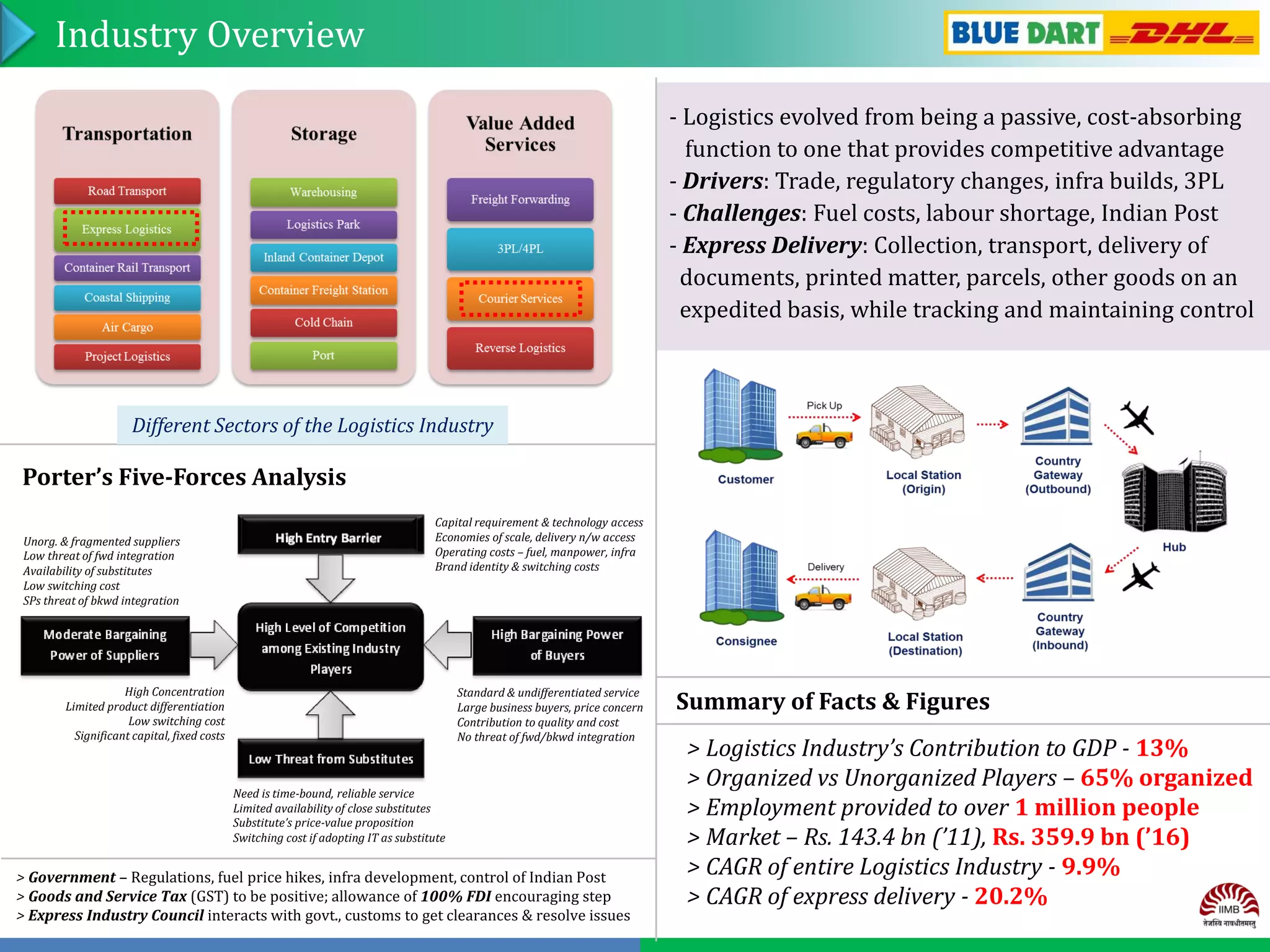
Industry Overview
- Logistics evolved from being a passive, cost-absorbing
function to one that provides competitive advantage
- Drivers: Trade, regulatory changes, infra builds, 3PL
- Challenges: Fuel costs, labour shortage, Indian Post
- Express Delivery: Collection, transport, delivery of
documents, printed matter, parcels, other goods on an
expedited basis, while tracking and maintaining control

Different Sectors of the Logistics Industry

Porter’s Five-Forces Analysis
Unorg. & fragmented suppliers
Low threat of fwd integration
Availability of substitutes
Low switching cost
SPs threat of bkwd integration

Capital requirement & technology access
Economies of scale, delivery n/w access
Operating costs – fuel, manpower, infra
Brand identity & switching costs

High Concentration
Limited product differentiation
Low switching cost
Significant capital, fixed costs

Standard & undifferentiated service
Large business buyers, price concern
Contribution to quality and cost
No threat of fwd/bkwd integration

Need is time-bound, reliable service
Limited availability of close substitutes
Substitute’s price-value proposition
Switching cost if adopting IT as substitute

> Government – Regulations, fuel price hikes, infra development, control of Indian Post
> Goods and Service Tax (GST) to be positive; allowance of 100% FDI encouraging step
> Express Industry Council interacts with govt., customs to get clearances & resolve issues

Summary of Facts & Figures
> Logistics Industry’s Contribution to GDP - 13%
> Organized vs Unorganized Players – 65% organized
> Employment provided to over 1 million people
> Market – Rs. 143.4 bn (’11), Rs. 359.9 bn (’16)
> CAGR of entire Logistics Industry - 9.9%
> CAGR of express delivery - 20.2%
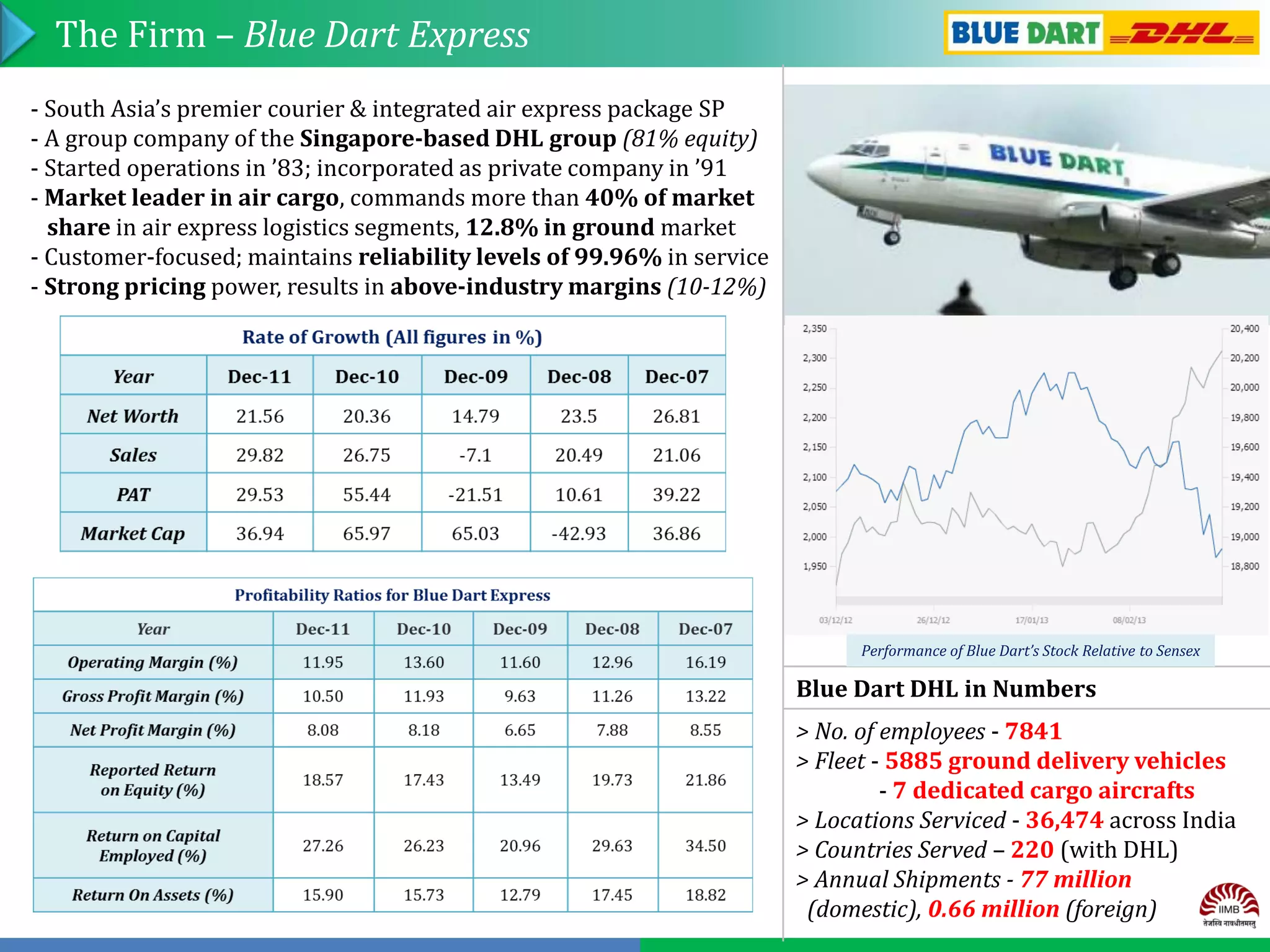
The Firm – Blue Dart Express
- South Asia’s premier courier & integrated air express package SP
- A group company of the Singapore-based DHL group (81% equity)
- Started operations in ’83; incorporated as private company in ’91
- Market leader in air cargo, commands more than 40% of market
share in air express logistics segments, 12.8% in ground market
- Customer-focused; maintains reliability levels of 99.96% in service
- Strong pricing power, results in above-industry margins (10-12%)

Performance of Blue Dart’s Stock Relative to Sensex

Blue Dart DHL in Numbers
> No. of employees - 7841
> Fleet - 5885 ground delivery vehicles
- 7 dedicated cargo aircrafts
> Locations Serviced - 36,474 across India
> Countries Served – 220 (with DHL)
> Annual Shipments - 77 million
(domestic), 0.66 million (foreign)
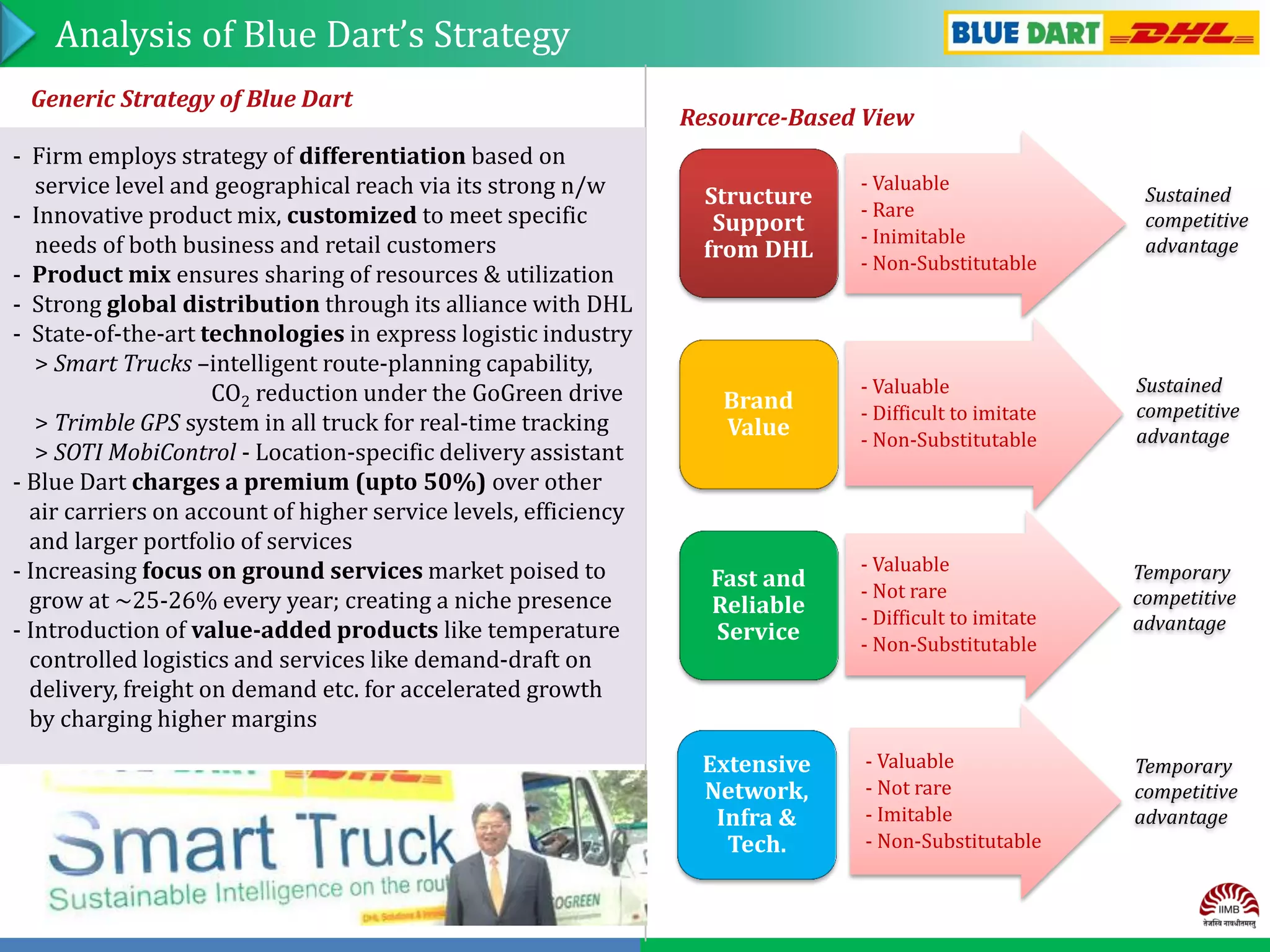
Analysis of Blue Dart’s Strategy
Generic Strategy of Blue Dart
- Firm employs strategy of differentiation based on
service level and geographical reach via its strong n/w
- Innovative product mix, customized to meet specific
needs of both business and retail customers
- Product mix ensures sharing of resources & utilization
- Strong global distribution through its alliance with DHL
- State-of-the-art technologies in express logistic industry
> Smart Trucks –intelligent route-planning capability,
CO2 reduction under the GoGreen drive
> Trimble GPS system in all truck for real-time tracking
> SOTI MobiControl - Location-specific delivery assistant
- Blue Dart charges a premium (upto 50%) over other
air carriers on account of higher service levels, efficiency
and larger portfolio of services
- Increasing focus on ground services market poised to
grow at ~25-26% every year; creating a niche presence
- Introduction of value-added products like temperature
controlled logistics and services like demand-draft on
delivery, freight on demand etc. for accelerated growth
by charging higher margins

Resource-Based View
Structure
Support
from DHL

- Valuable
- Rare
- Inimitable
- Non-Substitutable

Brand
Value

- Valuable
- Difficult to imitate
- Non-Substitutable

Sustained
competitive
advantage

Fast and
Reliable
Service

- Valuable
- Not rare
- Difficult to imitate
- Non-Substitutable

Temporary
competitive
advantage

Extensive
Network,
Infra &
Tech.

- Valuable
- Not rare
- Imitable
- Non-Substitutable

Temporary
competitive
advantage

Sustained
competitive
advantage
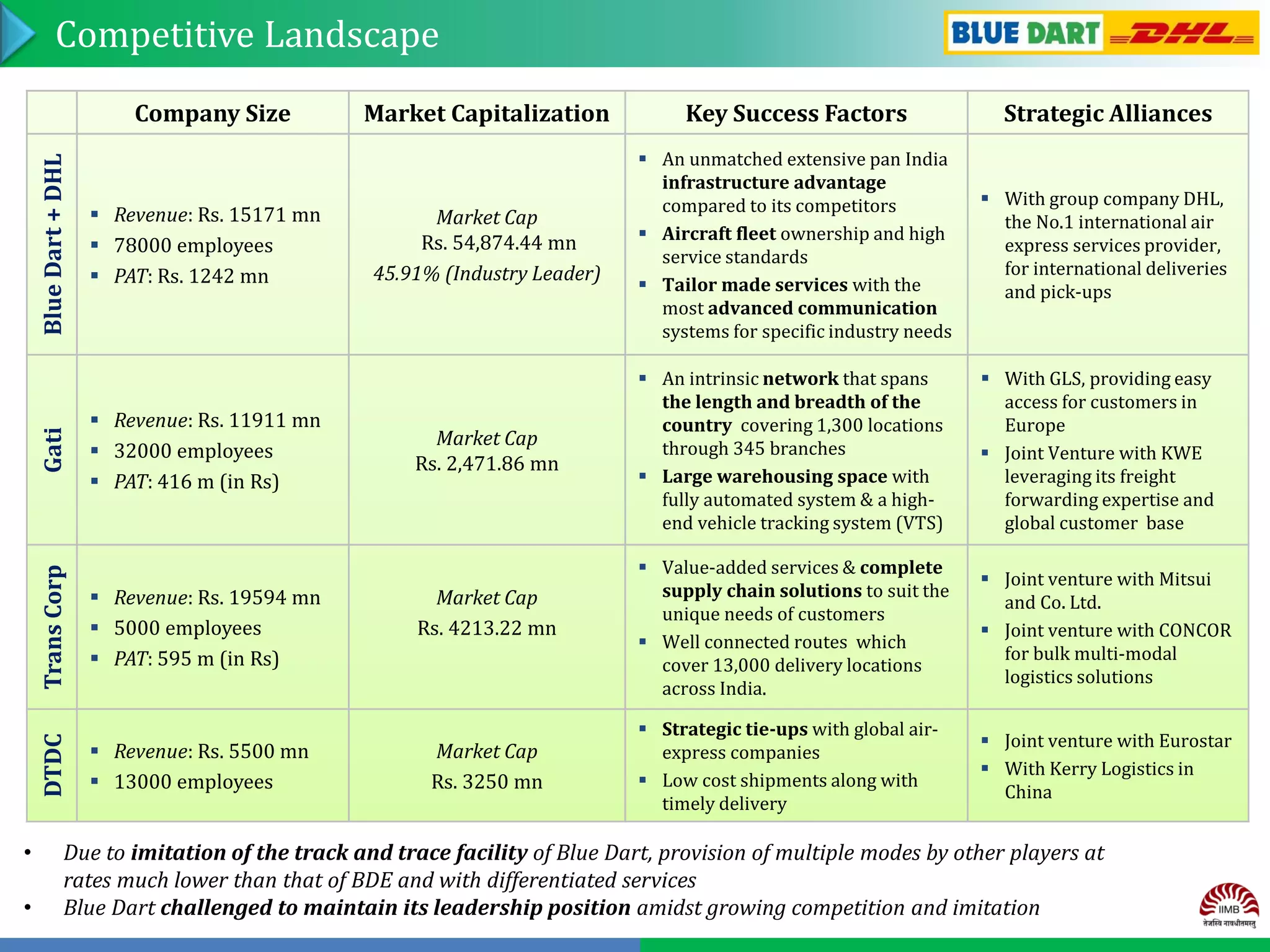
Competitive Landscape

 Revenue: Rs. 15171 mn
 78000 employees
 PAT: Rs. 1242 mn

Key Success Factors

Strategic Alliances

Market Cap
Rs. 54,874.44 mn
45.91% (Industry Leader)

 An unmatched extensive pan India
infrastructure advantage
compared to its competitors
 Aircraft fleet ownership and high
service standards
 Tailor made services with the
most advanced communication
systems for specific industry needs

 With group company DHL,
the No.1 international air
express services provider,
for international deliveries
and pick-ups

Market Cap
Rs. 2,471.86 mn

 An intrinsic network that spans
the length and breadth of the
country covering 1,300 locations
through 345 branches
 Large warehousing space with
fully automated system & a highend vehicle tracking system (VTS)

 With GLS, providing easy
access for customers in
Europe
 Joint Venture with KWE
leveraging its freight
forwarding expertise and
global customer base

 Value-added services & complete
supply chain solutions to suit the
unique needs of customers
 Well connected routes which
cover 13,000 delivery locations
across India.

 Joint venture with Mitsui
and Co. Ltd.
 Joint venture with CONCOR
for bulk multi-modal
logistics solutions

 Strategic tie-ups with global airexpress companies
 Low cost shipments along with
timely delivery

 Joint venture with Eurostar
 With Kerry Logistics in
China

Trans Corp

 Revenue: Rs. 11911 mn
 32000 employees
 PAT: 416 m (in Rs)

Market Capitalization

•
•

 Revenue: Rs. 19594 mn
 5000 employees
 PAT: 595 m (in Rs)

Market Cap
Rs. 4213.22 mn

DTDC

Gati

Blue Dart + DHL

Company Size

 Revenue: Rs. 5500 mn
 13000 employees

Market Cap
Rs. 3250 mn

Due to imitation of the track and trace facility of Blue Dart, provision of multiple modes by other players at
rates much lower than that of BDE and with differentiated services
Blue Dart challenged to maintain its leadership position amidst growing competition and imitation
Challenges & Recommendations
Challenges & Changes in the Industry
•
•
•
•
•
•

High correlation with GDP growth rates
Entry of foreign majors like FedEx and UPS in the Indian express
delivery market
Fluctuations in oil and aviation fuel prices
Increasing market share in the ground services market
The upcoming 3PL/4PL logistics wave due to entry of big retail
players in Indian market
Emergence of e-commerce websites as big buyers

Recommendations
•
•
•
•
•
•

Retain the market leadership position via differentiated
service: value focus on customer relationship, ease of payment
options and elaborate coverage network for delivery services
Increase footprint in Tier II and Tier III towns
Continuously adopt new technologies to improve workforce
efficiency
Provide specialized end-to-end logistics services like cold
storage, trans-national shipments
Increase portfolio of value-added services to create
differentiation in the industry
Create lock-ins with the e-commerce platform owners to
become their preferred shipper

Blue Dart Express Delivery Services: Competition and Strategy

  • 1.
    Group No. 13– PGP 2012 – Section D 1211254 - Chandan Satapathy 1211269 - Ashlesha Vishnu Kadam 1211284 - Pushpendra Singh 1211299 - Sherene Annabel 1211314 - Vishrut Shukla THE EXPRESS DELIVERY SERVICE INDUSTRY
  • 2.
    Industry Overview - Logisticsevolved from being a passive, cost-absorbing function to one that provides competitive advantage - Drivers: Trade, regulatory changes, infra builds, 3PL - Challenges: Fuel costs, labour shortage, Indian Post - Express Delivery: Collection, transport, delivery of documents, printed matter, parcels, other goods on an expedited basis, while tracking and maintaining control Different Sectors of the Logistics Industry Porter’s Five-Forces Analysis Unorg. & fragmented suppliers Low threat of fwd integration Availability of substitutes Low switching cost SPs threat of bkwd integration Capital requirement & technology access Economies of scale, delivery n/w access Operating costs – fuel, manpower, infra Brand identity & switching costs High Concentration Limited product differentiation Low switching cost Significant capital, fixed costs Standard & undifferentiated service Large business buyers, price concern Contribution to quality and cost No threat of fwd/bkwd integration Need is time-bound, reliable service Limited availability of close substitutes Substitute’s price-value proposition Switching cost if adopting IT as substitute > Government – Regulations, fuel price hikes, infra development, control of Indian Post > Goods and Service Tax (GST) to be positive; allowance of 100% FDI encouraging step > Express Industry Council interacts with govt., customs to get clearances & resolve issues Summary of Facts & Figures > Logistics Industry’s Contribution to GDP - 13% > Organized vs Unorganized Players – 65% organized > Employment provided to over 1 million people > Market – Rs. 143.4 bn (’11), Rs. 359.9 bn (’16) > CAGR of entire Logistics Industry - 9.9% > CAGR of express delivery - 20.2%
  • 3.
    The Firm –Blue Dart Express - South Asia’s premier courier & integrated air express package SP - A group company of the Singapore-based DHL group (81% equity) - Started operations in ’83; incorporated as private company in ’91 - Market leader in air cargo, commands more than 40% of market share in air express logistics segments, 12.8% in ground market - Customer-focused; maintains reliability levels of 99.96% in service - Strong pricing power, results in above-industry margins (10-12%) Performance of Blue Dart’s Stock Relative to Sensex Blue Dart DHL in Numbers > No. of employees - 7841 > Fleet - 5885 ground delivery vehicles - 7 dedicated cargo aircrafts > Locations Serviced - 36,474 across India > Countries Served – 220 (with DHL) > Annual Shipments - 77 million (domestic), 0.66 million (foreign)
  • 4.
    Analysis of BlueDart’s Strategy Generic Strategy of Blue Dart - Firm employs strategy of differentiation based on service level and geographical reach via its strong n/w - Innovative product mix, customized to meet specific needs of both business and retail customers - Product mix ensures sharing of resources & utilization - Strong global distribution through its alliance with DHL - State-of-the-art technologies in express logistic industry > Smart Trucks –intelligent route-planning capability, CO2 reduction under the GoGreen drive > Trimble GPS system in all truck for real-time tracking > SOTI MobiControl - Location-specific delivery assistant - Blue Dart charges a premium (upto 50%) over other air carriers on account of higher service levels, efficiency and larger portfolio of services - Increasing focus on ground services market poised to grow at ~25-26% every year; creating a niche presence - Introduction of value-added products like temperature controlled logistics and services like demand-draft on delivery, freight on demand etc. for accelerated growth by charging higher margins Resource-Based View Structure Support from DHL - Valuable - Rare - Inimitable - Non-Substitutable Brand Value - Valuable - Difficult to imitate - Non-Substitutable Sustained competitive advantage Fast and Reliable Service - Valuable - Not rare - Difficult to imitate - Non-Substitutable Temporary competitive advantage Extensive Network, Infra & Tech. - Valuable - Not rare - Imitable - Non-Substitutable Temporary competitive advantage Sustained competitive advantage
  • 5.
    Competitive Landscape  Revenue:Rs. 15171 mn  78000 employees  PAT: Rs. 1242 mn Key Success Factors Strategic Alliances Market Cap Rs. 54,874.44 mn 45.91% (Industry Leader)  An unmatched extensive pan India infrastructure advantage compared to its competitors  Aircraft fleet ownership and high service standards  Tailor made services with the most advanced communication systems for specific industry needs  With group company DHL, the No.1 international air express services provider, for international deliveries and pick-ups Market Cap Rs. 2,471.86 mn  An intrinsic network that spans the length and breadth of the country covering 1,300 locations through 345 branches  Large warehousing space with fully automated system & a highend vehicle tracking system (VTS)  With GLS, providing easy access for customers in Europe  Joint Venture with KWE leveraging its freight forwarding expertise and global customer base  Value-added services & complete supply chain solutions to suit the unique needs of customers  Well connected routes which cover 13,000 delivery locations across India.  Joint venture with Mitsui and Co. Ltd.  Joint venture with CONCOR for bulk multi-modal logistics solutions  Strategic tie-ups with global airexpress companies  Low cost shipments along with timely delivery  Joint venture with Eurostar  With Kerry Logistics in China Trans Corp  Revenue: Rs. 11911 mn  32000 employees  PAT: 416 m (in Rs) Market Capitalization • •  Revenue: Rs. 19594 mn  5000 employees  PAT: 595 m (in Rs) Market Cap Rs. 4213.22 mn DTDC Gati Blue Dart + DHL Company Size  Revenue: Rs. 5500 mn  13000 employees Market Cap Rs. 3250 mn Due to imitation of the track and trace facility of Blue Dart, provision of multiple modes by other players at rates much lower than that of BDE and with differentiated services Blue Dart challenged to maintain its leadership position amidst growing competition and imitation
  • 6.
    Challenges & Recommendations Challenges& Changes in the Industry • • • • • • High correlation with GDP growth rates Entry of foreign majors like FedEx and UPS in the Indian express delivery market Fluctuations in oil and aviation fuel prices Increasing market share in the ground services market The upcoming 3PL/4PL logistics wave due to entry of big retail players in Indian market Emergence of e-commerce websites as big buyers Recommendations • • • • • • Retain the market leadership position via differentiated service: value focus on customer relationship, ease of payment options and elaborate coverage network for delivery services Increase footprint in Tier II and Tier III towns Continuously adopt new technologies to improve workforce efficiency Provide specialized end-to-end logistics services like cold storage, trans-national shipments Increase portfolio of value-added services to create differentiation in the industry Create lock-ins with the e-commerce platform owners to become their preferred shipper