
The Professional Identity of Indonesian English Teachers

                       Ardian Wahyu Setiawan
        Dr. Ian Green, Dr. Linda Westphalen & Dr. Cally Guerin
English and Its Speakers


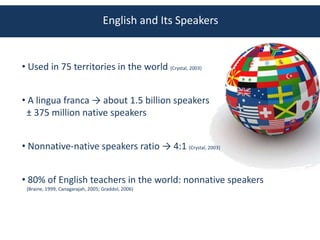
• Used in 75 territories in the world (Crystal, 2003)


• A lingua franca → about 1.5 billion speakers
 ± 375 million native speakers


• Nonnative-native speakers ratio → 4:1 (Crystal, 2003)


• 80% of English teachers in the world: nonnative speakers
 (Braine, 1999; Canagarajah, 2005; Graddol, 2006)
Discrimination against Nonnative English Teachers


  The majority of English teachers → Nonnative speakers
                           (Braine, 1999; Canagarajah, 2005; Graddol, 2006)


         THEY ARE DISCRIMINATED AGAINST

      Nonnative English teachers → treated unequally
   (Amin, 1997; Braine, 1999; Thomas, 1999; Kamhi-Stein, 2000; Mahboob, 2004; Clark & Paran, 2007)


                                     Less preferred
                  (Braine, 1999; Thomas, 1999; Kamhi- Stein, 2000; Mahboob, 2004)


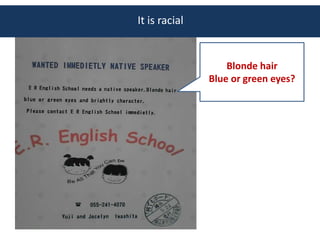
                         The discrimination → racial
                                       (Amin, 2004; Lee, 2007)
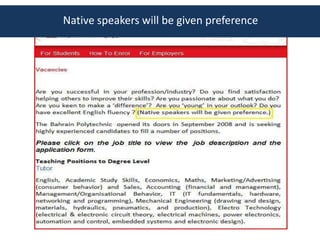
Native speakers will be given preference
It is racial


                   Blonde hair
               Blue or green eyes?
What causes?


                DISCRIMINATION


      Native English teachers → Ideal teachers
Nonnative English teachers → less competent teachers
               (Kamhi-Stein, 2000; Lee, 2000; McKay, 2002)
Unequal Views → Why?


• The Legacy of Colonialism
 Colonial discourse → operates → today

 Affects linguists, applied linguists, and teachers
 (Pennycook, 1994)


 English Language Teaching → Images of the speakers


• Communicative Language Teaching (CLT)
 too much emphasis on native competence as its goal (Preston,1989; Berns, 1990)
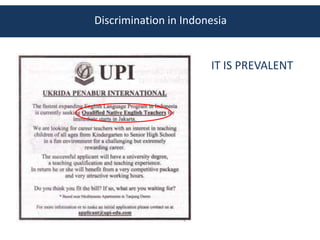
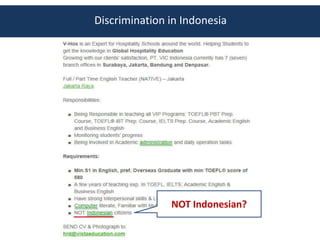
Discrimination in Indonesia


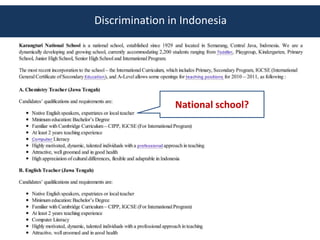
                       IT IS PREVALENT
Discrimination in Indonesia


               NOT Indonesian?
Discrimination in Indonesia


                National school?
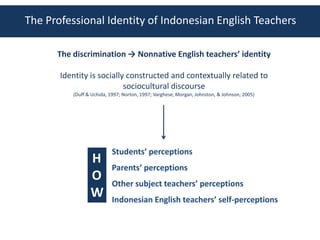
The Professional Identity of Indonesian English Teachers

      The discrimination → Nonnative English teachers’ identity

       Identity is socially constructed and contextually related to
                           sociocultural discourse
          (Duff & Uchida, 1997; Norton, 1997; Varghese, Morgan, Johnston, & Johnson; 2005)


                           Students’ perceptions
                 H
                          Parents’ perceptions
                 O         Other subject teachers’ perceptions
                 W         Indonesian English teachers’ self-perceptions
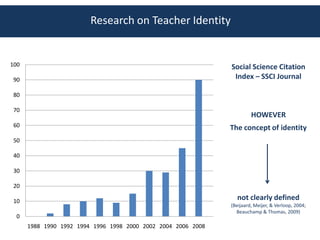
Research on Teacher Identity


100                                                            Social Science Citation
 90                                                             Index – SSCI Journal

 80

 70
                                                                        HOWEVER
 60                                                            The concept of identity
 50

 40

 30

 20

 10
                                                                 not clearly defined
                                                               (Beijaard, Meijer, & Verloop, 2004;
                                                                 Beauchamp & Thomas, 2009)
 0
      1988 1990 1992 1994 1996 1998 2000 2002 2004 2006 2008
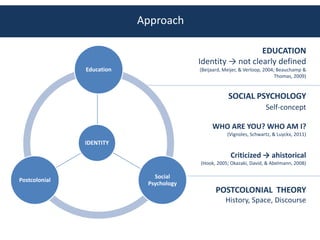
Approach

                                                           EDUCATION
                                         Identity → not clearly defined
               Education                 (Beijaard, Meijer, & Verloop, 2004; Beauchamp &
                                                                            Thomas, 2009)


                                                     SOCIAL PSYCHOLOGY
                                                                      Self-concept

                                              WHO ARE YOU? WHO AM I?
                                                     (Vignoles, Schwartz, & Luyckx, 2011)
               IDENTITY

                                                      Criticized → ahistorical
                                         (Hook, 2005; Okazaki, David, & Abelmann, 2008)

                              Social
Postcolonial
                            Psychology
                                                POSTCOLONIAL THEORY
                                                    History, Space, Discourse
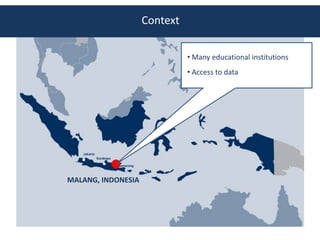
Context

                              • Many educational institutions
                              • Access to data


MALANG, INDONESIA
Theoretical Frameworks


• POSTCOLONIAL THEORY
  How colonial discourse operates; how stereotype works

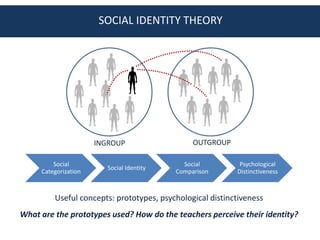
• SOCIAL IDENTITY THEORY
  How individuals attempt to maintain their identity
  positively valued / perceived

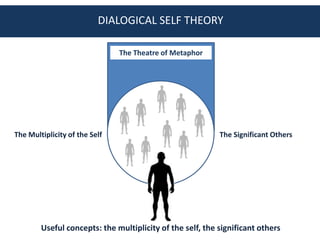
• DIALOGICAL SELF THEORY
  Individuals have multiple voices; the others are intrinsic
  part of the self
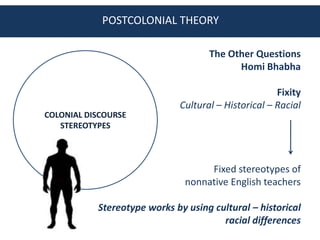
POSTCOLONIAL THEORY

                                    The Other Questions
                                          Homi Bhabha

                                                     Fixity
                             Cultural – Historical – Racial
COLONIAL DISCOURSE
   STEREOTYPES


                                    Fixed stereotypes of
                               nonnative English teachers

           Stereotype works by using cultural – historical
                                       racial differences
SOCIAL IDENTITY THEORY


                      INGROUP                   OUTGROUP

         Social                              Social         Psychological
                         Social Identity
     Categorization                        Comparison      Distinctiveness


         Useful concepts: prototypes, psychological distinctiveness
What are the prototypes used? How do the teachers perceive their identity?
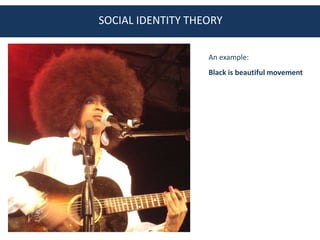
SOCIAL IDENTITY THEORY

                   An example:
                   Black is beautiful movement
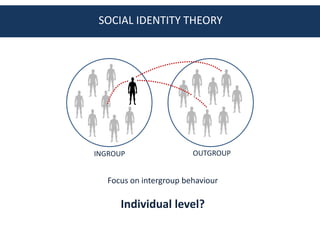
SOCIAL IDENTITY THEORY


INGROUP                  OUTGROUP


   Focus on intergroup behaviour

      Individual level?
DIALOGICAL SELF THEORY

                               The Theatre of Metaphor


The Multiplicity of the Self                               The Significant Others


        Useful concepts: the multiplicity of the self, the significant others
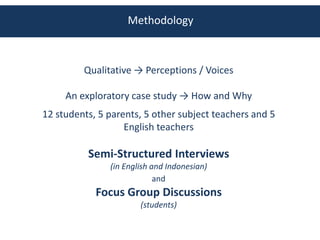
Methodology


         Qualitative → Perceptions / Voices

     An exploratory case study → How and Why
12 students, 5 parents, 5 other subject teachers and 5
                   English teachers

          Semi-Structured Interviews
               (in English and Indonesian)
                            and
            Focus Group Discussions
                       (students)
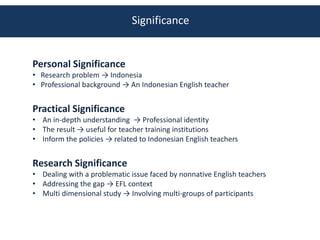
Significance


Personal Significance
• Research problem → Indonesia
• Professional background → An Indonesian English teacher


Practical Significance
• An in-depth understanding → Professional identity
• The result → useful for teacher training institutions
• Inform the policies → related to Indonesian English teachers


Research Significance
• Dealing with a problematic issue faced by nonnative English teachers
• Addressing the gap → EFL context
• Multi dimensional study → Involving multi-groups of participants
THANK YOU

Ardian ibp presentation_25012012

  • 1.
    The Professional Identityof Indonesian English Teachers Ardian Wahyu Setiawan Dr. Ian Green, Dr. Linda Westphalen & Dr. Cally Guerin
  • 2.
    English and ItsSpeakers • Used in 75 territories in the world (Crystal, 2003) • A lingua franca → about 1.5 billion speakers ± 375 million native speakers • Nonnative-native speakers ratio → 4:1 (Crystal, 2003) • 80% of English teachers in the world: nonnative speakers (Braine, 1999; Canagarajah, 2005; Graddol, 2006)
  • 3.
    Discrimination against NonnativeEnglish Teachers The majority of English teachers → Nonnative speakers (Braine, 1999; Canagarajah, 2005; Graddol, 2006) THEY ARE DISCRIMINATED AGAINST Nonnative English teachers → treated unequally (Amin, 1997; Braine, 1999; Thomas, 1999; Kamhi-Stein, 2000; Mahboob, 2004; Clark & Paran, 2007) Less preferred (Braine, 1999; Thomas, 1999; Kamhi- Stein, 2000; Mahboob, 2004) The discrimination → racial (Amin, 2004; Lee, 2007)
  • 4.
    Native speakers willbe given preference
  • 5.
    It is racial Blonde hair Blue or green eyes?
  • 6.
    What causes? DISCRIMINATION Native English teachers → Ideal teachers Nonnative English teachers → less competent teachers (Kamhi-Stein, 2000; Lee, 2000; McKay, 2002)
  • 7.
    Unequal Views →Why? • The Legacy of Colonialism Colonial discourse → operates → today Affects linguists, applied linguists, and teachers (Pennycook, 1994) English Language Teaching → Images of the speakers • Communicative Language Teaching (CLT) too much emphasis on native competence as its goal (Preston,1989; Berns, 1990)
  • 8.
  • 9.
  • 10.
  • 11.
    The Professional Identityof Indonesian English Teachers The discrimination → Nonnative English teachers’ identity Identity is socially constructed and contextually related to sociocultural discourse (Duff & Uchida, 1997; Norton, 1997; Varghese, Morgan, Johnston, & Johnson; 2005) Students’ perceptions H Parents’ perceptions O Other subject teachers’ perceptions W Indonesian English teachers’ self-perceptions
  • 12.
    Research on TeacherIdentity 100 Social Science Citation 90 Index – SSCI Journal 80 70 HOWEVER 60 The concept of identity 50 40 30 20 10 not clearly defined (Beijaard, Meijer, & Verloop, 2004; Beauchamp & Thomas, 2009) 0 1988 1990 1992 1994 1996 1998 2000 2002 2004 2006 2008
  • 13.
    Approach EDUCATION Identity → not clearly defined Education (Beijaard, Meijer, & Verloop, 2004; Beauchamp & Thomas, 2009) SOCIAL PSYCHOLOGY Self-concept WHO ARE YOU? WHO AM I? (Vignoles, Schwartz, & Luyckx, 2011) IDENTITY Criticized → ahistorical (Hook, 2005; Okazaki, David, & Abelmann, 2008) Social Postcolonial Psychology POSTCOLONIAL THEORY History, Space, Discourse
  • 14.
    Context • Many educational institutions • Access to data MALANG, INDONESIA
  • 15.
    Theoretical Frameworks • POSTCOLONIALTHEORY How colonial discourse operates; how stereotype works • SOCIAL IDENTITY THEORY How individuals attempt to maintain their identity positively valued / perceived • DIALOGICAL SELF THEORY Individuals have multiple voices; the others are intrinsic part of the self
  • 16.
    POSTCOLONIAL THEORY The Other Questions Homi Bhabha Fixity Cultural – Historical – Racial COLONIAL DISCOURSE STEREOTYPES Fixed stereotypes of nonnative English teachers Stereotype works by using cultural – historical racial differences
  • 17.
    SOCIAL IDENTITY THEORY INGROUP OUTGROUP Social Social Psychological Social Identity Categorization Comparison Distinctiveness Useful concepts: prototypes, psychological distinctiveness What are the prototypes used? How do the teachers perceive their identity?
  • 18.
    SOCIAL IDENTITY THEORY An example: Black is beautiful movement
  • 19.
    SOCIAL IDENTITY THEORY INGROUP OUTGROUP Focus on intergroup behaviour Individual level?
  • 20.
    DIALOGICAL SELF THEORY The Theatre of Metaphor The Multiplicity of the Self The Significant Others Useful concepts: the multiplicity of the self, the significant others
  • 21.
    Methodology Qualitative → Perceptions / Voices An exploratory case study → How and Why 12 students, 5 parents, 5 other subject teachers and 5 English teachers Semi-Structured Interviews (in English and Indonesian) and Focus Group Discussions (students)
  • 22.
    Significance Personal Significance • Researchproblem → Indonesia • Professional background → An Indonesian English teacher Practical Significance • An in-depth understanding → Professional identity • The result → useful for teacher training institutions • Inform the policies → related to Indonesian English teachers Research Significance • Dealing with a problematic issue faced by nonnative English teachers • Addressing the gap → EFL context • Multi dimensional study → Involving multi-groups of participants
  • 23.