node-red
with Raspberry Pi
What is Node-red?
Node-Red in its simplest form is an open
source visual editor for wiring the internet
of things produced by IBM.
More..
Node-RED is a visual tool for wiring
the Internet of Things (IoT).
Node-RED is platform-independent.
Node-RED takes care of the technicalities and
lets you concentrate on the logic of your
workflow. !
Traditional IoT development can be very technical:
Access to the GPIO and other hardware requires
skills in C or assembler, output of data to web
services or sending tweets and emails requires the
use of complex APIs.
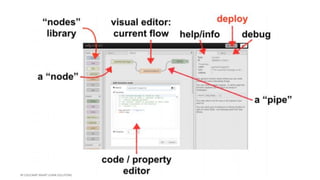
While most programming in Node-RED is
done visually using pre-defined functions
(“nodes”), any additional functionality can
be added in JavaScript.
How to Start with Raspberry Pi?
Desktop: Menu->Programming->Node-RED
Visit http://127.0.0.1:1880 in browser and get
your dashboard.
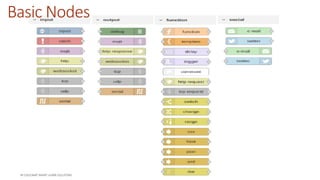
Basic Nodes
Flow 1: Twitting sensor data
Step 1 Drag and drop rpi input node to flow dashboard
Step 2 Double click to configure it and select the pin number
Step 3 Drag and drop twitter output node from social
Step 4 Double click the node to configure it, authenticate your
twitter account
Step 5 Connect both the nodes
Step 6 Deploy the project by clicking on the top right button Deploy
Step 7 Check your tweets on your twitter account, done by sensor.
Installing Thingspeak Node
Step 1 Stop the node-red running server by closing it or by “stop
node-red”
Step 2 Use “sudo npm install node-red-contrib-thingspeak” to install
thingspeak node
Step 3 Start node-red server, you will find thingspeak node in
functions at the end of the list
Step 4 Visiting thingspeak.com and signup for an account
Step 5 Create a channel and get Write API Key
Flow 1: Uploading sensor data on thingspeak
Step 1 Drag and drop rpi input node to flow dashboard
Step 2 Double click to configure it and select the pin number
Step 3 Drag and drop thingspeak node from function
Step 4 Double click the node to configure it, enter your write API
Key, Don’t forget to enter the field id as “1”
Step 5 Connect both the nodes
Step 6 Deploy the project by clicking on the top right button Deploy
Step 7 Check your private view in your thingspeak channel
Flow 1: IBM Watson IoT Demo
Step 1 Drag and drop rpi input node to flow dashboard
Step 2 Double click to configure it and select the pin number
Step 3 Use “Sudo npm install node-red-contrib-ibm-watson-iot
” to install the node
Step 4 Double click the node to configure it, select quickstart mode,
click on the edit symbol(pencil) next to it to get the dashboard.
Step 5 Connect both the nodes
Step 6 Deploy the project by clicking on the top right button Deploy
Step 7 Check your on the IBM Watson iot dashboard opened.
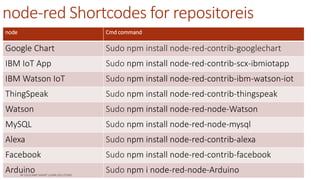
node-red Shortcodes for repositoreis
node Cmd command
Google Chart Sudo npm install node-red-contrib-googlechart
IBM IoT App Sudo npm install node-red-contrib-scx-ibmiotapp
IBM Watson IoT Sudo npm install node-red-contrib-ibm-watson-iot
ThingSpeak Sudo npm install node-red-contrib-thingspeak
Watson Sudo npm install node-red-node-Watson
MySQL Sudo npm install node-red-node-mysql
Alexa Sudo npm install node-red-contrib-alexa
Facebook Sudo npm install node-red-contrib-facebook
Arduino Sudo npm i node-red-node-Arduino
Cayenne Cloud by mydevices
Cayenne is the first of its kind drag and drop IoT project
builder that empowers developers to quickly create and
host their connected device projects.
Cayenne was designed for the Internet of Things.
It can control hardware remotely, it can display sensor
data, it can store data, analyze and do many other cool
things.
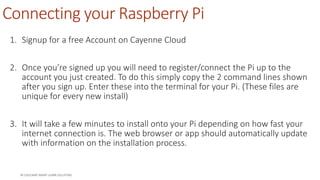
Connecting your Raspberry Pi
1. Signup for a free Account on Cayenne Cloud
2. Once you’re signed up you will need to register/connect the Pi up to the
account you just created. To do this simply copy the 2 command lines shown
after you sign up. Enter these into the terminal for your Pi. (These files are
unique for every new install)
3. It will take a few minutes to install onto your Pi depending on how fast your
internet connection is. The web browser or app should automatically update
with information on the installation process.
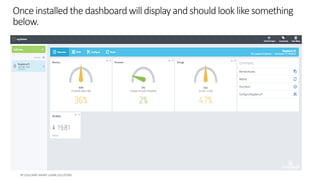
Onceinstalledthedashboardwill displayandshouldlook like something
below.
Controlling LED
1. Go to add new in the upper left corner of the dashboard
2. Now search for digital output and select it
3. For this device select your Pi, widget type is button, icon can be whatever
you want, and then select integrated GPIO. Finally channel is the pin/channel
that our LED is connected to. For this example it is pin #17. (This is the GPIO
numbering of the pins)
4. Now press the add sensor button
5. You can now turn the GPIO pin high & low from the dashboard and also use
it in a trigger
Explore more..
https://www.hackster.io
https://pimylifeup.com
http://codearduino.com
And google..
A BIG THANK YOU

Node red for Raspberry Pi

  • 1.
  • 2.
    What is Node-red? Node-Redin its simplest form is an open source visual editor for wiring the internet of things produced by IBM.
  • 3.
    More.. Node-RED is avisual tool for wiring the Internet of Things (IoT). Node-RED is platform-independent.
  • 4.
    Node-RED takes careof the technicalities and lets you concentrate on the logic of your workflow. ! Traditional IoT development can be very technical: Access to the GPIO and other hardware requires skills in C or assembler, output of data to web services or sending tweets and emails requires the use of complex APIs.
  • 5.
    While most programmingin Node-RED is done visually using pre-defined functions (“nodes”), any additional functionality can be added in JavaScript.
  • 6.
    How to Startwith Raspberry Pi? Desktop: Menu->Programming->Node-RED Visit http://127.0.0.1:1880 in browser and get your dashboard.
  • 8.
  • 9.
    Flow 1: Twittingsensor data Step 1 Drag and drop rpi input node to flow dashboard Step 2 Double click to configure it and select the pin number Step 3 Drag and drop twitter output node from social Step 4 Double click the node to configure it, authenticate your twitter account Step 5 Connect both the nodes Step 6 Deploy the project by clicking on the top right button Deploy Step 7 Check your tweets on your twitter account, done by sensor.
  • 10.
    Installing Thingspeak Node Step1 Stop the node-red running server by closing it or by “stop node-red” Step 2 Use “sudo npm install node-red-contrib-thingspeak” to install thingspeak node Step 3 Start node-red server, you will find thingspeak node in functions at the end of the list Step 4 Visiting thingspeak.com and signup for an account Step 5 Create a channel and get Write API Key
  • 11.
    Flow 1: Uploadingsensor data on thingspeak Step 1 Drag and drop rpi input node to flow dashboard Step 2 Double click to configure it and select the pin number Step 3 Drag and drop thingspeak node from function Step 4 Double click the node to configure it, enter your write API Key, Don’t forget to enter the field id as “1” Step 5 Connect both the nodes Step 6 Deploy the project by clicking on the top right button Deploy Step 7 Check your private view in your thingspeak channel
  • 12.
    Flow 1: IBMWatson IoT Demo Step 1 Drag and drop rpi input node to flow dashboard Step 2 Double click to configure it and select the pin number Step 3 Use “Sudo npm install node-red-contrib-ibm-watson-iot ” to install the node Step 4 Double click the node to configure it, select quickstart mode, click on the edit symbol(pencil) next to it to get the dashboard. Step 5 Connect both the nodes Step 6 Deploy the project by clicking on the top right button Deploy Step 7 Check your on the IBM Watson iot dashboard opened.
  • 13.
    node-red Shortcodes forrepositoreis node Cmd command Google Chart Sudo npm install node-red-contrib-googlechart IBM IoT App Sudo npm install node-red-contrib-scx-ibmiotapp IBM Watson IoT Sudo npm install node-red-contrib-ibm-watson-iot ThingSpeak Sudo npm install node-red-contrib-thingspeak Watson Sudo npm install node-red-node-Watson MySQL Sudo npm install node-red-node-mysql Alexa Sudo npm install node-red-contrib-alexa Facebook Sudo npm install node-red-contrib-facebook Arduino Sudo npm i node-red-node-Arduino
  • 14.
  • 15.
    Cayenne is thefirst of its kind drag and drop IoT project builder that empowers developers to quickly create and host their connected device projects. Cayenne was designed for the Internet of Things. It can control hardware remotely, it can display sensor data, it can store data, analyze and do many other cool things.
  • 16.
    Connecting your RaspberryPi 1. Signup for a free Account on Cayenne Cloud 2. Once you’re signed up you will need to register/connect the Pi up to the account you just created. To do this simply copy the 2 command lines shown after you sign up. Enter these into the terminal for your Pi. (These files are unique for every new install) 3. It will take a few minutes to install onto your Pi depending on how fast your internet connection is. The web browser or app should automatically update with information on the installation process.
  • 17.
  • 18.
    Controlling LED 1. Goto add new in the upper left corner of the dashboard 2. Now search for digital output and select it 3. For this device select your Pi, widget type is button, icon can be whatever you want, and then select integrated GPIO. Finally channel is the pin/channel that our LED is connected to. For this example it is pin #17. (This is the GPIO numbering of the pins) 4. Now press the add sensor button 5. You can now turn the GPIO pin high & low from the dashboard and also use it in a trigger
  • 19.
  • 20.