TABLE OF CONTENTS.
 What is NLP?
 Components of NLP
 NLU
 NLG
 Steps involved in NLP
 Applications of NLP.
What is NLP??
User 1 User 2
Machine
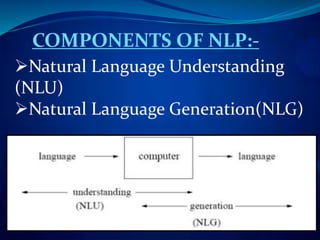
COMPONENTS OF NLP:-
Natural Language Understanding
(NLU)
Natural Language Generation(NLG)
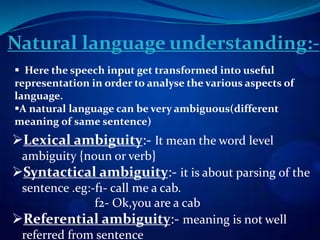
Natural language understanding:-
 Here the speech input get transformed into useful
representation in order to analyse the various aspects of
language.
A natural language can be very ambiguous(different
meaning of same sentence)
Lexical ambiguity:- It mean the word level
ambiguity {noun or verb}
Syntactical ambiguity:- it is about parsing of the
sentence .eg:-f1- call me a cab.
f2- Ok,you are a cab
Referential ambiguity:- meaning is not well
referred from sentence
Example of referential ambiguity
MEERA went to GEETA and said ‘I am hungry’
Here who is hungry is not clear from the sentence
This is referential ambiguity
Natural Language Generation
This is the process of converting the information
(representation ) to natural language
The process included in this are:-
 Text Planning:- It includes the extracting knowledge from
knowledge base
 Sentence Planning :- this includes selection of correct
words and forming sentences which follow the grammar
 Text realization :-Mapping the planned sentence into
reality
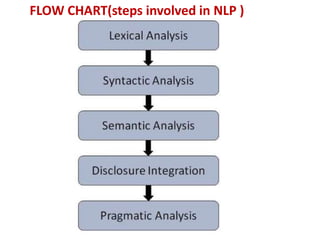
FLOW CHART(steps involved in NLP )
Lexical analysis
It deals with the recognition and identification
of structure of sentence
It divides the paragraph onto sentences,
phrases,words
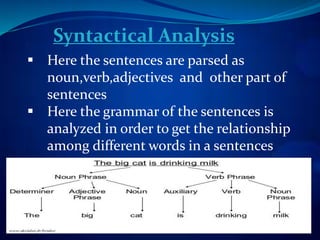
Syntactical Analysis
 Here the sentences are parsed as
noun,verb,adjectives and other part of
sentences
 Here the grammar of the sentences is
analyzed in order to get the relationship
among different words in a sentences
Semantic Analysis
 Here the actual meaning of the sentence
is extracted from the words used
 It checks whether the sentence makes any
meaning
 Eg.’Bitter sugar’ this is rejected in semantic
phase because it doesn’t makes any
meaning.
Disclosure Integration
Here the meaning of the sentence is
verified with sentence before it.
Pragmatic analysis
 Here the sentences are re-interpreted
to verify the correctness of meaning in
the given context.
 Here the real world knowledge of
language is required
Applications:-
 Natural Language generation
 Question answering
 Speech recognition
 Sentiment analysis
NLP

NLP

  • 2.
    TABLE OF CONTENTS. What is NLP?  Components of NLP  NLU  NLG  Steps involved in NLP  Applications of NLP.
  • 3.
    What is NLP?? User1 User 2 Machine
  • 4.
    COMPONENTS OF NLP:- NaturalLanguage Understanding (NLU) Natural Language Generation(NLG)
  • 5.
    Natural language understanding:- Here the speech input get transformed into useful representation in order to analyse the various aspects of language. A natural language can be very ambiguous(different meaning of same sentence) Lexical ambiguity:- It mean the word level ambiguity {noun or verb} Syntactical ambiguity:- it is about parsing of the sentence .eg:-f1- call me a cab. f2- Ok,you are a cab Referential ambiguity:- meaning is not well referred from sentence
  • 6.
    Example of referentialambiguity MEERA went to GEETA and said ‘I am hungry’ Here who is hungry is not clear from the sentence This is referential ambiguity
  • 7.
    Natural Language Generation Thisis the process of converting the information (representation ) to natural language The process included in this are:-  Text Planning:- It includes the extracting knowledge from knowledge base  Sentence Planning :- this includes selection of correct words and forming sentences which follow the grammar  Text realization :-Mapping the planned sentence into reality
  • 8.
  • 9.
    Lexical analysis It dealswith the recognition and identification of structure of sentence It divides the paragraph onto sentences, phrases,words
  • 10.
    Syntactical Analysis  Herethe sentences are parsed as noun,verb,adjectives and other part of sentences  Here the grammar of the sentences is analyzed in order to get the relationship among different words in a sentences
  • 11.
    Semantic Analysis  Herethe actual meaning of the sentence is extracted from the words used  It checks whether the sentence makes any meaning  Eg.’Bitter sugar’ this is rejected in semantic phase because it doesn’t makes any meaning.
  • 12.
    Disclosure Integration Here themeaning of the sentence is verified with sentence before it.
  • 13.
    Pragmatic analysis  Herethe sentences are re-interpreted to verify the correctness of meaning in the given context.  Here the real world knowledge of language is required
  • 14.
    Applications:-  Natural Languagegeneration  Question answering  Speech recognition  Sentiment analysis