Natural Language Processing
(NLP)
ASWIN KP
18390006
M.LIB.I.SC
PU
What is natural language processing?
• Process information contained in natural language text
• Also known as Computational Linguistics (CL), Human Language
Technology (HLT), Natural Language Engineering (NLE)
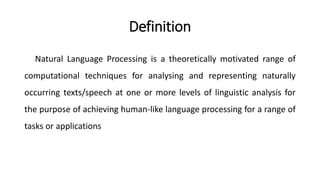
Definition
Natural Language Processing is a theoretically motivated range of
computational techniques for analysing and representing naturally
occurring texts/speech at one or more levels of linguistic analysis for
the purpose of achieving human-like language processing for a range of
tasks or applications
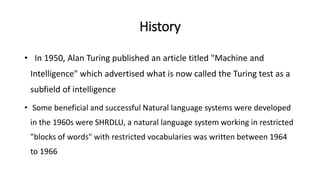
History
• In 1950, Alan Turing published an article titled "Machine and
Intelligence" which advertised what is now called the Turing test as a
subfield of intelligence
• Some beneficial and successful Natural language systems were developed
in the 1960s were SHRDLU, a natural language system working in restricted
"blocks of words" with restricted vocabularies was written between 1964
to 1966
Why NLP?
• A hallmark of human intelligence
• Text is the largest repository of human knowledge and is growing
quickly
• computer programmes that understood text or speech
Components of NLP
1 Natural Language Understanding
 Taking some spoken/typed sentence and working out what it means
 Mapping the given input in the natural language into a useful representation
 Different level of analysis required:
• morphological analysis
• syntactic analysis
• semantic analysis
• discourse analysis
2 Natural Language Generation
Taking some formal representation of what you want to say and working
out a way to express it in a natural (human) language (e.g., English)
Producing output in the natural language from some internal
representation
 Different level of synthesis required
• deep planning (what to say)
• syntactic generation
Steps of NLP
Morphological and Lexical Analysis
Syntactic Analysis
 Semantic Analysis
 Discourse Integration
 Pragmatic Analysis
Future of NLP
➢Semantic Web/Search
➢Sentiment Analysis / Opinion Mining
➢Machine Translation
➢Advanced Speech Processing Application
➢Social Network Analysis
➢Collective Intelligence
NLP in other Domains
➢Bio-Medical
➢Forensic Science
➢Advertisement
➢Education
➢Politics
➢E-governance
➢Business Development
➢Marketing
Reference
• http://jaganadhg.freeflux.net/blog
• https://epgp.inflibnet.ac.in
• https://www.slideshare.net
THANKS

Natural language processing (NLP)

  • 1.
    Natural Language Processing (NLP) ASWINKP 18390006 M.LIB.I.SC PU
  • 2.
    What is naturallanguage processing? • Process information contained in natural language text • Also known as Computational Linguistics (CL), Human Language Technology (HLT), Natural Language Engineering (NLE)
  • 3.
    Definition Natural Language Processingis a theoretically motivated range of computational techniques for analysing and representing naturally occurring texts/speech at one or more levels of linguistic analysis for the purpose of achieving human-like language processing for a range of tasks or applications
  • 4.
    History • In 1950,Alan Turing published an article titled "Machine and Intelligence" which advertised what is now called the Turing test as a subfield of intelligence • Some beneficial and successful Natural language systems were developed in the 1960s were SHRDLU, a natural language system working in restricted "blocks of words" with restricted vocabularies was written between 1964 to 1966
  • 5.
    Why NLP? • Ahallmark of human intelligence • Text is the largest repository of human knowledge and is growing quickly • computer programmes that understood text or speech
  • 6.
    Components of NLP 1Natural Language Understanding  Taking some spoken/typed sentence and working out what it means  Mapping the given input in the natural language into a useful representation  Different level of analysis required: • morphological analysis • syntactic analysis • semantic analysis • discourse analysis
  • 7.
    2 Natural LanguageGeneration Taking some formal representation of what you want to say and working out a way to express it in a natural (human) language (e.g., English) Producing output in the natural language from some internal representation  Different level of synthesis required • deep planning (what to say) • syntactic generation
  • 8.
    Steps of NLP Morphologicaland Lexical Analysis Syntactic Analysis  Semantic Analysis  Discourse Integration  Pragmatic Analysis
  • 9.
    Future of NLP ➢SemanticWeb/Search ➢Sentiment Analysis / Opinion Mining ➢Machine Translation ➢Advanced Speech Processing Application ➢Social Network Analysis ➢Collective Intelligence
  • 10.
    NLP in otherDomains ➢Bio-Medical ➢Forensic Science ➢Advertisement ➢Education ➢Politics ➢E-governance ➢Business Development ➢Marketing
  • 11.
  • 12.