Natural Language Processing
•Natural Language Processing(NLP) is defined as the
branch of Artificial Intelligence that provides
computers with the capability of understanding text
and spoken words in the same way a human being
can.
It incorporates machine learning models, statistics,
and deep learning models into computational
linguistics i.e. rule-based modeling of human
language to allow computers to understand text,
spoken words and understands human language,
intent, and sentiment.
•
3.
Natural Language Processing
•Humans communicate with each other using words and
text. The way that humans convey information to each
other is called Natural Language. Every day humans share
a large quality of information with each other in various
languages as speech or text.
However, computers cannot interpret this data, which is
in natural language, as they communicate in 1s and 0s.
The data produced is precious and can offer valuable
insights. Hence, you need computers to be able to
understand, emulate and respond intelligently to human
speech.
Natural Language Processing or NLP refers to the branch
of Artificial Intelligence that gives the machines the
ability to read, understand and derive meaning from
human languages.
•
•
4.
Natural Language Processing
•NLP combines the field of linguistics and
computer science to decipher language
structure and guidelines and to make models
which can comprehend, break down and
separate significant details from text and
speech.
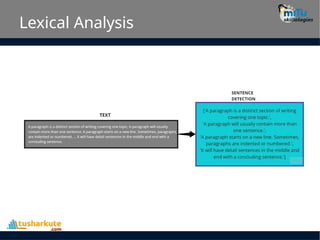
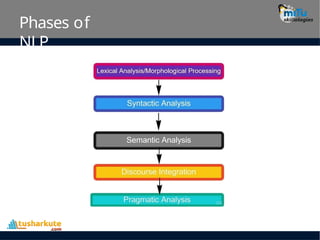
Lexical Analysis
• Thefirst phase is lexical analysis/morphological
processing. In this phase, the sentences,
paragraphs are broken into tokens.
These tokens are the smallest unit of text. It
scans the entire source text and divides it into
meaningful lexemes.
For example, The sentence “He goes to college.”
is divided into [ ‘He’ , ‘goes’ , ‘to’ , ‘college’, ‘.’] .
There are five tokens in the sentence. A
paragraph may also be divided into sentences.
•
•
•
Syntactic Analysis/Parsing
• Thesecond phase is Syntactic analysis. In this
phase, the sentence is checked whether it is
well- formed or not.
The word arrangement is studied and a
syntactic relationship is found between them.
It is checked for word arrangements and
grammar.
For example, the sentence “Delhi goes to
him” is rejected by the syntactic parser.
•
•
9.
Semantic Analysis
• Thethird phase is Semantic Analysis. In this
phase, the sentence is checked for the literal
meaning of each word and their arrangement
together.
For example, The sentence “I ate hot ice cream”
will get rejected by the semantic analyzer
because it doesn’t make sense.
E.g.. “colorless green idea.” This would be
rejected by the Symantec analysis as colorless
Here; green doesn’t make any sense.
•
•
10.
Discourse Integration
• Thefourth phase is discourse integration. In
this phase, the impact of the sentences before
a particular sentence and the effect of the
current sentence on the upcoming sentences is
determined.
For example, the word “that” in the sentence
“He wanted that” depends upon the prior
discourse context.
•
11.
Pragmatic
Analysis
• The lastphase of natural language processing is
Pragmatic analysis. Sometimes the discourse
integration phase and pragmatic analysis phase
are combined.
The actual effect of the text is discovered
by applying the set of rules that
characterize cooperative dialogues.
E.g., “close the window?” should be interpreted
as a request instead of an order.
•
•
12.
NLP Implementation
• Below,given are popular methods used for
Natural Learning Process:
– Machine learning: The learning nlp procedures
used during machine learning. It
automatically focuses on the most common
cases. So when we write rules by hand, it is
often not correct at all concerned about
human errors.
Statistical inference: NLP can make use of
statistical inference algorithms. It helps you to
produce models that are robust. e.g.,
containing words or structures which are
13.
NLP Steps
• Howto Perform NLP?
– Segmentation
– Tokenizing
– Removing Stop
Words:
– Stemming
– Lemmatization
– Part of Speech
Tagging
– Named Entity Tagging
14.
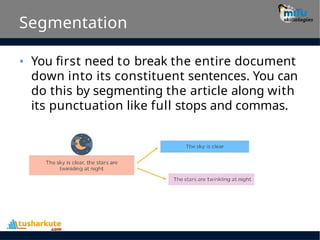
Segmentation
• You firstneed to break the entire document
down into its constituent sentences. You can
do this by segmenting the article along with
its punctuation like full stops and commas.
15.
Tokenizing
• For thealgorithm to understand these sentences,
you need to get the words in a sentence and
explain them individually to our algorithm.
So, you break down your sentence into its
constituent words and store them. This is called
tokenizing, and each world is called a token.
•
16.
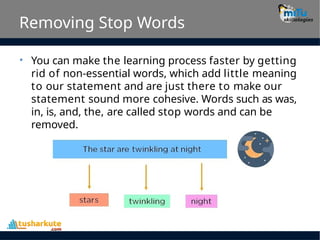
Removing Stop Words
•You can make the learning process faster by getting
rid of non-essential words, which add little meaning
to our statement and are just there to make our
statement sound more cohesive. Words such as was,
in, is, and, the, are called stop words and can be
removed.
17.
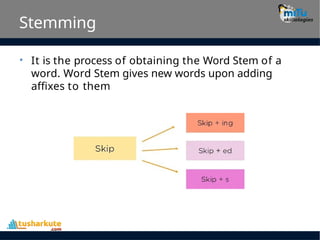
Stemming
• It isthe process of obtaining the Word Stem of a
word. Word Stem gives new words upon adding
affixes to them
18.
Lemmatization
• The processof obtaining the Root Stem of a word.
Root Stem gives the new base form of a word that
is present in the dictionary and from which the
word is derived.
You can also identify the base words for different
words based on the tense, mood, gender,etc.
19.
Part of SpeechTagging
• Now, you must explain the concept of nouns,
verbs, articles, and other parts of speech to the
machine by adding these tags to our words. This
is called ‘part of’.
20.
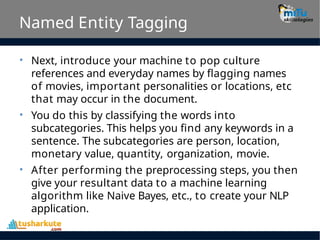
Named Entity Tagging
•Next, introduce your machine to pop culture
references and everyday names by flagging names
of movies, important personalities or locations, etc
that may occur in the document.
You do this by classifying the words into
subcategories. This helps you find any keywords in a
sentence. The subcategories are person, location,
monetary value, quantity, organization, movie.
After performing the preprocessing steps, you then
give your resultant data to a machine learning
algorithm like Naive Bayes, etc., to create your NLP
application.
•
•
Applications of
NLP
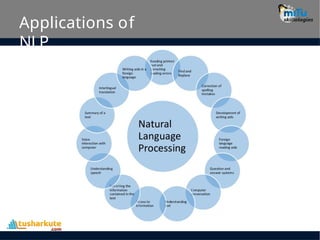
• NLPis one of the ways that people have
humanized machines and reduced the need for
labor. It has led to the automation of speech-
related tasks and human interaction. Some
applications of NLP include
:
– Translation Tools: Tools such as Google
Translate, Amazon Translate, etc. translate
sentences from one language to another
using NLP.
– Chatbots: Chatbots can be found on most
websites and are a way for companies to deal
with common queries quickly.
23.
Applications of
NLP
• VirtualAssistants: Virtual Assistants like Siri,
Cortana, Google Home, Alexa, etc can not only talk
to you but understand commands given to them.
• Targeted Advertising: Have you ever talked about a
product or service or just googled something and
then started seeing ads for it? This is called targeted
advertising, and it helps generate tons of revenue for
sellers as they can reach niche audiences at the right
time.
• Autocorrect: Autocorrect will automatically correct
any spelling mistakes you make, apart from this
grammar checkers also come into the picture which
helps you write flawlessly.
24.
Applications of
NLP
• Informationretrieval & Web Search: Google,
Yahoo, Bing, and other search engines base their
machine translation technology on NLP deep
learning models. It allows algorithms to read
text on a webpage, interpret its meaning and
translate it to another language.
Grammar Correction:
NLP technique is widely used by word
processor software like MS-word for spelling
correction & grammar check.
•
•
25.
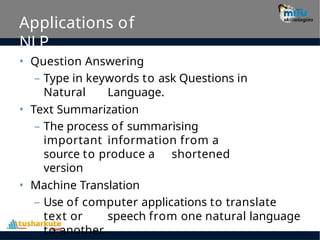
Applications of
NLP
• QuestionAnswering
– Type in keywords to ask Questions in
Natural Language.
• Text Summarization
– The process of summarising
important information from a
source to produce a shortened
version
• Machine Translation
– Use of computer applications to translate
text or speech from one natural language
to another.
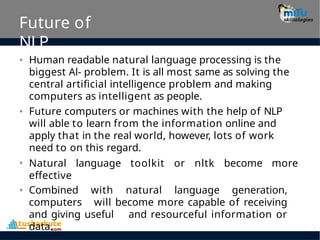
26.
Future of
NLP
• Humanreadable natural language processing is the
biggest Al- problem. It is all most same as solving the
central artificial intelligence problem and making
computers as intelligent as people.
• Future computers or machines with the help of NLP
will able to learn from the information online and
apply that in the real world, however, lots of work
need to on this regard.
• Natural language toolkit or nltk become more
effective
• Combined with natural language generation,
computers will become more capable of receiving
and giving useful and resourceful information or
data.
Advantages of
NLP
• Userscan ask questions about any subject and get a
direct response within seconds.
NLP system provides answers to the questions in
natural language
NLP system offers exact answers to the questions, no
unnecessary or unwanted information
The accuracy of the answers increases with the amount of
relevant information provided in the question.
NLP process helps computers communicate with humans in
their language and scales other language-related tasks
Allows you to perform more language-based data compares
to a human being without fatigue and in an unbiased and
consistent way.
Structuring a highly unstructured data source
•
•
•
•
•
•
29.
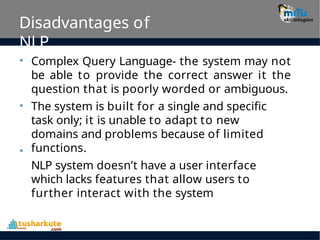
Disadvantages of
NLP
• ComplexQuery Language- the system may not
be able to provide the correct answer it the
question that is poorly worded or ambiguous.
The system is built for a single and specific
task only; it is unable to adapt to new
domains and problems because of limited
functions.
NLP system doesn’t have a user interface
which lacks features that allow users to
further interact with the system
•
•
30.
contact@mitu.co.in
tushar@tusharkute.c
om
Thank you
This presentationis created using LibreOffice Impress 5.1.6.2, can be used freely as per GNU General Public
License
Web Resources
http://mitu.co.in
http://tusharkute.co
m
/mITuSkillologies @mitu_grou
p
/company/
mitu-
skillologies
MITUSkillologies

![Lexical Analysis
• The first phase is lexical analysis/morphological
processing. In this phase, the sentences,
paragraphs are broken into tokens.
These tokens are the smallest unit of text. It
scans the entire source text and divides it into
meaningful lexemes.
For example, The sentence “He goes to college.”
is divided into [ ‘He’ , ‘goes’ , ‘to’ , ‘college’, ‘.’] .
There are five tokens in the sentence. A
paragraph may also be divided into sentences.
•
•
•](https://image.slidesharecdn.com/38-250709093605-4adf81b8/85/Natural-Language-Processing-Stages-and-application-area-pptx-6-320.jpg)