Overview of
Active
Technologies
for Engaged
Learning (ATEL)
The Relationship Between
Multimodality, Student
Engagement, and
ePortfolios
Marc Zaldivar
Director, ATEL, Virginia Tech
https://atel.tlos.vt.edu
marcz@vt.edu
NLI
Spring 2015
Overview
 How we got here
 Why engaged learning centric
 Where TEAL comes in
 What we mean by ATEL
 Examples of ATEL
 D.S
 Blogging
 ePs as catalyst for ATEL
 Multimodality of learning and creating
NLI 2015 – ATEL@VT
Presentation: http://www.slideshare.net/vtmarcz/nli-overview-s2015
How we got here…
 Phase 1 (Pre-2004): On your own
 Phase 2 (2004-7): Becoming systematic
 Phase 3 (2007-12): Centralizing,
department-focused, getting grounded,
tool-centered (ePortfolio Initiatives)
 Phase 4 (2012-now): Student- and
process-centered, tools abound (Active
Technologies for Engaged Learning)
NLI 2015 – ATEL@VT
Why active, engaged learning
 Some assumptions:
1. Learn best by doing.
2. Exploration and innovation are (should
be?) key learning outcomes.
3. It’s a long-term gain we’re after.
NLI 2015 – ATEL@VT
Why TEAL…
 Networked metaphor
 TEAL has collaborative, active-learning at its
heart.
 Active learning engages students in two
aspects – doing things and thinking about the
things they are doing. (Bonwell & Eison, 1991)
 Scenarios a plenty: Problem-based learning,
Kuh’s High-impact Practices, Flexible
Classroom spaces
 Many are still instructor- or class-focused.
NLI 2015 – ATEL@VT
Why ATEL…
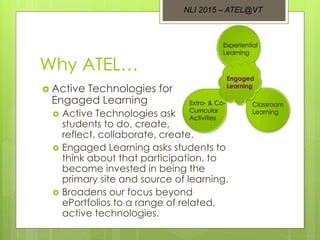
 Active Technologies for
Engaged Learning
 Active Technologies ask
students to do, create,
reflect, collaborate, create.
 Engaged Learning asks students to
think about that participation, to
become invested in being the
primary site and source of learning.
 Broadens our focus beyond
ePortfolios to a range of related,
active technologies.
Experiential
Learning
Extra- & Co-
Curricular
Activities
Classroom
Learning
Engaged
Learning
NLI 2015 – ATEL@VT
Examples of ATEL: Blogging
 Blogging provides the quick, easy ability to
write and share.
 Ranges from private, journal-space to large
syndicated “mother blogs.”
 Ranges from prompted to “free-range”
blogging.
 Example 1: Senior Seminar, English:
http://dylanseminar09.wordpress.com/
 Example 2: Honors Residential College:
https://blogs.lt.vt.edu/hrc/
NLI 2015 – ATEL@VT
Examples of ATEL: Digital
Storytelling
 Creating narratives of research and
experiences
 Can be a cyclic, reflective process
 Asking for different modes of
representation for ideas.
 Can be personal or professional
 Example 1: Architecture: What is Design?
 Example 2: History: From the corset to the
girdle.
NLI 2015 – ATEL@VT
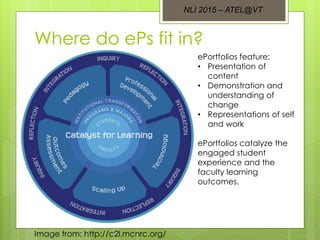
Where do ePs fit in?
Image from: http://c2l.mcnrc.org/
ePortfolios feature:
• Presentation of
content
• Demonstration and
understanding of
change
• Representations of self
and work
ePortfolios catalyze the
engaged student
experience and the
faculty learning
outcomes.
NLI 2015 – ATEL@VT
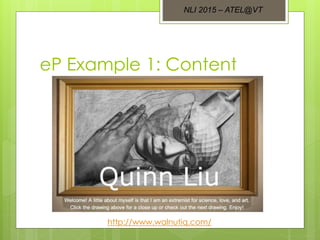
eP Example 1: Content
http://www.walnutiq.com/
NLI 2015 – ATEL@VT
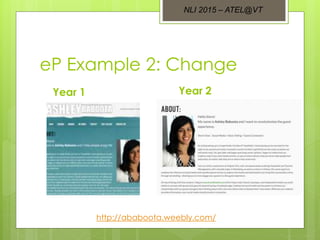
eP Example 2: Change
Year 1 Year 2
http://ababoota.weebly.com/
NLI 2015 – ATEL@VT
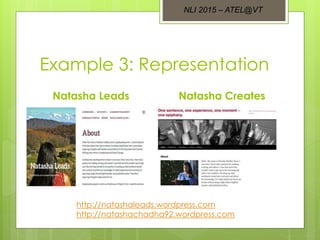
Example 3: Representation
Natasha Leads Natasha Creates
http://natashaleads.wordpress.com
http://natashachadha92.wordpress.com
NLI 2015 – ATEL@VT
Two dimensions of
multimodality
 Learning theory
 Gardner’s Multiple Intelligences (1991)
 Learning Styles: V/A/R/K
 Context of the individual(s) and moment
 Technology
 Modes of representation
 Image (moving and still), Sound, Text
NLI 2015 – ATEL@VT
ePs and multimodality
 Yes, ePs = multimodality.
 Learning and modality
 Various points-of-view on a single learning
experience.
 What happened? What changed? Why?
What’s next? How can you best show this?
 Various modes of representation available
 Pictures? Video? Text? Color? Sound?
NLI 2015 – ATEL@VT
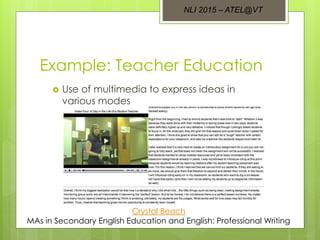
Example: Teacher Education
 Use of multimedia to express ideas in
various modes
Crystal Beach
MAs in Secondary English Education and English: Professional Writing
NLI 2015 – ATEL@VT
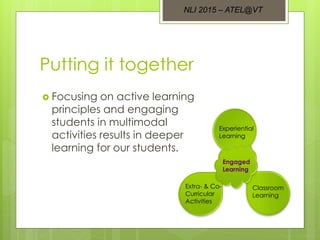
Putting it together
 Focusing on active learning
principles and engaging
students in multimodal
activities results in deeper
learning for our students.
Experiential
Learning
Extra- & Co-
Curricular
Activities
Classroom
Learning
Engaged
Learning
NLI 2015 – ATEL@VT
Putting it together
 ePortfolios and other digital artifacts of
learning, created using active learning
principles, reflect learning more
meaningfully.
 Active technologies, defined as those
technologies that support and encourage
active learning, can be used to heighten
student engagement, innovation, and
creativity.
NLI 2015 – ATEL@VT
Critical Questions
 How does an instructor untangle the contexts
for the different modalities to be employed?
 Should instructors be deciding on the
modalities?
 How can we shift from scaffolded learning to
free-style learning using active technologies
like ePortfolios, blogs and digital storytelling?
 How can student engagement become a
primary outcome of our learning
environments? What benefits would we see to
innovation, transference, and integration of
learning?
NLI 2015 – ATEL@VT
THANKS!
Marc Zaldivar
marcz@vt.edu
http://atel.tlos.vt.edu
This presentation available here:
http://www.slideshare.net/vtmarcz/nli-overview-
s2015
Examples here drawn from our student showcase
and gallery:
https://atel.tlos.vt.edu/student-showcase/
NLI 2015 – ATEL@VT

NLI ATEL Overview Spring 2015

  • 1.
    Overview of Active Technologies for Engaged Learning(ATEL) The Relationship Between Multimodality, Student Engagement, and ePortfolios Marc Zaldivar Director, ATEL, Virginia Tech https://atel.tlos.vt.edu marcz@vt.edu NLI Spring 2015
  • 2.
    Overview  How wegot here  Why engaged learning centric  Where TEAL comes in  What we mean by ATEL  Examples of ATEL  D.S  Blogging  ePs as catalyst for ATEL  Multimodality of learning and creating NLI 2015 – ATEL@VT Presentation: http://www.slideshare.net/vtmarcz/nli-overview-s2015
  • 3.
    How we gothere…  Phase 1 (Pre-2004): On your own  Phase 2 (2004-7): Becoming systematic  Phase 3 (2007-12): Centralizing, department-focused, getting grounded, tool-centered (ePortfolio Initiatives)  Phase 4 (2012-now): Student- and process-centered, tools abound (Active Technologies for Engaged Learning) NLI 2015 – ATEL@VT
  • 4.
    Why active, engagedlearning  Some assumptions: 1. Learn best by doing. 2. Exploration and innovation are (should be?) key learning outcomes. 3. It’s a long-term gain we’re after. NLI 2015 – ATEL@VT
  • 5.
    Why TEAL…  Networkedmetaphor  TEAL has collaborative, active-learning at its heart.  Active learning engages students in two aspects – doing things and thinking about the things they are doing. (Bonwell & Eison, 1991)  Scenarios a plenty: Problem-based learning, Kuh’s High-impact Practices, Flexible Classroom spaces  Many are still instructor- or class-focused. NLI 2015 – ATEL@VT
  • 6.
    Why ATEL…  ActiveTechnologies for Engaged Learning  Active Technologies ask students to do, create, reflect, collaborate, create.  Engaged Learning asks students to think about that participation, to become invested in being the primary site and source of learning.  Broadens our focus beyond ePortfolios to a range of related, active technologies. Experiential Learning Extra- & Co- Curricular Activities Classroom Learning Engaged Learning NLI 2015 – ATEL@VT
  • 7.
    Examples of ATEL:Blogging  Blogging provides the quick, easy ability to write and share.  Ranges from private, journal-space to large syndicated “mother blogs.”  Ranges from prompted to “free-range” blogging.  Example 1: Senior Seminar, English: http://dylanseminar09.wordpress.com/  Example 2: Honors Residential College: https://blogs.lt.vt.edu/hrc/ NLI 2015 – ATEL@VT
  • 8.
    Examples of ATEL:Digital Storytelling  Creating narratives of research and experiences  Can be a cyclic, reflective process  Asking for different modes of representation for ideas.  Can be personal or professional  Example 1: Architecture: What is Design?  Example 2: History: From the corset to the girdle. NLI 2015 – ATEL@VT
  • 9.
    Where do ePsfit in? Image from: http://c2l.mcnrc.org/ ePortfolios feature: • Presentation of content • Demonstration and understanding of change • Representations of self and work ePortfolios catalyze the engaged student experience and the faculty learning outcomes. NLI 2015 – ATEL@VT
  • 10.
    eP Example 1:Content http://www.walnutiq.com/ NLI 2015 – ATEL@VT
  • 11.
    eP Example 2:Change Year 1 Year 2 http://ababoota.weebly.com/ NLI 2015 – ATEL@VT
  • 12.
    Example 3: Representation NatashaLeads Natasha Creates http://natashaleads.wordpress.com http://natashachadha92.wordpress.com NLI 2015 – ATEL@VT
  • 13.
    Two dimensions of multimodality Learning theory  Gardner’s Multiple Intelligences (1991)  Learning Styles: V/A/R/K  Context of the individual(s) and moment  Technology  Modes of representation  Image (moving and still), Sound, Text NLI 2015 – ATEL@VT
  • 14.
    ePs and multimodality Yes, ePs = multimodality.  Learning and modality  Various points-of-view on a single learning experience.  What happened? What changed? Why? What’s next? How can you best show this?  Various modes of representation available  Pictures? Video? Text? Color? Sound? NLI 2015 – ATEL@VT
  • 15.
    Example: Teacher Education Use of multimedia to express ideas in various modes Crystal Beach MAs in Secondary English Education and English: Professional Writing NLI 2015 – ATEL@VT
  • 16.
    Putting it together Focusing on active learning principles and engaging students in multimodal activities results in deeper learning for our students. Experiential Learning Extra- & Co- Curricular Activities Classroom Learning Engaged Learning NLI 2015 – ATEL@VT
  • 17.
    Putting it together ePortfolios and other digital artifacts of learning, created using active learning principles, reflect learning more meaningfully.  Active technologies, defined as those technologies that support and encourage active learning, can be used to heighten student engagement, innovation, and creativity. NLI 2015 – ATEL@VT
  • 18.
    Critical Questions  Howdoes an instructor untangle the contexts for the different modalities to be employed?  Should instructors be deciding on the modalities?  How can we shift from scaffolded learning to free-style learning using active technologies like ePortfolios, blogs and digital storytelling?  How can student engagement become a primary outcome of our learning environments? What benefits would we see to innovation, transference, and integration of learning? NLI 2015 – ATEL@VT
  • 19.
    THANKS! Marc Zaldivar marcz@vt.edu http://atel.tlos.vt.edu This presentationavailable here: http://www.slideshare.net/vtmarcz/nli-overview- s2015 Examples here drawn from our student showcase and gallery: https://atel.tlos.vt.edu/student-showcase/ NLI 2015 – ATEL@VT

Editor's Notes

  • #17 So, at heart, this is how it plays out for me: by focusing on active learning principles and engaging students in meaningful activities that ask for different modes of thinking and doing, students learn more and more deeply.
  • #18 ePortfolios are a great place to reflect on and to represenat that meaningful learning. Active technologies, thos that ask students to DO and to think aboiut what they are doing, can encourage more creativity, more engagement, more innovation.
  • #19 But I’m left with some questions we’re still exploring at Virginia Tech. First, if learning is contextual, how is an instructor to untangle the contexts of a dozen, let alone hundreds, of learners? How are they to choose which modalities to encourage? As an extension, and maybe a possible solution, maybe we should ask if instructors are the right ones to decide on appropriate modalities? Maybe the students should play an active role in deciding how best to represent themselves.