The role of coaching
in telecollaborative language exchanges
Dr Sabela Melchor-Couto Dr Kristi Jauregi Ondarra
University of Roehampton Utrecht University
(London)
Introduction
New teacher roles
Time investment
Learning curve
Training
+
SupportCoaching
Summary of contents
 Brief introduction to TILA
 Coaching
 Coaching evaluation in TILA
 Perceived teacher competences
 Conclusion
 Bibliography
TILA
Funded by the European Commission
Context: the TILA project
2013-2015
269
teachers trained
550 h
coaching
Coaching
Lofthouse, Leat & Towler (2010) Coaching for teaching
and learning: a practical guide for schools. Reading:
CfBTEducation Trust
Pedagogical
innovation
+
technical guidance
BEFORE
DURING
AFTER
TC
SessionsTask design
Organisation
Implementation
Evaluation
Coaching assessment
 Evaluation survey
 Completed by 23 teachers
 Positive feedback
 Value of the guidance:
task design
organising TC sessions
coordinating with partners
Coaching assessment
Coaching assessment
30%
39%
26%
4%
Confidence for TC
5
4
3
2
1
Teacher competences
 15 teachers
 At least 3 TC sessions
 No previous TC experience
 Survey:
 Demographic information
 Organisational comp.: 9 items
 Pedagogical comp.: 5 items
 Digital comp.: 3 items
 Attitudes & beliefs: 2 items
Telecollaboration
Teacher Competences
(O’Dowd, 2015)
Organisational
Pedagogical
Digital
Attitudes &
beliefs
Organisational
Digital
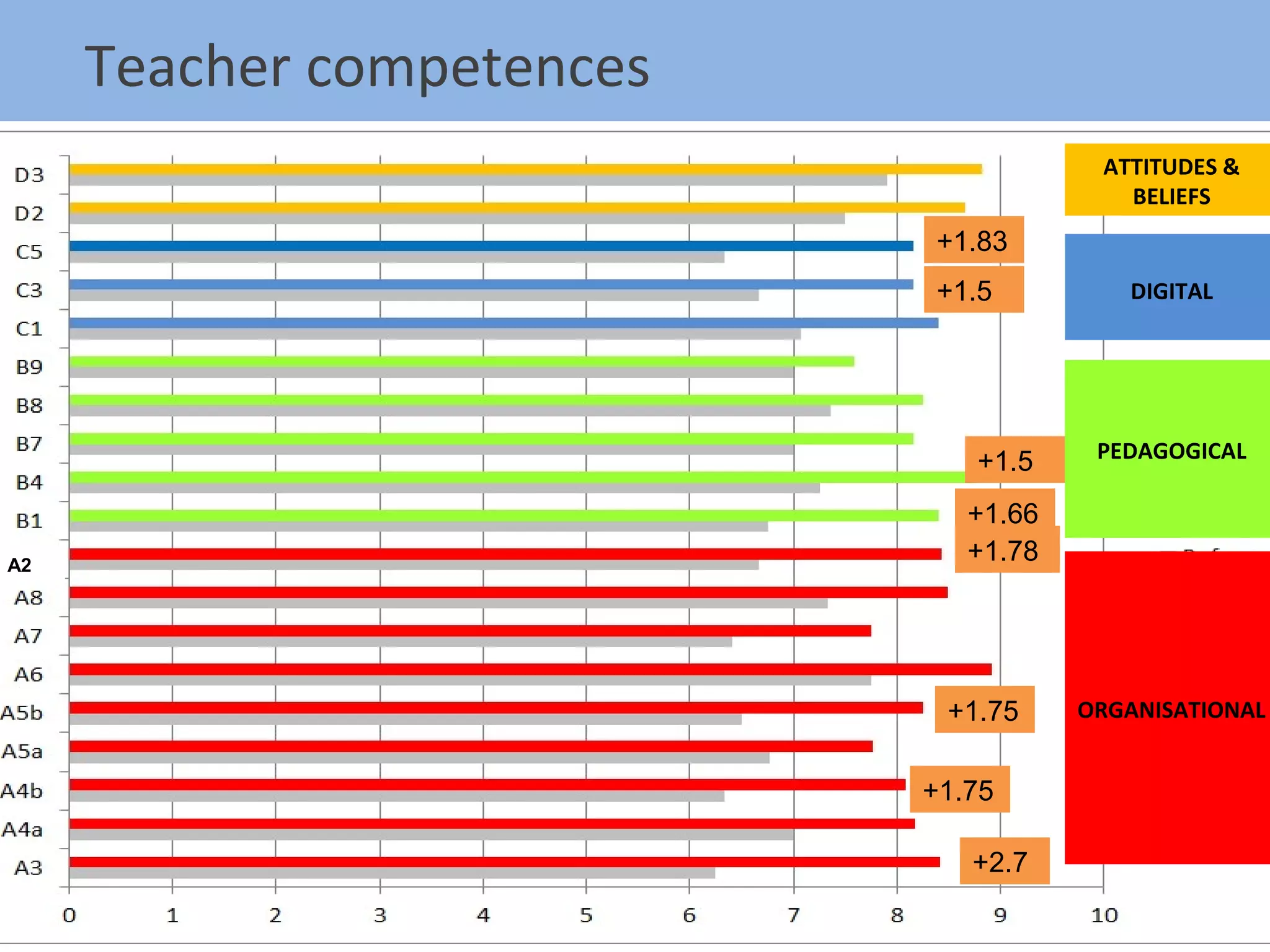
Teacher competences
Rate your ability to…
…organise and structure real-time student interaction taking
into account the particular affordances and technicalities of
synchronous tools such as videoconferencing, chat etc.
…explain clearly to possible partner-teachers your plans and
expectations related to a possible exchange
a)…employ various strategies to ‘match’ learners from the
different institutions
b)…to create effective partnerships and exchange groups
at the beginning / at the end of the telecollaboration
experience
Scale 1-10
Teacher competences
12 respondents
+1.48 +1.55+1.16
+1.04
ORGANISATIONAL PEDAGOGICAL DIGITAL ATTITUDES & BELIEFS
Teacher competences
+2.7
+1.78
+1.75
+1.75
+1.83
+1.5
+1.66
+1.5
ORGANISATIONAL
PEDAGOGICAL
DIGITAL
ATTITUDES &
BELIEFS
A2
Teacher competences
12 respondents
Role played by the coach in TC competences:
•Excellent guidance.
•The help provided by our coach has been priceless.
•The experience would not have been so positive without
the support and empathy provided by our coach.
•We have felt supported and motivated by our coach.
•Essential. I’ve felt supported at all times. We discussed
different options and it was very useful in terms of fine-
tuning tasks.
Teacher competences
12 respondents
• Very helpful, especially for organisational aspects.
• Their guidance in solving organisational and
technical problems has been useful and they have
helped us achieve our common goals.
• Their help has been useful for choosing the most
appropriate tool.
• The debriefing meetings held after every TC session
have been useful to correct certain aspects.
Teacher competences
Results Summary
• Digital competences
Digital competences Organisational competences
Highest
perceived
improvement
 Real-time
telecolaboration
 Explaining use of tools
 Choosing the right tool
Designing the exchange
Working with partner-teachers:
-Negotiating
-Explaining their objectives
Creating effective partnerships
& working with students
Conclusions
 Coaching is highly valued by participating teachers.
 It provides the necessary support, usually lacking at
their institutions.
 It provides motivation, essential when trying to
innovate
 It helps teachers develop pedagogical,
organisational and digital competences.
Limitations:
 Small number of participants
 Data gathered a few months after the TC experience
 Answers based on their perceptions
These limitations will be corrected in the next project!
Bibliography
Lofthouse, Leat & Towler (2010) Coaching for teaching and
learning: a practical guide for schools. Reading: CfBTEducation
Trust. Available at
http://www.ncl.ac.uk/cflat/news/documents/5414_CfT_FINAL
Web.pdf
O’Dowd, R. (2015) “Supporting in-service language educators in
learning to telecollaborate”. Language Learning & Technology,
19(1), 64–83.
Thank you!
Dr Sabela Melchor Couto: s.melchor-couto@roehampton.ac.uk
Dr Kristi Jauregi: k.jauregi@uu.nl

The role of coaching in telecollaborative language exchanges

  • 1.
    The role ofcoaching in telecollaborative language exchanges Dr Sabela Melchor-Couto Dr Kristi Jauregi Ondarra University of Roehampton Utrecht University (London)
  • 2.
    Introduction New teacher roles Timeinvestment Learning curve Training + SupportCoaching
  • 3.
    Summary of contents Brief introduction to TILA  Coaching  Coaching evaluation in TILA  Perceived teacher competences  Conclusion  Bibliography
  • 4.
    TILA Funded by theEuropean Commission Context: the TILA project 2013-2015 269 teachers trained 550 h coaching
  • 5.
    Coaching Lofthouse, Leat &Towler (2010) Coaching for teaching and learning: a practical guide for schools. Reading: CfBTEducation Trust Pedagogical innovation + technical guidance BEFORE DURING AFTER TC SessionsTask design Organisation Implementation Evaluation
  • 6.
    Coaching assessment  Evaluationsurvey  Completed by 23 teachers  Positive feedback  Value of the guidance: task design organising TC sessions coordinating with partners
  • 7.
  • 8.
  • 9.
    Teacher competences  15teachers  At least 3 TC sessions  No previous TC experience  Survey:  Demographic information  Organisational comp.: 9 items  Pedagogical comp.: 5 items  Digital comp.: 3 items  Attitudes & beliefs: 2 items Telecollaboration Teacher Competences (O’Dowd, 2015) Organisational Pedagogical Digital Attitudes & beliefs Organisational Digital
  • 10.
    Teacher competences Rate yourability to… …organise and structure real-time student interaction taking into account the particular affordances and technicalities of synchronous tools such as videoconferencing, chat etc. …explain clearly to possible partner-teachers your plans and expectations related to a possible exchange a)…employ various strategies to ‘match’ learners from the different institutions b)…to create effective partnerships and exchange groups at the beginning / at the end of the telecollaboration experience Scale 1-10
  • 11.
    Teacher competences 12 respondents +1.48+1.55+1.16 +1.04 ORGANISATIONAL PEDAGOGICAL DIGITAL ATTITUDES & BELIEFS
  • 12.
  • 13.
    Teacher competences 12 respondents Roleplayed by the coach in TC competences: •Excellent guidance. •The help provided by our coach has been priceless. •The experience would not have been so positive without the support and empathy provided by our coach. •We have felt supported and motivated by our coach. •Essential. I’ve felt supported at all times. We discussed different options and it was very useful in terms of fine- tuning tasks.
  • 14.
    Teacher competences 12 respondents •Very helpful, especially for organisational aspects. • Their guidance in solving organisational and technical problems has been useful and they have helped us achieve our common goals. • Their help has been useful for choosing the most appropriate tool. • The debriefing meetings held after every TC session have been useful to correct certain aspects.
  • 15.
    Teacher competences Results Summary •Digital competences Digital competences Organisational competences Highest perceived improvement  Real-time telecolaboration  Explaining use of tools  Choosing the right tool Designing the exchange Working with partner-teachers: -Negotiating -Explaining their objectives Creating effective partnerships & working with students
  • 16.
    Conclusions  Coaching ishighly valued by participating teachers.  It provides the necessary support, usually lacking at their institutions.  It provides motivation, essential when trying to innovate  It helps teachers develop pedagogical, organisational and digital competences. Limitations:  Small number of participants  Data gathered a few months after the TC experience  Answers based on their perceptions These limitations will be corrected in the next project!
  • 17.
    Bibliography Lofthouse, Leat &Towler (2010) Coaching for teaching and learning: a practical guide for schools. Reading: CfBTEducation Trust. Available at http://www.ncl.ac.uk/cflat/news/documents/5414_CfT_FINAL Web.pdf O’Dowd, R. (2015) “Supporting in-service language educators in learning to telecollaborate”. Language Learning & Technology, 19(1), 64–83.
  • 18.
    Thank you! Dr SabelaMelchor Couto: s.melchor-couto@roehampton.ac.uk Dr Kristi Jauregi: k.jauregi@uu.nl

Editor's Notes

  • #6 INDICAR QUE EN NUESTRO CASO VA DIRIGIDO A LA INNOVACIÓN PEDAGÓGICA CON EL USO DE NUEVAS HERRAMIENTAS DIGITALES PARA FAVORECER EL DESARROLLO DE LA COMUNICACIÓN INTERCULTURAL EN UN CONTEXTO INTERNACIONAL. SE TRATA DEL DESARROLLO DE DESTREZAS ORGANIZATIVAS, ALFABETIZACIÓN TECNOLÓGICA, INNOVACIÓN PEDAGÓGICA EN TORNO A TAREAS Y EL DESARROLLO DE COMPETENCIAS INTERCULTURALES.
  • #8 1:very poor 5: excellent More comments: Teachers value greatly the support provided by coaches in terms of the encouragement and ideas offered. They also mentioned more practical aspects such as their role in keeping both parties to previously agreed deadlines, which can be a challenge when combined with heavy teaching workloads. The coaches’ availability and the timeliness of their responses are highly rated in the comments gathered, as is their crucial role in coordinating work with their partner teachers. In terms of task design, teachers highlight the importance of their coaches’ input in creating and organising realistic tasks. Finally, the coach is also a valued guide when it comes to solving technical difficulties, something which is mentioned repeatedly in the comments provided by most participants. INDICAR CUÁNTOS PROFESORES (PARTICIPARON EN PROYECTOS DE TELECOLABORACIÓN Y) COMPLETARON EL CUESTIONARIO.
  • #9 Transición a la siguiente: Al final de la experiencia, los profesores valoran DE FORMA MUY POSITIVA, CASI EL 70% DE LOS PROFESORES) sobre 5 su confianza para llevar sesiones de telecolaboración. Vamos a indagar más para ver qué competencias creen haber desarrollado más durante la experiencia
  • #10 *O’Dowd, R. (2015). Supporting in-service language educators in learning to telecollaborate. Language Learning & Technology, 19(1), 64–83. Retrieved from http://llt.msu.edu/issues/february2015/odowd.pdf Items selected bearing in mind contents covered in coaching: original has 40 items
  • #13 A3 design the structure of an exchange C5 organise and structure real-time student interaction A2 explain clearly to possible partner-teachers his/her plans A5b to create effective partnerships A4b negotiate effectively with the partner-teacher the organisational technicalities B1 identify tasks for the online exchange which meet at least some of the objectives of the participating classes’ curricula B4 design tasks which are attractive and relevant for students and which develop culturally and linguistically rich interaction C3 explain the use of the chosen tools to his/her students or can provide them with online or third-party support for learning how to use them