NITI AAYOG
MARIA M GEORGE
MARY TRESA GABRIEL
MATHI CHANDRALEKHA
NITI AYOG- INTRODUCTION
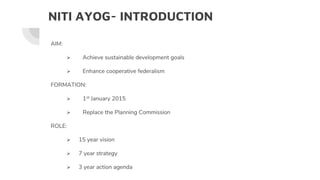
AIM:
 Achieve sustainable development goals
 Enhance cooperative federalism
FORMATION:
 1st January 2015
 Replace the Planning Commission
ROLE:
 15 year vision
 7 year strategy
 3 year action agenda
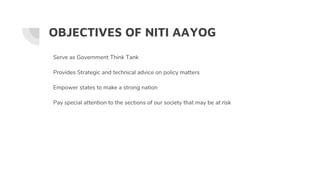
OBJECTIVES OF NITI AAYOG
Serve as Government Think Tank
Provides Strategic and technical advice on policy matters
Empower states to make a strong nation
Pay special attention to the sections of our society that may be at risk
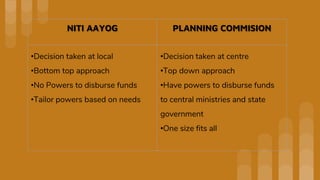
NITI AAYOG PLANNING COMMISION
•Decision taken at local
•Bottom top approach
•No Powers to disburse funds
•Tailor powers based on needs
•Decision taken at centre
•Top down approach
•Have powers to disburse funds
to central ministries and state
government
•One size fits all
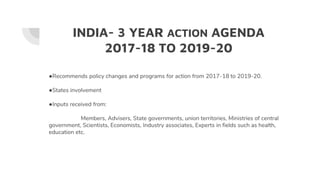
INDIA- 3 YEAR ACTION AGENDA
2017-18 TO 2019-20
●Recommends policy changes and programs for action from 2017-18 to 2019-20.
●States involvement
●Inputs received from:
Members, Advisers, State governments, union territories, Ministries of central
government, Scientists, Economists, Industry associates, Experts in fields such as health,
education etc.
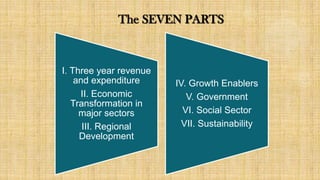
I. Three year revenue
and expenditure
II. Economic
Transformation in
major sectors
III. Regional
Development
IV. Growth Enablers
V. Government
VI. Social Sector
VII. Sustainability
The SEVEN PARTS
PART I
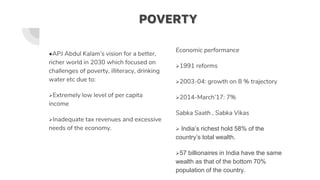
POVERTY
●APJ Abdul Kalam’s vision for a better,
richer world in 2030 which focused on
challenges of poverty, illiteracy, drinking
water etc due to:
Extremely low level of per capita
income
Inadequate tax revenues and excessive
needs of the economy.
Economic performance
1991 reforms
2003-04: growth on 8 % trajectory
2014-March’17: 7%
Sabka Saath , Sabka Vikas
 India’s richest hold 58% of the
country’s total wealth.
57 billionaires in India have the same
wealth as that of the bottom 70%
population of the country.
How to achieve poverty reduction in
next three years..?
● Since state government are handling social sector schemes , they should be given more
importance
● Expenditure proposals should be based on goals and priority
● Direct Tax Reforms should be taken into account
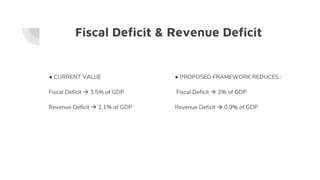
Fiscal Deficit & Revenue Deficit
● CURRENT VALUE
Fiscal Deficit  3.5% of GDP
Revenue Deficit  2.1% of GDP
● PROPOSED FRAMEWORK REDUCES :
Fiscal Deficit  3% of GDP
Revenue Deficit  0.9% of GDP
Action Agenda Proposes
● Shifting the composition of expenditure by allocating a larger proportion of additional
revenues that become available to high priority sectors
● Decline in the share of non – developmental revenue expenditure in total revenue
expenditure
● Rise in share of capital expenditure to promote development
● Expansion of expenditure on  education, health, agriculture, rural development, defence,
railways, roads
PART II
AGRICULTURE
●Doubling Farmers income by 2022.
●Kissan credit card
●Corporate farming
●Krish darshan channel on AIR and DD
●Enhancing agricultural productivity requires efficiently using inputs ,introducing new
technologies and shifting from low value to high value commodities.
INDUSTRY
●Unemployment rate consistently remains between 5% to 8%.
●Problem is not unemployment but underemployment.
●NITI Aayog is focussing on import substitution.
●Great show globally in IT, ITES, Pharma .
PART III
Urban, Rural and Regional
Development
●Rural area challenges:- Creating non- farm jobs ,skill development, accessing
education and health facilities, local governance , infrastructure , Drinking water &
sanitation and financial inclusion.
●In urban area focus is on building smart cities.
●Urban poverty is one major problem.
PART IV
Regional strategies to achieve balanced
growth across the country
●Regional strategies especially for areas of the north east , the Himalayan regions,
coastal regions, our deserts and islands.
●How to enhance the contribution of a number of growth enablers like digital
connectivity, PPP, Infrastructure , science & technology and energy ,effective
ecosystem , Transport and connectivity.
PART V
GOVERNANCE
● Actions to eliminate corruption and black money , strengthening federalism
● Ignored problems of money laundering and capital flight
● Reforms in civil service
● Electoral Reform  GST and Demonetisation
● Taxation policy and administration
● Strengthen the rule of India
PART VI
SOCIAL SECTORS
● Actions for improving country’s education system
● Transform the delivery of health services
● Action for building a more inclusive society
PART VII
SUSTAINABILITY
● Air pollution and Deforestation
●Water scarcity should be addressed
WEAKNESSES
● Not identify goals and also constraints
● The possible implications and estimates of GST is not mentioned
● Financial implications are not considered
● Various parameters on the emergent needs of economy have not been identified
● Completely ignored banking and financial sectors
Niti aayog
Niti aayog

Niti aayog

  • 1.
    NITI AAYOG MARIA MGEORGE MARY TRESA GABRIEL MATHI CHANDRALEKHA
  • 2.
    NITI AYOG- INTRODUCTION AIM: Achieve sustainable development goals  Enhance cooperative federalism FORMATION:  1st January 2015  Replace the Planning Commission ROLE:  15 year vision  7 year strategy  3 year action agenda
  • 3.
    OBJECTIVES OF NITIAAYOG Serve as Government Think Tank Provides Strategic and technical advice on policy matters Empower states to make a strong nation Pay special attention to the sections of our society that may be at risk
  • 4.
    NITI AAYOG PLANNINGCOMMISION •Decision taken at local •Bottom top approach •No Powers to disburse funds •Tailor powers based on needs •Decision taken at centre •Top down approach •Have powers to disburse funds to central ministries and state government •One size fits all
  • 6.
    INDIA- 3 YEARACTION AGENDA 2017-18 TO 2019-20 ●Recommends policy changes and programs for action from 2017-18 to 2019-20. ●States involvement ●Inputs received from: Members, Advisers, State governments, union territories, Ministries of central government, Scientists, Economists, Industry associates, Experts in fields such as health, education etc.
  • 7.
    I. Three yearrevenue and expenditure II. Economic Transformation in major sectors III. Regional Development IV. Growth Enablers V. Government VI. Social Sector VII. Sustainability The SEVEN PARTS
  • 8.
  • 9.
    POVERTY ●APJ Abdul Kalam’svision for a better, richer world in 2030 which focused on challenges of poverty, illiteracy, drinking water etc due to: Extremely low level of per capita income Inadequate tax revenues and excessive needs of the economy. Economic performance 1991 reforms 2003-04: growth on 8 % trajectory 2014-March’17: 7% Sabka Saath , Sabka Vikas  India’s richest hold 58% of the country’s total wealth. 57 billionaires in India have the same wealth as that of the bottom 70% population of the country.
  • 10.
    How to achievepoverty reduction in next three years..? ● Since state government are handling social sector schemes , they should be given more importance ● Expenditure proposals should be based on goals and priority ● Direct Tax Reforms should be taken into account
  • 11.
    Fiscal Deficit &Revenue Deficit ● CURRENT VALUE Fiscal Deficit  3.5% of GDP Revenue Deficit  2.1% of GDP ● PROPOSED FRAMEWORK REDUCES : Fiscal Deficit  3% of GDP Revenue Deficit  0.9% of GDP
  • 12.
    Action Agenda Proposes ●Shifting the composition of expenditure by allocating a larger proportion of additional revenues that become available to high priority sectors ● Decline in the share of non – developmental revenue expenditure in total revenue expenditure ● Rise in share of capital expenditure to promote development ● Expansion of expenditure on  education, health, agriculture, rural development, defence, railways, roads
  • 13.
  • 14.
    AGRICULTURE ●Doubling Farmers incomeby 2022. ●Kissan credit card ●Corporate farming ●Krish darshan channel on AIR and DD ●Enhancing agricultural productivity requires efficiently using inputs ,introducing new technologies and shifting from low value to high value commodities.
  • 15.
    INDUSTRY ●Unemployment rate consistentlyremains between 5% to 8%. ●Problem is not unemployment but underemployment. ●NITI Aayog is focussing on import substitution. ●Great show globally in IT, ITES, Pharma .
  • 16.
  • 17.
    Urban, Rural andRegional Development ●Rural area challenges:- Creating non- farm jobs ,skill development, accessing education and health facilities, local governance , infrastructure , Drinking water & sanitation and financial inclusion. ●In urban area focus is on building smart cities. ●Urban poverty is one major problem.
  • 18.
  • 19.
    Regional strategies toachieve balanced growth across the country ●Regional strategies especially for areas of the north east , the Himalayan regions, coastal regions, our deserts and islands. ●How to enhance the contribution of a number of growth enablers like digital connectivity, PPP, Infrastructure , science & technology and energy ,effective ecosystem , Transport and connectivity.
  • 20.
  • 21.
    GOVERNANCE ● Actions toeliminate corruption and black money , strengthening federalism ● Ignored problems of money laundering and capital flight ● Reforms in civil service ● Electoral Reform  GST and Demonetisation ● Taxation policy and administration ● Strengthen the rule of India
  • 22.
  • 23.
    SOCIAL SECTORS ● Actionsfor improving country’s education system ● Transform the delivery of health services ● Action for building a more inclusive society
  • 24.
  • 25.
    SUSTAINABILITY ● Air pollutionand Deforestation ●Water scarcity should be addressed
  • 26.
    WEAKNESSES ● Not identifygoals and also constraints ● The possible implications and estimates of GST is not mentioned ● Financial implications are not considered ● Various parameters on the emergent needs of economy have not been identified ● Completely ignored banking and financial sectors