Budget 2023-2024
Speech of
Nirmala Sitharaman
Minister of Finance
February 1, 2023
Hon’ble Speaker,
I present the Budget for 2023-24. This is the first Budget in Amrit
Kaal.
Introduction
1. This Budget hopes to build on the foundation laid in the previous
Budget, and the blueprint drawn for India@100. We envision a prosperous
and inclusive India, in which the fruits of development reach all regions and
citizens, especially our youth, women, farmers, OBCs, Scheduled Castes and
Scheduled Tribes.
2. In the 75th
year of our Independence, the world has recognised the
Indian economy as a ‘bright star’. Our current year’s economic growth is
estimated to be at 7 per cent. It is notable that this is the highest among all
the major economies. This is in spite of the massive slowdown globally
caused by Covid-19 and a war. The Indian economy is therefore on the right
track, and despite a time of challenges, heading towards a bright future.
3. Today as Indians stands with their head held high, and the world
appreciates India’s achievements and successes, we are sure that elders
who had fought for India’s independence, will with joy, bless us our
endeavors going forward.
Resilience amidst multiple crises
4. Our focus on wide-ranging reforms and sound policies, implemented
through Sabka Prayas resulting in Jan Bhagidari and targeted support to
those in need, helped us perform well in trying times. India’s rising global
2
profile is because of several accomplishments: unique world class digital
public infrastructure, e.g., Aadhaar, Co-Win and UPI; Covid vaccination drive
in unparalleled scale and speed; proactive role in frontier areas such as
achieving the climate related goals, mission LiFE, and National Hydrogen
Mission.
5. During the Covid-19 pandemic, we ensured that no one goes to bed
hungry, with a scheme to supply free food grains to over 80 crore persons
for 28 months. Continuing our commitment to ensure food and nutritional
security, we are implementing, from 1st
January 2023, a scheme to supply
free food grain to all Antyodaya and priority households for the next one
year, under PM Garib Kalyan Anna Yojana (PMGKAY). The entire
expenditure of about ` 2 lakh crore will be borne by the Central
Government.
G20 Presidency: Steering the global agenda through challenges
6. In these times of global challenges, the G20 Presidency gives us a
unique opportunity to strengthen India’s role in the world economic order.
With the theme of ‘Vasudhaiva Kutumbakam’, we are steering an
ambitious, people-centric agenda to address global challenges, and to
facilitate sustainable economic development.
Achievements since 2014: Leaving no one behind
7. The government’s efforts since 2014 have ensured for all citizens a
better quality of living and a life of dignity. The per capita income has more
than doubled to ` 1.97 lakh.
8. In these nine years, the Indian economy has increased in size from
being 10th
to 5th
largest in the world. We have significantly improved our
position as a well-governed and innovative country with a conducive
environment for business as reflected in several global indices. We have
made significant progress in many Sustainable Development Goals.
3
9. The economy has become a lot more formalised as reflected in the
EPFO membership more than doubling to 27 crore, and 7,400 crore digital
payments of ` 126 lakh crore through UPI in 2022.
10. The efficient implementation of many schemes, with
universalisation of targeted benefits, has resulted in inclusive development.
Some of the schemes are:
i. 11.7 crore household toilets under Swachh Bharat Mission,
ii. 9.6 crore LPG connections under Ujjawala,
iii. 220 crore Covid vaccination of 102 crore persons,
iv. 47.8 crore PM Jan Dhan bank accounts,
v. Insurance cover for 44.6 crore persons under PM Suraksha
Bima and PM Jeevan Jyoti Yojana, and
vi. Cash transfer of ` 2.2 lakh crore to over 11.4 crore farmers
under PM Kisan Samman Nidhi.
Vision for Amrit Kaal – an empowered and inclusive economy
11. Our vision for the Amrit Kaal includes technology-driven and
knowledge-based economy with strong public finances, and a robust
financial sector. To achieve this, Jan Bhagidari through Sabka Saath Sabka
Prayas is essential.
12. The economic agenda for achieving this vision focuses on three
things: first, facilitating ample opportunities for citizens, especially the
youth, to fulfil their aspirations; second, providing strong impetus to growth
and job creation; and third, strengthening macro-economic stability.
13. To service these focus areas in our journey to India@100, we believe
that the following four opportunities can be transformative during Amrit
Kaal.
4
1) Economic Empowerment of Women: Deendayal Antyodaya Yojana
National Rural Livelihood Mission has achieved remarkable success
by mobilizing rural women into 81 lakh Self Help Groups. We will
enable these groups to reach the next stage of economic
empowerment through formation of large producer enterprises or
collectives with each having several thousand members and
managed professionally. They will be helped with supply of raw
materials and for better design, quality, branding and marketing of
their products. Through supporting policies, they will be enabled to
scale up their operations to serve the large consumer markets, as
has been the case with several start-ups growing into ‘Unicorns’.
2) PM VIshwakarma KAushal Samman (PM VIKAS): For centuries,
traditional artisans and craftspeople, who work with their hands
using tools, have brought renown for India. They are generally
referred to as Vishwakarma. The art and handicraft created by them
represents the true spirit of Atmanirbhar Bharat. For the first time, a
package of assistance for them has been conceptualized. The new
scheme will enable them to improve the quality, scale and reach of
their products, integrating them with the MSME value chain. The
components of the scheme will include not only financial support
but also access to advanced skill training, knowledge of modern
digital techniques and efficient green technologies, brand
promotion, linkage with local and global markets, digital payments,
and social security. This will greatly benefit the Scheduled Castes,
Scheduled Tribes, OBCs, women and people belonging to the weaker
sections.
3) Tourism: The country offers immense attraction for domestic as well
as foreign tourists. There is a large potential to be tapped in tourism.
The sector holds huge opportunities for jobs and entrepreneurship
for youth in particular. Promotion of tourism will be taken up on
mission mode, with active participation of states, convergence of
government programmes and public-private partnerships.
5
4) Green Growth: We are implementing many programmes for green
fuel, green energy, green farming, green mobility, green buildings,
and green equipment, and policies for efficient use of energy across
various economic sectors. These green growth efforts help in
reducing carbon intensity of the economy and provides for large-
scale green job opportunities.
Priorities of this Budget
14. The Budget adopts the following seven priorities. They complement
each other and act as the ‘Saptarishi’ guiding us through the Amrit Kaal.
1) Inclusive Development
2) Reaching the Last Mile
3) Infrastructure and Investment
4) Unleashing the Potential
5) Green Growth
6) Youth Power
7) Financial Sector
Priority 1: Inclusive Development
15. The Government’s philosophy of Sabka Saath Sabka Vikas has
facilitated inclusive development covering in specific, farmers, women,
youth, OBCs, Scheduled Castes, Scheduled Tribes, divyangjan and
economically weaker sections, and overall priority for the underprivileged
(vanchiton ko variyata). There has also been a sustained focus on Jammu &
Kashmir, Ladakh and the North-East. This Budget builds on those efforts.
Agriculture and Cooperation
Digital Public Infrastructure for Agriculture
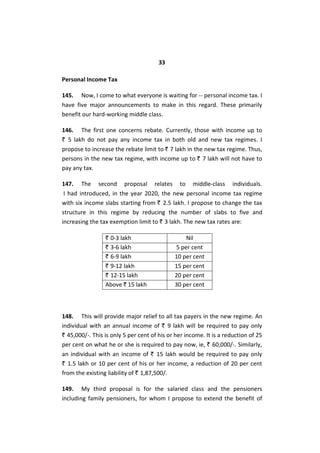
16. Digital public infrastructure for agriculture will be built as an open
source, open standard and inter operable public good. This will enable
6
inclusive, farmer-centric solutions through relevant information services for
crop planning and health, improved access to farm inputs, credit, and
insurance, help for crop estimation, market intelligence, and support for
growth of agri-tech industry and start-ups.
Agriculture Accelerator Fund
17. An Agriculture Accelerator Fund will be set-up to encourage agri-
startups by young entrepreneurs in rural areas. The Fund will aim at
bringing innovative and affordable solutions for challenges faced by
farmers. It will also bring in modern technologies to transform agricultural
practices, increase productivity and profitability.
Enhancing productivity of cotton crop
18. To enhance the productivity of extra-long staple cotton, we will
adopt a cluster-based and value chain approach through Public Private
Partnerships (PPP). This will mean collaboration between farmers, state and
industry for input supplies, extension services, and market linkages.
Atmanirbhar Horticulture Clean Plant Program
19. We will launch an Atmanirbhar Clean Plant Program to boost
availability of disease-free, quality planting material for high value
horticultural crops at an outlay of ` 2,200 crore.
Global Hub for Millets: ‘Shree Anna’
20. “India is at the forefront of popularizing Millets, whose consumption
furthers nutrition, food security and welfare of farmers,” said Hon’ble Prime
Minister.
21. We are the largest producer and second largest exporter of ‘Shree
Anna’ in the world. We grow several types of 'Shree Anna' such as jowar,
ragi, bajra, kuttu, ramdana, kangni, kutki, kodo, cheena, and sama. These
have a number of health benefits, and have been an integral part of our
food for centuries. I acknowledge with pride the huge service done by small
7
farmers in contributing to the health of fellow citizens by growing these
‘Shree Anna’.
22. Now to make India a global hub for 'Shree Anna', the Indian Institute
of Millet Research, Hyderabad will be supported as the Centre of Excellence
for sharing best practices, research and technologies at the international
level.
Agriculture Credit
23. The agriculture credit target will be increased
to ` 20 lakh crore with focus on animal husbandry, dairy and fisheries.
Fisheries
24. We will launch a new sub-scheme of PM Matsya Sampada Yojana
with targeted investment of ` 6,000 crore to further enable activities of
fishermen, fish vendors, and micro & small enterprises, improve value chain
efficiencies, and expand the market.
Cooperation
25. For farmers, especially small and marginal farmers, and other
marginalised sections, the government is promoting cooperative-based
economic development model. A new Ministry of Cooperation was formed
with a mandate to realise the vision of ‘Sahakar Se Samriddhi’. To realise
this vision, the government has already initiated computerisation of 63,000
Primary Agricultural Credit Societies (PACS) with an investment of ` 2,516
crore. In consultation with all stakeholders and states, model bye-laws for
PACS were formulated enabling them to become multipurpose PACS. A
national cooperative database is being prepared for country-wide mapping
of cooperative societies.
26. With this backdrop, we will implement a plan to set up massive
decentralised storage capacity. This will help farmers store their produce
and realize remunerative prices through sale at appropriate times. The
government will also facilitate setting up of a large number of multipurpose
8
cooperative societies, primary fishery societies and dairy cooperative
societies in uncovered panchayats and villages in the next 5 years.
Health, Education and Skilling
Nursing Colleges
27. One hundred and fifty-seven new nursing colleges will be
established in co-location with the existing 157 medical colleges established
since 2014.
Sickle Cell Anaemia Elimination Mission
28. A Mission to eliminate Sickle Cell Anaemia by 2047 will be launched.
It will entail awareness creation, universal screening of 7 crore people in the
age group of 0-40 years in affected tribal areas, and counselling through
collaborative efforts of central ministries and state governments.
Medical Research
29. Facilities in select ICMR Labs will be made available for research by
public and private medical college faculty and private sector R&D teams for
encouraging collaborative research and innovation.
Pharma Innovation
30. A new programme to promote research and innovation in
pharmaceuticals will be taken up through centers of excellence. We shall
also encourage industry to invest in research and development in specific
priority areas.
Multidisciplinary courses for medical devices
31. Dedicated multidisciplinary courses for medical devices will be
supported in existing institutions to ensure availability of skilled manpower
for futuristic medical technologies, high-end manufacturing and research.
9
Teachers’ Training
32. Teachers’ training will be re-envisioned through innovative
pedagogy, curriculum transaction, continuous professional development,
dipstick surveys, and ICT implementation. The District Institutes of
Education and Training will be developed as vibrant institutes of excellence
for this purpose.
National Digital Library for Children and Adolescents
33. A National Digital Library for children and adolescents will be set-up
for facilitating availability of quality books across geographies, languages,
genres and levels, and device agnostic accessibility. States will be
encouraged to set up physical libraries for them at panchayat and ward
levels and provide infrastructure for accessing the National Digital Library
resources.
34. Additionally, to build a culture of reading, and to make up for
pandemic-time learning loss, the National Book Trust, Children’s Book Trust
and other sources will be encouraged to provide and replenish non-
curricular titles in regional languages and English to these physical libraries.
Collaboration with NGOs that work in literacy will also be a part of this
initiative. To inculcate financial literacy, financial sector regulators and
organizations will be encouraged to provide age-appropriate reading
material to these libraries.
Priority 2: Reaching the Last Mile
35. Prime Minister Vajpayee’s government had formed the Ministry of
Tribal Affairs and the Department of Development of North-Eastern Region.
To provide a sharper focus to the objective of ‘reaching the last mile’, our
government has formed the ministries of AYUSH, Fisheries, Animal
Husbandry and Dairying, Skill Development, Jal Shakti and Cooperation.
10
Aspirational Districts and Blocks Programme
36. Building on the success of the Aspirational Districts Programme, the
Government has recently launched the Aspirational Blocks Programme
covering 500 blocks for saturation of essential government services across
multiple domains such as health, nutrition, education, agriculture, water
resources, financial inclusion, skill development, and basic infrastructure.
Pradhan Mantri PVTG Development Mission
37. To improve socio-economic conditions of the particularly vulnerable
tribal groups (PVTGs), Pradhan Mantri PVTG Development Mission will be
launched. This will saturate PVTG families and habitations with basic
facilities such as safe housing, clean drinking water and sanitation,
improved access to education, health and nutrition, road and telecom
connectivity, and sustainable livelihood opportunities. An amount
of ` 15,000 crore will be made available to implement the Mission in the
next three years under the Development Action Plan for the Scheduled
Tribes.
Eklavya Model Residential Schools
38. In the next three years, centre will recruit 38,800 teachers and
support staff for the 740 Eklavya Model Residential Schools, serving 3.5 lakh
tribal students.
Water for Drought Prone Region
39. In the drought prone central region of Karnataka, central assistance
of ` 5,300 crore will be given to Upper Bhadra Project to provide
sustainable micro irrigation and filling up of surface tanks for drinking
water.
PM Awas Yojana
40. The outlay for PM Awas Yojana is being enhanced
by 66 per cent to over ` 79,000 crore.
11
Bharat Shared Repository of Inscriptions (Bharat SHRI)
41. ‘Bharat Shared Repository of Inscriptions’ will be set up in a digital
epigraphy museum, with digitization of one lakh ancient inscriptions in the
first stage.
Support for poor prisoners
42. For poor persons who are in prisons and unable to afford the
penalty or the bail amount, required financial support will be provided.
Priority 3: Infrastructure & Investment
43. Investments in Infrastructure and productive capacity have a large
multiplier impact on growth and employment. After the subdued period of
the pandemic, private investments are growing again. The Budget takes the
lead once again to ramp up the virtuous cycle of investment and job
creation.
Capital Investment as driver of growth and jobs
44. Capital investment outlay is being increased steeply for the third
year in a row by 33 per cent to ` 10 lakh crore, which would be 3.3 per cent
of GDP. This will be almost three times the outlay in 2019-20.
45. This substantial increase in recent years is central to the
government’s efforts to enhance growth potential and job creation, crowd-
in private investments, and provide a cushion against global headwinds.
Effective Capital Expenditure
46. The direct capital investment by the Centre is complemented by the
provision made for creation of capital assets through Grants-in-Aid to
States. The ‘Effective Capital Expenditure’ of the Centre is budgeted at
` 13.7 lakh crore, which will be 4.5 per cent of GDP.
12
Support to State Governments for Capital Investment
47. I have decided to continue the 50-year interest free loan to state
governments for one more year to spur investment in infrastructure and to
incentivize them for complementary policy actions, with a significantly
enhanced outlay of ` 1.3 lakh crore.
Enhancing opportunities for private investment in Infrastructure
48. The newly established Infrastructure Finance Secretariat will assist
all stakeholders for more private investment in infrastructure, including
railways, roads, urban infrastructure and power, which are predominantly
dependent on public resources.
Harmonized Master List of Infrastructure
49. The Harmonized Master List of Infrastructure will be reviewed by an
expert committee for recommending the classification and financing
framework suitable for Amrit Kaal.
Railways
50. A capital outlay of ` 2.40 lakh crore has been provided for the
Railways. This highest ever outlay is about 9 times the outlay made in 2013-
14.
Logistics
51. One hundred critical transport infrastructure projects, for last and
first mile connectivity for ports, coal, steel, fertilizer, and food grains sectors
have been identified. They will be taken up on priority with investment of
` 75,000 crore, including ` 15,000 crore from private sources.
Regional Connectivity
52. Fifty additional airports, heliports, water aerodromes and advance
landing grounds will be revived for improving regional air connectivity.
13
Sustainable Cities of Tomorrow
53. States and cities will be encouraged to undertake urban planning
reforms and actions to transform our cities into ‘sustainable cities of
tomorrow’. This means efficient use of land resources, adequate resources
for urban infrastructure, transit-oriented development, enhanced
availability and affordability of urban land, and opportunities for all.
Making Cities ready for Municipal Bonds
54. Through property tax governance reforms and ring-fencing user
charges on urban infrastructure, cities will be incentivized to improve their
credit worthiness for municipal bonds.
Urban Infrastructure Development Fund
55. Like the RIDF, an Urban Infrastructure Development Fund (UIDF) will
be established through use of priority sector lending shortfall. This will be
managed by the National Housing Bank, and will be used by public agencies
to create urban infrastructure in Tier 2 and Tier 3 cities. States will be
encouraged to leverage resources from the grants of the 15th
Finance
Commission, as well as existing schemes, to adopt appropriate user charges
while accessing the UIDF. We expect to make
available ` 10,000 crore per annum for this purpose.
Urban Sanitation
56. All cities and towns will be enabled for 100 per cent mechanical
desludging of septic tanks and sewers to transition from manhole to
machine-hole mode. Enhanced focus will be provided for scientific
management of dry and wet waste.
Priority 4: Unleashing the Potential
57. “Good Governance is the key to a nation’s progress. Our government
is committed to providing a transparent and accountable administration
which works for the betterment and welfare of the common citizen,” said
Hon’ble Prime Minister.
14
Mission Karmayogi
58. Under Mission Karmayogi, Centre, States and Union Territories are
making and implementing capacity-building plans for civil servants. The
government has also launched an integrated online training platform, iGOT
Karmayogi, to provide continuous learning opportunities for lakhs of
government employees to upgrade their skills and facilitate people-centric
approach.
59. For enhancing ease of doing business, more than
39,000 compliances have been reduced and more than
3,400 legal provisions have been decriminalized. For furthering the trust-
based governance, we have introduced the Jan Vishwas Bill to amend 42
Central Acts. This Budget proposes a series of measures to unleash the
potential of our economy.
Centres of Excellence for Artificial Intelligence
60. For realizing the vision of “Make AI in India and Make AI work for
India”, three centres of excellence for Artificial Intelligence will be set-up in
top educational institutions. Leading industry players will partner in
conducting interdisciplinary research, develop cutting-edge applications and
scalable problem solutions in the areas of agriculture, health, and
sustainable cities. This will galvanize an effective AI ecosystem and nurture
quality human resources in the field.
National Data Governance Policy
61. To unleash innovation and research by start-ups and academia, a
National Data Governance Policy will be brought out. This will enable access
to anonymized data.
Simplification of Know Your Customer (KYC) process
62. The KYC process will be simplified adopting a ‘risk-based’ instead of
‘one size fits all’ approach. The financial sector regulators will also be
15
encouraged to have a KYC system fully amenable to meet the needs of
Digital India.
One stop solution for identity and address updating
63. A one stop solution for reconciliation and updating of identity and
address of individuals maintained by various government agencies,
regulators and regulated entities will be established using DigiLocker service
and Aadhaar as foundational identity.
Common Business Identifier
64. For the business establishments required to have a Permanent
Account Number (PAN), the PAN will be used as the common identifier for
all digital systems of specified government agencies. This will bring ease of
doing business; and it will be facilitated through a legal mandate.
Unified Filing Process
65. For obviating the need for separate submission of same information
to different government agencies, a system of ‘Unified Filing Process’ will be
set-up. Such filing of information or return in simplified forms on a common
portal, will be shared with other agencies as per filer’s choice.
Vivad se Vishwas I – Relief for MSMEs
66. In cases of failure by MSMEs to execute contracts during the Covid
period, 95 per cent of the forfeited amount relating to bid or performance
security, will be returned to them by government and government
undertakings. This will provide relief to MSMEs.
Vivad se Vishwas II – Settling Contractual Disputes
67. To settle contractual disputes of government and government
undertakings, wherein arbitral award is under challenge in a court, a
voluntary settlement scheme with standardized terms will be introduced.
This will be done by offering graded settlement terms depending on
pendency level of the dispute.
16
State Support Mission
68. The State Support Mission of NITI Aayog will be continued for three
years for our collective efforts towards national priorities.
Result Based Financing
69. To better allocate scarce resources for competing development
needs, the financing of select schemes will be changed, on a pilot basis,
from ‘input-based’ to ‘result-based’.
E-Courts
70. For efficient administration of justice, Phase-3 of the
E-Courts project will be launched with an outlay
of ` 7,000 crore.
Fintech Services
71. Fintech services in India have been facilitated by our digital public
infrastructure including Aadhaar, PM Jan Dhan Yojana, Video KYC, India
Stack and UPI. To enable more Fintech innovative services, the scope of
documents available in DigiLocker for individuals will be expanded.
Entity DigiLocker
72. An Entity DigiLocker will be set up for use by MSMEs, large business
and charitable trusts. This will be towards storing and sharing documents
online securely, whenever needed, with various authorities, regulators,
banks and other business entities.
5G Services
73. One hundred labs for developing applications using
5G services will be set up in engineering institutions to realise a new range
of opportunities, business models, and employment potential. The labs will
cover, among others, applications such as smart classrooms, precision
farming, intelligent transport systems, and health care applications.
17
Lab Grown Diamonds
74. Lab Grown Diamonds (LGD) is a technology-and innovation-driven
emerging sector with high employment potential. These environment-
friendly diamonds which have optically and chemically the same properties
as natural diamonds. To encourage indigenous production of LGD seeds and
machines and to reduce import dependency, a research and development
grant will be provided to one of the IITs for five years.
75. To reduce the cost of production, a proposal to review the custom
duty rate on LGD seeds will be indicated in Part B of the speech.
Priority 5: Green Growth
76. Hon’ble Prime Minister has given a vision for “LiFE”, or Lifestyle for
Environment, to spur a movement of environmentally conscious lifestyle.
India is moving forward firmly for the ‘panchamrit’ and net-zero carbon
emission by 2070 to usher in green industrial and economic transition. This
Budget builds on our focus on green growth.
Green Hydrogen Mission
77. The recently launched National Green Hydrogen Mission, with an
outlay of ` 19,700 crores, will facilitate transition of the economy to low
carbon intensity, reduce dependence on fossil fuel imports, and make the
country assume technology and market leadership in this sunrise sector.
Our target is to reach an annual production of 5 MMT by 2030.
Energy Transition
78. This Budget provides ` 35,000 crore for priority capital investments
towards energy transition and net zero objectives, and energy security by
Ministry of Petroleum & Natural Gas.
Energy Storage Projects
79. To steer the economy on the sustainable development path, Battery
Energy Storage Systems with capacity of 4,000 MWH will be supported with
18
Viability Gap Funding. A detailed framework for Pumped Storage Projects
will also be formulated.
Renewable Energy Evacuation
80. The Inter-state transmission system for evacuation and grid
integration of 13 GW renewable energy from Ladakh will be constructed
with investment of ` 20,700 crore including central support of ` 8,300 crore.
Green Credit Programme
81. For encouraging behavioural change, a Green Credit Programme will
be notified under the Environment (Protection) Act. This will incentivize
environmentally sustainable and responsive actions by companies,
individuals and local bodies, and help mobilize additional resources for such
activities.
PM-PRANAM
82. “PM Programme for Restoration, Awareness, Nourishment and
Amelioration of Mother Earth” will be launched to incentivize States and
Union Territories to promote alternative fertilizers and balanced use of
chemical fertilizers.
GOBARdhan scheme
83. 500 new ‘waste to wealth’ plants under GOBARdhan (Galvanizing
Organic Bio-Agro Resources Dhan) scheme will be established for promoting
circular economy. These will include 200 compressed biogas (CBG) plants,
including 75 plants in urban areas, and 300 community or cluster-based
plants at total investment of ` 10,000 crore. I will refer to this in Part B. In
due course, a 5 per cent CBG mandate will be introduced for all
organizations marketing natural and bio gas. For collection of bio-mass and
distribution of bio-manure, appropriate fiscal support will be provided.
19
Bhartiya Prakritik Kheti Bio-Input Resource Centres
84. Over the next 3 years, we will facilitate 1 crore farmers to adopt
natural farming. For this, 10,000 Bio-Input Resource Centres will be set-up,
creating a national-level distributed micro-fertilizer and pesticide
manufacturing network.
MISHTI
85. Building on India’s success in afforestation, ‘Mangrove Initiative for
Shoreline Habitats & Tangible Incomes’, MISHTI, will be taken up for
mangrove plantation along the coastline and on salt pan lands, wherever
feasible, through convergence between MGNREGS, CAMPA Fund and other
sources.
Amrit Dharohar
86. Wetlands are vital ecosystems which sustain biological diversity. In
his latest Mann Ki Baat, the Prime Minister said, “Now the total number of
Ramsar sites in our country has increased to 75. Whereas, before 2014,
there were only 26…” Local communities have always been at the forefront
of conservation efforts. The government will promote their unique
conservation values through Amrit Dharohar, a scheme that will be
implemented over the next three years to encourage optimal use of
wetlands, and enhance bio-diversity, carbon stock,
eco-tourism opportunities and income generation for local communities.
Coastal Shipping
87. Coastal shipping will be promoted as the energy efficient and lower
cost mode of transport, both for passengers and freight, through PPP mode
with viability gap funding.
Vehicle Replacement
88. Replacing old polluting vehicles is an important part of greening our
economy. In furtherance of the vehicle scrapping policy mentioned in
Budget 2021-22, I have allocated adequate funds to scrap old vehicles of
20
the Central Government. States will also be supported in replacing old
vehicles and ambulances.
Priority 6: Youth Power
89. To empower our youth and help the ‘Amrit Peedhi’ realize their
dreams, we have formulated the National Education Policy, focused on
skilling, adopted economic policies that facilitate job creation at scale, and
have supported business opportunities.
Pradhan Mantri Kaushal Vikas Yojana 4.0
90. Pradhan Mantri Kaushal Vikas Yojana 4.0 will be launched to skill
lakhs of youth within the next three years. On-job training, industry
partnership, and alignment of courses with needs of industry will be
emphasized. The scheme will also cover new age courses for Industry 4.0
like coding, AI, robotics, mechatronics, IOT, 3D printing, drones, and soft
skills. To skill youth for international opportunities, 30 Skill India
International Centres will be set up across different States.
Skill India Digital Platform
91. The digital ecosystem for skilling will be further expanded with the
launch of a unified Skill India Digital platform for:
 enabling demand-based formal skilling,
 linking with employers including MSMEs, and
 facilitating access to entrepreneurship schemes.
National Apprenticeship Promotion Scheme
92. To provide stipend support to 47 lakh youth in three years, Direct
Benefit Transfer under a pan-India National Apprenticeship Promotion
Scheme will be rolled out.
21
Tourism
93. With an integrated and innovative approach, at
least 50 destinations will be selected through challenge mode. In addition to
aspects such as physical connectivity, virtual connectivity, tourist guides,
high standards for food streets and tourists’ security, all the relevant
aspects would be made available on an App to enhance tourist experience.
Every destination would be developed as a complete package. The focus of
development of tourism would be on domestic as well as foreign tourists.
94. Sector specific skilling and entrepreneurship development will be
dovetailed to achieve the objectives of the ‘Dekho Apna Desh’ initiative.
This was launched as an appeal by the Prime Minister to the middle class to
prefer domestic tourism over international tourism. For integrated
development of theme-based tourist circuits, the ‘Swadesh Darshan
Scheme’ was also launched. Under the Vibrant Villages Programme, tourism
infrastructure and amenities will also be facilitated in border villages.
Unity Mall
95. States will be encouraged to set up a Unity Mall in their state capital
or most prominent tourism centre or the financial capital for promotion and
sale of their own ODOPs (one district, one product), GI products and other
handicraft products, and for providing space for such products of all other
States.
Priority 7: Financial Sector
96. Our reforms in the financial sector and innovative use of technology
have led to financial inclusion at scale, better and faster service delivery,
ease of access to credit and participation in financial markets. This Budget
proposes to further these measures.
Credit Guarantee for MSMEs
97. Last year, I proposed revamping of the credit guarantee scheme for
MSMEs. I am happy to announce that the revamped scheme will take effect
22
from 1st
April 2023 through infusion of ` 9,000 crore in the corpus. This will
enable additional collateral-free guaranteed credit of ` 2 lakh crore.
Further, the cost of the credit will be reduced by about 1 per cent.
National Financial Information Registry
98. A national financial information registry will be set up to serve as the
central repository of financial and ancillary information. This will facilitate
efficient flow of credit, promote financial inclusion, and foster financial
stability. A new legislative framework will govern this credit public
infrastructure, and it will be designed in consultation with the RBI.
Financial Sector Regulations
99. To meet the needs of Amrit Kaal and to facilitate optimum
regulation in the financial sector, public consultation, as necessary and
feasible, will be brought to the process of regulation-making and issuing
subsidiary directions.
100. To simplify, ease and reduce cost of compliance, financial sector
regulators will be requested to carry out a comprehensive review of existing
regulations. For this, they will consider suggestions from public and
regulated entities. Time limits to decide the applications under various
regulations will also be laid down.
GIFT IFSC
101. To enhance business activities in GIFT IFSC, the following measures
will be taken:
 Delegating powers under the SEZ Act to IFSCA to avoid dual
regulation,
 Setting up a single window IT system for registration and
approval from IFSCA, SEZ authorities, GSTN, RBI, SEBI and
IRDAI,
23
 Permitting acquisition financing by IFSC Banking Units of
foreign banks,
 Establishing a subsidiary of EXIM Bank for trade
re-financing,
 Amending IFSCA Act for statutory provisions for arbitration,
ancillary services, and avoiding dual regulation under SEZ Act,
and
 Recognizing offshore derivative instruments as valid contracts.
Data Embassy
102. For countries looking for digital continuity solutions, we will
facilitate setting up of their Data Embassies in GIFT IFSC.
Improving Governance and Investor Protection in Banking Sector
103. To improve bank governance and enhance investors’ protection,
certain amendments to the Banking Regulation Act, the Banking Companies
Act and the Reserve Bank of India Act are proposed.
Capacity Building in Securities Market
104. To build capacity of functionaries and professionals in the securities
market, SEBI will be empowered to develop, regulate, maintain and enforce
norms and standards for education in the National Institute of Securities
Markets and to recognize award of degrees, diplomas and certificates.
Central Data Processing Centre
105. A Central Processing Centre will be setup for faster response to
companies through centralized handling of various forms filed with field
offices under the Companies Act.
24
Reclaiming of shares and dividends
106. For investors to reclaim unclaimed shares and unpaid dividends
from the Investor Education and Protection Fund Authority with ease, an
integrated IT portal will be established.
Digital Payments
107. Digital payments continue to find wide acceptance. In 2022, they
show increase of 76 per cent in transactions
and 91 per cent in value. Fiscal support for this digital public infrastructure
will continue in 2023-24.
Azadi Ka Amrit Mahotsav Mahila Samman Bachat Patra
108. For commemorating Azadi Ka Amrit Mahotsav, a one-time new small
savings scheme, Mahila Samman Savings Certificate, will be made available
for a two-year period up to March 2025. This will offer deposit facility upto
` 2 lakh in the name of women or girls for a tenor of 2 years at fixed
interest rate of 7.5 per cent with partial withdrawal option.
Senior Citizens
109. The maximum deposit limit for Senior Citizen Savings Scheme will be
enhanced from ` 15 lakh to ` 30 lakh.
110. The maximum deposit limit for Monthly Income Account Scheme
will be enhanced from ` 4.5 lakh to ` 9 lakh for single account and from ` 9
lakh to ` 15 lakh for joint account.
Fiscal Management
Fifty-year interest free loan to States
111. The entire fifty-year loan to states has to be spent on capital
expenditure within 2023-24. Most of this will be at the discretion of states,
but a part will be conditional on states increasing their actual capital
25
expenditure. Parts of the outlay will also be linked to, or allocated for, the
following purposes:
 Scrapping old government vehicles,
 Urban planning reforms and actions,
 Financing reforms in urban local bodies to make them
creditworthy for municipal bonds,
 Housing for police personnel above or as part of police stations,
 Constructing Unity Malls,
 Children and adolescents’ libraries and digital infrastructure,
and
 State share of capital expenditure of central schemes.
Fiscal Deficit of States
112. States will be allowed a fiscal deficit of 3.5 per cent of GSDP of which
0.5 per cent will be tied to power sector reforms.
Revised Estimates 2022-23
113. The Revised Estimate of the total receipts other than borrowings is
` 24.3 lakh crore, of which the net tax receipts
are ` 20.9 lakh crore. The Revised Estimate of the total expenditure is
` 41.9 lakh crore, of which the capital expenditure is about ` 7.3 lakh crore.
114. The Revised Estimate of the fiscal deficit is 6.4 per cent of GDP,
adhering to the Budget Estimate.
Budget Estimates 2023-24
115. Coming to 2023-24, the total receipts other than borrowings and the
total expenditure are estimated at ` 27.2 lakh crore and ` 45 lakh crore
respectively. The net tax receipts are estimated at ` 23.3 lakh crore.
26
116. The fiscal deficit is estimated to be 5.9 per cent of GDP. In my
Budget Speech for 2021-22, I had announced that we plan to continue the
path of fiscal consolidation, reaching a fiscal deficit below 4.5 per cent by
2025-26 with a fairly steady decline over the period. We have adhered to
this path, and I reiterate my intention to bring the fiscal deficit below 4.5
per cent of GDP by 2025-26.
117. To finance the fiscal deficit in 2023-24, the net market borrowings
from dated securities are estimated at ` 11.8 lakh crore. The balance
financing is expected to come from small savings and other sources. The
gross market borrowings are estimated at ` 15.4 lakh crore.
I will, now, move to Part B.
27
PART B
Indirect Taxes
118. My indirect tax proposals aim to promote exports, boost domestic
manufacturing, enhance domestic value addition, encourage green energy
and mobility.
119. A simplified tax structure with fewer tax rates helps in reducing
compliance burden and improving tax administration. I propose to reduce
the number of basic customs duty rates on goods, other than textiles and
agriculture, from 21 to 13. As a result, there are minor changes in the basic
custom duties, cesses and surcharges on some items including toys,
bicycles, automobiles and naphtha.
Green Mobility
120. To avoid cascading of taxes on blended compressed natural gas, I
propose to exempt excise duty on GST-paid compressed bio gas contained
in it. To further provide impetus to green mobility, customs duty exemption
is being extended to import of capital goods and machinery required for
manufacture of lithium-ion cells for batteries used in electric vehicles.
Electronics
121. As a result of various initiatives of the Government, including the
Phased Manufacturing programme, mobile phone production in India has
increased from 5.8 crore units valued at about ` 18,900 crore in 2014-15 to
31 crore units valued at over ` 2,75,000 crore in the last financial year. To
further deepen domestic value addition in manufacture of mobile phones, I
propose to provide relief in customs duty on import of certain parts and
inputs like camera lens and continue the concessional duty on lithium-ion
cells for batteries for another year.
28
122. Similarly, to promote value addition in manufacture of televisions, I
propose to reduce the basic customs duty on parts of open cells of TV
panels to 2.5 per cent.
Electrical
123. To rectify inversion of duty structure and encourage manufacturing
of electric kitchen chimneys, the basic customs duty on electric kitchen
chimney is being increased from 7.5 per cent to 15 per cent and that on
heat coils for these is proposed to be reduced from 20 per cent to 15 per
cent.
Chemicals and Petrochemicals
124. Denatured ethyl alcohol is used in chemical industry.
I propose to exempt basic customs duty on it. This will also support the
Ethanol Blending Programme and facilitate our endeavour for energy
transition. Basic customs duty is also being reduced on acid grade fluorspar
from 5 per cent to 2.5 per cent to make the domestic fluorochemicals
industry competitive. Further, the basic customs duty on crude glycerin for
use in manufacture of epicholorhydrin is proposed to be reduced from 7.5
per cent to 2.5 per cent.
Marine products
125. In the last financial year, marine products recorded the highest
export growth benefitting farmers in the coastal states of the country. To
further enhance the export competitiveness of marine products,
particularly shrimps, duty is being reduced on key inputs for domestic
manufacture of shrimp feed.
Lab Grown Diamonds
126. India is a global leader in cutting and polishing of natural diamonds,
contributing about three-fourths of the global turnover by value. With the
depletion in deposits of natural diamonds, the industry is moving towards
Lab Grown Diamonds (LGDs) and it holds huge promise. To seize this
29
opportunity, I propose to reduce basic customs duty on seeds used in their
manufacture.
Precious Metals
127. Customs Duties on dore and bars of gold and platinum were
increased earlier this fiscal. I now propose to increase the duties on articles
made therefrom to enhance the duty differential. I also propose to increase
the import duty on silver dore, bars and articles to align them with that on
gold and platinum.
Metals
128. To facilitate availability of raw materials for the steel sector,
exemption from Basic Customs Duty on raw materials for manufacture of
CRGO Steel, ferrous scrap and nickel cathode is being continued.
129. Similarly, the concessional BCD of 2.5 per cent on copper scrap is
also being continued to ensure the availability of raw materials for
secondary copper producers who are mainly in the MSME sector.
Compounded Rubber
130. The basic customs duty rate on compounded rubber is being
increased from 10 per cent to ‘25 per cent or ` 30/kg whichever is lower’, at
par with that on natural rubber other than latex, to curb circumvention of
duty.
Cigarettes
131. National Calamity Contingent Duty (NCCD) on specified cigarettes
was last revised three years ago. This is proposed to be revised upwards by
about 16 per cent.
30
Direct Taxes
132. I now come to my direct tax proposals. These proposals aim to
maintain continuity and stability of taxation, further simplify and rationalise
various provisions to reduce the compliance burden, promote the
entrepreneurial spirit and provide tax relief to citizens.
133. It has been the constant endeavour of the Income Tax Department
to improve Tax Payers Services by making compliance easy and smooth. Our
tax payers’ portal received a maximum of 72 lakh returns in a day;
processed more than 6.5 crore returns this year; average processing period
reduced from 93 days in financial year 13-14 to 16 days now;
and 45 per cent of the returns were processed within 24 hours. We intend
to further improve this, roll out a next-generation Common IT Return Form
for tax payer convenience, and also plan to strengthen the grievance
redressal mechanism.
MSMEs and Professionals
134. MSMEs are growth engines of our economy. Micro enterprises with
turnover up to ` 2 crore and certain professionals with turnover of up to
` 50 lakh can avail the benefit of presumptive taxation. I propose to provide
enhanced limits of ` 3 crore and ` 75 lakh respectively, to the tax payers
whose cash receipts are no more than 5 per cent. Moreover, to support
MSMEs in timely receipt of payments, I propose to allow deduction for
expenditure incurred on payments made to them only when payment is
actually made.
Cooperation
135. Cooperation is a value to be cherished. In realizing our Prime
Minister’s goal of “Sahkar se Samriddhi”, and his resolve to “connect the
spirit of cooperation with the spirit of Amrit Kaal”, in addition to the
measures proposed in Part A, I have a slew of proposals for the co-operative
sector.
31
136. First, new co-operatives that commence manufacturing activities till
31.3.2024 shall get the benefit of a lower tax rate of 15 per cent, as is
presently available to new manufacturing companies.
137. Secondly, I propose to provide an opportunity to sugar co-operatives
to claim payments made to sugarcane farmers for the period prior to
assessment year 2016-17 as expenditure. This is expected to provide them
with a relief of almost ` 10,000 crore.
138. Thirdly, I am providing a higher limit of ` 2 lakh per member for cash
deposits to and loans in cash by Primary Agricultural Co-operative Societies
(PACS) and Primary Co-operative Agriculture and Rural Development Banks
(PCARDBs).
139. Similarly, a higher limit of ` 3 crore for TDS on cash withdrawal is
being provided to co-operative societies.
Start-Ups
140. Entrepreneurship is vital for a country’s economic development. We
have taken a number of measures for start-ups and they have borne results.
India is now the third largest ecosystem for start-ups globally, and ranks
second in innovation quality among middle-income countries. I propose to
extend the date of incorporation for income tax benefits to start-ups from
31.03.23 to 31.3.24. I further propose to provide the benefit of carry
forward of losses on change of shareholding of start-ups from seven years
of incorporation to ten years.
Appeals
141. To reduce the pendency of appeals at Commissioner level, I propose
to deploy about 100 Joint Commissioners for disposal of small appeals. We
shall also be more selective in taking up cases for scrutiny of returns already
received this year.
32
Better targeting of tax concessions
142. For better targeting of tax concessions and exemptions,
I propose to cap deduction from capital gains on investment in residential
house under sections 54 and 54F to ` 10 crore. Another proposal with
similar intent is to limit income tax exemption from proceeds of insurance
policies with very high value.
Rationalisation
143. There are a number of proposals relating to rationalisation and
simplification. Income of authorities, boards and commissions set up by
statutes of the Union or State for the purpose of housing, development of
cities, towns and villages, and regulating, or regulating and developing an
activity or matter, is proposed to be exempted from income tax. Other
major measures in this direction are:
 Removing the minimum threshold of ` 10,000/- for TDS and
clarifying taxability relating to online gaming;
 Not treating conversion of gold into electronic gold receipt and vice
versa as capital gain;
 Reducing the TDS rate from 30 per cent to 20 per cent on taxable
portion of EPF withdrawal in non-PAN cases; and
 Taxation on income from Market Linked Debentures.
Others
144. Other major proposals in the Finance Bill relate to the following:
 Extension of period of tax benefits to funds relocating to IFSC, GIFT
City till 31.03.2025;
 Decriminalisation under section 276A of the Income Tax Act;
 Allowing carry forward of losses on strategic disinvestment including
that of IDBI Bank; and
 Providing EEE status to Agniveer Fund.
33
Personal Income Tax
145. Now, I come to what everyone is waiting for -- personal income tax. I
have five major announcements to make in this regard. These primarily
benefit our hard-working middle class.
146. The first one concerns rebate. Currently, those with income up to
` 5 lakh do not pay any income tax in both old and new tax regimes. I
propose to increase the rebate limit to ` 7 lakh in the new tax regime. Thus,
persons in the new tax regime, with income up to ` 7 lakh will not have to
pay any tax.
147. The second proposal relates to middle-class individuals.
I had introduced, in the year 2020, the new personal income tax regime
with six income slabs starting from ` 2.5 lakh. I propose to change the tax
structure in this regime by reducing the number of slabs to five and
increasing the tax exemption limit to ` 3 lakh. The new tax rates are:
` 0-3 lakh Nil
` 3-6 lakh 5 per cent
` 6-9 lakh 10 per cent
` 9-12 lakh 15 per cent
` 12-15 lakh 20 per cent
Above ` 15 lakh 30 per cent
148. This will provide major relief to all tax payers in the new regime. An
individual with an annual income of ` 9 lakh will be required to pay only
` 45,000/-. This is only 5 per cent of his or her income. It is a reduction of 25
per cent on what he or she is required to pay now, ie, ` 60,000/-. Similarly,
an individual with an income of ` 15 lakh would be required to pay only
` 1.5 lakh or 10 per cent of his or her income, a reduction of 20 per cent
from the existing liability of ` 1,87,500/.
149. My third proposal is for the salaried class and the pensioners
including family pensioners, for whom I propose to extend the benefit of
34
standard deduction to the new tax regime. Each salaried person with an
income of ` 15.5 lakh or more will thus stand to benefit by ` 52,500.
150. My fourth announcement in personal income tax is regarding the
highest tax rate which in our country is 42.74 per cent. This is among the
highest in the world. I propose to reduce the highest surcharge rate from 37
per cent to 25 per cent in the new tax regime. This would result in reduction
of the maximum tax rate to 39 per cent.
151. Lastly, the limit of ` 3 lakh for tax exemption on leave encashment
on retirement of non-government salaried employees was last fixed in the
year 2002, when the highest basic pay in the government was ` 30,000/-
pm. In line with the increase in government salaries, I am proposing to
increase this limit to ` 25 lakh.
152. We are also making the new income tax regime as the default tax
regime. However, citizens will continue to have the option to avail the
benefit of the old tax regime.
153. Apart from these, I am also making some other changes as given in
the annexure.
154. As a result of these proposals, revenue of about ` 38,000 crore –
` 37,000 crore in direct taxes and ` 1,000 crore in indirect taxes – will be
forgone while revenue of about ` 3,000 crore will be additionally mobilized.
Thus, the total revenue forgone is about ` 35,000 crore annually.
155. Mr. Speaker Sir, with these words, I commend the Budget to this
august House.
*****
35
Annexure to Part B of the Budget Speech 2023-24
Amendments relating to Direct Taxes
A. PROVIDING TAX RELIEF UNDER NEW PERSONAL TAX REGIME
A.1 The new tax regime for Individual and HUF, introduced by the
Finance Act 2020, is now proposed to be the default regime.
A.2 This regime would also become the default regime for AOP (other
than co-operative), BOI and AJP.
A.3 Any individual, HUF, AOP (other than co-operative), BOI or AJP not
willing to be taxed under this new regime can opt to be taxed
under the old regime. For those person having income under the
head “profit and gains of business or profession” and having opted
for old regime can revoke that option only once and after that
they will continue to be taxed under the new regime. For those
not having income under the head “profit and gains of business or
profession”, option for old regime may be exercised in each year.
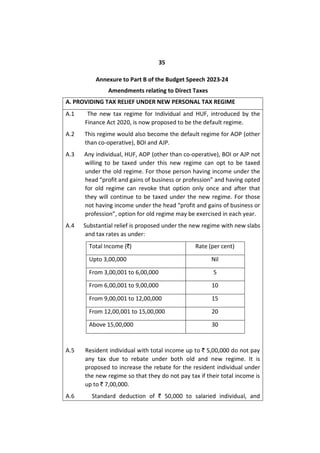
A.4 Substantial relief is proposed under the new regime with new slabs
and tax rates as under:
Total Income (`) Rate (per cent)
Upto 3,00,000 Nil
From 3,00,001 to 6,00,000 5
From 6,00,001 to 9,00,000 10
From 9,00,001 to 12,00,000 15
From 12,00,001 to 15,00,000 20
Above 15,00,000 30
A.5 Resident individual with total income up to ` 5,00,000 do not pay
any tax due to rebate under both old and new regime. It is
proposed to increase the rebate for the resident individual under
the new regime so that they do not pay tax if their total income is
up to ` 7,00,000.
A.6 Standard deduction of ` 50,000 to salaried individual, and
36
deduction from family pension up to ` 15,000, is currently allowed
only under the old regime. It is proposed to allow these two
deductions under the new regime also.
A.7 Surcharge on income-tax under both old regime and new regime is
10 per cent if income is above ` 50 lakh and up to ` 1 crore, 15 per
cent if income is above `1 crore and up to ` 2 crore, 25 per cent if
income is above ` 2 crore and up to ` 5 crore, and 37 per cent if
income is above ` 5 crore. It is proposed that the for those
individuals, HUF, AOP (other than co-operative), BOI and AJP
under the new regime, surcharge would be same except that the
surcharge rate of 37 per cent will not apply. Highest surcharge
shall be 25 per cent for income above
` 2 crore. This would reduce the maximum rate from about 42.7
per cent to about 39 per cent. No change in surcharge is proposed
for those who opt to be under the old regime.
A.8 Encashment of earned leave up to 10 months of average salary, at
the time of retirement in case of an employee (other than an
employee of the Central Government or State Government), is
exempt under sub-clause (ii) of clause (10AA) of section 10 of the
Income-tax Act (“the Act”) to the extent notified. The maximum
amount which can be exempted is ` 3 lakh at present. It is
proposed to issue notification to extend this limit to ` 25 lakh.
B. SOCIO-ECONOMIC WELFARE MEASURES
B.1 Promoting timely payments to Micro and Small Enterprises
In order to promote timely payments to micro and small
enterprises, it is proposed to include payments made to such
enterprises within the ambit of section 43B of the Act. Thus,
deduction for such payments would be allowed only when actually
paid. It will be allowed on accrual basis only if the payment is
within the time mandated under the Micro, Small and Medium
Enterprises Development Act.
B.2 Agnipath Scheme, 2022
The payment received from the Agniveer Corpus Fund by the
Agniveers enrolled in Agnipath Scheme, 2022 is proposed to be
exempt from taxes. Deduction in the computation of total income
is proposed to be allowed to the Agniveer on the contribution
37
made by him or the Central Government to his Seva Nidhi
account.
B.3 Relief to sugar co-operatives from past demand
It is proposed that for sugar co-operatives, for years prior to A.Y.
2016-17, if any deduction claimed for expenditure made on
purchase of sugar has been disallowed, an application may be
made to the Assessing Officer, who shall recompute the income of
the relevant previous year after allowing such deduction up to the
price fixed or approved by the Government for such previous year.
B.4 Increasing threshold limit for Co-operatives to withdraw cash
without TDS
It is proposed to enable co-operatives to withdraw cash up to ` 3
crore in a year without being subjected to TDS on such
withdrawal.
B.5 Penalty for cash loan/transactions against primary co-operatives
It is proposed to amend section 269SS of the Act to provide that
where a deposit is accepted by a primary agricultural credit
society or a primary co-operative agricultural and rural
development bank from its member or a loan is taken from a
primary agricultural credit society or a primary co-operative
agricultural and rural development bank by its member in cash, no
penal consequence would arise, if the amount of such loan or
deposit in cash is less than ` 2 lakh. Further, section 269T of the
Act is proposed to be amended to provide that where a deposit is
repaid by a primary agricultural credit society or a primary co-
operative agricultural and rural development bank to its member
or such loan is repaid to a primary agricultural credit society or a
primary co-operative agricultural and rural development bank by
its member in cash, no penal consequence shall arise, if the
amount of such loan or deposit in cash is less than ` 2 lakh.
B.6 Relief to start-ups in carrying forward and setting off of losses
The condition of continuity of at least 51 per cent shareholding for
setting off of carried forward losses is relaxed for an eligible start
up if all the shareholders of the company continue to hold those
shares. At present this relaxation applies for losses incurred during
the period of 7 years from incorporation of such start-up. It is
38
proposed to increase this period to 10 years.
B.7 Extension of date of incorporation for eligible start up for
exemption
Certain start-ups are eligible for some tax benefit if they are
incorporated before 1st April, 2023. The period of incorporation of
such eligible start-ups is proposed to be extended by one year to
before 1st April, 2024.
B.8 Gold to Electronic Gold Receipt
The conversion of physical gold to Electronic Gold Receipt and vice
versa is proposed not to be treated as a transfer and not to attract
any capital gains. This would promote investments in electronic
equivalent of gold.
B.9 Incentives to IFSC
Relocation of funds to IFSC has certain tax exemptions, if the
relocation is before 31.03.2023. This date is proposed to be
extended to 31.03.2025. Further, any distributed income from the
offshore derivative instruments entered into with an offshore
banking unit is also proposed to be exempted subject to certain
conditions.
B.10 Exemption to development authorities etc.
It is proposed to provide exemption to any income arising to a
body or authority or board or trust or commission, (not being a
company) which has been established or constituted by or under
a Central or State Act with the purposes of satisfying the need for
housing or for planning, development or improvement of cities,
towns and villages or for regulating any activity or matter,
irrespective of whether it is carrying out commercial activity.
B.11 Facilitating certain strategic disinvestments
To facilitate certain strategic disinvestments, it is proposed to
allow carry forward of accumulated losses and unabsorbed
depreciation allowance in the case of amalgamation of one or
more banking company with any other banking institution or a
company subsequent to a strategic disinvestment, if such
amalgamation takes place within 5 years of strategic
disinvestment. It is also proposed to modify the definition of
‘strategic disinvestment’.
39
B.12 15 per cent concessional tax to promote new manufacturing co-
operative society
In order to promote the growth of manufacturing in co-operative
sector, a new co-operative society formed on or after 01.04.2023,
which commences manufacturing or production by 31.03.2024
and do not avail of any specified incentive or deduction, is
proposed to be allowed an option to pay tax at a concessional rate
of 15 per cent similar to what is available to new manufacturing
companies.
C. EASE OF COMPLIANCE
C.1 Ease in claiming deduction on amortization of preliminary
expenditure
At present for claiming amortization of certain preliminary
expenses, the activity is to be carried out either by the assessee or
by a concern approved by the Board. In order to ease the process
of claiming amortization of these expenses it is proposed to
remove the condition of activity in connection with these
expenses to be carried out by a concern approved by the Board.
Format for reporting of such expenses by the assessee shall be
prescribed.
C.2 Increasing threshold limits for presumptive taxation schemes
In order to ease compliance and to promote non-cash
transactions, it is proposed to increase the threshold limits for
presumptive scheme of taxation for eligible businesses from ` 2
crore to ` 3 crore and for specified professions from ` 50 lakh to
` 75 lakh. The increased limit will apply only in case the amount or
aggregate of the amounts received during the year, in cash, does
not exceed five per cent of the total gross receipts/turnover.
C.3 Extending the scope for deduction of tax at source at lower or nil
rate
It is proposed to allow a taxpayer to obtain certificate of
deduction of tax at source to lower or nil rate on sums on which
tax is required to be deducted under section 194LBA of the Act by
Business Trusts.
40
D. WIDENING & DEEPENING OF TAX BASE AND ANTI AVOIDANCE
D.1 It is proposed to extend the deemed income accrual provision
relating to sums of money exceeding fifty thousand rupees,
received from residents without consideration to a not ordinarily
resident with effect from 1st
April, 2023.
D.2 It is proposed to omit the provision to allow tax exemption to
news agencies set up in India solely for collection and distribution
of news from the financial year 2023-24.
D.3 It is proposed to tax distributed income by business trusts in the
hands of a unit holder (other than dividend, interest or rent which
is already taxable) on which tax is currently avoided both in the
hands of unit holder as well as in the hands of business trust.
D.4 It is proposed to withdraw the exemption from TDS currently
available on interest payment on listed debentures.
D.5 With respect to presumptive schemes for non-residents, it is
proposed to disallow carried forward and set off of loss computed
as per books of account with presumptive income.
D.6 For online games, it is proposed to provide for TDS and taxability
on net winnings at the time of withdrawal or at the end of the
financial year. Moreover, TDS would be without the threshold of
` 10,000. For lottery, crossword puzzles games, etc threshold limit
` 10,000 for TDS shall continue but shall apply to aggregate
winnings during a financial year.
D.7 The rate of TCS for foreign remittances for education and for
medical treatment is proposed to continue to be 5 per cent for
remittances in excess of ` 7 lakh. Similarly, the rate of TCS on
foreign remittances for the purpose of education through loan
from financial institutions is proposed to continue to be 0.5 per
cent in excess of `7 lakh. However, for foreign remittances for
other purposes under LRS and purchase of overseas tour program,
it is proposed to increase the rates of TCS from 5 per cent to 20
per cent.
D.8 Tax on capital gains can be avoided by investing proceeds of such
gains in residential property. This is proposed to be capped at ` 10
crore.
41
D.9 The income from market linked debentures is proposed to be
taxed as short-term capital gains at the applicable rates.
D.10 It is proposed to provide for some provisions to minimise risk to
revenue due to undervaluation of inventory.
D.11 It is proposed to provide that where aggregate of premium for life
insurance policies (other than ULIP) issued on or after 1st
April,
2023 is above ` 5 lakh, income from only those policies with
aggregate premium up to ` 5 lakh shall be exempt. This will not
affect the tax exemption provided to the amount received on the
death of person insured. It will also not affect insurance policies
issued till 31st
March, 2023.
D.12 It is proposed to amend provisions for computing capital gains in
case of joint development of property to include the amount
received through cheque etc. as consideration.
D.13 While interest paid on borrowed capital for acquiring or improving
a property can, subject to certain conditions, be claimed as
deduction from income, it can also be included in the cost of
acquisition or improvement on transfer, thereby reducing capital
gains. It is proposed to provide that the cost of acquisition or
improvement shall not include the amount of interest claimed
earlier as deduction.
D.14 There are certain assets like intangible assets or rights for which
no consideration has been paid for acquisition and the transfer of
which may result in generation of income. Their cost of acquisition
is proposed to be defined to be NIL.
E. IMPROVING COMPLIANCE AND TAX ADMINISTRATION
E.1 With respect to rectification of orders by the Interim Board of
Settlement, it is proposed to provide that where the time-limit for
amending an order by it or for making an application to it expires
on or after 01.02.2021 but before 01.02.2022, such time-limit shall
stand extended to 30.09.2023.
E.2 To expedite the disposal of certain appeals pending with
Commissioner (Appeals), it is proposed to introduce a new
authority in the rank of Joint Commissioner/ Additional
Commissioner [JCIT(Appeals)], for appeals against certain orders
42
passed by or with the approval of an authority below the rank of
Joint Commissioner. Certain related and consequential
amendments are also proposed in this regard.
E.3 It is proposed to reduce the minimum time period required to be
provided by the transfer pricing officer to assessee for production
of documents and information from 30 days to 10 days.
E.4 It is proposed to provide for appeal against penalty orders passed
by Commissioner (Appeals) under certain sections of the Act
before the Appellate Tribunal. It is also proposed to provide that
an order under section 263 of the Act passed by the Principal
Chief Commissioner or Chief Commissioner and any rectification
order for the same shall also be appealable before the Appellate
Tribunal. Further, it is proposed to enable filing of memorandum
of cross-objections in all classes of cases against which appeal can
be made to the Appellate Tribunal.
E.5 It is proposed to amend section 132 of the Act, dealing with
search and seizure, to allow the authorised officer to take
assistance of specific domain experts like digital forensic
professionals, valuers and services of other professionals like
locksmiths, carpenters etc. during the course of search and also to
aid in accurate estimation of undisclosed income held in the form
of property by the assessee.
E.6 Section 170A of the Act, inserted vide Finance Act, 2022 is
proposed to be substituted to clarify that a modified return shall
be furnished by an entity to whom the order of the business
reorganisation applies, and to introduce provisions for assessment
or reassessment in cases where such modified return is furnished.
E.7 It is proposed that an order of assessment may be passed within a
period of 12 months from the end of the relevant assessment year
or the financial year in which updated return is filed, as the case
may be. It is also proposed that in cases where search under
section 132 of the Act or requisition under section 132A of the Act
has been made, the period of limitation of pending assessments
shall be extended by twelve months.
E.8 It is proposed to make amendments to empower the Central
Government to make modifications in the already notified
43
schemes regarding e-Verification, Dispute Resolution, Advance
Rulings, Appeal and Penalty, at any time to enable better
implementation of such schemes.
E.9 It is proposed to limit the time for furnishing of a return for
reassessment. Further, it is also proposed to provide that in cases
where search related information is available after 15th March of
any financial year, an additional period of fifteen days shall be
allowed for issuance of notice, for assessment/reassessments etc,
under section 148 of the Act. It is also proposed to clarify that the
specified authority for granting approval shall be Principal Chief
Commissioner or Principal Director General or Chief Commissioner
or Director General.
E.10 It is proposed to provide a penalty of ` 5,000 if there is any
inaccuracy in the statement of financial transactions submitted by
a prescribed reporting financial institution due to false or
inaccurate information submitted by the account holder.
E.11 It is proposed to amend section 271C and section 276B of the Act
to provide for penalty and prosecution where default in TDS
relates to transaction in kind.
E.12. It is proposed to amend the time period for filing of appeal against
the order of the Adjudicating authority under Benami Act within a
period of 45 days from the date when such order is received by
the Initiating Officer or the aggrieved person. The definition of
‘High Court’ is also proposed to be modified to allow
determination of jurisdiction for filing appeal in the case of non-
residents.
F. RATIONALISATION
F.1 The restriction on interest deductibility on interest payment to
overseas associated enterprise does not apply to those in the
business of banking and insurance. It is proposed to extend this
benefit to non-banking financial companies, as may be notified.
F.2 TDS on payment of certain income to a non-resident is currently at
the rate of 20 per cent, but the tax rate in treaties may be lower. It
is proposed to allow the benefit of tax treaty at the time of TDS on
such income under section 196A of the Act.
44
F.3 At present the TDS rate on withdrawal of taxable component from
Employees’ Provident Fund Scheme in non-PAN cases is 30 per
cent. It is proposed to reduce it to 20 per cent, as in other non-
PAN cases.
F.4 Sometimes, tax for income of an earlier year is deducted later,
while tax thereon has already been paid in the earlier year.
Amendment is proposed to facilitate such taxpayers to claim
credit of this TDS in the earlier year.
F.5 Higher TDS/TCS rate applies, if the recipient is a non-filer i.e. who
has not furnished his return of income of preceding previous year
and has aggregate of TDS and TCS of ` 50,000 or more. It is
proposed to exclude a person who is not required to furnish the
return of income for such previous year and who is notified by the
Central Government in the Official Gazette in this behalf.
F.6 It is proposed to clarify that the amount of advance tax paid is
reduced only once for computing the interest payable u/s 234B in
the case of an updated return.
F.7 It is proposed to extend taxability of the consideration (share
application money/ share premium) for shares exceeding the face
value of such shares to all investors including non-residents.
F.8 It is proposed to enable prescription of a uniform methodology for
computing the value of perquisite with respect to accommodation
provided by employers to their employees.
F.9 It is proposed to provide a time limit for an SEZ unit to bring the
proceeds from exports of goods or services into India. The filing of
income-tax return is also proposed to be made mandatory for
claiming deduction on export income.
F.10 Due to changes in classification of non-banking financial
companies by the Reserve Bank of India, it is proposed to make
necessary amendments to align such classifications in the Act with
the same.
F.11 It is proposed to clarify that for taxability under section 28 of the
Act as well for tax deduction at source under section 194R of the
Act, the benefit could also be in cash.
F.12 It is proposed to make amendments relating to exemption
45
provided to charitable trusts and institution to
 provide clarity on tax treatment on replenishment of corpus
and on repayment of loans/borrowings;
 treat only 85 per cent of donation made to another trust as
application;
 omit the redundant provisions related to rolling back of
exemption;
 combine provisional and regular registration in some cases;
 modify the scope of specified violation;
 provide for payment of tax on assets if a trust does not apply
for exemption after getting provisional exemption and for re-
exemption after expiry of exemption;
 align of time for furnishing of certain forms;
 clarify that the time provided for furnishing return of income
for claiming exemption shall not include the time provided for
furnishing updated return.
F.13 It is proposed to omit certain name-based funds from section 80G
of the Act, which provides for deduction of donation to such funds
from the income of the donor.
F.14 It is proposed to provide that where refund is due to a person,
such refund shall be set off against existing demand, and if
proceedings for assessment or reassessment are pending in such
case, the refund due will be withheld by the Assessing Officer till
the date of assessment or reassessment.
G. OTHERS
G.1 It is proposed to omit section 88 and some of the clauses of
section 10 of the Act which are no longer in force.
G.2 It is proposed to extend tax exemption to Specified Undertaking of
Unit Trust of India (SUUTI) till 30th
September, 2023. It is also
proposed to enable the Central Government to notify the date of
vacation of office of administrator of SUUTI.
G.3 It is proposed to decriminalize certain acts of omission of
liquidators under section 276A of the Act with effect from 1st
April, 2023.
46
Annexure to Part B of the Budget Speech 2023-24
Amendments relating to Indirect Taxes
A. LEGISLATIVE CHANGES IN CUSTOMS LAWS
A.1 Amendments in the Customs Act, 1962
Section 25 (4A) is being amended to exclude certain categories of
conditional customs duty exemptions from the validity period of
two years, such as, notifications issued in relation to multilateral
or bilateral trade agreements; obligations under international
agreements, treaties, conventions including with respect to UN
agencies, diplomats, international organizations; privileges of
constitutional authorities; schemes under Foreign Trade Policy;
Central Government schemes having a validity of more than two
years; re-imports, temporary imports, goods imported as gifts or
personal baggage; any other duties of Customs under any other
law in force including IGST levied under section 3(7) of Customs
Tariff Act, 1975, other than duty of customs levied under section
12 of the Customs Act 1962.
Section 127C is being amended to specify a time limit of nine
months from date of filing application for passing final order by
Settlement Commission.
A.2 Amendments in the provisions relating to Anti-Dumping Duty
(ADD), Countervailing Duty (CVD), and Safeguard Measures
Sections 9, 9A, 9C of the Customs Tariff Act are being amended to
clarify the intent and scope of these provisions. They are also
being validated retrospectively with effect from 1st January 1995.
A.3 Amendments in the First Schedule to the Customs Tariff Act, 1975
The First Schedule to the Customs Tariff Act, 1975 is being
amended to increase the rates on certain tariff items with effect
from 02.02.2023 and also modify the rates on certain other tariff
items as part of rate rationalisation with effect from date of
assent.
The First Schedule to the Customs Tariff Act is being proposed to
be amended in accordance with HSN 2022 amendments.
New tariff lines are also proposed to be created, which will help in
better identification of millet-based products, mozzarella cheese,
medicinal plants and their parts, certain pesticides, telecom
47
products, synthetic diamonds, cotton, fertilizer grade urea etc.
This will also help in trade facilitation by better identification of
the above items, getting clarity on availing concessional import
duty through various notifications and thus reducing dwell time.
These changes shall come into effect from 01.05.2023.
A.4 Amendment in the Second Schedule to the Customs Tariff Act,
1975
The Second Schedule (Export Tariff) is being amended to align the
entries under heading 1202 with that of the First Schedule (Import
Tariff) .
B. LEGISLATIVE CHANGES IN GST LAWS
B.1 Decriminalisation
Section 132 and section 138 of CGST Act are being amended, inter
alia, to -
 raise the minimum threshold of tax amount for launching
prosecution under GST from ` one crore to ` two crore,
except for the offence of issuance of invoices without supply
of goods or services or both;
 reduce the compounding amount from the present range of
50 per cent to 150 per cent of tax amount to the range of 25
per cent to 100 per cent;
 decriminalize certain offences specified under clause (g), (j)
and (k) of sub-section (1) of section 132 of CGST Act, 2017,
viz.-
o obstruction or preventing any officer in discharge of his
duties;
o deliberate tempering of material evidence;
o failure to supply the information.
B.2 Facilitate e-commerce for micro enterprises
Amendments are being made in section 10 and section 122 of the
CGST Act to enable unregistered suppliers and composition
taxpayers to make intra-state supply of goods through E-
Commerce Operators (ECOs), subject to certain conditions.
B.3 Amendment to Schedule III of CGST Act, 2017
Paras 7, 8 (a) and 8 (b) were inserted in Schedule III of CGST Act,
2017 with effect from 01.02.2019 to keep certain transactions/
activities, such as supplies of goods from a place outside the
taxable territory to another place outside the taxable territory,
high sea sales and supply of warehoused goods before their home
48
clearance, outside the purview of GST. In order to remove the
doubts and ambiguities regarding taxability of such transactions/
activities during the period 01.07.2017 to 31.01.2019, provisions
are being incorporated to make the said paras effective from
01.07.2017. However, no refund of tax paid shall be available in
cases where any tax has already been paid in respect of such
transactions/ activities during the period 01.07.2017 to
31.01.2019.
B.4 Return filing under GST
Sections 37, 39, 44 and 52 of CGST Act, 2017 are being amended
to restrict filing of returns/ statements to a maximum period of
three years from the due date of filing of the relevant return /
statement.
B.5 Input Tax Credit for expenditure related to CSR
Section 17(5) of CGST Act is being amended to provide that input
tax credit shall not be available in respect of goods or services or
both received by a taxable person, which are used or intended to
be used for activities relating to his obligations under corporate
social responsibility referred to in section 135 of the Companies
Act, 2013.
B.6 Sharing of information
A new section 158A in CGST Act is being inserted to enable sharing
of the information furnished by the registered person in his return
or application of registration or statement of outward supplies, or
the details uploaded by him for generation of electronic invoice or
E-way bill or any other details on the common portal, with other
systems in a manner to be prescribed
B.7 Amendments in section 2 clause (16) of IGST Act, 2017
Clause (16) of section 2 of IGST Act is amended to revise the
definition of “non-taxable online recipient” by removing the
condition of receipt of online information and database access or
retrieval services for purposes other than commerce, industry or
any other business or profession so as to provide for taxability of
OIDAR service provided by any person located in non-taxable
territory to an unregistered person receiving the said services and
located in the taxable territory. Further, it also seeks to clarify that
the persons registered solely in terms of clause (vi) of Section 24
of CGST Act shall be treated as unregistered person for the
purpose of the said clause.
49
B.8 Online information and database access or retrieval services
Clause (17) of section 2 of IGST Act is being amended to revise the
definition of “online information and database access or retrieval
services” to remove the condition of rendering of the said supply
being essentially automated and involving minimal human
intervention.
B.9 Place of supply in certain cases
Proviso to sub-section (8) of section 12 of the IGST Act is being
omitted so as to specify the place of supply, irrespective of
destination of the goods, in cases where the supplier of services
and recipient of services are located in India.
50
C. CUSTOMS DUTY RATE CHANGES
C.1. Reduction in basic customs duty to reduce input costs, deepen value
addition, to promote export competitiveness, correct inverted duty
structure so as to boost domestic manufacturing etc [with effect
from 02.02.2023]
S.
No.
Commodity
From
(per cent)
To
(per cent)
I. Agricultural Products
1. Pecan Nuts 100 30
2. Fish meal for manufacture of aquatic
feed
15 5
3. Krill meal for manufacture of aquatic
feed
15 5
4. Fish lipid oil for manufacture of aquatic
feed
30 15
5. Algal Prime (flour) for manufacture of
aquatic feed
30 15
6. Mineral and Vitamin Premixes for
manufacture of aquatic feed
15 5
7 Crude glycerin for use in manufacture
of Epichlorohydrin
7.5 2.5
8 Denatured ethyl alcohol for use in
manufacture of industrial chemicals.
5 Nil
II. Minerals
1 Acid grade fluorspar (containing by
weight more than 97 per cent of
calcium fluoride)
5 2.5
III. Gems and Jewellery Sector
1. Seeds for use in manufacturing of
rough lab-grown diamonds
5 Nil
51
IV. Capital Goods
1. Specified capital goods/machinery for
manufacture of lithium-ion cell for use
in battery of electrically operated
vehicle (EVs)
As
applicable
Nil
(up to
31.03.2024)
V. IT and Electronics
1. Specified chemicals/items for
manufacture of Pre-calcined Ferrite
Powder
7.5 Nil
(up to
31.03.2024)
2. Palladium Tetra Amine Sulphate for
manufacture of parts of connectors
7.5 Nil
(up to
31.03.2024)
3. Camera lens and its inputs/parts for
use in manufacture of camera module
of cellular mobile phone
2.5 Nil
4. Specified parts for manufacture of
open cell of TV panel
5 2.5
VI. Electronic Appliances
1. Heat coil for manufacture of electric
kitchen chimneys
20 15
VII. Others
1. Warm blood horse imported by sports
person of outstanding eminence for
training purpose
30 Nil
2. Vehicles, specified automobile
parts/components, sub-systems and
tyres when imported by notified
testing agencies, for the purpose of
testing and/ or certification, subject to
conditions.
As
applicable
Nil
52
C.2. Increase in Customs duty [with effect from 02.02.2023]
S. No. Commodity Rate of duties
From
(per cent)
To
(per cent)
I. Chemicals
1. Styrene 2
(+0.2 SWS)
2.5
(+0.25
SWS)
2. Vinyl chloride monomer 2
(+0.2 SWS)
2.5
(+0.25
SWS)
II Petrochemical
1 Naphtha 1
(+ 0.1 SWS)
2.5
(+0.25 SWS)
III. Precious Metals
1. Silver (including silver plated with gold
or platinum), unwrought or in semi-
manufactured forms, or in powder
form
7.5
(+ 2.5
AIDC+ 0.75
SWS)
10
(+ 5 AIDC+
Nil SWS)
2. Silver dore 6.1
(+ 2.5
AIDC+ 0.61
SWS)
10
(+ 4.35
AIDC+ Nil
SWS)
IV. Gems and Jewellery Sector
1. Articles of Precious Metals such as
gold/silver/platinum
20
(+Nil AIDC
+2 SWS)
25
(+Nil AIDC
+Nil SWS)
2. Imitation Jewellery 20 or `
400/kg.,
whichever is
higher
(+Nil AIDC +2
or ` 40 per
Kg SWS)
25 or `
600/kg.,
whichever is
higher
(+Nil AIDC
+Nil SWS)
53
S. No. Commodity Rate of duties
From
(per cent)
To
(per cent)
V. Automobiles
1 Vehicle (including electric vehicles) in
Semi-Knocked Down (SKD) form .
30
(+3 SWS)
35
(+Nil SWS)
2 Vehicle in Completely Built Unit (CBU)
form, other than with CIF more than
USD 40,000 or with engine capacity
more than 3000 cc for petrol-run
vehicle and more than 2500 cc for
diesel-run vehicles, or with both
60
(+6 SWS)
70
(+Nil SWS)
3 Electrically operated Vehicle in
Completely Built Unit (CBU) form,
other than with CIF value more than
USD 40,000
60
(+ 6 SWS)
70
(+Nil SWS)
VI. Others
1. Bicycles 30
(+ Nil AIDC
+3 SWS)
35
(+ Nil AIDC
+Nil SWS)
2. Toys and parts of toys (other than
parts of electronic toys)
60
(+Nil AIDC+
6 SWS)
70
(+Nil AIDC+
Nil SWS)
3. Compounded Rubber 10 25 or `
30/kg.,
whichever is
lower
4. Electric Kitchen Chimney 7.5 15
* AIDC -Agriculture Infrastructure Development Cess; SWS – Social Welfare
Surcharge
54
D. CHANGES IN CENTRAL EXCISE
D.1. NCCD Duty rate on Cigarettes [with effect from 02.02.2023]
Description of goods
Rate of excise duty
From
(` per 1000
sticks)
To
(` per 1000
sticks)
Other than filter cigarettes, of length not
exceeding 65 mm
200 230
Other than filter cigarettes, of length exceeding
65 mm but not exceeding 70 mm
250 290
Filter cigarettes of length not exceeding 65 mm 440 510
Filter cigarettes of length exceeding 65 mm but
not exceeding 70 mm
440 510
Filter cigarettes of length exceeding 70 mm but
not exceeding 75 mm
545 630
Other cigarettes 735 850
Cigarettes of tobacco substitutes 600 690
D.2. Other changes in Central Excise [with effect from 02.02.2023]
In order to promote green fuel, central excise duty exemption is being
provided to blended Compressed Natural Gas from so much of the amount
as is equal to the GST paid on Bio Gas/Compressed Bio Gas contained in the
blended CNG.
E. OTHERS
There are few other changes of minor nature. For details of the budget
proposals, the Explanatory Memorandum and other relevant budget
documents may be referred to.
*****

budget_speech.pdf

  • 1.
    Budget 2023-2024 Speech of NirmalaSitharaman Minister of Finance February 1, 2023 Hon’ble Speaker, I present the Budget for 2023-24. This is the first Budget in Amrit Kaal. Introduction 1. This Budget hopes to build on the foundation laid in the previous Budget, and the blueprint drawn for India@100. We envision a prosperous and inclusive India, in which the fruits of development reach all regions and citizens, especially our youth, women, farmers, OBCs, Scheduled Castes and Scheduled Tribes. 2. In the 75th year of our Independence, the world has recognised the Indian economy as a ‘bright star’. Our current year’s economic growth is estimated to be at 7 per cent. It is notable that this is the highest among all the major economies. This is in spite of the massive slowdown globally caused by Covid-19 and a war. The Indian economy is therefore on the right track, and despite a time of challenges, heading towards a bright future. 3. Today as Indians stands with their head held high, and the world appreciates India’s achievements and successes, we are sure that elders who had fought for India’s independence, will with joy, bless us our endeavors going forward. Resilience amidst multiple crises 4. Our focus on wide-ranging reforms and sound policies, implemented through Sabka Prayas resulting in Jan Bhagidari and targeted support to those in need, helped us perform well in trying times. India’s rising global
  • 2.
    2 profile is becauseof several accomplishments: unique world class digital public infrastructure, e.g., Aadhaar, Co-Win and UPI; Covid vaccination drive in unparalleled scale and speed; proactive role in frontier areas such as achieving the climate related goals, mission LiFE, and National Hydrogen Mission. 5. During the Covid-19 pandemic, we ensured that no one goes to bed hungry, with a scheme to supply free food grains to over 80 crore persons for 28 months. Continuing our commitment to ensure food and nutritional security, we are implementing, from 1st January 2023, a scheme to supply free food grain to all Antyodaya and priority households for the next one year, under PM Garib Kalyan Anna Yojana (PMGKAY). The entire expenditure of about ` 2 lakh crore will be borne by the Central Government. G20 Presidency: Steering the global agenda through challenges 6. In these times of global challenges, the G20 Presidency gives us a unique opportunity to strengthen India’s role in the world economic order. With the theme of ‘Vasudhaiva Kutumbakam’, we are steering an ambitious, people-centric agenda to address global challenges, and to facilitate sustainable economic development. Achievements since 2014: Leaving no one behind 7. The government’s efforts since 2014 have ensured for all citizens a better quality of living and a life of dignity. The per capita income has more than doubled to ` 1.97 lakh. 8. In these nine years, the Indian economy has increased in size from being 10th to 5th largest in the world. We have significantly improved our position as a well-governed and innovative country with a conducive environment for business as reflected in several global indices. We have made significant progress in many Sustainable Development Goals.
  • 3.
    3 9. The economyhas become a lot more formalised as reflected in the EPFO membership more than doubling to 27 crore, and 7,400 crore digital payments of ` 126 lakh crore through UPI in 2022. 10. The efficient implementation of many schemes, with universalisation of targeted benefits, has resulted in inclusive development. Some of the schemes are: i. 11.7 crore household toilets under Swachh Bharat Mission, ii. 9.6 crore LPG connections under Ujjawala, iii. 220 crore Covid vaccination of 102 crore persons, iv. 47.8 crore PM Jan Dhan bank accounts, v. Insurance cover for 44.6 crore persons under PM Suraksha Bima and PM Jeevan Jyoti Yojana, and vi. Cash transfer of ` 2.2 lakh crore to over 11.4 crore farmers under PM Kisan Samman Nidhi. Vision for Amrit Kaal – an empowered and inclusive economy 11. Our vision for the Amrit Kaal includes technology-driven and knowledge-based economy with strong public finances, and a robust financial sector. To achieve this, Jan Bhagidari through Sabka Saath Sabka Prayas is essential. 12. The economic agenda for achieving this vision focuses on three things: first, facilitating ample opportunities for citizens, especially the youth, to fulfil their aspirations; second, providing strong impetus to growth and job creation; and third, strengthening macro-economic stability. 13. To service these focus areas in our journey to India@100, we believe that the following four opportunities can be transformative during Amrit Kaal.
  • 4.
    4 1) Economic Empowermentof Women: Deendayal Antyodaya Yojana National Rural Livelihood Mission has achieved remarkable success by mobilizing rural women into 81 lakh Self Help Groups. We will enable these groups to reach the next stage of economic empowerment through formation of large producer enterprises or collectives with each having several thousand members and managed professionally. They will be helped with supply of raw materials and for better design, quality, branding and marketing of their products. Through supporting policies, they will be enabled to scale up their operations to serve the large consumer markets, as has been the case with several start-ups growing into ‘Unicorns’. 2) PM VIshwakarma KAushal Samman (PM VIKAS): For centuries, traditional artisans and craftspeople, who work with their hands using tools, have brought renown for India. They are generally referred to as Vishwakarma. The art and handicraft created by them represents the true spirit of Atmanirbhar Bharat. For the first time, a package of assistance for them has been conceptualized. The new scheme will enable them to improve the quality, scale and reach of their products, integrating them with the MSME value chain. The components of the scheme will include not only financial support but also access to advanced skill training, knowledge of modern digital techniques and efficient green technologies, brand promotion, linkage with local and global markets, digital payments, and social security. This will greatly benefit the Scheduled Castes, Scheduled Tribes, OBCs, women and people belonging to the weaker sections. 3) Tourism: The country offers immense attraction for domestic as well as foreign tourists. There is a large potential to be tapped in tourism. The sector holds huge opportunities for jobs and entrepreneurship for youth in particular. Promotion of tourism will be taken up on mission mode, with active participation of states, convergence of government programmes and public-private partnerships.
  • 5.
    5 4) Green Growth:We are implementing many programmes for green fuel, green energy, green farming, green mobility, green buildings, and green equipment, and policies for efficient use of energy across various economic sectors. These green growth efforts help in reducing carbon intensity of the economy and provides for large- scale green job opportunities. Priorities of this Budget 14. The Budget adopts the following seven priorities. They complement each other and act as the ‘Saptarishi’ guiding us through the Amrit Kaal. 1) Inclusive Development 2) Reaching the Last Mile 3) Infrastructure and Investment 4) Unleashing the Potential 5) Green Growth 6) Youth Power 7) Financial Sector Priority 1: Inclusive Development 15. The Government’s philosophy of Sabka Saath Sabka Vikas has facilitated inclusive development covering in specific, farmers, women, youth, OBCs, Scheduled Castes, Scheduled Tribes, divyangjan and economically weaker sections, and overall priority for the underprivileged (vanchiton ko variyata). There has also been a sustained focus on Jammu & Kashmir, Ladakh and the North-East. This Budget builds on those efforts. Agriculture and Cooperation Digital Public Infrastructure for Agriculture 16. Digital public infrastructure for agriculture will be built as an open source, open standard and inter operable public good. This will enable
  • 6.
    6 inclusive, farmer-centric solutionsthrough relevant information services for crop planning and health, improved access to farm inputs, credit, and insurance, help for crop estimation, market intelligence, and support for growth of agri-tech industry and start-ups. Agriculture Accelerator Fund 17. An Agriculture Accelerator Fund will be set-up to encourage agri- startups by young entrepreneurs in rural areas. The Fund will aim at bringing innovative and affordable solutions for challenges faced by farmers. It will also bring in modern technologies to transform agricultural practices, increase productivity and profitability. Enhancing productivity of cotton crop 18. To enhance the productivity of extra-long staple cotton, we will adopt a cluster-based and value chain approach through Public Private Partnerships (PPP). This will mean collaboration between farmers, state and industry for input supplies, extension services, and market linkages. Atmanirbhar Horticulture Clean Plant Program 19. We will launch an Atmanirbhar Clean Plant Program to boost availability of disease-free, quality planting material for high value horticultural crops at an outlay of ` 2,200 crore. Global Hub for Millets: ‘Shree Anna’ 20. “India is at the forefront of popularizing Millets, whose consumption furthers nutrition, food security and welfare of farmers,” said Hon’ble Prime Minister. 21. We are the largest producer and second largest exporter of ‘Shree Anna’ in the world. We grow several types of 'Shree Anna' such as jowar, ragi, bajra, kuttu, ramdana, kangni, kutki, kodo, cheena, and sama. These have a number of health benefits, and have been an integral part of our food for centuries. I acknowledge with pride the huge service done by small
  • 7.
    7 farmers in contributingto the health of fellow citizens by growing these ‘Shree Anna’. 22. Now to make India a global hub for 'Shree Anna', the Indian Institute of Millet Research, Hyderabad will be supported as the Centre of Excellence for sharing best practices, research and technologies at the international level. Agriculture Credit 23. The agriculture credit target will be increased to ` 20 lakh crore with focus on animal husbandry, dairy and fisheries. Fisheries 24. We will launch a new sub-scheme of PM Matsya Sampada Yojana with targeted investment of ` 6,000 crore to further enable activities of fishermen, fish vendors, and micro & small enterprises, improve value chain efficiencies, and expand the market. Cooperation 25. For farmers, especially small and marginal farmers, and other marginalised sections, the government is promoting cooperative-based economic development model. A new Ministry of Cooperation was formed with a mandate to realise the vision of ‘Sahakar Se Samriddhi’. To realise this vision, the government has already initiated computerisation of 63,000 Primary Agricultural Credit Societies (PACS) with an investment of ` 2,516 crore. In consultation with all stakeholders and states, model bye-laws for PACS were formulated enabling them to become multipurpose PACS. A national cooperative database is being prepared for country-wide mapping of cooperative societies. 26. With this backdrop, we will implement a plan to set up massive decentralised storage capacity. This will help farmers store their produce and realize remunerative prices through sale at appropriate times. The government will also facilitate setting up of a large number of multipurpose
  • 8.
    8 cooperative societies, primaryfishery societies and dairy cooperative societies in uncovered panchayats and villages in the next 5 years. Health, Education and Skilling Nursing Colleges 27. One hundred and fifty-seven new nursing colleges will be established in co-location with the existing 157 medical colleges established since 2014. Sickle Cell Anaemia Elimination Mission 28. A Mission to eliminate Sickle Cell Anaemia by 2047 will be launched. It will entail awareness creation, universal screening of 7 crore people in the age group of 0-40 years in affected tribal areas, and counselling through collaborative efforts of central ministries and state governments. Medical Research 29. Facilities in select ICMR Labs will be made available for research by public and private medical college faculty and private sector R&D teams for encouraging collaborative research and innovation. Pharma Innovation 30. A new programme to promote research and innovation in pharmaceuticals will be taken up through centers of excellence. We shall also encourage industry to invest in research and development in specific priority areas. Multidisciplinary courses for medical devices 31. Dedicated multidisciplinary courses for medical devices will be supported in existing institutions to ensure availability of skilled manpower for futuristic medical technologies, high-end manufacturing and research.
  • 9.
    9 Teachers’ Training 32. Teachers’training will be re-envisioned through innovative pedagogy, curriculum transaction, continuous professional development, dipstick surveys, and ICT implementation. The District Institutes of Education and Training will be developed as vibrant institutes of excellence for this purpose. National Digital Library for Children and Adolescents 33. A National Digital Library for children and adolescents will be set-up for facilitating availability of quality books across geographies, languages, genres and levels, and device agnostic accessibility. States will be encouraged to set up physical libraries for them at panchayat and ward levels and provide infrastructure for accessing the National Digital Library resources. 34. Additionally, to build a culture of reading, and to make up for pandemic-time learning loss, the National Book Trust, Children’s Book Trust and other sources will be encouraged to provide and replenish non- curricular titles in regional languages and English to these physical libraries. Collaboration with NGOs that work in literacy will also be a part of this initiative. To inculcate financial literacy, financial sector regulators and organizations will be encouraged to provide age-appropriate reading material to these libraries. Priority 2: Reaching the Last Mile 35. Prime Minister Vajpayee’s government had formed the Ministry of Tribal Affairs and the Department of Development of North-Eastern Region. To provide a sharper focus to the objective of ‘reaching the last mile’, our government has formed the ministries of AYUSH, Fisheries, Animal Husbandry and Dairying, Skill Development, Jal Shakti and Cooperation.
  • 10.
    10 Aspirational Districts andBlocks Programme 36. Building on the success of the Aspirational Districts Programme, the Government has recently launched the Aspirational Blocks Programme covering 500 blocks for saturation of essential government services across multiple domains such as health, nutrition, education, agriculture, water resources, financial inclusion, skill development, and basic infrastructure. Pradhan Mantri PVTG Development Mission 37. To improve socio-economic conditions of the particularly vulnerable tribal groups (PVTGs), Pradhan Mantri PVTG Development Mission will be launched. This will saturate PVTG families and habitations with basic facilities such as safe housing, clean drinking water and sanitation, improved access to education, health and nutrition, road and telecom connectivity, and sustainable livelihood opportunities. An amount of ` 15,000 crore will be made available to implement the Mission in the next three years under the Development Action Plan for the Scheduled Tribes. Eklavya Model Residential Schools 38. In the next three years, centre will recruit 38,800 teachers and support staff for the 740 Eklavya Model Residential Schools, serving 3.5 lakh tribal students. Water for Drought Prone Region 39. In the drought prone central region of Karnataka, central assistance of ` 5,300 crore will be given to Upper Bhadra Project to provide sustainable micro irrigation and filling up of surface tanks for drinking water. PM Awas Yojana 40. The outlay for PM Awas Yojana is being enhanced by 66 per cent to over ` 79,000 crore.
  • 11.
    11 Bharat Shared Repositoryof Inscriptions (Bharat SHRI) 41. ‘Bharat Shared Repository of Inscriptions’ will be set up in a digital epigraphy museum, with digitization of one lakh ancient inscriptions in the first stage. Support for poor prisoners 42. For poor persons who are in prisons and unable to afford the penalty or the bail amount, required financial support will be provided. Priority 3: Infrastructure & Investment 43. Investments in Infrastructure and productive capacity have a large multiplier impact on growth and employment. After the subdued period of the pandemic, private investments are growing again. The Budget takes the lead once again to ramp up the virtuous cycle of investment and job creation. Capital Investment as driver of growth and jobs 44. Capital investment outlay is being increased steeply for the third year in a row by 33 per cent to ` 10 lakh crore, which would be 3.3 per cent of GDP. This will be almost three times the outlay in 2019-20. 45. This substantial increase in recent years is central to the government’s efforts to enhance growth potential and job creation, crowd- in private investments, and provide a cushion against global headwinds. Effective Capital Expenditure 46. The direct capital investment by the Centre is complemented by the provision made for creation of capital assets through Grants-in-Aid to States. The ‘Effective Capital Expenditure’ of the Centre is budgeted at ` 13.7 lakh crore, which will be 4.5 per cent of GDP.
  • 12.
    12 Support to StateGovernments for Capital Investment 47. I have decided to continue the 50-year interest free loan to state governments for one more year to spur investment in infrastructure and to incentivize them for complementary policy actions, with a significantly enhanced outlay of ` 1.3 lakh crore. Enhancing opportunities for private investment in Infrastructure 48. The newly established Infrastructure Finance Secretariat will assist all stakeholders for more private investment in infrastructure, including railways, roads, urban infrastructure and power, which are predominantly dependent on public resources. Harmonized Master List of Infrastructure 49. The Harmonized Master List of Infrastructure will be reviewed by an expert committee for recommending the classification and financing framework suitable for Amrit Kaal. Railways 50. A capital outlay of ` 2.40 lakh crore has been provided for the Railways. This highest ever outlay is about 9 times the outlay made in 2013- 14. Logistics 51. One hundred critical transport infrastructure projects, for last and first mile connectivity for ports, coal, steel, fertilizer, and food grains sectors have been identified. They will be taken up on priority with investment of ` 75,000 crore, including ` 15,000 crore from private sources. Regional Connectivity 52. Fifty additional airports, heliports, water aerodromes and advance landing grounds will be revived for improving regional air connectivity.
  • 13.
    13 Sustainable Cities ofTomorrow 53. States and cities will be encouraged to undertake urban planning reforms and actions to transform our cities into ‘sustainable cities of tomorrow’. This means efficient use of land resources, adequate resources for urban infrastructure, transit-oriented development, enhanced availability and affordability of urban land, and opportunities for all. Making Cities ready for Municipal Bonds 54. Through property tax governance reforms and ring-fencing user charges on urban infrastructure, cities will be incentivized to improve their credit worthiness for municipal bonds. Urban Infrastructure Development Fund 55. Like the RIDF, an Urban Infrastructure Development Fund (UIDF) will be established through use of priority sector lending shortfall. This will be managed by the National Housing Bank, and will be used by public agencies to create urban infrastructure in Tier 2 and Tier 3 cities. States will be encouraged to leverage resources from the grants of the 15th Finance Commission, as well as existing schemes, to adopt appropriate user charges while accessing the UIDF. We expect to make available ` 10,000 crore per annum for this purpose. Urban Sanitation 56. All cities and towns will be enabled for 100 per cent mechanical desludging of septic tanks and sewers to transition from manhole to machine-hole mode. Enhanced focus will be provided for scientific management of dry and wet waste. Priority 4: Unleashing the Potential 57. “Good Governance is the key to a nation’s progress. Our government is committed to providing a transparent and accountable administration which works for the betterment and welfare of the common citizen,” said Hon’ble Prime Minister.
  • 14.
    14 Mission Karmayogi 58. UnderMission Karmayogi, Centre, States and Union Territories are making and implementing capacity-building plans for civil servants. The government has also launched an integrated online training platform, iGOT Karmayogi, to provide continuous learning opportunities for lakhs of government employees to upgrade their skills and facilitate people-centric approach. 59. For enhancing ease of doing business, more than 39,000 compliances have been reduced and more than 3,400 legal provisions have been decriminalized. For furthering the trust- based governance, we have introduced the Jan Vishwas Bill to amend 42 Central Acts. This Budget proposes a series of measures to unleash the potential of our economy. Centres of Excellence for Artificial Intelligence 60. For realizing the vision of “Make AI in India and Make AI work for India”, three centres of excellence for Artificial Intelligence will be set-up in top educational institutions. Leading industry players will partner in conducting interdisciplinary research, develop cutting-edge applications and scalable problem solutions in the areas of agriculture, health, and sustainable cities. This will galvanize an effective AI ecosystem and nurture quality human resources in the field. National Data Governance Policy 61. To unleash innovation and research by start-ups and academia, a National Data Governance Policy will be brought out. This will enable access to anonymized data. Simplification of Know Your Customer (KYC) process 62. The KYC process will be simplified adopting a ‘risk-based’ instead of ‘one size fits all’ approach. The financial sector regulators will also be
  • 15.
    15 encouraged to havea KYC system fully amenable to meet the needs of Digital India. One stop solution for identity and address updating 63. A one stop solution for reconciliation and updating of identity and address of individuals maintained by various government agencies, regulators and regulated entities will be established using DigiLocker service and Aadhaar as foundational identity. Common Business Identifier 64. For the business establishments required to have a Permanent Account Number (PAN), the PAN will be used as the common identifier for all digital systems of specified government agencies. This will bring ease of doing business; and it will be facilitated through a legal mandate. Unified Filing Process 65. For obviating the need for separate submission of same information to different government agencies, a system of ‘Unified Filing Process’ will be set-up. Such filing of information or return in simplified forms on a common portal, will be shared with other agencies as per filer’s choice. Vivad se Vishwas I – Relief for MSMEs 66. In cases of failure by MSMEs to execute contracts during the Covid period, 95 per cent of the forfeited amount relating to bid or performance security, will be returned to them by government and government undertakings. This will provide relief to MSMEs. Vivad se Vishwas II – Settling Contractual Disputes 67. To settle contractual disputes of government and government undertakings, wherein arbitral award is under challenge in a court, a voluntary settlement scheme with standardized terms will be introduced. This will be done by offering graded settlement terms depending on pendency level of the dispute.
  • 16.
    16 State Support Mission 68.The State Support Mission of NITI Aayog will be continued for three years for our collective efforts towards national priorities. Result Based Financing 69. To better allocate scarce resources for competing development needs, the financing of select schemes will be changed, on a pilot basis, from ‘input-based’ to ‘result-based’. E-Courts 70. For efficient administration of justice, Phase-3 of the E-Courts project will be launched with an outlay of ` 7,000 crore. Fintech Services 71. Fintech services in India have been facilitated by our digital public infrastructure including Aadhaar, PM Jan Dhan Yojana, Video KYC, India Stack and UPI. To enable more Fintech innovative services, the scope of documents available in DigiLocker for individuals will be expanded. Entity DigiLocker 72. An Entity DigiLocker will be set up for use by MSMEs, large business and charitable trusts. This will be towards storing and sharing documents online securely, whenever needed, with various authorities, regulators, banks and other business entities. 5G Services 73. One hundred labs for developing applications using 5G services will be set up in engineering institutions to realise a new range of opportunities, business models, and employment potential. The labs will cover, among others, applications such as smart classrooms, precision farming, intelligent transport systems, and health care applications.
  • 17.
    17 Lab Grown Diamonds 74.Lab Grown Diamonds (LGD) is a technology-and innovation-driven emerging sector with high employment potential. These environment- friendly diamonds which have optically and chemically the same properties as natural diamonds. To encourage indigenous production of LGD seeds and machines and to reduce import dependency, a research and development grant will be provided to one of the IITs for five years. 75. To reduce the cost of production, a proposal to review the custom duty rate on LGD seeds will be indicated in Part B of the speech. Priority 5: Green Growth 76. Hon’ble Prime Minister has given a vision for “LiFE”, or Lifestyle for Environment, to spur a movement of environmentally conscious lifestyle. India is moving forward firmly for the ‘panchamrit’ and net-zero carbon emission by 2070 to usher in green industrial and economic transition. This Budget builds on our focus on green growth. Green Hydrogen Mission 77. The recently launched National Green Hydrogen Mission, with an outlay of ` 19,700 crores, will facilitate transition of the economy to low carbon intensity, reduce dependence on fossil fuel imports, and make the country assume technology and market leadership in this sunrise sector. Our target is to reach an annual production of 5 MMT by 2030. Energy Transition 78. This Budget provides ` 35,000 crore for priority capital investments towards energy transition and net zero objectives, and energy security by Ministry of Petroleum & Natural Gas. Energy Storage Projects 79. To steer the economy on the sustainable development path, Battery Energy Storage Systems with capacity of 4,000 MWH will be supported with
  • 18.
    18 Viability Gap Funding.A detailed framework for Pumped Storage Projects will also be formulated. Renewable Energy Evacuation 80. The Inter-state transmission system for evacuation and grid integration of 13 GW renewable energy from Ladakh will be constructed with investment of ` 20,700 crore including central support of ` 8,300 crore. Green Credit Programme 81. For encouraging behavioural change, a Green Credit Programme will be notified under the Environment (Protection) Act. This will incentivize environmentally sustainable and responsive actions by companies, individuals and local bodies, and help mobilize additional resources for such activities. PM-PRANAM 82. “PM Programme for Restoration, Awareness, Nourishment and Amelioration of Mother Earth” will be launched to incentivize States and Union Territories to promote alternative fertilizers and balanced use of chemical fertilizers. GOBARdhan scheme 83. 500 new ‘waste to wealth’ plants under GOBARdhan (Galvanizing Organic Bio-Agro Resources Dhan) scheme will be established for promoting circular economy. These will include 200 compressed biogas (CBG) plants, including 75 plants in urban areas, and 300 community or cluster-based plants at total investment of ` 10,000 crore. I will refer to this in Part B. In due course, a 5 per cent CBG mandate will be introduced for all organizations marketing natural and bio gas. For collection of bio-mass and distribution of bio-manure, appropriate fiscal support will be provided.
  • 19.
    19 Bhartiya Prakritik KhetiBio-Input Resource Centres 84. Over the next 3 years, we will facilitate 1 crore farmers to adopt natural farming. For this, 10,000 Bio-Input Resource Centres will be set-up, creating a national-level distributed micro-fertilizer and pesticide manufacturing network. MISHTI 85. Building on India’s success in afforestation, ‘Mangrove Initiative for Shoreline Habitats & Tangible Incomes’, MISHTI, will be taken up for mangrove plantation along the coastline and on salt pan lands, wherever feasible, through convergence between MGNREGS, CAMPA Fund and other sources. Amrit Dharohar 86. Wetlands are vital ecosystems which sustain biological diversity. In his latest Mann Ki Baat, the Prime Minister said, “Now the total number of Ramsar sites in our country has increased to 75. Whereas, before 2014, there were only 26…” Local communities have always been at the forefront of conservation efforts. The government will promote their unique conservation values through Amrit Dharohar, a scheme that will be implemented over the next three years to encourage optimal use of wetlands, and enhance bio-diversity, carbon stock, eco-tourism opportunities and income generation for local communities. Coastal Shipping 87. Coastal shipping will be promoted as the energy efficient and lower cost mode of transport, both for passengers and freight, through PPP mode with viability gap funding. Vehicle Replacement 88. Replacing old polluting vehicles is an important part of greening our economy. In furtherance of the vehicle scrapping policy mentioned in Budget 2021-22, I have allocated adequate funds to scrap old vehicles of
  • 20.
    20 the Central Government.States will also be supported in replacing old vehicles and ambulances. Priority 6: Youth Power 89. To empower our youth and help the ‘Amrit Peedhi’ realize their dreams, we have formulated the National Education Policy, focused on skilling, adopted economic policies that facilitate job creation at scale, and have supported business opportunities. Pradhan Mantri Kaushal Vikas Yojana 4.0 90. Pradhan Mantri Kaushal Vikas Yojana 4.0 will be launched to skill lakhs of youth within the next three years. On-job training, industry partnership, and alignment of courses with needs of industry will be emphasized. The scheme will also cover new age courses for Industry 4.0 like coding, AI, robotics, mechatronics, IOT, 3D printing, drones, and soft skills. To skill youth for international opportunities, 30 Skill India International Centres will be set up across different States. Skill India Digital Platform 91. The digital ecosystem for skilling will be further expanded with the launch of a unified Skill India Digital platform for:  enabling demand-based formal skilling,  linking with employers including MSMEs, and  facilitating access to entrepreneurship schemes. National Apprenticeship Promotion Scheme 92. To provide stipend support to 47 lakh youth in three years, Direct Benefit Transfer under a pan-India National Apprenticeship Promotion Scheme will be rolled out.
  • 21.
    21 Tourism 93. With anintegrated and innovative approach, at least 50 destinations will be selected through challenge mode. In addition to aspects such as physical connectivity, virtual connectivity, tourist guides, high standards for food streets and tourists’ security, all the relevant aspects would be made available on an App to enhance tourist experience. Every destination would be developed as a complete package. The focus of development of tourism would be on domestic as well as foreign tourists. 94. Sector specific skilling and entrepreneurship development will be dovetailed to achieve the objectives of the ‘Dekho Apna Desh’ initiative. This was launched as an appeal by the Prime Minister to the middle class to prefer domestic tourism over international tourism. For integrated development of theme-based tourist circuits, the ‘Swadesh Darshan Scheme’ was also launched. Under the Vibrant Villages Programme, tourism infrastructure and amenities will also be facilitated in border villages. Unity Mall 95. States will be encouraged to set up a Unity Mall in their state capital or most prominent tourism centre or the financial capital for promotion and sale of their own ODOPs (one district, one product), GI products and other handicraft products, and for providing space for such products of all other States. Priority 7: Financial Sector 96. Our reforms in the financial sector and innovative use of technology have led to financial inclusion at scale, better and faster service delivery, ease of access to credit and participation in financial markets. This Budget proposes to further these measures. Credit Guarantee for MSMEs 97. Last year, I proposed revamping of the credit guarantee scheme for MSMEs. I am happy to announce that the revamped scheme will take effect
  • 22.
    22 from 1st April 2023through infusion of ` 9,000 crore in the corpus. This will enable additional collateral-free guaranteed credit of ` 2 lakh crore. Further, the cost of the credit will be reduced by about 1 per cent. National Financial Information Registry 98. A national financial information registry will be set up to serve as the central repository of financial and ancillary information. This will facilitate efficient flow of credit, promote financial inclusion, and foster financial stability. A new legislative framework will govern this credit public infrastructure, and it will be designed in consultation with the RBI. Financial Sector Regulations 99. To meet the needs of Amrit Kaal and to facilitate optimum regulation in the financial sector, public consultation, as necessary and feasible, will be brought to the process of regulation-making and issuing subsidiary directions. 100. To simplify, ease and reduce cost of compliance, financial sector regulators will be requested to carry out a comprehensive review of existing regulations. For this, they will consider suggestions from public and regulated entities. Time limits to decide the applications under various regulations will also be laid down. GIFT IFSC 101. To enhance business activities in GIFT IFSC, the following measures will be taken:  Delegating powers under the SEZ Act to IFSCA to avoid dual regulation,  Setting up a single window IT system for registration and approval from IFSCA, SEZ authorities, GSTN, RBI, SEBI and IRDAI,
  • 23.
    23  Permitting acquisitionfinancing by IFSC Banking Units of foreign banks,  Establishing a subsidiary of EXIM Bank for trade re-financing,  Amending IFSCA Act for statutory provisions for arbitration, ancillary services, and avoiding dual regulation under SEZ Act, and  Recognizing offshore derivative instruments as valid contracts. Data Embassy 102. For countries looking for digital continuity solutions, we will facilitate setting up of their Data Embassies in GIFT IFSC. Improving Governance and Investor Protection in Banking Sector 103. To improve bank governance and enhance investors’ protection, certain amendments to the Banking Regulation Act, the Banking Companies Act and the Reserve Bank of India Act are proposed. Capacity Building in Securities Market 104. To build capacity of functionaries and professionals in the securities market, SEBI will be empowered to develop, regulate, maintain and enforce norms and standards for education in the National Institute of Securities Markets and to recognize award of degrees, diplomas and certificates. Central Data Processing Centre 105. A Central Processing Centre will be setup for faster response to companies through centralized handling of various forms filed with field offices under the Companies Act.
  • 24.
    24 Reclaiming of sharesand dividends 106. For investors to reclaim unclaimed shares and unpaid dividends from the Investor Education and Protection Fund Authority with ease, an integrated IT portal will be established. Digital Payments 107. Digital payments continue to find wide acceptance. In 2022, they show increase of 76 per cent in transactions and 91 per cent in value. Fiscal support for this digital public infrastructure will continue in 2023-24. Azadi Ka Amrit Mahotsav Mahila Samman Bachat Patra 108. For commemorating Azadi Ka Amrit Mahotsav, a one-time new small savings scheme, Mahila Samman Savings Certificate, will be made available for a two-year period up to March 2025. This will offer deposit facility upto ` 2 lakh in the name of women or girls for a tenor of 2 years at fixed interest rate of 7.5 per cent with partial withdrawal option. Senior Citizens 109. The maximum deposit limit for Senior Citizen Savings Scheme will be enhanced from ` 15 lakh to ` 30 lakh. 110. The maximum deposit limit for Monthly Income Account Scheme will be enhanced from ` 4.5 lakh to ` 9 lakh for single account and from ` 9 lakh to ` 15 lakh for joint account. Fiscal Management Fifty-year interest free loan to States 111. The entire fifty-year loan to states has to be spent on capital expenditure within 2023-24. Most of this will be at the discretion of states, but a part will be conditional on states increasing their actual capital
  • 25.
    25 expenditure. Parts ofthe outlay will also be linked to, or allocated for, the following purposes:  Scrapping old government vehicles,  Urban planning reforms and actions,  Financing reforms in urban local bodies to make them creditworthy for municipal bonds,  Housing for police personnel above or as part of police stations,  Constructing Unity Malls,  Children and adolescents’ libraries and digital infrastructure, and  State share of capital expenditure of central schemes. Fiscal Deficit of States 112. States will be allowed a fiscal deficit of 3.5 per cent of GSDP of which 0.5 per cent will be tied to power sector reforms. Revised Estimates 2022-23 113. The Revised Estimate of the total receipts other than borrowings is ` 24.3 lakh crore, of which the net tax receipts are ` 20.9 lakh crore. The Revised Estimate of the total expenditure is ` 41.9 lakh crore, of which the capital expenditure is about ` 7.3 lakh crore. 114. The Revised Estimate of the fiscal deficit is 6.4 per cent of GDP, adhering to the Budget Estimate. Budget Estimates 2023-24 115. Coming to 2023-24, the total receipts other than borrowings and the total expenditure are estimated at ` 27.2 lakh crore and ` 45 lakh crore respectively. The net tax receipts are estimated at ` 23.3 lakh crore.
  • 26.
    26 116. The fiscaldeficit is estimated to be 5.9 per cent of GDP. In my Budget Speech for 2021-22, I had announced that we plan to continue the path of fiscal consolidation, reaching a fiscal deficit below 4.5 per cent by 2025-26 with a fairly steady decline over the period. We have adhered to this path, and I reiterate my intention to bring the fiscal deficit below 4.5 per cent of GDP by 2025-26. 117. To finance the fiscal deficit in 2023-24, the net market borrowings from dated securities are estimated at ` 11.8 lakh crore. The balance financing is expected to come from small savings and other sources. The gross market borrowings are estimated at ` 15.4 lakh crore. I will, now, move to Part B.
  • 27.
    27 PART B Indirect Taxes 118.My indirect tax proposals aim to promote exports, boost domestic manufacturing, enhance domestic value addition, encourage green energy and mobility. 119. A simplified tax structure with fewer tax rates helps in reducing compliance burden and improving tax administration. I propose to reduce the number of basic customs duty rates on goods, other than textiles and agriculture, from 21 to 13. As a result, there are minor changes in the basic custom duties, cesses and surcharges on some items including toys, bicycles, automobiles and naphtha. Green Mobility 120. To avoid cascading of taxes on blended compressed natural gas, I propose to exempt excise duty on GST-paid compressed bio gas contained in it. To further provide impetus to green mobility, customs duty exemption is being extended to import of capital goods and machinery required for manufacture of lithium-ion cells for batteries used in electric vehicles. Electronics 121. As a result of various initiatives of the Government, including the Phased Manufacturing programme, mobile phone production in India has increased from 5.8 crore units valued at about ` 18,900 crore in 2014-15 to 31 crore units valued at over ` 2,75,000 crore in the last financial year. To further deepen domestic value addition in manufacture of mobile phones, I propose to provide relief in customs duty on import of certain parts and inputs like camera lens and continue the concessional duty on lithium-ion cells for batteries for another year.
  • 28.
    28 122. Similarly, topromote value addition in manufacture of televisions, I propose to reduce the basic customs duty on parts of open cells of TV panels to 2.5 per cent. Electrical 123. To rectify inversion of duty structure and encourage manufacturing of electric kitchen chimneys, the basic customs duty on electric kitchen chimney is being increased from 7.5 per cent to 15 per cent and that on heat coils for these is proposed to be reduced from 20 per cent to 15 per cent. Chemicals and Petrochemicals 124. Denatured ethyl alcohol is used in chemical industry. I propose to exempt basic customs duty on it. This will also support the Ethanol Blending Programme and facilitate our endeavour for energy transition. Basic customs duty is also being reduced on acid grade fluorspar from 5 per cent to 2.5 per cent to make the domestic fluorochemicals industry competitive. Further, the basic customs duty on crude glycerin for use in manufacture of epicholorhydrin is proposed to be reduced from 7.5 per cent to 2.5 per cent. Marine products 125. In the last financial year, marine products recorded the highest export growth benefitting farmers in the coastal states of the country. To further enhance the export competitiveness of marine products, particularly shrimps, duty is being reduced on key inputs for domestic manufacture of shrimp feed. Lab Grown Diamonds 126. India is a global leader in cutting and polishing of natural diamonds, contributing about three-fourths of the global turnover by value. With the depletion in deposits of natural diamonds, the industry is moving towards Lab Grown Diamonds (LGDs) and it holds huge promise. To seize this
  • 29.
    29 opportunity, I proposeto reduce basic customs duty on seeds used in their manufacture. Precious Metals 127. Customs Duties on dore and bars of gold and platinum were increased earlier this fiscal. I now propose to increase the duties on articles made therefrom to enhance the duty differential. I also propose to increase the import duty on silver dore, bars and articles to align them with that on gold and platinum. Metals 128. To facilitate availability of raw materials for the steel sector, exemption from Basic Customs Duty on raw materials for manufacture of CRGO Steel, ferrous scrap and nickel cathode is being continued. 129. Similarly, the concessional BCD of 2.5 per cent on copper scrap is also being continued to ensure the availability of raw materials for secondary copper producers who are mainly in the MSME sector. Compounded Rubber 130. The basic customs duty rate on compounded rubber is being increased from 10 per cent to ‘25 per cent or ` 30/kg whichever is lower’, at par with that on natural rubber other than latex, to curb circumvention of duty. Cigarettes 131. National Calamity Contingent Duty (NCCD) on specified cigarettes was last revised three years ago. This is proposed to be revised upwards by about 16 per cent.
  • 30.
    30 Direct Taxes 132. Inow come to my direct tax proposals. These proposals aim to maintain continuity and stability of taxation, further simplify and rationalise various provisions to reduce the compliance burden, promote the entrepreneurial spirit and provide tax relief to citizens. 133. It has been the constant endeavour of the Income Tax Department to improve Tax Payers Services by making compliance easy and smooth. Our tax payers’ portal received a maximum of 72 lakh returns in a day; processed more than 6.5 crore returns this year; average processing period reduced from 93 days in financial year 13-14 to 16 days now; and 45 per cent of the returns were processed within 24 hours. We intend to further improve this, roll out a next-generation Common IT Return Form for tax payer convenience, and also plan to strengthen the grievance redressal mechanism. MSMEs and Professionals 134. MSMEs are growth engines of our economy. Micro enterprises with turnover up to ` 2 crore and certain professionals with turnover of up to ` 50 lakh can avail the benefit of presumptive taxation. I propose to provide enhanced limits of ` 3 crore and ` 75 lakh respectively, to the tax payers whose cash receipts are no more than 5 per cent. Moreover, to support MSMEs in timely receipt of payments, I propose to allow deduction for expenditure incurred on payments made to them only when payment is actually made. Cooperation 135. Cooperation is a value to be cherished. In realizing our Prime Minister’s goal of “Sahkar se Samriddhi”, and his resolve to “connect the spirit of cooperation with the spirit of Amrit Kaal”, in addition to the measures proposed in Part A, I have a slew of proposals for the co-operative sector.
  • 31.
    31 136. First, newco-operatives that commence manufacturing activities till 31.3.2024 shall get the benefit of a lower tax rate of 15 per cent, as is presently available to new manufacturing companies. 137. Secondly, I propose to provide an opportunity to sugar co-operatives to claim payments made to sugarcane farmers for the period prior to assessment year 2016-17 as expenditure. This is expected to provide them with a relief of almost ` 10,000 crore. 138. Thirdly, I am providing a higher limit of ` 2 lakh per member for cash deposits to and loans in cash by Primary Agricultural Co-operative Societies (PACS) and Primary Co-operative Agriculture and Rural Development Banks (PCARDBs). 139. Similarly, a higher limit of ` 3 crore for TDS on cash withdrawal is being provided to co-operative societies. Start-Ups 140. Entrepreneurship is vital for a country’s economic development. We have taken a number of measures for start-ups and they have borne results. India is now the third largest ecosystem for start-ups globally, and ranks second in innovation quality among middle-income countries. I propose to extend the date of incorporation for income tax benefits to start-ups from 31.03.23 to 31.3.24. I further propose to provide the benefit of carry forward of losses on change of shareholding of start-ups from seven years of incorporation to ten years. Appeals 141. To reduce the pendency of appeals at Commissioner level, I propose to deploy about 100 Joint Commissioners for disposal of small appeals. We shall also be more selective in taking up cases for scrutiny of returns already received this year.
  • 32.
    32 Better targeting oftax concessions 142. For better targeting of tax concessions and exemptions, I propose to cap deduction from capital gains on investment in residential house under sections 54 and 54F to ` 10 crore. Another proposal with similar intent is to limit income tax exemption from proceeds of insurance policies with very high value. Rationalisation 143. There are a number of proposals relating to rationalisation and simplification. Income of authorities, boards and commissions set up by statutes of the Union or State for the purpose of housing, development of cities, towns and villages, and regulating, or regulating and developing an activity or matter, is proposed to be exempted from income tax. Other major measures in this direction are:  Removing the minimum threshold of ` 10,000/- for TDS and clarifying taxability relating to online gaming;  Not treating conversion of gold into electronic gold receipt and vice versa as capital gain;  Reducing the TDS rate from 30 per cent to 20 per cent on taxable portion of EPF withdrawal in non-PAN cases; and  Taxation on income from Market Linked Debentures. Others 144. Other major proposals in the Finance Bill relate to the following:  Extension of period of tax benefits to funds relocating to IFSC, GIFT City till 31.03.2025;  Decriminalisation under section 276A of the Income Tax Act;  Allowing carry forward of losses on strategic disinvestment including that of IDBI Bank; and  Providing EEE status to Agniveer Fund.
  • 33.
    33 Personal Income Tax 145.Now, I come to what everyone is waiting for -- personal income tax. I have five major announcements to make in this regard. These primarily benefit our hard-working middle class. 146. The first one concerns rebate. Currently, those with income up to ` 5 lakh do not pay any income tax in both old and new tax regimes. I propose to increase the rebate limit to ` 7 lakh in the new tax regime. Thus, persons in the new tax regime, with income up to ` 7 lakh will not have to pay any tax. 147. The second proposal relates to middle-class individuals. I had introduced, in the year 2020, the new personal income tax regime with six income slabs starting from ` 2.5 lakh. I propose to change the tax structure in this regime by reducing the number of slabs to five and increasing the tax exemption limit to ` 3 lakh. The new tax rates are: ` 0-3 lakh Nil ` 3-6 lakh 5 per cent ` 6-9 lakh 10 per cent ` 9-12 lakh 15 per cent ` 12-15 lakh 20 per cent Above ` 15 lakh 30 per cent 148. This will provide major relief to all tax payers in the new regime. An individual with an annual income of ` 9 lakh will be required to pay only ` 45,000/-. This is only 5 per cent of his or her income. It is a reduction of 25 per cent on what he or she is required to pay now, ie, ` 60,000/-. Similarly, an individual with an income of ` 15 lakh would be required to pay only ` 1.5 lakh or 10 per cent of his or her income, a reduction of 20 per cent from the existing liability of ` 1,87,500/. 149. My third proposal is for the salaried class and the pensioners including family pensioners, for whom I propose to extend the benefit of
  • 34.
    34 standard deduction tothe new tax regime. Each salaried person with an income of ` 15.5 lakh or more will thus stand to benefit by ` 52,500. 150. My fourth announcement in personal income tax is regarding the highest tax rate which in our country is 42.74 per cent. This is among the highest in the world. I propose to reduce the highest surcharge rate from 37 per cent to 25 per cent in the new tax regime. This would result in reduction of the maximum tax rate to 39 per cent. 151. Lastly, the limit of ` 3 lakh for tax exemption on leave encashment on retirement of non-government salaried employees was last fixed in the year 2002, when the highest basic pay in the government was ` 30,000/- pm. In line with the increase in government salaries, I am proposing to increase this limit to ` 25 lakh. 152. We are also making the new income tax regime as the default tax regime. However, citizens will continue to have the option to avail the benefit of the old tax regime. 153. Apart from these, I am also making some other changes as given in the annexure. 154. As a result of these proposals, revenue of about ` 38,000 crore – ` 37,000 crore in direct taxes and ` 1,000 crore in indirect taxes – will be forgone while revenue of about ` 3,000 crore will be additionally mobilized. Thus, the total revenue forgone is about ` 35,000 crore annually. 155. Mr. Speaker Sir, with these words, I commend the Budget to this august House. *****
  • 35.
    35 Annexure to PartB of the Budget Speech 2023-24 Amendments relating to Direct Taxes A. PROVIDING TAX RELIEF UNDER NEW PERSONAL TAX REGIME A.1 The new tax regime for Individual and HUF, introduced by the Finance Act 2020, is now proposed to be the default regime. A.2 This regime would also become the default regime for AOP (other than co-operative), BOI and AJP. A.3 Any individual, HUF, AOP (other than co-operative), BOI or AJP not willing to be taxed under this new regime can opt to be taxed under the old regime. For those person having income under the head “profit and gains of business or profession” and having opted for old regime can revoke that option only once and after that they will continue to be taxed under the new regime. For those not having income under the head “profit and gains of business or profession”, option for old regime may be exercised in each year. A.4 Substantial relief is proposed under the new regime with new slabs and tax rates as under: Total Income (`) Rate (per cent) Upto 3,00,000 Nil From 3,00,001 to 6,00,000 5 From 6,00,001 to 9,00,000 10 From 9,00,001 to 12,00,000 15 From 12,00,001 to 15,00,000 20 Above 15,00,000 30 A.5 Resident individual with total income up to ` 5,00,000 do not pay any tax due to rebate under both old and new regime. It is proposed to increase the rebate for the resident individual under the new regime so that they do not pay tax if their total income is up to ` 7,00,000. A.6 Standard deduction of ` 50,000 to salaried individual, and
  • 36.
    36 deduction from familypension up to ` 15,000, is currently allowed only under the old regime. It is proposed to allow these two deductions under the new regime also. A.7 Surcharge on income-tax under both old regime and new regime is 10 per cent if income is above ` 50 lakh and up to ` 1 crore, 15 per cent if income is above `1 crore and up to ` 2 crore, 25 per cent if income is above ` 2 crore and up to ` 5 crore, and 37 per cent if income is above ` 5 crore. It is proposed that the for those individuals, HUF, AOP (other than co-operative), BOI and AJP under the new regime, surcharge would be same except that the surcharge rate of 37 per cent will not apply. Highest surcharge shall be 25 per cent for income above ` 2 crore. This would reduce the maximum rate from about 42.7 per cent to about 39 per cent. No change in surcharge is proposed for those who opt to be under the old regime. A.8 Encashment of earned leave up to 10 months of average salary, at the time of retirement in case of an employee (other than an employee of the Central Government or State Government), is exempt under sub-clause (ii) of clause (10AA) of section 10 of the Income-tax Act (“the Act”) to the extent notified. The maximum amount which can be exempted is ` 3 lakh at present. It is proposed to issue notification to extend this limit to ` 25 lakh. B. SOCIO-ECONOMIC WELFARE MEASURES B.1 Promoting timely payments to Micro and Small Enterprises In order to promote timely payments to micro and small enterprises, it is proposed to include payments made to such enterprises within the ambit of section 43B of the Act. Thus, deduction for such payments would be allowed only when actually paid. It will be allowed on accrual basis only if the payment is within the time mandated under the Micro, Small and Medium Enterprises Development Act. B.2 Agnipath Scheme, 2022 The payment received from the Agniveer Corpus Fund by the Agniveers enrolled in Agnipath Scheme, 2022 is proposed to be exempt from taxes. Deduction in the computation of total income is proposed to be allowed to the Agniveer on the contribution
  • 37.
    37 made by himor the Central Government to his Seva Nidhi account. B.3 Relief to sugar co-operatives from past demand It is proposed that for sugar co-operatives, for years prior to A.Y. 2016-17, if any deduction claimed for expenditure made on purchase of sugar has been disallowed, an application may be made to the Assessing Officer, who shall recompute the income of the relevant previous year after allowing such deduction up to the price fixed or approved by the Government for such previous year. B.4 Increasing threshold limit for Co-operatives to withdraw cash without TDS It is proposed to enable co-operatives to withdraw cash up to ` 3 crore in a year without being subjected to TDS on such withdrawal. B.5 Penalty for cash loan/transactions against primary co-operatives It is proposed to amend section 269SS of the Act to provide that where a deposit is accepted by a primary agricultural credit society or a primary co-operative agricultural and rural development bank from its member or a loan is taken from a primary agricultural credit society or a primary co-operative agricultural and rural development bank by its member in cash, no penal consequence would arise, if the amount of such loan or deposit in cash is less than ` 2 lakh. Further, section 269T of the Act is proposed to be amended to provide that where a deposit is repaid by a primary agricultural credit society or a primary co- operative agricultural and rural development bank to its member or such loan is repaid to a primary agricultural credit society or a primary co-operative agricultural and rural development bank by its member in cash, no penal consequence shall arise, if the amount of such loan or deposit in cash is less than ` 2 lakh. B.6 Relief to start-ups in carrying forward and setting off of losses The condition of continuity of at least 51 per cent shareholding for setting off of carried forward losses is relaxed for an eligible start up if all the shareholders of the company continue to hold those shares. At present this relaxation applies for losses incurred during the period of 7 years from incorporation of such start-up. It is
  • 38.
    38 proposed to increasethis period to 10 years. B.7 Extension of date of incorporation for eligible start up for exemption Certain start-ups are eligible for some tax benefit if they are incorporated before 1st April, 2023. The period of incorporation of such eligible start-ups is proposed to be extended by one year to before 1st April, 2024. B.8 Gold to Electronic Gold Receipt The conversion of physical gold to Electronic Gold Receipt and vice versa is proposed not to be treated as a transfer and not to attract any capital gains. This would promote investments in electronic equivalent of gold. B.9 Incentives to IFSC Relocation of funds to IFSC has certain tax exemptions, if the relocation is before 31.03.2023. This date is proposed to be extended to 31.03.2025. Further, any distributed income from the offshore derivative instruments entered into with an offshore banking unit is also proposed to be exempted subject to certain conditions. B.10 Exemption to development authorities etc. It is proposed to provide exemption to any income arising to a body or authority or board or trust or commission, (not being a company) which has been established or constituted by or under a Central or State Act with the purposes of satisfying the need for housing or for planning, development or improvement of cities, towns and villages or for regulating any activity or matter, irrespective of whether it is carrying out commercial activity. B.11 Facilitating certain strategic disinvestments To facilitate certain strategic disinvestments, it is proposed to allow carry forward of accumulated losses and unabsorbed depreciation allowance in the case of amalgamation of one or more banking company with any other banking institution or a company subsequent to a strategic disinvestment, if such amalgamation takes place within 5 years of strategic disinvestment. It is also proposed to modify the definition of ‘strategic disinvestment’.
  • 39.
    39 B.12 15 percent concessional tax to promote new manufacturing co- operative society In order to promote the growth of manufacturing in co-operative sector, a new co-operative society formed on or after 01.04.2023, which commences manufacturing or production by 31.03.2024 and do not avail of any specified incentive or deduction, is proposed to be allowed an option to pay tax at a concessional rate of 15 per cent similar to what is available to new manufacturing companies. C. EASE OF COMPLIANCE C.1 Ease in claiming deduction on amortization of preliminary expenditure At present for claiming amortization of certain preliminary expenses, the activity is to be carried out either by the assessee or by a concern approved by the Board. In order to ease the process of claiming amortization of these expenses it is proposed to remove the condition of activity in connection with these expenses to be carried out by a concern approved by the Board. Format for reporting of such expenses by the assessee shall be prescribed. C.2 Increasing threshold limits for presumptive taxation schemes In order to ease compliance and to promote non-cash transactions, it is proposed to increase the threshold limits for presumptive scheme of taxation for eligible businesses from ` 2 crore to ` 3 crore and for specified professions from ` 50 lakh to ` 75 lakh. The increased limit will apply only in case the amount or aggregate of the amounts received during the year, in cash, does not exceed five per cent of the total gross receipts/turnover. C.3 Extending the scope for deduction of tax at source at lower or nil rate It is proposed to allow a taxpayer to obtain certificate of deduction of tax at source to lower or nil rate on sums on which tax is required to be deducted under section 194LBA of the Act by Business Trusts.
  • 40.
    40 D. WIDENING &DEEPENING OF TAX BASE AND ANTI AVOIDANCE D.1 It is proposed to extend the deemed income accrual provision relating to sums of money exceeding fifty thousand rupees, received from residents without consideration to a not ordinarily resident with effect from 1st April, 2023. D.2 It is proposed to omit the provision to allow tax exemption to news agencies set up in India solely for collection and distribution of news from the financial year 2023-24. D.3 It is proposed to tax distributed income by business trusts in the hands of a unit holder (other than dividend, interest or rent which is already taxable) on which tax is currently avoided both in the hands of unit holder as well as in the hands of business trust. D.4 It is proposed to withdraw the exemption from TDS currently available on interest payment on listed debentures. D.5 With respect to presumptive schemes for non-residents, it is proposed to disallow carried forward and set off of loss computed as per books of account with presumptive income. D.6 For online games, it is proposed to provide for TDS and taxability on net winnings at the time of withdrawal or at the end of the financial year. Moreover, TDS would be without the threshold of ` 10,000. For lottery, crossword puzzles games, etc threshold limit ` 10,000 for TDS shall continue but shall apply to aggregate winnings during a financial year. D.7 The rate of TCS for foreign remittances for education and for medical treatment is proposed to continue to be 5 per cent for remittances in excess of ` 7 lakh. Similarly, the rate of TCS on foreign remittances for the purpose of education through loan from financial institutions is proposed to continue to be 0.5 per cent in excess of `7 lakh. However, for foreign remittances for other purposes under LRS and purchase of overseas tour program, it is proposed to increase the rates of TCS from 5 per cent to 20 per cent. D.8 Tax on capital gains can be avoided by investing proceeds of such gains in residential property. This is proposed to be capped at ` 10 crore.
  • 41.
    41 D.9 The incomefrom market linked debentures is proposed to be taxed as short-term capital gains at the applicable rates. D.10 It is proposed to provide for some provisions to minimise risk to revenue due to undervaluation of inventory. D.11 It is proposed to provide that where aggregate of premium for life insurance policies (other than ULIP) issued on or after 1st April, 2023 is above ` 5 lakh, income from only those policies with aggregate premium up to ` 5 lakh shall be exempt. This will not affect the tax exemption provided to the amount received on the death of person insured. It will also not affect insurance policies issued till 31st March, 2023. D.12 It is proposed to amend provisions for computing capital gains in case of joint development of property to include the amount received through cheque etc. as consideration. D.13 While interest paid on borrowed capital for acquiring or improving a property can, subject to certain conditions, be claimed as deduction from income, it can also be included in the cost of acquisition or improvement on transfer, thereby reducing capital gains. It is proposed to provide that the cost of acquisition or improvement shall not include the amount of interest claimed earlier as deduction. D.14 There are certain assets like intangible assets or rights for which no consideration has been paid for acquisition and the transfer of which may result in generation of income. Their cost of acquisition is proposed to be defined to be NIL. E. IMPROVING COMPLIANCE AND TAX ADMINISTRATION E.1 With respect to rectification of orders by the Interim Board of Settlement, it is proposed to provide that where the time-limit for amending an order by it or for making an application to it expires on or after 01.02.2021 but before 01.02.2022, such time-limit shall stand extended to 30.09.2023. E.2 To expedite the disposal of certain appeals pending with Commissioner (Appeals), it is proposed to introduce a new authority in the rank of Joint Commissioner/ Additional Commissioner [JCIT(Appeals)], for appeals against certain orders
  • 42.
    42 passed by orwith the approval of an authority below the rank of Joint Commissioner. Certain related and consequential amendments are also proposed in this regard. E.3 It is proposed to reduce the minimum time period required to be provided by the transfer pricing officer to assessee for production of documents and information from 30 days to 10 days. E.4 It is proposed to provide for appeal against penalty orders passed by Commissioner (Appeals) under certain sections of the Act before the Appellate Tribunal. It is also proposed to provide that an order under section 263 of the Act passed by the Principal Chief Commissioner or Chief Commissioner and any rectification order for the same shall also be appealable before the Appellate Tribunal. Further, it is proposed to enable filing of memorandum of cross-objections in all classes of cases against which appeal can be made to the Appellate Tribunal. E.5 It is proposed to amend section 132 of the Act, dealing with search and seizure, to allow the authorised officer to take assistance of specific domain experts like digital forensic professionals, valuers and services of other professionals like locksmiths, carpenters etc. during the course of search and also to aid in accurate estimation of undisclosed income held in the form of property by the assessee. E.6 Section 170A of the Act, inserted vide Finance Act, 2022 is proposed to be substituted to clarify that a modified return shall be furnished by an entity to whom the order of the business reorganisation applies, and to introduce provisions for assessment or reassessment in cases where such modified return is furnished. E.7 It is proposed that an order of assessment may be passed within a period of 12 months from the end of the relevant assessment year or the financial year in which updated return is filed, as the case may be. It is also proposed that in cases where search under section 132 of the Act or requisition under section 132A of the Act has been made, the period of limitation of pending assessments shall be extended by twelve months. E.8 It is proposed to make amendments to empower the Central Government to make modifications in the already notified
  • 43.
    43 schemes regarding e-Verification,Dispute Resolution, Advance Rulings, Appeal and Penalty, at any time to enable better implementation of such schemes. E.9 It is proposed to limit the time for furnishing of a return for reassessment. Further, it is also proposed to provide that in cases where search related information is available after 15th March of any financial year, an additional period of fifteen days shall be allowed for issuance of notice, for assessment/reassessments etc, under section 148 of the Act. It is also proposed to clarify that the specified authority for granting approval shall be Principal Chief Commissioner or Principal Director General or Chief Commissioner or Director General. E.10 It is proposed to provide a penalty of ` 5,000 if there is any inaccuracy in the statement of financial transactions submitted by a prescribed reporting financial institution due to false or inaccurate information submitted by the account holder. E.11 It is proposed to amend section 271C and section 276B of the Act to provide for penalty and prosecution where default in TDS relates to transaction in kind. E.12. It is proposed to amend the time period for filing of appeal against the order of the Adjudicating authority under Benami Act within a period of 45 days from the date when such order is received by the Initiating Officer or the aggrieved person. The definition of ‘High Court’ is also proposed to be modified to allow determination of jurisdiction for filing appeal in the case of non- residents. F. RATIONALISATION F.1 The restriction on interest deductibility on interest payment to overseas associated enterprise does not apply to those in the business of banking and insurance. It is proposed to extend this benefit to non-banking financial companies, as may be notified. F.2 TDS on payment of certain income to a non-resident is currently at the rate of 20 per cent, but the tax rate in treaties may be lower. It is proposed to allow the benefit of tax treaty at the time of TDS on such income under section 196A of the Act.
  • 44.
    44 F.3 At presentthe TDS rate on withdrawal of taxable component from Employees’ Provident Fund Scheme in non-PAN cases is 30 per cent. It is proposed to reduce it to 20 per cent, as in other non- PAN cases. F.4 Sometimes, tax for income of an earlier year is deducted later, while tax thereon has already been paid in the earlier year. Amendment is proposed to facilitate such taxpayers to claim credit of this TDS in the earlier year. F.5 Higher TDS/TCS rate applies, if the recipient is a non-filer i.e. who has not furnished his return of income of preceding previous year and has aggregate of TDS and TCS of ` 50,000 or more. It is proposed to exclude a person who is not required to furnish the return of income for such previous year and who is notified by the Central Government in the Official Gazette in this behalf. F.6 It is proposed to clarify that the amount of advance tax paid is reduced only once for computing the interest payable u/s 234B in the case of an updated return. F.7 It is proposed to extend taxability of the consideration (share application money/ share premium) for shares exceeding the face value of such shares to all investors including non-residents. F.8 It is proposed to enable prescription of a uniform methodology for computing the value of perquisite with respect to accommodation provided by employers to their employees. F.9 It is proposed to provide a time limit for an SEZ unit to bring the proceeds from exports of goods or services into India. The filing of income-tax return is also proposed to be made mandatory for claiming deduction on export income. F.10 Due to changes in classification of non-banking financial companies by the Reserve Bank of India, it is proposed to make necessary amendments to align such classifications in the Act with the same. F.11 It is proposed to clarify that for taxability under section 28 of the Act as well for tax deduction at source under section 194R of the Act, the benefit could also be in cash. F.12 It is proposed to make amendments relating to exemption
  • 45.
    45 provided to charitabletrusts and institution to  provide clarity on tax treatment on replenishment of corpus and on repayment of loans/borrowings;  treat only 85 per cent of donation made to another trust as application;  omit the redundant provisions related to rolling back of exemption;  combine provisional and regular registration in some cases;  modify the scope of specified violation;  provide for payment of tax on assets if a trust does not apply for exemption after getting provisional exemption and for re- exemption after expiry of exemption;  align of time for furnishing of certain forms;  clarify that the time provided for furnishing return of income for claiming exemption shall not include the time provided for furnishing updated return. F.13 It is proposed to omit certain name-based funds from section 80G of the Act, which provides for deduction of donation to such funds from the income of the donor. F.14 It is proposed to provide that where refund is due to a person, such refund shall be set off against existing demand, and if proceedings for assessment or reassessment are pending in such case, the refund due will be withheld by the Assessing Officer till the date of assessment or reassessment. G. OTHERS G.1 It is proposed to omit section 88 and some of the clauses of section 10 of the Act which are no longer in force. G.2 It is proposed to extend tax exemption to Specified Undertaking of Unit Trust of India (SUUTI) till 30th September, 2023. It is also proposed to enable the Central Government to notify the date of vacation of office of administrator of SUUTI. G.3 It is proposed to decriminalize certain acts of omission of liquidators under section 276A of the Act with effect from 1st April, 2023.
  • 46.
    46 Annexure to PartB of the Budget Speech 2023-24 Amendments relating to Indirect Taxes A. LEGISLATIVE CHANGES IN CUSTOMS LAWS A.1 Amendments in the Customs Act, 1962 Section 25 (4A) is being amended to exclude certain categories of conditional customs duty exemptions from the validity period of two years, such as, notifications issued in relation to multilateral or bilateral trade agreements; obligations under international agreements, treaties, conventions including with respect to UN agencies, diplomats, international organizations; privileges of constitutional authorities; schemes under Foreign Trade Policy; Central Government schemes having a validity of more than two years; re-imports, temporary imports, goods imported as gifts or personal baggage; any other duties of Customs under any other law in force including IGST levied under section 3(7) of Customs Tariff Act, 1975, other than duty of customs levied under section 12 of the Customs Act 1962. Section 127C is being amended to specify a time limit of nine months from date of filing application for passing final order by Settlement Commission. A.2 Amendments in the provisions relating to Anti-Dumping Duty (ADD), Countervailing Duty (CVD), and Safeguard Measures Sections 9, 9A, 9C of the Customs Tariff Act are being amended to clarify the intent and scope of these provisions. They are also being validated retrospectively with effect from 1st January 1995. A.3 Amendments in the First Schedule to the Customs Tariff Act, 1975 The First Schedule to the Customs Tariff Act, 1975 is being amended to increase the rates on certain tariff items with effect from 02.02.2023 and also modify the rates on certain other tariff items as part of rate rationalisation with effect from date of assent. The First Schedule to the Customs Tariff Act is being proposed to be amended in accordance with HSN 2022 amendments. New tariff lines are also proposed to be created, which will help in better identification of millet-based products, mozzarella cheese, medicinal plants and their parts, certain pesticides, telecom
  • 47.
    47 products, synthetic diamonds,cotton, fertilizer grade urea etc. This will also help in trade facilitation by better identification of the above items, getting clarity on availing concessional import duty through various notifications and thus reducing dwell time. These changes shall come into effect from 01.05.2023. A.4 Amendment in the Second Schedule to the Customs Tariff Act, 1975 The Second Schedule (Export Tariff) is being amended to align the entries under heading 1202 with that of the First Schedule (Import Tariff) . B. LEGISLATIVE CHANGES IN GST LAWS B.1 Decriminalisation Section 132 and section 138 of CGST Act are being amended, inter alia, to -  raise the minimum threshold of tax amount for launching prosecution under GST from ` one crore to ` two crore, except for the offence of issuance of invoices without supply of goods or services or both;  reduce the compounding amount from the present range of 50 per cent to 150 per cent of tax amount to the range of 25 per cent to 100 per cent;  decriminalize certain offences specified under clause (g), (j) and (k) of sub-section (1) of section 132 of CGST Act, 2017, viz.- o obstruction or preventing any officer in discharge of his duties; o deliberate tempering of material evidence; o failure to supply the information. B.2 Facilitate e-commerce for micro enterprises Amendments are being made in section 10 and section 122 of the CGST Act to enable unregistered suppliers and composition taxpayers to make intra-state supply of goods through E- Commerce Operators (ECOs), subject to certain conditions. B.3 Amendment to Schedule III of CGST Act, 2017 Paras 7, 8 (a) and 8 (b) were inserted in Schedule III of CGST Act, 2017 with effect from 01.02.2019 to keep certain transactions/ activities, such as supplies of goods from a place outside the taxable territory to another place outside the taxable territory, high sea sales and supply of warehoused goods before their home
  • 48.
    48 clearance, outside thepurview of GST. In order to remove the doubts and ambiguities regarding taxability of such transactions/ activities during the period 01.07.2017 to 31.01.2019, provisions are being incorporated to make the said paras effective from 01.07.2017. However, no refund of tax paid shall be available in cases where any tax has already been paid in respect of such transactions/ activities during the period 01.07.2017 to 31.01.2019. B.4 Return filing under GST Sections 37, 39, 44 and 52 of CGST Act, 2017 are being amended to restrict filing of returns/ statements to a maximum period of three years from the due date of filing of the relevant return / statement. B.5 Input Tax Credit for expenditure related to CSR Section 17(5) of CGST Act is being amended to provide that input tax credit shall not be available in respect of goods or services or both received by a taxable person, which are used or intended to be used for activities relating to his obligations under corporate social responsibility referred to in section 135 of the Companies Act, 2013. B.6 Sharing of information A new section 158A in CGST Act is being inserted to enable sharing of the information furnished by the registered person in his return or application of registration or statement of outward supplies, or the details uploaded by him for generation of electronic invoice or E-way bill or any other details on the common portal, with other systems in a manner to be prescribed B.7 Amendments in section 2 clause (16) of IGST Act, 2017 Clause (16) of section 2 of IGST Act is amended to revise the definition of “non-taxable online recipient” by removing the condition of receipt of online information and database access or retrieval services for purposes other than commerce, industry or any other business or profession so as to provide for taxability of OIDAR service provided by any person located in non-taxable territory to an unregistered person receiving the said services and located in the taxable territory. Further, it also seeks to clarify that the persons registered solely in terms of clause (vi) of Section 24 of CGST Act shall be treated as unregistered person for the purpose of the said clause.
  • 49.
    49 B.8 Online informationand database access or retrieval services Clause (17) of section 2 of IGST Act is being amended to revise the definition of “online information and database access or retrieval services” to remove the condition of rendering of the said supply being essentially automated and involving minimal human intervention. B.9 Place of supply in certain cases Proviso to sub-section (8) of section 12 of the IGST Act is being omitted so as to specify the place of supply, irrespective of destination of the goods, in cases where the supplier of services and recipient of services are located in India.
  • 50.
    50 C. CUSTOMS DUTYRATE CHANGES C.1. Reduction in basic customs duty to reduce input costs, deepen value addition, to promote export competitiveness, correct inverted duty structure so as to boost domestic manufacturing etc [with effect from 02.02.2023] S. No. Commodity From (per cent) To (per cent) I. Agricultural Products 1. Pecan Nuts 100 30 2. Fish meal for manufacture of aquatic feed 15 5 3. Krill meal for manufacture of aquatic feed 15 5 4. Fish lipid oil for manufacture of aquatic feed 30 15 5. Algal Prime (flour) for manufacture of aquatic feed 30 15 6. Mineral and Vitamin Premixes for manufacture of aquatic feed 15 5 7 Crude glycerin for use in manufacture of Epichlorohydrin 7.5 2.5 8 Denatured ethyl alcohol for use in manufacture of industrial chemicals. 5 Nil II. Minerals 1 Acid grade fluorspar (containing by weight more than 97 per cent of calcium fluoride) 5 2.5 III. Gems and Jewellery Sector 1. Seeds for use in manufacturing of rough lab-grown diamonds 5 Nil
  • 51.
    51 IV. Capital Goods 1.Specified capital goods/machinery for manufacture of lithium-ion cell for use in battery of electrically operated vehicle (EVs) As applicable Nil (up to 31.03.2024) V. IT and Electronics 1. Specified chemicals/items for manufacture of Pre-calcined Ferrite Powder 7.5 Nil (up to 31.03.2024) 2. Palladium Tetra Amine Sulphate for manufacture of parts of connectors 7.5 Nil (up to 31.03.2024) 3. Camera lens and its inputs/parts for use in manufacture of camera module of cellular mobile phone 2.5 Nil 4. Specified parts for manufacture of open cell of TV panel 5 2.5 VI. Electronic Appliances 1. Heat coil for manufacture of electric kitchen chimneys 20 15 VII. Others 1. Warm blood horse imported by sports person of outstanding eminence for training purpose 30 Nil 2. Vehicles, specified automobile parts/components, sub-systems and tyres when imported by notified testing agencies, for the purpose of testing and/ or certification, subject to conditions. As applicable Nil
  • 52.
    52 C.2. Increase inCustoms duty [with effect from 02.02.2023] S. No. Commodity Rate of duties From (per cent) To (per cent) I. Chemicals 1. Styrene 2 (+0.2 SWS) 2.5 (+0.25 SWS) 2. Vinyl chloride monomer 2 (+0.2 SWS) 2.5 (+0.25 SWS) II Petrochemical 1 Naphtha 1 (+ 0.1 SWS) 2.5 (+0.25 SWS) III. Precious Metals 1. Silver (including silver plated with gold or platinum), unwrought or in semi- manufactured forms, or in powder form 7.5 (+ 2.5 AIDC+ 0.75 SWS) 10 (+ 5 AIDC+ Nil SWS) 2. Silver dore 6.1 (+ 2.5 AIDC+ 0.61 SWS) 10 (+ 4.35 AIDC+ Nil SWS) IV. Gems and Jewellery Sector 1. Articles of Precious Metals such as gold/silver/platinum 20 (+Nil AIDC +2 SWS) 25 (+Nil AIDC +Nil SWS) 2. Imitation Jewellery 20 or ` 400/kg., whichever is higher (+Nil AIDC +2 or ` 40 per Kg SWS) 25 or ` 600/kg., whichever is higher (+Nil AIDC +Nil SWS)
  • 53.
    53 S. No. CommodityRate of duties From (per cent) To (per cent) V. Automobiles 1 Vehicle (including electric vehicles) in Semi-Knocked Down (SKD) form . 30 (+3 SWS) 35 (+Nil SWS) 2 Vehicle in Completely Built Unit (CBU) form, other than with CIF more than USD 40,000 or with engine capacity more than 3000 cc for petrol-run vehicle and more than 2500 cc for diesel-run vehicles, or with both 60 (+6 SWS) 70 (+Nil SWS) 3 Electrically operated Vehicle in Completely Built Unit (CBU) form, other than with CIF value more than USD 40,000 60 (+ 6 SWS) 70 (+Nil SWS) VI. Others 1. Bicycles 30 (+ Nil AIDC +3 SWS) 35 (+ Nil AIDC +Nil SWS) 2. Toys and parts of toys (other than parts of electronic toys) 60 (+Nil AIDC+ 6 SWS) 70 (+Nil AIDC+ Nil SWS) 3. Compounded Rubber 10 25 or ` 30/kg., whichever is lower 4. Electric Kitchen Chimney 7.5 15 * AIDC -Agriculture Infrastructure Development Cess; SWS – Social Welfare Surcharge
  • 54.
    54 D. CHANGES INCENTRAL EXCISE D.1. NCCD Duty rate on Cigarettes [with effect from 02.02.2023] Description of goods Rate of excise duty From (` per 1000 sticks) To (` per 1000 sticks) Other than filter cigarettes, of length not exceeding 65 mm 200 230 Other than filter cigarettes, of length exceeding 65 mm but not exceeding 70 mm 250 290 Filter cigarettes of length not exceeding 65 mm 440 510 Filter cigarettes of length exceeding 65 mm but not exceeding 70 mm 440 510 Filter cigarettes of length exceeding 70 mm but not exceeding 75 mm 545 630 Other cigarettes 735 850 Cigarettes of tobacco substitutes 600 690 D.2. Other changes in Central Excise [with effect from 02.02.2023] In order to promote green fuel, central excise duty exemption is being provided to blended Compressed Natural Gas from so much of the amount as is equal to the GST paid on Bio Gas/Compressed Bio Gas contained in the blended CNG. E. OTHERS There are few other changes of minor nature. For details of the budget proposals, the Explanatory Memorandum and other relevant budget documents may be referred to. *****