NIKE
SUMMARY
• Nike identity
- History of the company
- Location of its headquarters
- Logo
- Ethics
• Sustainability of the company
• Famous athlete who endorsed the brand
HISTORY OF THE COMPANY
• Nike, Inc., formerly (1964–78) Blue Ribbon Sports,American sportswear company. It was
founded in 1964 as Blue Ribbon Sports by Bill Bowerman, a track-and-field coach at the University
of Oregon, and his former student Phil Knight.They opened their first retail outlet in 1966 and
launched the Nike brand shoe in 1972.The company was renamed Nike, Inc., in 1978 and went
public two years later. By the early 21st century, Nike had retail outlets and distributors in more
than 170 countries, and its logo—a curved check mark called the “swoosh”—was recognized
throughout the world.
• From the late 1980s Nike steadily expanded its business and diversified its product line through
numerous acquisitions, including the shoe companies Cole Haan (1988; sold in 2012) and Converse,
Inc. (2003),the sports-equipment producer Canstar Sports, Inc. (1994; later called Bauer and sold in
2008),and the athletic apparel and equipment company Umbro (2008; sold in 2012).
L OC AT ION OF
T H E N IK E
H EA DQUA RT E R
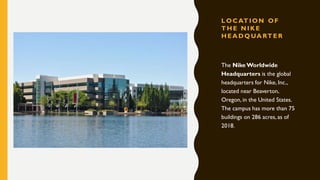
The Nike Worldwide
Headquarters is the global
headquarters for Nike, Inc.,
located near Beaverton,
Oregon, in the United States.
The campus has more than 75
buildings on 286 acres, as of
2018.
N IK E L OGO
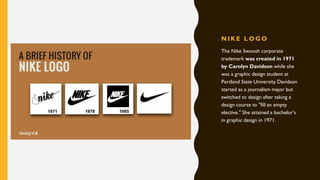
The Nike Swoosh corporate
trademark was created in 1971
by Carolyn Davidson while she
was a graphic design student at
Portland State University. Davidson
started as a journalism major but
switched to design after taking a
design course to "fill an empty
elective." She attained a bachelor's
in graphic design in 1971.
NIKE ETHICS
• Nike had been accused of using sweatshops to produce its sneakers and activewear since the
1970s, but it was only in 1991 when activist Jeff Ballinger published a report detailing the low
wages and poor working conditions in Nike’s Indonesian factories that the sportswear brand
came under fire. Soon after, it became the subject of an aggressive and sustained campaign
by United Students Against Sweatshops. Nike was initially slow to respond—but under
increasing pressure, it eventually made some changes by improving its monitoring efforts,
raising the minimum age of workers, and increasing factory audits.
NIKE SUSTAINABILITY
• First came the sports jerseys and sneakers crafted from recycled waste plastics.Then came the
eco swimwear collections, and pledges to use only renewable energy and reduce its shipping
emissions. Now, Nike has gone one further in its sustainability agenda with its “Move to Zero”
campaign – a commitment to reduce the American sportswear giant’s carbon emissions and
waste to zero.
• Move to Zero is Nike’s most ambitious undertaking to date. It’s the first time all aspects of
Nike globally have been aligned with one clear planet-saving mission.“We’re pursuing science-
based goals to aggressively reduce our carbon footprint and are innovating to reduce waste,”
says Rustique-Petteni.Tying it up under this one broad-reaching initiative is “really about making
the statement of future commitment and recognising that our brand can act as a catalyst for
change,” said Kinder.
NIKE 2025 VISION
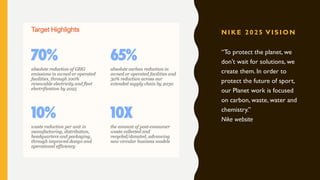
“To protect the planet, we
don’t wait for solutions, we
create them. In order to
protect the future of sport,
our Planet work is focused
on carbon, waste, water and
chemistry.”
Nike website
L EBRON JA M ES
N IK E
EN DORS EM E N T
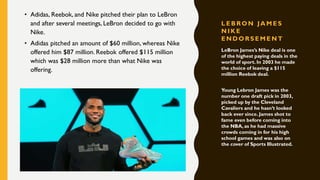
• Adidas, Reebok, and Nike pitched their plan to LeBron
and after several meetings, LeBron decided to go with
Nike.
• Adidas pitched an amount of $60 million, whereas Nike
offered him $87 million. Reebok offered $115 million
which was $28 million more than what Nike was
offering.
LeBron James’s Nike deal is one
of the highest paying deals in the
world of sport. In 2003 he made
the choice of leaving a $115
million Reebok deal.
Young Lebron James was the
number one draft pick in 2003,
picked up by the Cleveland
Cavaliers and he hasn’t looked
back ever since. James shot to
fame even before coming into
the NBA, as he had massive
crowds coming in for his high
school games and was also on
the cover of Sports Illustrated.
L EBRON JA M ES ’
N IK E DEA L
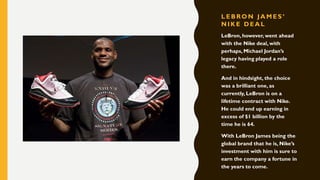
LeBron, however, went ahead
with the Nike deal, with
perhaps, Michael Jordan’s
legacy having played a role
there.
And in hindsight, the choice
was a brilliant one, as
currently, LeBron is on a
lifetime contract with Nike.
He could end up earning in
excess of $1 billion by the
time he is 64.
With LeBron James being the
global brand that he is, Nike’s
investment with him is sure to
earn the company a fortune in
the years to come.
THANKS FOR LISTENING

Nike presentation

  • 1.
  • 2.
    SUMMARY • Nike identity -History of the company - Location of its headquarters - Logo - Ethics • Sustainability of the company • Famous athlete who endorsed the brand
  • 3.
    HISTORY OF THECOMPANY • Nike, Inc., formerly (1964–78) Blue Ribbon Sports,American sportswear company. It was founded in 1964 as Blue Ribbon Sports by Bill Bowerman, a track-and-field coach at the University of Oregon, and his former student Phil Knight.They opened their first retail outlet in 1966 and launched the Nike brand shoe in 1972.The company was renamed Nike, Inc., in 1978 and went public two years later. By the early 21st century, Nike had retail outlets and distributors in more than 170 countries, and its logo—a curved check mark called the “swoosh”—was recognized throughout the world. • From the late 1980s Nike steadily expanded its business and diversified its product line through numerous acquisitions, including the shoe companies Cole Haan (1988; sold in 2012) and Converse, Inc. (2003),the sports-equipment producer Canstar Sports, Inc. (1994; later called Bauer and sold in 2008),and the athletic apparel and equipment company Umbro (2008; sold in 2012).
  • 4.
    L OC ATION OF T H E N IK E H EA DQUA RT E R The Nike Worldwide Headquarters is the global headquarters for Nike, Inc., located near Beaverton, Oregon, in the United States. The campus has more than 75 buildings on 286 acres, as of 2018.
  • 5.
    N IK EL OGO The Nike Swoosh corporate trademark was created in 1971 by Carolyn Davidson while she was a graphic design student at Portland State University. Davidson started as a journalism major but switched to design after taking a design course to "fill an empty elective." She attained a bachelor's in graphic design in 1971.
  • 6.
    NIKE ETHICS • Nikehad been accused of using sweatshops to produce its sneakers and activewear since the 1970s, but it was only in 1991 when activist Jeff Ballinger published a report detailing the low wages and poor working conditions in Nike’s Indonesian factories that the sportswear brand came under fire. Soon after, it became the subject of an aggressive and sustained campaign by United Students Against Sweatshops. Nike was initially slow to respond—but under increasing pressure, it eventually made some changes by improving its monitoring efforts, raising the minimum age of workers, and increasing factory audits.
  • 7.
    NIKE SUSTAINABILITY • Firstcame the sports jerseys and sneakers crafted from recycled waste plastics.Then came the eco swimwear collections, and pledges to use only renewable energy and reduce its shipping emissions. Now, Nike has gone one further in its sustainability agenda with its “Move to Zero” campaign – a commitment to reduce the American sportswear giant’s carbon emissions and waste to zero. • Move to Zero is Nike’s most ambitious undertaking to date. It’s the first time all aspects of Nike globally have been aligned with one clear planet-saving mission.“We’re pursuing science- based goals to aggressively reduce our carbon footprint and are innovating to reduce waste,” says Rustique-Petteni.Tying it up under this one broad-reaching initiative is “really about making the statement of future commitment and recognising that our brand can act as a catalyst for change,” said Kinder.
  • 8.
    NIKE 2025 VISION “Toprotect the planet, we don’t wait for solutions, we create them. In order to protect the future of sport, our Planet work is focused on carbon, waste, water and chemistry.” Nike website
  • 9.
    L EBRON JAM ES N IK E EN DORS EM E N T • Adidas, Reebok, and Nike pitched their plan to LeBron and after several meetings, LeBron decided to go with Nike. • Adidas pitched an amount of $60 million, whereas Nike offered him $87 million. Reebok offered $115 million which was $28 million more than what Nike was offering. LeBron James’s Nike deal is one of the highest paying deals in the world of sport. In 2003 he made the choice of leaving a $115 million Reebok deal. Young Lebron James was the number one draft pick in 2003, picked up by the Cleveland Cavaliers and he hasn’t looked back ever since. James shot to fame even before coming into the NBA, as he had massive crowds coming in for his high school games and was also on the cover of Sports Illustrated.
  • 10.
    L EBRON JAM ES ’ N IK E DEA L LeBron, however, went ahead with the Nike deal, with perhaps, Michael Jordan’s legacy having played a role there. And in hindsight, the choice was a brilliant one, as currently, LeBron is on a lifetime contract with Nike. He could end up earning in excess of $1 billion by the time he is 64. With LeBron James being the global brand that he is, Nike’s investment with him is sure to earn the company a fortune in the years to come.
  • 11.